



Abstract
P-Glycoprotein/MDR1 represents an important component of the blood brain barrier and contributes to multidrug resistance. We investigated two derivatives of the anti-malarial artemisinin, SM616 and GHP-AJM-3/23, concerning their ability to interact with P-glycoprotein. The ability of the two compounds to inhibit P-glycoprotein (P-gp) activity was examined in sensitive CCRF-CEM and P-gp over-expressing and multidrug-resistant CEM/ADR5000 cells as well as in porcine brain capillary endothelial cells (PBCEC) by means of calcein-AM assays. Verapamil as well-known P-gp inhibitor was used as control drug. CEM/ADR5000 cells exhibited cross-resistance to GHP-AJM-3/23, but slight collateral sensitivity to SM616. Furthermore, SM616 inhibited calcein efflux both in CEM/ADR5000 and PBCEC, whereas GHP-AJM-3/23 did only increase calcein fluorescence in PBCEC, but not CEM/ADR5000. This may be explained by the fact that CEM/ADR5000 only express P-gp but not other ATP-binding cassette transporters, whereas PBCEC are known to express several ABC transporters and calcein is transported by more than one ABC transporter. Hence, SM616 may be the more specific P-gp inhibitor. In conclusion, the collateral sensitivity of SM616 as well as the inhibition of calcein efflux in both CEM/ADR5000 cells and PBCEC indicate that this compound may be a promising P-gp inhibitor to treat cancer therapy and to overcome the blood brain barrier. 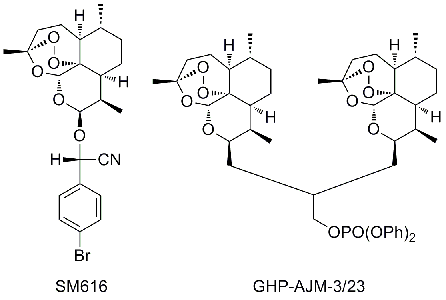
Keywords: blood brain barrier, calcein, multidrug resistance, P-glycoprotein
Footnotes
This article is published with open access at Springerlink.com
References
- [1].Li Y., Wu Y. L. Curr. Med. Chem. 2003;10:2197–2230. doi: 10.2174/0929867033456710. [DOI] [PubMed] [Google Scholar]
- [2].Efferth T., Kaina B. Crit. Rev. Toxicol. 2010;40:405–421. doi: 10.3109/10408441003610571. [DOI] [PubMed] [Google Scholar]
- [3].Sun W. S., Han J. X., Yang W. Y., Deng D. A., Yue X. F. Acta Pharmacol. Sin. 1992;13:541–543. [PubMed] [Google Scholar]
- [4].Woerdenbag H. J., Moskal T. A., Pras N., Malingre T. M., el-Feraly F. S., Kampinga H. H., Konings A. W. J. Nat. Prod. 1993;56:845–849. doi: 10.1021/np50096a007. [DOI] [PubMed] [Google Scholar]
- [5].Zheng G. Q. Planta Med. 1994;60:54–57. doi: 10.1055/s-2006-959408. [DOI] [PubMed] [Google Scholar]
- [6].Beekman A. C., Woerdenbag H. J., van Uden W., Pras N., Konings A. W., Wikstrom H. V. J. Pharm. Pharmacol. 1997;49:1254–1258. doi: 10.1111/j.2042-7158.1997.tb06080.x. [DOI] [PubMed] [Google Scholar]
- [7].Efferth T., Rücker G., Falkenberg M., Manns D., Olbrich A., Fabry U., Osieka R. Arzneimittelforschung. 1996;46:196–200. [PubMed] [Google Scholar]
- [8].Efferth T., Dunstan H., Sauerbrey A., Miyachi H., Chitambar C. R. Int. J. Oncol. 2001;18:767–773. doi: 10.3892/ijo.18.4.767. [DOI] [PubMed] [Google Scholar]
- [9].Efferth T., Sauerbrey A., Olbrich A., Gebhart E., Rauch P., Weber H. O., Hengstler J. G., Halatsch M. E., Volm M., Tew K. D., Ross D. D., Funk J. O. Mol. Pharmacol. 2003;64:382–394. doi: 10.1124/mol.64.2.382. [DOI] [PubMed] [Google Scholar]
- [10].Steinbrück L., Pereira G., Efferth T. Cancer Genomics Proteomics. 2010;7:337–346. [PubMed] [Google Scholar]
- [11].Sertel S., Eichhorn T., Sieber S., Sauer A., Weiss J., Plinkert P. K., Efferth T. Chem. Biol. Interact. 2010;185:42–52. doi: 10.1016/j.cbi.2010.02.002. [DOI] [PubMed] [Google Scholar]
- [12].Sertel S., Eichhorn T., Simon C. H., Plinkert P. K., Johnson S. W., Efferth T. Molecules. 2010;15:2886–2910. doi: 10.3390/molecules15042886. [DOI] [PMC free article] [PubMed] [Google Scholar]
- [13].Efferth T., Giaisi M., Merling A., Krammer P. H., Li-Weber M. PLoS One. 2007;2:e693. doi: 10.1371/journal.pone.0000693. [DOI] [PMC free article] [PubMed] [Google Scholar]
- [14].Dell’Eva R., Pfeffer U., Vené R., Anfosso L., Forlani A., Albini A., Efferth T. Biochem. Pharmacol. 2004;68:2359–2366. doi: 10.1016/j.bcp.2004.08.021. [DOI] [PubMed] [Google Scholar]
- [15].Anfosso L., Efferth T., Albini A., Pfeffer U. Pharmacogenomics J. 2006;6:269–278. doi: 10.1038/sj.tpj.6500371. [DOI] [PubMed] [Google Scholar]
- [16].Soomro S., Langenberg T., Mahringer A., Konkimalla V. B., Horwedel C., Holenya P., Brand A., Cetin C., Fricker G., Dewerchin M., Carmeliet P., Conway E. M., Jansen H., Efferth T. J. Cell Mol. Med. 2011;15:1122–1135. doi: 10.1111/j.1582-4934.2010.01120.x. [DOI] [PMC free article] [PubMed] [Google Scholar]
- [17].Rasheed S. A., Efferth T., Asangani I. A., Allgayer H. Int. J. Cancer. 2010;127:1475–1485. doi: 10.1002/ijc.25315. [DOI] [PubMed] [Google Scholar]
- [18].Li P. C., Lam E., Roos W. P., Zdzienicka M. Z., Kaina B., Efferth T. Cancer Res. 2008;68:4347–4351. doi: 10.1158/0008-5472.CAN-07-2970. [DOI] [PubMed] [Google Scholar]
- [19].Berdelle, N.; Nikolova, T.; Quiros, S.; Efferth, T.; Kaina, B. Mol. Cancer Ther.2011 [Epub ahead of print]. [DOI] [PubMed]
- [20].Efferth T., Briehl M. M., Tome M. E. Int. J. Oncol. 2003;23:1231–1235. [PubMed] [Google Scholar]
- [21].Efferth T., Oesch F. Biochem. Pharmacol. 2004;68:3–10. doi: 10.1016/j.bcp.2004.03.003. [DOI] [PubMed] [Google Scholar]
- [22].Efferth T., Volm M. In Vivo. 2005;19:225–232. [PubMed] [Google Scholar]
- [23].Efferth T., Benakis A., Romero M. R., Tomicic M., Rauh R., Steinbach D., Häfer R., Stamminger T., Oesch F., Kaina B., Marschall M. Free Radic. Biol. Med. 2004;37:998–1009. doi: 10.1016/j.freeradbiomed.2004.06.023. [DOI] [PubMed] [Google Scholar]
- [24].Kelter G., Steinbach D., Konkimalla V. B., Tahara T., Taketani S., Fiebig H. H., Efferth T. PLoS One. 2007;2:e798. doi: 10.1371/journal.pone.0000798. [DOI] [PMC free article] [PubMed] [Google Scholar]
- [25].Efferth T., Ramirez T., Gebhart E., Halatsch M. E. Biochem. Pharmacol. 2004;67:1689–1700. doi: 10.1016/j.bcp.2003.12.035. [DOI] [PubMed] [Google Scholar]
- [26].Konkimalla V. B., McCubrey J. A., Efferth T. Curr. Cancer Drug Targets. 2009;9:72–80. doi: 10.2174/156800909787314020. [DOI] [PubMed] [Google Scholar]
- [27].Bachmeier B., Fichtner I., Killian P. H., Kronski E., Pfeffer U., Efferth T. PLoS One. 2011;6:e20550. doi: 10.1371/journal.pone.0020550. [DOI] [PMC free article] [PubMed] [Google Scholar]
- [28].Price R., van Vugt M., Nosten F., Luxemburger C., Brockman A., Phaipun L., Chongsuphajaisiddhi T., White N. Am. J. Trop. Med. Hyg. 1998;59:883–888. doi: 10.4269/ajtmh.1998.59.883. [DOI] [PubMed] [Google Scholar]
- [29].Efferth T., Davey M., Olbrich A., Rücker G., Gebhart E., Davey R. Blood Cells Mol. Dis. 2002;28:160–168. doi: 10.1006/bcmd.2002.0492. [DOI] [PubMed] [Google Scholar]
- [30].Efferth T. Curr. Mol. Med. 2001;1:45–65. doi: 10.2174/1566524013364194. [DOI] [PubMed] [Google Scholar]
- [31].Gillet J. P., Efferth T., Remacle J. Biochim. Biophys. Acta. 2007;1775:237–262. doi: 10.1016/j.bbcan.2007.05.002. [DOI] [PubMed] [Google Scholar]
- [32].Eichhorn, T.; Efferth, T. J. Ethnopharmacol.2011 [Epub ahead of print]. [DOI] [PubMed]
- [33].Bauer B., Miller D. S., Fricker G. Pharm. Res. 2003;20:1170–1176. doi: 10.1023/A:1025040712857. [DOI] [PubMed] [Google Scholar]
- [34].Kimmig A., Gekeler V., Neumann M., Frese G., Handgretinger R., Kardos G., Diddens H., Niethammer D. Cancer Res. 1990;50:6793–6799. [PubMed] [Google Scholar]
- [35].Gillet J. P., Efferth T., Steinbach D., Hamels J., de Longueville F., Bertholet V., Remacle J. Cancer Res. 2004;64:8987–8993. doi: 10.1158/0008-5472.CAN-04-1978. [DOI] [PubMed] [Google Scholar]
- [36].Gottesman M. M., Pastan I. Annu. Rev. Biochem. 1993;62:385–427. doi: 10.1146/annurev.bi.62.070193.002125. [DOI] [PubMed] [Google Scholar]
- [37].Rautio J., Humphreys J. E., Webster L. O. Drug Metab. Dispos. 2006;34:786–792. doi: 10.1124/dmd.105.008615. [DOI] [PubMed] [Google Scholar]
- [38].Szybalski W., Bryson V. J. Bacteriol. 1952;64:489–499. doi: 10.1128/jb.64.4.489-499.1952. [DOI] [PMC free article] [PubMed] [Google Scholar]
- [39].Hall M. D., Handley M. D., Gottesman M. M. Trends Pharmacol. Sci. 2009;30:546–556. doi: 10.1016/j.tips.2009.07.003. [DOI] [PMC free article] [PubMed] [Google Scholar]
- [40].Schinkel A. H., Wagenaar E., Mol C. A., van Deemter L. J. Clin. Invest. 1996;97:2517–2524. doi: 10.1172/JCI118699. [DOI] [PMC free article] [PubMed] [Google Scholar]
- [41].Ayesh S., Shao Y. M., Stein W. D. Biochim. Biophys. Acta. 1996;1316:8–18. doi: 10.1016/0925-4439(96)00008-7. [DOI] [PubMed] [Google Scholar]
- [42].Borgnia M. J., Eytan G. D., Assaraf Y. G. J. Biol. Chem. 1996;271:3163–3171. doi: 10.1074/jbc.271.6.3163. [DOI] [PubMed] [Google Scholar]
- [43].Safa A. R. Curr. Med. Chem. Anticancer Agents. 2004;4:1–17. doi: 10.2174/1568011043482142. [DOI] [PMC free article] [PubMed] [Google Scholar]
- [44].Globisch C., Pajeva I. K., Wiese M. Chem. Med. Chem. 2008;3:280–295. doi: 10.1002/cmdc.200700249. [DOI] [PubMed] [Google Scholar]
- [45].Shapiro A. B., Ling V. Eur. J. Biochem. 1997;250:122–129. doi: 10.1111/j.1432-1033.1997.00122.x. [DOI] [PubMed] [Google Scholar]
- [46].Mahringer A., Karamustafa S., Klotz D., Kahl S., Konkimalla V. B., Wang Y., Wang J., Liu H. Y., Boechzelt H., Hao X., Bauer R., Fricker G., Efferth T. Cancer Genomics Proteomics. 2010;7:191–205. [PubMed] [Google Scholar]
- [47].Török M., Huwyler J., Gutmann H., Fricker G., Drewe J. Exp. Brain Res. 2003;153:356–365. doi: 10.1007/s00221-003-1620-4. [DOI] [PubMed] [Google Scholar]
- [48].Stark M., Rothem L., Jansen G., Scheffer G. L., Goldman I. D., Assaraf Y. G. Mol. Pharmacol. 2003;64:220–227. doi: 10.1124/mol.64.2.220. [DOI] [PubMed] [Google Scholar]