



Abstract
Background:
Healing ability of nonhealing chronic ulcers can be assessed by estimating hydroxyproline, total protein and enzymatic antioxidants such as glutathione peroxidase (GPx), glutathione S-transferase (GST) in the granulation tissue.
Materials and Method:
A total of 34 patients were analysed from two groups: Limited access dressing (LAD) group (n = 17) and conventional dressing group (n = 17).
Results:
Patients treated with LAD that exerts combination of intermittent negative pressure and moist wound-healing had shown a significant increase in the hydroxyproline (P = 0.026), total protein (P = 0.004), GPx level (P = 0.030) and GST level (P = 0.045).
Conclusion:
Patients treated with LAD indicated significantly better anabolic effect on wound-healing compared to that of patients treated with conventional dressing.
KEY WORDS: Chronic ulcers, chronic wound-healing, enzymatic antioxidants, hydroxyproline, limited access dressing, total protein
INTRODUCTION
Wound-healing is a multifunctional process that behaves in a harmonious manner involving progression of various sequential events such as the inflammatory phase, which begins immediately after injury and is associated with vasoconstriction that favours haemostasis and release of inflammation mediators. This is followed by the proliferative phase, characterised by granulation tissue proliferation, leading to the formation of fibroblasts and angiogenesis process. The remodelling phase involves reformulation and improvement in the collagen fibre components resulting in increased tensile strength.[1]
To manage the chronic wounds negative pressure wound therapy (NPWT) has since become an integral part of wound treatment protocols. In practice, it is a simple concept that involves creating a negative pressure environment at the wound site. NPWT benefits include rapid wound granulation, epithelialisation and contraction,[2] reduction of dressing changes,[3] reduced infection risk,[4] reduced treatment costs,[5] control of exudate,[6] concurrent rehabilitation,[7] and better patient tolerance.[8]
Chronic wounds often exhibit progressive oedema, compromise of perfusion, and elevated levels of proteolytic enzymes and cytokines, reactive oxygen species (ROS) that delay the wound-healing process, inhibit granulation tissue formation and epithelialization. The fluid that is drawn from the wound by the NPWT system is rich in cytokines, acute phase proteins, proteolytic enzymes and various types of pathogens responsible for wound infection.[9,10] Numerous antibiotics are being used for treatment of wound infections. However, they have been associated with adverse effects and found ineffective against resistant pathogens. The removal of interstitial fluid along with inhibitory cytokines (for cell proliferation and epithelialisation) and pathogens provides better wound environment. In a favourable wound environment hydroxyproline level in the granulation tissue is reported to be higher. Thus, NPWT has been shown to be useful in managing infected nonhealing wounds with a variable amount of discharge.[11,12,13] The present study intends to evaluate the effect of limited accessing dressing (LAD) on the level of hydroxyproline and selected antioxidants in chronic wound.
MATERIALS AND METHODS
Ethical approval and informed consent
This prospective randomised controlled trial study was carried out in the Department of Plastic Surgery, Kasturba Hospital, Manipal. Institutional Ethics committee of Kasturba Medical College and Hospital, Manipal University reviewed and approved the study protocol. Informed consent was obtained from all patients or their next of kin before inclusion into the study.
Clinical trial design
Sixty patients of age 12-65 years (mean age-38.5) ailing from chronic wounds of >4 weeks were enrolled into the study. After examined inclusion (nondiabetic chronic ulcers) and exclusion criteria (patients with collagen disorders, leprosy patients, pregnant women, liver cirrhosis, HIV positive status) forty-two patients were randomised of whom 20 and 22 were assigned to the LAD group (n = 20), conventional closed dressing group (n = 22) by simple randomisation [Figure 1]. LAD group - patients were treated LAD with intermittent negative pressure. Conventional closed dressing group - patients were dressed daily with 5% povidone iodine solution soked gauze. In LAD group wounds were washed daily by povidone iodine solution. Out of 42 patients, eight participants (three in the LAD group and five in the conventional dressing group), were lost to follow-up before Biopsy were taken. Thirty-four patients biopsies were taken on day 0th and 10th and were analysed for Biochemical parameters understudy.
Figure 1.
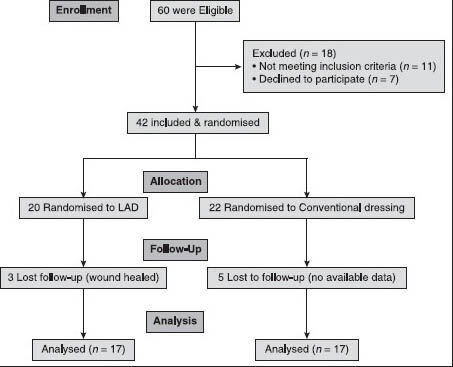
Consort flow chart
Randomisation
Simple randomisation, patients were randomized by generating tables of random numbers through www.random.org. Numbers were assigned to a treatment group and sealed in opaque envelopes containing labelled paper with treatment and patient ID.
Chemicals
All reagents used were of analytical grade. Reduced glutathione (GSH), 1-chloro-2,4 dinitrobenzene (SD Fine Chem. Ltd., Mumbai), 5,5-dithio-bis-2-nitrobenzoic acid, nicotine adenine dinucleotide phosphate (NADPH), glutathione reductase, bovine serum albumin (BSA), 3,3’-dithiobis 2-nitrobenzoic acid and 1-chloro-2, 4-dinitro benzene (CDNB) (Sigma, MO, USA), Standard L-Hydroxyproline (Sigma, MO, USA), ethylenediamine-tetra-acetic acid (EDTA), hydrogen peroxide (Merck, Mumbai).
Parameters studied
Tissue preparation for hydroxyproline estimation
The granulation tissue samples obtained from these subjects were used for the analysis. The wet weight of the tissues was noted and the tissues were dried at 60°C for 24 h to record the constant dry weight. The dried tissue were treated with 10 mL 6N HCl and kept at 110°C for 24 h. The neutralized acid hydrolysates of the dry tissue were used for determination of the Hydroxyproline content by the method of Neuman and Logan.[14]
Tissue preparation for estimation of enzymatic antioxidants activity
Total protein and antioxidant enzymes such as glutathione peroxidase (GPx), Glutathione S-transferase (GST) were determined in the wound granulation tissue. Granulation tissue homogenates were prepared by homogenising the tissues in a 2 mM phosphate buffer pH 7.4. The homogenate was then centrifuged at 15,000 rpm, 4°C for 20 min.
The supernatant was then analysed for estimation of total protein by method of Lowry et al.,[15] GPx measured using NADPH as a substrate,[16] and GST was measured by using CDNB as a substrate.[17] Necessary care was taken during sample collection, storage and assay.
Estimation of hydroxyproline
The neutralised acid hydrolysate of the dry tissue was used for the determination of hydroxyproline. The reaction mixture contains 0.05 M copper sulphate, 2.5N sodium hydroxide, 6% hydrogen peroxide, 3N sulphuric acid, 5% p-dimethylaminobenzaldehyde using L-hydroxyproline as standard. The absorbance was measured at 540 nM and expressed in μg/mg dry tissue weight.
Estimation of total protein
Protein content of the tissue homogenate was estimated by the method of Lowry et al. The absorbance was measured at 540 nm and expressed in mg/g of tissue. Standards were treated similarly using BSA at concentrations of 0, 20, 40, 60, 80, and 100 μg/mL in 0.1M phosphate buffer at pH 7.4.
Estimation of glutathione peroxidase
The assay system consisted of 50 mM potassiumphosphate buffer, pH 7.0, 10 mM EDTA, 1 mM sodium azide, and 0.2 mM NADPH and 1.0 mM GSH, 2.5 unit of glutathione reductase. After 2 min of incubation at 37°C. The absorbance was measured at 340 nM. Readings were recorded for 5 min at 1 min interval, expressed in μMoles of NADPH oxidized/minute/milligram protein.
Estimation of glutathione S-transferase
Glutathione S-transferase activity was determined according to the procedure described by Habig et al.[17] The reaction mixture consists of 0.1 M potassium phosphate, pH 6.5, 1.6 mM GSH and 1 mM CDNB. The reaction was monitored spectrophotometrically at 340nM at 1 min intervals for 5 min. The specific activity of GST was expressed as μmol GSH-CDNB conjugate formed/minute/ milligram protein.
Statistical analysis
Statistical analysis between LAD group and Conventional group was performed by the Student's t-test using the SPSS software 15th version package. The data were expressed as mean ± standard deviation (SD). P < 0.05 was considered to be significant. When appropriate, statistical uncertainty was expressed by the 95% confidence levels.
RESULTS
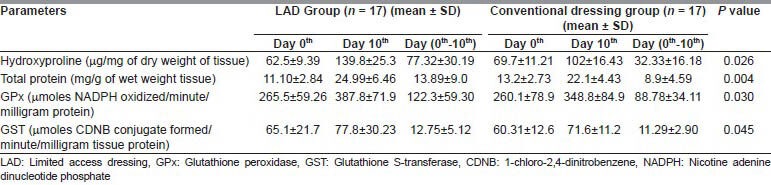
The results of hydroxyproline, total protein, enzymatic antioxidant activity of GPx and GST in Nonhealing chronic ulcer patients of LAD group to that of conventional dressing group as shown in Table 1.
Table 1.
Levels of hydroxyproline, total protein, GPx, GST in granulation tissue of chronic ulcer in LAD group and conventional dressing group
Hydroxyproline
Hydroxyproline is a major component in the ground substance of granulation tissue. In the present study, LAD group has significantly high hydroxyproline level 77.32 ± 30.19 μg/mg dry tissue weight than the conventional group 32.33 ± 16.18 μg/mg dry tissue weight (P = 0.026).
Total protein
Total protein is present in the ground substance of granulation tissue. In the present study, LAD group has high total protein level 13.89 ± 9.00 mg/g wet tissue weight than the conventional group 8.9 ± 4.59 mg/g wet tissue weight (P = 0.004.)
Glutathione peroxidase
Wound treated with LAD exhibit high activity of GPx 122.3 ± 59.30 μmol/minute/milligram protein than that of conventional group 88.78 ± 34.11 μmol/min/mg protein (P = 0.030).
Glutathione S-transferase
Wound treated with LAD exhibit high activity of GST 12.75 ± 5.12 μmol/minute/milligram protein than that of conventional group 11.29 ± 2.90 μmol/min/mg protein (P = 0.045).
DISCUSSION
Wound-healing is a complicated process that requires several steps, and any alteration at any step may delay the healing process. Factors affecting healing could be either local for example sepsis, prior irradiation, recurrent trauma, poor oxygenation, arterial insufficiency or lymphoedema, or systemic such as hypoxia, collagen disorder, diabetes.[18] Various biomarkers have been described for chronic wounds are excessive neutrophil infiltration and ROS, which exerts oxidative stress that damage the cells and healing tissues.[19] These wounds may not respond to skin substitutes and topical cytokines such as platelet-derived growth factor (PDGF) until the wound bed is properly prepared.[20,21]
In healing phase collagen content of the granulation can be measured by monitoring the concentration of hydroxyproline, which is a marker of collagen biosynthesis.[22] Higher concentration of hydroxyproline indicates faster rate of wound–healing, which reflects increased cellular proliferation and thereby increased collagen synthesis.[23,24,25] Lower concentration of hydroxyproline indicates poor wound-healing.[26] Various studies on Human wound models shown that dressing technique like moist wound dressing[27] and NPWT[28] increased the level of hydroxyproline content in wound granulation tissue.
In the present study, after 10 days treatment increase in the content in LAD group was 77.32 ± 30.19 (μg/mg of dry weight of tissue) significantly higher than conventional dressing group (32.33 ± 16.18) (P = 0.026) [Table 1].
Enzymatic antioxidants such as GPx, GST, catalase levels play crucial role during wound-healing.[29] Therefore, estimation of antioxidants like GPx, GST in granulation tissues is also relevant because these antioxidants hasten the process of wound-healing by destroying the free radicals.[30] In the present study, after 10 days treatment increase in the mean ± SD of GPx content in LAD group was 122.3 ± 59.30 (μMoles NADPH oxidized/minute/milligram tissue protein) and P = 0.030, GST content in LAD group was 12.75 ± 5.12 (μmoles CDNB conjugate formed/minute/milligram tissue protein) (P = 0.045) [Table 1].
CONCLUSION
The significant increase in the parametres like hydroxyproline, total protein level, antioxidant profile like GPx and GST indicates significantly better effect on wound-healing by LAD by exerting a combination of intermittent negative pressure and moist wound-healing when compared to that by conventional closed dressing.
Footnotes
Source of Support: Nil
Conflict of Interest: None declared.
REFERENCES
- 1.Goldberg SR, Diegelmann RF. Wound healing primer. Surg Clin North Am. 2010;90:1133–46. doi: 10.1016/j.suc.2010.08.003. [DOI] [PubMed] [Google Scholar]
- 2.Armstrong DG, Lavery LA. Diabetic Foot Study Consortium. Negative pressure wound therapy after partial diabetic foot amputation: A multicentre, randomised controlled trial. Lancet. 2005;366:1704–10. doi: 10.1016/S0140-6736(05)67695-7. [DOI] [PubMed] [Google Scholar]
- 3.Mouës CM, van den Bemd GJ, Meerding WJ, Hovius SE. An economic evaluation of the use of TNP on full-thickness wounds. J Wound Care. 2005;14:224–7. doi: 10.12968/jowc.2005.14.5.26776. [DOI] [PubMed] [Google Scholar]
- 4.Leininger BE, Rasmussen TE, Smith DL, Jenkins DH, Coppola C. Experience with wound VAC and delayed primary closure of contaminated soft tissue injuries in Iraq. J Trauma. 2006;61:1207–11. doi: 10.1097/01.ta.0000241150.15342.da. [DOI] [PubMed] [Google Scholar]
- 5.Apelqvist J, Armstrong DG, Lavery LA, Boulton AJ. Resource utilization and economic costs of care based on a randomized trial of vacuum-assisted closure therapy in the treatment of diabetic foot wounds. Am J Surg. 2008;195:782–8. doi: 10.1016/j.amjsurg.2007.06.023. [DOI] [PubMed] [Google Scholar]
- 6.Braakenburg A, Obdeijn MC, Feitz R, van Rooij IA, van Griethuysen AJ, Klinkenbijl JH. The clinical efficacy and cost effectiveness of the vacuum-assisted closure technique in the management of acute and chronic wounds: A randomized controlled trial. Plast Reconstr Surg. 2006;118:390–7. doi: 10.1097/01.prs.0000227675.63744.af. [DOI] [PubMed] [Google Scholar]
- 7.Park CA, Defranzo AJ, Marks MW, Molnar JA. Outpatient reconstruction using integra* and subatmospheric pressure. Ann Plast Surg. 2009;62:164–9. doi: 10.1097/SAP.0b013e31817d87cb. [DOI] [PubMed] [Google Scholar]
- 8.Hurd T, Chadwick P, Cote J, Cockwill J, Mole TR, Smith JM. Impact of gauze-based NPWT on the patient and nursing experience in the treatment of challenging wounds. Int Wound J. 2010;7:448–55. doi: 10.1111/j.1742-481X.2010.00714.x. [DOI] [PMC free article] [PubMed] [Google Scholar]
- 9.Kumar P. Limited access dressing and maggot. Wounds. 2009;21:150–2. [PubMed] [Google Scholar]
- 10.Kumar P, Sharma A. The limited access dressing for damage control in trauma patients. Wounds. 2010;22:188–92. [PubMed] [Google Scholar]
- 11.Joseph E, Hamori CA, Bergman S, Roaf E, Swann NF, Anastasi GW. A prospective, randomized trial of vacuum assisted closure versus standard therapy of chronic non healing wounds. Wounds. 2000;12:6–7. [Google Scholar]
- 12.Ford CN, Reinhard ER, Yeh D, Syrek D, De Las Morenas A, Bergman SB, et al. Interim analysis of a prospective, randomized trial of vacuum-assisted closure versus the healthpoint system in the management of pressure ulcers. Ann Plast Surg. 2002;49:55–61. doi: 10.1097/00000637-200207000-00009. [DOI] [PubMed] [Google Scholar]
- 13.Armstrong DG, Lavery LA, Boulton AJ. Negative pressure wound therapy via vacuum-assisted closure following partial foot amputation: What is the role of wound chronicity? Int Wound J. 2007;4:79–86. doi: 10.1111/j.1742-481X.2006.00270.x. [DOI] [PMC free article] [PubMed] [Google Scholar]
- 14.Neuman RE, Logan MA. The determination of collagen and elastin in tissues. J Biol Chem. 1950;186:549–56. [PubMed] [Google Scholar]
- 15.Lowry OH, Rosebrough NJ, Farr AL, Randall RJ. Protein measurement with the Folin phenol reagent. J Biol Chem. 1951;193:265–75. [PubMed] [Google Scholar]
- 16.Abstract Rotruck JT, Pope AL, Ganther HE, Swanson AB, Hafeman DG, Hoekstra WG. Selenium: Biochemical role as a component of glutathione peroxidase. Science. 1973;179:588–90. doi: 10.1126/science.179.4073.588. [DOI] [PubMed] [Google Scholar]
- 17.Habig WH, Pabst MJ, Jakoby WB. Glutathione S-transferases. The first enzymatic step in mercapturic acid formation. J Biol Chem. 1974;25(249):7130–9. [PubMed] [Google Scholar]
- 18.Kumar P, Honnegowda TM, Udupa EG, Rao P, Saran A, Bhandari S. The role of matrix metalloproteinase in the chronic wound healing. J Soc Wound Care Search. 2012;5:7–16. [Google Scholar]
- 19.Wenk J, Foitzik A, Achterberg V, Sabiwalsky A, Dissemond J, Meewes C, et al. Selective pick-up of increased iron by deferoxamine-coupled cellulose abrogates the iron-driven induction of matrix-degrading metalloproteinase 1 and lipid peroxidation in human dermal fibroblasts in vitro: A new dressing concept. J Invest Dermatol. 2001;116:833–9. doi: 10.1046/j.1523-1747.2001.01345.x. [DOI] [PubMed] [Google Scholar]
- 20.Robson MC, Mustoe TA, Hunt TK. The future of recombinant growth factors in wound healing. Am J Surg. 1998;176:80S–2. doi: 10.1016/s0002-9610(98)00186-x. [DOI] [PubMed] [Google Scholar]
- 21.Falanga V. Growth factors and wound healing. Dermatol Clin. 1993;11:667–75. [PubMed] [Google Scholar]
- 22.Kumar R, Katoch SS, Sharma S. Beta-adrenoceptor agonist treatment reverses denervation atrophy with augmentation of collagen proliferation in denervated mice gastrocnemius muscle. Indian J Exp Biol. 2006;44:371–6. [PubMed] [Google Scholar]
- 23.Prasad SK, Kumar R, Patel DK, Hemalatha S. Wound healing activity of Withania coagulans in streptozotocin-induced diabetic rats. Pharm Biol. 2010;48:1397–404. doi: 10.3109/13880209.2010.486837. [DOI] [PubMed] [Google Scholar]
- 24.Gupta A, Kumar R, Pal K, Banerjee PK, Sawhney RC. A preclinical study of the effects of seabuckthorn (Hippophae rhamnoides L.) leaf extract on cutaneous wound healing in albino rats. Int J Low Extrem Wounds. 2005;4:88–92. doi: 10.1177/1534734605277401. [DOI] [PubMed] [Google Scholar]
- 25.Gurung S, Skalko-Basnet N. Wound healing properties of Carica papaya latex: in vivo evaluation in mice burn model. J Ethnopharmacol. 2009;121:338–41. doi: 10.1016/j.jep.2008.10.030. [DOI] [PubMed] [Google Scholar]
- 26.Reddy GK, Stehno-Bittel L, Enwemeka CS. Laser photostimulation accelerates wound healing in diabetic rats. Wound Repair Regen. 2001;9:248–55. doi: 10.1046/j.1524-475x.2001.00248.x. [DOI] [PubMed] [Google Scholar]
- 27.Alvarez OM, Mertz PM, Eaglstein WH. The effect of occlusive dressings on collagen synthesis and re-epithelialization in superficial wounds. J Surg Res. 1983;35:142–8. doi: 10.1016/0022-4804(83)90136-1. [DOI] [PubMed] [Google Scholar]
- 28.Argenta LC, Morykwas MJ. Vacuum-assisted closure: A new method for wound control and treatment: Clinical experience. Ann Plast Surg. 1997;38:563–76. [PubMed] [Google Scholar]
- 29.Adamson B, Schwarz D, Klugston P, Gilmont R, Perry L, Fisher J, et al. Delayed repair: The role of glutathione in a rat incisional wound model. J Surg Res. 1996;62:159–64. doi: 10.1006/jsre.1996.0189. [DOI] [PubMed] [Google Scholar]
- 30.Halliwell B, Grootveld M, Gutteridge JM. Methods for the measurement of hydroxyl radicals in biomedical systems: Deoxyribose degradation and aromatic hydroxylation. Methods Biochem Anal. 1988;33:59–90. doi: 10.1002/9780470110546.ch2. [DOI] [PubMed] [Google Scholar]