



Abstract
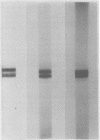
Enterotoxin produced by a sporulating culture of Clostridium perfringens type C, which had been isolated from a case of severe necrotic enteritis, was purified. The molecular weight was estimated to be 36,000 by gel chromatography on Sephadex G-100 and 33,400 by ultracentrifugation. The sedimentation coefficient S20,W was 2.92. The toxin protein exhibited unusual behavior on sodium dodecyl sulfate gels, and toxin aggregates having molecular weights of 68,000, 85,000, 105,000, and 140,000 were obtained. The purified enterotoxin often separated, apparently due to slight charge differences, into two protein bands on 7% polyacrylamide gels. Electrofocusing of enterotoxin on polyacrylamide gels gave an approximate isoelectric point of 4.3, with the enterotoxin being fractionated into four distinct protein bands. The specific toxicity of the enterotoxin was about 1,900 mouse mean lethal doses per mg of calculated nitrogen. The data obtained indicate that the enterotoxin from C. perfringens type C is identical in most respects to that obtained from type A strains. Whether or not this toxin plays a role in the necrotic enteritis caused by type C strains is unknown at present.
Full text
PDF




Images in this article
Selected References
These references are in PubMed. This may not be the complete list of references from this article.
- Andrews P. Estimation of the molecular weights of proteins by Sephadex gel-filtration. Biochem J. 1964 May;91(2):222–233. doi: 10.1042/bj0910222. [DOI] [PMC free article] [PubMed] [Google Scholar]
- Duncan C. L., Somers E. B. Quantitation of Clostridium perfringens type A enterotoxin by electroimmunodiffusion. Appl Microbiol. 1972 Nov;24(5):801–804. doi: 10.1128/am.24.5.801-804.1972. [DOI] [PMC free article] [PubMed] [Google Scholar]
- Duncan C. L., Strong D. H. Improved medium for sporulation of Clostridium perfringens. Appl Microbiol. 1968 Jan;16(1):82–89. doi: 10.1128/am.16.1.82-89.1968. [DOI] [PMC free article] [PubMed] [Google Scholar]
- Duncan C. L., Strong D. H., Sebald M. Sporulation and enterotoxin production by mutants of Clostridium perfringens. J Bacteriol. 1972 Apr;110(1):378–391. doi: 10.1128/jb.110.1.378-391.1972. [DOI] [PMC free article] [PubMed] [Google Scholar]
- Hauschild A. H., Hilsheimer R., Martin W. G. Improved purification and further characterization of Clostridium perfringens type A enterotoxin. Can J Microbiol. 1973 Nov;19(11):1379–1382. doi: 10.1139/m73-222. [DOI] [PubMed] [Google Scholar]
- Hauschild A. H., Hilsheimer R. Purification and characteristics of the enterotoxin of Clostridium perfringens type A. Can J Microbiol. 1971 Nov;17(11):1425–1433. doi: 10.1139/m71-227. [DOI] [PubMed] [Google Scholar]
- LOWRY O. H., ROSEBROUGH N. J., FARR A. L., RANDALL R. J. Protein measurement with the Folin phenol reagent. J Biol Chem. 1951 Nov;193(1):265–275. [PubMed] [Google Scholar]
- MURRELL T. G., ROTH L. Necrotizing jejunitis: a newly discovered disease in the highlands of New Guinea. Med J Aust. 1963 Jan 19;50(1):61–69. doi: 10.5694/j.1326-5377.1963.tb27120.x. [DOI] [PubMed] [Google Scholar]
- Malik N., Berrie A. New stain fixative for proteins separated by gel isoelectric focusing based on Coomassie Brilliant Blue. Anal Biochem. 1972 Sep;49(1):173–176. doi: 10.1016/0003-2697(72)90255-2. [DOI] [PubMed] [Google Scholar]
- Murrell T. G., Egerton J. R., Rampling A., Samels J., Walker P. D. The ecology and epidemiology of the pig-bel syndrome in man in New Guinea. J Hyg (Lond) 1966 Sep;64(3):375–396. doi: 10.1017/s0022172400040663. [DOI] [PMC free article] [PubMed] [Google Scholar]
- Skjelkvålé R., Duncan C. L. Enterotoxin formation by different toxigenic types of Clostridium perfringens. Infect Immun. 1975 Mar;11(3):563–575. doi: 10.1128/iai.11.3.563-575.1975. [DOI] [PMC free article] [PubMed] [Google Scholar]
- Stark R. L., Duncan C. L. Biological characteristics of Clostridium perfringens type A enterotoxin. Infect Immun. 1971 Aug;4(2):89–96. doi: 10.1128/iai.4.2.89-96.1971. [DOI] [PMC free article] [PubMed] [Google Scholar]
- Stark R. L., Duncan C. L. Purification and biochemical properties of Clostridium perfringens type A enterotoxin. Infect Immun. 1972 Nov;6(5):662–673. doi: 10.1128/iai.6.5.662-673.1972. [DOI] [PMC free article] [PubMed] [Google Scholar]
- Weber K., Osborn M. The reliability of molecular weight determinations by dodecyl sulfate-polyacrylamide gel electrophoresis. J Biol Chem. 1969 Aug 25;244(16):4406–4412. [PubMed] [Google Scholar]
- YPHANTIS D. A. EQUILIBRIUM ULTRACENTRIFUGATION OF DILUTE SOLUTIONS. Biochemistry. 1964 Mar;3:297–317. doi: 10.1021/bi00891a003. [DOI] [PubMed] [Google Scholar]
- ZEISSLER J., RASSFELD-STERNBERG L. Enteritis necroticans due to Clostridium welchii type F. Br Med J. 1949 Feb 12;1(4597):267–269. doi: 10.1136/bmj.1.4597.267. [DOI] [PMC free article] [PubMed] [Google Scholar]