


Abstract
Background
Parenting programmes are a potentially important means of supporting teenage parents and improving outcomes for their children, and parenting support is a priority across most Western countries. This review updates the previous version published in 2001.
Objectives
To examine the effectiveness of parenting programmes in improving psychosocial outcomes for teenage parents and developmental outcomes in their children.
Search methods
We searched to find new studies for this updated review in January 2008 and May 2010 in CENTRAL, MEDLINE, EMBASE, ASSIA, CINAHL, DARE, ERIC, PsycINFO, Sociological Abstracts and Social Science Citation Index. The National Research Register (NRR) was last searched in May 2005 and UK Clinical Research Network Portfolio Database in May 2010.
Selection criteria
Randomised controlled trials assessing short‐term parenting interventions aimed specifically at teenage parents and a control group (no‐treatment, waiting list or treatment‐as‐usual).
Data collection and analysis
We assessed the risk of bias in each study. We standardised the treatment effect for each outcome in each study by dividing the mean difference in post‐intervention scores between the intervention and control groups by the pooled standard deviation.
Main results
We included eight studies with 513 participants, providing a total of 47 comparisons of outcome between intervention and control conditions. Nineteen comparisons were statistically significant, all favouring the intervention group. We conducted nine meta‐analyses using data from four studies in total (each meta‐analysis included data from two studies). Four meta‐analyses showed statistically significant findings favouring the intervention group for the following outcomes: parent responsiveness to the child post‐intervention (SMD ‐0.91, 95% CI ‐1.52 to ‐0.30, P = 0.04); infant responsiveness to mother at follow‐up (SMD ‐0.65, 95% CI ‐1.25 to ‐0.06, P = 0.03); and an overall measure of parent‐child interactions post‐intervention (SMD ‐0.71, 95% CI ‐1.31 to ‐0.11, P = 0.02), and at follow‐up (SMD ‐0.90, 95% CI ‐1.51 to ‐0.30, P = 0.004). The results of the remaining five meta‐analyses were inconclusive.
Authors' conclusions
Variation in the measures used, the included populations and interventions, and the risk of bias within the included studies limit the conclusions that can be reached. The findings provide some evidence to suggest that parenting programmes may be effective in improving a number of aspects of parent‐child interaction both in the short‐ and long‐term, but further research is now needed.
Keywords: Adolescent, Child, Female, Humans, Child Development, Age Factors, Mother‐Child Relations, Parenting, Parenting/psychology, Program Evaluation, Randomized Controlled Trials as Topic
Plain language summary
Parenting programmes for teenage parents and their children
Adolescent parents face a range of problems. They are often from very deprived backgrounds; they can experience a range of mental health problems and a lack of social support; they often lack knowledge about child development and effective parenting skills, and they have developmental needs of their own. Possibly for these reasons, the children of teenage parents often have poor outcomes.
A range of interventions are being used to promote the well‐being of teenage parents and their children. Parenting programmes have been found to be effective in improving psychosocial health in parents more generally (including reducing anxiety and depression, and improving self‐esteem), alongside a range of developmental outcomes for children. This review therefore investigated the impact of parenting programmes aimed specifically at teenage parents on outcomes for both them and their children.
The findings are based on eight studies measuring a variety of outcomes, using a range of standardised measures. It was possible to combine results (meta‐analysis) for nine comparisons. Results from four of these meta‐analyses suggest that parenting programmes may be effective in improving parent responsiveness to the child, and parent‐child interaction, both post‐intervention and at follow‐up. Infant responsiveness to the mother also showed improvement at follow‐up. The results of the other five meta‐analyses we carried out were inconclusive.
Further rigorous research is needed that provides both short‐ and long‐term follow‐up of the children of teenage parents, and that assesses the benefits of parenting programmes for young fathers as well as young mothers.
Background
Description of the condition
The rate of births to teenage parents
Research examining the rate of births to women aged 15 to 19 in the Organisation for Economic Co‐operation and Development (OECD) countries showed that the lowest birth rates (2.9 to 6.5 per 1,000) were to be found in Korea, Japan, Switzerland, the Netherlands, and Sweden, and that the highest birth rates (52.1 per 1,000) were to be found in the USA, which has about four times the European Union average, and the UK, which has the highest teenage birth rate in Europe (30.8 per 1,000) (UNICEF 2001). Although these figures show a fall across many countries (DCSF 2008), teenage pregnancy continues to be regarded as a health problem in the Western world (As‐Sanie 2004). While there are cultural contexts worldwide in which it may not be unusual for children to be born to teenage mothers, there is some evidence that teenage pregnancy is also a concern in low‐ and middle‐income countries (Parekh 1997; Pyper 2000; Save the Children 2004).
Outcomes of teenage pregnancy
Although there is some recognition that teenage pregnancy can be a positive experience, particularly in the later teenage years (Harden 2006), there is also evidence of adverse health and social outcomes from a number of cohort studies that have controlled for selection effects (for example, Emisch 2003; Pevalin 2003 cited in Harden 2009). For example, an overview of the evidence about the impact of teenage pregnancy on a range of aspects of well‐being (HDA 2004) found that teenage mothers experienced more socio‐economic deprivation, mental health problems (particularly during the first three years following the birth), and drug problems. They had lower levels of educational attainment, were more likely to be living in deprived neighbourhoods, and their partners were more antisocial and abusive. It also showed lower rates of breast feeding in teenage mothers. Younger parents also often lack knowledge of child development and effective parenting skills (Bucholz 1993), due in part to their inexperience of life more generally (Utting 1993).
Young parenthood is often viewed as reinforcing social disadvantage because of the perceived consequences in terms of the teenage mother's life chances (Social Exclusion Unit 1999 cited in Duncan 2007), and also because of the estimated cost to society. For example, in the UK, the annual cost to the National Health Service of pregnancy in women under 18 years of age is over £63 million (HDA 2004).
Research also suggests that the children of teenage parents may have poorer outcomes in terms of educational attainment, emotional and behavioural problems, and higher rates of illness, accidents and injuries (Moffitt 2002 cited in HDA 2004). Some studies point to a higher risk of child maltreatment among younger parents (Bucholz 1993; Wakschlag 2000), although it is recognised that this risk is confounded by the environmental factors experienced by many younger parents, including socio‐economic deprivation, lack of social support, depression, low self‐esteem and emotional stress (Utting 1993). Other research has also suggested that poverty and lack of access to services are responsible for the poor outcomes experienced by teenage parents and their children, rather than the age of the mother per se (Cunnington 2001; Allen 2007).
Description of the intervention
Parenting programmes for teenage parents
Services targeting teenage parents remain a policy priority in many Western countries including the UK (DCSF 2007) and Australia (Karin 2002). A range of interventions have been developed to meet their needs including home visiting and parenting programmes (HDA 2004), and the focus of the current review is the effectiveness of parenting programmes designed explicitly to address the needs of teenage parents.
Standard parenting programmes are focused short‐term interventions aimed at helping parents improve their functioning as a parent, and their relationship with their child, and preventing or treating a range of child emotional and behavioural problems by increasing the knowledge, skills and understanding of parents. They typically involve the use of a manualised and standardised programme or curriculum, and are underpinned by a number of theoretical approaches (including Behavioural, Family Systems, Adlerian, and Psychodynamic). They can involve the use of a range of techniques in their delivery including discussion, role play, watching video vignettes, and homework. They are typically offered to parents over the course of eight to 12 weeks, for about one to two hours each week, in a range of settings including hospital/social work clinics and community‐based settings such as GP surgeries, schools and churches.
Although parenting programmes that are explicitly designed for teenage parents have much in common with standard parenting programmes, there may be important variations. For example, parenting programmes for teenagers may devote more time to factors that affect this 'hard‐to‐reach' group in terms of influencing their uptake and continuation with the programme, and in specifically addressing their communication needs. Such programmes may also focus more explicitly on aspects of parenting that research suggests may be difficult for teenage parents, such as understanding the developmental needs of their child.
How the intervention might work
The evidence suggests that adolescent parents have unmet developmental needs of their own; that they are often from very deprived backgrounds; that they may be experiencing a range of mental health problems and lack of social support, and that they often lack knowledge about child development and effective parenting skills. The evidence suggests that parenting programmes have learning components that appear to address many of the issues confronting teenage parents. For example, a meta‐ethnography of qualitative studies suggests that the acquisition of knowledge, skills and understanding, together with feelings of acceptance and support from other parents in the parenting group, are important in enabling parents to regain control, and in the development of feelings of being able to cope, which then leads to a reduction in feelings of guilt and social isolation, increased empathy with their children, and greater confidence in dealing with their behaviour (Kane 2007). Parenting programmes that improve the mental health of the parents (Barlow 2001a), and their capacity to regulate their emotions (Day 2010), may also help in terms of their functioning as parents. These findings were supported by recent research examining the effectiveness of parenting programmes delivered in disadvantaged areas, which suggested that the key factors in bringing about change were the provision of emotional support, and the development of parenting skills that improve the relationship with the child in ways that support positive behaviour and offer strategies to deal with negative or challenging behaviours (Scott 2006). The evidence also suggests that parenting programmes are effective in improving a range of outcomes in young children up to three years of age (Barlow 2010), and emotional and behavioural outcomes in children aged three to 14 years (NICE 2006). Programmes that explicitly target teenagers and the problems that they experience may be even more effective for teenage parents and their children.
Why it is important to do this review
While recent reductions in the rates of births to teenagers may be testament to the success of some of the many prevention initiatives now targeting teenage parents, the prevalence of teenage pregnancy continues to be high. Interventions such as parenting programmes that potentially address some of the aetiological factors involved in the transmission of poor outcomes from teenage parents to their children (for example, by improving parental mental health and maximizing parenting skills) may be crucial in optimising well‐being for both teenage parents and their children (Mental Health Europe 1999; Social Exclusion Unit 1999). There is a need to establish the impact of brief, structured parenting programmes, specifically targeting teenage parents, in terms of their benefits both for teenage parents and for their children.
Objectives
To evaluate the effectiveness of individual and group‐based parenting programmes in improving the psychosocial health of teenage parents and the developmental health of their children.
Methods
Criteria for considering studies for this review
Types of studies
Randomised controlled trials and quasi‐randomised trials in which participants were allocated to an experimental or a control group, the latter being a waiting‐list or no‐treatment group (including treatment‐as‐usual or normal service provision).
Types of participants
Parents aged 20 or under, from either clinical or population samples, and their infants/children. The upper age limit of 20 was used because this is consistent with the WHO definition of adolescent parents, thereby enabling the inclusion of international studies.
Types of interventions
Studies evaluating parenting programmes that met all of the following criteria were included in the review:
Individual or group‐based format;
Offered ante‐ and post‐natally or just post‐natally to teenage mothers and/or teenage fathers;
Based on the use of a structured format;
Focusing on the improvement of parenting attitudes, practices, skills/knowledge, or well‐being.
Parenting programmes which met any of the following criteria were excluded from the review:
Standard antenatal programmes specifically addressing the pregnancy care needs of teenagers, and programmes provided during the ante‐natal period only;
Programmes not specifically aimed at adolescent parents;
Evaluations of programmes that were aimed at parents of disabled children, children with long‐term health problems or pre‐term infants;
Programmes involving direct work with the children of teenage parents;
Programmes that were aimed exclusively at the prevention or reduction of teenage pregnancy;
Programmes in which the parenting programme was combined with a home visiting intervention.
While home visiting programmes, and parenting programmes combined with home visiting programmes, have been excluded from this review, manualised, short‐term (i.e. less than 20 week) parenting programmes that are delivered on a one‐to‐one basis in the home have been included. This reflects the fact that home‐visiting programmes are qualitatively different interventions (for example, broad based support which is provided on a frequent basis over an extended period of time) to parenting programmes that are delivered in the home (for example, brief, structured programmes with a specific focus on parenting).
Types of outcome measures
Primary outcomes
A. Parental psychosocial outcomes including:
1. psychosocial heath;
2. parenting knowledge;
3. parenting behaviours and skills;
4. sense of competence in the parenting role;
5. parent interaction with child.
B. Child health and development outcomes including:
1. child cognitive development;
2. child interaction with parent.
C. Combined parent‐child relationship
1. any combined parent‐child interaction.
Within each generic category of outcome there are sub‐outcomes, which will also be included; for example, parental psychosocial health includes depression, anxiety and stress, and self‐esteem. Child health and development similarly covers a wide range of outcomes such as cognitive and language development, both of which may have further sub‐outcomes. Outcomes were measured using a range of standardised and validated parent‐report and objective assessment instruments (see 'Outcomes' below).
Search methods for identification of studies
Electronic searches
For this update we searched the following electronic databases:
MEDLINE (1950 to May 2010) searched 6 May 2010
MEDLINE (1966 to January 2008) searched 24 January 2008
EMBASE (1980 to current) searched 6 May 2010 and 24 January 2008
CENTRAL (2010, Issue 2) searched 6 May 2010; (2008, Issue 10) searched 24 January 2008
DARE (The Cochrane Library 2010, Issue 4) searched 6 May 2010; DARE (The Cochrane Library 2008 Issue 1) searched 24 January 2008
CINAHL (1982 to May 2010) searched 6 May 2010 and 24 January 2008
PsycINFO (1872 to May 2010) searched 6 May 2010 and 24 January 2008
Social Science Citation Index (1956 to 6 May 2010) searched 6 May 2010 and 24 January 2008
ASSIA (1980 to 6 May 2010) searched 6 May 2010 and 24 January 2008
Sociological Abstracts (1963 to May 2010) searched 6 May 2010 and 24 January 2008
ERIC (1966 to 6 May 2010) searched 6 May 2010 and 24 January 2008
UK Clinical Research Network Portfolio Database searched 6 May 2010
National Research Register 2005 (Issue 1)
The search strategies used at this update, for each database, can be found in Appendix 1; Appendix 2; Appendix 3; Appendix 4; Appendix 5; Appendix 6; Appendix 7: Appendix 8; Appendix 9. An RCT filter was not used to ensure that the search was as inclusive as possible, and no language or date restrictions were applied. The original searches were run in 2000. We repeated the searches in 2008 and 2010 with the exception of the National Research Register which had ceased to exist by the time of this update.
Search terms and the databases used in the previous published version of the review can be found in Appendix 10.
Searching other resources
Reference lists of articles identified through database searches were examined to identify further relevant studies. Bibliographies of systematic and non‐systematic review articles were also examined to identify relevant studies. We contacted trial investigators for further information where details of trial conditions or outcome data were needed. No additional handsearching was conducted but the results of handsearches carried out by all Cochrane review groups are added to CENTRAL.
Data collection and analysis
Selection of studies
For the first published versions of the review, we reviewed titles and abstracts of studies identified through searches of electronic databases, to determine whether they met the inclusion criteria. Esther Coren (EC) identified titles and abstracts and EC and Jane Barlow (JB) read and reviewed these. Two independent review authors (EC and JB) assessed full copies of those papers which appeared to meet the inclusion criteria. We resolved uncertainties concerning the appropriateness of studies for inclusion in the review by consultation with a third person (Sarah Stewart‐Brown). For the updated review produced in 2010, Nadja Smailagic (NS) and Nick Huband (NH) carried out the eligibility assessments in consultation with EC, JB and Cathy Bennett (CB). JB had overall responsibility for the inclusion or exclusion of studies in this review.
Data extraction and management
For the updated review, data were extracted independently by two reviewers (NS and NH) using a data extraction form and entered into Review Manager 5. Where data were not available in the published trial reports, we contacted trial investigators to ask them to supply missing information.
Assessment of risk of bias in included studies
For each included study, two authors (NS and NH) independently completed the Cochrane Collaboration’s tool for assessing risk of bias (Higgins 2008, section 8.5.1) and disagreements were referred to a third review author (CB). We assessed the degree to which:
the allocation sequence was adequately generated (‘sequence generation’);
the allocation was adequately concealed (‘allocation concealment’);
knowledge of the allocated interventions was adequately prevented during the study (‘blinding’);
incomplete outcome data were adequately addressed;
reports of the study were free of suggestion of selective outcome reporting; and
the study was free of other problems that could put it at high risk of bias.
Each domain was allocated one of three possible categories for each of the included studies: ‘Yes’ for low risk of bias, ‘No’ for high risk of bias, and ‘Unclear’ where the risk of bias was uncertain or unknown.
Measures of treatment effect
We present the standardized mean differences (SMD) and 95% confidence intervals for individual outcomes in individual studies. The SMD was calculated by dividing the mean difference in post‐intervention scores between the intervention and control groups by the pooled standard deviation.
Unit of analysis issues
The randomisation of clusters can result in an overestimate of the precision of the results (with a higher risk of a Type I error) where their use has not been compensated for in the analysis. To address the effects of including cluster randomised trials in the meta‐analyses, we conducted sensitivity analyses to assess the influence of clustering, using plausible values of ICC. None of the included studies involved cross‐over randomisation.
Dealing with missing data
We assessed missing data and drop‐outs for each included study.
Assessment of heterogeneity
An assessment was made of the extent to which there were between‐study differences including the extent to which there were variations in the population, intervention or outcomes. While thresholds for the interpretation of I2 can be misleading since the importance of inconsistency depends on several factors, I2 > 50% was treated as evidence of substantial heterogeneity, the importance of the observed value of I2 being dependent on the magnitude and direction of effects and strength of evidence for heterogeneity (for example, the P value from the chi‐squared test, or a confidence interval for I2) (Higgins 2008). We assessed the extent to which there were between‐study differences including the extent to which there were variations in the population group and/or clinical intervention. We combined studies only if the between‐study differences were minor; in this update of the review we were able to combine studies that reported similar outcomes because the between‐study differences were few.
Data synthesis
Where appropriate, we used meta‐analyses to combine comparable outcome measures across studies, using a fixed‐effects model. The weight given to each study in each meta‐analysis represents the inverse of the variance, such that the more precise estimates (i.e. from larger studies with more events), have been given more weight. Where there was evidence of statistically significant heterogeneity, we tested the robustness of the results using a random effects model.
Results
Description of studies
Results of the search
The updated electronic searches in January 2008 produced 2,666 records. Two reviewers (NS and NH) independently examined the titles and abstracts. The majority of articles reviewed were written in English. We obtained a translation of one German study (Ziegenhain 2003) into English. All remaining studies in languages other than English had abstracts in English, and we excluded all these studies on the basis of information contained in the abstracts. We identified four new studies for inclusion. We updated the searches in May 2010 and this produced 1553 records. Two authors EC and NS, with CB, reviewed these search results. We consulted JB about any studies where there was uncertainty about whether the study met the inclusion criteria. No further studies were included following this search.
Included studies
Included studies
Four new studies (Wiemann 1990; Letourneau 2001; Ricks‐Saulsby 2001; Stirtzinger 2002) identified by the 2008 search were added to the four previously included studies (Truss 1977; Koniak‐Griffin 1992; Black 1997; Lagges 1999). The eight included studies produced a total of 47 comparisons of outcomes from group‐based or individual parent training programmes versus a treatment as usual (TAU) condition or a no‐treatment control condition. These were derived from 63 individual study results (40 post‐intervention and 23 follow‐up). There were some important differences between the studies, and these have been summarised alongside the main study characteristics below (see Characteristics of included studies table and Table 1).
1. Outcomes and outcome measures in the included studies.
| Main outcome | Specific outcome | Aspect | Measurement instrument | Study | Timing of outcome assessment | Used in meta‐analysis |
| Parental psychosocial outcomes | Psychosocial health | Depressive symptoms | Edinburgh Postnatal Depression Scale (EPDS) (Cox, Holden & Sagovsky 1987) Scale direction: lower score better |
Letourneau 2001 | Obtained: from mothers (self‐reported) Time of measurement: post‐intervention at 7 to 9 weeks of age, and at 11 to 13 weeks of age (but not at baseline) |
Not used: Mean and SD not provided |
| Parental psychosocial outcomes | Psychosocial health | Depressive symptoms | Beck Depression Inventory (BDI); cut‐off scores ranging from 12 to 16 have been found to discriminate adolescent as depressed or non‐depressed based on diagnostic criteria (Beck, Carlson, Russell & Brownfield, 1987) Scale direction: lower score better |
Stirtzinger 2002 | Obtained: from mothers by a trained research assistant (self‐administered questionnaire) Time of measurement: at baseline, at post‐intervention, and at 6‐month follow‐up |
Post intervention Parent report measurement used: Analysis 1.1 Follow up data only reported for the intervention group Meta analysis not used |
| Parental psychosocial outcomes | Psychosocial health | Stress | The questionnaire generated four variables: INTP (Interpersonal stress) TANG (Tangible stress) INST (Institutional stress) STRES (Overall stress) Scale direction: n/a scale not validated |
Wiemann 1990 | Obtained: from adolescent mothers during the interview Time of measurement: at baseline, and at 12‐week post intervention |
Post intervention Post‐intervention data not used: the scale not validated Follow up assessment not performed Meta analysis not used |
|
Parental psychosocial outcomes |
Parenting knowledge | Knowledge of parenting skills | Parenting knowledge test (PFT) (Segal, 1995) Scale direction: higher score better |
Lagges 1999 | Obtained: from mothers (the questions were read aloud by the teachers) Time of measurement at baseline and at 8 weeks follow‐up |
Post intervention Post‐intervention assessment not performed Follow up Parent outcome measurement used: Analysis 2.1 Meta analysis not used |
| Parental psychosocial outcomes |
Parenting knowledge | General knowledge of child development | Knowledge of Infant Development Inventory (KIDI) (MacPhee 1981) 3 outcome measurements: SUMRT, SUMWRG, and SUMNS Direction of the scale: high scores are better |
Wiemann 1990 | Obtained: from adolescent mothers during the interview. Time of measurement: at baseline, and at 12‐week post‐intervention. |
Post intervention Post‐intervention data used: Analysis 2.2; Analysis 2.3; Analysis 2.4 Follow up assessment not performed Meta analysis: not used |
|
Parental psychosocial outcomes |
Parenting behaviours | Play and discipline behaviours | The interview recalled scenarios (such as toys owned, discipline technique, physical punishment, and other) Not a validated scale Outcome measurements: TOYS, POS, PSNG, TECHN, NEG, PHYS |
Wiemann 1990 | Obtained: from adolescent mothers (self‐report) after interview/recalled scenario Time of measurement: at baseline, and at 12 week follow up |
Post intervention Post‐intervention data not used: the scale not validated Follow up assessment not performed Meta analysis not used |
| Parental psychosocial outcomes |
Parenting behaviours | Feeding behaviours |
The questionnaire generating five variables: positive change in amount of junk food (J); appropriateness of solid food (Food); appropriateness of milk used (FM); % of appropriate child done eating cues used (GDCUE); % of inappropriate child done eating cues used (BDCUE) Not a validated scale |
Wiemann 1990 | Obtained: from adolescent mothers during the interview Time of measurement: at baseline, and at 12‐week post‐intervention |
Post intervention Post‐intervention data not used: the scale not validated Follow up assessment not performed Meta analysis not used |
| Parental psychosocial outcomes |
Parenting behaviours | Behaviour towards coping with stress | The questionnaire generating six variables: PPOS1, PNEGI, PPOS2, PNEG2, PPOS3, PNEG3 Not a validated scale |
Wiemann 1990 | Obtained: from adolescent mothers during the interview Time of measurement: at baseline, and at 12‐week post‐intervention |
Post intervention Post‐intervention data not used: the scale not validated Follow up assessment not performed Meta analysis not used |
|
Parental psychosocial outcomes |
Sense of competence in parenting role | Maternal attitude towards mealtime communication | "About Your Child’s Eating" (AYCEQ) questionnaire (Davies et al,1993) Scale direction: higher score better |
Black 1997 | Obtained: from mothers Time of measurement: at baseline, and at post intervention |
Post intervention Post‐intervention data: Analysis 3.1 Follow up assessment not performed Meta analysis not used |
| Parental psychosocial outcomes |
Sense of competence in parenting role | Maternal attitude towards identity in parental role, SD‐Self | Neonatal Perception Inventory Scale (NPSIS) (Walker, 1982): Semantic differentials‐Myself as Mother (SD‐Self) Scale direction: higher score better |
Koniak‐Griffin 1992 |
Obtained: from mothers Time of measurement: at baseline, at post‐intervention, and at two months postpartum follow‐up |
Post intervention Parent report measurement used: Analysis 3.3 Follow up Follow up outcome measurement used: Analysis 3.3 Meta analysis: not used |
| Parental psychosocial outcomes |
Sense of competence in parenting role | Maternal attitude towards identity in parental role, SD‐Baby | Neonatal Perception Inventory Scale (NPIS) (Walker, 1982): Semantic differentials‐My Baby (SD‐Baby). Scale direction: higher score better. |
Koniak‐Griffin 1992 |
Obtained: from mothers Time of measurement: at baseline, at post‐intervention, and at two months postpartum follow‐up |
Post intervention Parent report measurement used: Analysis 3.4 Follow up Follow up outcome measurement used: Analysis 3.4 Meta analysis not used |
| Parental psychosocial outcomes |
Sense of competence in parenting role | Self‐confidence in infant care | Pharis Self‐Confidence in Infant care (PS‐CS) Scale (Pharis, 1978) Scale direction: higher score better |
Koniak‐Griffin 1992 | Obtained: from mothers Time of measurement: at baseline, at post‐intervention, and at two months postpartum follow‐up |
Post intervention Parent report measurement used: Analysis 3.5 Follow up Follow up outcome measurement used: Analysis 3.5 Meta analysis not used |
| Parental psychosocial outcomes |
Sense of competence in parenting role | Parenting attitudes towards belief in the value of adaptive parenting rather than coercive practice | Parental Attitude Questionnaire (PAQ) (No reference given) Scale direction: higher score better |
Lagges 1999 | Obtained: from mothers (the questions were read aloud by the teachers) Time of measurement: at baseline and at 8 weeks follow‐up |
Post intervention Post‐intervention assessment not performed Follow up Parent outcome measurement used: Analysis 3.2 Meta analysis not used |
| Parental psychosocial outcomes |
Sense of competence in parenting role | Parenting attitudes towards childrearing in parental role | Adult‐Adolescent Parenting Inventory (AAPI): four sub‐scale for passive learning (audio‐visual) and active learning Total score Appropriate developmental expectation of children Empathy toward children’s needs Non‐belief in the use of corporal punishment Lack of reversal of parent‐child roles Scale direction: higher score better |
Ricks‐Saulsby 2001 | Obtained: from report by parents (questionnaire) Times of measurement: at baseline, and at post‐intervention |
Post intervention Parent report measurement for passive learning used: Analysis 3.10 (Total score); Analysis 3.11 (Appropriate developmental expectation of children); Analysis 3.12 (Empathy toward children’s needs); Analysis 3.13 (Non‐belief in the use of corporal punishment); Analysis 3.14 (Lack of reversal of parent‐child roles). Parent report measurement for active learning used: Analysis 3.15 (Total score); Analysis 3.16 (Appropriate developmental expectation of children); Analysis 3.17 (Empathy toward children’s needs); Analysis 3.18 (Non‐belief in the use of corporal punishment); Analysis 3.19 (Lack of parent child role reversal); Follow up assessment not performed Meta analysis not used |
| Parental psychosocial outcomes |
Sense of competence in parenting role | Parenting attitudes towards childrearing in parental role | Adult‐Adolescent Parenting Inventory (AAPI) with four sub‐scales (as described above) Scale direction: higher score better |
Wiemann 1990 | Obtained: from adolescent mothers during the interview Time of measurement: at baseline, and at 12‐week post‐intervention |
Post intervention Post‐intervention data used: Analysis 3.6 (Lack of reversal of parent‐child roles);
Analysis 3.7 (Appropriate developmental expectation of children); Analysis 3.8 (Empathy toward children’s needs); Analysis 3.9 (Non‐belief in the use of corporal punishment).
Analysis 3.20 (Appropriate developmental expectation of children); Analysis 3.21 (Empathic awareness of child's needs) Analysis 3.22 (Lack of reversal of parent‐child roles); Analysis 3.23 (Non‐belief in the use of corporal punishment). Follow up assessment not performed Meta analysis Post‐intervention data used ('audiovisual only): Analysis 8.1(Appropriate developmental expectation of children) Analysis 8.2 (Empathy toward children’s needs); Analysis 8.3 (Non‐belief in the use of corporal punishment); Analysis 8.4 (Lack of parent child role reversal). |
| Parental psychosocial outcomes |
Sense of competence in parenting role | Parenting attitudes towards the self, self‐esteem in parental role | Rosenberg Self‐Efficacy Scale (RSES) (Rosenberg, 1965): ROS1: self‐esteem ROS2: lack of self‐denigration Scale direction: higher score better |
Wiemann 1990 | Obtained: from adolescent mothers during the interview Time of measurement: at baseline, and at 12‐week post‐intervention |
Post intervention Post‐intervention data used: Analysis 3.24; Analysis 3.25 Follow up assessment not performed Meta analysis not used |
| Parental psychosocial outcomes |
Sense of competence in parenting role | Parenting attitudes towards the self, self‐confidence in parental role | Parenting Self‐Confidence Scale (Myers‐Walls, 1979): TOTMW: parenting self‐confidence Not a validated scale |
Wiemann 1990 | Obtained: from adolescent mothers during the interview Time of measurement: at baseline, and at 12‐week post‐intervention |
Post intervention Post‐intervention data not used: the scale not validated Follow up assessment not performed Meta analysis not used |
| Parental psychosocial outcomes | Sense of competence in parenting role | Parental efficacy and control over potential causes of failure toward successful interaction with children: Adult Control over Failure and Child Control over Failure | Parent Attribution Test (PAT) (Bugental et al, 1989) Scale direction: higher 'Perceived Control over Failure' (PCF) score better |
Stirtzinger 2002 | Obtained: from mothers by a trained research assistant (self‐administered questionnaire) Time of measurement: at baseline, and at post‐intervention |
Not used: scores given were percentiles; Mean and SD for the baseline endpoint changes not reported |
| Parental psychosocial outcomes | Sense of competence in parenting role | Parental attribution for misdeeds | Parent’s attributions for misdeeds (Dix et al, 1986) Scale direction: higher scores indicate more negative emotions |
Stirtzinger 2002 | Obtained: from mothers by a trained research assistant (self‐administered questionnaire) Time of measurement: at baseline, and at post‐intervention |
Not used: scores given were percentiles; Mean and SD for the baseline endpoint changes not reported |
|
Parental psychosocial outcomes |
Parent interaction with child | Maternal behaviour ‐ maternal mealtime communication | A modified version (unpublished document) of the Parent Child Early Relational Assessment (PCERA) (Clark et al 1990) Scale direction: higher score better |
Black 1997 | Obtained: by assessors who videotaped mother‐infant feeding. Assessed: at baseline, and at post intervention |
Post intervention Parent report measurement used: Analysis 4.1 Follow up Follow up assessment not performed Meta analysis: not used |
| Parental psychosocial outcomes |
Parent interaction with child | Maternal behavior ‐ Mother’s sub‐scale (sensitivity to cues, response to distress, social‐emotional growth fostering activity, and cognitive growth fostering activity) | Nursing Child Assessment Teaching Scale (NCATS) Mother's sub‐scale (Bernard, 1978) Scale direction: higher score better |
Koniak‐Griffin 1992 |
Obtained: observed and videotaped by specifically trained professional nurse Assessed: at baseline, at post‐intervention, and at two months postpartum follow‐up. |
Post intervention
Observer outcome measurement used: Analysis 4.2 Follow up Observer outcome measurement used: Analysis 4.2 Meta analysis Both time points Analysis 9.1; Analysis 9.2 (fixed‐ and random‐effects models) |
| Parental psychosocial outcomes |
Parent interaction with child | Maternal behavior ‐ Cognitive growth fostering sub‐scale | Nursing Child Assessment Teaching Scale (NCATS) Mother's Fostering Growth Cognitive Subscale (Bernard, 1978) Scale direction: higher score better |
Koniak‐Griffin 1992 |
Obtained: observed and videotaped by specifically trained professional nurse Assessed: at baseline, at post‐intervention, and at two months postpartum follow‐up |
Post intervention Observer outcome measurement used: Analysis 4.3 Follow up Observer outcome measurement used: Analysis 4.3 Meta analysis: not used |
| Parental psychosocial outcomes |
Parent interaction with child | Parent outcome ‐ parent responsiveness to the interaction | Nursing Child Assessment Teaching Scale (NCATS) Parent sub‐scale) (Sumner & Spietz, 1994b) Scale direction: higher score better |
Letourneau 2001 | Obtained: by the study assessors (observational measure) Time of measurement: at 7 to 9, and 11 to 13 weeks of age (but not at baseline) |
Post intervention Observer outcome used: Analysis Analysis 4.5 Follow up Observer outcome used: Analysis 4.5 Meta analysis Both time points used: Analysis 9.1; Analysis 9.2 (fixed and random effects) |
| Parental psychosocial outcomes |
Parent interaction with child | Parent outcome ‐ parent responsiveness to the interaction | Nursing Child Assessment Feeding Scale (NCAFS) (Parent sub‐scale) (Sumner & Spietz, 1994a) Scale direction: higher score better |
Letourneau 2001 | Obtained: by the study assessors (observational measure) Time of measurement: post‐intervention at 7 to 9 weeks of age, and at 11 to 13 weeks of age (but not at baseline) |
Post intervention Observer outcome measurement used: Analysis Analysis 4.4 Follow up Observer outcome measurement used: Analysis 4.4 Meta analysis not used |
|
Child health and development outcomes |
Cognitive development | Infant cognitive and language development | Bzoch‐League Receptive‐Expressive Emergent Language (REEL) scale: Receptive Language Score (Bzoch & League, 1971) Scale direction: higher score better |
Truss 1977 | How obtained: not reported (independent observer) Time of measurement: when children were 1 year old, and 2 years old |
Post intervention Post intervention assessment not performed Follow up outcomes used: Analysis 5.1 Meta analysis not used |
| Child health and development outcomes |
Cognitive development | Infant cognitive and language development | Bzoch‐League Receptive‐Expressive Emergent Language (REEL) scale: Expressive language score (Bzoch & League, 1971) Scale direction: higher score better |
Truss 1977 | How obtained: not reported (independent observer) Time of measurement: when children were 1 year old, and 2 years old |
Post intervention Post intervention assessment not performed Follow upAnalysis 5.2 Meta analysis not used |
| Child health and development outcomes |
Cognitive development | Infant cognitive and language development | Utah Test of Language (UTL) Development: Expressive scale (Mecham, Jey & Jones, 1967) Scale direction: higher score better |
Truss 1977 | How obtained: not reported (independent observer). Time of measurement: follow‐up data reported only when children 2 years old |
Post intervention Post intervention assessment not performed Follow upAnalysis 5.3 Meta analysis not used |
| Child health and development outcomes | Cognitive development | Infant expectations | Visual Expectation Paradigm Test (VEXP)‐modified for this trial (Haith Hazan & Goodman 1998) Note: The modified VEXP scale had not been independently validated |
Letourneau 2001 | Obtained: by the study assessors (observational measure) Time of measurement: at 11 to 13 weeks follow up |
Not used: the scale was not validated |
| Child health and development outcomes | Cognitive development | Infant cognitive and developmental functioning | Bayley scales of infant development II: mental development index (MDI) provided cognitive development quotient scores (DQ) (Bayley 1993) Scale direction: higher score better |
Letourneau 2001 | Obtained: by the study assessors (observational measure) Time of measurement: at 11 to 13 weeks follow up |
Post intervention Observer outcome measurement not performed Follow up Observer outcome measurement used: Analysis 5.4 Meta analysis not used |
|
Child health and development outcomes |
Child interaction with parent |
Infant responsiveness to mother‐baby interaction: Baby’s sub‐scale (clarity and responsiveness to cues) | Nursing Child Assessment Teaching Scale (NCATS) Baby's sub‐scale (Bernard 1978) Scale direction: higher score better |
Koniak‐Griffin 1992 |
Obtained: observed and videotaped by specifically trained professional nurse Assessed: at baseline, at post‐intervention, and at two months postpartum follow‐up |
Post intervention Observer outcome measurement used: Analysis 6.1 Follow up Observer outcome measurement used: Analysis 6.1 Meta‐analysis Follow up data used: Analysis 10.1 |
| Child health and development outcomes |
Child interaction with parent |
Infant responsiveness to parent sub‐scale | Nursing Child Assessment Teaching Scale (NCATS) Infant ‐ Responsiveness to parent sub‐scale (Bernard 1978) Scale direction: higher score better |
Koniak‐Griffin 1992 |
Obtained: observed and videotaped by specifically trained professional nurse Assessed: at baseline, at post‐intervention, and at two months postpartum follow‐up |
Post intervention Observer outcome measurement used: Analysis 6.2 Follow up Observer outcome measurement used: Analysis 6.2 Meta‐analysis not used |
| Child health and development outcomes |
Child interaction with parent | Child outcome ‐ child responsiveness to the interaction | Nursing Child Assessment Teaching Scale (NCATS) Child sub‐scale (Sumner & Spietz 1994b) Scale direction: higher score better |
Letourneau 2001 | Obtained: by the study assessors (observational measure) Time of measurement: at 7 to 9 weeks of age, at 11 to 13 weeks of age (but not at baseline) |
Post intervention Observer outcome measurement not reported Follow up Observer outcome measurement used: Analysis 6.3 Meta‐analysis used: Analysis 10.1 |
|
Combined parent/child relationship |
Combined parent‐child interaction | Combined parent and child interactions | Nursing Child Assessment Teaching Scale (NCATS)Total score |
Koniak‐Griffin 1992 |
Obtained: observed and videotaped by specifically trained professional nurse Assessed: at baseline, at post‐intervention, and at two months postpartum follow‐up |
Post intervention Observer outcome measurement used: Analysis 7.1 Follow up Observer outcome measurement used: Analysis 7.1 Meta‐analysis Both time points used: Analysis 11.1 |
| Combined parent/child relationship |
Combined parent‐child interaction | Combined parent and child interactions | Nursing Child Assessment Teaching Scale (NCATS)Total score | Letourneau 2001 | Obtained: by the study assessors (observational measure) Time of measurement: post‐intervention at 7‐9 weeks of age, and at 11‐13 weeks of age (but not at baseline) |
Post intervention Observer outcome measurement used: Analysis 7.2 Follow up Observer outcome measurement used: Analysis 7.2 Meta analysis Both time points used: Analysis 11.1 |
| Parent/child relationship |
Combined parent‐child interaction | Combined parent and child/parent interactions | Nursing Child Assessment Feeding Scale (NCAFS) Total score (Sumner & Spietz, 1994a) Scale direction: higher score better |
Letourneau 2001 | Obtained: by the study assessors (observational measure) Time of measurement: post‐intervention at 7 to 9 weeks of age, and at 11 to 13 weeks of age (but not at baseline) |
Post intervention Observer outcome measurement used: Analysis 7.3 Follow up Observer outcome measurement used: Analysis 7.3 Meta analysis not used |
| Combined parent/child relationship |
Combined parent‐child interaction | Contingency score ‐ the degree of contingent responsiveness in the interaction | Nursing Child Assessment Teaching Scale (NCATS) Contingency sub‐scale (Sumner & Spietz, 1994b) Scale direction: higher score better |
Letourneau 2001 | Obtained: by the study assessors (observational measure) Times of measurement: post‐intervention at 7 to 9 weeks of age, and at 11 to 13 weeks of age (but not at baseline) |
Post intervention Observer outcome measurement used: Analysis 7.4 Follow up Observer outcome measurement used: Analysis 7.4 Meta analysis not used |
| Combined parent/child relationship |
Combined parent‐child interaction | Contingency score ‐ the degree of prompt, sensitive maternal response to signals from the child | Nursing Child Assessment Feeding Scale (NCAFS) Contingency sub‐scale) (Sumner & Spietz, 1994a) Scale direction: Higher score better |
Letourneau 2001 | Obtained: by the study assessors (observational measure) Time of measurement: post‐intervention at 7 to 9 weeks of age, and at 11 to 13 weeks of age (but not at baseline) |
Post intervention Observer outcome measurement used: Analysis 7.5 Follow up Observer outcome measurement used: Analysis 7.5 Meta analysis not used |
The full references to each scale given in this table appear in the bibliographies of the included studies and are not supplied in this review.
Design
All eight included studies were randomised controlled trials.
Cluster randomised studies
Two studies comprised cluster randomised controlled trials (Wiemann 1990; Lagges 1999). Lagges 1999 used classes of GRADS students as the unit of allocation, but Wiemann 1990 did not provide any information about the what unit (i.e. cluster) was used for the purpose of randomisation. The randomisation of clusters can result in an overestimate of the precision of the results (with a higher risk of a Type I error) where their use has not been compensated for in the analysis. Neither of the above studies provided information to indicate whether the 'design effect' was adjusted for in the analysis, and their results have therefore been treated with caution (Wiemann 1990).
Number of study centres
Five studies were single‐centre trials (Koniak‐Griffin 1992; Black 1997; Letourneau 2001; Ricks‐Saulsby 2001; Stirtzinger 2002). One study did not provide sufficient information to be classified (Truss 1977). The remaining two studies were multicentre (Wiemann 1990; Lagges 1999).
Treatment and control groups
The majority of studies were two‐condition comparisons of individual or group‐based teenage parenting programmes compared with a control group (Truss 1977; Koniak‐Griffin 1992; Black 1997; Lagges 1999; Letourneau 2001; Stirtzinger 2002), although two studies utilised more than one intervention group (Wiemann 1990; Ricks‐Saulsby 2001). Five studies used a no‐treatment control group (Truss 1977; Wiemann 1990; Koniak‐Griffin 1992; Black 1997; Ricks‐Saulsby 2001). Three studies (Lagges 1999; Letourneau 2001; Stirtzinger 2002) used a treatment‐as‐usual control group.
Sample sizes
None of the included studies provided details regarding the sample size calculations or information about the size of the changes that the study was powered to detect. One large multi‐centre trial (Truss 1977) randomised 164 participants. The remaining seven studies involved fewer than 90 participants with sample sizes ranging from 20 to 88. Overall, the number of participants (primary carer‐index child pair) initially randomised was 513, and ranged from 20 to 164.
In total, the eight studies included 351 participants in their analyses, with a range from 16 to 95 participants.
Location
Two studies were conducted in Canada (Letourneau 2001; Stirtzinger 2002); the remaining six studies were conducted in the USA.
Setting
Two studies recruited participants from outpatient settings on the basis of age (Truss 1977; Letourneau 2001). Four studies (Black 1997; Lagges 1999; Ricks‐Saulsby 2001; Stirtzinger 2002) recruited participants from community settings. Wiemann 1990 recruited from a range of settings (community and outpatients), while Koniak‐Griffin 1992 recruited participants from a residential maternity home.
Delivery of Intervention
Four studies (Black 1997; Lagges 1999; Ricks‐Saulsby 2001; Stirtzinger 2002) delivered the intervention in community settings, while Koniak‐Griffin 1992; Letourneau 2001 delivered the programme in the participants' homes. Wiemann 1990 delivered the intervention in both community and outpatient settings. One study (Truss 1977) failed to specify the intervention site.
Participants
Participants comprised primary carer‐index child pairs. All the studies targeted primary carers below the age of 20, who were adolescent mothers or were pregnant. The age range was 13 to 20 years. The mean age was 17 years in seven studies. One study (Truss 1977) did not report the mean age of mothers. Four studies evaluated the effectiveness of interventions with teenage parents of infants (Truss 1977; Koniak‐Griffin 1992; Black 1997; Letourneau 2001), and the remaining four studies included teenage parents of young children (ages unspecified) (Wiemann 1990; Lagges 1999; Ricks‐Saulsby 2001; Stirtzinger 2002). One study recruited only first‐time African‐American women less than 20 years of age (Black 1997).
The studies included in this review were largely directed at teenage mothers alone. While one study included two adolescent fathers, their results were excluded from the analysis (Lagges 1999).
Interventions
Three of the included studies evaluated the effectiveness of standard group‐based parenting programmes delivered over the course of between six to 10 weeks (Truss 1977; Ricks‐Saulsby 2001; Stirtzinger 2002). Three of the included studies evaluated the effectiveness of much briefer interventions that mostly comprised observation of videotape interactions over a brief period (i.e. one to two sessions) (Black 1997; Koniak‐Griffin 1992; Lagges 1999) or more extended period (i.e. six to seven weeks) (Wiemann 1990), and that focused primarily on improving parent‐infant interaction.
Outcomes
The included studies used a range of instruments to measure outcomes, using a wide range of scales, and sub‐scales. Many of these could not be combined because they were not measuring sufficiently similar underlying conditions. For example, although depression and self‐esteem are both aspects of psychosocial well‐being, we did not consider that it was appropriate to combine them (see Table 1).
Primary outcomes
We provide an overview of the outcomes and the instruments used to measure them in Table 1.
A) Parental psychosocial
All eight included studies reported parental psychosocial outcomes. Two studies (Koniak‐Griffin 1992; Letourneau 2001) measured the impact of a parenting programme on parent interaction with the child (parent sub‐scales) (see Table 1).
B) Child health and development
Three studies (Truss 1977; Koniak‐Griffin 1992; Letourneau 2001) measured child health and development (Table 1) and two studies (Koniak‐Griffin 1992; Letourneau 2001) measured the child's interaction with the parent (child sub‐scales).
C) Combined parent‐child relationship
Two studies (Koniak‐Griffin 1992; Letourneau 2001) measured overall parent‐child interaction (total scores measuring combined parent and child interactions) (see Table 1).
Time points
Five studies provided an assessment of outcome immediately post‐intervention (Koniak‐Griffin 1992; Black 1997; Letourneau 2001; Ricks‐Saulsby 2001; Stirtzinger 2002), and one of these studies also provided follow‐up data (Black 1997). Three studies provided assessment at follow‐up only (i.e. no assessment of outcome was made immediately post‐intervention) (Truss 1977; Wiemann 1990; Lagges 1999).
Excluded studies
In the previous published version of the review, we excluded 19 studies. Following the updated searches in 2008 (2666 records), we obtained 40 full text copies, and we excluded 36. We discarded eleven of these 36 of these as irrelevant; 22 of these 36 appear in the excluded studies table (Badger 1974; Robertson 1978; Brady 1987; Greenberg 1988; Evangelisti 1989; Donovan 1994; Bamba 2001; Black 2001; Ford 2001; Letourneau 2001a; Stevens‐Simon 2001; Barnet 2002; Mazza 2002; Nguyen 2003; Quinlivan 2003; Ziegenhain 2003; Thomas 2004; Logsdon 2005; Barlow 2006; Deutscher 2006; Malone 2006; McDonell 2007). In the updated searches, we identified three studies (Field 1980; Westney 1988; Butler 1993) of 36 that also appeared in the excluded studies list of the previously published version of this review. We re‐examined them and again excluded these three studies.
From the searches in May 2010, we excluded seven studies (Fagan 2008; Gurdin 2008; Aracena 2009; Barnet 2009; Oswalt 2009; Walkup 2009; Meglio 2010). Forty‐eight studies that did not fit one or more of the inclusion criteria are listed in the Characteristics of excluded studies table. We did not exclude any study solely on the basis of the outcomes reported or the absence of standardised measures. The Characteristics of excluded studies table summarises all the reasons given for exclusion. However, five studies, in addition to other reasons for exclusion, did not assess relevant outcomes or used non‐standardised outcome measures (Robertson 1978; Westney 1988; Letourneau 2001a; Mazza 2002; Meglio 2010).
Of the 48 excluded studies, 20 were not randomised or the allocation method was unclear (with no further details available from the trial investigator) (Badger 1974; Robertson 1978; Roosa 1983; Roosa 1984; Brady 1987; Greenberg 1988; Evangelisti 1989; Fulton 1991; Dickenson 1992; Kissman 1992; Weinman 1992; Butler 1993; Donovan 1994; Emmons 1994; Cook 1995; Treichel 1995; Britner 1997; Thomas 2004; Deutscher 2006; Malone 2006). A further eleven were excluded because the control group did not meet the inclusion criteria (i.e. it was not a waiting‐list, no‐treatment or treatment‐as‐usual/normal service provision group) (Badger 1981; Field 1982; Brophy 1997; Black 2001; Letourneau 2001a; Stevens‐Simon 2001; Mazza 2002; Nguyen 2003; Logsdon 2005; Fagan 2008; Walkup 2009). We excluded six studies because they had a home visiting component (Aracena 2009; Barnet 2009; Field 1980; Donovan 1994; Koniak‐Griffin 1999; Wagner 1999). One (Ford 2001) focused on ante‐natal care only and another (Westney 1988) was delivered to adolescent fathers in the ante‐natal period only. Two studies (Bamba 2001; Ziegenhain 2003) were not aimed specifically at adolescent parents. Meglio 2010 focused on breastfeeding duration. The remaining six studies were not brief, structured parenting programmes, or addressed other outcomes such as healthcare and social support (Porter 1984; Quinlivan 2003; Barlow 2006; McDonell 2007; Gurdin 2008; Oswalt 2009).
Risk of bias in included studies
We assessed risk of bias for the eight included studies (see Characteristics of included studies and Figure 1). Each risk of bias table provides a decision about the adequacy of the study in relation to the entry criterion, such that a judgement of ‘Yes’ indicates low risk of bias, ‘No’ indicates high risk of bias, and ‘Unclear’ indicates unclear or unknown risk of bias (Higgins 2008).
1.

Risk of bias summary: review authors' judgements about each risk of bias item for each included study.
Allocation
Only one study described the method of sequence generation (Ricks‐Saulsby 2001). The principal investigator for Lagges 1999 confirmed that a random number table was used to assign the school classes to the study conditions. Only one study (Letourneau 2001) described the method of concealing allocation to study groups.
Blinding
No study adequately blinded participants and personnel because it is not possible to fully blind either participants or personnel in this type of study. This constitutes a source of potential bias. Only two studies blinded assessors for all outcomes (Wiemann 1990; Black 1997). Two studies blinded assessors to some outcomes only (Koniak‐Griffin 1992; Letourneau 2001). The four remaining studies did not report on blinding of assessors (Truss 1977; Lagges 1999; Ricks‐Saulsby 2001; Stirtzinger 2002).
Incomplete outcome data
One study provided information concerning the reason for incomplete data (Black 1997). Koniak‐Griffin 1992 collected study data on all participants at each time point and none of the participating families dropped out. Wiemann 1990 did not provide sufficient information to make a judgement. Outcome data was incompletely reported in the five remaining studies (Truss 1977; Lagges 1999; Letourneau 2001; Ricks‐Saulsby 2001; Stirtzinger 2002) raising the possibility of a risk of bias. None of the included studies reported intention‐to‐treat analyses.
Selective reporting
We did not identify any indications of bias due to selective reporting in the eight included studies.
Other potential sources of bias
While the use of randomisation should in theory ensure that any possible confounders are equally distributed between the arms of the trial, the randomisation of small numbers may result in an unequal distribution of confounding factors. It is therefore important that the distribution of known potential confounders is either (i) compared between the different study groups at the outset, or (ii) adjusted for at the analysis stage.
Six studies provide information about the distribution of potential confounders (Wiemann 1990; Koniak‐Griffin 1992; Black 1997; Lagges 1999; Letourneau 2001; Ricks‐Saulsby 2001; Stirtzinger 2002) by reporting differences between the intervention and control groups at the start of the study. Only Koniak‐Griffin 1992 reported that there were significant differences between the groups (in terms of racial/ethnic variations) and trial investigators explored the implications for this in the study report. We were not able to make a judgment as to whether four studies were free of other sources of potential bias (Truss 1977; Wiemann 1990; Lagges 1999Letourneau 2001), but judged that three studies (Black 1997; Ricks‐Saulsby 2001; Stirtzinger 2002) were free of other sources of bias.
Effects of interventions
The included studies reported data that had been collected using a range of outcome instruments. We were unable to combine much of the reported data using meta‐analysis because of the following: i) a wide range of divergent outcomes were measured; ii) the outcomes were not measured at comparable time points; iii) assessments were reported for the same group of participants using a number of subscales (i.e. which would have led to double counting of the participants).
The results presented in the Data and analyses tables comprise individual study results and the nine meta‐analyses that were possible.
Table 1 provides full details of the individual outcomes reported in each of the included studies, and the results of the meta‐analyses. This table also lists the outcome measures that we combined using meta‐analysis and directs the reader to the relevant analysis. Table 1 also provides additional information about the time‐point at which measurement was undertaken, and the direction of the scales used (i.e. whether a high score represents improvement or deterioration).
A narrative summary is provided below of the individual study results for each primary outcome and the results of the meta‐analyses.
Individual study results ‐ parent training versus control
The eight included studies provided data on a total of 47 comparisons of outcome between intervention and control conditions. Nineteen of these comparisons were statistically significant, either at post‐intervention or follow‐up, each favouring the intervention. These are organised by outcome and by time point in Analyses 1 to 7.
Meta‐analyses ‐ parent training versus control
We were able to carry out meta‐analyses of parent‐training versus control for four outcomes:
1. Parent psychosocial outcomes ‐ sense of competence in parental role;
2. Parent psychosocial outcomes ‐ parent interaction with child;
3. Child health and development outcomes ‐ child interaction with parent;
4. Combined parent‐child relationship ‐ any combined parent‐child interaction.
The results presented below are organised by outcome and measurement time‐point (Analyses 8 to 11). The results are presented as effect‐sizes with 95% confidence intervals. A minus sign indicates that the result favours the intervention group. We used post‐intervention scores and follow‐up scores to calculate effect sizes rather than change scores (i.e. pre‐ to post‐scores for each group). This reflects the fact that a change standard deviation is required to calculate change scores, and these data were not available for any of the included studies.
We combined data for three outcomes assessing different aspects of parent‐infant interaction (for example, parent responsiveness; infant responsiveness; combined interaction) derived from two studies, producing a total of five meta‐analyses. We also combined data from two further studies assessing parenting competence in four meta‐analyses, producing nine meta‐analyses in total. Four of five meta‐analyses using data from the two studies Koniak‐Griffin 1992 and Letourneau 2001 produced statistically significant findings favouring the intervention for the following: parent responsiveness to the child post‐intervention (SMD ‐0.91; 95% CI ‐1.52 to ‐0.30; P=0.04; Analysis 9.1); infant responsiveness to mother at follow‐up (SMD ‐0.65; 95% CI ‐1.25 to ‐0.06; P=0.03; Analysis 10.1); and overall parent‐child interaction both post‐intervention (SMD ‐0.71; 95% CI ‐1.31 to ‐0.11; P=0.02; Analysis 11.1) and at follow‐up (SMD ‐0.90; 95% CI ‐1.51 to ‐0.30; P = 0.004; Analysis 11.1).
9.1. Analysis.

Comparison 9 Meta‐analysis of parent training versus control: parental psychosocial outcomes (parent interaction with child) (NCATS), Outcome 1 Maternal interactions, parent child teaching interaction (NCATS) ‐ Parent subscale.
10.1. Analysis.

Comparison 10 Meta‐analysis of parent training versus control: child health and development outcomes, (child interaction with parent) (NCATS ‐ Baby's subscale), Outcome 1 Child/Parent Interaction ‐ Infant responsiveness to mother ‐ NCATS (Baby's subscale).
11.1. Analysis.

Comparison 11 Meta‐analysis Parent training versus control: combined parent‐child relationship (combined parent‐child interaction) (NCATS), Outcome 1 Parent ‐ child relationship (parent‐child teaching interaction, (NCATS) ‐ Total score).
The fifth meta‐analysis using data from Koniak‐Griffin 1992 and Letourneau 2001 produced statistically significant findings favouring the intervention for parent responsiveness to the child at follow‐up when a fixed effect model was used; however, there was significant hetereogeneity and the confidence interval we found when using a random‐effects model (SMD ‐6.11; 95% CI ‐16.99 to 4.77; P=0.27; Analysis 9.2) did not allow us to conclude whether or not the intervention has an effect on parent responsiveness to the child at follow‐up.
9.2. Analysis.

Comparison 9 Meta‐analysis of parent training versus control: parental psychosocial outcomes (parent interaction with child) (NCATS), Outcome 2 Follow up (random effects model).
The four meta‐analyses of parenting competence using data from two further studies Wiemann 1990 and Ricks‐Saulsby 2001 were also inconclusive.
Individual study results
Parental psychosocial outcomes
Analysis 1: Parental psychosocial health ‐ depressive symptoms (Beck Depression Inventory)
One study (Stirtzinger 2002) found non‐significant results for depressive symptoms post‐intervention, measured using the Beck Depression Inventory (BDI‐Depressive symptoms scale) Analysis 1.1. No follow‐up data for this outcome was available.
1.1. Analysis.

Comparison 1 Parent training versus control: parental psychosocial outcomes (psychosocial health), Outcome 1 Depressive symptoms (BDI).
Analysis 2: Parenting knowledge (various scales)
Lagges 1999 did not report post‐intervention results, but reported one statistically significant result for the Parenting Knowledge Test (PKT parent‐report) (SMD ‐0.95; 95% CI ‐1.54 to ‐0.36; Analysis 2.1) at follow‐up. To assess the impact of clustering in this study, we estimated that an Intraclass correlation co‐efficient (ICC) of 0.355 would be required to eliminate the significant finding obtained, and we therefore concluded that the above result is robust to clustering effects.
2.1. Analysis.

Comparison 2 Parent training versus control: parental psychosocial outcomes (parenting skills, various scales), Outcome 1 Knowledge of parenting skills (PKT).
Wiemann 1990 reported no statistically significant results for any of the subscales of the KIDI post‐intervention (Analysis 2.2;Analysis 2.3; Analysis 2.4). We were unable to conduct any meta‐analyses because the outcome measurements were made at different time points in the two studies.
2.2. Analysis.

Comparison 2 Parent training versus control: parental psychosocial outcomes (parenting skills, various scales), Outcome 2 General knowledge of general child development (KIDI) ‐ total number correctly answered items (combined intervention).
2.3. Analysis.

Comparison 2 Parent training versus control: parental psychosocial outcomes (parenting skills, various scales), Outcome 3 General knowledge of general child development (KIDI) ‐ total number of incorrectly answered items (combined intervention).
2.4. Analysis.

Comparison 2 Parent training versus control: parental psychosocial outcomes (parenting skills, various scales), Outcome 4 General knowledge of general child development (KIDI) ‐ total number of 'not sure' answered items (combined intervention).
Parenting behaviours and skills
No studies used validated outcome scales to measure parenting behaviour or skills (see Table 1).
Analysis 3: Sense of competence in the parenting role (various scales)
Black 1997 reported a statistically significant result post‐intervention favouring the intervention group for maternal attitude towards mealtime communication (parent report from the "About your child's eating questionnaire", AYCEQ) (SMD ‐1.28; 95% CI ‐1.84 to ‐0.71; Analysis 3.1).
3.1. Analysis.

Comparison 3 Parent training versus control: parental psychosocial outcomes (parent sense of competence in the parenting role, various scales), Outcome 1 Maternal attitude toward mealtime communication ‐ (AYCEQ).
Lagges 1999 found no statistically significant results at follow‐up for parenting attitudes towards adaptive parenting as opposed to coercive parenting practices (Analysis 3.2) using the Parental Attitude Questionnaire (PAQ).
3.2. Analysis.

Comparison 3 Parent training versus control: parental psychosocial outcomes (parent sense of competence in the parenting role, various scales), Outcome 2 Parenting attitude towards belief in the value of adaptive rather than coercive practice (PAQ).
Koniak‐Griffin 1992 reported statistically significant results favouring the intervention group for the Neonatal Perception Inventory Scale (NPIS), semantic differential sub‐scale (SDM‐Myself as Mother ‐ parent report), at follow‐up only (SMD ‐0.81; 95% CI ‐1.55 to ‐0.08; Analysis 3.3). There were also significant results for the NPIS SDM‐My Baby (parent report) post‐intervention for the subscale SDM‐My Baby (mother‐report) (SMD ‐0.80 95% CI ‐1.53 to ‐0.06; Analysis 3.4.1), and at follow‐up (SMD ‐0.78; 95% CI ‐1.51 to ‐0.04; Analysis 3.4.2).
3.3. Analysis.

Comparison 3 Parent training versus control: parental psychosocial outcomes (parent sense of competence in the parenting role, various scales), Outcome 3 Maternal attitude toward identity in parental role (NPIS) ‐ Semantic Differential Measure ‐ Myself as Mother (SD‐Self).
3.4. Analysis.

Comparison 3 Parent training versus control: parental psychosocial outcomes (parent sense of competence in the parenting role, various scales), Outcome 4 Maternal attitude toward identity in parental role (NPIS) ‐ Semantic Differential Measure ‐ My Baby (SD‐Baby).
Non‐significant results at both time points were reported for self‐confidence in infant care, measured by the 'Pharis Self‐Confidence Scale' (PS‐CS) ‐ mother report (Analysis 3.5).
3.5. Analysis.

Comparison 3 Parent training versus control: parental psychosocial outcomes (parent sense of competence in the parenting role, various scales), Outcome 5 Self‐confidence in infant care (PS‐CS).
Wiemann 1990 found a significant result favouring the intervention group for empathic awareness towards children's needs (video only) measured using the Adult‐Adolescent Parenting Inventory (AAPI) post‐intervention (SMD ‐0.74; 95% CI ‐1.48 to ‐0.00; Analysis 3.8). We conducted a sensitivity analysis to assess the influence of clustering using plausible values of ICC (i.e. an ICC from a similar study was not available). Based on possible cluster size at randomisation and the drop‐out pattern, the ICC would have had to be between 0.015 and 0.025 (Design Effect 1.06) to overturn the statistical significance. The effect of clustering on the width of the confidence interval would be small because the size of the clusters is small, and we have therefore concluded that this result is reliable.
3.8. Analysis.

Comparison 3 Parent training versus control: parental psychosocial outcomes (parent sense of competence in the parenting role, various scales), Outcome 8 Parenting attitudes towards child rearing in parental role (AAPI) ‐ Empathic awareness towards children's needs ‐ (audiovisual only).
Ricks‐Saulsby 2001 reported ten outcome measurements from the AAPI scale (parent report), five from active learning (demonstration and practice of parenting skills) versus control, and five from passive learning (audiovisual only) versus control. Only one outcome measurement from the active learning versus control comparison showed significant results favouring the intervention group post‐intervention: AAPI‐Lack of parent child role reversal (SMD ‐1.03; 95% CI ‐1.71 to ‐0.34; Analysis 3.19).
3.19. Analysis.

Comparison 3 Parent training versus control: parental psychosocial outcomes (parent sense of competence in the parenting role, various scales), Outcome 19 Parenting attitudes towards child rearing in parental role (AAPI) ‐ Lack of parent child role reversal ‐ active learning.
Two outcome measurements from passive learning versus control comparisons indicated significant results favouring the control group: AAPI‐Appropriate developmental expectations of children (at post‐intervention: SMD 0.73; 95% CI 0.08 to 1.38; Analysis 3.11); and AAPI‐Empathic awareness towards children’s needs (at post‐intervention: SMD 0.77; 95% CI 0.11 to 1.43; Analysis 3.12).
3.11. Analysis.

Comparison 3 Parent training versus control: parental psychosocial outcomes (parent sense of competence in the parenting role, various scales), Outcome 11 Parenting attitudes towards child rearing in parental role (AAPI) ‐ Appropriate developmental expectation of children ‐ passive learning (audiovisual only).
3.12. Analysis.

Comparison 3 Parent training versus control: parental psychosocial outcomes (parent sense of competence in the parenting role, various scales), Outcome 12 Parenting attitudes towards child rearing in parental role (AAPI) ‐ Empathic awareness towards children's needs ‐ passive learning (audiovisual only).
The remaining outcomes from Ricks‐Saulsby 2001 showed non‐significant results.
Analysis 4: Parent interaction with child (various scales)
Black 1997 reported a significant result post‐intervention favouring the intervention group for maternal mealtime communication using the modified 'Parent Child Early Relational Assessment' (PCERA) (independent report) (SMD ‐0.54; 95% CI ‐1.07 to ‐0.02; Analysis 4.1).
4.1. Analysis.

Comparison 4 Parent training versus control: parental psychosocial outcomes (parent interaction with child, various scales), Outcome 1 Maternal interactions, mealtime communication (independent data) ‐ (PCERA) (modified).
Koniak‐Griffin 1992 reported three significant results favouring the intervention group, for the Nursing Child Assessment Teaching Scale (NCATS), two of these being for the NCATS‐Mother’s sub‐scale (independent report) at post‐intervention (SMD ‐0.98; 95% CI ‐1.73, ‐0.23; Analysis 4.2.1) and follow‐up (SMD ‐0.82; 95% CI ‐1.56 to ‐0.08; Analysis 4.2.2); and the NCATS‐Cognitive Growth Fostering Subscale (independent report) at post intervention (SMD ‐0.93; 95% CI ‐1.67 to ‐0.18; Analysis 4.3).
4.2. Analysis.

Comparison 4 Parent training versus control: parental psychosocial outcomes (parent interaction with child, various scales), Outcome 2 Maternal interactions, parent child teaching interaction (NCATS) ‐ Mother's subscale (independent data).
4.3. Analysis.

Comparison 4 Parent training versus control: parental psychosocial outcomes (parent interaction with child, various scales), Outcome 3 Maternal interactions, parent child teaching interaction (NCATS) Mother's Cognitive Growth Fostering subscale (independent data).
Letourneau 2001 reported significant results favouring the intervention group for the NCAFS‐Parent sub‐scale (independent report), both post‐intervention (SMD ‐1.13; 95% CI ‐2.24, to ‐0.01; Analysis 4.4.1), and at follow‐up (SMD ‐1.82; 95% CI ‐3.04 to ‐0.60; Analysis 4.4.2).
4.4. Analysis.

Comparison 4 Parent training versus control: parental psychosocial outcomes (parent interaction with child, various scales), Outcome 4 Maternal interactions, parent child feeding interaction (NCAFS) ‐ Parent subscale (independent data).
No other results were significant for the parent‐child interaction outcomes reported by Letourneau 2001 using the NCATS‐Parent sub‐scale (Analysis 4.5), but we conducted a meta‐analysis for this outcome (parent responsiveness to child) because data were available for the NCATS‐Parent sub‐scale from Koniak‐Griffin 1992 and Letourneau 2001 (see Meta‐analyses below).
4.5. Analysis.

Comparison 4 Parent training versus control: parental psychosocial outcomes (parent interaction with child, various scales), Outcome 5 Maternal interactions, parent child teaching interaction (NCATS) ‐ Parent subscale (independent data).
Child health and development outcomes
Analysis 5: Cognitive development (various scales)
Truss 1977 found a significant result post‐intervention favouring the intervention group for language development measured using the Bzoch‐League Receptive‐Expressive Emergent Language scale (REEL) (SMD ‐0.73; 95% CI ‐1.31 to ‐0.06; Analysis 5.2.2), but there was no significant difference using the Utah test of Language development (*SMD ‐0.2; 95% CI ‐0.91 to 0.5; Analysis 5.3.1). The results for the REEL Receptive Language score were non‐significant at follow‐up (SMD ‐0.24; 95% CI ‐0.84 to 0.37; Analysis 5.1.2). Letourneau 2001 reported non‐significant results for infant mental development at follow‐up using the Bayley Mental Development Index (MDI) (SMD ‐0.95; 95% CI ‐2.04 to 0.14; Analysis 5.4).
5.2. Analysis.

Comparison 5 Parent training versus control: child health and development outcomes (cognitive development, various scales), Outcome 2 Infant cognitive and language development Bzoch‐League REEL (Expressive Language Score).
5.3. Analysis.

Comparison 5 Parent training versus control: child health and development outcomes (cognitive development, various scales), Outcome 3 Infant cognitive and language development UTLD.
5.4. Analysis.

Comparison 5 Parent training versus control: child health and development outcomes (cognitive development, various scales), Outcome 4 Infant cognitive and developmental functioning (Bayley MDI).
Analysis 6: Child interaction with parent (various scales)
None of the individual study results were statistically significant at post‐intervention or follow‐up. Follow‐up data from two studies (Koniak‐Griffin 1992 and Letourneau 2001) for infant responsiveness to the mother (using the NCATS‐Child sub‐scale) were combined in a meta‐analysis Analysis 10.1 (see Meta‐analyses below).
Combined parent‐child relationship
Analysis 7: Combined parent‐child interaction (various scales)
Five post‐intervention parent‐child outcome measurements were available from two studies (Koniak‐Griffin 1992; Letourneau 2001). Koniak‐Griffin 1992 reported two significant results favouring the intervention group post‐intervention for the NCATS‐Total score (independent data) (SMD ‐0.77; 95% CI ‐1.50 to ‐0.03; Analysis 7.1.1), and at follow‐up (SMD ‐0.79 95%CI ‐1.53 to ‐0.06 (Analysis 7.1.2).
7.1. Analysis.

Comparison 7 Parent training versus control: combined parent‐child relationship (combined parent‐child interaction, various scales), Outcome 1 Parent ‐ child relationship, parent child teaching interaction, (NCATS) ‐ Total score ‐ independent data.
The NCATS‐Total score (i.e. teaching scale) (SMD ‐1.14 85%CI ‐2.22 to ‐0.06; Analysis 7.2); the NCAFS‐Total score (i.e. feeding score) (SMD ‐1.25; 95% CI ‐2.39 to ‐0.11; Analysis 7.3.1), and the NCAFS‐Contingency score (SMD ‐1.26; 95% CI ‐2.40 to ‐0.11 (Analysis 7.5), were all significant at follow‐up.
7.2. Analysis.

Comparison 7 Parent training versus control: combined parent‐child relationship (combined parent‐child interaction, various scales), Outcome 2 Parent ‐ child relationship, parent child teaching interaction, (NCATS) ‐ Total score ‐ independent data.
7.3. Analysis.

Comparison 7 Parent training versus control: combined parent‐child relationship (combined parent‐child interaction, various scales), Outcome 3 Parent ‐ child relationship, parent child feeding interaction (NCAFS) ‐ Total score ‐ independent data.
7.5. Analysis.

Comparison 7 Parent training versus control: combined parent‐child relationship (combined parent‐child interaction, various scales), Outcome 5 Parent ‐ child relationship, parent child feeding interaction (NCAFS) ‐ Contingency ‐ independent data.
NCATS‐Contingency at post‐intervention and follow‐up (Letourneau 2001) was not statistically significant (Analysis 7.4).
7.4. Analysis.

Comparison 7 Parent training versus control: combined parent‐child relationship (combined parent‐child interaction, various scales), Outcome 4 Parent ‐ child relationship, parent child teaching interaction (NCATS) ‐ Contigency ‐ independent data.
The remaining follow‐up results (Letourneau 2001 (NCAFS‐Total score Analysis 7.3.2; NCATS‐Contingency Analysis 7.4.2; NCAFS contingency; Analysis 7.5.2) were all non‐significant.
Meta‐analyses
Parental psychosocial outcomes
Analysis 8: Sense of competence in the parenting role (Adult Adolescent Parenting Inventory (AAPI))
Wiemann 1990 and Ricks‐Saulsby 2001 provided post‐intervention data assessing parent‐child interaction (audiovisual only treatment versus control). The overall effects for the meta‐analyses measured with four parent sub‐scales from the Adult Adolescent Parenting Inventory (AAPI) produced insignificant results: AAPI‐Appropriate developmental expectation of children (SMD 0.17; 95% CI ‐0.96 to 1.30; P=0.77; Analysis 8.1) with I2 = 81% (P=0.02) and a total of 70 participants; AAPI‐Empathic awareness (SMD 0.02; 95% CI ‐1.46 to 1.50; P=0.98; Analysis 8.2) with I2 = 89% (P=0.003), and a total of 69 participants; AAPI‐Non‐belief in corporal punishment (SMD 0.26; 95% CI ‐0.22 to 0.73; P=0.29; Analysis 8.3) with I2 = 0% (P=0.50), and a total of 69 participants; AAPI‐Lack of parent‐child role reversal (SMD 0.09; 95% CI ‐0.38 to 0.56; P=0.71; Analysis 8.4) with I2 = 0% (P=0.99), and a total of 70 participants. Since none of the meta‐analyses that include data from Wiemann 1990 are statistically significant, adjustment for possible clustering effects were not undertaken.
8.1. Analysis.

Comparison 8 Meta‐analysis of parent training versus control: parental psychosocial outcomes (parent sense of competence in the parenting role), (AAPI), Outcome 1 Parenting attitudes towards child rearing in parental role (AAPI) ‐ Appropriate developmental expectation of children ‐ (audiovisual intervention only).
8.2. Analysis.

Comparison 8 Meta‐analysis of parent training versus control: parental psychosocial outcomes (parent sense of competence in the parenting role), (AAPI), Outcome 2 Parenting attitudes towards child rearing in parental role (AAPI) ‐ Lack of empathic awareness ‐ (audiovisual only).
8.3. Analysis.

Comparison 8 Meta‐analysis of parent training versus control: parental psychosocial outcomes (parent sense of competence in the parenting role), (AAPI), Outcome 3 Parenting attitudes towards child rearing in parental role (AAPI) ‐ Non‐belief in corporal punishment ‐ (audiovisual intervention only).
8.4. Analysis.
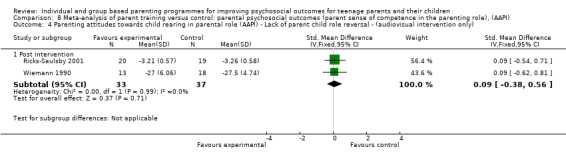
Comparison 8 Meta‐analysis of parent training versus control: parental psychosocial outcomes (parent sense of competence in the parenting role), (AAPI), Outcome 4 Parenting attitudes towards child rearing in parental role (AAPI) ‐ Lack of parent child role reversal ‐ (audiovisual intervention only).
Analysis 9: Parent interaction with child (Nursing Child Assessment Teaching Scale (NCATS))
Two studies (Koniak‐Griffin 1992; Letourneau 2001) provided post‐intervention data from a total of 46 participants (22 in the intervention group and 24 in the control group) for an assessment of parent outcomes post‐intervention. The overall effect for the NCATS‐Parent sub‐scale (independent data) was SMD ‐0.91 (95% CI ‐1.52 to ‐0.30; P=0.004; Analysis 9.1.1). There was no between‐study heterogeneity (I2 = 0%; P=0.75).
Koniak‐Griffin 1992 and Letourneau 2001 also provided follow‐up data from a total of 47 participants (23 in the intervention group and 24 in the control group) for an assessment of parent outcome at three months. The meta‐analysis of the parent‐child interaction measured using the NCATS‐Parent sub‐scale (independent data) showed a significant difference favouring the intervention group (SMD ‐1.07; 95% CI ‐1.80 to ‐0.34; P=0.004; Analysis 9.1). However, there was a highly significant level of between‐studies heterogeneity ‐ the I2 measure of heterogeneity was 95% (P=0.00001), and the use of a random‐effects model did not substantiate the finding (SMD ‐6.11; 95% CI ‐16.99 to 4.77; P=0.27; Analysis 9.2).
Child health and development outcomes
Analysis 10: Child interaction with parent (Nursing Child Assessment Teaching Scale (NCATS Baby's sub‐scale))
Two studies (Koniak‐Griffin 1992; Letourneau 2001) provided follow‐up data from a total of 47 participants (23 in the intervention group and 24 in the control group). The overall effect for child‐parent interaction measured using the NCATS‐Baby sub‐scale (independent data) was SMD ‐0.65 (95% CI ‐1.25 to ‐0.06; P=0.03; Analysis 10.1). The I2 measure of heterogeneity was not significant at 0% (P=0.49).
Combined parent‐child relationship
Analysis 11: Combined parent‐child interaction (Nursing Child Assessment Teaching Scale (NCATS))
Two studies (Koniak‐Griffin 1992; Letourneau 2001) provided post‐intervention data from a total of 46 participants (22 in the intervention group and 24 in the control group) for an assessment of combined parent‐child interaction. The meta‐analysis using the NCATS‐Total score (independent data) showed a statistically significant difference favouring the intervention group (SMD ‐0.71; 95% CI ‐1.31 to ‐0.11; P=0.02; Analysis 11.1). There was no between‐study heterogeneity (I2 = 0%; P=0.79).
At follow‐up, two studies (Koniak‐Griffin 1992; Letourneau 2001) provided data from a total of 47 participants (23 in the intervention group and 24 in the control group) for parent‐child interaction measured using the NCATS‐Total score (independent data). The meta‐analysis showed a significant difference favouring the intervention group ‐SMD ‐0.90 (95% CI ‐1.51 to ‐0.30; P=0.004; Analysis 11.1.2). The measure of between‐study heterogeneity was not significant (I2 = 0%; P=0.60)
Discussion
Summary of main results
Although the addition of four studies to the four included in the original review has increased the overall number of participants, we could not combine many of the data in a meta‐analysis due to the diversity of the outcomes measured. Furthermore, there was considerable diversity amongst the parenting programmes in terms of their duration and content (see below for further discussion).
It was only possible to combine data for a limited number of outcomes from four studies, producing a total of nine meta‐analyses (Analyses 8 to 11). Four meta‐analyses assessed parental attitudes to child rearing using the Adult‐Adolescent Parenting Inventory and were not able to establish if parent training was effective or not. The remaining five meta‐analyses assessed parent interactions with infants, using a number of sub‐scales of the Nursing Child Assessment Teaching Scale (NCATS), and, while it is difficult to draw conclusions from one of these due to high heterogeneity, four found large effect sizes (ranging from 0.65 through to 1.07) favouring the intervention group.
Of the remaining 47 individual study assessments of outcome, 19 produced statistically significant effect sizes favouring the intervention group. These results suggest that parenting programmes directed specifically at teenage parents may be effective in improving important infant and child outcomes such as the infant's response to the parent, the clarity of the infant's cues and the child's ability to understand and respond to language. One study reported large significant changes in maternal sensitivity, maternal identity, maternal self‐confidence, and the cognitive growth‐fostering capacities of the mother (Koniak‐Griffin 1992), and a further study reported significant differences post‐intervention in maternal attitudes to mealtimes and maternal mealtime communication (Black 1997).
Overall completeness and applicability of evidence
The included studies reflect the wide range of settings in which interventions for teenage parents are provided, including schools (Lagges 1999), health settings (Truss 1977), residential maternity homes (Koniak‐Griffin 1992), community health clinics and family support centres (Truss 1977; Black 1997), and the participant's home (Wiemann 1990; Black 1997). The mechanisms of delivery of programmes were varied and included video‐tape modelling (for example, Koniak‐Griffin 1992; Black 1997), use of booklets, alone and in combination with other components (Truss 1977; Wiemann 1990), home visiting (for example, Black 1997; Letourneau 2001), and were delivered by a range of personnel including nurses (for example, Koniak‐Griffin 1992; Letourneau 2001), with differing foci such as feeding (Black 1997) or maternal depression (Stirtzinger 2002). For more detail see Characteristics of included studies.
The generalisability of the results obtained from the included studies is limited for a number of reasons. Some studies targeted teenage parents experiencing very specific problems (for example, teenage parents with depressive symptoms (Stirtzinger 2002), or living in poverty (Truss 1977; Stirtzinger 2002). With one exception (which did not report the results for teenage fathers) (Lagges 1999), the included studies were all directed at teenage mothers only, and the findings of this review cannot therefore be generalised to adolescent fathers. One study was specifically directed at African‐Caribbean mothers (Black 1997), and a number of other studies included a mixed ethnic profile. This suggests that the findings are relevant to parents from a range of ethnic groups. However, all of the studies were conducted in the USA or Canada (Letourneau 2001; Stirtzinger 2002), and caution should therefore be exercised before the findings are generalised to other social and cultural contexts.
Although the interventions were delivered using both individual and group‐based formats, it was not possible to examine the impact of individual or group format on outcomes for parents and their children. Peer group relations may be an important component of such interventions for teenage parents, and although the potential role of the group process in interventions with teenage mothers has been acknowledged, there is very little research available to date that addresses its impact (Schamess 1990; Parekh 1997). The group facilitator/leader may also have an important part to play in helping parents not only to persist with a particular programme (Frankel 1992), but in facilitating an atmosphere of openness and trust between the participating parents, and in helping parents to feel respected, understood, and supported. Facilitators can play an important role in modelling positive attributes including empathy, honesty and respect, and personal qualities such as a sense of humour, enthusiasm, flexibility, and warmth.
All of the included studies involved parents who had volunteered to take part in the study. Parents who volunteer to take part in parenting programmes may not be representative of the wider group of parents, perhaps most importantly due to the fact that volunteers are very often better motivated than parents who have been referred by professional agencies. This, once again, limits the generalisability of the results.
Although there is some recognition that parenting programmes can have adverse effects such as increasing the tension between parents when only one parent attends the programme (Mockford 2004), research from qualitative studies has not to date identified any other adverse outcomes (Barlow 2001).
Quality of the evidence
Overall, the evidence base for teenage parent parenting programmes is of poor quality with many threats to internal validity and significant risk of bias.
Potential biases in the review process
We did not attempt to identify evidence of harmful outcomes in this review, and indeed, none of the included studies identified evidence of harm.
Agreements and disagreements with other studies or reviews
The wider evidence with regard to parenting programmes for parents generally suggests that they are largely effective with diverse populations of parents, and to that extent the largely positive, albeit statistically non‐significant, findings of the current review, are consistent with the broader evidence base on this topic. However, teenage parents are a highly vulnerable group with very specific needs relating to their age and stage of development. Home visiting programmes, which comprise a more intensive intervention (i.e. often beginning ante‐natally and continuing for up to two years postnatally), and that target much broader outcomes aimed explicitly at addressing the issue of social exclusion (i.e. parental education, training and return to work), may be better suited to meeting their needs. Parenting programmes may therefore have a more limited role in terms of providing support to teenage parents, and should possibly be used alongside more intensive forms of provision.
Authors' conclusions
Implications for practice.
Although the included studies suggest some benefits of parenting programmes for teenage parents and their children, particularly those that focus on improving early parent‐infant interaction, the methodological quality of the included studies was poor, and there was significant clinical heterogeneity in terms of the focus and duration of the interventions, and indeed the age of the children targeted. As such, it is not possible at the current time to be clear what the necessary ingredients of successful parenting programmes for teenage parents comprise or which outcomes they have most impact on, and further research is required.
Implications for research.
This review shows that the available evidence on the effectiveness of parenting programmes for teenage parents is wide ranging (for example, varying widely in content, duration and format), and there is a need for further evidence that explicitly evaluates the impact of different programmes. For example, the evidence suggests that brief video‐interaction guidance can help improve the interactions of teenage parents with their babies and further research should be undertaken to evaluate the effectiveness of this particular format of provision.
The conclusions that can be reached at the current time are limited by the lack of consistent measurement across the various studies both in terms of the outcomes measured, and also the time points at which measures were assessed. This review points to the need for more consistent measurement of the effectiveness of both individual and group‐based parenting programmes in improving both parental and infant/child outcomes. There is also a need for studies that recruit larger numbers of teenage parents thereby improving the external validity of the research. Future studies should include parents other than volunteers, i.e. parents who have been referred to parenting programmes. There is also a need to include teenage fathers or fathers of the children of teenage mothers in studies of the effectiveness of parenting programmes targeting teenage parents.
None of the included studies discussed the role of process factors, for example, group processes and facilitator skills, and future research should address their impact on the effectiveness of these programmes for teenage parents.
What's new
| Date | Event | Description |
|---|---|---|
| 8 May 2012 | Amended | Line added to Acknowledgements section on behalf of author CB |
History
Protocol first published: Issue 1, 2001 Review first published: Issue 3, 2001
| Date | Event | Description |
|---|---|---|
| 1 November 2010 | New search has been performed | New search identified new studies to be included. Conclusions not changed. Author order changed. |
| 1 November 2010 | New citation required but conclusions have not changed | New authors added. |
| 25 June 2008 | Amended | Converted to new review format. |
| 21 May 2001 | New citation required and conclusions have changed | Substantive amendment |
Notes
Change in author line.
Acknowledgements
We thank the Cochrane Developmental, Psychosocial and Learning Problems Group for supporting the update of this review, and the following colleagues who provided further information about studies that we assessed for eligibility during this update of the review: Dr O Westney, Dr U Ziegenhain, Dr B Donovan, Dr C Norlin. We also thank Ms Verena Roloff, PhD Student, MRC Cambridge, Cambridge, UK for her advice on adjusting for the effects of cluster randomised trials. Ms Roloff provided advice, the explanatory text used in the review and sample calculations.
Cathy Bennett thanks the University of Bristol and Queen’s University Belfast for awarding visiting fellowships to support her in the academic activities of writing this review between 2008 and 2012.
Appendices
Appendix 1. MEDLINE search strategy
MEDLINE searched via OVID
1 (parent$ adj3 program$).tw.
2 (parent$ adj3 train$).tw.
3 (parent$ adj3 educat$).tw.
4 (parent$ adj3 promot$).tw.
5 parent‐program$.tw.
6 parent‐train$.tw.
7 parent‐educat$.tw.
8 parent‐promot$.tw.
9 exp Health Education/
10 exp Health Promotion/
11 Education/
12 Adolescent Health Services/
13 or/1‐12
14 (adolescen$ adj3 parent$).tw.
15 (adolescen$ adj3 mother$).tw.
16 (adolescen$ adj3 father$).tw.
17 (teen$ adj3 mother$).tw.
18 (teen$ adj3 father$).tw.
19 (teen$ adj3 parent$).tw.
20 Pregnancy in Adolescence/
21 or/14‐20
22 13 and 21
Appendix 2. The Cochrane Library (CENTRAL) search strategy
Cochrane Library (CENTRAL & DARE) and National Research Register
1 (parent* near/3 program*) or (parent* near/3 train*) or (parent* near/3 educat*) or (parent* near/3 promot*)
#2 (parent‐program*) or (parent‐train*) or (parent‐educat*) or (parent‐promot*)
#3 MeSH descriptor Health Education explode all trees
#4 MeSH descriptor Health Promotion explode all trees
#5 MeSH descriptor Education explode all trees
#6 MeSH descriptor Adolescent Health Services explode all trees
#7 (#1 OR #2 OR #3 OR #4 OR #5 OR #6)
#8 (adolescen* near/3 parent*) or (adolescen* near/3 mother*) or (adolescen* near/3 father*)
#9 (teen* near/3 mother*) or (teen* near/3 father*) or (teen* near/3 parent*)
#10 MeSH descriptor Pregnancy in Adolescence explode all trees
#11 (#8 OR #9 OR #10)
#12 (#7 AND #11)
Appendix 3. ERIC
ERIC searched via Dialog Datastar
1 (parent$ NEAR (program$ or educat$ or train$ or
promot$))
2 parent‐program$
3 parent‐train$
4 parent‐educat$
5 parent‐promot$
6 exp health education .DE
7 Health education .DE
8 Parent education .DE
9 1 or 2 or 3 or 4 or 5 or 6 or 7 or 8
10 Pregnant students.DE
11 Early parenthood/.DE
12 (adolescent$ NEAR (parent$ or mother$ or father$))
13 (teen$ NEAR (parent$ or father$ or mother$))
14 10 or 11 or 12 or 13
15 9 and 14
Appendix 4. SSCI search strategy
SSCI searched via Web of Knowledge
#2 OR #1
# 2 TS=((parent* SAME program*) or (parent* SAME training) or (parent* SAME education) or (parent* SAME promotion))
# 1 TS=(parent*‐program* or parent*‐training or parent*‐education or parent*‐promotion)
Appendix 5. ASSIA search strategy
ASSIA searched via CSA
(((adolescen* within 3 parent*) or (adolescen* within 3 mother*) or
(adolescen* within 3 father*)) or ((teen* within 3 mother*) or (teen*
within 3 father*) or (teen* within 3 parent*))) and ((DE="education") or
(DE="health promotion") or (DE="health education") or (((parent* within 3
program*) or (parent* within 3 train*) or (parent* within 3 educat*)) or
(parent* within 3 promot*)) or ((parent‐program* or parent‐train* or
parent‐educat*) or parent‐promot*))
Appendix 6. Sociological abstracts search strategy
SOCIOLOGICAL ABSTRACTS searched via CSA
(((adolescen* within 3 parent*) or (adolescen* within 3 mother*) or
(adolescen* within 3 father*)) or ((teen* within 3 mother*) or (teen*
within 3 father*) or (teen* within 3 parent*))) and ((DE="education") or
(DE="health promotion") or (DE="health education") or (((parent* within 3
program*) or (parent* within 3 train*) or (parent* within 3 educat*)) or
(parent* within 3 promot*)) or ((parent‐program* or parent‐train* or
parent‐educat*) or parent‐promot*))
Appendix 7. PsycINFO search strategy
PsycINFO searched via EBSCOhost in May 2010
S21 S12 and S20
S20 S13 or S14 or S15 or S16 or S17 or S18 or S19
S19 teen* n3 parent*
S18 teen* n3 mother*
S17 teen* n3 father*
S16 adolescen* n3 father*
S15 adolescen* n3 mother*
S14 adolescen* n3 parent*
S13 DE "Adolescent Pregnancy" or DE "Adolescent Fathers" or DE "Adolescent
Mothers"
S12 S1 or S2 or S3 or S4 or S5 or S6 or S7 or S8 or S9 or S10 or S11
S11 DE " education"
S10 DE "health education"
S9 DE "Health Promotion"
S8 parent‐promot*
S7 parent‐educat*
S6 parent‐train*
S5 parent‐program*
S4 parent n3 promot*
S3 parent n3 educat*
S2 parent n3 train*
S1 parent n3 program*
PsycINFO searched via SilverPlatter in January 2008
#12 (("Adolescent‐Pregnancy" in MJ,MN) or ((teen* near3 mother*) or (teen* near3 father*) or (teen* near3 parent*)) or ((adolescen* near3 parent*) or (adolescen* near3 mother*) or (adolescen* near3 father*))) and (("Education‐" in MJ,MN) or ("Health‐Promotion" in MJ,MN) or (explode "Health‐Education" in MJ,MN) or (parent‐program* or parent‐train* or parent‐educat* or parent‐promot*) or ((parent* near3 program*) or (parent* near3 train*) or (parent* near3 educat*) or (parent* near3 promot*))) and (PY:PSYI = 2001‐2008)
#11 (("Adolescent‐Pregnancy" in MJ,MN) or ((teen* near3 mother*) or (teen* near3 father*) or (teen* near3 parent*)) or ((adolescen* near3 parent*) or (adolescen* near3 mother*) or (adolescen* near3 father*))) and (("Education‐" in MJ,MN) or ("Health‐Promotion" in MJ,MN) or (explode "Health‐Education" in MJ,MN) or (parent‐program* or parent‐train* or parent‐educat* or parent‐promot*) or ((parent* near3 program*) or (parent* near3 train*) or (parent* near3 educat*) or (parent* near3 promot*)))
#10 ("Adolescent‐Pregnancy" in MJ,MN) or ((teen* near3 mother*) or (teen* near3 father*) or (teen* near3 parent*)) or ((adolescen* near3 parent*) or (adolescen* near3 mother*) or (adolescen* near3 father*))
#9 "Adolescent‐Pregnancy" in MJ,MN
#8 (teen* near3 mother*) or (teen* near3 father*) or (teen* near3 parent*)
#7 (adolescen* near3 parent*) or (adolescen* near3 mother*) or (adolescen* near3 father*)
#6 ("Education‐" in MJ,MN) or ("Health‐Promotion" in MJ,MN) or (explode "Health‐Education" in MJ,MN) or (parent‐program* or parent‐train* or parent‐educat* or parent‐promot*) or ((parent* near3 program*) or (parent* near3 train*) or (parent* near3 educat*) or (parent* near3 promot*))
#5 "Education‐" in MJ,MN
#4 "Health‐Promotion" in MJ,MN
#3 explode "Health‐Education" in MJ,MN
#2 parent‐program* or parent‐train* or parent‐educat* or parent‐promot*
#1 (parent* near3 program*) or (parent* near3 train*) or (parent* near3 educat*) or (parent* near3 promot*)
Appendix 8. EMBASE search strategy
EMBASE searched via OVID
1 (parent$ adj3 program$).tw.
2 (parent$ adj3 train$).tw.
3 (parent$ adj3 educat$).tw.
4 (parent$ adj3 promot$).tw.
5 parent‐program$.tw.
6 parent‐train$.tw.
7 parent‐educat$.tw.
8 parent‐promot$.tw.
9 exp Health Education/
10 exp Health Promotion/
11 Education/
12 Child Health Care/
13 or/1‐12
14 (adolescen$ adj3 parent$).tw.
15 (adolescen$ adj3 mother$).tw.
16 (adolescen$ adj3 father$).tw.
17 (teen$ adj3 mother$).tw.
18 (teen$ adj3 father$).tw.
19 (teen$ adj3 parent$).tw.
20 Adolescent Pregnancy/
21 or/14‐20
22 13 and 21
Appendix 9. CINAHL search strategy
CINAHL searched via EBSCOhost in May 2010
S18 S13 and S17
S17 S14 or S15 or S16
S16 (MH "Pregnancy in Adolescence+")
S15 (teen* n3 mother*) or (teen* n3 father*) or (teen* n3 parent*)
S14 (adolescent* n3 parent*) or (adolescent* n3 mother*) or (adolescent*
n3 father*)
S13 S1 or S2 or S3 or S4 or S5 or S6 or S7 or S8 or S9 or S10 or S11 or S12
S12 (MH "Health Promotion+")
S11 (MH "Adolescent Health Services")
S10 (MH "Education+")
S9 (MH "Health Education")
S8 parent‐educat*
S7 parent‐promot*
S6 parent‐train*
S5 parent‐program*
S4 parent* N3 promot*
S3 parent* N3 educat*
S2 parent* N3 train*
S1 parent* N3 program*
CINAHL searched via EBSCO in January 2008
1 (parent* n/3 program*)
2 (parent* n/3 train*)
3 (parent* n/3 educat*)
4 (parent* n/3 promot*)
5 parent‐program*
6 parent‐train*
7 parent‐educat*
8 parent‐promot*
9 Health Education/
10 exp Health Promotion/
11 exp Education/
12 Adolescent Health Services/
13 1 or 2 or 3 or 4 or 5 or 6or 7or 8 or 9 or10 or 11 or 12
14 (adolescent* n/3 (parent* or mother* or father*))
15 (teen* n/3 (mother* or father* or parent*))
16 exp Pregnancy in Adolescence/
17 14 or 15 or 16
18 13 and 17
Appendix 10. Search terms used in previously published versions of the review
We modified the search terms used to meet the requirements of individual databases as regards differences in fields. Preliminary searches indicated that a narrowing of the search strategy using terms designed to identify RCTs, resulted in the exclusion of many potentially relevant studies. As a result we adopted a wide search strategy without any specific methodological terms, to ensure we did not miss any relevant studies.
The following search terms were used for the Cochrane Library and other databases: (PARENT* near PROGRAM*) (PARENT* near TRAIN*) (PARENT* near EDUCAT*) (PARENT* near PROMOT*) PARENT‐PROGRAM* PARENT‐TRAIN* PARENT‐EDUCAT* PARENT‐PROMOT* HEALTH‐EDUCATION*:ME HEALTH‐PROMOTION*:ME EDUCATION*:ME ADOLESCENT‐HEALTH‐SERVICES*:ME (((((((((((#1 or #2) or #3) or #4) or #5) or #6) or #7) or #8) or #9) or #10) or #11) or #12) (ADOLESCEN* near PARENT) (ADOLESCEN* near MOTHER*) (ADOLESCEN* near PARENT*) (ADOLESCEN* near FATHER*) (TEEN* near MOTHER*) (TEEN* near FATHER*) (TEEN* near PARENT*) PREGNANCY‐IN‐ADOLESCENCE:ME (((((((#14 or #15) or #16) or #17) or #18) or #19) or #20) or #21) (#13 and #22)
We searched the following electronic databases:
1. Biomedical sciences databases
MEDLINE Journal articles (1970 to 2000)
EMBASE 1980‐2000)
2. Social Science and General Reference databases:
CINAHL (1982‐2000)
PsychLIT Journal Articles and Chapter/Books (1970 to 2000)
Sociofile (1980‐2000)
Social Science Citation Index (1980‐2000)
ASSIA (1980‐2000)
3. Other sources of information:
The Cochrane Library including SPECTR, CENTRAL
National Research Register (NRR)
ERIC (1970‐2000)
We examined reference lists of articles identified through database searches to identify further relevant studies. We also examined bibliographies of systematic and non‐systematic review articles, to identify relevant studies
Data and analyses
Comparison 1. Parent training versus control: parental psychosocial outcomes (psychosocial health).
| Outcome or subgroup title | No. of studies | No. of participants | Statistical method | Effect size |
|---|---|---|---|---|
| 1 Depressive symptoms (BDI) | 1 | Mean Difference (IV, Fixed, 95% CI) | Totals not selected | |
| 1.1 Post‐intervention | 1 | Mean Difference (IV, Fixed, 95% CI) | 0.0 [0.0, 0.0] |
Comparison 2. Parent training versus control: parental psychosocial outcomes (parenting skills, various scales).
| Outcome or subgroup title | No. of studies | No. of participants | Statistical method | Effect size |
|---|---|---|---|---|
| 1 Knowledge of parenting skills (PKT) | 1 | Std. Mean Difference (IV, Fixed, 95% CI) | Totals not selected | |
| 1.1 Follow up | 1 | Std. Mean Difference (IV, Fixed, 95% CI) | 0.0 [0.0, 0.0] | |
| 2 General knowledge of general child development (KIDI) ‐ total number correctly answered items (combined intervention) | 1 | Std. Mean Difference (IV, Fixed, 95% CI) | Totals not selected | |
| 2.1 Post intervention | 1 | Std. Mean Difference (IV, Fixed, 95% CI) | 0.0 [0.0, 0.0] | |
| 3 General knowledge of general child development (KIDI) ‐ total number of incorrectly answered items (combined intervention) | 1 | Std. Mean Difference (IV, Fixed, 95% CI) | Totals not selected | |
| 3.1 Post intervention | 1 | Std. Mean Difference (IV, Fixed, 95% CI) | 0.0 [0.0, 0.0] | |
| 4 General knowledge of general child development (KIDI) ‐ total number of 'not sure' answered items (combined intervention) | 1 | Std. Mean Difference (IV, Fixed, 95% CI) | Totals not selected | |
| 4.1 Post intervention | 1 | Std. Mean Difference (IV, Fixed, 95% CI) | 0.0 [0.0, 0.0] |
Comparison 3. Parent training versus control: parental psychosocial outcomes (parent sense of competence in the parenting role, various scales).
| Outcome or subgroup title | No. of studies | No. of participants | Statistical method | Effect size |
|---|---|---|---|---|
| 1 Maternal attitude toward mealtime communication ‐ (AYCEQ) | 1 | Std. Mean Difference (IV, Fixed, 95% CI) | Totals not selected | |
| 1.1 Post intervention | 1 | Std. Mean Difference (IV, Fixed, 95% CI) | 0.0 [0.0, 0.0] | |
| 2 Parenting attitude towards belief in the value of adaptive rather than coercive practice (PAQ) | 1 | Std. Mean Difference (IV, Fixed, 95% CI) | Totals not selected | |
| 2.1 Follow up | 1 | Std. Mean Difference (IV, Fixed, 95% CI) | 0.0 [0.0, 0.0] | |
| 3 Maternal attitude toward identity in parental role (NPIS) ‐ Semantic Differential Measure ‐ Myself as Mother (SD‐Self) | 1 | Std. Mean Difference (IV, Fixed, 95% CI) | Totals not selected | |
| 3.1 Post intervention | 1 | Std. Mean Difference (IV, Fixed, 95% CI) | 0.0 [0.0, 0.0] | |
| 3.2 Follow up | 1 | Std. Mean Difference (IV, Fixed, 95% CI) | 0.0 [0.0, 0.0] | |
| 4 Maternal attitude toward identity in parental role (NPIS) ‐ Semantic Differential Measure ‐ My Baby (SD‐Baby) | 1 | Std. Mean Difference (IV, Fixed, 95% CI) | Totals not selected | |
| 4.1 Post intervention | 1 | Std. Mean Difference (IV, Fixed, 95% CI) | 0.0 [0.0, 0.0] | |
| 4.2 Follow up | 1 | Std. Mean Difference (IV, Fixed, 95% CI) | 0.0 [0.0, 0.0] | |
| 5 Self‐confidence in infant care (PS‐CS) | 1 | Std. Mean Difference (IV, Fixed, 95% CI) | Totals not selected | |
| 5.1 Post intervention | 1 | Std. Mean Difference (IV, Fixed, 95% CI) | 0.0 [0.0, 0.0] | |
| 5.2 Follow up | 1 | Std. Mean Difference (IV, Fixed, 95% CI) | 0.0 [0.0, 0.0] | |
| 6 Parenting attitudes towards child rearing in parental role (AAPI) ‐ Lack of parent child role reversal ‐ (audiovisual only) | 1 | Std. Mean Difference (IV, Fixed, 95% CI) | Totals not selected | |
| 6.1 Post intervention | 1 | Std. Mean Difference (IV, Fixed, 95% CI) | 0.0 [0.0, 0.0] | |
| 7 Parenting attitudes towards child rearing in parental role (AAPI) ‐ Appropriate developmental expectation of children ‐ (audiovisual only) | 1 | Std. Mean Difference (IV, Fixed, 95% CI) | Totals not selected | |
| 7.1 Post intervention | 1 | Std. Mean Difference (IV, Fixed, 95% CI) | 0.0 [0.0, 0.0] | |
| 8 Parenting attitudes towards child rearing in parental role (AAPI) ‐ Empathic awareness towards children's needs ‐ (audiovisual only) | 1 | Std. Mean Difference (IV, Fixed, 95% CI) | Totals not selected | |
| 8.1 Post intervention | 1 | Std. Mean Difference (IV, Fixed, 95% CI) | 0.0 [0.0, 0.0] | |
| 9 Parenting attitudes towards child rearing in parental role (AAPI) ‐ Non ‐ belief in corporal punishment ‐ (audiovisual only) | 1 | Std. Mean Difference (IV, Fixed, 95% CI) | Totals not selected | |
| 9.1 Post intervention | 1 | Std. Mean Difference (IV, Fixed, 95% CI) | 0.0 [0.0, 0.0] | |
| 10 Parenting attitudes towards child rearing in parental role (AAPI) ‐ Total score ‐ passive learning (audiovisual only) | 1 | Std. Mean Difference (IV, Fixed, 95% CI) | Totals not selected | |
| 10.1 Post intervention | 1 | Std. Mean Difference (IV, Fixed, 95% CI) | 0.0 [0.0, 0.0] | |
| 11 Parenting attitudes towards child rearing in parental role (AAPI) ‐ Appropriate developmental expectation of children ‐ passive learning (audiovisual only) | 1 | Std. Mean Difference (IV, Fixed, 95% CI) | Totals not selected | |
| 11.1 Post intervention | 1 | Std. Mean Difference (IV, Fixed, 95% CI) | 0.0 [0.0, 0.0] | |
| 12 Parenting attitudes towards child rearing in parental role (AAPI) ‐ Empathic awareness towards children's needs ‐ passive learning (audiovisual only) | 1 | Std. Mean Difference (IV, Fixed, 95% CI) | Totals not selected | |
| 12.1 Post intervention | 1 | Std. Mean Difference (IV, Fixed, 95% CI) | 0.0 [0.0, 0.0] | |
| 13 Parenting attitudes towards child rearing in parental role (AAPI) ‐ Non belief in corporal punishment ‐ passive learning (audiovisual only) | 1 | Std. Mean Difference (IV, Fixed, 95% CI) | Totals not selected | |
| 13.1 Post intervention | 1 | Std. Mean Difference (IV, Fixed, 95% CI) | 0.0 [0.0, 0.0] | |
| 14 Parenting attitudes towards child rearing in parental role (AAPI) ‐ Lack of parent child role reversal ‐ passive learning (audiovisual only) | 1 | Std. Mean Difference (IV, Fixed, 95% CI) | Totals not selected | |
| 14.1 Post intervention | 1 | Std. Mean Difference (IV, Fixed, 95% CI) | 0.0 [0.0, 0.0] | |
| 15 Parenting attitudes towards child rearing in parental role (AAPI) ‐ Total score ‐ active learning | 1 | Std. Mean Difference (IV, Fixed, 95% CI) | Totals not selected | |
| 15.1 Post intervention | 1 | Std. Mean Difference (IV, Fixed, 95% CI) | 0.0 [0.0, 0.0] | |
| 16 Parenting attitudes towards child rearing in parental role (AAPI) ‐ Appropriate developmental expectations of children ‐ active learning | 1 | Std. Mean Difference (IV, Fixed, 95% CI) | Totals not selected | |
| 16.1 Post intervention | 1 | Std. Mean Difference (IV, Fixed, 95% CI) | 0.0 [0.0, 0.0] | |
| 17 Parenting attitudes towards child rearing in parental role (AAPI) ‐ Empathic awareness towards children's needs ‐ active learning | 1 | Std. Mean Difference (IV, Fixed, 95% CI) | Totals not selected | |
| 17.1 Post intervention | 1 | Std. Mean Difference (IV, Fixed, 95% CI) | 0.0 [0.0, 0.0] | |
| 18 Parenting attitudes towards child rearing in parental role (AAPI) ‐ Non belief in corporal punishment ‐ active learning | 1 | Std. Mean Difference (IV, Fixed, 95% CI) | Totals not selected | |
| 18.1 Post intervention | 1 | Std. Mean Difference (IV, Fixed, 95% CI) | 0.0 [0.0, 0.0] | |
| 19 Parenting attitudes towards child rearing in parental role (AAPI) ‐ Lack of parent child role reversal ‐ active learning | 1 | Std. Mean Difference (IV, Fixed, 95% CI) | Totals not selected | |
| 19.1 Post intervention | 1 | Std. Mean Difference (IV, Fixed, 95% CI) | 0.0 [0.0, 0.0] | |
| 20 Parenting attitudes towards child rearing in parental role (AAPI) ‐ Appropriate developmental expectations of children (combined intervention) | 1 | Std. Mean Difference (IV, Fixed, 95% CI) | Totals not selected | |
| 20.1 Post intervention | 1 | Std. Mean Difference (IV, Fixed, 95% CI) | 0.0 [0.0, 0.0] | |
| 21 Parenting attitudes towards child rearing in parental role (AAPI) ‐ Empathic awareness (combined intervention) | 1 | Std. Mean Difference (IV, Fixed, 95% CI) | Totals not selected | |
| 21.1 Post intervention | 1 | Std. Mean Difference (IV, Fixed, 95% CI) | 0.0 [0.0, 0.0] | |
| 22 Parenting attitudes towards child rearing in parental role (AAPI) ‐ Lack of parent‐child role reversal (combined intervention) | 1 | Std. Mean Difference (IV, Fixed, 95% CI) | Totals not selected | |
| 22.1 Post intervention | 1 | Std. Mean Difference (IV, Fixed, 95% CI) | 0.0 [0.0, 0.0] | |
| 23 Parenting attitudes towards child rearing in parental role (AAPI) ‐ Non belief in corporal punishment (combined intervention) | 1 | Std. Mean Difference (IV, Fixed, 95% CI) | Totals not selected | |
| 23.1 Post intervention | 1 | Std. Mean Difference (IV, Fixed, 95% CI) | 0.0 [0.0, 0.0] | |
| 24 Parenting attitudes towards the self/self esteem in parental role (RSES) ‐ parent self esteem (combined intervention) | 1 | Std. Mean Difference (IV, Fixed, 95% CI) | Totals not selected | |
| 24.1 Post intervention | 1 | Std. Mean Difference (IV, Fixed, 95% CI) | 0.0 [0.0, 0.0] | |
| 25 Parenting attitudes towards the self/self esteem in parental role (RSES) self denigration ‐ parent self esteem (combined intervention) | 1 | Std. Mean Difference (IV, Fixed, 95% CI) | Totals not selected | |
| 25.1 Post intervention | 1 | Std. Mean Difference (IV, Fixed, 95% CI) | 0.0 [0.0, 0.0] |
3.6. Analysis.

Comparison 3 Parent training versus control: parental psychosocial outcomes (parent sense of competence in the parenting role, various scales), Outcome 6 Parenting attitudes towards child rearing in parental role (AAPI) ‐ Lack of parent child role reversal ‐ (audiovisual only).
3.7. Analysis.

Comparison 3 Parent training versus control: parental psychosocial outcomes (parent sense of competence in the parenting role, various scales), Outcome 7 Parenting attitudes towards child rearing in parental role (AAPI) ‐ Appropriate developmental expectation of children ‐ (audiovisual only).
3.9. Analysis.

Comparison 3 Parent training versus control: parental psychosocial outcomes (parent sense of competence in the parenting role, various scales), Outcome 9 Parenting attitudes towards child rearing in parental role (AAPI) ‐ Non ‐ belief in corporal punishment ‐ (audiovisual only).
3.10. Analysis.

Comparison 3 Parent training versus control: parental psychosocial outcomes (parent sense of competence in the parenting role, various scales), Outcome 10 Parenting attitudes towards child rearing in parental role (AAPI) ‐ Total score ‐ passive learning (audiovisual only).
3.13. Analysis.

Comparison 3 Parent training versus control: parental psychosocial outcomes (parent sense of competence in the parenting role, various scales), Outcome 13 Parenting attitudes towards child rearing in parental role (AAPI) ‐ Non belief in corporal punishment ‐ passive learning (audiovisual only).
3.14. Analysis.

Comparison 3 Parent training versus control: parental psychosocial outcomes (parent sense of competence in the parenting role, various scales), Outcome 14 Parenting attitudes towards child rearing in parental role (AAPI) ‐ Lack of parent child role reversal ‐ passive learning (audiovisual only).
3.15. Analysis.

Comparison 3 Parent training versus control: parental psychosocial outcomes (parent sense of competence in the parenting role, various scales), Outcome 15 Parenting attitudes towards child rearing in parental role (AAPI) ‐ Total score ‐ active learning.
3.16. Analysis.

Comparison 3 Parent training versus control: parental psychosocial outcomes (parent sense of competence in the parenting role, various scales), Outcome 16 Parenting attitudes towards child rearing in parental role (AAPI) ‐ Appropriate developmental expectations of children ‐ active learning.
3.17. Analysis.

Comparison 3 Parent training versus control: parental psychosocial outcomes (parent sense of competence in the parenting role, various scales), Outcome 17 Parenting attitudes towards child rearing in parental role (AAPI) ‐ Empathic awareness towards children's needs ‐ active learning.
3.18. Analysis.

Comparison 3 Parent training versus control: parental psychosocial outcomes (parent sense of competence in the parenting role, various scales), Outcome 18 Parenting attitudes towards child rearing in parental role (AAPI) ‐ Non belief in corporal punishment ‐ active learning.
3.20. Analysis.

Comparison 3 Parent training versus control: parental psychosocial outcomes (parent sense of competence in the parenting role, various scales), Outcome 20 Parenting attitudes towards child rearing in parental role (AAPI) ‐ Appropriate developmental expectations of children (combined intervention).
3.21. Analysis.

Comparison 3 Parent training versus control: parental psychosocial outcomes (parent sense of competence in the parenting role, various scales), Outcome 21 Parenting attitudes towards child rearing in parental role (AAPI) ‐ Empathic awareness (combined intervention).
3.22. Analysis.

Comparison 3 Parent training versus control: parental psychosocial outcomes (parent sense of competence in the parenting role, various scales), Outcome 22 Parenting attitudes towards child rearing in parental role (AAPI) ‐ Lack of parent‐child role reversal (combined intervention).
3.23. Analysis.

Comparison 3 Parent training versus control: parental psychosocial outcomes (parent sense of competence in the parenting role, various scales), Outcome 23 Parenting attitudes towards child rearing in parental role (AAPI) ‐ Non belief in corporal punishment (combined intervention).
3.24. Analysis.

Comparison 3 Parent training versus control: parental psychosocial outcomes (parent sense of competence in the parenting role, various scales), Outcome 24 Parenting attitudes towards the self/self esteem in parental role (RSES) ‐ parent self esteem (combined intervention).
3.25. Analysis.

Comparison 3 Parent training versus control: parental psychosocial outcomes (parent sense of competence in the parenting role, various scales), Outcome 25 Parenting attitudes towards the self/self esteem in parental role (RSES) self denigration ‐ parent self esteem (combined intervention).
Comparison 4. Parent training versus control: parental psychosocial outcomes (parent interaction with child, various scales).
| Outcome or subgroup title | No. of studies | No. of participants | Statistical method | Effect size |
|---|---|---|---|---|
| 1 Maternal interactions, mealtime communication (independent data) ‐ (PCERA) (modified) | 1 | Std. Mean Difference (IV, Fixed, 95% CI) | Totals not selected | |
| 1.1 Post intervention | 1 | Std. Mean Difference (IV, Fixed, 95% CI) | 0.0 [0.0, 0.0] | |
| 2 Maternal interactions, parent child teaching interaction (NCATS) ‐ Mother's subscale (independent data) | 1 | Std. Mean Difference (IV, Fixed, 95% CI) | Totals not selected | |
| 2.1 Post intervention | 1 | Std. Mean Difference (IV, Fixed, 95% CI) | 0.0 [0.0, 0.0] | |
| 2.2 Follow up | 1 | Std. Mean Difference (IV, Fixed, 95% CI) | 0.0 [0.0, 0.0] | |
| 3 Maternal interactions, parent child teaching interaction (NCATS) Mother's Cognitive Growth Fostering subscale (independent data) | 1 | Std. Mean Difference (IV, Fixed, 95% CI) | Totals not selected | |
| 3.1 Post intervention | 1 | Std. Mean Difference (IV, Fixed, 95% CI) | 0.0 [0.0, 0.0] | |
| 3.2 Follow up | 1 | Std. Mean Difference (IV, Fixed, 95% CI) | 0.0 [0.0, 0.0] | |
| 4 Maternal interactions, parent child feeding interaction (NCAFS) ‐ Parent subscale (independent data) | 1 | Std. Mean Difference (IV, Fixed, 95% CI) | Totals not selected | |
| 4.1 Post intervention | 1 | Std. Mean Difference (IV, Fixed, 95% CI) | 0.0 [0.0, 0.0] | |
| 4.2 Follow up | 1 | Std. Mean Difference (IV, Fixed, 95% CI) | 0.0 [0.0, 0.0] | |
| 5 Maternal interactions, parent child teaching interaction (NCATS) ‐ Parent subscale (independent data) | 1 | Std. Mean Difference (IV, Fixed, 95% CI) | Totals not selected | |
| 5.1 Post intervention | 1 | Std. Mean Difference (IV, Fixed, 95% CI) | 0.0 [0.0, 0.0] | |
| 5.2 Follow up | 1 | Std. Mean Difference (IV, Fixed, 95% CI) | 0.0 [0.0, 0.0] |
Comparison 5. Parent training versus control: child health and development outcomes (cognitive development, various scales).
| Outcome or subgroup title | No. of studies | No. of participants | Statistical method | Effect size |
|---|---|---|---|---|
| 1 Infant cognitive and language development Bzoch‐League REEL (Receptive Language Score) | 1 | Std. Mean Difference (IV, Fixed, 95% CI) | Totals not selected | |
| 1.1 Follow up when child was 1 year old | 1 | Std. Mean Difference (IV, Fixed, 95% CI) | 0.0 [0.0, 0.0] | |
| 1.2 Follow up when child was 2 years old | 1 | Std. Mean Difference (IV, Fixed, 95% CI) | 0.0 [0.0, 0.0] | |
| 2 Infant cognitive and language development Bzoch‐League REEL (Expressive Language Score) | 1 | Std. Mean Difference (IV, Fixed, 95% CI) | Totals not selected | |
| 2.1 Follow up when child was 1 year old | 1 | Std. Mean Difference (IV, Fixed, 95% CI) | 0.0 [0.0, 0.0] | |
| 2.2 Follow up when child was 2 years old | 1 | Std. Mean Difference (IV, Fixed, 95% CI) | 0.0 [0.0, 0.0] | |
| 3 Infant cognitive and language development UTLD | 1 | Std. Mean Difference (IV, Fixed, 95% CI) | Totals not selected | |
| 3.1 Follow up when child was 2 years old | 1 | Std. Mean Difference (IV, Fixed, 95% CI) | 0.0 [0.0, 0.0] | |
| 4 Infant cognitive and developmental functioning (Bayley MDI) | 1 | Std. Mean Difference (IV, Fixed, 95% CI) | Totals not selected | |
| 4.1 Follow up | 1 | Std. Mean Difference (IV, Fixed, 95% CI) | 0.0 [0.0, 0.0] |
5.1. Analysis.

Comparison 5 Parent training versus control: child health and development outcomes (cognitive development, various scales), Outcome 1 Infant cognitive and language development Bzoch‐League REEL (Receptive Language Score).
Comparison 6. Parent training versus control: child health and development outcomes (child interaction with parent, various scales).
| Outcome or subgroup title | No. of studies | No. of participants | Statistical method | Effect size |
|---|---|---|---|---|
| 1 Infant responsiveness to mother, parent child teaching interaction (NCATS) ‐ Baby's subscale | 1 | Std. Mean Difference (IV, Fixed, 95% CI) | Totals not selected | |
| 1.1 Post intervention | 1 | Std. Mean Difference (IV, Fixed, 95% CI) | 0.0 [0.0, 0.0] | |
| 1.2 Follow up | 1 | Std. Mean Difference (IV, Fixed, 95% CI) | 0.0 [0.0, 0.0] | |
| 2 Infant responsiveness to mother, parent child teaching interaction (NCATS) ‐ Infant responsiveness to parent subscale | 1 | Std. Mean Difference (IV, Fixed, 95% CI) | Totals not selected | |
| 2.1 Post intervention | 1 | Std. Mean Difference (IV, Fixed, 95% CI) | 0.0 [0.0, 0.0] | |
| 2.2 Follow up | 1 | Std. Mean Difference (IV, Fixed, 95% CI) | 0.0 [0.0, 0.0] | |
| 3 Infant responsiveness to mother, parent child teaching interaction (NCATS) ‐ Child subscale | 1 | Std. Mean Difference (IV, Fixed, 95% CI) | Totals not selected | |
| 3.1 Follow up | 1 | Std. Mean Difference (IV, Fixed, 95% CI) | 0.0 [0.0, 0.0] |
6.1. Analysis.

Comparison 6 Parent training versus control: child health and development outcomes (child interaction with parent, various scales), Outcome 1 Infant responsiveness to mother, parent child teaching interaction (NCATS) ‐ Baby's subscale.
6.2. Analysis.

Comparison 6 Parent training versus control: child health and development outcomes (child interaction with parent, various scales), Outcome 2 Infant responsiveness to mother, parent child teaching interaction (NCATS) ‐ Infant responsiveness to parent subscale.
6.3. Analysis.

Comparison 6 Parent training versus control: child health and development outcomes (child interaction with parent, various scales), Outcome 3 Infant responsiveness to mother, parent child teaching interaction (NCATS) ‐ Child subscale.
Comparison 7. Parent training versus control: combined parent‐child relationship (combined parent‐child interaction, various scales).
| Outcome or subgroup title | No. of studies | No. of participants | Statistical method | Effect size |
|---|---|---|---|---|
| 1 Parent ‐ child relationship, parent child teaching interaction, (NCATS) ‐ Total score ‐ independent data | 1 | Std. Mean Difference (IV, Fixed, 95% CI) | Totals not selected | |
| 1.1 Post intervention | 1 | Std. Mean Difference (IV, Fixed, 95% CI) | 0.0 [0.0, 0.0] | |
| 1.2 Follow up | 1 | Std. Mean Difference (IV, Fixed, 95% CI) | 0.0 [0.0, 0.0] | |
| 2 Parent ‐ child relationship, parent child teaching interaction, (NCATS) ‐ Total score ‐ independent data | 1 | Std. Mean Difference (IV, Fixed, 95% CI) | Totals not selected | |
| 2.1 Post intervention | 1 | Std. Mean Difference (IV, Fixed, 95% CI) | 0.0 [0.0, 0.0] | |
| 2.2 Follow up | 1 | Std. Mean Difference (IV, Fixed, 95% CI) | 0.0 [0.0, 0.0] | |
| 3 Parent ‐ child relationship, parent child feeding interaction (NCAFS) ‐ Total score ‐ independent data | 1 | Std. Mean Difference (IV, Fixed, 95% CI) | Totals not selected | |
| 3.1 Post intervention | 1 | Std. Mean Difference (IV, Fixed, 95% CI) | 0.0 [0.0, 0.0] | |
| 3.2 Follow up | 1 | Std. Mean Difference (IV, Fixed, 95% CI) | 0.0 [0.0, 0.0] | |
| 4 Parent ‐ child relationship, parent child teaching interaction (NCATS) ‐ Contigency ‐ independent data | 1 | Std. Mean Difference (IV, Fixed, 95% CI) | Totals not selected | |
| 4.1 Post intervention | 1 | Std. Mean Difference (IV, Fixed, 95% CI) | 0.0 [0.0, 0.0] | |
| 4.2 Follow up | 1 | Std. Mean Difference (IV, Fixed, 95% CI) | 0.0 [0.0, 0.0] | |
| 5 Parent ‐ child relationship, parent child feeding interaction (NCAFS) ‐ Contingency ‐ independent data | 1 | Std. Mean Difference (IV, Fixed, 95% CI) | Totals not selected | |
| 5.1 Post interventionNew Subgroup | 1 | Std. Mean Difference (IV, Fixed, 95% CI) | 0.0 [0.0, 0.0] | |
| 5.2 Follow up | 1 | Std. Mean Difference (IV, Fixed, 95% CI) | 0.0 [0.0, 0.0] |
Comparison 8. Meta‐analysis of parent training versus control: parental psychosocial outcomes (parent sense of competence in the parenting role), (AAPI).
| Outcome or subgroup title | No. of studies | No. of participants | Statistical method | Effect size |
|---|---|---|---|---|
| 1 Parenting attitudes towards child rearing in parental role (AAPI) ‐ Appropriate developmental expectation of children ‐ (audiovisual intervention only) | 2 | Std. Mean Difference (IV, Random, 95% CI) | Subtotals only | |
| 1.1 Post intervention | 2 | 70 | Std. Mean Difference (IV, Random, 95% CI) | 0.17 [‐0.96, 1.30] |
| 2 Parenting attitudes towards child rearing in parental role (AAPI) ‐ Lack of empathic awareness ‐ (audiovisual only) | 2 | Std. Mean Difference (IV, Random, 95% CI) | Subtotals only | |
| 2.1 Post intervention | 2 | 69 | Std. Mean Difference (IV, Random, 95% CI) | 0.02 [‐1.46, 1.50] |
| 3 Parenting attitudes towards child rearing in parental role (AAPI) ‐ Non‐belief in corporal punishment ‐ (audiovisual intervention only) | 2 | Std. Mean Difference (IV, Fixed, 95% CI) | Subtotals only | |
| 3.1 Post‐intervention | 2 | 69 | Std. Mean Difference (IV, Fixed, 95% CI) | 0.26 [‐0.22, 0.73] |
| 4 Parenting attitudes towards child rearing in parental role (AAPI) ‐ Lack of parent child role reversal ‐ (audiovisual intervention only) | 2 | Std. Mean Difference (IV, Fixed, 95% CI) | Subtotals only | |
| 4.1 Post intervention | 2 | 70 | Std. Mean Difference (IV, Fixed, 95% CI) | 0.09 [‐0.38, 0.56] |
Comparison 9. Meta‐analysis of parent training versus control: parental psychosocial outcomes (parent interaction with child) (NCATS).
| Outcome or subgroup title | No. of studies | No. of participants | Statistical method | Effect size |
|---|---|---|---|---|
| 1 Maternal interactions, parent child teaching interaction (NCATS) ‐ Parent subscale | 2 | Std. Mean Difference (IV, Fixed, 95% CI) | Subtotals only | |
| 1.1 Post intervention | 2 | 46 | Std. Mean Difference (IV, Fixed, 95% CI) | ‐0.91 [‐1.52, ‐0.30] |
| 1.2 Follow up (fixed effect model) | 2 | 47 | Std. Mean Difference (IV, Fixed, 95% CI) | ‐1.07 [‐1.80, ‐0.34] |
| 2 Follow up (random effects model) | 2 | 47 | Std. Mean Difference (IV, Random, 95% CI) | ‐6.11 [‐16.99, 4.77] |
Comparison 10. Meta‐analysis of parent training versus control: child health and development outcomes, (child interaction with parent) (NCATS ‐ Baby's subscale).
| Outcome or subgroup title | No. of studies | No. of participants | Statistical method | Effect size |
|---|---|---|---|---|
| 1 Child/Parent Interaction ‐ Infant responsiveness to mother ‐ NCATS (Baby's subscale) | 2 | Std. Mean Difference (IV, Fixed, 95% CI) | Subtotals only | |
| 1.1 Follow up | 2 | 47 | Std. Mean Difference (IV, Fixed, 95% CI) | ‐0.65 [‐1.25, ‐0.06] |
Comparison 11. Meta‐analysis Parent training versus control: combined parent‐child relationship (combined parent‐child interaction) (NCATS).
| Outcome or subgroup title | No. of studies | No. of participants | Statistical method | Effect size |
|---|---|---|---|---|
| 1 Parent ‐ child relationship (parent‐child teaching interaction, (NCATS) ‐ Total score) | 2 | Std. Mean Difference (IV, Fixed, 95% CI) | Subtotals only | |
| 1.1 Post intervention | 2 | 46 | Std. Mean Difference (IV, Fixed, 95% CI) | ‐0.71 [‐1.31, ‐0.11] |
| 1.2 Follow up | 2 | 47 | Std. Mean Difference (IV, Fixed, 95% CI) | ‐0.90 [‐1.51, ‐0.30] |
Characteristics of studies
Characteristics of included studies [ordered by study ID]
Black 1997.
| Methods | Parallel randomised controlled trial. | |
| Participants |
Participants: African‐American adolescent mothers of healthy infants, recruited from urban, high schools, mother and child clinics and family support centres. Sex: all female. Age of parents: mean 17.1 years (SD 1.1) intervention; mean 16.5 years (SD 1.3) control. Number randomised: 64 (29 intervention; 35 control). Number used in analysis: 59 (26 intervention; 33 control). Country: USA; urban; community setting. Inclusion criteria: first‐time African‐American mothers aged less than 20 years with healthy infants less than 13 months old. Exclusion criteria: mothers with infants who had a history of a major perinatal complications, congenital disorders, chronic illness, or growth deficiency. Ethnicity: all African‐American. Baseline characteristics: marital status: none of the mothers were married, 14% lived with the infant's father, 74% lived with their mother; education: 97% of mothers were in school. ANOVAs analyses showed no significant demographic differences between the treatment conditions. |
|
| Interventions | Two conditions: educational video‐tape modelling and feeding observation parent programme; no‐treatment control. Content of intervention: a 15‐minute culturally sensitive videotape 'Feeding your baby with love' viewed in the group and received a copy to take home. Intervention provided on a one‐to‐one basis. Duration of intervention: 2 weeks (15 minutes watching the video in the group and viewing the same video at home, over 2 weeks). Length of follow‐up: no follow‐up. |
|
| Outcomes | Maternal attitudes to mealtime communication (About Your Child's Eating Questionnaire). Maternal mealtime communication (Parent Child Early Relational Assessment). |
|
| Notes | ||
| Risk of bias | ||
| Bias | Authors' judgement | Support for judgement |
| Random sequence generation (selection bias) | Unclear risk | Investigators report "mothers were randomised into intervention or control groups" (col 2, page 433). Information reported insufficient for a judgement to be made. |
| Allocation concealment (selection bias) | Unclear risk | Information reported insufficient for a judgement to be made. |
| Blinding (performance bias and detection bias) Participants | High risk | Review authors judged that it would not be possible to fully blind participants in this type of study. We found no indication of any specific additional measures taken to reduce the risk of bias that might result from differential behaviours by participants. |
| Blinding (performance bias and detection bias) Personnel | High risk | Investigators report "no identifying names or codes were visible on the videotape, so the rater could not determine group identity or the order in which the videotapes were made" (column 2, page 434). Review authors judged that while an attempt at blinding was made for rater and assessor, no further information was given regarding other personnel, therefore the personal were not adequately blinded. |
| Blinding (performance bias and detection bias) Outcome assessors | Low risk | Investigators report that outcome assessors were blind to allocation status of participants (column 2, page 434). |
| Incomplete outcome data (attrition bias) All outcomes | Low risk | Investigators report "fifty‐nine of the 64 adolescent mothers (92%) returned to the second laboratory visit. Multiple follow‐up appointments were scheduled and three mothers in the intervention group and two in the control group failed to attend. No differences were found between those who returned and those who did not on any of the demographic variables or on the measures administered during the first laboratory visit" (column 2, page 434). Review authors judge that incomplete outcome data is reported and appears unlikely to introduce bias. No indication of intention‐to‐treat analysis. |
| Selective reporting (reporting bias) | Low risk | Review authors judge that the published report includes all expected outcomes, including those that were pre‐specified. |
| Other bias | Low risk | The study appeared to be free of other sources of bias. |
Koniak‐Griffin 1992.
| Methods | Parallel randomised controlled trial. | |
| Participants | Participants: volunteer adolescent mothers, recruited from a residential maternity home. Sex: all female. Age of parents: mean 17.4 years (SD 1.59) intervention; 16.94 years (SD 1.44). Number randomised: 31 (15 intervention; 16 control). Number used in analysis: 31 (15 intervention; 16 control). Country: USA. Inclusion criteria: age 20 years or younger; primiparous; completion of a normal pregnancy and delivery of a healthy, full‐term infant; and ability to read and speak English. Exclusion criteria: not stated. Ethnicity: intervention: 6 (40%) black, 3 (20%) Hispanic, 6 (40%) white; control: 7 (43.8%) black, 9 (56.2%) Hispanic. Baseline characteristics: all participants were single, and 90% were experiencing their first pregnancy; no significant differences were found between participants in both treatment conditions for age, marital status, socioeconomic status, or infant birth weight. |
|
| Interventions | Two conditions: individual‐based educational video‐tape modelling parent programme; no‐treatment control. Content of intervention: two structured teaching tasks during the instructional session. Instruction and feedback were provided. The discussion on infant cues, maternal response to infant distress, and use of language took place. After completion of the instructional session each mother was asked to performed the more difficult task for a second time, using the interaction techniques discussed. Duration of intervention: intervention lasted only one visit, and it is likely that duration was a few hours. Length of follow‐up: at 4 weeks after delivery of the intervention. |
|
| Outcomes | Maternal behaviour and infant responsiveness to mother (Nursing Child Assessment Teaching Scale). Maternal identity (Neonatal Perception Inventory Scale). Self‐confidence in infant care (Pharis Self Confidence scale). |
|
| Notes | ||
| Risk of bias | ||
| Bias | Authors' judgement | Support for judgement |
| Random sequence generation (selection bias) | Unclear risk | Investigators report "subjects were randomly assigned to the experimental (15) and control (16) groups" (col 2, page 571). Information reported insufficient for a judgement to be made. |
| Allocation concealment (selection bias) | Unclear risk | Information reported insufficient for a judgement to be made. |
| Blinding (performance bias and detection bias) Participants | High risk | Investigators report "mothers in the control group received two home visits at comparable time intervals. They were requested to perform the same structured teaching tasks as subjects in the experimental group. The NCATS protocols were similarly applied, and the episodes were video recorded; however, no instruction or feedback was provided" (col 1, page 572). Review authors judge that design of study means participants were likely to be aware of whether or not they had received instruction or feedback. |
| Blinding (performance bias and detection bias) Personnel | High risk | Investigators report "a specially trained professional nurse observed the mother‐infant interactions and video‐taped the two episodes" (col 2, page 571). Review authors judge that design of study means the specially trained professional nurse would always be aware of the allocation status of the participant they were observing. No further information given regarding other personnel. |
| Blinding (performance bias and detection bias) Outcome assessors | Low risk | Investigators report "the videotapes of maternal‐infant interactions were reviewed and scored by a NCATS certified instructor who was blind to subjects’ experimental/control conditions" (col 1, page 572). Review authors judge blinding of assessors was adequate. |
| Incomplete outcome data (attrition bias) All outcomes | Low risk | Investigators report " behavioural, altitudinal, and demographic data were collected on all mothers and infants prior to the initiation of intervention and at time of the first and second visit" (page 572, col 1). Review authors judged that there were no missing data. |
| Selective reporting (reporting bias) | Low risk | Review authors judge that the published report includes all expected outcomes, including those that were pre‐specified. |
| Other bias | High risk | Investigators report "significant ethnic/racial differences were observed between the groups, which could have had a confounding effect on the outcomes" (col 2, page 574). Review authors judge there might be the possibility of bias arising from the above issues. |
Lagges 1999.
| Methods | Cluster randomised controlled trial | |
| Participants |
Participants: volunteer pregnant or parenting adolescents recruited in classes from a school‐based programme for teen parents. Sex: all female. Age of parents: mean 16.6 years (SD 1.3) intervention; 17.3 (SD 0.8) control. Number randomised: 8 classes; 62 participants (33 intervention; 29 control). Number used in analysis: 50 participants (28 intervention; 22 control). Country: USA. Inclusion criteria: pregnant or parenting adolescents enrolled in an Ohio Department of Education high school. Exclusion criteria: not stated. Ethnicity: intervention: 24 white, 4 black; 20 white, 2 black. Baseline characteristics: intervention: 4 married, 24 single; 17 live with parents; 20 had at least 1 child, 8 expecting first child; control: 3 married, 19 single; 15 lived with parents; 10 had at least 1 child, 12 expecting first child; no significant difference between the treatment conditions on the categorical demographic data; on the continuous demographic data the treatment groups differed only on age (the participants in the control group were older). |
|
| Interventions | Two conditions: Parenting Adolescent Wisely program; wait‐list control. Content of intervention: a brief computer‐assisted interactive videodisc intervention with a group component. This programme addresses communication skills, speaking respectfully, and assertive discipline. Duration of intervention: 2 weeks (two consecutive weekly sessions & one discussion session). Length of follow‐up: 2 months. |
|
| Outcomes | Sense of competence in parental role (Parental Attitude Questionnaire). Parenting knowledge (Parenting Knowledge Test). |
|
| Notes | ||
| Risk of bias | ||
| Bias | Authors' judgement | Support for judgement |
| Random sequence generation (selection bias) | Low risk | Investigators report "eight classes of GRADS students were randomly assigned to either the control (29 students) or experimental group (33 students) (page 24). The authors were contacted and reported that a random number table was used to assign the school classes to the study conditions. |
| Allocation concealment (selection bias) | Unclear risk | Information reported insufficient for a judgement to be made. |
| Blinding (performance bias and detection bias) Participants | High risk | Review authors judged that it would not be possible to fully blind participants in this type of study. We found no indication of any specific additional measures taken to reduce the risk of bias that might result from differential behaviours by participants. |
| Blinding (performance bias and detection bias) Personnel | High risk | Review authors judged that design of the study means personnel would be aware which classes had been assigned to the intervention condition. |
| Blinding (performance bias and detection bias) Outcome assessors | Unclear risk | Information reported insufficient for a judgement to be made. |
| Incomplete outcome data (attrition bias) All outcomes | High risk | Investigators report "four students in the intervention group and six students in the control group failed to complete post‐study measures (page 29); of the original 62 subjects, 10 were not included in the final analysis because they failed to complete posttest measures; in addition, two males who completed posttest measures were removed from the analyses" (no reasons given). "Therefore, 50 subjects were included in the final analyses; the demographic analyses were repeated for these subjects to ensure that the drop‐outs did not interfere with the original equivalence of the groups" (page 29‐30). Review authors judged that outcome data is incompletely reported with the possibility of inducing bias. Dropouts not included in final analysis. No indication of intention‐to‐treat analysis. |
| Selective reporting (reporting bias) | Low risk | Review authors judge that the published report includes all expected outcomes, including those that were pre‐specified. |
| Other bias | Unclear risk | Investigators report that both the Parental Attitudes Questionnaire and the scenario questions were developed specifically for the study and do not appear to be fully validated. Random allocation by class rather than by individual could introduce bias if classes differ significantly from each other. Review authors judge there might be the possibility of bias arising from the above issues. |
Letourneau 2001.
| Methods | Parallel randomised controlled trial (the post‐test only design). | |
| Participants |
Participants: adolescent mothers recruited in classes from a school‐based programme for teen parents. Sex: all female. Age of parents: (at birth for 18 participants): 18.06 years (SD 1.01); range 15.96 to 19.79 years. Number randomised: 24 (13 intervention; 11 control). Number used in analysis: 15 (7 intervention; 8 control) at 7 to 9 weeks (infant's age); 16 (8 intervention; 8 control) at 11 to 13 weeks (infant's age). Country: Canada; single site; urban. Inclusion criteria: a first‐time and inexperienced primary caregiver aged 13 to 19 years; uneventful postpartum recovery; not known to have abused alcohol or drugs during pregnancy; able to read and write English; resident in a large Canadian city or surrounding area. Eligible infants: healthy singleton birth; at least 35 weeks gestation; minimum 2.5 kg at birth. Exclusion criteria: not stated. Ethnicity: not stated. Baseline characteristics: all participants reported being the major caregiver for their infants; mean Edinburgh Postnatal Depression Scale score at 7 to 9 weeks 7.07 (SD 4.15); mean Edinburgh Postnatal Depression Scale score at 11 to 13 weeks 6.69 (SD 4.35); no significant differences were found with respect to demographic characteristics between treatment conditions. |
|
| Interventions | Two conditions: Keys to Caregiving parent educational behaviour programme; treatment‐as‐usual control. Content of intervention: manualised programme designed to improve interactions and contingent responsiveness between adolescent mothers and their infants; commenced when infant < 1 week old; information pamphlet provided before each home visit. Duration of intervention: 6 weeks. Length of follow‐up: 4 to 5 weeks. |
|
| Outcomes | Depressive symptoms (Edinburgh Postnatal Depression Scale). Contingent responsiveness of parents and infants to each other (feeding) (Nursing Child Assessment Feeding Scale). Contingent responsiveness of parents and infants to each other (teaching) (Nursing Child Assessment Teaching Scale). Infant expectations (Visual Expectation Paradigm Test). Infant cognitive developmental functioning (Bayley scales of infant development II). |
|
| Notes | ||
| Risk of bias | ||
| Bias | Authors' judgement | Support for judgement |
| Random sequence generation (selection bias) | Unclear risk | Investigators report "participants were randomly assigned to the intervention or the control group based on a random assignment schedule that had been developed before commencement of the study" (page 55). Information reported insufficient for a judgement to be made. |
| Allocation concealment (selection bias) | Low risk | Investigators report "small sealed envelopes, each containing an assignment to a group, were randomly matched with a case number. Once the sealed envelope was opened, a nurse‐interventionist initiated plans for the assigned group" (p.55). Concealment achieved by use of central allocation opaque envelopes that were opened in sequence by research staff with trial coordinator masked to allocations that participants and any investigator enrolling participants could not foresee assignment. |
| Blinding (performance bias and detection bias) Participants | High risk | Investigators report "potential participants were told that they would receive six home visits from a registered nurse. It was explained to participants that the specific differences between the two programmes could not be revealed until the end of the study to prevent bias. All discussions with participants about the details of the study took place before random assignment to groups. This created the partial blind (Christensen 1994) hence expectations about study results could not be conveyed differently to the intervention and control group participants" (page 55). We judged that although it is not possible to fully blind participants in this type of study, some additional measures had been taken to reduce the risk of bias that might result from differential behaviours by participants. However, we decided that these measures did not constitute adequate blinding of the participants. |
| Blinding (performance bias and detection bias) Personnel | High risk | Investigators report "the same nurse provided both the control and the intervention program" (page 55). Review authors judged that trial personnel were not blind to allocation status of participants. |
| Blinding (performance bias and detection bias) Outcome assessors | Unclear risk | Investigators report "a certified instructor taught one data coder, blind to participants’ group assignment, to score the tapes according to the NCAFS and NCATS protocol" (page 56); the investigator conducted DQ (development quotient) tests was aware of participants group assignment" (p.58). Review authors judged that not all assessors were blinded. |
| Incomplete outcome data (attrition bias) All outcomes | High risk | Data for 6 of 13 (46.2%) were missing from the intervention condition, and for 3 of 11 (27.3%) from the control condition when infants were 7 to 9 weeks old. Data for 3 of 13 (23.1%) were missing from the intervention condition, and for 5 of 11 (45.5%) from the control condition when infants were 11 to 13 weeks old. Overall attrition was 36.7% at 7 to 9 weeks, and 34.3% at 11 to 13 weeks. Reasons for missing data not provided. Review authors considered the numbers of missing data were not balanced across the treatment conditions. |
| Selective reporting (reporting bias) | Low risk | Review authors judged that the published report included all expected outcomes, including those that were pre‐specified. |
| Other bias | Unclear risk | Investigators report "the post‐test‐only design makes it impossible to eliminate the chance that group differences on the outcome variables were present at baseline" (pages 59 to 60). Insufficient information to assess whether the study had baseline imbalance. |
Ricks‐Saulsby 2001.
| Methods | Parallel randomised controlled trial. | |
| Participants |
Participants: adolescent mothers recruited from the South Side Help Centre in Chicago. Sex: all female. Age of parents: mean 17 years. Number randomised: 60 (20 active learning intervention; 20 passive learning intervention; 20 control). Number used in analysis: a maximum of 40 participants used in analysis (different numbers reported for individual outcome assessments). Country: USA. Inclusion criteria: primiparity; age between 15 and 19 years; single, never married; living with maternal parent; normal pregnancy, labour and delivery; educational level between grades 9 and 12; infants between 2 and 12 months of age. Exclusion criteria: not stated. Ethnicity: 90% African‐American; 3% Caucasian; 7% Hispanic. Baseline characteristics: no statistically significant differences were found between the treatment groups with respect to age or grade. |
|
| Interventions | Two conditions: group‐based educational active learning parent programme; group‐based educational passive learning parent programme; no‐treatment control. Content of intervention: group‐based educational active learning parent programme: demonstration and practice of parenting skills; group‐based educational passive learning parent programme: audiovisual‐only education on parenting skills intervention. Parenting skills class covered: i) appropriate developmental expectations ii) appropriate empathy for children needs; iii) alternatives to corporal punishment; iv) family roles. Duration of intervention: 4 weeks. Length of follow‐up: no follow‐up. |
|
| Outcomes | Sense of competence in parental role (Adult Adolescent Parenting Inventory). | |
| Notes | ||
| Risk of bias | ||
| Bias | Authors' judgement | Support for judgement |
| Random sequence generation (selection bias) | Low risk | Investigators report "computer‐generating sequence of random numbers (using the uniform 0,1 distribution function in SPSS for Windows) was used to randomise subjects. For each potential subject, a random number was generated by the SPSS for Windows; the subjects were then sorted according to their random numbers, from lowest to highest" (page 47). |
| Allocation concealment (selection bias) | Unclear risk | Information reported insufficient for a judgement to be made. |
| Blinding (performance bias and detection bias) Participants | High risk | Review authors judged that it would not be possible to fully blind participants in this type of study. |
| Blinding (performance bias and detection bias) Personnel | High risk | Review author judged that design of study means personnel would be aware which group had been assigned to the intervention or control condition. |
| Blinding (performance bias and detection bias) Outcome assessors | Unclear risk | Information reported insufficient for a judgement to be made. |
| Incomplete outcome data (attrition bias) All outcomes | High risk | The study report states that 20 participants were randomised into intervention or control group and that analyses were performed on fewer than 20 completers (range of dropout is 5% to 10%). Reasons for non‐completion were not specified. Review authors considered that incomplete outcome data are likely to introduce bias. |
| Selective reporting (reporting bias) | Low risk | Review authors judged that the published report included all expected outcomes, including those that were pre‐specified. |
| Other bias | Low risk | The study appeared to be free of other sources of bias. |
Stirtzinger 2002.
| Methods | Parallel randomised controlled trial. | |
| Participants |
Participants: pregnant adolescents or adolescent mothers, who frequently had problematic relationship with their families of origin. Sex: all female. Age of parents: mean 17 years (range 14 to 20 years). Number randomised: 20 (10 intervention; 10 control). Number used in analysis: 16 (9 intervention; 7 control). Country: Canada; single site; community setting. Inclusion criteria: female adolescents with clinical depression, pregnant or parenting very young children and attending the school‐based community organization; score of 16 or above on Beck Depression Inventory. Exclusion criteria: presence of psychosis. Ethnicity: 40% black; 40 % white; 20% bi‐racial or Philipino. Baseline characteristics: mean baseline BDI scores: 21 (treatment group), 19 (control group); both treatment groups showed similar ethnic and racial distribution and levels of conflict and trauma. |
|
| Interventions | Two conditions: Group‐based prevention/intervention parent programme; treatment‐as‐usual control. Content of intervention: Group‐based prevention/intervention parent programme: 10 sessions, each lasted 1.5 hours; each session consisted of three components: group analysis of actual families interacting with their children; techniques to encourage participants to reflect on the parenting they received and wished to give; provision of information on maternal infant mental health. Treatment‐as‐usual consisted of the organisation’s educational support programmes (i.e. self‐esteem courses, educational parenting, and child development courses) and access to medical services (for example, obstetrical, paediatric or family medicine support). Duration of intervention: 10 weeks. Length of intervention: 6 months. |
|
| Outcomes | Depressive symptoms ( Beck Depression Inventory). Sense of competence in parenting role (Parent Attribution Test). |
|
| Notes | ||
| Risk of bias | ||
| Bias | Authors' judgement | Support for judgement |
| Random sequence generation (selection bias) | Unclear risk | Information reported insufficient for a judgement to be made. |
| Allocation concealment (selection bias) | Unclear risk | Information reported insufficient for a judgement to be made. |
| Blinding (performance bias and detection bias) Participants | High risk | Review authors judged that it would not be possible to fully blind participants in this type of study. |
| Blinding (performance bias and detection bias) Personnel | High risk | Review author judged that design of study means personnel would be aware which group had been assigned to the intervention or control condition. |
| Blinding (performance bias and detection bias) Outcome assessors | Unclear risk | Information reported insufficient for a judgement to be made. |
| Incomplete outcome data (attrition bias) All outcomes | High risk | Data for 1 of 20 (5%) were missing from the intervention condition, and for 3 of 20 (15%) from the control condition. Reasons for missing data not given. Overall attrition was 10% at post‐intervention. Review authors considered the numbers of missing data were not balanced across the treatment conditions. |
| Selective reporting (reporting bias) | Low risk | Review authors judged that the published report included all expected outcomes, including those that were pre‐specified. |
| Other bias | Low risk | The study appeared to be free of other sources of bias. |
Truss 1977.
| Methods | Parallel randomised controlled trial. | |
| Participants |
Participants: volunteer adolescent mothers or expectant mothers recruited from a clinic with a programme for teenage parents. Sex: all female. Age of parents: adolescent age (not specified). Number randomised: 164 (127 intervention; 37 control). Number used in analysis: up to 95 in total used in analysis (different numbers reported for individual outcome assessments). At short‐term follow‐up (1 year) 83 intervention; 12 control; and at longer term follow up (2 years) 37 intervention; 12 control for Bzoch League REEL Receptive language score and Bzoch League REEL Emergent language score; For Utah Test of Language Development at long‐term follow‐up (2 years) 35 intervention condition; 10 control. Country: USA. Inclusion criteria: teenage mothers or expectant teenage mothers whose babies would be less than 6 months of age at the start of parenting programme; adolescents who were in general considered as a "borderline poverty group". Exclusion criteria: not stated. Ethnicity: 98% white; 25% Cuban. Baseline characteristics: not stated. |
|
| Interventions | Two conditions: Group‐based educational parent programme; no‐treatment control. Content of intervention: parent training programme on infant/child management techniques and practical teaching skills. Every session lasted three hours. In addition, mailing of supplemental booklets on "What, how and when teach babies” was provided for 48 months on a two‐month interval. Duration of intervention: 10‐12 weeks. Length of follow‐up: follow‐up when child was 1 year old and 2 years old. |
|
| Outcomes | Infant cognitive and language development (Bzoch League Receptive Expressive Emergent Language; Utah Test of Language). | |
| Notes | ||
| Risk of bias | ||
| Bias | Authors' judgement | Support for judgement |
| Random sequence generation (selection bias) | Unclear risk | Information reported insufficient for a judgement to be made. |
| Allocation concealment (selection bias) | Unclear risk | Information reported insufficient for a judgement to be made. |
| Blinding (performance bias and detection bias) Participants | High risk | Review authors judged that it would not be possible to fully blind participants in this type of study. |
| Blinding (performance bias and detection bias) Personnel | High risk | The information reported insufficient for a judgement to be made, but no mention was made of blinding of the personnel and it is unlikely that personnel could have been adequately blinded given the nature of the intervention. |
| Blinding (performance bias and detection bias) Outcome assessors | Unclear risk | Information reported insufficient for a judgement to be made. |
| Incomplete outcome data (attrition bias) All outcomes | High risk | Data for 44 of 127 (35%) were missing from the intervention condition, and for 25 of 37 (68%) from the control condition at short‐term follow‐up. Reasons for missing data not given. Data for 72 of 127 (57%) were missing from the intervention condition, and for 27 of 37 (73%) from the control condition at long‐term follow‐up. Reasons for missing data not given. Overall attrition was 51% at short‐term follow‐up and 70% long‐term follow‐up. Review authors considered that the numbers of missing data were not balanced across the treatment conditions. |
| Selective reporting (reporting bias) | Low risk | Review authors judged that the published report included all expected outcomes, including those that were pre‐specified. |
| Other bias | Unclear risk | Information reported insufficient for a judgement to be made. |
Wiemann 1990.
| Methods | Cluster randomised controlled trial. | |
| Participants |
Participants: adolescent mothers with primary custody of their child, recruited from 20 urban and rural sites in the Lafayette area, Indiana (from high school, hospital community health nurse, health clinic, and social service agency). Sex: all female. Age of parents: mean 17.7 years (SD 1.25; range 14 to 19 years). Number randomised: 20 sites; 88 participants (4 sites, 23 participants audiovisual; 4 sites, 22 participants booklet; 6 sites, 21 participants combined intervention; 6 sites, 22 participants control). Number used in analysis: audiovisual (video) 13, combined intervention 13, control 18). (Numbers completing the study: 74 participants audiovisual (video) 19; booklet 20; combined intervention 17; control 18). Country: USA; multiple sites; mixed rural and urban. Inclusion criteria: adolescent mother with primary custody of her child; aged between 14 and 19 years; lower socioeconomic level (determined by the educational and occupational status of adults in the participant's own family). Exclusion criteria: having more than one child; having a child older than one and a half years; having child born earlier than 36 weeks gestation; participation in a parent education or child care programme or class within the year preceding the first interview. Ethnicity: 69 (78.4%) white; 17 (19.3%) black; 2 (2.3%) Hispanic. Baseline characteristics: 65 (73.9%) single/engaged, 21 (23.8%) married, 2 (2.3%) divorced; 3 (3.4%) currently pregnant; 55 (62.5%) currently in education; mean 10.76 (SD 1.41) years in education; 60 (68.2%) urban; 28 (31.8%) rural; 21 (23.9%) employed; 41 (46.6%) of children female; none had children who had spent time in foster care. |
|
| Interventions | Four conditions: audiovisual (video) only; booklet only; audiovisual (video) and booklet; treatment‐as‐usual control. Content of intervention: all treatments were short‐term parent education programmes and were provided in a group format. The topics were the same for all three interventions. Session one: Come play with me: Play activity and infant stimulation; Session two: Help me take it through the day: Stress and coping strategies; Session three: Why won't you behave? Discipline strategies with young children; Session four: Time to eat! Nutrition and feeding tips for babies and toddlers; Session five With a little help from my friends: Formal and informal support system; Session six: My how you've grown! Development in early childhood. Duration of intervention: 6 to 7 weeks. Length of follow‐up: no follow‐up. |
|
| Outcomes | Knowledge of child development (Knowledge of Infant Development Inventory). Parenting attitudes (Adult Adolescent Parenting Inventory). Self‐esteem (Rosenberg Self Efficacy Scale). |
|
| Notes | ||
| Risk of bias | ||
| Bias | Authors' judgement | Support for judgement |
| Random sequence generation (selection bias) | Unclear risk | Information reported insufficient for a judgement to be made. |
| Allocation concealment (selection bias) | Unclear risk | Information reported insufficient for a judgement to be made. |
| Blinding (performance bias and detection bias) Participants | High risk | Review authors judged that it would not be possible to fully blind participants in this type of study. |
| Blinding (performance bias and detection bias) Personnel | High risk | Investigators report "site personnel were unaware of the treatment group to which they were assigned until after the pre‐test interviews were completed. This helped to prevent systematic variation introduced when subjects are recruited to participate in video‐ versus reading‐based programs versus the two combined" (page 49). Review authors judged that trial personnel were not blind to allocation status of participants once the intervention had begun (that is, after the pre‐test interviews the personnel were aware of the treatment group to which they had been assigned). |
| Blinding (performance bias and detection bias) Outcome assessors | Low risk | Investigators report "a group of ten graduate students in child‐ and family‐related fields were trained to interview the adolescent mothers. All but two of these interviewers were blind to the treatment condition to which the teens were assigned" (page 52). Review authors judged that outcome assessors were blind to allocation status of participants. |
| Incomplete outcome data (attrition bias) All outcomes | Unclear risk | Data for 4 of 23 (17%) were missing from the video condition; data for 2 of 22 (9%) were missing from the booklet condition; data for 4 of 21 (19%) were missing from the video and booklet condition; data for 4 of 22 (18%) were missing from the booklet condition. Numbers of missing data balanced between 3 of the 4 treatment conditions. Reasons for missing data not given. Review authors judged that there is insufficient information to make a judgement. |
| Selective reporting (reporting bias) | Low risk | Review authors judged that the published report included all expected outcomes, including those that were pre‐specified. |
| Other bias | Unclear risk | The investigators note that although the demographic data from the 14 interview non‐completers did not differ significantly from that from the 74 interview completers, a greater proportion of non‐completers were black (35.7% versus 16.2%) and fewer had been pregnant at the first interview (0% versus 6.8%) (page 45). While there is information about the demographic characteristics of those who remained in the study, compared with those who dropped out, there is no information about any imbalance between the baseline characteristics in the intervention or control groups. |
Characteristics of excluded studies [ordered by study ID]
| Study | Reason for exclusion |
|---|---|
| Aracena 2009 | Randomised; participants are adolescent mothers; a normal service provision control group; ante‐natal and early stage of motherhood home visiting programme; duration of programme was 12 months. |
| Badger 1974 | Not randomised; unclear if all participants below the age of 20 years; control group does not meet the inclusion criteria; unclear if the intervention was a structured parenting programme. |
| Badger 1981 | Randomised; participants below the age of 20 years; control group does not meet the inclusion criteria; compares weekly postnatal mother‐infant parenting classes with weekly non‐instructive home‐visiting programme. |
| Bamba 2001 | Randomised; two treatment subgroups of participants aged under 20 years; two waiting list control groups; intervention was a structured parenting programme, but not aimed specifically at adolescent parents. |
| Barlow 2006 | Randomised; participants below the age of 20 years; unclear whether 'breast feeding intervention' can be regarded as a 'no‐treatment' control group; intervention was a structured parenting programme aimed at adolescents, but the intervention did not focus on parenting ‐ covered a broad range of issues including prenatal care, labour, delivery, breast feeding, nutrition etc. |
| Barnet 2002 | Randomised; participant age under 20 years; a normal service provision control group; intervention was a structured parenting programme, but focused not only on parenting but also on broader issues, including housing, daycare, domestic violence etc. |
| Barnet 2009 | Randomised; participants are pregnant teenagers aged 18 years and older; a normal service provision control group; home visiting programme focusing on pregnancy prevention; duration of programme was 15 to 24 months. |
| Black 2001 | Randomised; participant age under 20 years; unclear whether control group meets the inclusion criteria; intervention was a structured parenting programme, but the focus was on an intervention to delay the early introduction of complementary feeding. |
| Brady 1987 | Not randomised; not all participants were below the age of 20 years; control group does not meet the inclusion criteria; intervention was a structured parenting programme aimed at adolescent parents, with control groups of childless adolescents and pregnant adults. |
| Britner 1997 | Not randomised; participants were below the age of 20 years; control group does not meet the inclusion criteria ‐ matched controls only; 12‐week group‐based programme of parent education and support designed for adolescent mothers at risk of child maltreatment. |
| Brophy 1997 | Randomised; participants were below the age of 20 years; control group does not meet the inclusion criteria; parenting home visiting programme focused on broad issues. |
| Butler 1993 | Not randomised; participants below the age of 20 years; a no‐treatment control group; intervention was a structured parenting programme. |
| Cook 1995 | Not randomised; participants were below the age of 20 years; control group does not meet the inclusion criteria (a comparison group consists of non‐pregnant teenagers); no description of the intervention given ‐ a year long advocacy intervention programme aimed at reducing stress and enhancing parental competencies. |
| Deutscher 2006 | Not randomised; participants below the age of 20 years; unclear whether control group meets the inclusion criteria; intervention was a structured parenting programme. |
| Dickenson 1992 | Not randomised; participant below the age of 20 years; no control group; intervention was not a structured parenting programme ‐ it was delivered via booklets sent monthly to participants. |
| Donovan 1994 | This is described as a paraprofessional home visiting programme delivered on a one‐to‐one basis in the home over an extended period of time. |
| Emmons 1994 | Not randomised; participants were adolescents (no age given); a no‐treatment control group; intervention was a structured parenting programme. |
| Evangelisti 1989 | Not randomised; participant below the age of 20 years; control group does not meet the inclusion criteria; intervention was a structured parenting programme. |
| Fagan 2008 | Randomised to two intervention groups; control group was not randomised, comprised fathers who did not attend intervention; participants are fathers younger than 25 years; the control group received two pre‐birth intervention focusing on co‐parenting. |
| Field 1980 | Randomised. Home visiting programme. Bi‐weekly 2‐person half‐hour home visits to promote mothers' knowledge of child care and development, facilitate positive interactions and age‐appropriate stimulation. Improvements for intervention group both in terms of the mothers' attitudes and expectations, and infant growth and development. n=150 mothers including 60 teenage mothers of preterm infants. Duration of intervention unclear; no further information available from trial investigators (Field 2009). |
| Field 1982 | Randomised; participant age below 20 years; comparison between 2 intervention groups (home visiting intervention programme versus nursery intervention programme that provided parent training, job training, and income), and control group (not specified); focus of study on broad issues including education, employment, welfare use, repeat pregnancy. |
| Ford 2001 | Randomised. Ante‐natal component only. |
| Fulton 1991 | Not randomised; no control group; 4 month programme including professional home visits (twice monthly) and centre visits by the parent (alternate weeks) to disseminate information about parenting and child development. |
| Greenberg 1988 | Not randomised; participants below the age of 20 years; unclear whether control group meets the inclusion criteria; intervention was a structured parenting programme. |
| Gurdin 2008 | Randomised; participants are adolescent mothers; a normal service provision control group; a clinic/home based programme focusing on second pregnancy prevention and other broader issues; duration of programme was 18 months. |
| Kissman 1992 | Unclear allocation method. Weekly group‐work sessions for one academic year in a school setting using cognitive‐behavioural approach aimed at strengthening parenting skills, stimulating social support and increasing parenting knowledge. |
| Koniak‐Griffin 1999 | No information about group assignment. Participants below the age of 20 years; randomised to either intervention or treatment as usual, parenting home visiting programme focused on broad issues. |
| Letourneau 2001a | Randomised; participants below the age of 20 years; control group does not meet the inclusion criteria; intervention was a structured parenting programme; no relevant outcome measures ‐ study focused on attrition. |
| Logsdon 2005 | Randomised; participants below the age of 20 years; control group does not meet the inclusion criteria; intervention was not structured individual or group based parent training (it was a social support intervention). |
| Malone 2006 | Not randomised; participants below the age of 20 years; participants in the control group were non‐pregnant/non‐parenting adolescents; intervention was a structured parenting programme. |
| Mazza 2002 | Randomised; participants below the age of 20 years; the control group does not meet the inclusion criteria; intervention was a structured parenting programme; no relevant outcome measures ‐ study focused on attrition. |
| McDonell 2007 | Randomised; participants below the age of 20 years; control group meets the inclusion criteria; intervention was not structured and focused on broad issues, not specifically on parenting. |
| Meglio 2010 | Randomised; participants are adolescent mothers; a no treatment control group; intervention focuses on breastfeeding duration; absence of relevant outcomes. |
| Nguyen 2003 | Randomised; participants below the age of 20 years; control group does not meet the inclusion criteria; intervention was not a structured parenting programme; no relevant outcome measures. |
| Oswalt 2009 | Randomised; participants are adolescent mothers; a no‐treatment control group; massage intervention, not a brief, structured parenting programme; relevant outcomes reported. |
| Porter 1984 | Randomised; participants below the age of 20 years; a no‐treatment control group; intervention does not meet the inclusion criteria ‐ it focuses on health care and promotes the abilities of pregnant adolescents to care about themselves ('patient centred approach'); data for three outcomes (self‐esteem, self‐care agencies and pregnancy acceptance) not provided. |
| Quinlivan 2003 | Randomised; participants below the age of 20 years; a treatment‐as‐usual control group; intervention was not a structured parenting programme. |
| Robertson 1978 | Unclear if randomisation took place; participants below the age of 20 years; a no‐treatment control group; intervention was a structured parenting programme; instrument used was not standardised. |
| Roosa 1983 | Not randomised; a comparative study between pregnant and non pregnant teenagers; 3 groups: 1) mothers attending alternative school curriculum including family living, parenting and child development, with infants in nursery programme; 2) alternative curriculum without nursery provision; 3) receiving standard curriculum. |
| Roosa 1984 | Not randomised; participants below the age of 20 years; no control group; participants recruited from 3 school‐based programmes, which included courses on family life, parenting and child development but the overall aim of the programmes was the promotion of educational outcomes. |
| Stevens‐Simon 2001 | Randomised home visiting plus CAMP versus CAMP programme. CAMP is a treatment programme therefore two interventions were compared in this study (control group does not meet inclusion criteria ‐ no treatment or TAU group). Duration of intervention is over 12 weeks. |
| Thomas 2004 | Not randomised; participants below the age of 20 years; control group does not meet inclusion criteria; intervention was a structured parenting programme. |
| Treichel 1995 | Not randomised; not all participants below the age of 20 years (range 12 to 22 years); no control group; intervention was a group parenting education and support programme ‐ support and information about parenting provided and facilitated by women who were once adolescent mothers; groups met weekly for 2 years. |
| Wagner 1999 | Randomised; participants below the age of 20 years; a normal service provision control group; home visiting programme focused on broad issues. |
| Walkup 2009 | Randomised to two home‐visiting interventions; participants are pregnant women aged 12 to 22 years; control group did not meet the study criteria; home visiting programme focuses on a broad issues, not a brief intervention. |
| Weinman 1992 | Not randomised; participants below the age of 20 years; no control group; intervention was a structured parenting programme. |
| Westney 1988 | Sampling was not random, but allocation appeared to be randomised; participants below the age of 20 years; a no‐treatment control group; intervention was a structured parenting programme; instrument used was not standardised according to the author "instruments used for the pre‐ and post‐evaluation of the outcome measures were not standardised" (Letter from Dr Westney on March 18th 2009). Provided ante‐natally. |
| Ziegenhain 2003 | Randomised; the age criteria was not fulfilled; a normal service provision control group; intervention was a structured parenting programme. |
Differences between protocol and review
We defined the inclusion criteria to state more clearly we included manualised, short‐term (i.e. less than 12 week) parenting programmes, which are delivered on a one‐to‐one basis in the home. This reflects the fact that home visiting programmes are qualitatively different interventions (for example, broad based support which is provided on a frequent basis over an extended period of time) to parenting programmes which are delivered in the home (for example, brief, structured programmes with a specific focus on parenting). This is not a departure from protocol but we have clarified it because in the protocol and previously published versions of the review we implied but did not state clearly the conditions under which parenting programmes are delivered.
The upper age limit of 20 years was also clarified in terms of its consistency with the WHO definition of adolescent parents, thereby enabling the inclusion of international studies.
The inclusion criteria originally stated that the intervention should be "offered ante‐ or post‐natally to pregnant or parenting teenagers, to teenage mothers or teenage fathers". The wording was changed to state "offered ante‐ and post‐natally or just post‐natally to teenage mothers and/or teenage fathers", to make it clear that ante‐natal parenting programmes would be excluded because they may have pregnancy care components rather than being focused on parenting outcomes (such as improvement of parenting attitudes, practices, skills or knowledge).
Previously published versions of the review did not specify that studies aimed at parents of disabled infants or infants with long‐term health problems or pre‐term infants were excluded, although such studies appear in the excluded studies list (for example, Field 1980). Studies involving parents of these children may involve clinically different populations from studies aimed at the general population of teenage parents, and the inclusion criteria now make it clear that studies focusing on these parents are excluded.
We also specified the primary outcomes more clearly, and the outcome 'knowledge of parent child development' was changed to 'knowledge about parenting skills', and parent and child interactions were also defined as a primary outcome. We also added combined parent‐child interaction as an outcome category.
In the first published version of the review, the reporting of outcomes or mode of reporting (validated scales) was an inclusion criterion. In this version of the review we did not exclude any study solely on the basis of the outcomes reported or the absence of standardised measures (we provide all reasons for the exclusion in the Excluded studies table).
We added the methods for analysing cluster randomised trials in this updated version of the review.
Contributions of authors
JB: edited the review, took overall responsibility for selection of the included and excluded studies, and updated the Background and Discussion sections.
NS: reviewed the draft and scope of the review with the contact author of the review. Searched for potential included studies from searches run by the Cochrane DPLP Group, identified included studies, checked old excluded studies and excluded newly found studies which did not fit the inclusion criteria. Carried out data extraction and entry. Completed the tables of characteristics of studies, extracted data, competed risk of bias tables (RoB), extracted data for use in analysis, constructed outcomes tables, checked the existing included studies data, set up the analyses in the updated review, entered data into analysis table, wrote up methods and results section, inserted analysis results into text, entered and checked references, attended progress meetings, was responsible for working collaboratively with other authors to meet publication deadlines.
CB: worked with all review authors to ensure that the review met publication deadlines, contributed to the methods section, analyses, recorded outcomes for drafts of the additional tables, and excluded studies table, set up the analyses in the updated review, and provided general review and publication support.
NH: assisted in identifying potential included studies, extracted data, and provided advice on analyses.
HJ: constructed the RoB tables, extracted RoB data from new included studies, and checked RoB tables with NS.
EC: contributed to the update of Background and Discussion sections and to the selection of studies, discussed the Methods, gave advice about the set up of the analyses, and took overall responsibility for ensuring data in the review are correct.
Sources of support
Internal sources
Nottinghamshire Healthcare NHS Trust, UK.
External sources
NHS Cochrane Collaboration Programme Grant Scheme (NIHR), UK.
Declarations of interest
Jane Barlow ‐ None known
Nadja Smailagic ‐ None known
Cathy Bennett ‐ I am employed by Systematic Research Ltd. and I received a consultancy fee for my contributions to this review
Nick Huband ‐ None known
Hannah Jones ‐ None known
Esther Coren ‐ None known
Edited (no change to conclusions)
References
References to studies included in this review
Black 1997 {published data only}
- Black MM, Teti LO. Promoting mealtime communication between adolescent mothers and their infants through videotape. Pediatrics 1997;99(3):432‐7. [DOI] [PubMed] [Google Scholar]
Koniak‐Griffin 1992 {published data only}
- Koniak‐Griffin D, Verzemnieks I, Cahill D. Using videotape instruction and feedback to improve adolescents' mothering behaviours. Journal of Adolescent Health 1992;13:570‐5. [DOI] [PubMed] [Google Scholar]
Lagges 1999 {published data only}
- Lagges AM, Gordon DA. Use of an interactive laserdisc parent training program with teenage parents. Child and Family Behavior Therapy 1999;21(1):19‐37. [Google Scholar]
Letourneau 2001 {published data only}
Ricks‐Saulsby 2001 {published data only}
- Ricks‐Saulsby R. A Comparative Study of Efficiency of Strengthening African American Adolescent Parental Attitudes and Child Rearing Practices through Orems Self Care Nursing Manual (UMI Number: 3016001). USA: Walden University, 2001. [Google Scholar]
Stirtzinger 2002 {published data only}
- Stirtzinger R, McDermid S, Grusec J, Bernardini S, Quinlan K, Marshal M. Interrupting the inter‐generational cycle in high risk adolescent pregnancy. Journal of Primary Prevention 2002;23(1):7‐22. [Google Scholar]
Truss 1977 {published data only}
- Truss CV, Benson JF, Hirsch VA, Lickiss K. Parent training in preprimary competence. EDRS Availability: Microfiche and Paper 1977. [ERIC AN: ED153701]
Wiemann 1990 {published data only}
- Wiemann CM. Evaluating education strategies for adolescent parents. USA: Purdue University, 1990. [Google Scholar]
References to studies excluded from this review
Aracena 2009 {published data only}
- Aracena M, Krause M, Mendez MJ, Salvatierra, L, Soto M, Pantoja T, et al. A cost‐effectiveness evaluation of a home visit program for adolescent mothers. Journal of Health Psychology 2009;14(7):878‐87. [MEDLINE: ] [DOI] [PubMed] [Google Scholar]
Badger 1974 {unpublished data only}
- Badger E, Elsass S, Sutherland JM. Mother training as a means of accelerating childhood development in a high risk population. Oral presentation, Society for Pediatric Research, Washington DC. Ohio: University of Cincinnati, May 2, 1974:16 pages.
Badger 1981 {published data only}
- Badger E. Effects of teenage parent education program on teenage mothers and their offspring. In: Scott KG, Field T, Robertson E editor(s). Teenage Parents and Their Offspring. New York: Grune and Stratton, 1981:283‐310. [Google Scholar]
Bamba 2001 {published data only}
- Bamba ML. Evaluating the impact of parent education for parents of young children. Dissertation Abstracts International Section A: Humanities and Social Sciences 2001; Vol. 61:7‐A.
Barlow 2006 {published data only}
Barnet 2002 {published data only}
- Barnet B, Duggan AK, Devoe M, Burrell L. The effect of volunteer home visitation for adolescent mothers on parenting and mental health outcomes: a randomized trial. Archives of Pediatrics and Adolescent Medicine 2002;156(12):1216‐22. [DOI] [PubMed] [Google Scholar]
Barnet 2009 {published data only}
- Barnet B, Liu J, DeVoe M, Duggan A, Gold M, Pecukonis E. Motivational intervention to reduce rapid subsequent births to adolescent mothers: a community‐based randomized trial. Annals of Family Medicine 2009;7(5):436‐45. [MEDLINE: ; 1544‐1709] [DOI] [PMC free article] [PubMed] [Google Scholar]
Black 2001 {published data only}
- Black MM, Siegel EH, Abel Y, Bentley ME. Home and videotape intervention delays early complementary feeding among adolescent mothers. Pediatrics 2001;107(5):1‐8. [DOI] [PubMed] [Google Scholar]
Brady 1987 {published data only}
- Brady SS. The Effects of a Pre‐parenting Information Course on the Parenting Knowledge of Pregnant Adolescents (PhD accession number 389). Texas, USA: Texas Woman's University, 1987. [Google Scholar]
Britner 1997 {published data only}
- Britner PA, Reppucci ND. Prevention of child maltreatment: evaluation of a parent education program for teen mothers. Journal of Child and Family Studies 1997;6(2):165‐75. [Google Scholar]
Brophy 1997 {published data only}
- Brophy HE, Honig AS. Delivering Service to Teenage Mothers: Issues and Outcomes. EDRS Availability: microfiche, paper. 1997. [ERIC AN: ED409100]
Butler 1993 {published data only}
- Butler C, Rickel AU, Thomas E, Hendren M. An intervention program to build competencies in adolescent parents. The Journal of Primary Prevention 1993;13(3):183‐98. [DOI] [PubMed] [Google Scholar]
Cook 1995 {published data only}
- Cook A, Troike R. Adolescent parenting: contrasts in self‐esteem and locus of control. EDRS Availability: microfiche and paper. 1995. [ERIC AN: ED389991]
Deutscher 2006 {published data only}
- Deutscher B, Fewell RR, Gross M. Enhancing the interactions of teenage mothers and their at‐risk children: effectiveness of a maternal‐focused intervention. Topics in Early Childhood Special Education 2006; Vol. 26, issue 4:194‐205.
Dickenson 1992 {published data only}
- Dickenson NS, Cudaback DJ. Parent education for adolescent mothers. The Journal of Primary Prevention 1992;13(1):23‐35. [DOI] [PubMed] [Google Scholar]
Donovan 1994 {published data only}
- Donovan BR. Paraprofessional Home Visiting for High‐risk Adolescent Mothers: Effects on Social Support and Parenting (PhD accession number 256). New York, USA: State University of New York at Albany, 1994. [Google Scholar]
Emmons 1994 {published data only}
- Emmons RD, Nystul MS. The effects of a prenatal course including PREP for effective family living on self‐esteem and parenting attitudes of adolescents: a brief report. Adolescence 1994;29(116):935‐8. [PubMed] [Google Scholar]
Evangelisti 1989 {published data only}
- Evangelisti DB. A Comparison of the Relative Effectiveness of Three Intervention Strategies with Adolescent Mothers and their Infants (PhD accession number 322). Indiana, USA: University of Notre Dame, 1989. [Google Scholar]
Fagan 2008 {published data only}
- Fagan J. Randomized study of a prebirth coparenting intervention with adolescent and young fathers. Family Relations 2008;57(3):309‐23. [MEDLINE: ; 0197‐6664] [Google Scholar]
Field 1980 {published data only}
- Field TM, Widmayer SM, Stringer S, Ignatoff E. Teenage, lower‐class, black mothers and their preterm infants: an intervention and developmental follow‐up. Child Development 1980;51(2):426‐36. [PubMed] [Google Scholar]
Field 1982 {published data only}
- Field T, Widmayer S, Stoller S. Effects of parent training on teenage mothers and their infants. Pediatrics 1982;69(6):703‐7. [PubMed] [Google Scholar]
Ford 2001 {published data only}
- Ford K, Hoyer P, Weglicki L, Kershaw T, Schram C, Jacobson M. Effects of a parental care intervention on the self‐concept and self‐efficacy of adolescent mothers. The Journal of Perinatal Education 2001;10(2):15‐22. [DOI] [PMC free article] [PubMed] [Google Scholar]
Fulton 1991 {published data only}
- Fulton AM, Murphy KR, Anderson SL. Increasing adolescent mothers' knowledge of child development: an intervention program. Adolescence 1991;26(101):73‐81. [PubMed] [Google Scholar]
Greenberg 1988 {published data only}
- Greenberg R. The Effects of a Short Term Perinatal Intervention on Stress and Parenting Attitudes, Perceptions and Behaviors of Black Adolescent Mothers (PhD accession number 378). Michigan, USA: University of Michigan, 1988. [Google Scholar]
Gurdin 2008 {published data only}
- Gurdin JB, Niego S, Mince J. A health care program for first‐time adolescent mothers and their infants: a second pregnancy prevention program for teen mothers. In: Card JJ, Benner TA, Card JJE, Benner TAE editor(s). Model Programs for Adolescent Sexual Health: Evidence‐based HIV, STI, and Pregnancy Prevention Interventions. New York: Springer Publishing Co, 2008:121‐9. [MEDLINE: ] [Google Scholar]
Kissman 1992 {published data only}
- Kissman K. Parent skills training: expanding school‐based services for adolescent mothers. Research on Social Work Practice 1992;2(2):161‐71. [Google Scholar]
Koniak‐Griffin 1999 {published data only}
- Koniak‐Griffin D, Mathenge C, Anderson NLR, Verzemnieks I. An early intervention program for adolescent mothers: a nursing demonstration project. Journal of Obstetric, Gynecologic, and Neonatal Nursing 1999;28(1):51‐9. [DOI] [PubMed] [Google Scholar]
Letourneau 2001a {published data only}
- Letourneau N. Attrition among adolescents and infants involved in a parenting intervention. Child: Care, Health and Development 2001;27(2):183‐6. [DOI] [PubMed] [Google Scholar]
Logsdon 2005 {published data only}
- Logsdon MC, Birkimer JC, Simpson T, Looney S. Postpartum depression and social support in adolescents. Journal of Obstetric, Gynecologic, and Neonatal Nursing 2005;34(1):46‐54. [DOI] [PubMed] [Google Scholar]
Malone 2006 {published data only}
- Malone TG. Adolescent Parenting Interventions: The Role of Depression, Cognitive Ability and Social Skills in the Evaluation of Program Effectiveness (PhD accession number 17). Alabama, USA: The University of Alabama at Birmingham, 2006. [Google Scholar]
Mazza 2002 {published data only}
- Mazza C. Young dads: the effects of a parenting program on urban African‐American adolescent fathers. Adolescence 2002;37(148):681‐93. [PubMed] [Google Scholar]
McDonell 2007 {published data only}
- McDonell JR, Limber SP, Connor GJ. Pathways teen mother support project: longitudinal findings. Children and Youth Services Review 2007; Vol. 29, issue 7:840‐55.
Meglio 2010 {published data only}
- Meglio GD, McDermott MP, Klein JD. A randomized controlled trial of telephone peer support's influence on breastfeeding duration in adolescent mothers. Breastfeeding Medicine 2010;5(1):41‐7. [MEDLINE: ] [DOI] [PubMed] [Google Scholar]
Nguyen 2003 {published data only}
- Nguyen JD, Carson ML, Parris KM, Place P. A comparison pilot study of public health field nursing home visitation program interventions for pregnant Hispanic adolescents. Public Health Nursing 2003;20(5):412‐8. [DOI] [PubMed] [Google Scholar]
Oswalt 2009 {published data only}
- Oswalt K, Biasini F, Wilson L, Mrug S. Outcomes of a massage intervention on teen mothers: a pilot study. Pediatric Nursing 2009;35(5):284. [MEDLINE: ; 0097‐9805] [PubMed] [Google Scholar]
Porter 1984 {published data only}
- Porter LS. Parenting enhancement among high‐risk adolescents. Nursing Clinics of North America 1984;19(1):89‐102. [PubMed] [Google Scholar]
Quinlivan 2003 {published data only}
- Quinlivan JA, Box H, Evans SF. Postnatal home visits in teenage mothers: a randomised controlled trial. Lancet 2003;361(9361):893‐900. [DOI] [PubMed] [Google Scholar]
Robertson 1978 {published data only}
- Robertson EE. Effect of Parent Training on Teenage Mothers. USA: Walden University, 1978:101 pages. [Google Scholar]
Roosa 1983 {published data only}
- Roosa MW, Vaughn L. Teen mothers enrolled in an alternative parenting program: a comparison with their peers. Urban Education 1983;18(3):348‐60. [Google Scholar]
Roosa 1984 {published data only}
- Roosa MW. Short‐term effects of teenage parenting programs on knowledge and attitudes. Adolescence 1984;19(75):659‐66. [PubMed] [Google Scholar]
Stevens‐Simon 2001 {published data only}
- Stevens‐Simon C, Nelligan D, Kelly L. Adolescents at risk for mistreating their children. Part II: A home‐ and clinic‐based prevention program. Child Abuse and Neglect 2001;25(6):753‐69. [DOI] [PubMed] [Google Scholar]
Thomas 2004 {published data only}
Treichel 1995 {published data only}
- Treichel CJ. The MELD for young moms program: a national study of demographics and program outcomes. EDRS Availability, microfiche and paper 1995. [ERIC AN: ED 396847]
Wagner 1999 {published data only}
- Wagner MM, Clayton SL. The parents as teachers program: results from two demonstrations. The Future of Children 1999;9(1):91‐115. [PubMed] [Google Scholar]
Walkup 2009 {published data only}
- Walkup JT, Barlow A, Mullany BC, Pan W, Goklish N, Hasting R, et al. Randomized controlled trial of a paraprofessional‐delivered in‐home intervention for young reservation‐based American Indian mothers. Journal of the American Academy of Child and Adolescent Psychiatry 2009; Vol. 48, issue 6:591‐601. [MEDLINE: ] [DOI] [PMC free article] [PubMed]
Weinman 1992 {published data only}
- Weinman ML, Schreiber NB, Robinson M. Adolescent mothers: were there any gains in a parent education program?. Family Community Health 1992;15(3):1‐10. [Google Scholar]
Westney 1988 {published data only}
- Westney OE, Cole OJ, Munford TL. The effects of prenatal education intervention on unwed prospective adolescent fathers. Journal of Adolescent Health Care 1988;9(3):214‐8. [DOI] [PubMed] [Google Scholar]
Ziegenhain 2003 {published data only}
- Ziegenhain U, Derksen B, Dreisorner R. Young parenthood: adolescent mothers and their children [Frühe Elternschaft: jugendluche Mütter and ihre Kinder]. Monatsschrift fur Kinderheilkunde 2003;151(6):608‐12. [Google Scholar]
Additional references
Allen 2007
- Allen E, Bonell C, Strange V, Copas A, Stephenson J, Johnson A, et al. Does the UK government's teenage pregnancy strategy deal with the correct risk factors? Findings from a secondary analysis of data from a randomised trial of sex education and their implications for policy. Journal of Epidemiology and Community Health 2007;61:20‐7. [DOI] [PMC free article] [PubMed] [Google Scholar]
As‐Sanie 2004
- As‐Sanie S, Gantt A, Rosenthal M. Pregnancy prevention in adolescents. American Family Physician 2004;70(8):1517‐24. [PubMed] [Google Scholar]
Barlow 2001
- Barlow J, Stewart‐Brown S. Understanding parenting programmes: parents views. Primary Health Care Research And Development 2001;2:117‐30. [Google Scholar]
Barlow 2001a
- Barlow J, Coren E, Stewart‐Brown S. Parent‐training programmes for improving maternal psychosocial health. Cochrane Database of Systematic Reviews 2001, Issue 2. [DOI: 10.1002/14651858.CD002020.pub2] [DOI] [PubMed] [Google Scholar]
Barlow 2010
- Barlow J, Smailagic N, Ferriter M, Bennett C, Jones H. Group‐based parent‐training programmes for improving emotional and behavioural adjustment in children from birth to three years old. Cochrane Database of Systematic Reviews 2010, Issue 3. [DOI: 10.1002/14651858.CD003680.pub2] [DOI] [PMC free article] [PubMed] [Google Scholar]
Bucholz 1993
- Bucholz ES, Korn‐Bursztyn C. Children of adolescent mothers: are they at risk for abuse?. Adolescence 1993;28:361‐82. [PubMed] [Google Scholar]
Cunnington 2001
- Cunnington A. What's so bad about teenage pregnancy?. Journal of Family Planning and Reproductive Health Care 2001;27(1):36‐41. [DOI] [PubMed] [Google Scholar]
Day 2010
- Day C, Kowalenko S, Ellis M, Dawe S, Harnett P, Scott S. The Helping Families Programme: A new parenting intervention for children with severe and persistent conduct problems. Child and Adolescent Mental Health 2010 Dec 30 [Epub ahead of print]. [DOI: 10.1111/j.1475-3588.2010.00588.x] [DOI] [PubMed]
DCSF 2007
- Department for Children, Schools, Families. Teenage parents next steps: guidance for local authorities and primary care trusts. Available from www.everychildmatters.gov.uk/_files/6983570B080FA8B58C9CF31C58547A7D.pdf. Nottingham: Department for Children, Schools and Families, (accessed 25 May 2009). [ISBN: 978‐1‐84478‐986‐3] [Google Scholar]
DCSF 2008
- Department for Children, Schools, Families. Targeted youth support and teenage pregnancy ‐ working together to reduce teenage pregnancy rates and support young parents. London: DCSF 2008.
Duncan 2007
- Duncan S. What's the problem with teenage parents? And what's the problem with policy?. Critical Social Policy 2007;27(3):307‐34. [Google Scholar]
Emisch 2003
- Emisch J. Does a 'teen‐birth' have longer‐term impacts on the mother? suggestive evidence from the British household panel survey. Institute for Social and Economic Research 2003.
Field 2009
- Field T. Teenage, lower‐class, black mothers and their pre‐term infants: an intervention and developmental follow up. Email 1 October 2009. [PubMed]
Frankel 1992
- Frankel F, Simmons JQ. Parent behavioral training: why and when some parents drop out. Journal of Clinical Child Psychology 1992;4:322‐30. [Google Scholar]
Harden 2006
- Harden A, Brunton G, Fletcher A, Oakley A, Burchett H, Backhans M. Young people, pregnancy and social exclusion: a systematic synthesis of research evidence to identify effective, appropriate and promising approaches for prevention and support. London: EPPI‐Centre, Social Science Research Unit, Institute of Education, University of London 2006; Vol. (ISBN: 0955154812):118.
Harden 2009
- Harden A, Brunton G, Fletcher A, Oakley A. Teenage pregnancy and social disadvantage: systematic review integrating controlled trials and qualitative studies. BMJ 2009;339:b4254. [DOI] [PMC free article] [PubMed] [Google Scholar]
HDA 2004
- Health Development Agency. Teenage pregnancy: an overview of the research evidence. Health Development Agency 2004:12.
Higgins 2008
- Higgins JPT, Green S (editors). Cochrane Handbook for Systematic Reviews of Interventions Version 5.0.0 [updated February 2008] The Cochrane Collaboration, 2008. Available from www.cochrane‐handbook.org.
Kane 2007
- Kane GA, Wood VA, Barlow J. Parenting Programmes: A systematic review and synthesis of qualitative research. Child: Care, Health and Development 2007;33(6):784‐93. [DOI] [PubMed] [Google Scholar]
Karin 2002
- Karin AM, Westenberg L, Chan A, Dekker G, Keane RJ. Teenage pregnancy: trends, characteristics and outcomes in South Australia and Australia. Health Inequalities 2002;26(2):125‐31. [DOI] [PubMed] [Google Scholar]
Mental Health Europe 1999
- Mental Health Europe. Mental Health Promotion for Children up to 6 Years: Directory of Projects in the European Union. Brussels: European Regional Council of the World Federation for Mental Health, 1999. [Google Scholar]
Mockford 2004
- Mockford C, Barlow J. Parenting programmes: some unintended consequences. Primary Health Care Research and Development 2004;5(3):219‐27. [Google Scholar]
Moffitt 2002
- Moffitt T and the E‐Risk Study team. Teen‐aged mothers in contemporary Britain. Journal of Child Psychology and Psychiatry 2002;43(6):727‐42. [DOI] [PubMed] [Google Scholar]
NICE 2006
- NICE. Parent Training/education Programmes in the Management of Children with Conduct Disorders. London: National Institute for Health and Clinical Excellence, 2006. [Google Scholar]
Parekh 1997
- Parekh A, Rey C. Intragroup accounts of teenage motherhood: a community based psychological perspective. South African Journal of Psychology 1997;27(4):223‐9. [Google Scholar]
Pevalin 2003
- Pevalin DJ. Outcomes in childhood and adulthood by mother's age: evidence from the 1970 British Cohort Study. Institute for Social and Economic Research 2003;ISER Working Papers, Number 2003‐31:available from http://www.iser.essex.ac.uk/pubs/workpaps/. [Google Scholar]
Pyper 2000
- Pyper C. Sexual Health Project IPPF Community Participation Approach Follow‐up Evaluation 1999‐2000. Unpublished report 2000.
Save the Children 2004
- Save the Children. Children having children. State of the World’s Mothers 2004 May 2004. [ISBN 1‐888393‐16‐5]
Schamess 1990
- Schamess G. Toward an understanding of the etiology and treatment of psychological dysfunction among single teenage mothers: part 1, a review of the literature. Smith College Studies in Social Work 1990;60(2):153‐68. [Google Scholar]
Scott 2006
- Scott S, O'Connor T, Futh A. What Makes Parenting Programmes Work in Disadvantaged Areas?. York, UK: Joseph Rowntree Foundation, 2006. [ISBN‐10: 1 85935 462 9] [Google Scholar]
Social Exclusion Unit 1999
- Social Exclusion Unit. Teenage Pregnancy. London: The Stationary Office, 1999. [Google Scholar]
UNICEF 2001
- UNICEF. A league Table of Teenage Births in Rich Nations. Available from www.unicef‐icdc.org/publications/inde.html. Innocenti Report Card No. 3. Florence: UNICEF Innocenti Research Centre, 2001. [Google Scholar]
Utting 1993
- Utting D, Bright J, Henricson L. Crime and the Family: Improving Child Rearing and Preventing Delinquency. Occasional Paper 16. London: Family Policy Studies Centre, 1993. [Google Scholar]
Wakschlag 2000
- Wakschlag LS, Hans SL. Early parenthood in context: implications for development and intervention. In: CH Zeanah editor(s). Handbook of Infant Mental Health. New York: Guilford Press, 2000. [Google Scholar]
References to other published versions of this review
Coren 2001
- Coren E, Barlow J. Individual and group‐based parenting programmes for improving psychosocial outcomes for teenage parents and their children. Cochrane Database of Systematic Reviews 2001, Issue 3. [DOI: 10.1002/14651858.CD002964] [DOI] [PubMed] [Google Scholar]