



Abstract

The nickel-catalyzed amination of aryl O-sulfamates and chlorides using the green solvent 2-methyl-THF is reported. This methodology employs the commercially available and air-stable precatalyst NiCl2(DME), is broad in scope, and provides access to aryl amines in synthetically useful yields. The utility of this methodology is underscored by examples of gram-scale couplings conducted with catalyst loadings as low as 1 mol % nickel. Moreover, the nickel-catalyzed amination described is tolerant of heterocycles and should prove useful in the synthesis of pharmaceutical candidates and other heteroatom-containing compounds.
Keywords: nickel, catalysis, amination, cross-coupling, 2-methyl-THF, green chemistry
Transition metal-catalyzed cross-couplings have had a profound impact on chemical synthesis.1 As mild and useful alternatives to classical fragment couplings, cross-couplings have become one of the most frequently employed transformations for the construction of carbon–carbon (C–C) and carbon–heteroatom (C–X) bonds in both academic and industrial settings.1 Although palladium-catalyzed couplings dominate the field, there has been growing interest in the development of related couplings that employ nonprecious metals.2 Nickel, in particular, is very attractive in part due to its wide availability and low cost.2d−2h Additionally, certain nickel catalysts have the unique ability to activate a wide range of electrophilic coupling partners, well beyond the scope of traditional cross-couplings that use palladium catalysis.2d−2h Moreover, in addition to cost and reactivity benefits, nickel catalysis has shown great promise for operating under green reaction conditions,3 particularly in green solvents.4
Our research group and others have developed new protocols for aryl C–C and C–N bond formation5 using nickel catalysis.2d−2h,4,6−8 These procedures not only enable the desired bond formations but often also utilize air and moisture stable Ni(II) precatalysts that do not require glovebox handling. To render these transformations more practical, we have recently focused our efforts on developing greener variants. This has led to a general nickel-catalyzed Suzuki–Miyaura coupling procedure that takes place in a variety of green solvents, is scalable at low catalyst loadings, and possesses an unusually broad substrate scope.4 Herein, we report a complementary procedure for the efficient formation of aryl C–N bonds that proceeds in a green solvent using nickel catalysis (Figure 1).
Figure 1.

Amination of (hetero)aryl chlorides and sulfamates in a green solvent using nickel catalysis.
Having previously established the nickel-catalyzed amination of aryl sulfamates,7g,7j albeit not in a green solvent, we sought to first develop the corresponding coupling of aryl chlorides. We chose naphthyl chloride 1a for our studies and tested its coupling with morpholine (2) using nickel catalysis (Table 1). Indeed, upon exposure of 1a and 2 to our previously disclosed sulfamate amination conditions,7g,7j,9,10 product 4 was obtained when toluene was used as the solvent (entry 1). Other solvents that have some attractive attributes were also tested.11,12 The use of DMF gave 4 in 50% yield (entry 2). We also examined alcohol solvents. Although the desired coupling did not take place when n-butanol was employed (entry 3), we found that the use of t-amyl alcohol gave the aminated product in good yield (entry 4). Ethereal solvents were also tested. Fortunately, the use of THF, MTBE, CPME,13 or 2-Me-THF (entries 5–8, respectively) uniformly furnished 4 in excellent yield.
Table 1. Examination of Solvents in the Amination of 1-Chloronaphthalenea.
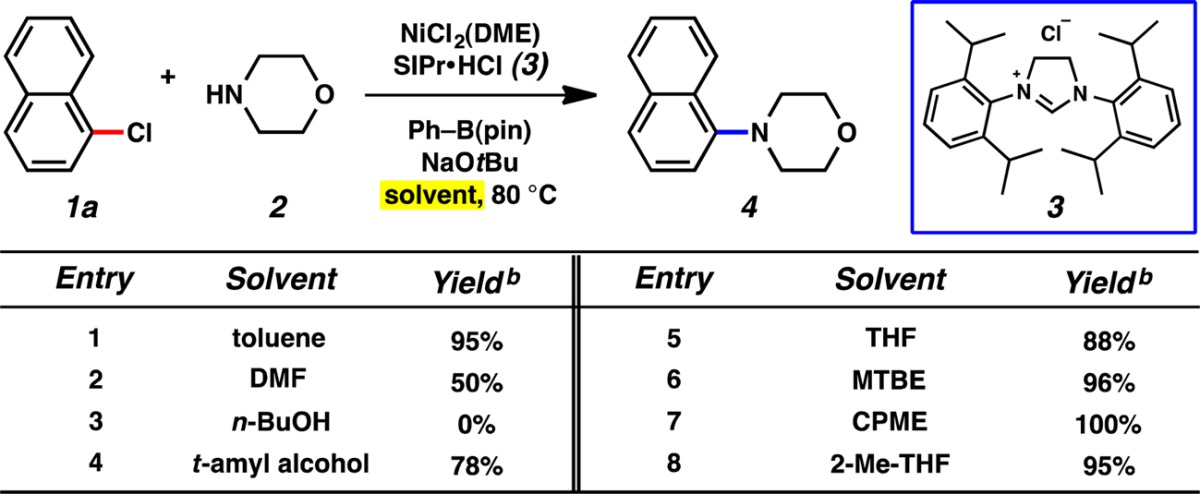
Reactions were carried out with NiCl2(DME) (5 mol %), SIPr·HCl (10 mol %), Ph-B(pin) (0.55 equiv), substrate (0.5 mmol, 1.00 equiv), morpholine (1.80 equiv), NaOtBu (1.85 equiv), hexamethylbenzene (0.10 equiv), and solvent (used as received, 2.5 mL), for 3 h.
Yields were determined using hexamethylbenzene as an internal standard.
Of the solvents surveyed, we elected to focus on the use of 2-Me-THF for our subsequent studies.14 2-Me-THF has gained attention as a promising solvent for industrial applications15 due to several salient features, including the following: (a) it is not easily oxidized; (b) it readily phase-separates from aqueous layers (in contrast to THF); (c) it is obtained from furfural, which in turn comes from renewable feedstock; (d) it has a higher boiling point compared to THF, which can be advantageous in some instances; and (e) it poses minimal health risks.
After establishing suitable reaction conditions for the amination of 1a with morpholine (2), we probed the use of other 1-naphthyl-based electrophilic coupling partners 1 in this methodology (Table 2). We were delighted to find that 1-bromonaphthalene could also be employed (entry 2). However, the corresponding iodide and triflate substrates gave only modest yields of 4 (entries 3 and 4). The use of a tosylate coupling partner, on the other hand, led to the desired product in 71% yield (entry 5). Finally, whereas the pivalate ester substrate failed (entry 6), we found that the corresponding carbamate and sulfamate substrates could be employed in the methodology (entries 7 and 8). Overall, the chloride and sulfamate substrates gave the best yields of product 4; thus, we elected to evaluate the scope of the methodology for these two types of electrophiles.16,17
Table 2. Evaluation of Various Electrophilesa.

Reactions were carried out with NiCl2(DME) (5 mol %), SIPr·HCl (10 mol %), Ph–B(pin) (0.55 equiv), substrate (0.5 mmol, 1.00 equiv), morpholine (1.80 equiv), NaOtBu (1.85 equiv), hexamethylbenzene (0.10 equiv), and solvent (used as received, 2.5 mL), for 3 h.
Yields were determined using hexamethylbenzene as an internal standard.
Figure 2 highlights the scope of the methodology with regard to the coupling of aryl sulfamate substrates using morpholine (2) as the amine partner and 2-Me-THF as the solvent. Simple aryl hydrocarbon substrates, such as naphthyl and phenyl sulfamates, were readily aminated as demonstrated by the high yielding formation of 4 and 5, respectively. Additionally, the generation of products 6–9 in good yields shows the methodology’s tolerance of electron-donating, electron-withdrawing, and ortho substituents. Given the prevalence of heterocycles in pharmaceuticals, where amination reactions are widely employed, we also tested several heterocyclic sulfamate substrates. Both 2- and 3-substituted pyridines were well tolerated, as demonstrated by the formation of products 10 and 11, respectively. Moreover, indole-, isoquinoline-, and dihydrobenzofuran-containing substrates were suitable coupling partners, as judged by the formation of 12–14 in synthetically useful yields.
Figure 2.
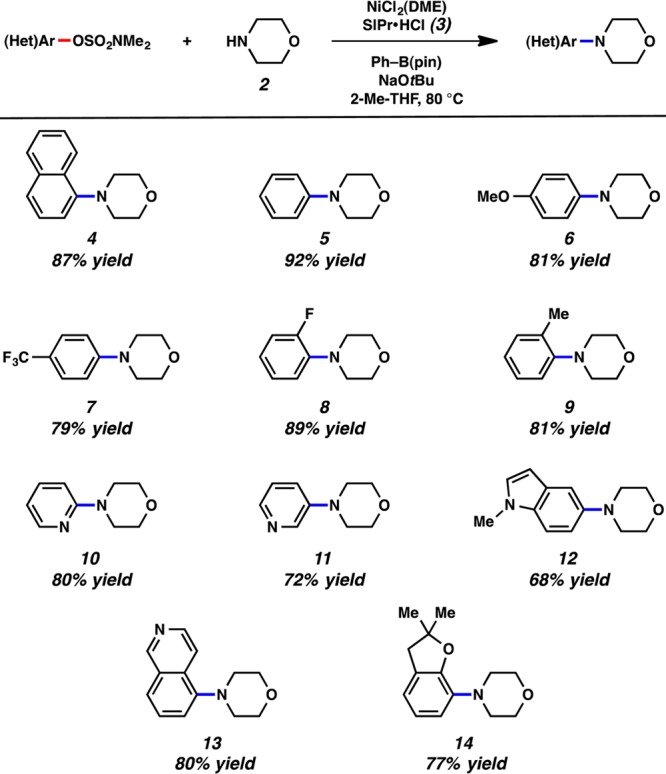
Coupling of (hetero)aryl sulfamates with morpholine in 2-Me-THF. Reactions were carried out with NiCl2(DME) (5–15 mol %), SIPr·HCl (10–30 mol %), Ph–B(pin) (0.30–0.45 equiv), substrate (0.5 mmol, 1.00 equiv), morpholine (1.80 equiv), NaOtBu (2.25–2.55 equiv), hexamethylbenzene (0.10 equiv), and solvent (used as received, 2.5 mL), for 3 h. Yields were determined using hexamethylbenzene as an internal standard.
Similarly, an array of aryl chlorides underwent the nickel-catalyzed amination reaction with morpholine (2) in 2-Me-THF (Figure 3). Nonheterocyclic substrates, including those containing electronically or sterically biasing substituents, coupled smoothly, as shown by the formation of adducts 4 and 6–9. Of note, commercially available heterocyclic aryl chlorides could also be employed, thus giving rise to products 10, 11, 15, and 16. The tolerance of the methodology to pyridines, quinolines, and benzothiophenes suggests the utility of our coupling conditions for applications in drug discovery.
Figure 3.
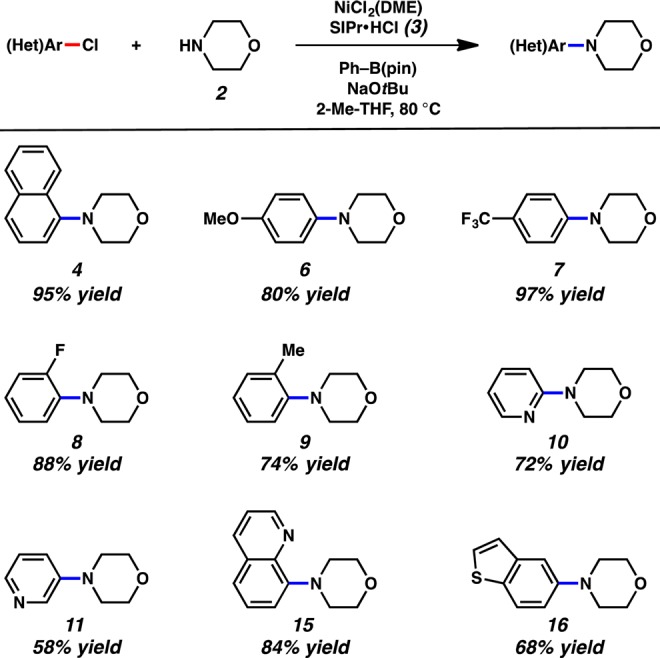
Coupling of (hetero)aryl chlorides with morpholine in 2-Me-THF. Reactions were carried out with NiCl2(DME) (5–15 mol %), SIPr·HCl (10–30 mol %), Ph–B(pin) (0.35–0.70 equiv), substrate (0.5 mmol, 1.00 equiv), morpholine (1.80 equiv), NaOtBu (2.25–2.70 equiv), hexamethylbenzene (0.10 equiv), and solvent (used as received, 2.5 mL), for 3 h. Yields were determined using hexamethylbenzene as an internal standard.
As shown in Figure 4, the scope of this amination methodology is not limited to the use of morpholine as the amine coupling partner. For example, pyrrolidine could be employed to give aminated product 17. As demonstrated by the formation of 18, the acyclic amine n-methylbutylamine was also tolerated in this methodology. Additionally, we found that 2,6-dimethylaniline, despite its steric hindrance, underwent the desired amination to give the unsymmetrical biaryl amine product 19. We were also delighted to find that a piperazine nucleophile bearing a pyridine ring coupled smoothly to give product 20 in 94% yield.
Figure 4.
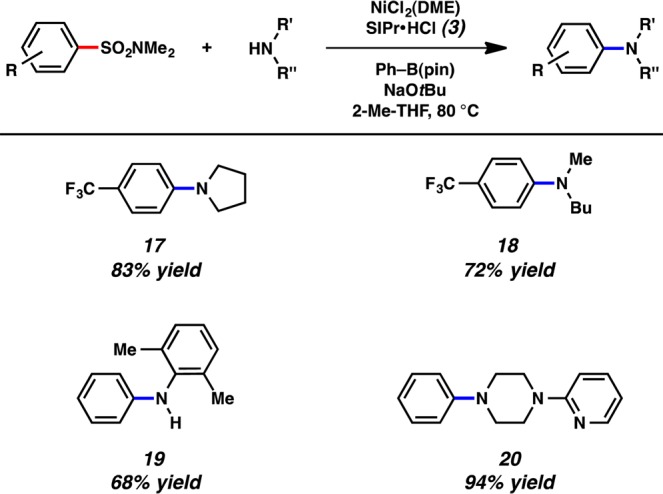
Scope of amine component in the coupling reaction. Reactions were carried out with NiCl2(DME) (5–15 mol %), SIPr·HCl (10–30 mol %), Ph–B(pin) (0.35–0.75 equiv), substrate (0.5 mmol, 1.00 equiv), morpholine (1.20–2.40 equiv), NaOtBu (2.10–3.45 equiv), hexamethylbenzene (0.10 equiv), and solvent (used as received, 2.5 mL), for 3 h. Yields were determined using hexamethylbenzene as an internal standard.
One general limitation pertaining to nickel-catalyzed cross-couplings is the frequent use of high catalyst loadings (i.e., often >10%).2d−2h Whereas progress has been made in rendering nickel-catalyzed Suzuki–Miyaura couplings more efficient,4,6i corresponding achievements in nickel-mediated amination reactions have been lacking. To address this challenge, we tested the coupling of trifluoromethyl-containing sulfamate and chloride substrates 21a and 21b, respectively, in the amination reaction with 2 using 2-Me-THF as the solvent (Figure 5). Using 3 and 1 mol % Ni, respectively, we found that gram-scale couplings could be achieved to give the arylated morpholine product 7 in excellent yields.
Figure 5.

Gram-scale couplings of trifluoromethyl-containing substrates.
As noted earlier, the amination of heterocyclic substrates in 2-Me-THF provides a promising tool for synthesizing pharmaceutical candidates. To further probe this notion, we tested the gram-scale couplings of heterocycle-containing substrates, as shown in Figure 6. Chloroquinoline 22 underwent facile coupling with morpholine (2) to generate aminated product 15 in 94% yield. This coupling was performed on gram-scale using 3 mol % Ni. Finally, we tested the gram-scale coupling of trifluoromethylated aryl chloride 21b with pyridyl piperazine derivative 23. This reaction provided adduct 24 in 88% yield; of note, 24 contains two heterocycles and a trifluoromethyl group, all of which are motifs commonly seen in pharmaceuticals.
Figure 6.
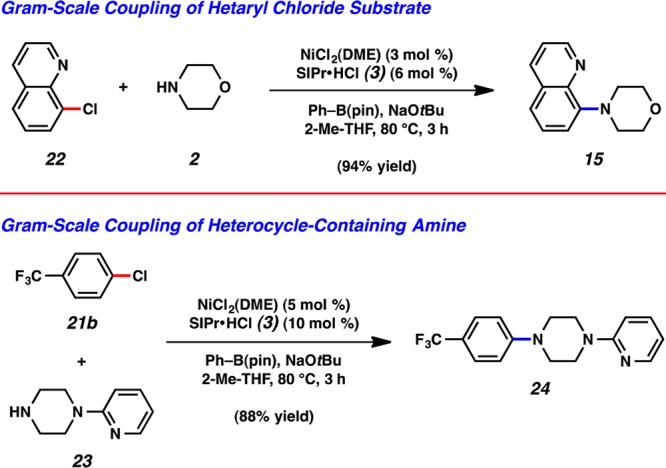
Gram-scale couplings of heterocyclic substrates.
In summary, we have developed the nickel-catalyzed coupling of a variety of electrophilic substrates (e.g., halides and pseudohalides) with amines using the attractive, green solvent 2-Me-THF. The couplings of aryl O-sulfamates and aryl chlorides proceed in the highest yields and may be achieved using an air-stable nickel precatalyst. The methodology has a broad scope and is tolerant of electronically biasing substituents, sterics, and even pharmaceutically relevant heterocycles. The scalability of the nickel-catalyzed amination in 2-Me-THF using low catalyst loading bodes well for future synthetic applications in drug discovery and other arenas.
Acknowledgments
We thank the ACS Green Chemistry Institute Pharmaceutical Roundtable for helpful discussions. The authors are grateful to Boehringer Ingelheim, DuPont, Eli Lilly, Amgen, AstraZeneca, Roche, Bristol-Myers Squibb, the Camille and Henry Dreyfus Foundation, the A. P. Sloan Foundation, the UCLA CSST program (support of X.J.), the ACS GCI, the S. T. Li Foundation, and the University of California, Los Angeles for financial support. N.F.F.N. acknowledges the NIH for a predoctoral fellowship (F31 GM101951-02) and L.H. thanks the Pauley Family for their generous support. These studies were supported by shared instrumentation grants from the NSF (CHE-1048804) and the National Center for Research Resources (S10RR025631).
Supporting Information Available
Experimental details and compound characterization data. This material is available free of charge via the Internet at http://pubs.acs.org.
The authors declare no competing financial interest.
Funding Statement
National Institutes of Health, United States
Supplementary Material
References
- a Hassan J.; Sévignon M.; Gozzi C.; Schulz E.; Lemaire M. Chem. Rev. 2002, 102, 1359–1470. [DOI] [PubMed] [Google Scholar]; b Muci A. R.; Buchwald S. L. In Topics in Current Chemistry; Miyaura N., Ed.; Springer Verlag: New York, 2002; Vol. 219, pp 131–209. [Google Scholar]; c Jiang L.; Buchwald S. L. In Metal-Catalyzed Cross-Coupling Reactions, 2nd ed.; Meijere A., Diederich F., Eds.; Wiley-VCH: Weinheim, 2004; pp 699–760. [Google Scholar]; d Corbet J. P.; Mignani G. Chem. Rev. 2006, 106, 2651–2710. [DOI] [PubMed] [Google Scholar]; e Negishi E. Bull. Chem. Soc. Jpn. 2007, 80, 233–257. [Google Scholar]; f Shen H. C. In Application of Transition Metal Catalysis in Drug Discovery and Development: An Industrial Perspective; Crawley M. L., Trost B. M., Eds.; John Wiley & Sons, Inc.: Hoboken, NJ, 2012; pp 25–96. [Google Scholar]
- a Bolm C.; Legros J.; Le Paih J.; Zani L. Chem. Rev. 2004, 104, 6217–6254. [DOI] [PubMed] [Google Scholar]; b Enthaler S.; Junge K.; Beller M. Angew. Chem., Int. Ed. 2008, 47, 3317–3321. [DOI] [PubMed] [Google Scholar]; c Bauer E. B. Curr. Org. Chem. 2008, 12, 1341–1369. [Google Scholar]; d Yu D.-G.; Li B.-J.; Shi Z.-J. Acc. Chem. Res. 2010, 43, 1486–1495. [DOI] [PubMed] [Google Scholar]; e Rosen B. M.; Quasdorf K. W.; Wilson D. A.; Zhang N.; Resmerita A.-M.; Garg N. K.; Percec V. Chem. Rev. 2011, 111, 1346–1416. [DOI] [PMC free article] [PubMed] [Google Scholar]; f Li B.-J.; Yu D.-G.; Sun C.-L.; Shi Z.-J. Chem.—Eur. J. 2011, 17, 1728–1759. [DOI] [PubMed] [Google Scholar]; g Mesganaw T.; Garg N. K. Org. Process Res. Dev. 2013, 17, 29–39. [Google Scholar]; h Tasker S. Z.; Standley E. A.; Jamison T. F. Nature 2014, 509, 299–309. [DOI] [PMC free article] [PubMed] [Google Scholar]
- a Anastas P. T.; Warner J. C.. Green Chemistry: Theory and Practice; Oxford University Press: New York, 1998. [Google Scholar]; b Anastas P. T.; Kirchhoff M. M. Acc. Chem. Res. 2002, 35, 686–694. [DOI] [PubMed] [Google Scholar]
- a Ramgren S. D.; Hie L.; Ye Y.; Garg N. K. Org. Lett. 2013, 15, 3950–3953. [DOI] [PMC free article] [PubMed] [Google Scholar]; b Hie L.; Chang J. J.; Garg N. K.. J. Chem. Educ. 2014, in press [DOI] [PMC free article] [PubMed]
- For reviews on Buchwald–Hartwig cross-couplings, see:; a Wolfe J. P.; Wagaw S.; Marcoux J.-F.; Buchwald S. L. Acc. Chem. Res. 1998, 31, 805–818. [Google Scholar]; b Hartwig J. F. Angew. Chem., Int. Ed. 1998, 37, 2046–2067. [DOI] [PubMed] [Google Scholar]; c Anderson K. W.; Tundel R. E.; Ikawa T.; Altman R. A.; Buchwald S. L. Angew. Chem., Int. Ed. 2006, 45, 6523–6527. [DOI] [PubMed] [Google Scholar]; d Kienle M.; Dubbaka S. R.; Brade K.; Knochel P. Eur. J. Org. Chem. 2007, 4166–4176. [Google Scholar]; e Surry D. S.; Buchwald S. L. Angew. Chem., Int. Ed. 2008, 47, 6338–6361. [DOI] [PMC free article] [PubMed] [Google Scholar]; f Hartwig J. F. Acc. Chem. Res. 2008, 41, 1534–1544see also ref (1b). [DOI] [PMC free article] [PubMed] [Google Scholar]
- For select recent examples of aryl C–C bond couplings using Ni catalysis, see:; a Guan B.-T.; Wang Y.; Li B.-J.; Yu D.; Shi Z.-J. J. Am. Chem. Soc. 2008, 130, 14468–14470. [DOI] [PubMed] [Google Scholar]; b Quasdorf K. W.; Tian X.; Garg N. K. J. Am. Chem. Soc. 2008, 130, 14422–14423. [DOI] [PubMed] [Google Scholar]; c Tobisu M.; Shimasaki T.; Chatani N. Angew. Chem., Int. Ed. 2008, 47, 4866–4869. [DOI] [PubMed] [Google Scholar]; d Quasdorf K. W.; Riener M.; Petrova K. V.; Garg N. K. J. Am. Chem. Soc. 2009, 131, 17748–17749. [DOI] [PMC free article] [PubMed] [Google Scholar]; e Antoft-Finch A.; Blackburn T.; Snieckus V. J. Am. Chem. Soc. 2009, 131, 17750–17752. [DOI] [PubMed] [Google Scholar]; f Xi L.; Li B.-J.; Wu Z.-H.; Lu X.-Y.; Guan B.-T.; Wang B.-Q.; Zhao K.-Q.; Shi Z.-J. Org. Lett. 2010, 12, 884–887. [DOI] [PubMed] [Google Scholar]; g Quasdorf K. W.; Antoft-Finch A.; Liu P.; Silberstein A. L.; Komaromi A.; Blackburn T.; Ramgren S. D.; Houk K. N.; Snieckus V.; Garg N. K. J. Am. Chem. Soc. 2011, 133, 6352–6363. [DOI] [PMC free article] [PubMed] [Google Scholar]; h Zhang N.; Hoffman D. J.; Gutsche N.; Gupta J.; Percec V. J. Org. Chem. 2012, 77, 5956–5964. [DOI] [PubMed] [Google Scholar]; i Ge S.; Hartwig J. F. Angew. Chem., Int. Ed. 2012, 51, 12837–12841see also ref (4). [DOI] [PMC free article] [PubMed] [Google Scholar]
- For select recent examples of aryl C–N bond couplings using Ni catalysis, see:; a Ogata T.; Hartwig J. F. J. Am. Chem. Soc. 2008, 130, 13848–13849. [DOI] [PMC free article] [PubMed] [Google Scholar]; b Gao C.-Y.; Yang L.-M. J. Org. Chem. 2008, 73, 1624–1627. [DOI] [PubMed] [Google Scholar]; c Fors B. P.; Watson D. A.; Biscoe M. R.; Buchwald S. L. J. Am. Chem. Soc. 2008, 130, 13552–13554. [DOI] [PMC free article] [PubMed] [Google Scholar]; d Tobisu M.; Shimasaki T.; Chatani N. Chem. Lett. 2009, 38, 710–711. [Google Scholar]; e Shimasaki T.; Tobisu M.; Chatani N. Angew. Chem., Int. Ed. 2010, 49, 2929–2932. [DOI] [PubMed] [Google Scholar]; f Mesganaw T.; Silberstein A. L.; Ramgren S. D.; Fine Nathel N. F.; Hong X.; Liu P.; Garg N. K. Chem. Sci. 2011, 2, 1766–1771. [DOI] [PMC free article] [PubMed] [Google Scholar]; g Ramgren S. D.; Silberstein A. L.; Yang Y.; Garg N. K. Angew. Chem., Int. Ed. 2011, 50, 2171–2173. [DOI] [PMC free article] [PubMed] [Google Scholar]; h Ackermann L.; Sandmann R.; Song W. Org. Lett. 2011, 13, 1784–1786. [DOI] [PubMed] [Google Scholar]; i Huang J.-H.; Yang L.-M. Org. Lett. 2011, 13, 3750–3753. [DOI] [PubMed] [Google Scholar]; j Hie L.; Ramgren S. D.; Mesganaw T.; Garg N. K. Org. Lett. 2012, 14, 4182–4185. [DOI] [PMC free article] [PubMed] [Google Scholar]
- For select seminal studies on aryl C–C and C–N bond coupling using Ni catalysis, see:; a Sengupta S.; Leite M.; Raslan D. S.; Quesnelle C.; Snieckus V. J. Org. Chem. 1992, 57, 4066–4068. [Google Scholar]; b Wolfe J. P.; Buchwald S. L. J. Am. Chem. Soc. 1997, 119, 6054–6058. [Google Scholar]; c Hamann B. C.; Hartwig J. F. J. Am. Chem. Soc. 1998, 120, 7369–7370. [Google Scholar]; d Brenner E.; Fort Y. Tetrahedron Lett. 1998, 39, 5359–5362. [Google Scholar]; e Wehn P. M.; Du Bois J. Org. Lett. 2005, 7, 4685–4688. [DOI] [PubMed] [Google Scholar]
- The addition of Ph–B(pin) is believed to be instrumental in reducing the Ni(II) precatalyst to an active Ni(0) species.
- For nickel-catalyzed amination methodologies that use Ni(II) precatalysts with Zn or hydrides as reducing agents, see:; a Fan X.-H.; Li G.; Yang L.-M. J. Organomet. Chem. 2011, 696, 2482–2484. [Google Scholar]; b Gao C.-Y.; Cao X.; Yang L.-M. Org. Biomol. Chem. 2009, 7, 3922–3925. [DOI] [PubMed] [Google Scholar]; c Manolikakes G.; Gavryushin A.; Knochel P. J. Org. Chem. 2008, 73, 1429–1434. [DOI] [PubMed] [Google Scholar]; d Omar-Amrani R.; Thomas A.; Brenner E.; Schneider R.; Fort Y. Org. Lett. 2003, 5, 2311–2314. [DOI] [PubMed] [Google Scholar]; e Desmarets C.; Schneider R.; Fort Y. J. Org. Chem. 2002, 67, 3029–3036. [DOI] [PubMed] [Google Scholar]; f Gradel B.; Brenner E.; Schneider R.; Fort Y. Tetrahedron Lett. 2001, 42, 5689–5692. [Google Scholar]
- Solvents were selected from the ACS Green Chemistry Institute Roundtable Solvent Selection Guide. http://www.acs.org/content/dam/acsorg/greenchemistry/industriainnovation/roundtable/acs-gci-pr-solvent-selection-guide.pdf.
- For solvent selection guides in medicinal chemistry, see:; a Alfonsi K.; Colberg J.; Dunn P. J.; Fevig T.; Jennings S.; Johnson T. A.; Kleine H. P.; Knight C.; Nagy M. A.; Perry D. A.; Stefaniak M. Green Chem. 2008, 10, 31–36. [Google Scholar]; b Henderson R. K.; Jiménez-González C.; Constable D. J. C.; Alston S. R.; Inglis G. G. A.; Fisher G.; Sherwood J.; Binks S. P.; Curzons A. D. Green Chem. 2011, 13, 854–862. [Google Scholar]
- For a discussion on CPME, see:; a Watanabe K.; Yamagiwa N.; Torisawa Y. Org. Process Res. Dev. 2007, 11, 251–258. [Google Scholar]; b Antonucci V.; Coleman J.; Ferry J. B.; Johnson N.; Mathe M.; Scott J. P.; Xu J. Org. Process Res. Dev. 2011, 15, 939–941. [Google Scholar]
- tert-Amyl alcohol was also considered an especially promising solvent for the amination reaction; however, it was found to be less generally useful compared to 2-Me-THF in attempts to couple various other substrates.
- For discussion on 2-Me-THF, see:; a Aycock D. F. Org. Process Res. Dev. 2007, 11, 156–159. [Google Scholar]; b Pace V.; Hoyos P.; Castoldi L.; Domínguez de María P.; Alcántara A. R. ChemSusChem 2012, 5, 1369–1379see also ref (13b). [DOI] [PubMed] [Google Scholar]
- Aryl chlorides are attractive substrates as they are often available commercially or are easily synthesized. Additionally, aryl chlorides are often robust enough to be carried through multiple synthetic operations.
- Aryl sulfamates bear many notable features. They are easily synthesized from their corresponding phenols, which are often commercially available, and are generally stable to acidic and basic reaction conditions. Moreover, aryl sulfamates may be used to direct arene functionalization through electrophilic aromatic substitution or ortho-lithiation processes. For a discussion of these features, see:; a Snieckus V. Chem. Rev. 1990, 90, 879–933. [Google Scholar]; b Hartung C. G.; Snieckus V. In Modern Arene Chemistry; Astruc D., Ed.; Wiley-VCH: New York, 2002; pp 330–367. [Google Scholar]; c Macklin T. K.; Snieckus V. Org. Lett. 2005, 7, 2519–2522. [DOI] [PubMed] [Google Scholar]; d Snieckus V.; Macklin T. In Handbook of C-H Transformations; Dyker G., Ed.; Wiley-VCH: New York, 2005; Vol. 1, pp 106–118; see also ref (6d). [Google Scholar]
Associated Data
This section collects any data citations, data availability statements, or supplementary materials included in this article.