



Background
The extralevator type of abdominoperineal resection of the rectum (ELAPR) has become the gold standard for low rectal cancer when the anal sphincter cannot be preserved or preservation is inappropriate. Reconstruction of the perineal defect following ELAPR can be difficult, often requiring complex procedures. We report a simple method of reconstructing the perineal defect in a female patient with a uterus.
Technique
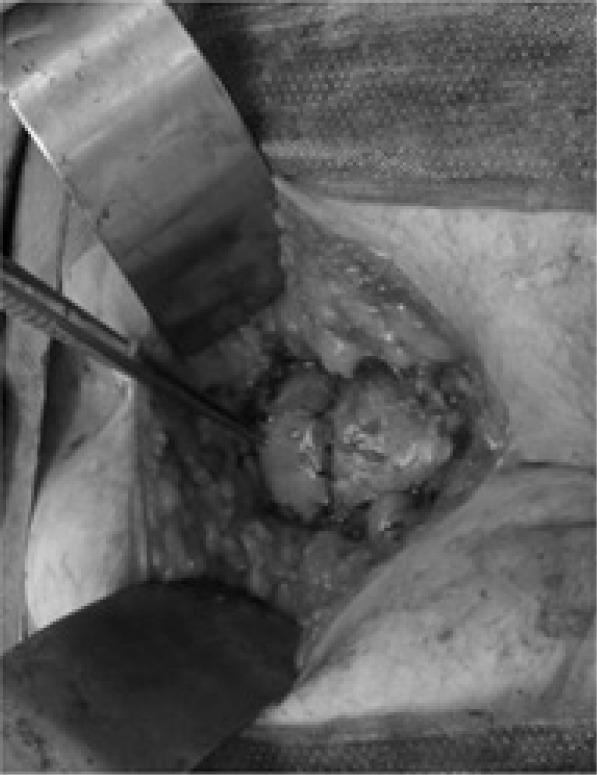
We first perform the abdominal part of the operation in the Lloyd-Davies position. The patient is then placed in a prone jack-knife position and an ELAPR is carried out. The uterus is retroverted and stitched to the perineal defect at the perimeter using interrupted polydioxanone sutures (Fig 1). A subcutaneous suction drain is inserted. The subcutaneous tissues layer and skin are approximated with absorbable sutures and interrupted nylon sutures respectively.
Figure 1. A retroverted uterus (on the left with an instrument pointing to it and the vagina on its right) is used to fill the gap in the perineum.
Discussion
This method is useful in women who have completed their family and still have a mobile retrovertible uterus. We have used it successfully in more than ten consecutive patients. We do not claim that this technique is original but it is useful, can be learnt easily, saves operating time and does not require an expensive prosthesis. The uterus is a highly vascularised organ, resistant to infection, and the chances of wound dehiscence are rare. This technique is a valuable alternative to complex procedures in dealing with a perineal defect following an abdominoperineal resection of rectum in women.