


Abstract
Ophthalmic involvement appears rarely in multiple myeloma (MM). Ophthalmic findings are mostly noted as complications caused by disease or treatment. MM-associated with 6th nerve paralysis is a rare entity. Bortezomib, one of the novel agents used to treat MM, has neurotoxic effect and may cause permanent nerve damage. Herein, we report a 50-year-old male patient with MM who developed the 6th nerve paralysis while receiving bortezomib and discuss its relevant causes.
Keywords: Multiple myeloma, The 6th nerve paralysis, Bortezomib
Introduction
Multiple myeloma (MM) is a malignant disease characterized by monoclonal protein in serum and/or urine due to plasma cells, lytic lesions in bone, renal failure, anemia, susceptibility to infections and hypercalcemia [1, 2]. MM is likely to manifest itself along with a wide variety of symptoms in many organs due to the physiopathology of the disease. Ophthalmic findings are rarely encountered [3]. In the literature, ophthalmic findings associated with compression by plasmacytoma and/or orbital infiltration have been reported. The 6th nerve involvement is a very rare condition [4].
Case Report
The 50-year-old male patient was diagnosed with stage IIIB Durie-Salmon, ISS stage 3, IgG kappa MM following the investigations due to the diffuse body pain and asthenia (Table 1). The neurological examination showed that the cranial nerves were normal and that the extra-ocular muscles as well as strength, sensory and extra pyramidal systems were intact, and that deep tendon reflexes were normal, and that pathologic reflexes were absent. The patient was administered chemotherapy with VAD (vincristine, adriamycin and dexamethasone) protocol, who was considered being a candidate for autologous cell transplantation due to his appropriate age and to performance. Because no response was elicited after two cycles of the chemotherapy, initiation of bortezomib–dexamethasone was decided (BD). After 3 cycles of BD, hematological remission was achieved. (Table 1) Upon initiating the fourth cycles of the treatment, complaint of diplopia developed, with no complaint about headache. On neurological examination there was left abducens palsy, and the pupils and the eye fundus were normal and the patient was conscious, cooperative, as well as oriented and the sense of touch was decreased on both feet, while being normal on the ankles. Pinprick, temperature and vibratory sensation were intact. Ophthalmology and neurology consultations unfolded the 6th nerve paralysis (Fig. 1). Nerve conduction study (NCS) and electromyogram (EMG) were normal.
Table 1.
Laboratory findings
| Pre-treatment | After 3 courses of BD | |
|---|---|---|
| WBC (/mm3) | 8300 | 5430 |
| Hemoglobin (g/dl) | 8.2 | 13.1 |
| Hematocrit (%) | 23.7 | 39 |
| Platelets (103/mm3) | 138 | 184 |
| Urea (mg/dl) | 52 | 28 |
| Creatinine (mg/dl) | 1.8 | 0.7 |
| T. Protein (g/dl) | 9.9 | 6.3 |
| Albumin (g/dl) | 3.5 | 4.1 |
| LDH (IU/l) (N:120-246) | 328 | 272 |
| B2 M (mg/dl) | 25.5 | 2.6 |
| Ca (mg/dl) | 14 | 9.6 |
| ESR (mm/h) | 125 | 19 |
| Ig G (mg/dl) | 6420 | 826 |
| IgA (mg/dl) | 69.6 | 38.7 |
| IgM (mg/dl) | 55.4 | 39.1 |
WBC White blood cell, LDH lactate dehydrogenase, B2M beta 2 microglobuline, Ca calcium, ESR erythrocyte sedimentation rate, Ig G, Ig A, Ig M immunglobuline G, A, M
Fig. 1.

6 nerve paralysis
The 6th nerve paralysis and in particular paresthetic complaints in the lower extremities were primarily ascribed to bortezomib neurotoxicity in the patient who was in medullar remission as noted in hematological parameters and thus the bortezomib treatment was discontinued. On the other hand, the cranial MRI taken in order not to miss a possible extramedullary involvement, revealed contrasted pathological signal changes in the calvarium due to MM with diameter of about 4.5 cm in the clivus (Fig. 2a, b, c). However, no optical nerve and chiasma infiltration nor pressure was found (Fig. 2a, b, c). Although bortezomib treatment was stopped, diplopia progressed and a malign infiltration was assumed despite there being no radiological findings being able to affect the 6th nerve. Therefore, radiotherapy (RT) was administered. On the 4th day of RT, the complaints of diplopia improved.
Fig. 2.
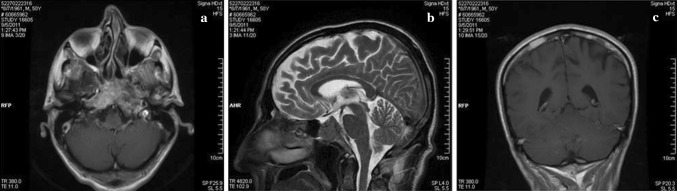
a, b and c Axial, sagittal and coronal MR images showing the lesions, the largest being 4.5 cm in diameter in clivus
Following the completion of RT, the treatment of oral lenalidomid was decided to continue for systemic control of myeloma. The patient, whose ophthalmic findings were completely remitted, was in remission under lenalidomide treatment and he was prepared for stem cell transplantation (Fig. 3).
Fig. 3.

Resolved 6 nerve paralysis
Discussion
MM may present along with a wide variety of findings; however, orbital involvement is uncommon. Jung Hwa Na et al. reported a case of MM that presented with the 6th nerve involvement [5]. In contrast to this case, the 6th nerve involvement in our patient developed when the disease was in remission and the patient was on treatment. Prior to BD treatment the neurological examination of the patient was completely normal. The electromyographic examination done after the occurrence of the 6th cranial nerve palsy showed no evidence of myopathy. Thus, dexamethasone induced myopathy was excluded. The patient had no headache, which would be suggestive of increased intracranial pressure. Furthermore, the consciousness of the patient was not affected; there were no findings of papilloedema on fundoscopy. The gadolinium enhanced MRI divulged neither intracranial lesion nor any signs suggestive of increased intracranial pressure. Consequently, it was deemed that the 6th nerve paralysis might be linked to bortezomib, a neurotoxic agent.
Bortezomib, a proteasome inhibitor, is known to stimulate apoptosis in the myeloma cells, to suppress angiogenesis, to reduce drug resistance and to affect microenvironment [6, 7]. The most important adverse effects of bortezomib are peripheral neuropathy and thrombocytopenia, both being dose-limiting. More rarely, it may lead to gastrointestinal discomfort, hypercalcemia, fever, and muscle cramps. While most of these side effects resolve completely when the drug is stopped, neuropathy may persist [8].
To the best of our knowledge, only one case was reported in which 6th nerve paralysis occurred in MM with the use of bortezomib [9]. In the case reported by Toema et al. the 6th nerve paralysis was observed during the first week of bortezomib treatment when myeloma was active and this was attributed to MM involvement.
In our case, the 6th nerve paralysis developed on BD treatment and while the disease was under systemic control. Since there were no radiological findings demonstrating a myeloma involvement leading to 6th nerve paralysis, bortezomib was stopped considering that it might have a possible neurotoxic effect. However, since neither resolution nor progression was observed after stopping the drug, radiotherapy was initiated. The diplopia resolved soon after the initiation of radiotherapy.
In conclusion, the occurrence of 6th could not definitely be associated with bortezomib. It was rather a diagnosis of exclusion. This case is reported aiming, both, to point out to the potential side effects of the new generation drugs with proven efficacy and to report a rare clinical finding observed in MM.
Contributor Information
Guven Cetin, Phone: +90(532) 551 47 98, Email: drgvn@mynet.com.
M. Cem Ar, Email: mcemar68@yahoo.com
Abdullah Cerit, Email: acerit85@gmail.com.
Kubra Gozubenli, Email: kbrgzbnli@yahoo.com.
Simge Erdem, Email: simge_85@hotmail.com.
Gulistan Halac, Email: halacdr@yahoo.com.
References
- 1.Dispenzieri A, Lacy MQ, Greipp PR. Multiple Myeloma. In: Greer JP, Foerster J, Rodgers GM, Paraskevas F, Glader B, Daniel AA, Means RT, editors. Wintrobe’s Clinical Hematology. Philadelphia: Lippincott Williams & Wilkins; 2009. pp. 2372–2420. [Google Scholar]
- 2.Hoffbrand AV, Catovsky D, Tuddenham EGD, Green AR. Multiple Myeloma. In: San-Miguel J, Blade J, editors. Postgraduate Haematology. 6. London: Wiley-Blackwell; 2011. pp. 577–598. [Google Scholar]
- 3.Fung S, Selva D, Leibovitch I, et al. Ophthalmic manifestations of multiple myeloma. Ophthalmologica. 2005;219:43–48. doi: 10.1159/000081782. [DOI] [PubMed] [Google Scholar]
- 4.Movsas TZ, Balcer LJ, Eggenberger ER, et al. Sixth nerve palsy as a presenting sign of intracranial plasmacytoma and multiplemyeloma. J Neuroophthalmol. 2000;20:242–245. doi: 10.1097/00041327-200020040-00006. [DOI] [PubMed] [Google Scholar]
- 5.Na JH, Park SH, Shin SY. Multiple myeloma manifesting as a fluctuating sixth nerve palsy. Korean J Ophthalmol. 2009;23:232–233. doi: 10.3341/kjo.2009.23.3.232. [DOI] [PMC free article] [PubMed] [Google Scholar]
- 6.Hideshima T, Richardson P, Chauhan D, et al. The proteasome inhibitor PS-341 inhibits growth, induces apoptosis, and overcomes drug resistance in human multiple myeloma cells. Cancer Res. 2001;61:3071–3076. [PubMed] [Google Scholar]
- 7.Hideshima T, Mitsiades C, Akiyama M, et al. Molecular mechanisms mediating antimyeloma activity of proteasome inhibitor PS-341. Blood. 2003;101:1530–1534. doi: 10.1182/blood-2002-08-2543. [DOI] [PubMed] [Google Scholar]
- 8.Andreas A, Argyriou AA, Iconomou G, Kalofonos HP. Bortezomib-induced peripheral neuropathy in multiple myeloma: a comprehensive review of the literature. Blood. 2008;112:1593–1599. doi: 10.1182/blood-2008-04-149385. [DOI] [PubMed] [Google Scholar]
- 9.Toema B, El-Sweilmeen H, Helmy T. Oculomotor nerve palsy associated with bortezomib in a patient with multiple myeloma: a case report. J Med Case Rep. 2010;4:342. doi: 10.1186/1752-1947-4-342. [DOI] [PMC free article] [PubMed] [Google Scholar]