



Abstract
Motivation: Recent breakthroughs in protein residue–residue contact prediction have made reliable de novo prediction of protein structures possible. The key was to apply statistical methods that can distinguish direct couplings between pairs of columns in a multiple sequence alignment from merely correlated pairs, i.e. to separate direct from indirect effects. Two classes of such methods exist, either relying on regularized inversion of the covariance matrix or on pseudo-likelihood maximization (PLM). Although PLM-based methods offer clearly higher precision, available tools are not sufficiently optimized and are written in interpreted languages that introduce additional overheads. This impedes the runtime and large-scale contact prediction for larger protein families, multi-domain proteins and protein–protein interactions.
Results: Here we introduce CCMpred, our performance-optimized PLM implementation in C and CUDA C. Using graphics cards in the price range of current six-core processors, CCMpred can predict contacts for typical alignments 35–113 times faster and with the same precision as the most accurate published methods. For users without a CUDA-capable graphics card, CCMpred can also run in a CPU mode that is still 4–14 times faster. Thanks to our speed-ups (http://dictionary.cambridge.org/dictionary/british/speed-up) contacts for typical protein families can be predicted in 15–60 s on a consumer-grade GPU and 1–6 min on a six-core CPU.
Availability and implementation: CCMpred is free and open-source software under the GNU Affero General Public License v3 (or later) available at https://bitbucket.org/soedinglab/ccmpred
Contact: johannes.soeding@mpibpc.mpg.de
Supplementary information: Supplementary data are available at Bioinformatics online.
1 INTRODUCTION
Evolutionary pressure to maintain a stable protein structure gives rise to correlated mutations between contacting residue pairs. These correlated mutations can be observed in a multiple sequence alignment (MSA) of the protein family and can be used to predict residue–residue contacts. A recent breakthrough was achieved by applying methods from statistics and statistical physics that aim at disentangling direct couplings from mere correlations between MSA columns (Ekeberg et al., 2013; Kamisetty et al., 2013; Marks et al., 2011; Weigt et al., 2009). This has resulted in a boost in contact prediction accuracy, thanks to which it is now possible to reliably predict protein structures using only sequence information if enough homologous sequences are available (Hopf et al., 2012; Marks et al., 2011; Nugent and Jones, 2012). Currently, 30% of Pfam families meet a reasonable criterion of having three homologous sequences per residue in the chain (see Supplementary Section 7 for details).
Modern contact prediction methods differ by their strategy in the disentangling step: the most accurate class of methods (Ekeberg et al., 2013; Kamisetty et al., 2013) such as plmDCA (Ekeberg et al., 2013) and GREMLIN (Kamisetty et al., 2013) learn the direct couplings as parameters of a Markov random field by maximizing its pseudo-likelihood, which has runtime complexity of O(NL2) where N is the number of homologous sequences in the MSA and L its number of columns. The less accurate methods based on sparse covariance matrix inversion such as PSICOV (Jones et al., 2012) or Mean Field Direct Coupling Analysis use the sequence information only in a preprocessing step, while the main computation in O(L3) is independent of N. This makes them fast for short alignments (small L) but slow for large alignments. Whereas most protein families used for benchmarking so far have been relatively short, in practice, longer alignments are more relevant, for example, to predict interdomain or even interprotein contacts (Ovchinnikov et al., 2014). Still, existing methods would take ∼29 CPU years to complete large-scale studies such as the computation of contact predictions for the 30% of Pfam with sufficient sequence coverage (see Supplementary Section 7).
2 RESULTS
CCMpred implements the approach taken in plmDCA and GREMLIN, which is based on maximizing the pseudo-likelihood of an L2-regularized Markov random field (see Supplementary Information for details). After successful optimization, the couplings are ranked by the Frobenius norms of the pairwise potentials and the average product correction (Dunn et al., 2008) is applied to compute the final score.
As explained in the Supplementary Information, the task of computing the gradient of the pseudo-likelihood represents an almost ideal use-case for GPUs, as the computations can be run efficiently in parallel on the thousands of GPU processors with little idling due to memory access limitations.
We compare the runtimes and precisions of CCMpred with two other pseudo-likelihood maximization (PLM)-based tools, plmDCA (plmDCA-symmetric 3, plmDCA-asymmetric 1) and GREMLIN (version 2.01), and with the covariance matrix inversion-based tool PSICOV. The recently published FreeContact (Kaján et al., 2014) software is much faster than PSICOV but clearly less accurate than plmDCA and GREMLIN and was not included here.
2.1 Precision
For benchmarking the precision of contact prediction methods, we use the same set of 150 Pfam families with sequences and high-resolution structures (1.9 Å) with identical input alignments as used in the PSICOV (Jones et al., 2012) method. We rank the list of predicted contacts and determine the fraction of physical contacts (Cβ distance Å) when selecting increasing numbers of contacts. Figure 1 shows that CCMpred is among the top tools.
Fig. 1.
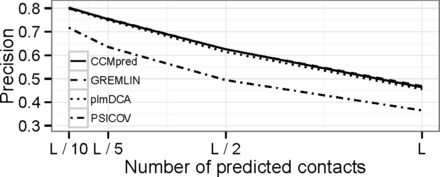
Precision of contact prediction for increasing numbers of predicted pairs, normalized by length L of the target
2.2 Runtimes
For runtime benchmarks, we generated synthetic MSAs with 3000 sequences and 50, 100, … , 1000 columns (real alignments show similar speedups but exhibit more variance in their runtimes—see Supplementary Fig. S4 for details). Because GPUs and CPUs differ in their numbers of cores, frequency per core, etc., we attempt to make a fair comparison by comparing runtimes for hardware of similar price. We ran the GPU version of CCMpred on an NVIDIA GeForce GTX 780 Ti, all CPU-based methods on an Intel Xeon E5–2620 six-core processor. Alignments with L > 500 were run on a Tesla K40 GPU with 12 GB RAM (gray points).
Figure 2 shows the runtime of the methods for increasing alignment length. PSICOV is the fastest CPU method for small L, as its runtime is independent of sequence count. However, for , CCMpred becomes faster than PSICOV for alignments with typical numbers of sequences (). At typical alignment lengths of L = 300, the CCMpred GPU code is 35 times faster than plmDCA, 113 times faster than GREMLIN and 16 times faster than PSICOV. On the same data, our CPU version is 4.3 times faster than plmDCA, 14 times faster than GREMLIN, 8.3 times slower than our GPU code and 2.0 times faster than PSICOV. For plmDCA and our CPU version, we use all six cores. PSICOV and GREMLIN do not support multi-threading and, therefore, ran on a single core. However, even if implementations with perfect scaling existed (dividing runtimes by six), GREMLIN would still not be as fast as the CPU version of CCMpred. Our GPU code would be faster than a parallelized PSICOV at L > 150, and our CPU code would be faster at L > 600.
Fig. 2.
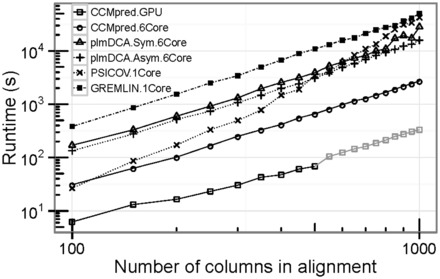
Total runtimes on MSAs with 3000 sequences.
3 CONCLUSION
CCMpred is a fast GPU and CPU implementation of a top-performing PLM-based contact prediction approach that runs in a fraction of the time of comparably accurate methods. The speed increase is particularly important for long proteins and large-scale applications. Because CCMpred is free and open-source software, we hope that it also can serve as a basis for further methods development in this field.
Supplementary Material
ACKNOWLEDGEMENTS
The authors would like to thank Markus Meier for the distribution over SCOP domain lengths and Jessica Andreani, Susann Vorberg, Markus and Armin Meier for helpful comments and discussions.
Funding: This work was funded by the Deutsche Forschungsgemeinschaft (Grants GRK1721 and SFB646) and the Bavarian Center for Molecular Biosystems (BioSysNet). We thank NVIDIA Corporation for donating a Tesla K40 GPU used in this work.
Conflict of interest: none declared.
REFERENCES
- Dunn SD, et al. Mutual information without the influence of phylogeny or entropy dramatically improves residue contact prediction. Bioinformatics. 2008;24:333–340. doi: 10.1093/bioinformatics/btm604. [DOI] [PubMed] [Google Scholar]
- Ekeberg M, et al. Improved contact prediction in proteins: using pseudolikelihoods to infer potts models. Phys. Rev. E. 2013;87:012707. doi: 10.1103/PhysRevE.87.012707. [DOI] [PubMed] [Google Scholar]
- Hopf TA, et al. Three-dimensional structures of membrane proteins from genomic sequencing. Cell. 2012;149:1607–1621. doi: 10.1016/j.cell.2012.04.012. [DOI] [PMC free article] [PubMed] [Google Scholar]
- Jones DT, et al. PSICOV: precise structural contact prediction using sparse inverse covariance estimation on large multiple sequence alignments. Bioinformatics. 2012;28:184–190. doi: 10.1093/bioinformatics/btr638. [DOI] [PubMed] [Google Scholar]
- Kaján L, et al. FreeContact: fast and free software for protein contact prediction from residue co-evolution. BMC Bioinformatics. 2014;15:85. doi: 10.1186/1471-2105-15-85. [DOI] [PMC free article] [PubMed] [Google Scholar]
- Kamisetty H, et al. Assessing the utility of coevolution-based residue-residue contact predictions in a sequence- and structure-rich era. Proc. Natl Acad. Sci. USA. 2013;110:15674–15679. doi: 10.1073/pnas.1314045110. [DOI] [PMC free article] [PubMed] [Google Scholar]
- Marks DS, et al. Protein 3D structure computed from evolutionary sequence variation. PloS One. 2011;6:e28766. doi: 10.1371/journal.pone.0028766. [DOI] [PMC free article] [PubMed] [Google Scholar]
- Nugent T, Jones DT. Accurate de novo structure prediction of largetransmembrane protein domains using fragment-assembly and correlatedmutation analysis. Proc. Natl Acad. Sci. USA. 2012;109:E1540–E1547. doi: 10.1073/pnas.1120036109. [DOI] [PMC free article] [PubMed] [Google Scholar]
- Ovchinnikov S, et al. Robust and accurate prediction of residue-residue interactions across protein interfaces using evolutionary information. eLife. 2014;3:e02030. doi: 10.7554/eLife.02030. [DOI] [PMC free article] [PubMed] [Google Scholar]
- Weigt M, et al. Identification of direct residue contacts in protein-proteininteraction by message passing. Proc. Natl Acad. Sci. USA. 2009;106:67–72. doi: 10.1073/pnas.0805923106. [DOI] [PMC free article] [PubMed] [Google Scholar]
Associated Data
This section collects any data citations, data availability statements, or supplementary materials included in this article.