



Abstract
Simulation is becoming increasingly integral to surgical training with progressive restrictions on working hours. This paper describes a unique, cable free, laparoscopic trainer that can be constructed using items readily available to the average surgical trainee. The trainer described is not a substitute for surgical practice but, nonetheless, a useful tool in developing skills such as hand-eye co-ordination, triangulation and depth queuing.
Keywords: Cable free, home built, laparoscopic trainer, simple, surgical training
Simulation has become an integral part of surgical training as it provides a safe method of acquiring core, transferable skills at a time where restrictions in working hours may limit exposure. Laparoscopic trainers are an example of a successful adjunct in developing skills such as hand-eye co-ordination, triangulation and depth queuing. Commercial laparoscopic trainers are expensive, making them unattainable to most trainees. Inexpensive, home-made laparoscopic trainers have previously been described[1,2] but these require the purchase of a webcam and the use of cables. Here, we describe a unique, cable free, laparoscopic trainer that can be constructed using items readily available to the average surgical trainee at no additional cost.
Four items are required: A smart phone, a tablet computer, a torch and a box. We used an iPhone 5, an iPad mini, a Petzl headlamp and a cardboard box. Step 1: Modify the box to create a bevelled surface to hold the smart phone [Figure 1]. Cut a hole for the smart phone camera. Place the torch inside the box. Step 2: Download/install an application to the phone and tablet allowing the phone camera to act as a remote camera (we used WiFi Camera). Step 3: Obtain laparoscopic tools (out-of-date equipment are often available) and the trainer is ready [Figure 2]. Many variations of the above can be constructed depending on type of smart phone, tablet computer and software available to the surgical trainee. Additionally, a conventional laptop or desktop can be used provided WiFi capability.
Figure 1.
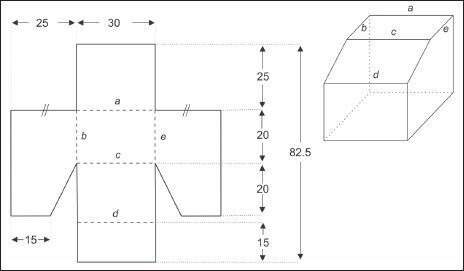
Drawing showing box template, dimensions (in centimetres) and fold lines (a-e) 40 prior to and after assembly
Figure 2.
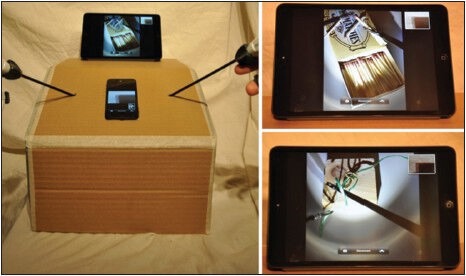
Illustration showing the completed box trainer in use (stacking dice) with additional images of the screen from the perspective of the operating surgeon performing a matchstick exercise and a knot tying exercise
The trainer described is simple, can be constructed in 15 minutes, with equipment often readily available. This is not a substitute for surgical practice but, nonetheless, a useful tool in developing laparoscopic skills.
Footnotes
Source of Support: Nil
Conflict of Interest: None declared.
REFERENCES
- 1.Raptis DA, Mouzaki K, Gore DM. DIY laparoscopic kit. Ann R Coll Surg Engl. 2008;90:167–8. [Google Scholar]
- 2.Dennis R. A simple and cheap home built laparoscopic trainer. J Min Access Surg. 2008;3:88. doi: 10.4103/0972-9941.43095. [DOI] [PMC free article] [PubMed] [Google Scholar]
