



Abstract
The current study seeks to evaluate relationships between drinking motives and alcohol-related ambivalence in the prediction of problem drinking. We expected that: 1) main effects would emerge such that alcohol-related ambivalence would be positively associated with peak drinking and problems; drinking motives would be positively associated with drinking and problems, and 2) interactions would emerge between motives and ambivalence in predicting problematic drinking such that drinking motives would be positively associated with peak drinking and problems, especially among those high in ambivalence over drinking. Six hundred sixty-nine undergraduate students (mean age = 22.95, SD = 5.47, 82.22% female) completed study materials. Results showed that consistent with expectations, ambivalence was positively associated with peak drinking and problems. Further, consistent with expectations, drinking motives were positively associated with peak drinking and problems. Additionally, ambivalence was positively associated with drinking motives. Significant interactions emerged between drinking motives (social and coping) and ambivalence when predicting peak drinking and alcohol-related problems. These findings highlight the importance of considering motives in the relationship between ambivalence and drinking. Clinical implications include the need for tailoring interventions to target individual difference factors that increase risk for heavy drinking and associated problems. This is especially important among college students who may be at risk for problematic behavior.
Keywords: Drinking, Social, Coping, Enhancement, Conformity
1 Introduction
1.1 College drinking
Alcohol contributes to the leading cause of accidental death such as falls and motor vehicle crashes (U.S. Dept of Health and Human Services, 1990; Wechsler & Davenport, 1994; Wechsler & Nelson, 2008). Alcohol use at any level significantly increases the odds of dying in a motor vehicle accident (Taylor & Rehm, 2012) and as such, alcohol consumption has important public health implications. There are many negative consequences associated with alcohol intoxication, and these include unintentional injuries, unsafe sex, and growing threat of the spread of acquired immunodeficiency syndrome (AIDS), as well as other sexually transmitted diseases (Cooper, 2002; Hanson & Engs, 1992; Presley, Meilman, & Lyerla, 1993; Scott-Sheldon, Carey, & Carey, 2010; Wechsler & Isaac, 1992). Although drinking is illegal in the United States for undergraduate students not yet 21 years of age, prevalence of college drinking and harms associated with it continue to rise (Mitka, 2009). A review of undergraduate drinking across multiple countries including Brazil, Australia, Egypt, Ecuador, Hong Kong, Germany, Lebanon, Ireland, Nigeria, New Zealand, The Netherlands, Sweden, and Turkey revealed that college students are at elevated risk for heavy drinking (Karam, Kypri, & Salamoun, 2007). As such, regardless of country or culture, undergraduates are at increased risk for serious immediate and longer team health risks including driving while intoxicated, other substance use, and alcohol dependence (Karam et al., 2007).
1.2 Ambivalence
Many individuals who engage in heavy alcohol use experience ambivalence toward alcohol (Cameron, Stritzke, & Durkin, 2003; Conner et al., 2002; Graham, 2003; Leigh, 1989; Miller & Rollnick, 2002). Ambivalence is conceptualized as internal conflict induced by holding opposing cognitions (e.g., I enjoy the buzzed feeling I get from drinking, however, I dislike the hangover I feel in the morning). Ambivalence can exist in degrees that increase or decrease with time as an individual struggles with the experience of dissonant and conflicting motivations (Miller & Rollnick, 2002). Drinkers tend to have complicated positive and negative evaluations of drinking and are cognizant of compelling reasons for drinking (e.g., de Visser & Smith, 2007). Individuals struggling with alcohol addiction typically experience co-existing and discordant motivations including simultaneously wanting to quit (e.g., recognizing harm involved with heavy drinking) and not wanting to quit (e.g., being attached to drinking; Walker, Stephens, Rowland, & Roffman, 2011). Ambivalence is a complex phenomenon and a defining characteristic of addictive behaviors (Miller & Rollnick, 2002; Morgenstern et al., 2012; Orford, 1985). Given the paradoxical effects of drinking which may produce negative and positive outcomes at varying stages of a single drinking episode, ambivalence, at times referred to as the “drinkers' dilemma” (Edwards et al., 1994) is not surprising.
The ambivalence and alcohol literature demonstrates that ambivalence predicts addictive behaviors including heavy alcohol use (Hernandez, Salerno, & Bottoms, 2010; Oser, McKellar, Moos, & Moos, 2010), desire to quit substance use (Lipkus, Green, Feaganes, & Sedikides, 2001) and smoking relapse (Menninga, Dijkstra, & Gebhardt, 2011). Further, ambivalence has been shown to mediate the relationship between treatment and heavy drinking (Oser et al., 2010). Although the literature indicates that ambivalence might have some predictive utility with respect to behaviors, some research contrarily indicates that ambivalent attitudes are worse predictors of behavior than attitudes which are unequivocal (Armitage, 2003; Conner, Povey, Sparks, James, & Shepherd, 2003). Most individuals who drink do not have uncomplicated positive evaluations of alcohol, and the literature reflects a complex relationship between ambivalence and drinking. Therefore, additional research is needed to better understand factors that might influence the effect of ambivalence on drinking so as to elucidate this relationship.
1.3 Drinking motives
College drinking can be evaluated from a motivational perspective using a drinking motive framework. This framework conceptualizes motives as a proximal pathway to alcohol consumption (Cooper, 1994; Kuntsche, Knibbe, Gmel, & Engels, 2005; Read, Wood, Kahler, Maddock, & Palfai, 2003; Stewart & Devine, 2000) and suggests that motives reflect both environmental and individual influences on drinking (Cox & Klinger, 1988). Thus, this perspective suggests that individuals drink to enhance favorable outcomes or to mitigate unfavorable consequences. Behavioral scientists have long used motivational drinking models to understand and explain the reasons for drinking, and drinking can be conceptualized as being motivated by perceived functions of alcohol (Cooper, 1994).
Motives are important predictors of drinking behavior, and this has been predicted by health behavior theories (e.g., Edwards, 1954; Fishbein & Ajzen, 1972). Four common drinking motives have been suggested: social (drinking for favorable social outcomes such as to enjoy a party); conformity (drinking to avoid rejection or encourage acceptance from social group or peers); coping (drinking to mitigate negative affect such as to forget one's problems); and enhancement (drinking to increase positive affect such as to experience a pleasant feeling) motives (Cooper, 1994).
The drinking motive literature suggests that drinking motives are strongly linked with college alcohol behaviors (Abbey, Smith, & Scott, 1993; Foster & Neighbors, 2013; Kuntsche et al., 2005; Maggs & Schulenberg, 1998; Mohr et al., 2005; Read et al., 2003; Schulenberg, O'Malley, Bachman, Wadsworth, & Johnston, 1996). Undergraduate students frequently endorse enhancement and social motives, and these are often linked with heavier alcohol consumption (Kuntsche et al., 2005; LaBrie, Hummer, & Pedersen, 2007; Lewis, Phillippi, & Neighbors, 2007). Conformity and coping motives are less frequently endorsed by undergraduates, however, they are consistently and more strongly associated with alcohol-related problems relative to social and enhancement motives (Kuntsche et al., 2005). Previous studies further show that motives mediate the relationship between alcohol expectancies and use (Abbey et al., 1993; Read et al., 2003; Williams & Clark, 1998). Moreover, among college students, the most common reasons that undergraduates give for drinking include social and enhancement motives (Kuntsche et al., 2005; Mohr et al., 2005).
The literature evaluating drinking motives and ambivalence provides some evidence that motives and ambivalence intersect in the prediction of drinking. To illustrate this poignantly, one study found that most motives for drinking were also identified as reasons for not drinking if consumption became excessive (de Visser & Smith, 2007). Simply put, although motives for alcohol consumption have been linked with use, motives might not always be consistent predictors of alcohol consumption. For example, a student who drinks to be more social and less inhibited but drinks too much may become antisocial or even belligerent due to having less concern about adverse effects of their behavior. Therefore, rather than having simple favorable versus unfavorable motives for drinking, individuals aware of the positive and negative aspects of drinking tend to feel ambivalent toward alcohol (Cameron et al., 2003; Conner et al., 2002; Graham, 2003). Interestingly, while this is the case, many individuals who express ambivalence continue to drink for varying reasons, despite the experience of negative consequences (de Visser & Smith, 2007).
In summary, motives represent individual-specific motivations for drinking, whereas ambivalence represents feeling two ways about one's behavior. For those high in ambivalence (e.g., individuals who recognize the “other side of the coin” with respect to drinking), engaging in alcohol use for specific reasons (e.g., for social reasons or to regulate negative affect) might increase risk for heavier drinking and problems compared to individuals who are less likely to endorse drinking motives. Further research is needed to better understand the influence of motives on the relationship between ambivalence and drinking.
1.4 Current study
This study seeks to elucidate the effect of ambivalence on drinking by considering motives as a moderator of the association. We expected that ambivalence and motives would positively associate with drinking and problems. We further expected that the relationship between ambivalence and drinking would be moderated by motives such that ambivalence would be positively associated with drinking, particularly among individuals low in drinking motives.
2 Method
2.1 Participants
Six hundred and seventy-nine undergraduate students (mean age = 22.95, SD = 5.47, 82.22% female) completed an online survey. Participants were recruited from psychology courses via in-class recruitment and flyers placed around the university campus. Participants received extra credit for courses as compensation for participation. Participants reported the following races and were generally representative of the university undergraduate population: 40.94% = Caucasian, 18.73% — Black/African American, 20.09% — Asian/Pacific Islander, 5.59% — Multi-ethnic, 0.76% — Native American/American Indian, and 13.90% — other. Further, 28.61% self-reported as Hispanic/Latino.
2.2 Measures
2.2.1 Demographics
Participants reported demographic information such as age, gender, religious affiliation, racial and ethnic background, and year in school.
2.2.2 Alcohol consumption
The Quantity/Frequency Scale (QF; Baer, 1993; Marlatt, Baer, & Larimer, 1995) was used to measure drinking. The QF is a five item scale that assesses the number of drinks and the number of hours spent drinking on a drinking occasion within the past month, as well as the number of days out of the month that alcohol was consumed. The response scale ranges from 0 to 6 (0 = I do not drink at all, 1 = about once per month, 2 = two to three times a month, 3 = once or twice per week, 4 = three to four times per week, 5 = almost every day, 6 = I drink once daily or more). The Daily Drinking Questionnaire (DDQ; Collins, Parks, & Marlatt, 1985; Kivlahan, Marlatt, Fromme, Coppel, & Williams, 1990) was also used to assess drinking. The DDQ asks participants to estimate the standard number of alcoholic beverages that they consumed on every day of a typical week (Monday–Sunday) within the last 90 days (three months). Drinks on each day of the week are added in order to derive the average number of drinks that are consumed over the course of each week. The Cronbach's α was .78. In this research, drinks per week was considered an indication of typical drinking whereas peak drinking (controlling for typical drinking) was considered an indicator of problematic drinking.
2.2.3 Alcohol-related problems
The Rutgers Alcohol Problem Index (RAPI; White & Labouvie, 1989) was used to assess consequences related to drinking. The RAPI is a 23-item measure that assesses alcohol-related negative consequences experienced in the last month. Responses range from “Never” (0) to “10 times or more” (4). We also included two driving items to the measure. All items were rated based on how many times each problem occurred while drinking, such as “went to work or school high or drunk.” Total summed scores for the RAPI ranged from 0 to 97 (White & Labouvie, 1989; Cronbach's α = .96).
2.2.4 Ambivalence measure
The Drinking Ambivalence Scale (DAS) was modified from the General Ambivalence Scale (Thompson, Zanna, & Griffin, 1995) and was used to measure ambivalence related to alcohol. The DAS asks about attitudes, feelings, and thoughts toward drinking. Items evaluating the positive or negative qualities of alcohol ask participants to evaluate these qualities according to a scale ranging from 1 (not at all) to 4 (extremely). Participants rate the positivity and negativity of their attitudes, feelings, and thoughts. Items include “Considering only the favorable qualities of drinking, how favorable is your evaluation of drinking?” for the positive aspect of attitudes toward alcohol and “Considering only the unfavorable qualities of drinking and ignoring the unfavorable characteristics, how favorable is your evaluation of drinking?” for the negative aspect of attitudes toward alcohol.
2.2.5 Drinking motives
The Drinking Motives Questionnaire—Revised (DMQR; Cooper, 1994) was used to measure motives related to alcohol consumption. Participants provided ratings on a 5-point scale ranging from 1 (Never/Almost Never) to 5 (Almost Always/Always) regarding 20 reasons why individuals might be motivated to drink. The measure yields four sub-scales that reflect motives for drinking including social (e.g., “Because it helps you enjoy a party”; α = .93), coping (e.g., “To forget your worries”; α = .89), enhancement (e.g., “Because you like the feeling”; α = .88), and conformity (e.g., “Because your friends pressure you to drink”; α = .87) motives.
3 Results
3.1 Descriptives
Means, standard deviations, and correlations for all of the variables are presented in Table 1. Drinking variables (peak drinks, drinking frequency, drinks per week, and alcohol-related problems) were positively correlated with each other. Motive subscales (social, coping, enhancement, and conformity) were positively associated with each other and with all drinking outcomes. Ambivalence was positively correlated with all drinking outcomes and motives. Gender was positively linked with all drinking frequency, drinks per week, and peak drinks, and marginally and positively associated with social and enhancement motives. The gender variable was dummy coded such that males received a 1 and females received a 0. Thus, positive correlations indicate that males drink more and report higher drinking motives.
Table 1.
Means, standard deviations, and correlations among variables.
| 1 | 2 | 3 | 4 | 5 | 6 | 7 | 8 | 9 | 11 | |
|---|---|---|---|---|---|---|---|---|---|---|
| 1. Peak drinks | – | |||||||||
| 2. Drinking frequency | 0.72*** | – | ||||||||
| 3. Drinks per week | 0.71*** | 0.67*** | – | |||||||
| 4. Alcohol-related problems | 0.40*** | 0.34*** | 0.40*** | – | ||||||
| 5. Social drinking motives | 0.45*** | 0.47*** | 0.34*** | 0.30*** | – | |||||
| 6. Coping drinking motives | 0.35*** | 0.34*** | 0.27*** | 0.43*** | 0.65*** | – | ||||
| 7. Enhancement drinking motives | 0.47*** | 0.47*** | 0.41*** | 0.37*** | 0.81*** | 0.66*** | – | |||
| 8. Conformity drinking motives | 0.17*** | 0.13*** | 0.14*** | 0.46*** | 0.49*** | 0.53*** | 0.48*** | – | ||
| 9. Ambivalence | 0.38*** | 0.41*** | 0.26*** | 0.21*** | 0.42*** | 0.34*** | 0.39*** | 0.18*** | – | |
| 10. Gender | 0.12** | 0.08* | 0.14*** | 0.06 | 0.07**** | 0.0006 | 0.06**** | 0.06 | 0.01 | – |
| Mean | 3.26 | 2.98 | 3.94 | 29.27 | 11.54 | 8.26 | 9.62 | 6.85 | 4.29 | 0.18 |
| Standard deviation | 3.62 | 2.66 | 6.20 | 8.68 | 5.56 | 4.20 | 4.85 | 3.24 | 2.34 | 0.38 |
Note. N = 679.
p < .05.
p < .01.
p < .001.
p < .10.
3.2 Primary analyses
We conducted multiple regression analyses to evaluate relationships between motives, ambivalence, and drinking. In each analysis ambivalence and motives were mean centered and entered into the regression model with their product term. Peak drinks and alcohol-related problems were specified as dependent variables. Weekly drinking was included as a covariate, thus results reflect effects on peak drinking and problems after controlling for typical drinking. Thus, effects on problematic drinking cannot be attributed to typical drinking. There were positive main effects of social, coping, and enhancement motives on peak drinks and problems. Ambivalence positively predicted peak drinks when controlling each of the four motive subscales, however, there was no main effect of ambivalence on problems (Table 1).
A significant interaction emerged between ambivalence and coping motives when predicting peak drinks such that ambivalence was positively linked with peak drinks, and this relationship was stronger among those low in coping motives, however, those high in coping motives were at greater risk for increased peak drinking levels overall (Fig. 1). Two additional interactions emerged between ambivalence and both social (Fig. 2) and coping (Fig. 3) motives when predicting problems. Ambivalence was positive associated with problems among those low in social or coping motives and negatively associated with problems among those high in social or coping motives (Table 2). Findings remained consistent with and without drinks per week controlled. Interactions were graphed using parameters from the regression equation as described in Cohen, Cohen, West, and Aiken (2003). Values in Figs. 1, 2, and 3 represent the number of peak drinks or problems that would be predicted for an individual who scored one standard deviation above (high) and below (low) the mean of each of the motives and one standard deviation above (high) and below (low) the mean of ambivalence.
Fig. 1.

Coping drinking motives and ambivalence interacted when predicting alcohol-related problems.
Fig. 2.
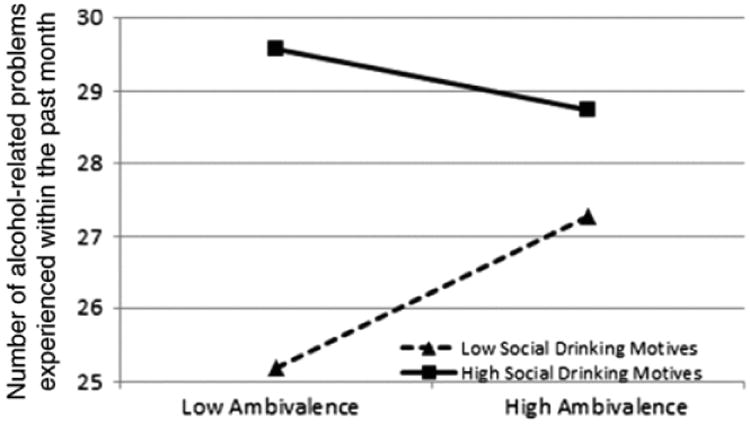
Social drinking motives and ambivalence interacted when predicting alcohol-related problems.
Fig. 3.

Coping drinking motives and ambivalence interacted when predicting peak drinks.
Table 2.
Regression analysis predicting alcohol consumption and problems from SRDI and DB.
| Criterion | Predictor | B | SE B | β | |
|---|---|---|---|---|---|
| Peak drinks | Step 1 | Ambivalence (AMB) | 0.21 | 0.04 | 0.13*** |
| Social drinking motives (SDM) | 0.12 | 0.02 | 0.19*** | ||
| Drinks per week | 0.36 | 0.02 | 0.61*** | ||
| AMB * SDM | − 0.01 | 0.01 | − 0.04 | ||
| Step 1 | AMB | 0.26 | 0.04 | 0.17*** | |
| Coping drinking motives (CDM) | 0.11 | 0.02 | 0.13*** | ||
| Drinks per week | 0.37 | 0.02 | 0.63*** | ||
| AMB * CDM | − 0.02 | 0.01 | − 0.06* | ||
| Step 1 | AMB | 0.23 | 0.04 | 0.15*** | |
| Enhancement drinking motives (EDM) | 0.13 | 0.02 | 0.17*** | ||
| Drinks per week | 0.35 | 0.02 | 0.60*** | ||
| AMB * EDM | − 0.01 | 0.01 | − 0.04 | ||
| Step 1 | AMB | 0.31 | 0.04 | 0.20*** | |
| Conformity drinking motives (ODM) | 0.05 | 0.03 | 0.05**** | ||
| Drinks per week | 0.38 | 0.02 | 0.65*** | ||
| AMB * ODM | − 0.01 | 0.01 | − 0.01 | ||
| Alcohol-related problems | Step 1 | AMB | 0.13 | 0.15 | 0.04 |
| SDM | 0.26 | 0.06 | 0.17*** | ||
| Drinks per week | 0.47 | 0.05 | 0.34*** | ||
| Step 2 | AMB * SDM | − 0.06 | 0.02 | − 0.08* | |
| Step 1 | AMB | 0.01 | 0.13 | 0.00 | |
| CDM | 0.74 | 0.07 | 0.346*** | ||
| Drinks per week | 0.43 | 0.05 | 0.31*** | ||
| AMB * CDM | − 0.08 | 0.03 | − 0.09** | ||
| Step 1 | AMB | 0.10 | 0.14 | 0.03 | |
| EDM | 0.44 | 0.07 | 0.25*** | ||
| Drinks per week | 0.42 | 0.05 | 0.30*** | ||
| AMB * EDM | − 0.05 | 0.03 | − 0.07**** | ||
| Step 1 | AMB | 0.19 | 0.12 | 0.05 | |
| ODM | 1.07 | 0.09 | 0.41*** | ||
| Drinks per week | 0.46 | 0.05 | 0.33*** | ||
| AMB * ODM | − 0.04 | 0.04 | − 0.04 |
Note. N = 679.
p < .05.
p < .01.
p < .001.
p < .10.
4 Discussion
This study evaluated the influence of drinking motives in the relationship between ambivalence and alcohol use. Our first expectation was that ambivalence would be positively associated with drinking and problems, and results supported this prediction for both correlational and regression main effect analyses. This is consistent with previous studies that suggest ambivalence is linked with heavier alcohol use (Hernandez et al., 2010; Oser et al., 2010). As such, the perspective that ambivalence may have some predictive utility with respect to addictive behaviors is supported. It is worth noting that some research suggests that ambivalent attitudes are worse predictors for behavior relative to behaviors which are homogeneous (Armitage, 2003; Conner et al., 2003). On the surface it may seem as though our findings are inconsistent with this view, however, deeper reflection may reveal that there may be a somewhat linear relationship in predictive utility such that homogeneous attitudes are the strongest predictor of behavior (e.g., individuals who want to drink and see the positive aspects of drinking), followed by ambivalent attitudes (e.g., individuals who want to drink but see the positive and negative aspects of drinking). It makes intuitive sense that a person who wants to drink and sees no harm in it will be more likely to drink relative to a person who is aware of potential benefits and costs of alcohol use. Moreover, most drinkers do not have uncomplicated positive evaluations of drinking (Cameron et al., 2003; Conner et al., 2002; Graham, 2003; Leigh, 1989; Miller & Rollnick, 2002; Orford, 1985), and thus, a homogeneous positive drinking attitude might be rare.
Our second expectation was that drinking motives would be positively associated with alcohol use and related problems. Correlational and main effect results were largely consistent with this prediction. This finding supports previous research which shows strong links between drinking motives and college alcohol behavior (Abbey et al., 1993; Foster & Neighbors, 2013; Kuntsche et al., 2005; Maggs & Schulenberg, 1998; Mohr et al., 2005; Read et al., 2003; Schulenberg et al., 1996). The literature evaluating motives and ambivalence suggests that most of the motives that college drinkers identify as reasons for drinking can also be identified as reasons for not drinking if consumption becomes excessive (de Visser & Smith, 2007). As such, the relationship between ambivalence and motives appears to be more complicated than simple correlation.
Our third hypothesis was that an interaction would emerge between motives and ambivalence in predicting drinking such that motives would moderate the effect of ambivalence on drinking outcomes. We found multiple significant interactions in support of this hypothesis (Figs. 1–3). The first significant interaction which emerged was between ambivalence and coping motives in predicting peak drinking. Findings showed that ambivalence was positively linked with peak drinks, and although this positive relationship was stronger among those low in coping motives (i.e., steeper positive slope), those high in coping motives appeared to be at greater risk for increased peak drinking levels, regardless of ambivalence level. The second and third interactions which emerged were between ambivalence, and coping and social motives in predicting alcohol-related problems. Findings from these interactions mirrored those from the previous interactions such that ambivalence was positively associated with problems among those low in social or coping motives, and those high in social or coping motives were at greater risk for problems, regardless of ambivalence level. These findings make intuitive sense in that college students who drink for favorable social outcomes (e.g., to loosen up at a party) or to cope with negative affect (e.g., to feel better after a break-up) are likely to have higher levels of alcohol consumption and experience more problems relative to individuals who do not. This is consistent with the perspective that ambivalent drinkers are at increased risk for heavier drinking levels and problems if they are high in drinking motives and suggests that interventions that target clinical modification of motives might have significant public health impact.
It is not clear why enhancement and conformity motives did not emerge as significant moderators of the relationship between ambivalence and drinking. In light of previous research, the lack of significance for enhancement and conformity motives is somewhat admissible. Two major motivations for college drinking are for social reasons (Kuntsche et al., 2005; LaBrie et al., 2007; Lewis et al., 2007; Mohr et al., 2005; Read et al., 2003) or to regulate affect (Carey & Correia, 1997; Foster et al., submitted for publication; Ham, Zamboanga, Bacon, & Garcia, 2009; Kassel, Jackson, & Unrod, 2000; Kuntsche, Knibbe, Engels, & Gmel, 2007; Martens et al., 2008; Merrill & Read, 2010), and although enhancement and conformity motives are linked with drinking, they are less frequently endorsed among college students. Our own data bore this out, demonstrating that of the four motives, social motives most strongly predicted drinking, and coping motives most strongly predicted problems (Table 2). Thus, it is possible that the moderating effect for enhancement and conformity motives did not emerge as a function of fewer endorsements of those motives (e.g., low power to detect effects), and as such, it follows that among the college students in our sample, the relationship between ambivalence and alcohol outcomes was not significantly moderated by enhancement or conformity motives but was moderated by social and coping motives.
Another potential explanation for the lack of significant moderating findings for conformity or enhancement motives stems from research suggesting a temporally diminishing relationship between motives and drinking with age. Motives are linked with drinking among adolescents (Cooper, 1994; Cox & Klinger, 1988), and although this relationship continues to exist for college-age young adults, it appears to be less robust relative to adolescent samples (Kuntsche et al., 2005). The relationship between drinking motives and alcohol use appears to diminish (Sher, Wood, Wood, & Raskin, 1996) or disappear (Read et al., 2003) as individuals progress through adolescence to college and beyond. Thus, it is possible that among adolescents, each of the drinking motives – including enhancement (drinking to experience positive emotion) and conformity (drinking as a result of social pressure) – significantly moderate the relationship between ambivalence and drinking. It is also possible that this moderating relationship might have diminished in strength for college samples, particularly for enhancement and conformity motives. It could be that social and coping reasons for drinking remain salient for college samples, and thus, effects may diminish less quickly over time. Replications of this research in adolescent samples are needed to better understand moderating relationships and whether these change as a function of time or age.
4.1 Limitations and future directions
The strengths of this research should be considered in light of its limitations. The main study limitation is that we do not fully know what the modified Drinking Ambivalence Scale measures, and in particular, the extent to which it is context-specific and differs from the original General Ambivalence Scale. Additionally, the current study was cross-sectionally designed, and thus, the ability to make causal inferences is mitigated. Further, we recruited college students to participate in this study, and as such, generalizability to non-college populations may be attenuated. Relatedly, the majority of this convenience sample was female (82.2%), which might limit generalizability of findings to males. Future studies might consider strengthening the study design by incorporating longitudinal assessments to address causal implications. It is important to determine whether, for example, motives temporally lead to increased drinking, as opposed to heavier drinkers having more salient motives for drinking relative to light drinkers or abstainers. Additionally, a longitudinal design would facilitate determining whether motives increase risk for longer term comorbid problems including depressive symptoms.
Data gathered as part of a preliminary unpublished trial suggest that 50% of college students from our sample are mildly depressed according to the Center for Epidemiologic Studies Depression Scale (CESD; Radloff, 1977). Moreover, depressive symptoms have been found to predict increased coping motives (Cooper, Frone, Russell, & Mudar, 1995; Grayson & Nolen-Hoeksema, 2005). As such, individuals higher in exhibit depressive symptoms might engage in alcohol behaviors as an avoidance coping strategy (Dixon, Leen-Feldner, Ham, Feldner, & Lewis, 2009; Saladin, Brady, Dansky, & Kilpatrick, 1995; Stewart, Mitchell, Wright, & Loba, 2004) which relieves distress related to the experience of an anxiety-provoking or stressful event (e.g., taking exam, dealing with a break-up). Therefore, further research is needed to evaluate whether depressive symptoms might play a role in relationships among ambivalence, motives, and drinking.
4.2 Conclusion
This study contributes to the alcohol literature by evaluating drinking motives as moderators of ambivalence's effect on drinking. These findings highlight the importance of considering motives in the relationship between ambivalence and drinking. Clinical implications include the need for tailoring interventions to target individual difference factors that increase risk for heavy drinking and associated problems. This is especially important among college students who may be at risk for problematic behavior. This study expands existing literature and sheds light on the relationship between important psychological constructs. The broad, long-term implication of current findings is the potential for enhancing future interventions by increasing knowledge of the role motivational factors play in college drinking.
Highlights.
We evaluated motives as moderators of problems.
Drinking motives and ambivalence interacted to predict problems.
Hierarchical regressions were used to evaluate these effects.
Acknowledgments
The authors would like to sincerely thank our research assistant, Ankita Pai, for assisting with data collection, conducting literature reviews, and proofreading/editing the manuscript.
Role of funding sources: This research was not supported by any grant.
Footnotes
Contributors: Dawn Foster designed the study, wrote the protocol, conducted literature searches, provided summaries of previous research studies, conducted the statistical analysis, and drafted the manuscript. Clayton Neighbors and Alexander Prokhorov provided feedback to manuscript drafts. All authors contributed to and have approved the final manuscript.
Conflict of interest: All authors declare that they have no conflicts of interest.
References
- Abbey A, Smith MJ, Scott RO. The relationship between reasons for drinking alcohol and alcohol consumption: An interactional approach. Addictive Behaviors. 1993;18(6):659–670. doi: 10.1016/0306-4603(93)90019-6. [DOI] [PMC free article] [PubMed] [Google Scholar]
- Armitage CJ. Beyond attitudinal ambivalence: Effects of belief homogeneity on attitude–intention–behaviour relations. European Journal of Social Psychology. 2003;33(4):551–563. [Google Scholar]
- Baer JS. Etiology and secondary prevention of alcohol problems with young adults. In: Baer J, Marlatt G, McMahon R, Baer J, Marlatt G, McMahon R, editors. Addictive behaviors across the life span: Prevention, treatment, and policy issues. Sage Publications, Inc.; Thousand Oaks, CA US: 1993. pp. 111–137. [Google Scholar]
- Baumeister RF, Stillwell AM, Heatherton TF. Personal narratives about guilt: Role in action control and interpersonal relationships. Basic and Applied Social Psychology. 1995;17(1–2):173–198. [Google Scholar]
- Benson PL. Religion and substance use. In: Schumaker JF, editor. Religion and mental health. Oxford Univ. Press; New York: 1992. pp. 211–220. [Google Scholar]
- Bock E, Cochran JK, Beeghley L. Moral messages: The relative influence of denomination on the religiosity–alcohol relationship. The Sociological Quarterly. 1987;28(1):89–103. [Google Scholar]
- Cameron C, Stritzke W, Durkin K. Alcohol expectancies in late childhood: An ambivalence perspective on transitions toward alcohol use. Journal of Child Psychology and Psychiatry. 2003;44:687–698. doi: 10.1111/1469-7610.00155. [DOI] [PubMed] [Google Scholar]
- Carey KB, Correia CJ. Drinking motives predict alcohol-related problems in college students. Journal of Studies on Alcohol. 1997;58(1):100–105. doi: 10.15288/jsa.1997.58.100. [DOI] [PubMed] [Google Scholar]
- Cohen J, Cohen P, West SG, Aiken LS. Applied multiple regression/correlation analysis for the behavioral sciences. 3rd. Erlbaum; Hillsdale, NJ: 2003. [Google Scholar]
- Collins SE, Carey KB, Otto JM. A new decisional balance measure of motivation to change among at-risk college drinkers. Psychology of Addictive Behaviors. 2009;23(3):464–471. doi: 10.1037/a0015841. [DOI] [PMC free article] [PubMed] [Google Scholar]
- Collins R, Parks GA, Marlatt G. Social determinants of alcohol consumption: The effects of social interaction and model status on the self-administration of alcohol. Journal of Consulting and Clinical Psychology. 1985;53:189–200. doi: 10.1037//0022-006x.53.2.189. [DOI] [PubMed] [Google Scholar]
- Conner M, Povey R, Sparks P, James R, Shepherd R. Moderating role of attitudinal ambivalence within the theory of planned behaviour. British Journal of Social Psychology. 2003;42:75–94. doi: 10.1348/014466603763276135. [DOI] [PubMed] [Google Scholar]
- Conner M, Sparks P, Povey R, James R, Shepherd R, Armitage CJ. Moderator effects of attitudinal ambivalence on attitude–behaviour relationships. European Journal of Social Psychology. 2002;32(5):705–718. [Google Scholar]
- Cooper ML. Motivations for alcohol use among adolescents: Development and validation of a four-factor model. Psychological Assessment. 1994;6:117–128. [Google Scholar]
- Cooper ML. Alcohol use and risky sexual behavior among college students and youth: Evaluating the evidence. Journal of Studies on Alcohol. 2002;(14):101–117. doi: 10.15288/jsas.2002.s14.101. [DOI] [PubMed] [Google Scholar]
- Cooper ML, Frone MR, Russell M, Mudar P. Drinking to regulate positive and negative emotions: A motivational model of alcohol use. Journal of Personality and Social Psychology. 1995;69:990–1005. doi: 10.1037//0022-3514.69.5.990. [DOI] [PubMed] [Google Scholar]
- Cox W, Klinger A. A motivational model of alcohol use. Journal of Abnormal Psychology. 1988;97(2):168–180. doi: 10.1037//0021-843x.97.2.168. [DOI] [PubMed] [Google Scholar]
- Daugherty TK, McLarty LM. Religious coping, drinking motivation, and sex. Psychological Reports. 2003;92(2):643. doi: 10.2466/pr0.2003.92.2.643. [DOI] [PubMed] [Google Scholar]
- de Visser RO, Smith JA. Young men's ambivalence toward alcohol. Social Science & Medicine. 2007;64(2):350–362. doi: 10.1016/j.socscimed.2006.09.010. [DOI] [PubMed] [Google Scholar]
- Dearing RL, Stuewig J, Tangney J. On the importance of distinguishing shame from guilt: Relations to problematic alcohol and drug use. Addictive Behaviors. 2005;30(7):1392–1404. doi: 10.1016/j.addbeh.2005.02.002. [DOI] [PMC free article] [PubMed] [Google Scholar]
- Dixon LJ, Leen-Feldner EW, Ham LS, Feldner MT, Lewis SF. Alcohol use motives among traumatic event-exposed, treatment-seeking adolescents: Associations with posttraumatic stress. Addictive Behaviors. 2009;34:1065–1068. doi: 10.1016/j.addbeh.2009.06.008. [DOI] [PMC free article] [PubMed] [Google Scholar]
- Drerup ML, Johnson TJ, Bindl S. Mediators of the relationship between religiousness/spirituality and alcohol problems in an adult community sample. Addictive Behaviors. 2011;36(12):1317–1320. doi: 10.1016/j.addbeh.2011.07.013. [DOI] [PubMed] [Google Scholar]
- Edwards W. The theory of decision making. Psychological Bulletin. 1954;51(4):380–417. doi: 10.1037/h0053870. [DOI] [PubMed] [Google Scholar]
- Fishbein M, Ajzen I. Attitudes and opinions. Annual Review of Psychology. 1972;487–544 [Google Scholar]
- Forthun LF, Bell NJ, Peek CW, Sheh-Wei S. Religiosity, sensation seeking, and alcohol/drug use in denominational and gender contexts. Journal of Drug Issues. 1999;29(1):75–90. [Google Scholar]
- Fossos N, Kaysen D, Neighbors C, Lindgren KP, Hove MC. Coping motives as a mediator of the relationship between sexual coercion and problem drinking in college students. Addictive Behaviors. 2011;36:1001–1007. doi: 10.1016/j.addbeh.2011.06.001. [DOI] [PMC free article] [PubMed] [Google Scholar]
- Foster DW, Neighbors C. Self-consciousness as a moderator of the effect of social drinking motives on alcohol use. Addictive Behaviors. 2013;38(4):1996–2002. doi: 10.1016/j.addbeh.2013.01.011. [DOI] [PMC free article] [PubMed] [Google Scholar]
- Foster DW, Young CM, Nguyen ML, Quist MC, Bryan JL, Neighbors C. Tears in your beer: Gender differences in coping drinking motives, depressive symptoms and drinking. 2013 doi: 10.1007/s11469-014-9504-3. submitted for publication. [DOI] [PMC free article] [PubMed] [Google Scholar]
- Galen LW, Rogers WM. Religiosity, alcohol expectancies, drinking motives and their interaction in the prediction of drinking among college students. Journal of Studies on Alcohol. 2004;65(4):469–476. doi: 10.15288/jsa.2004.65.469. [DOI] [PubMed] [Google Scholar]
- Gorsuch RL. Religious aspects of substance use and recovery. Journal of Social Issues. 1995;51:65–83. [Google Scholar]
- Graham K. The yin and yang of alcohol intoxication: Implications for research on the social consequences of drinking. Addiction. 2003;98:1021–1023. doi: 10.1046/j.1360-0443.2003.00468.x. [DOI] [PubMed] [Google Scholar]
- Grayson CE, Nolen-Hoeksema S. Motives to drink as mediators between childhood sexual assault and alcohol problems in adult women. Journal of Traumatic Stress. 2005;18:137–145. doi: 10.1002/jts.20021. [DOI] [PubMed] [Google Scholar]
- Ham BL, Zamboanga AK, Bacon TA, Garcia TA. Drinking motives as mediators of social anxiety and hazardous drinking among college students. Cognitive Behaviour Therapy. 2009;38(3):133–145. doi: 10.1080/16506070802610889. [DOI] [PubMed] [Google Scholar]
- Hanson DJ, Engs RC. College students' drinking problems: A national study, 1982–1991. Psychological Reports. 1992;71:39–42. doi: 10.2466/pr0.1992.71.1.39. [DOI] [PubMed] [Google Scholar]
- Hernandez G, Salerno JM, Bottoms BL. Attachment to God, spiritual coping, and alcohol use. International Journal for the Psychology of Religion. 2010;20(2):97–108. [Google Scholar]
- Johnson TJ, Sheets VL, Kristeller JL. Identifying mediators of the relationship between religiousness/spirituality and alcohol use. Journal of Studies on Alcohol and Drugs. 2008;69(1):160–170. doi: 10.15288/jsad.2008.69.160. [DOI] [PubMed] [Google Scholar]
- Karam E, Kypri K, Salamoun M. Alcohol use among college students: An international perspective. Current Opinion in Psychiatry. 2007;20(3):213–221. doi: 10.1097/YCO.0b013e3280fa836c. [DOI] [PubMed] [Google Scholar]
- Kassel SI, Jackson M, Unrod M. Generalized expectancies for negative mood regulation and problem drinking among college students. Journal of Studies on Alcohol. 2000;61(2):332–340. doi: 10.15288/jsa.2000.61.332. [DOI] [PubMed] [Google Scholar]
- Kendler KS, Gardner CO, Prescott CA. Religion, psychopathology, and substance use and abuse: A multimeasure, genetic-epidemiological study. The American Journal of Psychiatry. 1997;154:322–329. doi: 10.1176/ajp.154.3.322. [DOI] [PubMed] [Google Scholar]
- Kivlahan DR, Marlatt GA, Fromme K, Coppel DB, Williams E. Secondary prevention with college drinkers: Evaluation of an alcohol skills training program. Journal of Consulting and Clinical Psychology. 1990;58:805–810. doi: 10.1037//0022-006x.58.6.805. [DOI] [PubMed] [Google Scholar]
- Kuntsche E, Knibbe R, Engels R, Gmel G. Bullying and fighting among adolescents —- Do drinking motives and alcohol use matter? Addictive Behaviors. 2007;32(12):3131–3135. doi: 10.1016/j.addbeh.2007.07.003. [DOI] [PubMed] [Google Scholar]
- Kuntsche E, Knibbe R, Gmel G, Engels R. Why do young people drink? A review of drinking motives. Clinical Psychology Review. 2005;25:841–861. doi: 10.1016/j.cpr.2005.06.002. [DOI] [PubMed] [Google Scholar]
- LaBrie JW, Hummer JF, Pedersen ER. Reasons for drinking in the college student context: The differential role and risk of the social motivator. Journal of Studies on Alcohol and Drugs. 2007;68(3):393–398. doi: 10.15288/jsad.2007.68.393. [DOI] [PMC free article] [PubMed] [Google Scholar]
- Leigh B. In search of the seven dwarves: Issues of measurement and meaning in alcohol expectancy research. Psychological Bulletin. 1989;105:361–373. doi: 10.1037/0033-2909.105.3.361. [DOI] [PubMed] [Google Scholar]
- Lewis HB. Shame and guilt in neurosis. International Universities Press; New York: 1971. [Google Scholar]
- Lewis MA, Phillippi J, Neighbors C. Morally based self-esteem, drinking motives, and alcohol use among college students. Psychology of Addictive Behaviors. 2007;21(3):398–403. doi: 10.1037/0893-164X.21.3.398. [DOI] [PubMed] [Google Scholar]
- Lindsay-Hartz J, de Rivera J, Mascolo M. Differentiating guilt and shame and their effects on motivation. In: Tangne JP, Fischer KW, editors. Self-conscious emotions: Shame, guilt, embarrassment, and pride. Guilford; New York, NY: 1995. pp. 274–300. [Google Scholar]
- Lipkus IM, Green JD, Feaganes JR, Sedikides C. The relationship between attitudinal ambivalence and desire to quit smoking among college smokers. Journal of Applied Social Psychology. 2001;31(1):113–133. [Google Scholar]
- Maggs JL, Schulenberg J. Reasons to drink and not to drink: Altering trajectories of drinking through an alcohol misuse prevention program. Applied Developmental Science. 1998;2(1):48–60. [Google Scholar]
- Marlatt G, Baer JS, Larimer M. Preventing alcohol abuse in college students: A harm-reduction approach. In: Boyd GM, Howard J, Zucker RA, editors. Alcohol problems among adolescents: Current directions in prevention research. Lawrence Erlbaum Associates, Inc.; Hillsdale, NJ: 1995. pp. 147–172. [Google Scholar]
- Martens MP, Neighbors C, Lewis MA, Lee CM, Oster-Aaland L, Larimer ME. The roles of negative affect and coping motives in the relationship between alcohol use and alcohol-related problems among college students. Journal of Studies on Alcohol and Drugs. 2008;69(3):412–419. doi: 10.15288/jsad.2008.69.412. [DOI] [PMC free article] [PubMed] [Google Scholar]
- Menninga KM, Dijkstra A, Gebhardt WA. Mixed feelings: Ambivalence as a predictor of relapse in ex-smokers. British Journal of Health Psychology. 2011;16(3):580–591. doi: 10.1348/135910710X533219. [DOI] [PubMed] [Google Scholar]
- Merrill JE, Read JP. Motivational pathways to unique types of alcohol consequences. Psychology of Addictive Behaviors. 2010;24(4):705–711. doi: 10.1037/a0020135. [DOI] [PMC free article] [PubMed] [Google Scholar]
- Miller WR, Rollnick S. Motivational interviewing: Preparing people to change. 1st. Guilford Press; New York, NY: 1991. [Google Scholar]
- Miller WR, Rollnick S. Motivational interviewing: Preparing people for change. 2nd. Guilford Press; New York, NY: 2002. [Google Scholar]
- Mitka M. College binge drinking still on the rise. JAMA: The Journal of the American Medical Association. 2009;302(8):836–837. doi: 10.1001/jama.2009.1154. [DOI] [PubMed] [Google Scholar]
- Mohr CD, Armeli S, Tennen H, Temple M, Todd M, Clark J, et al. Moving beyond the key party: A daily process study of college student drinking motivations. Psychology of Addictive Behaviors. 2005;19:392–403. doi: 10.1037/0893-164X.19.4.392. [DOI] [PubMed] [Google Scholar]
- Morgenstern J, Kuerbis A, Amrhein P, Hail L, Lynch K, McKay JR. Motivational interviewing: A pilot test of active ingredients and mechanisms of change. Psychology of Addictive Behaviors. 2012;26(4):859–869. doi: 10.1037/a0029674. [DOI] [PMC free article] [PubMed] [Google Scholar]
- Orford J. Excessive appetites: A psychological view of addictions. Wiley; New York: 1985. [Google Scholar]
- Oser ML, McKellar J, Moos BS, Moos RH. Changes in ambivalence mediate the relation between entering treatment and change in alcohol use and problems. Addictive Behaviors. 2010;35(4):367–369. doi: 10.1016/j.addbeh.2009.10.024. [DOI] [PubMed] [Google Scholar]
- Presley CA, Meilman PW, Lyerla R. Alcohol and drugs on American college campuses: Use, consequence, and perceptions of the campus environment. I. The Core Institute; Carbondale, Ill: 1993. pp. 1989–1991. [Google Scholar]
- Prochaska JO, DiClemente CC. Toward a comprehensive model of change. In: Miller WR, Heather N, Miller WR, Heather N, editors. Treating addictive behaviors: Processes of change. Plenum; New York, NY: 1986. pp. 3–27. [Google Scholar]
- Prochaska JQ, DiClemente CC. Stages of change in the modification of problem behaviors. In: Hersen M, Eisler RM, Miller PM, editors. Progress in behavior modification. Sycamore Press; Sycamore, IL: 1992. pp. 184–214. [PubMed] [Google Scholar]
- Prochaska JO, DiClemente CC, Norcross JC. In search of how people change: Applications to addictive behavior. American Psychologist. 1992;47:1102–1114. doi: 10.1037//0003-066x.47.9.1102. [DOI] [PubMed] [Google Scholar]
- Radloff LS. The CES-D Scale: A self-report depression scale for research in the general population. Applied Psychological Measurement. 1977;1(3):385–401. [Google Scholar]
- Read JP, Wood MD, Kahler CW, Maddock JE, Palfai TP. Examining the role of drinking motives in college student alcohol use and problems. Psychology of Addictive Behaviors. 2003;17:13–23. doi: 10.1037/0893-164x.17.1.13. [DOI] [PubMed] [Google Scholar]
- Saladin ME, Brady KT, Dansky BS, Kilpatrick DG. Understanding comorbidity between PTSD and substance use disorders: Two preliminary investigations. Addictive Behaviors. 1995;20:643–655. doi: 10.1016/0306-4603(95)00024-7. [DOI] [PubMed] [Google Scholar]
- Schuck AM, Widom CS. Childhood victimization and alcohol symptoms in females: Causal inferences and hypothesized mediators. Child Abuse & Neglect. 2001;25:1069–1092. doi: 10.1016/s0145-2134(01)00257-5. [DOI] [PubMed] [Google Scholar]
- Schulenberg J, O'Malley PM, Bachman JG, Wadsworth KN, Johnston LD. Getting drunk and growing up: Trajectories of frequent binge drinking during the transition to young adulthood. Journal of Studies on Alcohol. 1996;57(3):289–304. doi: 10.15288/jsa.1996.57.289. [DOI] [PubMed] [Google Scholar]
- Scott-Sheldon LA, Carey MP, Carey KB. Alcohol and risky sexual behavior among heavy drinking college students. AIDS and Behavior. 2010;14(4):845–853. doi: 10.1007/s10461-008-9426-9. [DOI] [PMC free article] [PubMed] [Google Scholar]
- Sher KJ, Wood MD, Wood PK, Raskin G. Alcohol outcome expectancies and alcohol use: A latent variable cross-lagged panel study. Journal of Abnormal Psychology. 1996;105(4):561–574. doi: 10.1037/0021-843X.105.4.561. [DOI] [PubMed] [Google Scholar]
- Stewart SH, Devine H. Relations between personality and drinking motives in young adults. Personality and Individual Differences. 2000;29:495–511. [Google Scholar]
- Stewart SH, Mitchell TL, Wright KD, Loba P. The relations of PTSD symptoms to alcohol use and coping drinking in volunteers who responded to the Swissair Flight 111 airline disaster. Journal of Anxiety Disorders. 2004;18:51–68. doi: 10.1016/j.janxdis.2003.07.006. [DOI] [PubMed] [Google Scholar]
- Tangney JP, Dearing RL. Shame and guilt. Guilford; New York: 2002. [Google Scholar]
- Tangney JP, Wagner P, Fletcher C, Gramzow R. Shamed into anger? The relation of shame and guilt to anger and self-reported aggression. Journal of Personality and Social Psychology. 1992;62:669–675. doi: 10.1037//0022-3514.62.4.669. [DOI] [PubMed] [Google Scholar]
- Taylor B, Rehm J. The relationship between alcohol consumption and fatal motor vehicle injury: High risk at low alcohol levels. Alcoholism, Clinical and Experimental Research. 2012;36(10):1827–1834. doi: 10.1111/j.1530-0277.2012.01785.x. [DOI] [PMC free article] [PubMed] [Google Scholar]
- Thompson MM, Zanna MP, Griffin DW. Let's not be indifferent about (attitudinal) ambivalence. In: Petty RE, Krosnick JA, editors. Attitude strength: Antecedents and consequences. Vol. 4. Erlbaum; Hillsdale, NJ: 1995. pp. 361–386. [Google Scholar]
- U.S. Dept of Health and Human Services. Alcohol and health. National Institute on Alcohol Abuse and Alcoholism; Rockville, Md: 1990. [Google Scholar]
- Ullman SE, Filipas HH, Townsend SM, Starzynski LL. Trauma exposure, posttraumatic stress disorder and problem drinking in sexual assault survivors. Journal of Studies on Alcohol. 2005;66:610–619. doi: 10.15288/jsa.2005.66.610. [DOI] [PubMed] [Google Scholar]
- Walker D, Stephens R, Rowland J, Roffman R. The influence of client behavior during motivational interviewing on marijuana treatment outcome. Addictive Behaviors. 2011;36(6):669–673. doi: 10.1016/j.addbeh.2011.01.009. [DOI] [PMC free article] [PubMed] [Google Scholar]
- Wechsler H, Davenport A. Health and behavioral consequences of binge drinking in college. JAMA: The Journal of the American Medical Association. 1994;272(21):1672. [PubMed] [Google Scholar]
- Wechsler H, Isaac N. ‘Binge’ drinkers at Massachusetts colleges: Prevalence, drinking styles, time trends, and associated problems. JAMA: The Journal of the American Medical Association. 1992;267:2929–2931. doi: 10.1001/jama.267.21.2929. [DOI] [PubMed] [Google Scholar]
- Wechsler H, Nelson TF. What we have learned from the Harvard School of Public Health College Alcohol Study: Focusing attention on college student alcohol consumption and the environmental conditions that promote it. Journal of Studies on Alcohol and Drugs. 2008;69:481–490. doi: 10.15288/jsad.2008.69.481. [DOI] [PubMed] [Google Scholar]
- Williams A, Clark D. Alcohol consumption in university students: The role of reasons for drinking, coping strategies, expectancies, and personality traits. Addictive Behaviors. 1998;23(3):371–378. doi: 10.1016/s0306-4603(97)80066-4. [DOI] [PubMed] [Google Scholar]
- Wills TA, Yaeger AM, Sandy JM. Buffering effect of religiosity for adolescent substance use. Psychology of Addictive Behaviors. 2003;17:24–31. doi: 10.1037/0893-164x.17.1.24. [DOI] [PubMed] [Google Scholar]
- Woien SL, Ernst HAH, Patock-Peckham JA, Nagoshi CT. Validation of the TOSCA to measure shame and guilt. Personality and Individual Differences. 2003;35:313–326. [Google Scholar]