



Abstract
IMPORTANCE
Household environmental surfaces may serve as vectors for acquisition and spread of methicillin-resistant Staphylococcus aureus (MRSA) among household members, though few studies have evaluated which objects are important MRSA reservoirs.
OBJECTIVES
Determine the prevalence of environmental MRSA contamination in households of children with MRSA infection; define the molecular epidemiology of environmental, pet, and human MRSA strains within households; and identify factors associated with household MRSA contamination.
DESIGN, SETTING, AND PARTICIPANTS
Fifty households of children with active or recent culture-positive community-associated MRSA infection were enrolled from 2012–13 at St. Louis Children’s Hospital and community pediatric practices affiliated with the Washington University Pediatric and Adolescent Ambulatory Research Consortium.
MAIN OUTCOMES AND MEASURES
Participants’ nares, axillae, and inguinal folds were cultured to detect S. aureus colonization. Twenty-one environmental surfaces and pet dogs and cats were cultured. Molecular typing of S. aureus strains was performed by repetitive-sequence polymerase chain reaction to determine strain relatedness within households.
RESULTS
MRSA was recovered from environmental surfaces in 23 (46%) households, most frequently from the participant’s bed linens (18%), television remote control (16%), and bathroom hand towel (15%). MRSA colonized 12% of dogs and 7% of cats. At least 1 surface was contaminated with a strain type matching the participant’s isolate in 20 (40%) households. Participants colonized with S. aureus had a higher proportion of MRSA-contaminated surfaces (0.15 ± 0.17) than non-colonized participants [0.03± 0.06; mean difference 0.12 (95% CI 0.05, 0.20)]. A greater number of individuals per 1000 ft2 was also associated with a higher proportion of MRSA-contaminated surfaces (β=0.34, p=0.03). The frequency of cleaning household surfaces was not associated with S. aureus environmental contamination.
CONCLUSIONS AND RELEVANCE
MRSA strains concordant with infecting and colonizing strains are present on commonly handled household surfaces, a factor that likely perpetuates MRSA transmission and recurrent disease. Future studies are needed to determine methods to eradicate environmental contamination and prevent MRSA transmission in households.
INTRODUCTION
Over the past decade, strains of methicillin-resistant Staphylococcus aureus (MRSA) with enhanced virulence emerged in the community (designated community-associated [CA]-MRSA), causing anation wide epidemic of cutaneous and invasive infections in otherwise healthy individuals.1–3 CA-MRSA poses a major public health challenge, accounting for 2 million infections in the U.S. annually, resulting in a societal economic burden of $2.7 billion.4
CA-MRSA infections cluster within households.5,6 Household contacts of children with MRSA disease have a substantially higher prevalence of MRSA colonization and infection compared to the general population.7–9 A recent randomized trial determined that decolonization of all household members resulted in a significantly reduced incidence of skin and soft tissue infections (SSTI) compared to decolonization of apediatric index patient alone.10 Still, over 12 months, greater than 50% of these index patients experienced recurrent SSTI, suggesting that other reservoirs may perpetuate MRSA transmission and recurrent disease.
Given that S. aureus survives on inanimate objects for prolonged periods, household environmental surfaces may serve as vectors for acquisition and spread of MRSA among household members.5,6,11–13 A case-control study in Manhattan found that household environments of patients with recent MRSA infections were more likely to be contaminated with MRSA compared to control households.9 Additionally, transmission of MRSA between pets and humans has been proposed, but the directionality is unclear.6,14–18
To date, few studies have comprehensively evaluated the household environment to determine which environmental surfaces represent MRSA reservoirs. The objectives of this study were to determine the prevalence of environmental MRSA contamination in households of children with MRSA infection; define the molecular epidemiology of environmental, pet, and human MRSA strains within households; and identify factors associated with household MRSA contamination. Ultimately, defining important household MRSA reservoirs will inform future interventions to decrease the burden of MRSA in households and reduce the risk of ongoing transmission and infection.
PARTICIPANTS AND METHODS
Participant recruitment
Between January 2012 and February 2013, 50 children with culture-positive active or recent (within the past 2 months) CA-MRSA infections (48 SSTI, 1 retropharyngeal abscess, and 1 bacteremia/myositis/septic pulmonary emboli) were enrolled in the study. Participants were recruited from St. Louis Children’s Hospital (SLCH) and community pediatric practices affiliated with the Washington University Pediatric and Adolescent Ambulatory Research Consortium (WU PAARC). Children with nosocomial infections or risk factors for healthcare-associated infections19 and those who had performed decolonization (with mupirocin, chlorhexidine, or bleach baths) within the past month were excluded. Available MRSA isolates recovered from the site of infection were obtained from the SLCH microbiology laboratory. The Washington University Institutional Review Board and Animal Studies Committee approved study procedures.
Data and specimen collection
An enrollment visit was conducted in each participant’s home. Written informed consent was obtained for participants and household pets. Questionnaires were administered to collect data regarding medical history, prior S. aureus infections, hygiene practices, activities, household member and pet characteristics, home layout, and cleaning frequency.
Colonization cultures were collected from the anterior nares, axillae, and inguinal folds of each participant (Eswab, Becton Dickinson [BD], Franklin Lakes, NJ). Indoor pet dogs and cats were sampled by nasal culture for the presence of S. aureus colonization (BBL CultureSwab Liquid Amies, Regular Aluminum Wire, BD). Twenty-one environmental surfaces presumed to be frequently handled by multiple household members or posited to play a role in transmission were sampled.11 Standardized operating procedures were developed for each surface to ensure consistency in sampling across all households; the methods employed included the Baird Parker Agar contact plate (Hardy, Santa Maria, CA) and the premoistened Eswab (BD).20 Environmental sites cultured in the living room, bathroom, kitchen, and bedroom, and their sampling method, are listed in Table 1. We instructed participants not to perform any special cleaning measures, and specific surfaces to be sampled were not disclosed prior to enrollment. Only used towels and bed linens that had not been laundered prior to our visit were sampled.
Table 1.
Prevalence of S. aureus on Household Environmental Surfaces and Sampling Technique Employed for Culture
| Household Surfacea | Number of Households with S. aureus on Surfaceb | Number of Households with MRSA on Surfaceb | Number of Households with MSSA on Surfaceb | Culturing Technique |
|---|---|---|---|---|
| Living Room | ||||
|
| ||||
| TV remote control (n=49) | 13 (26) | 8 (16) | 5 (10) | Eswab |
| Main telephonec(n=50) | 10 (20) | 6 (12) | 4 (8) | Eswab |
| Computer keyboard and mouse (n=45) | 8 (18) | 4 (9) | 4 (9) | Eswab |
| Video game controller (n=38) | 9 (24) | 4 (11) | 5 (13) | Eswab |
|
| ||||
| Bathroom | ||||
|
| ||||
| Sink faucet handle (n=50) | 9 (18) | 5 (10) | 4 (8) | Eswab |
| Hand towel (n=40) | 7 (18) | 6 (15) | 1 (3) | Eswab |
| Participant bath towel (n=29) | 4 (14) | 0 (0) | 4 (14) | Eswab |
| Toilet handle (n=50) | 4 (8) | 3 (6) | 1 (2) | Eswab |
| Door handle (n=50) | 2 (4) | 1 (2) | 1 (2) | Eswab |
| Light switch (n=50) | 12 (24) | 5 (10) | 7 (14) | Eswab |
| Sink (n=50) | 9 (18) | 5 (10) | 4 (8) | Contact plate |
| Bathtub (n=50) | 4 (8) | 1 (2) | 3 (6) | Contact plate |
| Soap bar and dish (n=32) | 2 (6) | 2 (6) | 0 (0) | Contact plate |
| Toilet seat (n=50) | 3 (6) | 2 (4) | 1 (2) | Contact plate |
| Countertop (n=50) | 11 (22) | 4 (8) | 7 (14) | Contact plate |
|
| ||||
| Kitchen | ||||
|
| ||||
| Hand towel (n=36) | 6 (17) | 3 (8) | 3 (8) | Eswab |
| Sink faucet handle (n=50) | 3 (6) | 2 (4) | 1 (2) | Eswab |
| Sponge or dish cloth (n=44) | 1 (2) | 1 (2) | 0 (0) | Eswab |
| Refrigerator door handle (n=50) | 7 (14) | 3 (6) | 4 (8) | Contact plate |
| Table top (n=48) | 4 (8) | 4 (8) | 0 (0) | Contact plate |
|
| ||||
| Bedroom | ||||
|
| ||||
| Participant bed sheets and pillowcase (n=50) | 12 (24) | 9 (18) | 3 (6) | Eswab |
|
| ||||
| Pets | ||||
|
| ||||
| Dogs (n=26) | 6 (23) | 3 (12) | 3 (12) | Liquid Amies swab |
| Cats (n=14) | 1 (7) | 1 (7) | 0 (0) | Liquid Amies swab |
Abbreviations: MRSA, methicillin-resistant S. aureus; MSSA, methicillin-susceptible S. aureus
All objects and surfaces were not present in all homes; if present, the object/surface was sampled.
(#) represents row percentage
If a landline was not present, the mobile phone of the participant or the participant’s mother was cultured.
S. aureus isolation, identification, and strain typing methods
From human and environmental culture swabs, 100 μL of eluant was inoculated into tryptic soy broth (TSB) with 6.5% NaCl (BBL, BD); pet swabs were placed directly into TSB with 6.5% NaCl. Broth cultures were incubated overnight at 35°C, and 100 μL of broth was subsequently plated to trypticase soy agar with 5% sheep blood (blood agar plate [BAP]; BBL, BD). For environmental culture swabs, in addition to TSB overnight incubation, 100 μL of eluant was also inoculated directly to a BAP and incubated overnight. Contact plates were incubated overnight at 35°C, and growth was subcultured to a BAP. S. aureus identification and antibiotic susceptibility testing were performed by established procedures.21–23
To determine relatedness of isolates infecting or colonizing the participant, pets, and environmental surfaces, all S. aureus isolates were analyzed by repetitive-sequence PCR (repPCR) as previously described.24–27 Isolates with a similarity index ≥95% were considered the same strain. Each distinct repPCR pattern was assigned a numeric “reference strain” designation. RepPCR queries the entire chromosome but is not specific to the mecA gene; thus an MRSA and methicillin-susceptible S. aureus (MSSA) strain could be considered concordant by repPCR. All isolates recovered from pets and the reference strain isolates were confirmed as S. aureus by matrix-assisted laser desorption ionization time-of-flight mass spectrometry (MALDI-TOF MS) using the Vitek MS v2.0.28 A multiplex PCR assay was also performed as described previously for staphylococcal cassette chromosome mec (SCCmec) characterization of all recovered S. aureusstrains.29 PCR for mecA and mecC was performed on all MSSA isolates that contained SCCmec, using previously described conditions.30 MSSA isolates harboring mecA were subjected to additional phenotypic methods: repeat cefoxitin disk diffusion testing, PBP2a colony assay (Alere, Scarborough, ME), and failure to grow on Spectra MRSA selective agar (Remel, Lenexa, KS).
Statistical analysis
Data were analyzed using SPSS 20 for Windows (IBM SPSS, Chicago, IL). Risk factors for household environmental S. aureus contamination were analyzed by Student’s t-test, ANOVA, or linear regression (for continuous data) and Fisher’s exact test (for categorical data). When analyzing cleaning frequency and household contamination with S. aureus, the Fisher’s exact test was calculated using the Freeman-Halton extension.31 Relative risks and mean differences [with 95% confidence intervals (CI) were calculated where appropriate for categorical and continuous variables, respectively. All tests for significance were 2-tailed, and p-values of <0.05 were considered significant.
Urban and rural designations 32 were assigned to participants by geocoding addresses in ArcGIS 10 (ESRI, Redlands, CA). Data were spatially joined with shape files from the 2010 U.S. Census.33
RESULTS
Study population and participant S. aureus colonization
Fifty participants with confirmed MRSA infections were enrolled. The median age was 3.0 years (range 0.6–18.6); 58% were male, 64% were Caucasian, and 56% had private health insurance (Table 2). The median time from acute infection to study enrollment was 20 days (range 3–56). The median distance between participants’ homes and SLCH was 17.3 miles (range 1.2–76.0); most (84%)families lived in urbanized areas (≥50,000 people within a census tract).32,33 The median number of individuals per household was 4(range 2–7). Pet dogs or cats were present in 54% of households; the median number of pets in these households was 2 (range 1–9).
Table 2.
Participant and Household Characteristics
| Characteristic | N = 50 (%) |
|---|---|
| Age, years, median (range) | 3.01 (0.61 – 18.60) |
| Racea | |
| Caucasian | 32 (64) |
| African American | 13 (26) |
| Multiracialb | 5 (10) |
| Latino/Hispanic ethnicitya | 4 (8) |
| Male | 29 (58) |
| Health insurance status | |
| Private | 28 (56) |
| Medicaid | 20 (40) |
| Tricare/Veterans Administration | 2 (4) |
| Type of home | |
| House | 39 (78) |
| Apartment, townhome or condominium | 11 (22) |
| Owns home | 32 (64) |
| Individuals per household, median (range) | 4 (2–7) |
| Individuals per bedroom per household, median (range) | 1.33 (0.67–2.50) |
| Individuals per 1000ft2, median (range) | 3.6 (1.4–7.5) |
| Distance of the home from SLCH, miles, median (range) | 17.3 (1.2–76.0) |
| Urban/rural statusc | |
| Urbanized area | 42 (84) |
| Urban cluster | 5 (10) |
| Rural | 3 (6) |
| Participant colonization status | |
| Not colonized with S. aureus | 29 (58) |
| MRSA | 14 (28) |
| MSSA | 6 (12) |
| Both MRSA and MSSA | 1 (2) |
| S. aureus infection in participant everd | 18 (36) |
| S. aureus infection in household contact ever | 23 (46) |
| SSTI in index case during the past yeard | 29 (58) |
| SSTI in household contact during the past year | 33 (66) |
| Pet dog or cat present in householde | 27 (54) |
| Number of pets in household, median (range)f | 2 (1–9) |
Abbreviations: SLCH, St. Louis Children’s Hospital; MRSA, methicillin-resistant S. aureus; MSSA, methicillin-susceptible S. aureus; SSTI, skin and soft tissue infection
Race and ethnicity were self-reported.
Multiracial participants include African American/Caucasian (3), Caucasian/American Indian (1), and African American/Caucasian/American Indian (1).
Categorization based on 2010 U.S. Census Bureau TIGER/Line® Shapefiles.33 Urbanized areas and urban clusters are densely settled territories measured at the census tract and census block levels of geography that contain ≥50,000 people or between 2,500–49,999 people, respectively. All other areas are considered rural.32
This does not include the infection which prompted enrollment into the study.
There were 36 dogs and 21 cats present in the households. Other pets present, but not included in analysis, included 4 turtles, 3 fish, a snake, a hamster, and a bearded dragon.
Analysis of median number of pets in the home limited to households with pets.
Of 50 participants, 42% were colonized with S. aureus at one or more body sites:28% exclusively with MRSA, 12% exclusively with MSSA, and 2% with MRSA and MSSA at different anatomic sites. The MRSA infection isolate was available for 35 (70%)participants.
Prevalence of S. aureus in the household environment and pets
S. aureus was recovered from at least 1 environmental surface in 32 (64%) households:8 (16%) exclusively with MRSA, 9 (18%) exclusively with MSSA, and 15 (30%) with MRSA and MSSA recovered from different surfaces. Of households with S. aureus in the environment, the median number of contaminated surfaces was 3 (range 1–15). MRSA was most frequently recovered from the participant’s bed linens (18%), television remote control (16%), and bathroom hand towel (15%)(Table 1).
Of 26 dogs cultured, 6 (23%) were colonized with S. aureus (3 of 26 [12%] with MRSA) and of 14 cats cultured, 1 (7%) was colonized with S. aureus (specifically MRSA, Table 1); colonized pets were reportedly in good health. One of the 7 colonized pets (14%, dog) had experienced a SSTI in the past 6 months, compared to 4 of 33 (12%, all dogs) non-colonized pets.
Participant and household characteristics were evaluated as potential risk factors for household environmental contamination with overall S. aureus and specifically MRSA. Participants colonized with S. aureus had a higher proportion of S. aureus-contaminated surfaces (0.24 ± 0.22) than non-colonized participants [0.07 ± 0.10; mean difference 0.17 (95% CI 0.07, 0.28)]. Participants renting their home had a higher proportion of S. aureus-contaminated surfaces (0.23 ± 0.23) than participants who own their home [0.09 ± 0.13; mean difference 0.14 (95% CI 0.02, 0.26)]. A greater number of individuals per 1000 ft2 was also associated with a higher proportion of S. aureus-contaminated surfaces (β=0.42, p=0.006) (Table 3).
Table 3.
Potential Risk Factors for Household Contamination with S. aureus
| Factora | Proportion of Environmental Surfaces Per Household Contaminated with S. aureusb, mean ± SD | Mean Difference (95% CI) |
|---|---|---|
| Racec | ||
| African-American and multiraciald (N=18) | 0.17 ± 0.19 | 0.05 (−0.06, 0.15) |
| Caucasian (N=32) | 0.13 ± 0.18 | 1 [Reference] |
| Health insurance status | ||
| Medicaid (N=20) | 0.16 ± 0.18 | 0.04 (−0.07, 0.14) |
| Private or Tricare (N=30) | 0.13 ± 0.18 | 1 [Reference] |
| Type of home | ||
| Apartment, townhome, or condominium (N=11) | 0.19 ± 0.24 | 0.06 (−0.07, 0.18) |
| House (N=39) | 0.13 ± 0.16 | 1 [Reference] |
| Home ownership status | ||
| Rents (N=18) | 0.23 ± 0.23 | 0.14 (0.02, 0.26) |
| Owns (N=32) | 0.09 ± 0.13 | 1 [Reference] |
| Urban/rural statuse | ||
| Urbanized area (N=42) | 0.16 ± 0.19 | 0.12 (−0.10, 0.35) |
| Urban cluster (N=5) | 0.10 ± 0.15 | 0.06 (−0.16, 0.29) |
| Rural (N=3) | 0.04 ± 0.06 | 1 [Reference] |
| Household member within age group, yearsf | ||
| ≤3 (N=35) | 0.15 ± 0.20 vs. 0.14 ± 0.14g | 0.01 (−0.10, 0.13) |
| 4–10 (N=28) | 0.16 ± 0.17 vs. 0.12 ± 0.20 | 0.04 (−0.06, 0.15) |
| 11–17 (N=17) | 0.13 ± 0.15 vs. 0.15 ± 0.20 | −0.02 (−0.13, 0.09) |
| 18–34 (N=33) | 0.16 ± 0.20 vs. 0.12 ± 0.14 | 0.03 (−0.08, 0.15) |
| ≥35 (N=30) | 0.11 ± 0.15 vs. 0.19 ± 0.22 | −0.08 (−0.19, 0.04) |
| Pet dog or cat present in household | ||
| Yes (N=27) | 0.17 ± 0.19 | 0.05 (−0.06, 0.15) |
| No (N=23) | 0.12 ± 0.17 | 1 [Reference] |
| Participant colonization | ||
| Colonized with S. aureus (N=21) | 0.24 ± 0.22 | 0.17 (0.07, 0.28) |
| Not colonized (N=29) | 0.07 ± 0.10 | 1 [Reference] |
| Any history of S. aureus infection in participanth | ||
| Yes (N=18) | 0.14 ± 0.19 | −0.01 (−0.12, 0.10) |
| No (N=32) | 0.15 ± 0.18 | 1 [Reference] |
| Any history of S. aureus infection in household contact(s) | ||
| Yes (N=23) | 0.15 ± 0.18 | 0.004 (−0.10, 0.11) |
| No (N=27) | 0.14 ± 0.19 | 1 [Reference] |
| SSTI in participant past yearh | ||
| Yes (N=29) | 0.17 ± 0.20 | 0.07 (−0.04, 0.17) |
| No (N=21) | 0.10 ± 0.16 | 1 [Reference] |
| SSTI in household contact past year | ||
| Yes (N=33) | 0.16 ± 0.20 | 0.05 (−0.06, 0.16) |
| No (N=17) | 0.11 ± 0.13 | 1 [Reference] |
Abbreviations: SSTI, skin and soft tissue infection
Factors analyzed by linear regression and not included in table include people per 1000 ft2, number of colonized pets in home, and distance (in miles) from medical center.
Mean number of cultured environmental surfaces per household is 19 (range 16–21).
Race and ethnicity were self-reported.
Multiracial participants include African American/Caucasian (3), Caucasian/American Indian (1), and African American/Caucasian/American Indian (1).
Categorization based on 2010 U.S. Census Bureau TIGER/Line® Shapefiles.33 Urbanized areas and urban clusters are densely settled territories measured at the census tract and census block levels of geography that contain 50,000 people or between 2,500–49,999 people, respectively. All other areas are considered rural.32
“Household member” includes the participant and their household contacts.
Data presented represent the proportion of environmental surfaces contaminated in households with a member within the age category vs. no household member within the age category.
This does not include the infection which prompted enrollment into the study.
Participants colonized with S. aureus had a higher proportion of MRSA-contaminated surfaces (0.15 ± 0.17) than non-colonized participants [0.03 ± 0.06; mean difference 0.12 (95% CI 0.05, 0.20)]. A greater number of individuals per 1000 ft2 was also associated with a higher proportion of MRSA-contaminated surfaces (β=0.34, p=0.03)(eTable 1 in the Supplement).
The frequency of cleaning selected environmental surfaces was not associated with overall S. aureus contamination of that surface. Similarly, hot-water washing of bath towels after each use and bed linens weekly did not correlate with S. aureus recovery (eTable 2 in the Supplement).
Molecular epidemiology
SCCmec types I (n=4), II (n=1), III (n=21), and IV (n=140) were detected in our sample of 212 S. aureus isolates. All MRSA isolates (n=138) contained SCCmec IV. Twenty-eight of 74 (38%) MSSA isolates possessed the SCCmec cassette (eFigure 1 in the Supplement); three of these MSSA isolates carried mecAby PCR, but methicillin resistance was not detected by additional phenotypic methods. Thus, these isolates appear to possess genetic remnants of mecA that are not expressed.
Among 212 S. aureus isolates recovered from participants, pets, and household surfaces, 7 distinct strain types were identified by repPCR (1 MRSA, 3 MSSA and 3 comprising both MRSA and MSSA); 1 predominant strain type accounted for 59% of all isolates (eTable 3 in the Supplement). Among 35 MRSA SSTI isolates, 3 distinct strain types were identified. Among 30 S. aureus isolates colonizing participants, 4 distinct strain types were detected. Seven distinct strain types were recovered from household environmental surfaces (n=140 S. aureus isolates). Among 7 S. aureus isolates colonizing pets, 3 distinct strain types were detected. Two of the 7 overall strain types were recovered only from non-human sites (eTable 3 in the Supplement). Of households with ≥1 strains available for typing, the median number of strain types per household was 2 (range 1–4).
Focusing solely on the 35 participants with an infecting isolate available for typing, 31% possessed concordant infecting and colonizing strain types, while 14% were colonized with a strain type distinct from the infecting strain type. Thirteen (37%) were infected with a strain type identical to at least 1 strain recovered from the household environment. Of 20 participants reporting SSTI in the year prior to their enrollment infection, 10 (50%) had concordant infecting and environmental strains, compared with 3 of 15 (20%) participants who did not report SSTI in the prior year (p=0.09).
Of the 50 participants, 14(28%) were colonized with a strain type concordant with an environmental strain. Overall, 20 participants (40%) had a colonizing or infecting strain concordant with an environmental strain recovered from their household. Environmental surfaces most commonly contaminated with a strain concordant with the participant’s strain included the participants’ bed linens (20%), television remote control (20%), bathroom light switch (17%), bathroom hand towel (16%), and bathroom sink (15%)(Figure 1).
Figure 1. Proportion of households contaminated with an environmental strain type correlating with the participants’ baseline colonizing or infecting strain type by household surface.
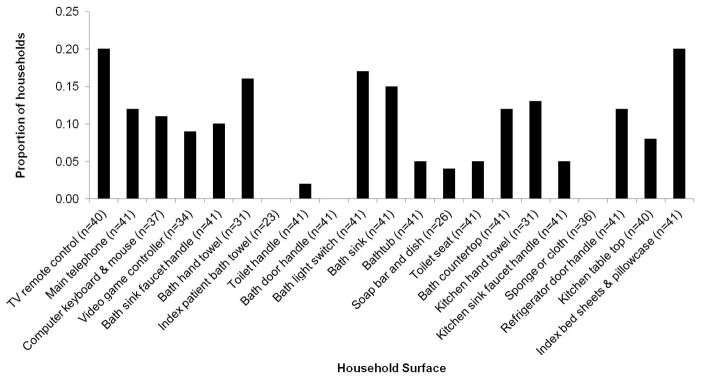
NOTE: RepPCR queries the entire chromosome but is not specific to the mecA gene; thus an MRSA and MSSA strain could be considered concordant by this typing method. N for each surface determined by whether the surface was available for sampling and if there was at least one baseline isolate for the participant (colonizing or infecting) available for analysis (nine participants had no baseline isolates available).
Of 3 participants with a baseline colonizing or infecting strain and a colonized pet, 1 participant’s strain was concordant with their pet’s strain. Within that household (2 dogs, 1 cat), 2 dogs were colonized with S. aureus, 1 with a strain type concordant with the participant, and 1 with a strain type discordant from the other dog and participant. One other household had multiple pets (2 dogs) colonized with S. aureus (with concordant strain types).
DISCUSSION
The household environment is an important reservoir for S. aureus contamination.9,11 In the present investigation of children with MRSA infection, nearly half of the household environments sampled were contaminated with MRSA. Surfaces commonly touched by multiple household members, such as the television remote control or bathroom hand towel, and surfaces with which individuals have prolonged, close contact, including bed linens, were frequently contaminated with MRSA. Interestingly, surfaces commonly perceived to be contaminated, such as toilet seats and door handles, were not major MRSA reservoirs.
The present study’s prevalence of MRSA household environmental contamination is concordant with other studies. A case-control study by Uhlemann and colleagues in Manhattan (sampling eight household surfaces on average) detected MRSA environmental contamination in significantly more case households (32%) than control households (5%). MRSA was most frequently detected on doorknobs and couches.9 In a survey by Scott et al in Boston comprised of healthy individuals with a child in diapers and a pet dog or cat, MRSA was recovered in 26% of the 35 homes sampled. Of 32 sites sampled, prevalent sites of MRSA contamination included kitchen dish towels, faucet handles, and the infant high chair tray. Household members had no known history of MRSA colonization or infection and were not cultured to detect colonization.11
In the present study, 40% of participants were colonized or infected with a S. aureus strain type concordant with a strain type recovered from their household environment. Surfaces frequently contaminated with a participant’s strain type were again those commonly handled by multiple individuals and the bed linens. In the Uhlemann study, 33% of the cases were infected with a strain type (as determined by spa typing) concordant with a strain recovered from an environmental source.9 Interestingly, the case’s infecting strain was more likely to be concordant with an environmental strain if it was a recurrent infection rather than a primary infection. This finding further implicates the environment as an important reservoir for on going exposure and recurrent infections.
Of 7 distinct S. aureus repPCR strain types identified in our study population, 3 were recovered from sites of infection. The richest strain type diversity was in isolates recovered from environmental surfaces (7strain types). These findings suggest that while S. aureus may exist on fomites, not all strain types may be well adapted to cause infection. We also evaluated all isolates for the SCCmec element. All MRSA strains possessed the SCCmec IV element, consistent with contemporary “community-associated” strains. In a study by Miller and Daum evaluating the molecular epidemiology of infecting and colonizing strains, most MRSA isolates possessed SCCmec IV.8 Interestingly, we detected genetic remnants of SCCmec and mecA in our MSSA isolates. These MSSA isolates possessed diverse SCCmec types – both the contemporary SCCmec IV, and SCCmec I, II, and III, traditionally associated with healthcare-associated strains. Detection of MSSA isolates with SCCmec genetic remnants has been described,34–36 indicating the circulation of MSSA strains with a genetic backbone similar to common MRSA strains. Thus, epidemiologic studies should consider the role MSSA plays in S. aureus transmission dynamics.
Transmission of MRSA between pets and humans has been described, although the directionality is unclear.14–17 Contact with children is a reported risk factor for pet colonization with S. aureus.6 In the present study, 10% of sampled dogs and cats were colonized with MRSA. However, purported risk factors (e.g., the pet’s overall health or recent SSTI) were not significantly associated with pet colonization. While the presence of pets was not a risk factor for environmental MRSA contamination in the present study, the survey by Scott et al demonstrated that cats were significantly associated with MRSA contamination of the household environment.11 Lastly, in the present study, 1 of 3 participants having an infecting or colonizing strain and a colonized pet carried a strain type concordant with their pet’s strain. While not evidence-based, some physicians recommend removal of or restricted contact with pets in households with recurrent MRSA infections.37,38 Further study of MRSA transmission between pets and owners will inform the management of pets in households with recurrent MRSA infections.
This study has several limitations. Colonization cultures were not obtained at the time of acute infection; 58% of participants were not colonized at enrollment, which may have resulted from systemic antibiotic administration and temporary eradication of carriage. The infecting isolate was available for only 70% of participants, limiting our analysis of the molecular epidemiology of MRSA strains recovered from participants and household surfaces. We acknowledge that participants may not have answered survey questions regarding personal hygiene and household cleaning frequency truthfully in an effort to provide “socially acceptable” responses; this may have biased the analysis of their association with the presence of MRSA in the household environment toward the null. Finally, as a prior study rarely detected MRSA in control households,9 and our study goal was to specify reservoirs of MRSA contamination in households burdened by MRSA infections, and ultimately targets for intervention, control households were not included.
Important strengths of this study are the wide geographic catchment area (121-mile diameter) of our study population and the extensive microbiologic data, culturing anatomic sites of participants, 21 environmental surfaces, and pets. We also performed molecular typing by repPCR and SCCmec typing on all S. aureus isolates to classify the recovered strains.
Although MRSA may persist on environmental surfaces for extended periods,11,39 current guidelines do not address environmental decontamination of the home.40–42 Clinicians often recommend household hygiene measures to patients in an effort to prevent recurrent CA-MRSA infections.2 Data such as ours can inform prevention strategies within the household. For example, the recommended laundering of bath towels after each use in hot water and avoiding use of bar soap may not be effective, given the low frequency with which we recovered MRSA from these sources. Additional studies to specify longitudinal MRSA household transmission dynamics and effective household decontamination strategies are needed to interrupt the spread of MRSA.
Supplementary Material
Acknowledgments
We appreciate assistance in patient recruitment by Rachel Orscheln, MD, Lisa Robertson, RN, Carol Patrick, Jeffrey Wang, J. Christian Lukas, Mary Boyle, RN, MSN, Madeline Martin, RN, BSN, Jennifer Seigel, RN, PNP and the SLCH Pediatric Ambulatory Wound Service, and Jane Garbutt, MB, ChB and the physicians and staff of the participating WUPAARC practices, including Mercy Pediatrics – Union and Washington, Johnson Pediatric Center, Heartland Pediatrics, Forest Park Pediatrics, Tots Thru Teens, Pediatric Healthcare Unlimited, Northwest Pediatrics – St. Charles, Fenton Pediatrics, LLC, and Southwest Pediatrics. We acknowledge Melanie Sullivan, MT, ASCP for assistance with molecular typing of the S. aureus isolates and the SLCH clinical microbiology laboratory technologists for procuring participants’ clinical isolates. We also thank Michael Talcott, DVM and Mary Ellenberger, DVM, MS for providing training in animal culturing, Sarah Gehlert, PhD for assistance with study design, and David Hunstad, MD for thoughtful review of this manuscript.
Funding for this project was provided by the Children’s Discovery Institute of Washington University and St. Louis Children’s Hospital; National Institutes of Health grants K23-AI091690 and UL1-TR000448; and grant R01-HS021736 from the Agency for Healthcare Research and Quality.
Footnotes
Conflict of Interest Statement: None of the authors have financial relationships relevant to this article to disclose.
Stephanie Fritz had full access to all the data in the study and takes responsibility for the integrity of the data and the accuracy of the data analysis. None of the authors have financial relationships relevant to this article to disclose.
The content is solely the responsibility of the authors and does not necessarily represent the official views of the National Institutes of Health or the Agency for Healthcare Research and Quality.
Author Contributions:
Study concept and design: Fritz, Hogan, Burnham, Fraser
Acquisition of data: Fritz, Hogan, Singh, Thompson, Wallace, Whitney, Al-Zubeidi
Analysis interpretation of data: Fritz, Hogan, Singh, Thompson, Wallace, Whitney, Burnham
Drafting of the manuscript: Fritz, Hogan, Burnham, Fraser
Critical revision of the manuscript for important intellectual content: All authors
Statistical analysis: Fritz, Hogan
Obtained funding: Fritz, Fraser
Administrative, technical, and material support: Fritz, Burnham, Fraser
Study supervision: Fritz, Burnham, Fraser.
These funding sources had no role in the design and conduct of the study; collection, management, analysis, and interpretation of the data; preparation, review, or approval of the manuscript; or decision to submit the manuscript for publication.
References
- 1.Herold BC, Immergluck LC, Maranan MC, et al. Community-acquired methicillin-resistant Staphylococcus aureus in children with no identified predisposing risk. JAMA. 1998;279(8):593–598. doi: 10.1001/jama.279.8.593. [DOI] [PubMed] [Google Scholar]
- 2.Kaplan SL. Community-acquired methicillin-resistant Staphylococcus aureus infections in children. Semin Pediatr Infect Dis. 2006;17(3):113–119. doi: 10.1053/j.spid.2006.06.004. [DOI] [PubMed] [Google Scholar]
- 3.Lina G, Piemont Y, Godail-Gamot F, et al. Involvement of Panton-Valentine leukocidin-producing Staphylococcus aureus in primary skin infections and pneumonia. Clin Infect Dis. 1999;29(5):1128–1132. doi: 10.1086/313461. [DOI] [PubMed] [Google Scholar]
- 4.Lee BY, Singh A, David MZ, et al. The economic burden of community-associated methicillin-resistant Staphylococcus aureus (CA-MRSA) Clin Microbiol Infect. 2013;19(6):528–536. doi: 10.1111/j.1469-0691.2012.03914.x. [DOI] [PMC free article] [PubMed] [Google Scholar]
- 5.Miller LG, Diep BA. Clinical practice: colonization, fomites, and virulence: rethinking the pathogenesis of community-associated methicillin-resistant Staphylococcus aureus infection. Clin Infect Dis. 2008;46(5):752–760. doi: 10.1086/526773. [DOI] [PubMed] [Google Scholar]
- 6.Davis MF, Iverson SA, Baron P, et al. Household transmission of meticillin-resistant Staphylococcus aureus and other staphylococci. Lancet Infect Dis. 2012;12(9):703–716. doi: 10.1016/S1473-3099(12)70156-1. [DOI] [PubMed] [Google Scholar]
- 7.Fritz SA, Hogan PG, Hayek G, et al. Staphylococcus aureus colonization in children with community-associated Staphylococcus aureus skin infections and their household contacts. Arch Pediatr Adolesc Med. 2012;166(6):551–557. doi: 10.1001/archpediatrics.2011.900. [DOI] [PMC free article] [PubMed] [Google Scholar]
- 8.Miller LG, Eells SJ, Taylor AR, et al. Staphylococcus aureus colonization among household contacts of patients with skin infections: risk factors, strain discordance, and complex ecology. Clin Infect Dis. 2012;54(11):1523–1535. doi: 10.1093/cid/cis213. [DOI] [PMC free article] [PubMed] [Google Scholar]
- 9.Uhlemann AC, Knox J, Miller M, et al. The environment as an unrecognized reservoir for community-associated methicillin resistant Staphylococcus aureus USA 300: a case-control study. PLoS ONE. 2011;6(7):e22407. doi: 10.1371/journal.pone.0022407. [DOI] [PMC free article] [PubMed] [Google Scholar]
- 10.Fritz SA, Hogan PG, Hayek G, et al. Household versus individual approaches to eradication of community-associated Staphylococcus aureus in children: a randomized trial. Clin Infect Dis. 2012;54(6):743–751. doi: 10.1093/cid/cir919. [DOI] [PMC free article] [PubMed] [Google Scholar]
- 11.Scott E, Duty S, Callahan M. A pilot study to isolate Staphylococcus aureus and methicillin-resistant S. aureus from environmental surfaces in the home. Am J Infect Control. 2008;36(6):458–460. doi: 10.1016/j.ajic.2007.10.012. [DOI] [PubMed] [Google Scholar]
- 12.Wagenvoort JH, Sluijsmans W, Penders RJ. Better environmental survival of outbreak vs. sporadic MRSA isolates. J Hosp Infect. 2000;45(3):231–234. doi: 10.1053/jhin.2000.0757. [DOI] [PubMed] [Google Scholar]
- 13.Oller AR, Mitchell A. Staphylococcus aureus recovery from cotton towels. J Infect Dev Ctries. 2009;3(3):224–228. doi: 10.3855/jidc.40. [DOI] [PubMed] [Google Scholar]
- 14.Weese JS, Dick H, Willey BM, et al. Suspected transmission of methicillin-resistant Staphylococcus aureus between domestic pets and humans in veterinary clinics and in the household. Vet Microbiol. 2006;115(1–3):148–155. doi: 10.1016/j.vetmic.2006.01.004. [DOI] [PubMed] [Google Scholar]
- 15.Rutland BE, Weese JS, Bolin C, Au J, Malani AN. Human-to-dog transmission of methicillin-resistant Staphylococcus aureus. Emerg Infect Dis. 2009;15(8):1328–1330. doi: 10.3201/eid1508.081635. [DOI] [PMC free article] [PubMed] [Google Scholar]
- 16.van Duijkeren E, Wolfhagen MJ, Heck ME, Wannet WJ. Transmission of a Panton-Valentine leucocidin-positive, methicillin-resistant Staphylococcus aureus strain between humans and a dog. J Clin Microbiol. 2005;43(12):6209–6211. doi: 10.1128/JCM.43.12.6209-6211.2005. [DOI] [PMC free article] [PubMed] [Google Scholar]
- 17.Boost MV, O’Donoghue MM, James A. Prevalence of Staphylococcus aureus carriage among dogs and their owners. Epidemiol Infect. 2008;136(7):953–964. doi: 10.1017/S0950268807009326. [DOI] [PMC free article] [PubMed] [Google Scholar]
- 18.Hanselman BA, Kruth SA, Rousseau J, Weese JS. Coagulase positive staphylococcal colonization of humans and their household pets. Can Vet J. 2009;50(9):954–958. [PMC free article] [PubMed] [Google Scholar]
- 19.Klevens RM, Morrison MA, Fridkin SK, et al. Community-associated methicillin-resistant Staphylococcus aureus and healthcare risk factors. Emerg Infect Dis. 2006;12(12):1991–1993. doi: 10.3201/eid1212.060505. [DOI] [PMC free article] [PubMed] [Google Scholar]
- 20.Hogan PG, Singh LN, Al-Zubeidi D, et al. Evaluation of environmental sampling methods for detection of Staphylococcus aureus for epidemiologic studies. IDWeek; San Diego, CA. 2012 Oct 17–21; A Joint Meeting of IDSA, SHEA, HIVMA, and PIDS; 2012. p. Abstract 175. [Google Scholar]
- 21.Fritz SA, Garbutt J, Elward A, Shannon W, Storch GA. Prevalence of and risk factors for community-acquired methicillin-resistant and methicillin-sensitive Staphylococcus aureus colonization in children seen in a practice-based research network. Pediatrics. 2008;121(6):1090–1098. doi: 10.1542/peds.2007-2104. [DOI] [PubMed] [Google Scholar]
- 22.Clinical and Laboratory Standards Institute. Performance Standards for Antimicrobial Susceptibility Testing; Twenty-Third Informational Supplement, M100-S23. Wayne, PA: Clinical and Laboratory Standards Institute; 2013. [Google Scholar]
- 23.Lewis JS, 2nd, Jorgensen JH. Inducible clindamycin resistance in Staphylococci: should clinicians and microbiologists be concerned? Clin Infect Dis. 2005;40(2):280–285. doi: 10.1086/426894. [DOI] [PubMed] [Google Scholar]
- 24.Kang HP, Dunne WM. Stability of repetitive-sequence PCR patterns with respect to culture age and subculture frequency. J Clin Microbiol. 2003;41(6):2694–2696. doi: 10.1128/JCM.41.6.2694-2696.2003. [DOI] [PMC free article] [PubMed] [Google Scholar]
- 25.Fritz SA, Krauss MJ, Epplin EK, et al. The natural history of contemporary Staphylococcus aureus nasal colonization in community children. Pediatr Infect Dis J. 2011;30(4):349–351. doi: 10.1097/INF.0b013e3181fe075e. [DOI] [PMC free article] [PubMed] [Google Scholar]
- 26.Tang Y-W, Stratton CW. Advanced Techniques in Diagnostic Microbiology. New York (NY): Springer Science; 2006. [Google Scholar]
- 27.El Feghaly RE, Stamm JE, Fritz SA, Burnham CA. Presence of the bla(Z) beta-lactamase gene in isolates of Staphylococcus aureus that appear penicillin susceptible by conventional phenotypic methods. Diagn Microbiol Infect Dis. 2012;74(4):388–393. doi: 10.1016/j.diagmicrobio.2012.07.013. [DOI] [PubMed] [Google Scholar]
- 28.Rychert J, Burnham CA, Bythrow M, et al. Multicenter evaluation of the Vitek MS matrix-assisted laser desorption ionization-time of flight mass spectrometry system for identification of Gram-positive aerobic bacteria. J Clin Microbiol. 2013;51(7):2225–2231. doi: 10.1128/JCM.00682-13. [DOI] [PMC free article] [PubMed] [Google Scholar]
- 29.Boye K, Bartels MD, Andersen IS, Moller JA, Westh H. A new multiplex PCR for easy screening of methicillin-resistant Staphylococcus aureus SCCmec types I-V. Clin Microbiol Infect. 2007;13(7):725–727. doi: 10.1111/j.1469-0691.2007.01720.x. [DOI] [PubMed] [Google Scholar]
- 30.Stegger M, Andersen PS, Kearns A, et al. Rapid detection, differentiation and typing of methicillin-resistant Staphylococcus aureus harbouring either mecA or the new mecA homologue mecA(LGA251) Clin Microbiol Infect. 2012;18(4):395–400. doi: 10.1111/j.1469-0691.2011.03715.x. [DOI] [PubMed] [Google Scholar]
- 31.VassarStats: Website for Statistical Computation. Fisher Exact Probability Test: 2x3. 2014 [cited 2014 May 13]. http://vassarstats.net/fisher2x3.html.
- 32.National Archives and Records Administration Department of Commerce, Bureau of the Census. Qualifying Urban Areas for the 2010 Census. Federal Register. 2012;77(59):18651–18669. [Google Scholar]
- 33.U.S. Department of Commerce USCB. TIGER/Line Shapefiles. 2012 [cited 2013 Jun 15]. ftp://ftp2.census.gov/geo/tiger/TIGER2012/UAC/
- 34.Donnio PY, Fevrier F, Bifani P, et al. Molecular and epidemiological evidence for spread of multiresistant methicillin-susceptible Staphylococcus aureus strains in hospitals. Antimicrob Agents Chemother. 2007;51(12):4342–4350. doi: 10.1128/AAC.01414-06. [DOI] [PMC free article] [PubMed] [Google Scholar]
- 35.Arbefeville SS, Zhang K, Kroeger JS, Howard WJ, Diekema DJ, Richter SS. Prevalence and genetic relatedness of methicillin-susceptible Staphylococcus aureus isolates detected by the Xpert MRSA nasal assay. J Clin Microbiol. 2011;49(8):2996–2999. doi: 10.1128/JCM.00046-11. [DOI] [PMC free article] [PubMed] [Google Scholar]
- 36.Vandendriessche S, Vanderhaeghen W, Larsen J, et al. High genetic diversity of methicillin-susceptible Staphylococcus aureus (MSSA) from humans and animals on livestock farms and presence of SCCmec remnant DNA in MSSA CC 398. J Antimicrob Chemother. 2013 doi: 10.1093/jac/dkt366. [DOI] [PubMed] [Google Scholar]
- 37.Faires MC, Tater KC, Weese JS. An investigation of methicillin-resistant Staphylococcus aureus colonization in people and pets in the same household with an infected person or infected pet. J Am Vet Med Assoc. 2009;235(5):540–543. doi: 10.2460/javma.235.5.540. [DOI] [PubMed] [Google Scholar]
- 38.Barton M, Hawkes M, Moore D, et al. Guidelines for the prevention and management of community-associated methicillin-resistant Staphylococcus aureus: A perspective for Canadian health care practitioners. Can J Infect Dis Med Microbiol. 2006;17(Suppl C):4C–24C. [PMC free article] [PubMed] [Google Scholar]
- 39.Huang R, Mehta S, Weed D, Price CS. Methicillin-resistant Staphylococcus aureus survival on hospital fomites. Infect Control Hosp Epidemiol. 2006;27(11):1267–1269. doi: 10.1086/507965. [DOI] [PubMed] [Google Scholar]
- 40.Creech CB, Beekmann SE, Chen Y, Polgreen PM. Variability among pediatric infectious diseases specialists in the treatment and prevention of methicillin-resistant Staphylococcus aureus skin and soft tissue infections. Pediatr Infect Dis J. 2008;27(3):270–272. doi: 10.1097/INF.0b013e31815c9068. [DOI] [PubMed] [Google Scholar]
- 41.Stevens DL, Bisno AL, Chambers HF, et al. Practice guidelines for the diagnosis and management of skin and soft-tissue infections. Clin Infect Dis. 2005;41(10):1373–1406. doi: 10.1086/497143. [DOI] [PubMed] [Google Scholar]
- 42.Gorwitz RJ, Jernigan DB, Powers JH, Jernigan JA. Participants in the CDC-Convened Experts’ Meeting on Management of MRSA in the Community. Strategies for clinical management of MRSA in the community: Summary of an experts’ meeting convened by the Centers for Disease Control and Prevention. 2006 http://www.cdc.gov/ncidod/dhqp/ar_mrsa_ca.html.
Associated Data
This section collects any data citations, data availability statements, or supplementary materials included in this article.