



Abstract
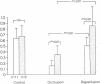
Currently available noninvasive techniques are unable to rapidly assess artery patency and tissue viability during acute myocardial infarction. In prior studies, rubidium-82 (Rb-82), a short-lived positron emitter obtained from a generator, was validated as an indicator of flow with a model that included the rate constants for transfer into and out of the cell. Accordingly, in the current study, 20 open-chested dogs with experimental infarction were studied serially at base line, after coronary occlusion, and at reperfusion. Time-activity curves acquired with beta probes on the epicardial surface were used to measure flow and net transfer of rubidium. Flow decreased to 0.41 +/- 0.08 ml/min per gram during occlusion and increased to 2.73 +/- 0.56 ml/min per gram in potentially viable ischemic tissue, whereas flows were 0.32 +/- 0.08 during occlusion (P less than 0.05 vs. viable) and 1.58 ml/min per gram (P less than 0.002 vs. viable) in irreversibly injured tissue. The transfer rate constant for Rb-82, kT, at base line was +1.22 +/- 0.60 X 10(-3) s-1 and did not change significantly during occlusion in viable vs. nonviable samples (+1.41 +/- 1.27 vs. +0.93 +/- 1.51 X 10(-3) s-1, respectively), except that 4 out of 11 nonviable tissue samples had negative kTs. At reperfusion, viable myocardial samples were all positive (+1.26 +/- 1.58 X 10(-3) s-1), whereas all irreversibly injured tissues had a negative kT, indicating leakage of tracer (-1.50 +/- 1.10 X 10(-3) s-1, P less than 0.001). This study suggests that Rb-82 time-activity curves can be useful to determine patency of an infarct related artery and potential viability after reperfusion during myocardial infarction.
Full text
PDF


Images in this article
Selected References
These references are in PubMed. This may not be the complete list of references from this article.
- Becker L., Ferreira R., Thomas M. Comparison of 86Rb and microsphere estimates of left ventricular bloodflow distribution. J Nucl Med. 1974 Nov;15(11):969–973. [PubMed] [Google Scholar]
- Bresnahan G. F., Roberts R., Shell W. E., Ross J., Jr, Sobel B. E. Deleterious effects due to hemorrhage after myocardial reperfusion. Am J Cardiol. 1974 Jan;33(1):82–86. doi: 10.1016/0002-9149(74)90742-5. [DOI] [PubMed] [Google Scholar]
- DONATO L., BARTOLOMEI G., GIORDANI R. EVALUATION OF MYOCARDIAL BLOOD PERFUSION IN MAN WITH RADIOACTIVE POTASSIUM OR RUBIDIUM AND PRECORDIAL COUNTING. Circulation. 1964 Feb;29:195–203. doi: 10.1161/01.cir.29.2.195. [DOI] [PubMed] [Google Scholar]
- Ellis S. G., Henschke C. I., Sandor T., Wynne J., Braunwald E., Kloner R. A. Time course of functional and biochemical recovery of myocardium salvaged by reperfusion. J Am Coll Cardiol. 1983 Apr;1(4):1047–1055. doi: 10.1016/s0735-1097(83)80107-7. [DOI] [PubMed] [Google Scholar]
- Fishbein M. C., Meerbaum S., Rit J., Lando U., Kanmatsuse K., Mercier J. C., Corday E., Ganz W. Early phase acute myocardial infarct size quantification: validation of the triphenyl tetrazolium chloride tissue enzyme staining technique. Am Heart J. 1981 May;101(5):593–600. doi: 10.1016/0002-8703(81)90226-x. [DOI] [PubMed] [Google Scholar]
- Goldstein R. A., Klein M. S., Welch M. J., Sobel B. E. External assessment of myocardial metabolism with C-11 palmitate in vivo. J Nucl Med. 1980 Apr;21(4):342–348. [PubMed] [Google Scholar]
- Goldstein R. A., Mullani N. A., Marani S. K., Fisher D. J., Gould K. L., O'Brien H. A., Jr Myocardial perfusion with rubidium-82. II. Effects of metabolic and pharmacologic interventions. J Nucl Med. 1983 Oct;24(10):907–915. [PubMed] [Google Scholar]
- Heymann M. A., Payne B. D., Hoffman J. I., Rudolph A. M. Blood flow measurements with radionuclide-labeled particles. Prog Cardiovasc Dis. 1977 Jul-Aug;20(1):55–79. doi: 10.1016/s0033-0620(77)80005-4. [DOI] [PubMed] [Google Scholar]
- Ishii Y., MacIntyre W. J., Pritchard W. H., Eckstein R. W. Measurement of total myocardial blood flow in dogs with 43K and the scintillation camera. Circ Res. 1973 Jul;33(1):113–122. doi: 10.1161/01.res.33.1.113. [DOI] [PubMed] [Google Scholar]
- Kloner R. A., Ganote C. E., Jennings R. B. The "no-reflow" phenomenon after temporary coronary occlusion in the dog. J Clin Invest. 1974 Dec;54(6):1496–1508. doi: 10.1172/JCI107898. [DOI] [PMC free article] [PubMed] [Google Scholar]
- LOVE W. D., BURCH G. E. Influence of the rate of coronary plasma flow on the extraction of Rb86 from coronary blood. Circ Res. 1959 Jan;7(1):24–30. doi: 10.1161/01.res.7.1.24. [DOI] [PubMed] [Google Scholar]
- Lerch R. A., Ambos H. D., Bergmann S. R., Sobel B. E., Ter-Pogossian M. M. Kinetics of positron emitters in vivo characterized with a beta probe. Am J Physiol. 1982 Jan;242(1):H62–H67. doi: 10.1152/ajpheart.1982.242.1.H62. [DOI] [PubMed] [Google Scholar]
- Lerch R. A., Ambos H. D., Bergmann S. R., Welch M. J., Ter-Pogossian M. M., Sobel B. E. Localization of viable, ischemic myocardium by positron-emission tomography with 11C-palmitate. Circulation. 1981 Oct;64(4):689–699. doi: 10.1161/01.cir.64.4.689. [DOI] [PubMed] [Google Scholar]
- Lerch R. A., Bergmann S. R., Ambos H. D., Welch M. J., Ter-Pogossian M. M., Sobel B. E. Effect of flow-independent reduction of metabolism on regional myocardial clearance of 11C-palmitate. Circulation. 1982 Apr;65(4):731–738. doi: 10.1161/01.cir.65.4.731. [DOI] [PubMed] [Google Scholar]
- Marshall R. C., Tillisch J. H., Phelps M. E., Huang S. C., Carson R., Henze E., Schelbert H. R. Identification and differentiation of resting myocardial ischemia and infarction in man with positron computed tomography, 18F-labeled fluorodeoxyglucose and N-13 ammonia. Circulation. 1983 Apr;67(4):766–778. doi: 10.1161/01.cir.67.4.766. [DOI] [PubMed] [Google Scholar]
- Mullani N. A., Goldstein R. A., Gould K. L., Marani S. K., Fisher D. J., O'Brien H. A., Jr, Loberg M. D. Myocardial perfusion with rubidium-82. I. Measurement of extraction fraction and flow with external detectors. J Nucl Med. 1983 Oct;24(10):898–906. [PubMed] [Google Scholar]
- Neirinckx R. D., Kronauge J. F., Gennaro G. P., Loberg M. D. Evaluation of inorganic adsorbents for the rubidium-82 generator: I. Hydrous SnO2. J Nucl Med. 1982 Mar;23(3):245–249. [PubMed] [Google Scholar]
- Parkey R. W., Bonte F. J., Meyer S. L., Atkins J. M., Curry G. L., Stokely E. M., Willerson J. T. A new method for radionuclide imaging of acute myocardial infarction in humans. Circulation. 1974 Sep;50(3):540–546. doi: 10.1161/01.cir.50.3.540. [DOI] [PubMed] [Google Scholar]
- Pohost G. M., Zir L. M., Moore R. H., McKusick K. A., Guiney T. E., Beller G. A. Differentiation of transiently ischemic from infarcted myocardium by serial imaging after a single dose of thallium-201. Circulation. 1977 Feb;55(2):294–302. doi: 10.1161/01.cir.55.2.294. [DOI] [PubMed] [Google Scholar]
- Ritchie J. L., Zaret B. L., Strauss H. W., Pitt B., Berman D. S., Schelbert H. R., Ashburn W. L., Berger H. J., Hamilton G. W. Myocardial imaging with thallium-201: a multicenter study in patients with angina pectoris or acute myocardial infarction. Am J Cardiol. 1978 Sep;42(3):345–350. doi: 10.1016/0002-9149(78)90926-8. [DOI] [PubMed] [Google Scholar]
- Schaper J., Schaper W. Reperfusion of ischemic myocardium: ultrastructural and histochemical aspects. J Am Coll Cardiol. 1983 Apr;1(4):1037–1046. doi: 10.1016/s0735-1097(83)80106-5. [DOI] [PubMed] [Google Scholar]
- Schelbert H. R., Ashburn W. L., Chauncey D. M., Halpern S. E. Comparative myocardial uptake of intravenously administered radionuclides. J Nucl Med. 1974 Dec;15(12):1092–1100. [PubMed] [Google Scholar]
- Schelbert H. R., Phelps M. E., Hoffman E. J., Huang S. C., Selin C. E., Kuhl D. E. Regional myocardial perfusion assessed with N-13 labeled ammonia and positron emission computerized axial tomography. Am J Cardiol. 1979 Feb;43(2):209–218. doi: 10.1016/s0002-9149(79)80006-5. [DOI] [PubMed] [Google Scholar]
- Sheehan R. M., Renkin E. M. Capillary, interstitial, and cell membrane barriers to blood-tissue transport of potassium and rubidium in mammalian skeletal muscle. Circ Res. 1972 May;30(5):588–607. doi: 10.1161/01.res.30.5.588. [DOI] [PubMed] [Google Scholar]
- Ter-Pogossian M. M., Klein M. S., Markham J., Roberts R., Sobel B. E. Regional assessment of myocardial metabolic integrity in vivo by positron-emission tomography with 11C-labeled palmitate. Circulation. 1980 Feb;61(2):242–255. doi: 10.1161/01.cir.61.2.242. [DOI] [PubMed] [Google Scholar]
- Wackers F. J., Sokole E. B., Samson G., Schoot J. B., Lie K. I., Liem K. L., Wellens H. J. Value and limitations of thallium-201 scintigraphy in the acute phase of myocardial infarction. N Engl J Med. 1976 Jul 1;295(1):1–5. doi: 10.1056/NEJM197607012950101. [DOI] [PubMed] [Google Scholar]
- Willerson J. T., Parkey R. W., Bonte F. J., Meyer S. L., Stokely E. M. Acute subendocardial myocardial infarction in patients. Its detection by Technetium 99-m stannous pyrophosphate myocardial scintigrams. Circulation. 1975 Mar;51(3):436–441. doi: 10.1161/01.cir.51.3.436. [DOI] [PubMed] [Google Scholar]
- Ziegler W. H., Goresky C. A. Kinetics of rubidium uptake in the working dog heart. Circ Res. 1971 Aug;29(2):208–220. doi: 10.1161/01.res.29.2.208. [DOI] [PubMed] [Google Scholar]