



Abstract
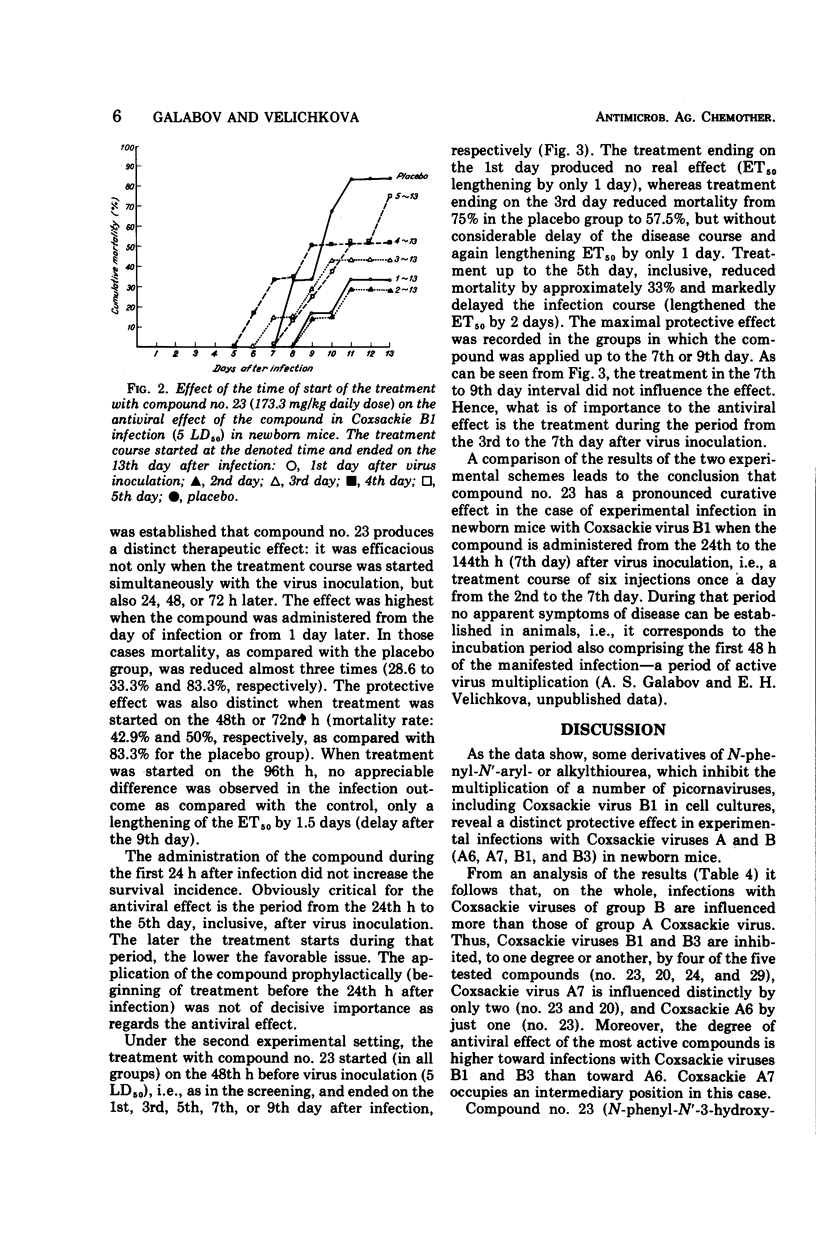
The effect of five derivatives of N-phenyl-N′-aryl- or alkylthiourea—inhibitors of the multiplication of Coxsackie virus B1 and other picornaviruses in vitro—was tested in experimental infections with Coxsackie viruses B1, B3, A6, and A7 in newborn mice. Under the action of N-phenyl-N′-3-hydroxyphenylthiourea (no. 23) and N-phenyl-N′-4-carboxy-5-hydroxyphenylthiourea (no. 20) a two- to threefold reduction in mortality was observed, as well as an appreciable delay in the course of the disease (mean effective dose, lengthening by 2 to 6 days) after infection with Coxsackie viruses B1, B3, and A7. The infection with Coxsackie virus A6 was affected only by compound no. 23 and, at that, to a low degree. If the antiviral effect is to be obtained, the compounds must be applied daily (once subcutaneously) from the 24th to the 144th h after virus inoculation, a period which corresponds to the incubation period and the beginning of the manifested infection. On the basis of these data, as well as of the relatively high selectivity (therapeutic index of 3 to 20), the two indicated substances may be considered to be reliable antiviral chemotherapeutic agents.
Full text
PDF




Selected References
These references are in PubMed. This may not be the complete list of references from this article.
- BARRERA-ORO J. G., MELNICK J. L. The effect of guanidine: (1). On experimental poliomyelitis induced by oral administration of virus to cynomolgus monkeys; (2). On naturally occurring enteroviruses of cynomolgus monkeys. Tex Rep Biol Med. 1961;19:529–539. [PubMed] [Google Scholar]
- Galabov A., Shindarov L., Vassilev G., Vassileva R. Inhibitory effect of N-phenyl-N'-aryl or alkylthiourea derivatives on poliovirus multiplication in cell cultures. Chemotherapy. 1972;17(3):161–174. doi: 10.1159/000220850. [DOI] [PubMed] [Google Scholar]
- Galabov A., Shindarov L., Vassilev G., Vassileva R. Inhibitory effect of N-phenyl-N'-aryl or alkylthiourea derivatives on the multiplication of some picornaviruses (Coxsackie B 1, ECHO 19, and foot-and-mouth disease virus) in cell cultures. Arch Gesamte Virusforsch. 1972;38(2):159–166. doi: 10.1007/BF01249666. [DOI] [PubMed] [Google Scholar]
- Kucera L. S., Herrmann E. C., Jr Gradient plate technique applied to the study of antiviral substances. Proc Soc Exp Biol Med. 1966 May;122(1):258–262. doi: 10.3181/00379727-122-31104. [DOI] [PubMed] [Google Scholar]
- LODDO B., FERRARI W., SPANEDDA A., BROTZU G. In vitro guanidino-resistance and guanidino-dependence of poliovirus. Experientia. 1962 Nov 15;18:518–519. doi: 10.1007/BF02151608. [DOI] [PubMed] [Google Scholar]
- Link F., Rada B., Blaskovic D. Problems of in vitro and in vivo testing of antiviral substances. Ann N Y Acad Sci. 1965 Jul 30;130(1):31–43. doi: 10.1111/j.1749-6632.1965.tb12536.x. [DOI] [PubMed] [Google Scholar]
- RIGHTSEL W. A., DICE J. R., McALPINE R. J., TIMM E. A., McLEAN I. W., Jr, DIXON G. J., SCHABEL F. M., Jr Antiviral effect of guanidine. Science. 1961 Aug 25;134(3478):558–559. doi: 10.1126/science.134.3478.558. [DOI] [PubMed] [Google Scholar]
- TAMM I., EGGERS H. J. SPECIFIC INHIBITION OF REPLICATION OF ANIMAL VIRUSES. Science. 1963 Oct 4;142(3588):24–33. doi: 10.1126/science.142.3588.24. [DOI] [PubMed] [Google Scholar]
- Tamm I., Eggers H. J. Chemical approaches to selective inhibition of viral multiplication. Calif Med. 1965 Nov;103(5):305–309. [PMC free article] [PubMed] [Google Scholar]