



Abstract
Background
During the 2009 influenza pandemic both seasonal and 2009 pandemic vaccines were recommended. We conducted a randomized trial of monovalent 2009-H1N1 vaccine and seasonal trivalent inactivated influenza vaccine (IIV3) given sequentially or concurrently to adults.
Methods
Adults randomized to 4 study groups and stratified by age (18-64 and ≥65 years) received 1 dose of seasonal IIV3 or placebo and 2 doses of 2009-H1N1 vaccine or placebo in one of 4 combinations, i.e., H1N1+Placebo/H1N1+Placebo/IIV3 (HP/HP/V3), H1N1+ IIV3/H1N1+Placebo/Placebo (HV3/HP/P), H1N1+Placebo/H1N1+ IIV3/Placebo (HP/HV3/P), and IIV3+Placebo/H1N1+Placebo/H1N1 (V3P/HP/H). Intramuscular injections were given three times at 21 day intervals. Sera for antibody assays were obtained prior to and 21 days after each vaccination. Reactogenicity and adverse events were monitored.
Results
Eight hundred-five (805) adults were enrolled. All combinations of vaccines were safe and well tolerated. In general, one dose of 2009-H1N1 and one dose of IIV3, regardless of sequence or concurrency of administration, were immunogenic in adults. There were no significant differences in geometric mean titers (GMT) or the proportions of subjects with ≥4-fold rise in antibody responses and titers ≥40 for any vaccine group or between age strata for 2009-H1N1 after the first or second dose, although the vaccine sequence affected the titers to the IIV3 antigens. Hemagglutination inhibition antibody (HAI) GMTs against 2009-H1N1 for the combined age strata 21 days after the first 2009-H1N1 dose were 190.4, 182.1, 232.9 and 157.5 for HP/HP/V3, HV3/HP/P, HP/HV3/P and V3P/HP/H, respectively. While IIV3 GMTs were adequate they were generally lower than the 2009-H1N1 GMTs. In a subset of subjects, there was good correlation between HAI and microneutralization (MN) titers (Spearman's correlation coefficient 0.92).
Conclusions
All vaccine combinations were generally well tolerated. Immune responses to one dose of 2009-H1N1 were adequate regardless of the sequence of vaccination in all age groups, but the sequence affected titers to IIV3 antigens.
Keywords: Influenza vaccine, 2009-H1N1, seasonal IIV3, pandemic, adults, elderly, concurrent, sequential, HAI, microneutralization
Introduction
During April 2009, the pandemic 2009-H1N1 influenza virus (A/California/7/09) was identified as a novel influenza strain(1-4). Although children and young adults had little pre-existing antibody to this virus, some studies found older adults did have pre-existing antibody to 2009-H1N1(5-7). Concern about the potential impact of the 2009-H1N1 virus led to rapid evaluation of a monovalent pandemic H1N1 vaccine in adults and children(8-17). This study was designed to inform U.S. policy by determining whether the receipt of pandemic monovalent 2009-H1N1 inactivated influenza vaccine (2009-H1N1) concurrently with, prior to, or following licensed seasonal inactivated influenza vaccine (IIV3) affected the reactogenicity or antibody responses for either vaccine in adults aged ≥18 years.
Methods
Vaccines
The split-virion 2009 pandemic influenza vaccine (Sanofi Pasteur, one lot,UD12415) contained 15 μg/0.5mL of H1 hemagglutinin (HA) [A/California/7/09 (H1N1)-like virus] based on high performance liquid chromatography (HPLC) potency testing. Subsequent testing with single radial immunodiffusion (SRID) found the potency of the vaccine to be 22-25μg/0.5mL. The 2009-2010 IIV3 (Sanofi Pasteur, one lot, U3189AA) contained 15μg HA each of A/Brisbane/59/2007 (H1N1), A/Uruguay/716/2007 [A/Brisbane/10/2007 (H3N2)-like virus] and B/Brisbane/60/2008. The placebo was normal saline. All injections were administered as a single 0.5 mL intramuscular injection into the deltoid muscle; one per arm.
Subjects and Study design
Subjects, ≥18 years of age, were enrolled in an NIH-sponsored, randomized, placebo-controlled phase II vaccine trial conducted at 4 sites in the United States. The study was approved by the Institutional Review Board of each of the participating sites and all subjects provided informed consent. Subjects were randomized in a 1:1:1:1 ratio to 4 groups (Figure 1), stratified by age [planned 200 subjects per group with 100 subjects per age-stratum (18-64 or ≥65 years)], to receive 1 dose of IIV3 or placebo and 2 doses of 2009-H1N1 vaccine or placebo in one of 4 combinations such that each subject received 2 injections (one per arm) on Days 0 and 21 and 1 injection on Day 42. The groups are as follows: H1N1+Placebo/H1N1+Placebo/IIV3 (HP/HP/V3), H1N1+ IIV3/H1N1+Placebo/Placebo (HV3/HP/P), H1N1+Placebo/H1N1+ IIV3/Placebo (HP/HV3/P), and IIV3+Placebo/H1N1+Placebo/H1N1 (V3P/HP/H).
Figure 1. DMID 09-0039.

Figure 1 provides the study groups, and the number of subjects randomized and included in the immunogenicity anaylsis.
V3 = trivalent vaccine, H = 2009 H1N1, P=placebo
H1N1+Placebo/H1N1+Placebo/IIV3 = HP/HP/V3; H1N1+IIV3/H1N1+Placebo/Placebo = HV3/HP/P; H1N1+Placebo/H1N1+IIV3/Placebo = HP/HV3/P; and IIV3+Placebo/H1N1+Placebo/H1N1 = V3P/HP/H
Safety and Immunogenicity
Safety was measured by assessment of reactogenicity for 8 days and adverse events (AEs) for 21 days after each vaccination, and serious adverse events (SAEs) and new-onset chronic medical conditions for 8 months after first vaccination. HAI titers were measured prior to each vaccination and 21 days following the last vaccination. Microneutralization (MN) titers were measured against 2009-H1N1 on a subset of subjects per group prior to and 21 days after the first vaccination.
Antibody Assays
Southern Research Institute (SR) performed HAI assays(18) and MN assays(19)for 2009-H1N1 and Cincinnati Children's Hospital Medical Center performed a standard HAI assay for seasonal influenza as previously described(18). Virus reference strains were provided by the Center for Disease Control and Prevention (CDC).
Enrollment Criteria
Healthy, nonpregnant adults ≥18 years of age were eligible to participate if they had not previously received a 2009-2010 seasonal influenza vaccine. Women of childbearing potential used adequate contraception from the time of enrollment through 30 days after the last vaccination. Exclusions included egg allergy; acute illness; oral temperature ≥101°F (≥38.3°C) within 3 days prior to vaccination; history of Guillain-Barré Syndrome; immunosuppression, or planned travel outside of North America within the 63 days after first vaccination (full enrollment criteria available at clinicaltrials.gov NCT00943878).
Statistical Analyses
The sample size for this phase II study was powered to detect differences in immune response rates without correction for multiple comparisons. It was projected to have 80% power for a two-tail test with Type I Error=5.0% to detect different frequencies between two vaccine groups within the same age-stratum when the true differences were more than 27%. The sample size was determined to have >95% power to observe one or more SAEs related to vaccination when the true underlying rate was 0.50%. Within a single age-stratum vaccine schedule-specific group, the power was 78% to observe one or more such events when the true rate was 3.0%.
Safety
Injection site and systemic reactogenicity summary rates were analyzed by dichotomizing the most severe response for each event over the 8 day post vaccination period into binary variables (none versus mild, moderate or severe) and using exact confidence intervals. Unsolicited AEs were reported using rates and exact 95% confidence intervals.
Immunogenicity
The proportions of subjects achieving ≥4-fold rise in HAI titer, an HAI titer of ≥40 and the geometric mean titers (GMT) at 21 days after each vaccination were evaluated. Analyses of GMTs were computed on a logarithmic scale and converted back to the original scale.
Unless otherwise noted, analyses were primarily conducted using analysis of variance for continuous variables, with results occasionally confirmed, but not reported, using standard non-parametric methods. Binary results were analyzed using logistic regression and contingency table methods. Ten subjects with unknown prior influenza vaccination status were not included in multivariate modeling.
Results
Subject Characteristics and Safety Results
Eight hundred-five (805) subjects were vaccinated between August 7 and 28, 2009. Fifty-five percent of the subjects were female, 91% were white, and 96% were non-Hispanic (Table 1). There were 408 (50.7%) subjects in the 18-64 year old group, median age 48.3 (range 18-64) years and 397 (49.3%) subjects in the ≥ 65 years old group, median age 70.4 (range 65-92) years. Overall the median age was 64.5 (range 18-92) years. Ethnicity, race, percentage of males and age did not vary significantly across treatment groups.
Table 1. Demographics by Demographic Data by Study Group and Age Stratum.
| All Groups (N= 805) |
HP/HP/V3 (N= 202) |
HV3/HP/P (N= 200) |
HP/HV3/P (N= 203) |
V3/HP/H (N= 200) |
|||||||||||
|---|---|---|---|---|---|---|---|---|---|---|---|---|---|---|---|
| All | Age 18-64 yr (N=408) | Age ≥65 yr (N=397) | All | Age 18-64 yr (N=101) | Age ≥65 yr (N=101) | All | Age 18-64 yr (N=103) | Age ≥65 yr (N=97) | All | Age 18-64 yr (N=102) | Age ≥65 yr (N=101) | All | Age 18-64 yr (N=102) | Age ≥65 yr (N=98) | |
| Gender -- N(%) | |||||||||||||||
| Male | 361 (45) | 167 (41) | 194 (49) | 103 (51) | 44 (44) | 59 (58) | 82 (41) | 39 (38) | 43 (44) | 99 (49) | 44 (43) | 55 (54) | 77 (39) | 40 (39) | 37 (38) |
| Female | 444 (55) | 241 (59) | 203 (51) | 99 (49) | 57 (56) | 42 (42) | 118 (59) | 64 (62) | 54 (56) | 104 (51) | 58 (57) | 46 (46) | 123 (62) | 62 (61) | 61 (62) |
| Ethnicity -- N(%) | |||||||||||||||
| Non-Hispanic | 773 (96) | 380 (93) | 393 (99) | 194 (96) | 95 (94) | 99 (98) | 191 (96) | 95 (92) | 96 (99) | 194 (96) | 93 (91) | 101 (100) | 194 (97) | 97 (95) | 97 (99) |
| Hispanic | 32 (4) | 28 (7) | 4 (1) | 8 (4) | 6 (6) | 2 (2) | 9 (5) | 8 (8) | 1 (1) | 9 (4) | 9 (9) | 0 | 6 (3) | 5 (5) | 1 (1) |
| Race -- N(%) | |||||||||||||||
| Asian | 12 (1) | 12 (3) | 0 | 2 (1) | 2 (2) | 0 | 3 (2) | 3 (3) | 0 | 3 (1) | 3 (3) | 0 | 4 (2) | 4 (4) | 0 |
| Hawaiian/Pacific Islander | 1 (0) | 1 (0) | 0 | 0 | 0 | 0 | 0 | 0 | 0 | 1 (0) | 1 (1) | 0 | 0 | 0 | 0 |
| Black/African American | 44 (5) | 33 (8) | 11 (3) | 7 (3) | 6 (6) | 1 (1) | 11 (6) | 5 (5) | 6 (6) | 11 (5) | 10 (10) | 1 (1) | 15 (8) | 12 (12) | 3 (3) |
| White | 734 (91) | 351 (86) | 383 (96) | 189 (94) | 90 (89) | 99 (98) | 181 (91) | 91 (88) | 90 (93) | 186 (92) | 87 (85) | 99 (98) | 178 (89) | 83 (81) | 95 (97) |
| Multi-Racial | 8 (1) | 7 (2) | 1 (0) | 1 (0) | 1 (1) | 0 | 3 (2) | 2 (2) | 1 (1) | 1 (0) | 1 (1) | 0 | 3 (2) | 3 (3) | 0 |
| Other/Unknown | 6 (1) | 4 (1) | 2 (1) | 3 (1) | 2 (2) | 1 (1) | 2 (1) | 2 (2) | 0 | 1 (0) | 0 | 1 (1) | 0 | 0 | 0 |
| Age | |||||||||||||||
| Mean (STD) | 58.8 (16.2) | 45.9 (12.2) | 72.1 (5.6) | 59.2 (16.2) | 46.5 (12.6) | 72.0 (6.1) | 58.4 (16.7) | 45.2 (12.3) | 72.4 (5.6) | 58.5 (16.6) | 44.9 (12.3) | 72.1 (5.3) | 59.1 (15.3) | 47.0 (11.5) | 71.6 (5.5) |
| Median | 64.5 | 48.3 | 70.4 | 65.0 | 48.4 | 69.9 | 64.1 | 46.6 | 71.1 | 64.9 | 48.6 | 70.5 | 62.8 | 48.7 | 70.1 |
| Min,Max | (18, 92) | (18, 64) | (65, 92) | (18, 92) | (18, 64) | (65, 92) | (21, 87) | (21, 64) | (65, 87) | (20, 89) | (20, 64) | (65, 89) | (18, 88) | (18, 64) | (65, 88) |
V3 = trivalent vaccine, H = 2009 H1N1, P=placebo
H1N1+Placebo/H1N1+Placebo/IIV3 = HP/HP/V3; H1N1+IIV3/H1N1+Placebo/Placebo = HV3/HP/P; H1N1+Placebo/H1N1+IIV3/Placebo = HP/HV3/P; and IIV3+Placebo/H1N1+Placebo/H1N1= V3P/HP/H
Forty subjects received only the first dose(s) of vaccine(s) at Day 0, and 19 subjects did not receive the third dose (Figure 1). Reasons for not receiving the full vaccine schedule included reaction to prior dose(s) (n=2); unrelated illness (n=25); no longer eligible, mostly due to new or changed medications (n=21); subject noncompliance with the visit schedule (n=10); and subject refusal (n=1). Fourteen and 11 subjects did not complete the Day 42 and/or Day 63 blood draw, respectively.
Injection Site Reactogenicity
The percentages of subjects in each treatment group who experienced any injection site reaction (pain, tenderness or swelling) in the eight days after vaccinations ranged from 71.3 - 78.0%(data not shown). Tenderness and pain were the most common injection site reactions across all groups and vaccinations.
No subjects experienced severe injection site reactions after any vaccination. Moderate injection site reactions occurred in 47 (6%) subjects after the first two injections on Day 0, 36 (4%) subjects after the second two injections on Day 21, and 22 (3%) subjects after the third injection on Day 42. There were no significant differences by vaccine group or whether vaccines were given sequentially or concurrently (Table 2 for moderate combined with severe reactogenicity and adverse event grading).
Table 2. Proportion1 of Subjects Reporting Moderate and/or Severe Solicited Systemic and Local Reactions2 in the 8 Days After Each Vaccination.
| Study Group (Dose 1/Dose 2/Dose 3) | Age Stratum | Vaccine 1 (%) | Vaccine 2 (%) | Vaccine 3 (%) | ||||||||
|---|---|---|---|---|---|---|---|---|---|---|---|---|
| HP/HP/V3 | 18-64 yr | N | Systemic | Injection Site | N | Systemic | Injection Site | N | Systemic | Inj. Site | ||
| H1N1 Arm | Placebo Arm | H1N1 Arm | Placebo Arm | IIV3 Arm | ||||||||
| 101 | 15 | 5 | 4 | 95 | 9 | 7 | 1 | 95 | 5 | 9 | ||
| ≥ 65 yr | 101 | 6 | 0 | 0 | 984 | 5 | 0 | 0 | 95 | 1 | 5 | |
| HV3/HP/P | 18-64 yr | N | Systemic | Injection Site | N | Systemic | Injection Site | N | Systemic | Inj. Site | ||
| H1N1 Arm | IIV3 Arm | H1N1 Arm | Placebo Arm | Placebo Arm | ||||||||
| 103 | 19 | 4 | 12 | 97 | 11 | 3 | 0 | 95 | 5 | 2 | ||
| ≥ 65 yr | 97 | 1 | 1 | 6 | 93 | 2 | 1 | 0 | 90 | 4 | 0 | |
| HP/HV3/P | 18-64 yr | N | Systemic | Injection Site | N | Systemic | Injection Site | N | Systemic | Inj. Site | ||
| H1N1 Arm | Placebo Arm | H1N1 Arm | IIV3 Arm | Placebo Arm | ||||||||
| 102 | 5 | 3 | 2 | 95 | 12 | 4 | 7 | 90 | 8 | 1 | ||
| ≥ 65 yr | 101 | 3 | 1 | 0 | 94 | 6 | 2 | 6 | 93 | 7 | 1 | |
| V3P/HP/H | 18-64 yr | N | Systemic | Injection Site | N | Systemic | Injection Site | N | Systemic | Inj. Site | ||
| Placebo Arm | IIV3 Arm | H1N1 Arm | Placebo Arm | H1N1 Arm | ||||||||
| 102 | 14 | 3 | 11 | 97 | 8 | 4 | 3 | 96 | 5 | 6 | ||
| ≥ 65 yr | 98 | 6 | 2 | 3 | 95 | 4 | 1 | 1 | 92 | 0 | 0 | |
| Vaccination visits where both H1N1 and IIV3 are given are shaded | ||||||||||||
Since N is near 100 for each group/age stratum, the number of subjects reporting moderate and/or severe events is equivalent to the percentage; therefore, only the percentage is presented.
Reasctions were graded as mild, moderate or severe. Mild events did not interfere with daily activity. Moderate events resulted in some interference with daily activity. Severe events resulted in significant interference of daily activity. Fever was graded as mild (38.0-38.4° C), moderate (38.5-38.9° C) or severe (≥39°C).
H1N1+Placebo/H1N1+Placebo/IIV3 = HP/HP/V3; H1N1+IIV3/H1N1+Placebo/Placebo = HV3/HP/P; H1N1+Placebo/H1N1+IIV3/Placebo = HP/HV3/P; and IIV3+Placebo/H1N1+Placebo/H1N1= V3P/HP/H
Reactogenicity data for one subject was not available.
V3 = trivalent vaccine, H = 2009 H1N1, P=placebo
Nine (1%) subjects experienced large (>50mm) injection site erythema and/or swelling post vaccination, across all treatment groups. Only in the HV3/HP/P group did subjects report large reactions after receipt of concurrently administered vaccines, with 2 subjects reporting large swelling after receiving both products at Day 0, one in the arm that received 2009-H1N1 and one in the arm that received V3(data not shown).
Systemic Reactions
Among all subjects, 7 (0.9%) experienced severe solicited systemic reactions after vaccination, i.e., 2, 3, 1 and 1 subjects in the HP/HP/V3, HV3/HP/P, HP/HV3/P, V3P/HP/H groups, respectively (Table 2 for moderate combined with severe reactogenicity and adverse event grading). Six subjects were in the younger age stratum. No subjects reported severe fever (>39°C) after any dose. Overall, there were no significant differences within any age strata for the solicited systemic symptoms after any vaccination. In general, more subjects 18-64 years of age (47.1%-63.4%) reported solicited systemic symptoms compared to the ≥65 years old group (29.6%-42.6%), with more than twice the number of subjects in the younger age group reporting symptoms after the first dose compared to subjects ≥65 years. Across all vaccinations and study groups, headache was the most prominent systemic symptom reported followed by malaise. In contrast, subjects in the ≥65 years age group reported a higher frequency of malaise than headache compared to the younger age group.
Unsolicited Adverse Events
A total of 858 unsolicited nonserious AEs were reported by 465 (57.8%) subjects; of these 111 (13.8%) subjects reported events considered to be associated to vaccine. There were no significant differences in the proportion of subjects in the 4 groups experiencing events considered to be associated with vaccination between study groups. Significantly more subjects experienced AEs associated with vaccination in the younger group [78(19.1%)] than in the older group [33(8.3%)] (p<0.001). There were 48 severe unsolicited AEs reported over the course of the study; 36 of these events were considered to be SAEs, unrelated to study vaccines. Only two severe events, vomiting and possible tendonitis with fasciitis (both non-serious) were considered associated with vaccine. One death occurred due to acute subarachnoid hemorrhage in an 82 year-old subject.
Immunogenicity Results
2009-H1N1
Response to 2009-H1N1 after First Dose (Primary Endpoints)
The proportions of subjects with ≥4-fold HAI antibody titer increases against 2009-H1N1 virus 21 days following the first dose of 2009-H1N1 were not significantly different when compared by vaccination schedule. Nor was there a significant difference in response by age-strata: 85% and 75% of subjects in age strata 18-64 and ≥65 years, respectively, achieved a ≥4-fold rise response (Table 3). In the younger and older age strata, respectively, the ≥ 4-fold rise response rates for vaccine groups were HP/HP/V3 (86% and 77%), HV3/HP/P (82% and 74%), HP/HV3/P (90% and 77%), V3P/HP/H (83% and 72%). Since baseline titers were uniformly low across all groups and age strata (Table4.a,Figure 2), the proportions of subjects achieving a serum HAI antibody titer of ≥40 against the 2009-H1N1 virus 21 days following the first dose of 2009-H1N1 vaccine followed the same pattern, and were just slightly higher overall, e.g., 89% and 82% percent in age groups 18-64 and ≥65 years, respectively (Table 3). The requirements for FDA licensure were met for 2009-H1N1 by all groups in both strata(20).
Table 3. HAI Antibody Titer, and Proportion of Subjects Stratified by Age1 with ≥1:40 Titer to Indicated Antigen and Proportion of Subjects with ≥4-Fold Rise 21 Days After Receipt of Antigen-Specific Vaccine.
| Titer of 1:40 or Greater | 4-Fold or Greater Increase from Baseline | |||
|---|---|---|---|---|
| Stratum | Antigen | Day Post Vaccination | Proportion Responding (95% CI) | Proportion Responding (95% CI) |
| V3 B strain | 21 Days Post IIV3 | 0.91 (0.88, 0.94) | 0.46 (0.41, 0.52) | |
| V3 H1 strain | 21 Days Post IIV3 | 0.87 (0.83, 0.90) | 0.38 (0.33, 0.43) | |
| 18-64 years | V3 H3 strain | 21 Days Post IIV3 | 0.92 (0.89, 0.94) | 0.57 (0.52, 0.62) |
| 2009 Novel | 21 Days Post Vac. 1 | 0.89 (0.86, 0.92) | 0.85 (0.81, 0.89) | |
| H1N1 | 21 Days Post Vac. 2 | 0.92 (0.89, 0.95) | 0.88 (0.84, 0.91) | |
| 65 years and older | V3 B strain | 21 Days Post IIV3 | 0.78 (0.74, 0.82) | 0.18 (0.14, 0.22) |
| V3 H1 strain | 21 Days Post IIV3 | 0.84 (0.80, 0.88) | 0.36 (0.32, 0.41) | |
| V3 H3 strain | 21 Days Post IIV3 | 0.93 (0.90, 0.95) | 0.45 (0.40, 0.50) | |
| 2009 Novel H1N1 | 21 Days Post Vac. 1 | 0.82 (0.78, 0.86) | 0.75 (0.71, 0.79) | |
| 21 Days Post Vac. 2 | 0.84 (0.80, 0.88) | 0.78 (0.73, 0.82) |
V3 = trivalent vaccine, H = 2009 H1N1, P=placebo
All 4 vaccine groups are combined
Table 4.a. Geometric Mean Titers (95% Confidence Intervals) as Assessed by the Hemagglutination Inhibition Assay, Novel H1N1 Antigen.
| All Subjects | Day 0 | Day 21 | Day 42 | Day 63 | ||||
|---|---|---|---|---|---|---|---|---|
| Study Group | N | GMT (95% CI) | N | GMT (95% CI) | N | GMT (95% CI) | N | GMT (95% CI) |
| HP/HP/V3 | 199 | 7.7 (6.8- 8.7) | 199 | 190.4 (152.4- 237.9) | 190 | 196.3 (160.3- 240.3) | 183 | 182.8 (149.4- 223.6) |
| HV3/HP/P | 198 | 8.2 (7.1- 9.6) | 198 | 182.1 (145.3- 228.3) | 184 | 164.2 (132.0- 204.3) | 176 | 132.2 (105.1- 166.3) |
| HP/HV3/P | 200 | 9.5 (8.1- 11.2) | 200 | 232.9 (188.9- 287.1) | 183 | 245.5 (201.5- 299.1) | 179 | 221.1 (181.5- 269.3) |
| V3P/HP/HP | 196 | 8.1 (7.0- 9.3) | 196 | 9.9 (8.4- 11.7) | 189 | 157.5 (124.5- 199.1) | 181 | 157.3 (124.5- 198.6) |
| Subjects Age 18 – 64 Years | ||||||||
| HP/HP/V3 | 98 | 7.3 (6.2- 8.6) | 98 | 289.8 (218.3- 384.9) | 94 | 277.1 (215.2- 356.9) | 91 | 254.6 (196.8- 329.4) |
| HV3/HP/P | 101 | 8.1 (6.6- 9.9) | 101 | 231.8 (169.4- 317.1) | 92 | 199.1 (145.8- 271.8) | 89 | 160.0 (115.5- 221.7) |
| HP/H1V3/P | 99 | 6.9 (5.8- 8.3) | 99 | 285.8 (217.1- 376.1) | 90 | 311.5 (245.8- 394.8) | 89 | 254.3 (197.6- 327.3) |
| V3+P/HP/HP | 99 | 7.6 (6.4- 9.0) | 99 | 9.3 (7.4- 11.6) | 94 | 232.5 (166.6- 324.4) | 90 | 229.8 (169.5- 311.4) |
| Subjects Age 65 Years and Older | ||||||||
| HP/HP/V3 | 101 | 8.1 (6.8- 9.8) | 101 | 126.7 (91.4- 175.7) | 96 | 140.0 (103.3- 189.8) | 92 | 131.7 (97.6- 177.7) |
| HV3/HP/P | 97 | 8.4 (6.8- 10.4) | 97 | 141.7 (102.5- 195.9) | 92 | 135.4 (99.6- 184.1) | 87 | 108.7 (78.6- 150.4) |
| HP/HV3/P | 101 | 13.0 (10.0- 16.8) | 101 | 190.6 (139.1- 261.2) | 93 | 194.9 (142.8- 266.1) | 90 | 192.5 (141.8- 261.2) |
| V3P/HP/HP | 97 | 8.6 (6.9- 10.6) | 97 | 10.6 (8.4- 13.5) | 95 | 107.1 (78.0- 147.1) | 91 | 108.1 (76.8- 152.1) |
V3 = trivalent vaccine, H = 2009 H1N1, P=placebo
H1N1+Placebo/H1N1+Placebo/IIV3 = HP/HP/V3; H1N1+IIV3/H1N1+Placebo/Placebo = HV3/HP/P; H1N1+Placebo/H1N1+IIV3/Placebo = HP/HV3/P; and IIV3+Placebo/H1N1+Placebo/H1N1= V3P/HP/H
Figure 2. Immunogenicity.
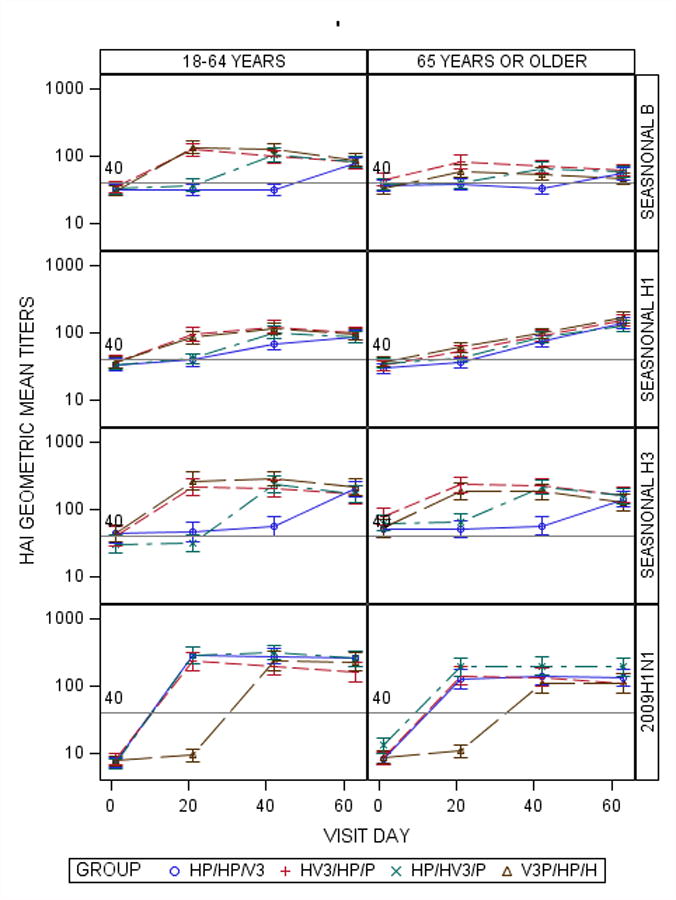
Geometric mean titers 21 days after each vaccination by vaccination group and age strata for each of the 4 vaccine strains, 2009H1N1 [A/California/7/09 (H1N1) v-like virus] and IIV3 {A/Brisbane/59/2007 (H1N1), A/Uruguay/716/2007 [A/Brisbane/10/2007 (H3N2)-like virus] and B/Brisbane/60/2008 virus}.
Responses to 2009-H1N1 after the Second Dose (Secondary Endpoints)
There was a minimal increase in titers after the second dose of 2009-H1N1 (Table 4.a,Figure 2). The proportions of subjects with ≥4-fold HAI antibody titer increases against 2009-H1N1 virus 21 days following the second dose of 2009-H1N1 were not significantly different when compared across vaccination schedules. Nor was there a significant difference in response by age-strata: 88% and 78% of subjects in age groups 18-64 and ≥65 years, respectively, achieved a ≥four-fold response (Table 3). In the younger stratum, the ≥4-fold response rates for vaccine groups HP/HP/V3, HV3/HP/P, HP/HV3/P, V3P/HP/H were 90%, 84%, 94% and 83%, respectively. In the older stratum, the ≥4-fold response rates for the groups were 83%, 79%, 77% and 71%, as above. Proportions ≥40 were again just slightly higher than proportions with ≥4-fold rise.
2009-H1N1 HAI GMT Responses
Prevaccination GMT against 2009-H1N1 were <10 for all 4 vaccine groups in the younger age stratum regardless of prior receipt of the 2008-2009 seasonal vaccine (Table 4.a). Prevaccination GMTs for groups receiving HP/HP/V3, HV3/HP/P, V3P/HP/H were also <10 in the older age stratum(Figure 2). However, In the HP/HV3/P group, the overall prevaccination GMT was 13.0; 13.5 and 6.2 for those with (n=94) and without (n=5) prior receipt of 2008-2009 seasonal vaccine, respectively.
GMTs 21 days after the first dose of 2009-H1N1 vaccine were greater in the younger stratum overall (p<0.0001) and within each vaccination group (Table 4.a,Figure 2). GMTs by group (p-values for group-specific age stratum differences) were HP/HP/V3 (289.8 vs 126.7, p=0.0008), HV3/HP/P (231.8 vs 141.7 p=0.07), HP/HV3/P (285.8 vs 190.6p=0.02), and V3P/HP/H (232.5 vs 107.1 p=0.0007) in subjects in the younger versus older age groups, respectively.
Similarly, GMTs 21 days after the second dose of 2009-H1N1 vaccine, were greater in the younger stratum overall (p<0.0001) and within each vaccination group (Table 4.a,Figure 2). GMTs by group (p-values for group-specific age stratum differences) were HP/HP/V3 (277.1 vs 140.0, p<0.0001), HV3/HP/P (199.1 vs 135.4, p=0.03), HP/HV3/P (311.5 vs 194.4, p=0.04), and V3P/HP/H (229.8 vs 108.1, p=0.0008) in subjects in the younger versus older age groups, respectively. Results for the group initially co-administered H1N1+V3 on Day 0 were consistently lower than those receiving 2009-H1N1 alone in both age strata, but the differences were not significant. Overall, the second dose of 2009-H1N1 did not effectively boost titers.
IIV3
Seasonal H1N1 HAI Responses (Secondary Endpoints)
For both age strata, the best responses to seasonal H1N1 at 21 days post receipt of IIV3 were noted in the group receiving pandemic 2009 H1N1 alone at the first and second vaccination (Table 4.b). In the younger age stratum, the only significant differences in HAI titers for the seasonal H1N1 antigen were for four-fold rise responses(Not shown). Group HP/HP/V3 had a higher response rate than the HV3/HP/P group (49% vs 31%, p=0.02) or the V3P/HP/H group (49% vs 26%, p=0.004). In the older stratum, the four-fold response rates for the groups HP/HP/V3, HV3/HP/P, HP/HV3/P and V3/HP/H were 72%, 16%, 42% and 18%, respectively, 21 days after receipt of IIV3. The HP/HP/V3 group was statistically superior to all other groups (p≤0.004) and the HP/HV3/P group was superior to groups HV3/HP/P and V3/HP/H (p≤0.001). Overall, GMTs against IIV3 H1N1 strain continued to increase after the first vaccination through day 63 regardless of the timing of the IIV3 (Table 4.b).
Table 4.b. Geometric Mean Titers (95% Confidence Intervals) as Assessed by the Hemagglutination Inhibition Assay, IIV3 H1 Antigen.
| All Subjects* | Day 0 | Day 21 | Day 42 | Day 63 | ||||
|---|---|---|---|---|---|---|---|---|
| Study Group | N | GMT (95% CI) | N | GMT (95% CI) | N | GMT (95% CI) | N | GMT (95% CI) |
| HP/HP/V3 | 199 | 31.0 (27.2- 35.4) | 199 | 37.2 (32.7- 42.3) | 189 | 71.7 (62.7- 81.9) | 183 | 110.8 (95.7- 128.3) |
| HV3/HP/P | 198 | 34.5 (30.1- 39.7) | 198 | 70.3 (60.0- 82.3) | 184 | 105.3 (91.4- 121.4) | 176 | 121.4 (103.9- 141.9) |
| HP/HV3/P | 200 | 34.3 (30.6- 38.5) | 200 | 41.7 (37.2- 46.7) | 183 | 92.7 (80.9- 106.4) | 178 | 104.3 (90.3- 120.4) |
| V3P/HP/HP | 196 | 36.2 (32.0- 41.0) | 196 | 71.7 (62.2- 82.6) | 188 | 105.9 (93.2- 120.2) | 181 | 124.7 (108.1- 144.0) |
| Subjects Age 18 – 64 Years | ||||||||
| HP/HP/V3 | 98 | 33.0 (26.5- 41.1) | 98 | 39.2 (31.9- 48.1) | 94 | 68.5 (56.1- 83.7) | 91 | 87.7 (71.1- 108.0) |
| HV3/HP/P | 101 | 36.8 (29.9- 45.4) | 101 | 93.0 (73.2-118.3) | 92 | 121.1 (98.1- 149.5) | 89 | 97.2 (77.6- 121.8) |
| HP/HV3/P | 99 | 33.6 (28.4- 39.7) | 99 | 41.1 (35.1- 48.2) | 90 | 100.8 (81.3- 125.0) | 88 | 85.9 (71.0- 103.9) |
| V3+P/HP/HP | 99 | 35.8 (29.8- 42.9) | 99 | 85.2 (69.0-105.2) | 94 | 114.8 (94.8- 139.1) | 90 | 93.3 (76.8- 113.3) |
| Subjects Age 65 Years and Older | ||||||||
| HP/HP/T V3 | 101 | 29.2 (25.0- 34.0) | 101 | 35.4 (30.2- 41.4) | 95 | 74.9 (62.6- 89.7) | 92 | 139.7 (114.7- 170.2) |
| HV3/HP/P | 97 | 32.3 (26.9- 38.8) | 97 | 52.5 (43.3- 63.6) | 92 | 91.6 (75.7- 110.9) | 87 | 152.5 (123.8- 187.9) |
| HP/HV3/P | 101 | 35.1 (29.9- 41.2) | 101 | 42.3 (35.8- 49.8) | 93 | 85.6 (71.9- 101.8) | 90 | 126.0 (101.9- 155.8) |
| V3P/HP/HP | 97 | 36.7 (31.0- 43.5) | 97 | 60.1 (50.0- 72.3) | 94 | 97.6 (82.5- 115.6) | 91 | 166.2 (136.6- 202.3) |
Slight differences arise between the tables containing all per protocol subjects and the numbers quoted in the text that are a result of statistical modeling that drops 10 subjects who did not know if they had received the prior year's seasonal influenza vaccine
V3 = trivalent vaccine, H = 2009 H1N1, P=placebo
H1N1+Placebo/H1N1+Placebo/IIV3 = HP/HP/V3; H1N1+IIV3/H1N1+Placebo/Placebo = HV3/HP/P; H1N1+Placebo/H1N1+IIV3/Placebo = HP/HV3/P; and IIV3+Placebo/H1N1+Placebo/H1N1= V3P/HP/H
The proportion of subjects with a titer of ≥40 against seasonal H1N1 21 days after vaccination with IIV3 in the younger age stratum is not statistically different between groups. The proportion of subjects with a titer of ≥40 in groups HP/HP/V3, HV3/HP/P, HP/HV3/P, V3P/HP/H in the older age stratum were 92%, 74%, 92% and 78%, respectively. The HP/HP/V3 and HP/HV3/P groups are each superior to groups HV3/H/P and V3P/HP/H (p=0.001-0.01).
GMTs against seasonal H1N1 21 days after vaccination with seasonal V3 for the younger age stratum for groups HP/HP/V3, HV3/HP/P, HP/HV3/P, V3P/HP/H were not statistically different, 88, 93,101 and 85, respectively (Table 4.b). GMTs for the older age stratum follow a similar pattern: 140, 52, 86, and 60 (peak titers were 152, 126 and 166 at day 63), respectively. The HP/HP/V3 group was statistically superior to all other groups (p≤0.0001) and group HP/HV3P/P was superior to groups V3/HP/P and V3P/HP/H(p≤0.01).
H3N2
There were no significant group differences for the H3N2 antigen in either age stratum for the proportion of subjects with a 4-fold rise in titer, titers of ≥40, and GMTs (Table 3, Table 4.c).
Table 4.c. Geometric Mean Titers (95% Confidence Intervals) as Assessed by the Hemagglutination Inhibition Assay, IIV3 H3 Antigen.
| All Subjects | Day 0 | Day 21 | Day 42 | Day 63 | ||||
|---|---|---|---|---|---|---|---|---|
| Study Group | N | GMT (95% CI) | N | GMT (95% CI) | N | GMT (95% CI) | N | GMT (95% CI) |
| HP/HP/V3 | 199 | 47.0 (37.6- 58.6) | 199 | 47.9 (38.4- 59.9) | 189 | 55.6 (44.3- 69.9) | 183 | 168.1 (138.8- 203.5) |
| HV3/HP/P | 198 | 56.0 (44.4- 70.5) | 198 | 223.9 (185.1- 270.8) | 184 | 216.3 (179.6- 260.4) | 176 | 163.8 (134.5- 199.6) |
| HP/HV3/P | 200 | 43.8 (35.6- 53.8) | 200 | 45.6 (37.1- 56.1) | 183 | 225.0 (187.5- 270.0) | 178 | 163.8 (134.4- 199.6) |
| V3P/HP/HP | 196 | 47.6 (38.6- 58.6) | 196 | 222.3 (181.9- 271.8) | 188 | 227.9 (190.3- 273.1) | 181 | 165.6 (135.0- 203.2) |
| Subjects Age 18 – 64 Years | ||||||||
| HP/HP/V3 | 98 | 42.9 (31.1- 59.2) | 98 | 45.4 (32.6- 63.4) | 94 | 54.9 (39.1- 77.2) | 91 | 199.6 (151.6- 262.6) |
| HV3/HP/P | 101 | 40.6 (28.9- 56.9) | 101 | 217.9 (162.5- 292.1) | 92 | 206.7 (156.4- 273.2) | 89 | 165.1 (122.4- 222.7) |
| HP/HV3/P | 99 | 30.4 (22.6- 40.9) | 99 | 31.5 (23.5- 42.3) | 90 | 235.2 (177.8- 311.0) | 88 | 170.4 (126.4- 229.7) |
| V3P/HP/HP | 99 | 43.2 (32.3- 57.8) | 99 | 264.9 (197.0- 356.2) | 94 | 286.5 (224.9- 365.0) | 90 | 217.7 (164.3- 288.5) |
| Subjects Age 65 Years and Older | ||||||||
| HP/HP/V3 | 101 | 51.2 (37.6- 69.8) | 101 | 50.5 (37.3- 68.4) | 95 | 56.4 (41.3- 76.9) | 92 | 141.8 (108.6- 185.3) |
| HV3/HP/P | 97 | 78.3 (57.7- 106.3) | 97 | 230.4 (180.2- 294.4) | 92 | 226.3 (176.1- 290.7) | 87 | 162.6 (125.0- 211.4) |
| HP/HV3/P | 101 | 62.5 (47.6- 82.0) | 101 | 65.6 (49.6- 86.6) | 93 | 215.6 (169.5- 274.1) | 90 | 157.6 (120.7- 205.7) |
| V3P/HP/HP | 97 | 52.5 (38.7- 71.1) | 97 | 185.9 (141.7- 243.9) | 94 | 181.4 (139.3- 236.2) | 91 | 126.3 (94.4- 169.1) |
V3 = trivalent vaccine, H = 2009 H1N1, P=placebo
H1N1+Placebo/H1N1+Placebo/IIV3 = HP/HP/V3; H1N1+IIV3/H1N1+Placebo/Placebo = HV3/HP/P; H1N1+Placebo/H1N1+IIV3/Placebo = HP/HV3/P; and IIV3+Placebo/H1N1+Placebo/H1N1= V3P/HP/H
B
The only significant difference for the B antigen was the HAI GMT 21 days post V3 vaccination within the younger stratum (Table 4.d). GMTs for the V3P/HP/H group were greater than the groups receiving HP/HP/V3 (GMT=133 vs 79, p=0.0002) and HP/HV3/P (GMT=133 vs 103, p=0.004). The GMT for HV3/HP/P was 123. There were no significant differences for the B antigen in the older stratum for any parameter.
Table 4.b. Geometric Mean Titers (95% Confidence Intervals) as Assessed by the Hemagglutination Inhibition Assay, IIV3 B Antigen.
| All Subjects* | Day 0 | Day 21 | Day 42 | Day 63 | ||||
|---|---|---|---|---|---|---|---|---|
| Study Group | N | GMT (95% CI) | N | GMT (95% CI) | N | GMT (95% CI) | N | GMT (95% CI) |
| HP/HP/V3 | 199 | 33.8 (29.5- 38.8) | 199 | 34.6 (30.0- 39.8) | 189 | 32.5 (28.2- 37.3) | 183 | 65.4 (57.0- 75.2) |
| HV3/HP/P | 198 | 38.9 (33.8- 44.8) | 198 | 101.5 (86.1- 119.6) | 184 | 82.4 (70.6- 96.3) | 176 | 70.5 (60.9- 81.6) |
| HP/HV3/P | 200 | 35.3 (30.7- 40.7) | 200 | 38.5 (33.4- 44.3) | 183 | 82.5 (70.5- 96.5) | 178 | 69.3 (60.0- 79.9) |
| V3P/HP/HP | 196 | 31.8 (27.8- 36.3) | 196 | 89.9 (76.4- 105.8) | 188 | 81.8 (69.6- 96.1) | 181 | 62.6 (54.0- 72.6) |
| Subjects Age 18 – 64 Years | ||||||||
| HP/HP/V3 | 98 | 31.5 (25.6- 38.6) | 98 | 31.5 (25.5- 38.8) | 94 | 31.6 (25.9- 38.5) | 91 | 78.8 (65.2- 95.2) |
| HV3/HP/P | 101 | 34.6 (28.8- 41.6) | 101 | 123.3 (99.5- 152.8) | 92 | 98.0 (79.2- 121.4) | 89 | 80.0 (64.7- 98.9) |
| HP/HV3/P | 99 | 33.1 (27.1- 40.4) | 99 | 37.0 (30.4- 45.2) | 90 | 103.9 (83.6- 129.3) | 88 | 81.9 (66.9- 100.3) |
| V3P/HP/HP | 99 | 30.4 (25.3- 36.7) | 99 | 135.3 (109.1- 167.6) | 94 | 123.6 (100.1- 152.7) | 90 | 87.1 (71.0- 106.8) |
| Subjects Age 65 Years and Older | ||||||||
| HP/HP/V3 | 101 | 36.3 (30.1- 43.8) | 101 | 37.9 (31.3- 45.8) | 95 | 33.3 (27.3- 40.7) | 92 | 54.5 (44.6- 66.5) |
| HV3/HP/P | 97 | 43.9 (35.3- 54.5) | 97 | 82.9 (64.7- 106.3) | 92 | 69.3 (55.4- 86.8) | 87 | 62.0 (50.7- 75.8) |
| HP/HV3/P | 101 | 37.6 (30.7- 46.1) | 101 | 40.0 (32.6- 49.0) | 93 | 65.9 (52.9- 82.1) | 90 | 58.8 (48.2- 71.8) |
| V3P/HP/HP | 97 | 33.2 (27.3- 40.4) | 97 | 59.3 (47.6- 73.8) | 94 | 54.1 (43.7- 67.1) | 91 | 45.2 (37.2- 54.9) |
Slight differences arise between the tables containing all per protocol subjects and the numbers quoted in the text that are a result of statistical modeling that drops 10 subjects who did not know if they had received the prior year's seasonal influenza vaccine
V3 = trivalent vaccine, H = 2009 H1N1, P=placebo
H1N1+Placebo/H1N1+Placebo/IIV3 = HP/HP/V3; H1N1+IIV3/H1N1+Placebo/Placebo = HV3/HP/P; H1N1+Placebo/H1N1+IIV3/Placebo = HP/HV3/P; and IIV3+Placebo/H1N1+Placebo/H1N1= V3P/HP/H
Analysis of covariance for IIV3 strain-specific log (HAI) responses modeled against baseline titer, vaccine group, clinical site, age strata and prior receipt of IIV3 did not result in significant associations for prevaccination titers, vaccination treatment group, and prior year's vaccination status for any of the 3 viral strains represented in the 2009-2010 seasonal influenza vaccine
Microneutralization
Overall, MN results against 2009-H1N1 among the subset tested at Day 0 and 21 only after first vaccination were well correlated with HAI results (data not shown). The Spearman's correlation between the 2 assays is 0.90 restricting to pairs for which at least one assay showed some detectable titer. GMTs to vaccination were high for subjects in the younger stratum receiving H1N1 vaccine in Groups HP/HP/V3, HV3/HP/P and HP/HV3/P, ranging from 370 to 453 at Day 21. They were somewhat reduced in the older stratum, ranging from 173 to 297.
Discussion
The 2009-2010 influenza pandemic provided an opportunity to evaluate the effect of the timing of administration of two recommended influenza vaccinations in adults on safety and immunogenicity. The data from this study provided information to guide U.S. policy for the co-administration of these vaccines during the 2009-2010 influenza season, and provides valuable information and insight for the development of recommendations for future influenza pandemic seasons.
The vaccines were well-tolerated. The majority of injection site and systemic reactions were mild to moderate. Less than 1% experienced severe systemic reactions related to vaccine. The favorable safety profile following the administration of 2009-H1N1 vaccine in adults is consistent with the findings in multiple trials of adjuvanted and unadjuvanted 2009-H1N1 tested as a single vaccine(9,11,12,21,22,23-31) or concurrently or sequentially administered with V3(27-31) and during surveillance during a mass vaccination campaign.
Pre-vaccination GMTs against 2009-H1N1 were low; however, adequate titers (≥40 in HAI assay) were achieved after one dose of vaccine in a high proportion of subjects, consistent with prior priming against H1N1 viruses, and a second dose of 2009-H1N1 did not boost GMTs. There were no significant differences in HAI titers by vaccine group or age strata for GMT, proportions with ≥four-fold rise or titers ≥ 40 after either H1N1 vaccination. Correlation of HAI with the MN assay was high.
Of interest, the proportions of responders to seasonal H1N1 were highest when IIV3 was given as the third vaccination. A similar response was observed in other studies(31). Overall, when both age strata are combined, GMTs against IIV3 H1 continued to increase after the first vaccination through day 63 regardless of the timing of the IIV3 vaccination. The reason for this is not clear but cross clade and hetero-subtypic antibody responses may play a role. Also, a slower antibody response to IIV3 has been described in the elderly(32). In contrast, the responses to the B antigen were higher if the IIV3 was given as the first vaccine. This may be partially due to antigenic competition when 2009-H1N1 is administered first.
When multivariate analysis was performed with adjustments for vaccine group, gender, clinical site and receipt of the prior year's seasonal influenza vaccine, receipt of the prior year's seasonal influenza vaccine had little effect on 2009-H1N1 antibody titers.
Conclusions
The study was undertaken to assist in setting policy for the co-administration of the pandemic and seasonal influenza vaccines in adults. Co-administration is supported by the production of adequate HAI titers against 2009-H1N1 H1 and IIV3 antigens. Only one dose of 2009-H1N1 vaccine given concurrently with IIV3 was required to achieve levels of antibody that are associated with protection against influenza.
Acknowledgments
We would like to thank the volunteers without whom this study would not have been possible. Special thanks to Linda Lambert, Katherine Muth, Richard Gorman and Soju Chang at the Division of Microbiology and Infectious Diseases, National Institute of Allergy and Infectious Diseases. We would like to acknowledge the extraordinary efforts of the entire staff at the VTEU sites with special thanks to Thomas Pacatte, Carolyn Stefanski, Karla Mosby, Carol Duane and the staff of the SLU VTEU; Vicki Smith, Susan Parker, Jesse Lepage and the staff of the Cincinnati Children's Hospital Medical Center; Jane Skvarich, Nayoka Rimann, Eric Strait, Vickie Grimes, Rebecca Gerkin, Ellen DeStefano, Jo Ann Sadowski, Alexis Daugherty, Beverly Weaver, Bill Emery, Jiangao Xu, Susan Rogers and the Staff of Emory University VTEU; Lisreina Toro, Susan Bobbitt, Jesus Banay, Diane Nino, Connie Rangel and the staff of the Baylor College of Medicine VTEU; Logan Haller, Barbara Taggart, Donna Bowen, Michelle Bell, Lisa Slappey, and Valerie Johnson, Candi Looney, Shixiong Li, and F. Owen Griffin at Southern Research Institute; and Bernadette Jolles, Kuo Guo and Fenhua He of EMMES.
This project has been funded in whole or in part with Federal funds from the National Institute of Allergy and Infectious Diseases, National Institutes of Health, Department of Health and Human Services, under Contract Nos. HHSN272200800003C (SEF, RBB, IG, ELA); HHSN272200800006C (DIB, RCB, MD); HHSN272200800002C (WAK, HES, RLA, SMP); HHSN272200800005C (NGR, MJM, SE); NO1-30063 (DLN); HHSN272200800013C (HH, MW).
Footnotes
Sharon Frey, David Bernstein, Wendy Keitel, Hana El Sahly, Rebecca Brady, Nadine Georges Rouphael, Mark J. Mulligan, Heather Hill, Mark Wolff, Diana Noah, Robert Belshe, Robert L. Atmar, Srilatha Edupuganti, Shital M. Patel, Irene Graham and Edwin Anderson have no conflicts of interest to declare.
The findings of this study were presented in part at the February 18-19, 2010 WHO Influenza Vaccine meeting in Geneva.
ClinicalTrials.gov Identifier: NCT00943878
Publisher's Disclaimer: This is a PDF file of an unedited manuscript that has been accepted for publication. As a service to our customers we are providing this early version of the manuscript. The manuscript will undergo copyediting, typesetting, and review of the resulting proof before it is published in its final citable form. Please note that during the production process errors may be discovered which could affect the content, and all legal disclaimers that apply to the journal pertain.
References
- 1.Garten RJ, Davis CT, Russel CA, et al. Antigenic and genetic characteristics of swine-origin 2009 A(H1N1) influenza viruses circulating in humans. Science. 2009;325:197–201. doi: 10.1126/science.1176225. [DOI] [PMC free article] [PubMed] [Google Scholar]
- 2.Novel Swine-Origin Influenza A (H1N1) Virus Investigation Team. Emergence of a novel swine-origin influenza A (H1N1) virus in humans. N Engl J Med. 2009;360:2605–15. doi: 10.1056/NEJMoa0903810. Erratum, N Engl J Med 2009;361:1027. [DOI] [PubMed] [Google Scholar]
- 3.Jain S, Kamimoto L, Bramley AM, et al. Hospitalized patients with 2009 H1N1 influenza in the United States, April – June 2009. N Engl J Med. 2009;361:1935–44. doi: 10.1056/NEJMoa0906695. [DOI] [PubMed] [Google Scholar]
- 4.France AM, Jackson M, Schrag S, et al. Household transmission of 2009 influenza A (H1N1) virus after a school-based outbreak in New York City, April-May 2009. J Infect Dis. 2010;201:984–92. doi: 10.1086/651145. [DOI] [PubMed] [Google Scholar]
- 5.Centers for Disease control and Prevention. Update: Novel influenza A (H1N1) virus infections – worldwide, May 6, 2009. MMWR Morb Mortal Wkly Rep. 2009;58:453–8. [PubMed] [Google Scholar]
- 6.Centers for Diseases Control and Prevention. Serum cross-reactive antibody response to a novel influenza A (H1N1) virus after vaccination with seasonal influenza vaccine. MMWR Morb Mortal Wkly Rep. 2009;58:521–4. [PubMed] [Google Scholar]
- 7.Hancock K, Veguilla V, Lu X, et al. Cross-reactive antibody responses to the 2009 pandemic H1N1 influenza virus. N Engl J Med. 2009;361:1945–52. doi: 10.1056/NEJMoa0906453. [DOI] [PubMed] [Google Scholar]
- 8.Wu J, Xu F, Lu L, et al. Safety and effectiveness of a 2009 H1N1 vaccine in Beijing. N Engl J Med. 2010;363:2416–23. doi: 10.1056/NEJMoa1006736. [DOI] [PubMed] [Google Scholar]
- 9.Zhu FC, Wang H, Fang HH, et al. A novel influenza A (H1N1) vaccine in various age groups. N Engl J Med. 2009;361:2414–23. doi: 10.1056/NEJMoa0908535. [DOI] [PubMed] [Google Scholar]
- 10.Arguedas A, Soley C, Lindert K. Responses to 2009 H1N1 vaccine in children 3 to 17 years of age. N Engl J Med. 2010;362:370–2. doi: 10.1056/NEJMc0909988. [DOI] [PubMed] [Google Scholar]
- 11.Talaat KR, Greenberg ME, Lai MH, et al. A single dose of unadjuvanted novel 2009 H1N1 vaccine is immunogenic and well tolerated in young and elderly adults. J Infect Dis. 2010;202:1327–37. doi: 10.1086/656601. [DOI] [PubMed] [Google Scholar]
- 12.Greenberg ME, Lai MH, Hartel GF, et al. Response to a monovalent 2009 influenza A (H1N1) vaccine. N Engl J Med. 2009;361:2405–13. doi: 10.1056/NEJMoa0907413. [DOI] [PubMed] [Google Scholar]
- 13.Madhun AS, Akselsen PE, Sjursen H, et al. An adjuvanted pandemic influenza H1N1 vaccine provides early and long term protection in health care workers. Vaccine. 2010;29:266–73. doi: 10.1016/j.vaccine.2010.10.038. [DOI] [PubMed] [Google Scholar]
- 14.Clark TW, Pareek M, Hoschler K, et al. Trial of 2009 influenza A (H1N1) monovalent MF59-adjuvanted vaccine. N Engl J Med. 2009;361:2424–35. doi: 10.1056/NEJMoa0907650. [DOI] [PubMed] [Google Scholar]
- 15.Mallory RM, Malkin E, Ambrose CS, et al. Safety and immunogenicity following administration of a live, attenuated monovalent 2009 H1N1 influenza vaccine to children and adults in two randomized controlled trials. PLoS One. 2010;5:e13755. doi: 10.1371/journal.pone.0013755. [DOI] [PMC free article] [PubMed] [Google Scholar]
- 16.Frey SE, Bernstein DI, Gerber MA, Keyserling HL, Munoz FM, Winokur PL, et al. Safety and immune responses in children after concurrent or sequential 2009 H1N1 and 2009 – 2010 seasonal trivalent influenza vaccinations. J Infect Dis. 2012;206:828–37. doi: 10.1093/infdis/jis445. [DOI] [PMC free article] [PubMed] [Google Scholar]
- 17.Nolan T, McVernon J, Skeljo M, et al. Immunogenicity of a monovalent 2009 influenza A (H1N1) vaccine in infants and children:a randomized trial. JAMA. 2010;303:37–46. doi: 10.1001/jama.2009.1911. [DOI] [PubMed] [Google Scholar]
- 18.Noah DL, Hill H, Hines D, et al. Qualification of the hemagglutination inhibition assay in support of pandemic influenza vaccine licensure. Clin Vacc Immunol. 2009;16:558–66. doi: 10.1128/CVI.00368-08. [DOI] [PMC free article] [PubMed] [Google Scholar]
- 19.Rowe T, Abernathy RA, Hu-Primmer J, et al. Detection of antibody to avian influenza A (H5N1) virus in human serum by using a combination of serologic assays. J Clin Micro. 1999;37:937–43. doi: 10.1128/jcm.37.4.937-943.1999. [DOI] [PMC free article] [PubMed] [Google Scholar]
- 20.http://www.fda.gov/biologicsbloodvaccines/guidancecomplianceregulatoryinformation/guidances/vaccines/ucm074786.htm
- 21.Jackson LA, Chen WH, Stapleton JT, Dekker CL, Wald A, Brady RC, et al. Immunogenicity and safety of varying dosages of a monovalent 2009 H1N1 influenza vaccine given with and without AS03 adjuvant system in healthy adults and older persons. J Infect Dis. 2012;206:811–20. doi: 10.1093/infdis/jis427. [DOI] [PMC free article] [PubMed] [Google Scholar]
- 22.Chen WH, Winokur PL, Edwards KM, Jackson LA, Wald A, Walter EB, et al. Phase 2 assessment of the safety and immunogenicity of two inactivated pandemic monovalent H1N1 vaccines in adults as a component of the U.S. pandemic preparedness plan in 2009. Vaccine. 2012;30:4240–8. doi: 10.1016/j.vaccine.2012.04.044. [DOI] [PMC free article] [PubMed] [Google Scholar]
- 23.Liang XF, Wang HQ, Wang JZ, et al. Safety and immunogenicity of 2009 pandemic influenza A H1N1 vaccines in China: a multicentre, double-blind, randomized, placebo-controlled trial. Lancet. 2010;375:56–66. doi: 10.1016/S0140-6736(09)62003-1. Erratum, Lancet 2010;375:1694. [DOI] [PubMed] [Google Scholar]
- 24.Kulkarni PS, Manjunath K, Agarkhedkar S Group of SII IIV Studies. Safety and immunogenicity of an adjuvanted whole virion, inactivated A (H1N1) 2009 influenza vaccine in young and elderly adults, and children. Vaccine. 2012;31:20–2. doi: 10.1016/j.vaccine.2012.10.081. [DOI] [PubMed] [Google Scholar]
- 25.Duval X, Caplanusi A, Laurichesse H, Deplanque D, Loulergue P, Vaman T, et al. Flexibility of interval between vaccinations with AS03A-adjuvanted influenza A (H1N1) 2009 vaccine in adults aged 18-60 and >60 years: a randomized trial. BMC Infect Dis. 2012;12:162. doi: 10.1186/1471-2334-12-162. [DOI] [PMC free article] [PubMed] [Google Scholar]
- 26.Miraglia JL, Abdala E, Hoff PM, Luiz AM, Oliveira DS, Saad CGS, et al. Immunogenicity and reactogenicity of 2009 influenza A (H1N1) inactivated monovalent non-adjuvanted vaccine in elderly and immunocompromised patients. PLoS One. 2011;6:e27214. doi: 10.1371/journal.pone.0027214. [DOI] [PMC free article] [PubMed] [Google Scholar]
- 27.Viganò A, Giacomet V, Pariani E, Giani E, Manfredini V, Bedogni G, et al. Long-term immunogenicity after one and two doses of a monovalent MF59-adjuvanted A/H1N1 Influenza virus vaccine coadministered with the seasonal 2009-2010 nonadjuvanted Influenza virus vaccine in HIV-infected children, adolescents, and young adults in a randomized controlled trial. Clin Vaccine Immunol. 2011;18:1503–9. doi: 10.1128/CVI.05200-11. [DOI] [PMC free article] [PubMed] [Google Scholar]
- 28.Peeters M, Regner S, Vaman T, Devaster JM, Rombo L. Safety and immunogenicity of an AS03-adjuvanted A(H1N1)pmd09 vaccine administered simultaneously or sequentially with a seasonal trivalent vaccine in adults 61 years or older: data from two multicenter randomised trials. Vaccine. 2012;30:6483–91. doi: 10.1016/j.vaccine.2012.07.081. [DOI] [PubMed] [Google Scholar]
- 29.Vajo Z, Tamas F, Sinka L, Jankovics I. Safety and immunogenicity of a 2009 pandemic influenza A H1N1 vaccine when administered alone or simultaneously with the seasonal influenza vaccine for the 2009-10 influenza season: a multicentre, randomised controlled trial. Lancet. 2010;375:49–55. doi: 10.1016/S0140-6736(09)62039-0. [DOI] [PubMed] [Google Scholar]
- 30.Langley JM, Frenette L, Chu L, McNeil S, Halperin S, Li P, et al. A randomized, controlled non-inferiority trial comparing A(H1N1)pmd09 vaccine antigen, with and without AS03 adjuvant system, co-administered or sequentially administered with an inactivated trivalent seasonal influenza vaccine. BMC Infect Dis. 2012;12:279. doi: 10.1186/1471-2334-12-279. [DOI] [PMC free article] [PubMed] [Google Scholar]
- 31.Uno S, Kimachi K, Kei J, Miyazaki K, Oohama A, Nishimura T, et al. Effect of prior vaccination with a seasonal trivalent influenza vaccine on the antibody response to the influenza pandemic H1N1 2009 vaccine: a randomized controlled trial. Microbiol Immunol. 2011;55:783–9. doi: 10.1111/j.1348-0421.2011.00381.x. [DOI] [PubMed] [Google Scholar]
- 32.Levine M, Beattie BL, McLean DM, Corman D. Characterization of the immune response to trivalent influenza vaccine in elderly men. J Am Geriatr Soc. 1987;35:609–15. doi: 10.1111/j.1532-5415.1987.tb04335.x. [DOI] [PubMed] [Google Scholar]