



Abstract
Rationale
Metabolic syndrome, inflammatory and vascular injury markers measured in serum after WTC exposures predict abnormal FEV1. We hypothesized that elevated LPA levels predict FEV1<LLN.
Methods
Nested case-control study of WTC-exposed firefighters. Cases had FEV1<LLN. Controls derived from the baseline cohort. Demographics, pulmonary function, serum lipids, LPA and ApoA1 were measured.
Results
LPA and ApoA1 levels were higher in cases than controls and predictive of case status. LPA increased the odds by 13% while ApoA1 increased the odds by 29% of an FEV1<LLN in a multivariable model.
Conclusions
Elevated LPA and ApoA1 are predictive of a significantly increased risk of developing an FEV1<LLN.
Keywords: Biomarkers, World Trade Center, Dyslipidemia and Occupational Exposure
INTRODUCTION
The destruction of the World Trade Center (WTC) complex led to the exposure of thousands of subjects to particulates and the products of combustion. The intense particulate matter (PM) exposure at the WTC site overwhelmed the lung’s normal protective defenses. Respiratory compromise after WTC-PM exposure has been documented in FDNY rescue workers, (Prezant et al., 2002, Banauch et al., 2005, Banauch et al., 2006, Feldman et al., 2004, Banauch et al., 2003, Felipe et al., 2011, Aldrich et al., 2010) other exposed workers (Herbert et al., 2006) and lower Manhattan residents.(Reibman et al., 2005, 2002a, 2002b) Some individuals subsequently developed abnormal lung function while others improved. It is this dichotomous outcome and identifying predictive biomarkers that has been the focus of our recent work.
Our group has published that mediators of metabolic syndrome, inflammation and vascular injury in early serum samples are predictive of lung function outcome in a longitudinally followed never smoking World Trade Center exposed FDNY cohort.(Nolan et al., 2012) Development of lung dysfunction following particulate exposure is a major health concern worldwide. The prevalence of metabolic syndrome is high in industrialized nations and is rapidly increasing in developing nations where high ambient particulates are also a tremendous health concern.(Chen and Schwartz, 2008) The interaction of these two disorders is a topic of considerable importance.
Nearly half of chronic obstructive pulmonary disease (COPD) patients demonstrate the presence of one or more components of metabolic derangement. Lipids are key components of metabolic syndrome and their metabolites have been linked to pulmonary inflammation and subsequent airflow obstruction.(Tiengo et al., 2008) We also know that statin therapy reduced airspace inflammatory cells and Th2 cytokine production in murine allergic asthma. (Yeh and Huang, 2004, McKay et al., 2004) Simvastatin inhibited lung parenchymal destruction and peribronchial and perivascular inflammatory cell infiltration in a murine model of smoking-induced emphysema.(Lee et al., 2005) In asthmatics, statin therapy is associated with reduced leukocytes and leukotrienes in sputum and improvement in FEV1.(Hothersall et al., 2008, Cowan et al., 2010) Subjects with COPD treated with statins had reduced FEV1 decline, decreased intubations and decreased mortality.(Blamoun et al., 2008, Soyseth et al., 2007) There are also data that suggest a relationship between serum total and non-HDL cholesterol and having asthma.(Fessler et al., 2009) Therefore not only are lipids biologically active in the development of lung disease but they are also plausible therapeutic targets. However, the systemic inflammatory effects of lipids, their subsequent end-organ effects and the mechanism of lipid-induced pulmonary inflammation are poorly understood.
Low density lipoprotein (LDL), high density lipoprotein (HDL) and triglycerides (Trig) are routinely available biomarkers of vascular disease and are components of metabolic syndrome. Our group has recently shown that dyslipidemia is a predictor of developing World Trade Center-lung injury (WTC-LI). As a logical extension of our earlier work we therefore turned our attention to the biological active lipids, LPA (an LDL derivative) and ApoA1 (a component of HDL). We hypothesized that LPA and ApoA1, a known mediator of LPA, predict the development of World Trade Center-LI. In a nested case control study we show that increased serum LPA and ApoA1 levels predict the development of an abnormal FEV1 in our WTC-PM exposed firefighters. Some of the results of these studies have been previously reported in the form of an abstract.(Cho et al., 2013)
METHODS
Study Design
As part of the first medical monitoring exam (MME) post-9/11, all participants received pulmonary function testing (PFT) and serum samples were collected and banked in a biorepository. Firefighters who presented with pulmonary symptoms were referred to subspecialty pulmonary evaluation (SPE) between 9/12/2001 and 3/10/2008. The baseline cohort was derived from the 1,720 exposed symptomatic workers who needed subspecialty pulmonary evaluation (SPE) and treatment within 6.5 years of 9/11/2001.(Weiden et al., 2012, Naveed et al., 2012) We performed a nested case-control study on a homogeneous baseline cohort of 801 subjects without prior lung disease and without tobacco use as a lung disease confounder. We specifically excluded all subjects who ever reported smoking on any of their yearly monitoring visits. Cases and controls were both drawn from this baseline cohort. Cases of WTC-LI were identified as the 100 (62 of whom had all final model parameters) that had the lowest FEV1 at the time of SPE. Specifically, cases were defined as being in the bottom octile of FEV1 % predicted at SPE. The FEV1 % predicted of the cases was below the lower limit of normal (LLN) as calculated by NHANES III. The cohort control (N = 171) was randomly selected from the baseline cohort after stratification on BMI and FEV1 at MME. The controls are all individuals in the random sample cohort control who did not meet criteria to be a World Trade Center-LI case (n=153). Controls with all final model parameters were 111/153. All subjects signed informed Institutional Review Board-approved consent at the time of enrollment allowing analysis of their information and samples for research. This study has been approved by the Institutional Review Boards of Montefiore Medical Center; #07-09-320 and New York University; #11-00439).
Demographics
Age, race and years of service at FDNY were obtained from the FDNY-WTC-monitoring database. BMIs were calculated from height and weight measured at the time of MME and SPE. Degree of exposure was self-reported at the first FDNY-WTC-monitoring and was categorized using the FDNY-World Trade Center Exposure Intensity Index (Arrival Time): 1. Present on the morning of 9/11/2001; 2. Arrived between afternoon on 9/11/2001 and 9/12/2001.(Weiden et al., 2010) Those arriving after day three were excluded from analysis as a result of their low numbers in this sample.(Longo et al., 2011) In addition, medication histories were obtained by reviewing clinical and electronic medication records. Subject were considered to have received pulmonary specific treatment if they had ever received either a short acting beta-agonist, long acting beta-agonist or inhaled corticosteroid. In addition, we considered a subject to have received lipid-lowering therapy if they were on any statin at any time.
Serum Sampling
Blood drawn at the first post-9/11 FDNY-WTC monitoring exam was allowed to stand for one hour at room temperature before being centrifuged at 1,800g for ten minutes. Serum was stored at −80°C (Bio-Reference Laboratories, Inc. Elmwood Park, NJ). Serum was thawed once at 4°C and assayed using LPA Elisa (Echelon, USA) and Apolipoprotein Plex (Millipore, USA) according to manufacturer’s instructions on a Luminex 200IS (Luminex Corporation, Austin, TX). Data were analyzed using Graphpad Prism V (San Diego, USA) and MasterPlexQT (Mirabio, USA). Other measures of inflammation such as white blood cell count (WBC) and differential were obtained from the medical records at the time of MME serum sampling.
Statistical Analysis
We tested normality using the Shapiro-Wilk test and Q-Q plots. Data are expressed as median (interquartile range, IQR) or Odds Ratio (95% confidence interval), unless otherwise stated. A two-sided p-value less than 0.05 were considered significant. All analyses were performed with STATA/SE version 12.1 (StataCorp LP, College Station, TX) and SPSS version 20(IBM, USA). We used Wilcoxon rank sum test for between group comparisons, as appropriate. Chi-squared test was used to determine significance of categorical variable.
Lipid Predictors of WTC-LI Model Building and Validation
Given the dichotomous outcome of normal and abnormal FEV1 we tested if serum biomarkers predicted airflow obstruction using logistic regression. Variables identified as potential confounders and those with a P value < 0.2 in univariable analysis were included in the multivariable logistic regression model. The Hosmer-Lemeshow goodness-of-fit test was used to assess calibration of the final model. The model discrimination was evaluated using the receiver operating characteristic area under the curve (AUC). Bootstrap was used to internally validate and confirm the robustness of the classification performance using 10,000 samples of equal size to the original data set used to develop the final model.(Steyerberg et al., 2001)
RESULTS
Nested Case-Control Design
FEV1 was measured starting three years prior to 9/11/2001. FEV1 is still performed at every FDNY-WTC-Medical Monitoring and Treatment Program (MMTP) visit, giving a comprehensive measure of changing lung function over time. The baseline cohort was derived from the symptomatic subjects enrolled in the SPE cohort if they met the inclusion criteria as outlined in Figure 1 and as previously described. Derivation of 801 baseline cohort, 62 cases, and 111 controls from the SPE cohort with final model characteristics available is described in Figure 1.
Figure 1. Study Design/Timeline.
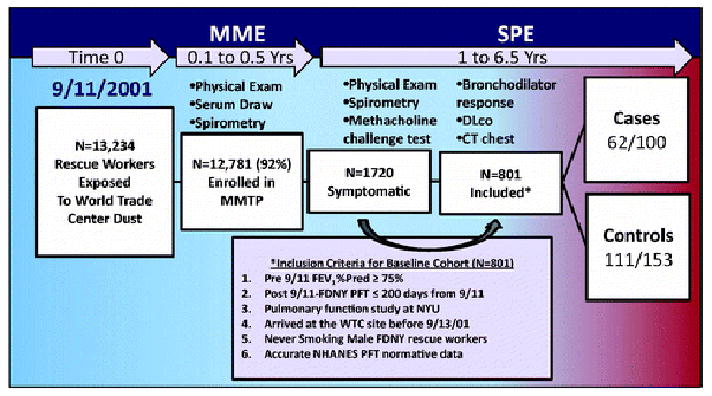
Symptomatic subjects in the FDNY medical monitoring exam (MME) presented for subspecialty pulmonary evaluation (SPE). Subjects underwent outlined studies at MME and SPE respectively. Baseline Cohort met the listed inclusion criteria. Cases (N=62) and Controls (N=111) had all final model variables available.
Demographics of both the SPE cohort and baseline cohort were similar to sub-cohort controls, as previously described.(Nolan et al., 2011) Cases and controls had statistically similar time from 9/11 to MME and SPE, years of service, and age at 9/11. Cases had a similar percentage of subjects that arrived at the site on the morning of 9/11 as arrived on the afternoon of 9/11 till 9/12. BMI of the cases was only significantly elevated compared to controls at SPE, Table 1.
Table 1.
Demographics
| Characteristics | Baseline Cohort | Cases | Controls | p‡ | |
|---|---|---|---|---|---|
| WTC Arrival* | Morning 9/11 | 197 (25) | 17 (24) | 18 (16) | 0.079 |
| Afternoon 9/11–9/12 | 604 (75) | 45 (76) | 93 (84) | ||
| 9/11 to Study, Months† | MME | 2.7 (2–4) | 2.7 (2–4) | 2.5 (2–3) | 0.170 |
| SPE | 33.8 (25–57) | 32.7 (21–53) | 33.8 (26–56) | 0.472 | |
| BMI kg/m2† | MME | 28.0 (26–30) | 29.1 (27–31) | 27.9 (26–31) | 0.077 |
| SPE | 28.9 (27–31) | 30.0 (28–34) | 29.0 (27–31) | 0.006 | |
| Years of Service at 9/11† | 13 (7–19) | 15 (9–18) | 14 (8–18) | 0.977 | |
| Age at 9/11† | 40.0 (36–45) | 40 (36–46) | 42 (37–46) | 0.666 | |
Definition of abbreviations: MME = medical monitoring entry; SPE = subspecialty pulmonary evaluation; BMI = body mass index.
Expressed as N(%);
Expressed as Median(Inter Quartile Range);
Significance assessed by Wilcoxon Rank Sum Test and Chi-Squared test.
Lung Function and Computed Tomography (CT)-Scan Phenotyping
Lung Function
Controls had similar FEV1, forced vital capacity (FVC) and FEV1/FVC compared to the SPE cohort (N=1720) and baseline cohort (N=801) (data not shown). Cases had lower FEV1, FVC, FEV1/FVC, total lung capacity (TLC), alveolar volume (VA), carbon monoxide diffusing capacity (DLCO) and DLCO/VA when compared to controls at all-time points. Measures of airflow obstruction, including methacholine slope and bronchodilator response was statistically increased in the cases when compared to controls, Table 2. Lung function in sub-cohort controls increased from the MME to SPE (93% to 97%) while the FEV1% predicted (FEV1%pred) of affected cases continued to decline between the two pulmonary function tests (78% to 72%; p<0.0001 all comparisons). Despite these significant differences in lung function we found that 57/62 (92%) of cases and 91/111 (82%) of controls were receiving some pulmonary specific treatment. (Pearson’s χ2 3.188, p=0.074).
Table 2.
Pulmonary Function Testing and CT Phenotype
| Cases | Controls | p‡ | ||
|---|---|---|---|---|
| Pre 9/11* | FEV1 | 88 (82–96) | 104 (92–113) | <0.001 |
| FVC | 87 (80–96) | 97 (88–108) | <0.001 | |
| FEV1/FVC | 82 (78–86) | 85 (81–88) | 0.001 | |
|
| ||||
| MME* | FEV1 | 78 (71–88) | 93 (85–100) | <0.001 |
| FVC | 79 (72–88) | 89 (82–95) | <0.001 | |
| FEV1/FVC | 82 (76–86) | 84 (80–87) | 0.021 | |
|
| ||||
| SPE* | FEV1 | 72 (68–74) | 97 (88–104) | <0.001 |
| FVC | 79 (75–85) | 98 (93–106) | <0.001 | |
| FEV1/FVC | 71 (65–77) | 77 (74–81) | <0.001 | |
| TLC | 96 (83–105) | 103 (98–109) | 0.001 | |
| VA | 83 (76–90) | 94 (88–101) | <0.001 | |
| DLCO %§ | 96 (86–107) | 107 (101–116) | 0.001 | |
| DLCO/VA | 121 (113–132) | 117 (103–122) | 0.044 | |
| MCT Slope|| | 0.148 (0.05–1.09) | 0.04 (0.02–0.10) | 0.005 | |
| BD Response** | 15 (8–25) | 5 (2–8) | <0.001 | |
|
| ||||
| CT Findings† | Air Trapping | 22/38 (58) | 25/61 (41) | 0.147 |
| BWT | 13/38 (34) | 22/61 (36) | 1.000 | |
Definition of abbreviations: MME = medical monitoring entry; SPE = subspecialty pulmonary evaluation; MCT = methacholine challenge test; BD = bronchodilator response; BWT = bronchial wall thickening
Values Expressed as Median (Inter Quartile Range);
Expressed as N (%);
Significance assessed by Wilcoxon Rank Sum Test or Chi-Squared Test;
DLCO % Predicted: Controls N=50; Cases N=42;
MCT Slope: Controls N=90; Cases N=30;
BD Response : Controls N=54; Cases=46.
CT-Scan Phenotype
CT scans had been done on 38/62 cases and 61/111 controls. Cases had similar measures of air trapping and bronchial wall thickening as controls.
Clinical Biomarkers of Inflammation and Lipid Derangement in Cases and Controls
We used logistic regression as a tool to analyze our data (binary outcome), we indeed checked the linear relationship between the logit (log-odds) and the continuous variables following the steps described by Hosmer and Lemeshow.(Hosmer and Lemeshow, 1989) No transformations of the data were needed.
Univariable regression was used to identify potential predictors and confounders of case status. Based on the analysis, LPA, ApoA1 and, as previously showed, dyslipidemia were significant predictors of case status. On the other hand, HDL, LDL, triglycerides, WBC and cell differential were not, Table 3. LPA, ApoA1, Dyslipidemia, polymorphonuclear (PMN) all had a P value < 0.2 and were included in the multivariable logistic regression model. Even though the medians of LPA levels were similar between cases and controls, the same magnitude of increment (10 uM) does not behave the same in terms of LI prediction. In the univariable and multivariable logistic analyses per every 10uM increased in LPA the odd of developing LI was estimated to be 1.12 and 1.13 times larger respectively.
Table 3.
Biomarkers and Crude OR Predicting WTC-LI
| Analyte | Cases* | Controls* | Crude OR | p |
|---|---|---|---|---|
| LPA, μM | 11.4 (5.6–42.8) | 11.5 (4.0–24.2) | 1.123 (1.020–1.237)** | 0.018 |
| Apo AI, mg/mL | 4.36 (2.06–6.32) | 2.55 (1.83–3.79) | 1.237 (1.085–1.409) | 0.001 |
|
| ||||
| HDL, mg/dL | 43 (38–54) | 48 (41–55) | 0.985 (0.958–1.013) | 0.288 |
| LDL, mg/dL§ | 133 (115–153) | 131 (106–158) | 1.001 (0.992–1.010) | 0.852 |
| TG, mg/dL | 142 (106–226) | 144 (97–246) | 1.000 (0.997–1.002) | 0.929 |
| Dyslipidemia, N%† | 18 (29) | 17 (15) | 2.262 (1.065–4.805) | 0.034 |
|
| ||||
| WBC, × 103 | 6.3 (5.1–7.2) | 6.2 (5.5–7.4) | 0.926 (0.764–1.124) | 0.437 |
| PMN, × 103 | 3.5 (2.8–4.3) | 3.6 (3.0–4.4) | 0.787 (0.597–1.040) | 0.092 |
| Lymphocyte, Abs | 1686 (1512–2200) | 1760 (1508–2208) | 1.000 (1.000–1.001) | 0.395 |
| Platelets | 230 (219–263) | 239 (206–265) | 1.000 (0.993–1.007) | 0.920 |
Definition of abbreviations: HDL = high-density lipoprotein; LDL = low-density lipoprotein; TG = triglyceride; WBC = white blood cell PMN = polymorphonuclear cell; OR = odds ratio
Expressed as Median (Inter Quartile Range) except for Dyslipidemia;
Dyslipidemia = HDL<40mg/dL and Trig>150mg/dL, reference is no dyslipidemia;
OR (95%CI);
LDL Cases (n=57), Controls (n=103).
per 10 μM
Despite platelet count not being significant in univariate analysis we chose to include it in multivariable analysis, since it is a known potential confounder of vascular disease and a source of LPA. (Boucharaba et al., 2004) In addition, review of their electronic medical record showed that 16/111 (15%) of the control patients and 11/62 (18%) of the cases were taking a statin (Pearson’s χ2 0.336; p=0.56).
Inflammatory and Dyslipidemic Biomarkers Predict Decline in Lung Function
To assess the relationship between LPA and ApoA1 with the outcome of being a susceptible case, we fitted a multivariable logistic model adjusted for BMI at SPE, exposure intensity, pre-9/11 FEV1 % predicted, age on 9/11, and WTC arrival time, dyslipidemia, platelet and PMN count, Table 4. In the adjusted model, a 10 μM increase of LPA was associated with a 14% increase in the odds of having WTC-LI while an increase of 1 mg/mL of ApoA1 increased the odds of developing WTC-LI by 29%, Table 4. The interaction term was not significant. The change in BMI was also adjusted for in this same model and a 10 μM increase of LPA was associated with a 12% increase in the odds of having World Trade Center-LI while an increase of 1 mg/mL of ApoA1 increased the odds of developing World Trade Center-LI by 29%.
Table 4.
Models Predicting Susceptibility to WTC -LI
| Analyte | OR (95 % CI)* | p | |
|---|---|---|---|
| Single Analyte | LPA, μM per 10 | 1.134 (1.020–1.261) | 0.020 |
| Apo AI, mg/mL | 1.290 (1.090–1.527) | 0.003 | |
| Dyslipidemia, N (%) | 1.618 (0.660–3.968) | 0.293 | |
| PMN, × 103 | 0.727 (0.521–1.015) | 0.061 | |
| Platelets | 1.005 (0.996–1.014) | 0.318 | |
|
| |||
| Multi-Analytes | LPA, μM per 10 | 1.139 (1.020–1.272) | 0.021 |
| Apo AI, mg/mL | 1.288 (1.089–1.522) | 0.003 | |
Definition of abbreviations: PMN = polymorphonuclear cell count; OR = odds ratio
Adjusted for Plt count, BMI at SPE, exposure intensity, pre-9/11 FEV1% predicted, PMN count, and presence of dyslipidemia (HDL<40mg/dL and Trig>150mg/dL); χ2 (8)=69.34, p<0.001.; Hosmer-Lemeshow (Goodness of Fit) p=0.184; AUC=0.848 (0.786–0.910)
Model Validation
Since there is no external cohort that can be used to validate this model, we chose bootstrapping as an internal method to validate the models classification performance. We chose to use bootstrapping since it outperforms jackknife.(Steyerberg et al., 2001) For LPA the calculated bias was 0.0019022 (Coefficient p = 0.045) and for ApoA1 of 0.0342232 (Coefficient p = 0.007). Therefore, these results internally confirm the classification performances of the model developed above.
The Effect of LPA and ApoA1 Level on the Probability of Developing WTC-LI
To better understand the effect of LPA and ApoA1 on the probability of developing WTC-LI, we utilized a 3-Dimensional (3D) surface plot of the 25th and 75th percentiles of both LPA and ApoA1, Figure 2. The chance of developing WTC-LI is shown as a probability isopleth. LPA and ApoA1 both show that with increasing serum levels, the probability of WTC-LI is increased. Specifically, LPA Axis: the probability of developing WTC-LI goes from 43% to 51%, when ApoA1=1.94, and from 61% to 68% when ApoA1=4.76, where 1.94 and 4.76 are ApoA1 IQR. ApoA1 axis: the probability of developing WTC-LI goes from 43% to 61%, when LPA=4.3, and from 51% to 68% when LPA=27.7, Figure 2.
Figure 2. Multi-Analyte Model as 3D Plot.
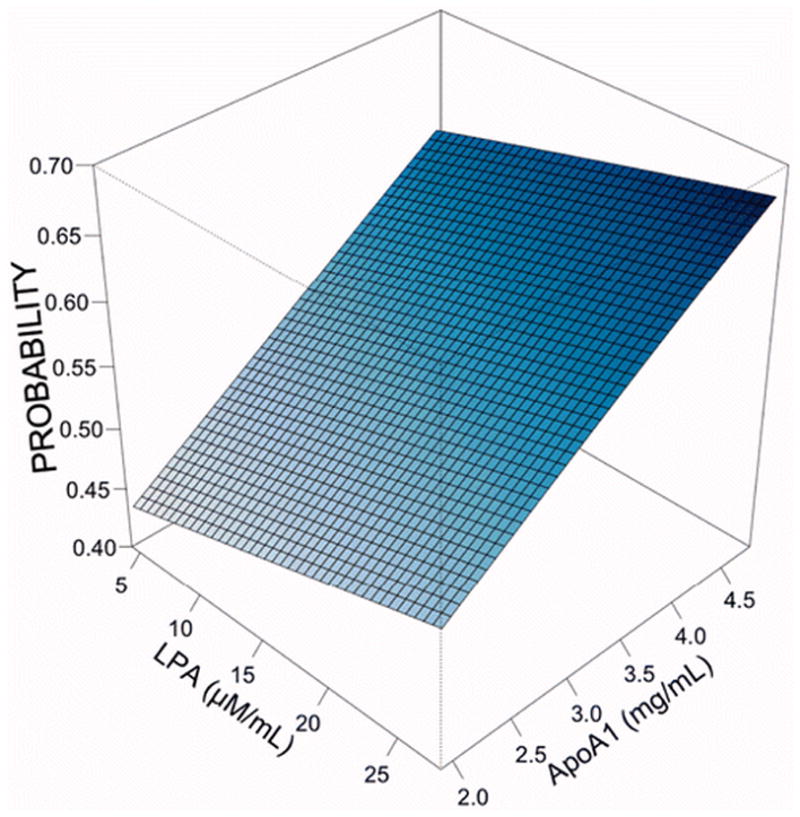
Probability of developing World Trade Center-LI of both LPA and ApoA1 are represented when adjusting for the covariates of exposure, BMI at SPE, pre-9/11 FEV1 % predicted, dyslipidemia, platelet and PMN count. Plots express probability isopleths for the development of World Trade Center-LI with all other covariates held constant.
DISCUSSION
In this report we find that increased levels of LPA and ApoA1 in serum sampled within 6 months of 9/11 are associated with eventual loss of FEV1 to less than LLN in the World Trade Center exposed FDNY firefighter cohort. These analytes were significant predictors when adjusted for exposure (9/11 arrival time), dyslipidemia, BMI at SPE, Pre-911 FEV1% predicted, platelet and PMN counts. These finding suggest the LPA and ApoA1 are biomarkers of World Trade Center-PM associated loss of FEV1.
Development of ventilatory dysfunction following particulate exposure is a major health concern worldwide. In addition, lipid derangement has also become a major health concern in both first and in emerging nations. Both diseases place a tremendous burden on the world’s health resources. Particulate matter exposure and lipid derangements cause systemic inflammation, endothelial dysfunction, and subsequent end-organ damage.(Mills et al., 2007, Tornqvist et al., 2007, Gosker et al., 2006, Gan et al., 2004)
This study focuses on cases defined by their decline in FEV1 to less than LLN at the time of symptomatic presentation. We believe that FEV1<LLN is the single best outcome measure to define lung injury in the FDNY cohort. FEV1 has been longitudinally measured starting three years prior to 9/11/2001 and continues to be performed at every FDNY-WTC-MMTP with quality controls that meet ATS criteria. This measurement has proven to be robust and reproducible. FEV1<LLN is widely used as an outcome in the pulmonary literature so using it in the WTC exposed FDNY cohort improves generalizability of our findings. Using FEV1 as single measure of lung function could lead to non-differential misclassification since FEV1 is reduced in both restriction and obstruction. In prior investigation, we have observed that obstruction caused the vast majority of abnormal FEV1 in WTC exposed fire fighters.(Weiden et al., 2010) While misclassification may occur when using FEV1<LLN as a single measure of abnormal lung function, heterogeneity of disease(s) produced by this single measure will bias the results toward the null. In spite of the potential for non-differential information bias, using FEV1<LLN has yielded strong biomarkers-disease associations.(Weiden et al., 2013) Furthermore, our cases and controls had similar exposure as defined by World Trade Center arrival time, age at the time of exposure and normal FEV1 pre-911, relative to LLN. Finally, we had previously shown that our cohort had similar prevalence of lipid derangements as the larger population that it was drawn from.
Elevated LPA was observed to predict loss of FEV1 in cases of World Trade Center-LI. LPA is an oxidative product of low-density lipoprotein (LDL).(Siess et al., 1999)LPA is a phospholipid and is soluble in both cell membranes and in aqueous fluid. LPA activates pathways involved in vascular injury.(Moolenaar et al., 2004, Lin et al., 2010, Murph and Mills, 2007, Smyth et al., 2008) In addition, receptors of LPA are found in the lung. Specifically, the receptor for advanced glycation end-products (RAGE) has recently been identified as a novel mediator of LPA signaling.(Rai et al., 2012) In the lung, RAGE is expressed at the highest baseline level of any other organ.(Buckley and Ehrhardt, 2010) Pulmonary vascular injury occurs early in smoking-related COPD with pulmonary perfusion abnormalities and reduced blood return to the heart observed prior to development of abnormal FEV1.(Rodriguez-Roisin et al., 2009, Liebow, 1959) Similar pathophysiology likely occurs in irritant-induced COPD. Pulmonary arteriopathy was also present in over 50% of lung biopsies from non-FDNY World Trade Center-PM exposed individuals and in over 70% with constrictive bronchiolitis after inhalational exposures during military service.(Caplan-Shaw et al., 2011, King et al., 2011) Aberrant LPA signaling is implicated in numerous pathologies including vascular injury and tumorigenesis and the pathways involved are potential therapeutic targets.
ApoA1 was also found to predict loss of FEV1 as in our prior study.(Weiden et al., 2013) Our current study is the first to show an association between elevated ApoA1 and lung function loss in particulate exposure in a multianalyte model including other lipid mediators. ApoA1 is a mediator of LPA and a major protein in HDL and therefore their association with PM induced lung injury is of particular interest. ApoA1 is known to bind pro-inflammatory phospholipids such as LPA. In a murine cancer model, overexpression of ApoA1 not only led to increased survival but also to reduced levels of LPA.(Su et al., 2010) We know that mice with a genetic deletion of ApoA1 have increased airway resistance, inflammatory cell recruitment and airway collagen deposition in the steady state.(Wang et al., 2010) In contrast, ApoA1 is involved in the activation of protein kinase C which is involved in the activation of vascular and bronchial smooth muscles.(Hu et al., 1994, Mukherjee et al., 2013) In our analysis, the interaction term for LPA and ApoA1 was not significant, suggesting that the odds for developing an abnormal FEV1 due to an elevation of both biomarkers are likely additive, not synergistic.
This study has several limitations. Our FDNY firefighter cohort is unique as they had massive acute exposure to World Trade Center-PM dusts. This limits the generalizability of these finding to other study populations with lower level PM exposure produced by ambient air pollution. We did not have an unexposed control group to compare and therefore we could not determine the direct effect of World Trade Center-PM exposure on LPA or ApoA1 levels. Replication of these findings in other longitudinally followed populations with and without PM exposure will be important to demonstrate the generalizability of these findings.
This investigation shows that elevated serum LPA and ApoA1 in serum sampled within 6 months of 9/11 predict eventual loss of FEV1 on average 6 years later. These results suggest these biologically active lipid mediators are involved in the pathogenesis of World Trade Center-PM mediated lung injury. Further investigation is required to define the mechanistic underpinning of LPA as a mediator of lung function loss after PM exposure. This finding could place LPA and ApoA1 in the center of a lipid driven inflammatory cascade.
Acknowledgments
Funding Sources:
This work was supported by NIEHST32ES007267 (SJC, BN), NIH-NHLBI K23HL084191/S1(AN), NIAID (MDW) K24A1080298, NIH-R01HL057879 (MDW), and NIOSH (U10-OH008243, U10-OH008242) and UL1RR029893 (DJP). This work was also partially funded by the NYU-HHC Clinical and Translational Science Institute which is supported in part by grant UL1TR000038 from the National Center for Advancing Translational Sciences of the National Institutes of Health. The funding agencies did not participate in the study design; in the collection, analysis and interpretation of data; in the writing of the report; and in the decision to submit the article for publication.
The authors would like to thank the firefighters and rescue workers for their participation in this study and for their selfless contributions.
Footnotes
Author Contributions: AN, MDW, DJP, AMS participated in study conception and design; AN, SJC were the primary investigators; AN, SJC, SK, AC and PJ were responsible for data collection; AN, SK were responsible for data validation; AN, SJC, SK participated in data analysis; AN, SJC, GCE, MDW undertook the statistical analysis. All authors participated in data interpretation, writing and revision of the report and approval of the final version.
Competing interests: The authors report no financial or competing interests.
References
- From the Centers for Disease Control and Prevention. Self-reported increase in asthma severity after the September 11 attacks on the World Trade Center--Manhattan New York 2001. Jama. 2002a;288:1466–7. [PubMed] [Google Scholar]
- Self-reported increase in asthma severity after the September 11 attacks on the World Trade Center--Manhattaan New York 2001. MMWR Morb Mortal Wkly Rep. 2002b;51:781–4. [PubMed] [Google Scholar]
- ALDRICH TK, GUSTAVE J, HALL CB, COHEN HW, WEBBER MP, ZEIG-OWENS R, COSENZA K, CHRISTODOULOU V, GLASS L, AL-OTHMAN F, WEIDEN MD, KELLY KJ, PREZANT DJ. Lung function in rescue workers at the World Trade Center after 7 years. N Engl J Med. 2010;362:1263–72. doi: 10.1056/NEJMoa0910087. [DOI] [PMC free article] [PubMed] [Google Scholar]
- BANAUCH GI, ALLEYNE D, SANCHEZ R, OLENDER K, COHEN HW, WEIDEN M, KELLY KJ, PREZANT DJ. Persistent hyperreactivity and reactive airway dysfunction in firefighters at the World Trade Center. Am J Respir Crit Care Med. 2003;168:54–62. doi: 10.1164/rccm.200211-1329OC. [DOI] [PubMed] [Google Scholar]
- BANAUCH GI, DHALA A, ALLEYNE D, ALVA R, SANTHYADKA G, KRASKO A, WEIDEN M, KELLY KJ, PREZANT DJ. Bronchial hyperreactivity and other inhalation lung injuries in rescue/recovery workers after the World Trade Center collapse. Crit Care Med. 2005;33:S102–6. doi: 10.1097/01.ccm.0000151138.10586.3a. [DOI] [PubMed] [Google Scholar]
- BANAUCH GI, HALL C, WEIDEN M, COHEN HW, ALDRICH TK, CHRISTODOULOU V, ARCENTALES N, KELLY KJ, PREZANT DJ. Pulmonary function after exposure to the World Trade Center collapse in the New York City Fire Department. Am J Respir Crit Care Med. 2006;174:312–9. doi: 10.1164/rccm.200511-1736OC. [DOI] [PMC free article] [PubMed] [Google Scholar]
- BLAMOUN AI, BATTY GN, DEBARI VA, RASHID AO, SHEIKH M, KHAN MA. Statins may reduce episodes of exacerbation and the requirement for intubation in patients with COPD: evidence from a retrospective cohort study. Int J Clin Pract. 2008;62:1373–8. doi: 10.1111/j.1742-1241.2008.01731.x. [DOI] [PubMed] [Google Scholar]
- BOUCHARABA A, SERRE CM, GRES S, SAULNIER-BLACHE JS, BORDET JC, GUGLIELMI J, CLEZARDIN P, PEYRUCHAUD O. Platelet-derived lysophosphatidic acid supports the progression of osteolytic bone metastases in breast cancer. J Clin Invest. 2004;114:1714–25. doi: 10.1172/JCI22123. [DOI] [PMC free article] [PubMed] [Google Scholar]
- BUCKLEY ST, EHRHARDT C. The receptor for advanced glycation end products (RAGE) and the lung. J Biomed Biotechnol. 2010;2010:917108. doi: 10.1155/2010/917108. [DOI] [PMC free article] [PubMed] [Google Scholar]
- CAPLAN-SHAW CE, YEE H, ROGERS L, ABRAHAM JL, PARSIA SS, NAIDICH DP, BORCZUK A, MOREIRA A, SHIAU MC, KO JP, BRUSCA-AUGELLO G, BERGER KI, GOLDRING RM, REIBMAN J. Lung pathologic findings in a local residential and working community exposed to World Trade Center dust, gas, and fumes. J Occup Environ Med. 2011;53:981–91. doi: 10.1097/JOM.0b013e31822fff60. [DOI] [PubMed] [Google Scholar]
- CHEN JC, SCHWARTZ J. Metabolic syndrome and inflammatory responses to long-term particulate air pollutants. Environ Health Perspect. 2008;116:612–7. doi: 10.1289/ehp.10565. [DOI] [PMC free article] [PubMed] [Google Scholar]
- CHO S, KWON S, NAVEED B, SCHENCK E, TSUKIJI J, SCHMIDT A, PREZANT D, ROM W, WEIDEN M, NOLAN A. RAGE Mediates LPA Induced Pulmonary Inflammation. American journal of respiratory & critical care medicine. 2013;187:A3787–A3787. [Google Scholar]
- COWAN DC, COWAN JO, PALMAY R, WILLIAMSON A, TAYLOR DR. Simvastatin in the treatment of asthma: lack of steroid-sparing effect. Thorax. 2010;65:891–6. doi: 10.1136/thx.2010.138990. [DOI] [PubMed] [Google Scholar]
- FELDMAN DM, BARON SL, BERNARD BP, LUSHNIAK BD, BANAUCH G, ARCENTALES N, KELLY KJ, PREZANT DJ. Symptoms, respirator use, and pulmonary function changes among New York City firefighters responding to the World Trade Center disaster. Chest. 2004;125:1256–64. doi: 10.1378/chest.125.4.1256. [DOI] [PubMed] [Google Scholar]
- FELIPE A, ARTIGAS JM, DIEZ-AJENJO A, GARCIA-DOMENE C, ALCOCER P. Residual astigmatism produced by toric intraocular lens rotation. J Cataract Refract Surg. 2011;37:1895–901. doi: 10.1016/j.jcrs.2011.04.036. [DOI] [PubMed] [Google Scholar]
- FESSLER MB, MASSING MW, SPRUELL B, JARAMILLO R, DRAPER DW, MADENSPACHER JH, ARBES SJ, CALATRONI A, ZELDIN DC. Novel relationship of serum cholesterol with asthma and wheeze in the United States. J Allergy Clin Immunol. 2009;124:967–74. e1–15. doi: 10.1016/j.jaci.2009.08.005. [DOI] [PMC free article] [PubMed] [Google Scholar]
- GAN WQ, MAN SF, SENTHILSELVAN A, SIN DD. Association between chronic obstructive pulmonary disease and systemic inflammation: a systematic review and a meta-analysis. Thorax. 2004;59:574–80. doi: 10.1136/thx.2003.019588. [DOI] [PMC free article] [PubMed] [Google Scholar]
- GOSKER HR, SCHRAUWEN P, BROEKHUIZEN R, HESSELINK MK, MOONEN-KORNIPS E, WARD KA, FRANSSEN FM, WOUTERS EF, SCHOLS AM. Exercise training restores uncoupling protein-3 content in limb muscles of patients with chronic obstructive pulmonary disease. Am J Physiol Endocrinol Metab. 2006;290:E976–81. doi: 10.1152/ajpendo.00336.2005. [DOI] [PubMed] [Google Scholar]
- HERBERT R, MOLINE J, SKLOOT G, METZGER K, BARON S, LUFT B, MARKOWITZ S, UDASIN I, HARRISON D, STEIN D, TODD A, ENRIGHT P, STELLMAN JM, LANDRIGAN PJ, LEVIN SM. The World Trade Center disaster and the health of workers: five-year assessment of a unique medical screening program. Environ Health Perspect. 2006;114:1853–8. doi: 10.1289/ehp.9592. [DOI] [PMC free article] [PubMed] [Google Scholar]
- HOSMER DW, LEMESHOW S. Applied logistic regression. New York: Wiley; 1989. [Google Scholar]
- HOTHERSALL EJ, CHAUDHURI R, MCSHARRY C, DONNELLY I, LAFFERTY J, MCMAHON AD, WEIR CJ, MEIKLEJOHN J, SATTAR N, MCINNES I, WOOD S, THOMSON NC. Effects of atorvastatin added to inhaled corticosteroids on lung function and sputum cell counts in atopic asthma. Thorax. 2008;63:1070–5. doi: 10.1136/thx.2008.100198. [DOI] [PubMed] [Google Scholar]
- HU RM, CHUANG MY, PRINS B, KASHYAP ML, FRANK HJ, PEDRAM A, LEVIN ER. High density lipoproteins stimulate the production and secretion of endothelin-1 from cultured bovine aortic endothelial cells. J Clin Invest. 1994;93:1056–62. doi: 10.1172/JCI117055. [DOI] [PMC free article] [PubMed] [Google Scholar]
- KING MS, EISENBERG R, NEWMAN JH, TOLLE JJ, HARRELL FE, JR, NIAN H, NINAN M, LAMBRIGHT ES, SHELLER JR, JOHNSON JE, MILLER RF. Constrictive bronchiolitis in soldiers returning from Iraq and Afghanistan. N Engl J Med. 2011;365:222–30. doi: 10.1056/NEJMoa1101388. [DOI] [PMC free article] [PubMed] [Google Scholar]
- LEE JH, LEE DS, KIM EK, CHOE KH, OH YM, SHIM TS, KIM SE, LEE YS, LEE SD. Simvastatin inhibits cigarette smoking-induced emphysema and pulmonary hypertension in rat lungs. Am J Respir Crit Care Med. 2005;172:987–93. doi: 10.1164/rccm.200501-041OC. [DOI] [PubMed] [Google Scholar]
- LIEBOW AA. Pulmonary emphysema with special reference to vascular changes. Am Rev Respir Dis. 1959;80:67–93. doi: 10.1164/arrd.1959.80.1P2.67. [DOI] [PubMed] [Google Scholar]
- LIN ME, HERR DR, CHUN J. Lysophosphatidic acid (LPA) receptors: signaling properties and disease relevance. Prostaglandins Other Lipid Mediat. 2010;91:130–8. doi: 10.1016/j.prostaglandins.2009.02.002. [DOI] [PMC free article] [PubMed] [Google Scholar]
- LONGO KA, GOVEK EK, NOLAN A, MCDONAGH T, CHAROENTHONGTRAKUL S, GIULIANA DJ, MORGAN K, HIXON J, ZHOU C, KELDER B, KOPCHICK JJ, SAUNDERS JO, NAVIA MA, CURTIS R, DISTEFANO PS, GEDDES BJ. Pharmacologic inhibition of ghrelin receptor signaling is insulin sparing and promotes insulin sensitivity. J Pharmacol Exp Ther. 2011;339:115–24. doi: 10.1124/jpet.111.183764. [DOI] [PubMed] [Google Scholar]
- MCKAY A, LEUNG BP, MCINNES IB, THOMSON NC, LIEW FY. A novel anti-inflammatory role of simvastatin in a murine model of allergic asthma. J Immunol. 2004;172:2903–8. doi: 10.4049/jimmunol.172.5.2903. [DOI] [PubMed] [Google Scholar]
- MILLS NL, TORNQVIST H, GONZALEZ MC, VINK E, ROBINSON SD, SODERBERG S, BOON NA, DONALDSON K, SANDSTROM T, BLOMBERG A, NEWBY DE. Ischemic and thrombotic effects of dilute diesel-exhaust inhalation in men with coronary heart disease. N Engl J Med. 2007;357:1075–82. doi: 10.1056/NEJMoa066314. [DOI] [PubMed] [Google Scholar]
- MOOLENAAR WH, VAN MEETEREN LA, GIEPMANS BN. The ins and outs of lysophosphatidic acid signaling. Bioessays. 2004;26:870–81. doi: 10.1002/bies.20081. [DOI] [PubMed] [Google Scholar]
- MUKHERJEE S, TRICE J, SHINDE P, WILLIS RE, PRESSLEY TA, PEREZ-ZOGHBI JF. Ca2+ oscillations, Ca2+ sensitization, and contraction activated by protein kinase C in small airway smooth muscle. J Gen Physiol. 2013;141:165–78. doi: 10.1085/jgp.201210876. [DOI] [PMC free article] [PubMed] [Google Scholar]
- MURPH M, MILLS GB. Targeting the lipids LPA and S1P and their signalling pathways to inhibit tumour progression. Expert Rev Mol Med. 2007;9:1–18. doi: 10.1017/S1462399407000476. [DOI] [PubMed] [Google Scholar]
- NAVEED B, WEIDEN MD, KWON S, GRACELY EJ, COMFORT AL, FERRIER N, KASTURIARACHCHI KJ, COHEN HW, ALDRICH TK, ROM WN, KELLY K, PREZANT DJ, NOLAN A. Metabolic syndrome biomarkers predict lung function impairment: a nested case-control study. Am J Respir Crit Care Med. 2012;185:392–9. doi: 10.1164/rccm.201109-1672OC. [DOI] [PMC free article] [PubMed] [Google Scholar]
- NOLAN A, NAVEED B, COMFORT A, FERRIER N, HALL C, KWON S, KASTURIARACHCHI K, COHEN H, ZEIG-OWENS R, GLASER M, WEBBER M, ALDRICH T, ROM W, KELLY K, PREZANT D, WEIDEN M. Inflammatory Biomarkers Predict Airflow Obstruction After Exposure to World Trade Center Dust. Chest. 2012:412–418. doi: 10.1378/chest.11-1202. [DOI] [PMC free article] [PubMed] [Google Scholar]
- NOLAN A, NAVEED B, COMFORT AL, FERRIER N, HALL CB, KWON S, KASTURIARACHCHI KJ, COHEN HW, ZEIG-OWENS R, GLASER MS, WEBBER MP, ALDRICH TK, ROM WN, KELLY K, PREZANT DJ, WEIDEN MD. Inflammatory Biomarkers Predict Airflow Obstruction After Exposure to World Trade Center Dust. Chest. 2011;142:412–418. doi: 10.1378/chest.11-1202. [DOI] [PMC free article] [PubMed] [Google Scholar]
- PREZANT DJ, WEIDEN M, BANAUCH GI, MCGUINNESS G, ROM WN, ALDRICH TK, KELLY KJ. Cough and bronchial responsiveness in firefighters at the World Trade Center site. N Engl J Med. 2002;347:806–15. doi: 10.1056/NEJMoa021300. [DOI] [PubMed] [Google Scholar]
- RAI V, TOURE F, CHITAYAT S, PEI R, SONG F, LI Q, ZHANG J, ROSARIO R, RAMASAMY R, CHAZIN WJ, SCHMIDT AM. Lysophosphatidic acid targets vascular and oncogenic pathways via RAGE signaling. J Exp Med. 2012;209:2339–50. doi: 10.1084/jem.20120873. [DOI] [PMC free article] [PubMed] [Google Scholar]
- REIBMAN J, LIN S, HWANG SA, GULATI M, BOWERS JA, ROGERS L, BERGER KI, HOERNING A, GOMEZ M, FITZGERALD EF. The World Trade Center residents’ respiratory health study: new-onset respiratory symptoms and pulmonary function. Environ Health Perspect. 2005;113:406–11. doi: 10.1289/ehp.7375. [DOI] [PMC free article] [PubMed] [Google Scholar]
- RODRIGUEZ-ROISIN R, DRAKULOVIC M, RODRIGUEZ DA, ROCA J, BARBERA JA, WAGNER PD. Ventilation-perfusion imbalance and chronic obstructive pulmonary disease staging severity. J Appl Physiol. 2009;106:1902–8. doi: 10.1152/japplphysiol.00085.2009. [DOI] [PubMed] [Google Scholar]
- SIESS W, ZANGL KJ, ESSLER M, BAUER M, BRANDL R, CORRINTH C, BITTMAN R, TIGYI G, AEPFELBACHER M. Lysophosphatidic acid mediates the rapid activation of platelets and endothelial cells by mildly oxidized low density lipoprotein and accumulates in human atherosclerotic lesions. Proc Natl Acad Sci U S A. 1999;96:6931–6. doi: 10.1073/pnas.96.12.6931. [DOI] [PMC free article] [PubMed] [Google Scholar]
- SMYTH SS, CHENG HY, MIRIYALA S, PANCHATCHARAM M, MORRIS AJ. Roles of lysophosphatidic acid in cardiovascular physiology and disease. Biochim Biophys Acta. 2008;1781:563–70. doi: 10.1016/j.bbalip.2008.05.008. [DOI] [PMC free article] [PubMed] [Google Scholar]
- SOYSETH V, BREKKE PH, SMITH P, OMLAND T. Statin use is associated with reduced mortality in COPD. Eur Respir J. 2007;29:279–83. doi: 10.1183/09031936.00106406. [DOI] [PubMed] [Google Scholar]
- STEYERBERG EW, HARRELL FE, JR, BORSBOOM GJ, EIJKEMANS MJ, VERGOUWE Y, HABBEMA JD. Internal validation of predictive models: efficiency of some procedures for logistic regression analysis. J Clin Epidemiol. 2001;54:774–81. doi: 10.1016/s0895-4356(01)00341-9. [DOI] [PubMed] [Google Scholar]
- SU F, KOZAK KR, IMAIZUMI S, GAO F, AMNEUS MW, GRIJALVA V, NG C, WAGNER A, HOUGH G, FARIAS-EISNER G, ANANTHARAMAIAH GM, VAN LENTEN BJ, NAVAB M, FOGELMAN AM, REDDY ST, FARIAS-EISNER R. Apolipoprotein A-I (apoA-I) and apoA-I mimetic peptides inhibit tumor development in a mouse model of ovarian cancer. Proc Natl Acad Sci U S A. 2010;107:19997–20002. doi: 10.1073/pnas.1009010107. [DOI] [PMC free article] [PubMed] [Google Scholar]
- TIENGO A, FADINI GP, AVOGARO A. The metabolic syndrome, diabetes and lung dysfunction. Diabetes Metab. 2008;34:447–54. doi: 10.1016/j.diabet.2008.08.001. [DOI] [PubMed] [Google Scholar]
- TORNQVIST H, MILLS NL, GONZALEZ M, MILLER MR, ROBINSON SD, MEGSON IL, MACNEE W, DONALDSON K, SODERBERG S, NEWBY DE, SANDSTROM T, BLOMBERG A. Persistent endothelial dysfunction in humans after diesel exhaust inhalation. Am J Respir Crit Care Med. 2007;176:395–400. doi: 10.1164/rccm.200606-872OC. [DOI] [PubMed] [Google Scholar]
- WANG W, XU H, SHI Y, NANDEDKAR S, ZHANG H, GAO H, FEROAH T, WEIHRAUCH D, SCHULTE ML, JONES DW, JARZEMBOWSKI J, SORCI-THOMAS M, PRITCHARD KA., JR Genetic deletion of apolipoprotein A-I increases airway hyperresponsiveness, inflammation, and collagen deposition in the lung. J Lipid Res. 2010;51:2560–70. doi: 10.1194/jlr.M004549. [DOI] [PMC free article] [PubMed] [Google Scholar]
- WEIDEN MD, FERRIER N, NOLAN A, ROM WN, COMFORT A, GUSTAVE J, ZEIG-OWENS R, ZHENG S, GOLDRING RM, BERGER KI, COSENZA K, LEE R, WEBBER MP, KELLY KJ, ALDRICH TK, PREZANT DJ. Obstructive airways disease with air trapping among firefighters exposed to World Trade Center dust. Chest. 2010;137:566–74. doi: 10.1378/chest.09-1580. [DOI] [PMC free article] [PubMed] [Google Scholar]
- WEIDEN MD, NAVEED B, KWON S, CHO SJ, COMFORT AL, PREZANT DJ, ROM WN, NOLAN A. Cardiovascular biomarkers predict susceptibility to lung injury in World Trade Center dust-exposed firefighters. Eur Respir J. 2013;41:1023–30. doi: 10.1183/09031936.00077012. [DOI] [PMC free article] [PubMed] [Google Scholar]
- WEIDEN MD, NAVEED B, KWON S, SEGAL LN, CHO SJ, TSUKIJI J, KULKARNI R, COMFORT AL, KASTURIARACHCHI KJ, PROPHETE C, COHEN MD, CHEN LC, ROM WN, PREZANT DJ, NOLAN A. Comparison of WTC dust size on macrophage inflammatory cytokine release in vivo and in vitro. PLoS One. 2012;7:e40016. doi: 10.1371/journal.pone.0040016. [DOI] [PMC free article] [PubMed] [Google Scholar]
- YEH YF, HUANG SL. Enhancing effect of dietary cholesterol and inhibitory effect of pravastatin on allergic pulmonary inflammation. J Biomed Sci. 2004;11:599–606. doi: 10.1007/BF02256124. [DOI] [PubMed] [Google Scholar]