



Abstract
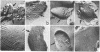
Two integral glycoproteins from the human erythrocyte have been studied after their incorporation into lipid bilayer systems. Glycophorin (which is the M/N blood group determinant) and the concanavalin A receptor were isolated and purified prior to incorporation into model membranes by dialytic removal of detergent from lipid/protein solutions. Under the conditions described, glycoprotein receptors maintain their function in that they bind external agents specific for them, such as concanavalin A and immunoglobulins. So-called intramembranous particles are a feature of freeze-fractured preparations of lipid bilayers containing either (or both) glycoprotein(s), and to some extent each has a characteristic particle appearance. Liposomes containing the concanavalin A receptor (with or without glycophorin) are agglutinable by concanavalin A, whereas human erythrocytes are normally considered to be nonagglutinable by this lectin. Liposomes containing glycophorin alone are readily agglutinable by the appropriate glycophorin-directed M/N antiserum, as are human erythrocytes. The added presence of concanavalin A receptor in the liposomes can markedly inhibit agglutination by M/N antiserum without preventing immunoglobulin binding.
Full text
PDF


Images in this article
Selected References
These references are in PubMed. This may not be the complete list of references from this article.
- Bachi T., Schnebli H. P. Reaction of lectins with human erythrocytes. II. Mapping of conA receptors by freeze-etching electron microscopy. Exp Cell Res. 1975 Mar 15;91(2):285–295. doi: 10.1016/0014-4827(75)90106-8. [DOI] [PubMed] [Google Scholar]
- Barratt D. G., Sharom F. J., Thede A. E., Grant C. W. Isolation and incorporation into lipid vesicles of a concanavalin A receptor from human erythrocytes. Biochim Biophys Acta. 1977 Mar 1;465(2):191–197. doi: 10.1016/0005-2736(77)90073-6. [DOI] [PubMed] [Google Scholar]
- Brûlet P., McConnell H. M. Protein-lipid interactions glycophorin and dipalmitolyphosphatidylcholine. Biochem Biophys Res Commun. 1976 Jan 26;68(2):363–368. doi: 10.1016/0006-291x(76)91153-0. [DOI] [PubMed] [Google Scholar]
- Chen Y. S., Hubbell W. L. Temperature- and light-dependent structural changes in rhodopsin-lipid membranes. Exp Eye Res. 1973 Dec 24;17(6):517–532. doi: 10.1016/0014-4835(73)90082-1. [DOI] [PubMed] [Google Scholar]
- DODGE J. T., MITCHELL C., HANAHAN D. J. The preparation and chemical characteristics of hemoglobin-free ghosts of human erythrocytes. Arch Biochem Biophys. 1963 Jan;100:119–130. doi: 10.1016/0003-9861(63)90042-0. [DOI] [PubMed] [Google Scholar]
- Findlay J. B. The receptor proteins for concanavalin A and Lens culinaris phytohemagglutinin in the membrane of the human erythrocyte. J Biol Chem. 1974 Jul 25;249(14):4398–4403. [PubMed] [Google Scholar]
- Grant C. W., McConnell H. M. Glycophorin in lipid bilayers. Proc Natl Acad Sci U S A. 1974 Dec;71(12):4653–4657. doi: 10.1073/pnas.71.12.4653. [DOI] [PMC free article] [PubMed] [Google Scholar]
- Guidotti G. Membrane proteins. Annu Rev Biochem. 1972;41:731–752. doi: 10.1146/annurev.bi.41.070172.003503. [DOI] [PubMed] [Google Scholar]
- Hong K., Hubbell W. L. Lipid requirements for Rhodopsin regenerability. Biochemistry. 1973 Oct 23;12(22):4517–4523. doi: 10.1021/bi00746a033. [DOI] [PubMed] [Google Scholar]
- Hong K., Hubbell W. L. Preparation and properties of phospholipid bilayers containing rhodopsin. Proc Natl Acad Sci U S A. 1972 Sep;69(9):2617–2621. doi: 10.1073/pnas.69.9.2617. [DOI] [PMC free article] [PubMed] [Google Scholar]
- Höchli M., Hackenbrock C. R. Fluidity in mitochondrial membranes: thermotropic lateral translational motion of intramembrane particles. Proc Natl Acad Sci U S A. 1976 May;73(5):1636–1640. doi: 10.1073/pnas.73.5.1636. [DOI] [PMC free article] [PubMed] [Google Scholar]
- Kleemann W., Grant C. W., McConnell H. M. Lipid phase separations and protein distribution in membranes. J Supramol Struct. 1974;2(5-6):609–616. doi: 10.1002/jss.400020508. [DOI] [PubMed] [Google Scholar]
- Kleemann W., McConnell H. M. Interactions of proteins and cholesterol with lipids in bilayer membranes. Biochim Biophys Acta. 1976 Jan 21;419(2):206–222. doi: 10.1016/0005-2736(76)90347-3. [DOI] [PubMed] [Google Scholar]
- Kleemann W., McConnell H. M. Lateral phase separations in Escherichia coli membranes. Biochim Biophys Acta. 1974 Apr 29;345(2):220–230. doi: 10.1016/0005-2736(74)90260-0. [DOI] [PubMed] [Google Scholar]
- Lyles D. S., Landsberger F. R. V irus and lectin agglutination of erythrocytes: spin label study of membrane lipid-protein interactions. Proc Natl Acad Sci U S A. 1976 Oct;73(10):3497–3501. doi: 10.1073/pnas.73.10.3497. [DOI] [PMC free article] [PubMed] [Google Scholar]
- MacLennan D. H., Seeman P., Iles G. H., Yip C. C. Membrane formation by the adenosine triphosphatase of sarcoplasmic reticulum. J Biol Chem. 1971 Apr 25;246(8):2702–2710. [PubMed] [Google Scholar]
- Marcelja S. Lipid-mediated protein interaction in membranes. Biochim Biophys Acta. 1976 Nov 11;455(1):1–7. doi: 10.1016/0005-2736(76)90149-8. [DOI] [PubMed] [Google Scholar]
- Marchesi V. T., Andrews E. P. Glycoproteins: isolation from cellmembranes with lithium diiodosalicylate. Science. 1971 Dec 17;174(4015):1247–1248. doi: 10.1126/science.174.4015.1247. [DOI] [PubMed] [Google Scholar]
- Marchesi V. T., Tillack T. W., Jackson R. L., Segrest J. P., Scott R. E. Chemical characterization and surface orientation of the major glycoprotein of the human erythrocyte membrane. Proc Natl Acad Sci U S A. 1972 Jun;69(6):1445–1449. doi: 10.1073/pnas.69.6.1445. [DOI] [PMC free article] [PubMed] [Google Scholar]
- Nicolson G. L. Transmembrane control of the receptors on normal and tumor cells. I. Cytoplasmic influence over surface components. Biochim Biophys Acta. 1976 Apr 13;457(1):57–108. doi: 10.1016/0304-4157(76)90014-9. [DOI] [PubMed] [Google Scholar]
- Pinto da Silva P., Branton D. Membrane intercalated particles: the plasma membrane as a planar fluid domain. Chem Phys Lipids. 1972 May;8(4):265–278. doi: 10.1016/0009-3084(72)90054-0. [DOI] [PubMed] [Google Scholar]
- Pinto da Silva P., Branton D. Membrane splitting in freeze-ethching. Covalently bound ferritin as a membrane marker. J Cell Biol. 1970 Jun;45(3):598–605. doi: 10.1083/jcb.45.3.598. [DOI] [PMC free article] [PubMed] [Google Scholar]
- Roses A. D. Substrate heterogeneity of component a of the human erythrocyte membrane. J Supramol Struct. 1976;4(4):481–486. doi: 10.1002/jss.400040407. [DOI] [PubMed] [Google Scholar]
- Schnebli H. P., Bächi T. Reaction of lectins with human erythrocytes. I. Factors governing the agglutination reaction. Exp Cell Res. 1975 Mar 1;91(1):175–183. doi: 10.1016/0014-4827(75)90155-x. [DOI] [PubMed] [Google Scholar]
- Segrest J. P., Gulik-Krzywicki T., Sardet C. Association of the membrane-penetrating polypeptide segment of the human erythrocyte MN-glycoprotein with phospholipid bilayers. I. Formation of freeze-etch intramembranous particles. Proc Natl Acad Sci U S A. 1974 Aug;71(8):3294–3298. doi: 10.1073/pnas.71.8.3294. [DOI] [PMC free article] [PubMed] [Google Scholar]
- Shechter E., Letellier L., Gulik-Krzywicki G. Relations between structure and function in cytoplasmic membrane vesicles isolated from an Escherichia coli fatty-acid auxotroph. High-angle x-ray diffraction, freeze-etch electron microscopy and transport studies. Eur J Biochem. 1974 Nov 1;49(1):61–76. doi: 10.1111/j.1432-1033.1974.tb03811.x. [DOI] [PubMed] [Google Scholar]
- Silva P. P., Nicolson G. L. Freeze-etch localization of concanavalin A receptors to the membrane intercalated particles of human erythrocyte ghost membranes. Biochim Biophys Acta. 1974 Sep 23;363(3):311–319. doi: 10.1016/0005-2736(74)90071-6. [DOI] [PubMed] [Google Scholar]
- Singer K. A., Morrison M. Effect of metabolic state on agglutination of human erythrocytes by concanavalin A. Biochim Biophys Acta. 1976 Feb 19;426(1):123–131. doi: 10.1016/0005-2736(76)90434-x. [DOI] [PubMed] [Google Scholar]
- Singer S. J. Molecular biology of cellular membranes with applications to immunology. Adv Immunol. 1974;19(0):1–66. doi: 10.1016/s0065-2776(08)60251-5. [DOI] [PubMed] [Google Scholar]
- Tourtellotte M. E., Branton D., Keith A. Membrane structure: spin labeling and freeze etching of Mycoplasma laidawii. Proc Natl Acad Sci U S A. 1970 Jul;66(3):909–916. doi: 10.1073/pnas.66.3.909. [DOI] [PMC free article] [PubMed] [Google Scholar]
- Tourtellotte M. E., Zupnik J. S. Freeze-fractured Acholeplasma laidlawii membranes: nature of particles observed. Science. 1973 Jan 5;179(4068):84–86. doi: 10.1126/science.179.4068.84. [DOI] [PubMed] [Google Scholar]
- Verkleij A. J., Ververgaert P. H., van Deenen L. L., Elbers P. F. Phase transitions of phospholipid bilayers and membranes of Acholeplasma laidlawii B visualized by freeze fracturing electron microscopy. Biochim Biophys Acta. 1972 Nov 2;288(2):326–332. doi: 10.1016/0005-2736(72)90253-2. [DOI] [PubMed] [Google Scholar]
- Warren G. B., Houslay M. D., Metcalfe J. C., Birdsall N. J. Cholesterol is excluded from the phospholipid annulus surrounding an active calcium transport protein. Nature. 1975 Jun 26;255(5511):684–687. doi: 10.1038/255684a0. [DOI] [PubMed] [Google Scholar]
- Yu J., Branton D. Reconstitution of intramembrane particles in recombinants of erythrocyte protein band 3 and lipid: effects of spectrin-actin association. Proc Natl Acad Sci U S A. 1976 Nov;73(11):3891–3895. doi: 10.1073/pnas.73.11.3891. [DOI] [PMC free article] [PubMed] [Google Scholar]
- Yu J., Steck T. L. Isolation and characterization of band 3, the predominant polypeptide of the human erythrocyte membrane. J Biol Chem. 1975 Dec 10;250(23):9170–9175. [PubMed] [Google Scholar]