



In the crystal of the title compound, molecules are linked by N—H⋯O hydrogen bonds between the imino group and the carbonyl O atom in the ethyl ester group, forming a tape structure along the c-axis direction. The oxazolidine rings of adjacent tapes are arranged into a layer parallel to the ac plane, which is a favourable arrangement for the polymerization of the title compound in the solid state.
Keywords: crystal structure, solid-state polymerization, amino acid N-carboxy anhydrides, hydrogen bonding
Abstract
In the title compound (alternative name N-carboxy-l-glutamic anhydride γ-ethyl ester), C8H11NO5, the oxazolidine ring is essentially planar, with a maximum deviation of 0.019 (2) Å. In the crystal, molecules are linked by N—H⋯O hydrogen bonds between the imino group and the carbonyl O atom in the ethyl ester group, forming a tape structure along the c-axis direction. The oxazolidine rings of adjacent tapes are arranged into a layer parallel to the ac plane. This arrangement is favourable for the polymerization of the title compound in the solid state.
Chemical context
N-Carboxy anhydrides (NCAs) of amino acids are extensively used as monomers in the preparation of high molecular weight polypeptides (Kricheldorf, 2006 ▸). Amino acid NCAs are easily soluble but the resulting polypeptides are not soluble in general organic solvents. Only a few amino acid ester NCAs such as γ-benzyl-l-glutamate NCA and β-benzyl-l-aspartate NCA can be polymerized in solutions, because the resulting polypeptides are soluble in them. Thus, the polymerization of these amino acid ester NCAs has been investigated by many researchers. We found that every amino acid NCA crystal is polymerized in the solid state in hexane by the initiation of amines, and have studied the solid-state polymerization of amino acid NCAs with reference to the crystal structures (Kanazawa, 1992 ▸; Kanazawa & Magoshi, 2003 ▸; Kanazawa et al., 2006 ▸).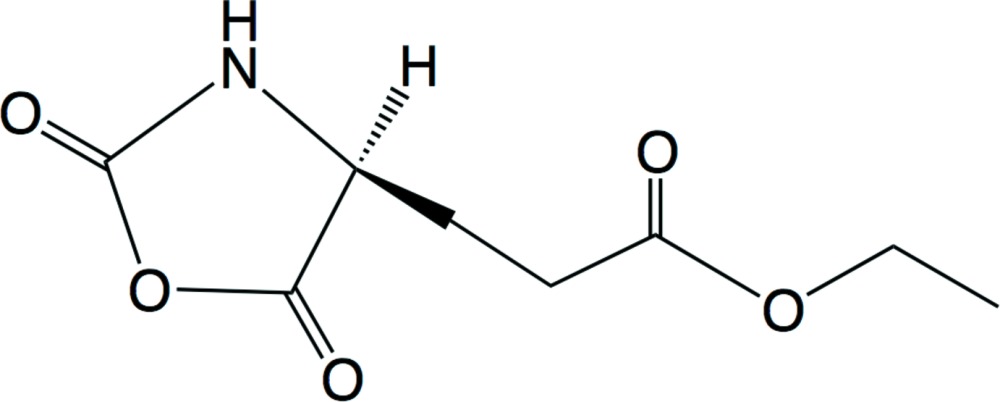
The title compound, γ-ethyl-l-glutamate NCA (ELG NCA) is polymerized both in dioxane solution and in the solid state in hexane, using butylamine as initiator. However, ELG NCA is very reactive in the solid state in hexane using the same initiator. Therefore, it is important to determine the crystal structure in order to consider the difference in the reactivity of ELG NCA in solution and in the solid state.
Structural commentary
The molecular structure of the title compound is shown in Fig. 1 ▸. The oxazolidine ring is essentially planar, with a maximum deviation of 0.019 (2) Å for atom C1. The side chain has an extended conformation with the torsion angles C3—C4—C5—C6 and C4—C5—C6—O5 being 177.65 (13) and −172.05 (13)°, respectively.
Figure 1.

The molecular structure of the title compound showing atom labels and 50% probability displacement ellipsoids for non-H atoms.
Supramolecular features
In the crystal, ELG NCA molecules are linked by N1—H1⋯O4 hydrogen bonds along the c axis (Table 1 ▸ and Fig. 2 ▸). The five-membered oxazolidine rings are packed in a layer and the –CH2CH2COOCH2CH3 groups are packed in another layer; these two different layers are stacked alternately. This sandwich structure is one of the important requirements for high reactivity in the solid state, because the five-membered rings can react with each other in the layer.
Table 1. Hydrogen-bond geometry (, ).
| DHA | DH | HA | D A | DHA |
|---|---|---|---|---|
| N1H1O4i | 0.76(2) | 2.13(2) | 2.8766(17) | 170(2) |
Symmetry code: (i)  .
.
Figure 2.

A crystal packing diagram of the title compound, viewed approximately along the a axis, showing the hydrogen bonds as dashed lines (see Table 1 ▸ for details).
Database survey
A search of the Cambridge Structural Database (Version 5.35, May 2014; Groom & Allen, 2014 ▸) revealed the presence of 20 hits for 4-methyloxazolidine-2,5-dione derivatives. A number of these compounds involve amino acid sides chains (amino acid NCAs). These include two polymorphs of a compound involving l-aspartate, namely N-carboxy-β-benzyl-l-aspartate anhydride (SOHRIQ: Kanazawa, 1998 ▸; no coordinates were deposited) and (SOHRIQ01: Kanazawa & Magoshi, 2003 ▸). Two other compounds involving l-glutamate have also been reported. They are very similar to the title compound and are polymorphs of N-carboxy-γ-benzyl-l-glutamate anhydride (ANCBGL; Kanazawa et al., 1978 ▸) and (WIPDUV; Kanazawa et al., 2006 ▸). For the latter, unfortunately no coordinates have been deposited. The structural overlay of the title compound and ANCBGL indicates that the N-carboxy-l-glutamate anhydride moieties have very similar conformations (Fig. 3 ▸).
Figure 3.

A view of the structural overlay of the title compound (blue) and ANCBGL (red; Kanazawa et al., 1978 ▸).
Synthesis and crystallization
The synthesis of γ-ethyl-l-glutamate (ELG) was carried out by the reaction of l-glutamic acid with ethanol in a manner similar to that of γ-benzyl-l-glutamate (BLG) (Kanazawa, 1992 ▸). The title compound was obtained by the reaction of γ-ethyl-l-glutamate with trichloromethyl chloroformate or triphosgene in tetrahydrofuran, as reported previously for β-benzyl-l-aspartate (BLA) NCA (Kanazawa & Magoshi, 2003 ▸). The reaction product was recrystallized in a mixture of ethyl acetate and hexane (1:50 v/v), avoiding moisture contamination.
Refinement details
Crystal data, data collection and structure refinement details are summarized in Table 2 ▸. The N-bound H atom was found in a difference Fourier map and its position was refined with U iso(H) = 1.5U eq(N). C-bound H atoms were positioned geometrically (C—H = 0.96–0.98 Å) and treated as riding with U iso(H) = 1.2U eq(C).
Table 2. Experimental details.
| Crystal data | |
| Chemical formula | C8H11NO5 |
| M r | 201.18 |
| Crystal system, space group | Orthorhombic, P21212 |
| Temperature (K) | 293 |
| a, b, c () | 7.9337(19), 20.581(5), 5.8405(14) |
| V (3) | 953.7(4) |
| Z | 4 |
| Radiation type | Mo K |
| (mm1) | 0.12 |
| Crystal size (mm) | 0.66 0.39 0.14 |
| Data collection | |
| Diffractometer | Rigaku XtaLAB mini |
| Absorption correction | Multi-scan (REQAB; Rigaku, 1998 ▸) |
| T min, T max | 0.926, 0.984 |
| No. of measured, independent and observed [I > 2(I)] reflections | 9982, 2190, 2042 |
| R int | 0.024 |
| (sin /)max (1) | 0.649 |
| Refinement | |
| R[F 2 > 2(F 2)], wR(F 2), S | 0.034, 0.081, 1.03 |
| No. of reflections | 2190 |
| No. of parameters | 131 |
| H-atom treatment | H atoms treated by a mixture of independent and constrained refinement |
| max, min (e 3) | 0.16, 0.16 |
Supplementary Material
Crystal structure: contains datablock(s) I, New_Global_Publ_Block. DOI: 10.1107/S2056989014027170/is5383sup1.cif
Structure factors: contains datablock(s) I. DOI: 10.1107/S2056989014027170/is5383Isup2.hkl
Supporting information file. DOI: 10.1107/S2056989014027170/is5383Isup3.cml
CCDC reference: 1038820
Additional supporting information: crystallographic information; 3D view; checkCIF report
Acknowledgments
HK thanks Mr Kazuyoshi Nakamura of Fukushima Technology Centre for assistance with the synthesis of the title compound.
supplementary crystallographic information
Crystal data
| C8H11NO5 | F(000) = 424 |
| Mr = 201.18 | Dx = 1.401 Mg m−3 |
| Orthorhombic, P21212 | Mo Kα radiation, λ = 0.71069 Å |
| Hall symbol: P 2 2ab | θ = 3.2–27.5° |
| a = 7.9337 (19) Å | µ = 0.12 mm−1 |
| b = 20.581 (5) Å | T = 293 K |
| c = 5.8405 (14) Å | Prism, colorless |
| V = 953.7 (4) Å3 | 0.66 × 0.39 × 0.14 mm |
| Z = 4 |
Data collection
| Rigaku XtaLAB mini diffractometer | 2190 independent reflections |
| Radiation source: fine-focus sealed tube | 2042 reflections with I > 2σ(I) |
| Graphite monochromator | Rint = 0.024 |
| Detector resolution: 6.827 pixels mm-1 | θmax = 27.5°, θmin = 3.2° |
| ω scans | h = −10→10 |
| Absorption correction: multi-scan (REQAB; Rigaku, 1998) | k = −26→26 |
| Tmin = 0.926, Tmax = 0.984 | l = −7→7 |
| 9982 measured reflections |
Refinement
| Refinement on F2 | Primary atom site location: structure-invariant direct methods |
| Least-squares matrix: full | Secondary atom site location: difference Fourier map |
| R[F2 > 2σ(F2)] = 0.034 | Hydrogen site location: inferred from neighbouring sites |
| wR(F2) = 0.081 | H atoms treated by a mixture of independent and constrained refinement |
| S = 1.03 | w = 1/[σ2(Fo2) + (0.0385P)2 + 0.167P] where P = (Fo2 + 2Fc2)/3 |
| 2190 reflections | (Δ/σ)max = 0.010 |
| 131 parameters | Δρmax = 0.16 e Å−3 |
| 0 restraints | Δρmin = −0.16 e Å−3 |
Special details
| Geometry. All e.s.d.'s (except the e.s.d. in the dihedral angle between two l.s. planes) are estimated using the full covariance matrix. The cell e.s.d.'s are taken into account individually in the estimation of e.s.d.'s in distances, angles and torsion angles; correlations between e.s.d.'s in cell parameters are only used when they are defined by crystal symmetry. An approximate (isotropic) treatment of cell e.s.d.'s is used for estimating e.s.d.'s involving l.s. planes. |
| Refinement. Refinement of F2 against ALL reflections. The weighted R-factor wR and goodness of fit S are based on F2, conventional R-factors R are based on F, with F set to zero for negative F2. The threshold expression of F2 > σ(F2) is used only for calculating R-factors(gt) etc. and is not relevant to the choice of reflections for refinement. R-factors based on F2 are statistically about twice as large as those based on F, and R- factors based on ALL data will be even larger. |
Fractional atomic coordinates and isotropic or equivalent isotropic displacement parameters (Å2)
| x | y | z | Uiso*/Ueq | ||
| O1 | −0.02731 (16) | 0.77067 (6) | −0.0480 (2) | 0.0538 (4) | |
| O2 | 0.10460 (14) | 0.72562 (4) | 0.25649 (18) | 0.0385 (3) | |
| O3 | 0.27691 (18) | 0.70878 (5) | 0.5536 (2) | 0.0548 (4) | |
| O4 | 0.19733 (14) | 0.94889 (5) | 0.93375 (19) | 0.0417 (3) | |
| O5 | 0.26952 (18) | 1.03085 (5) | 0.7069 (2) | 0.0539 (4) | |
| N1 | 0.15491 (17) | 0.82887 (6) | 0.1795 (2) | 0.0344 (3) | |
| C1 | 0.06782 (19) | 0.77729 (7) | 0.1092 (3) | 0.0355 (3) | |
| C2 | 0.22322 (19) | 0.74470 (6) | 0.4126 (3) | 0.0340 (3) | |
| C3 | 0.26475 (17) | 0.81536 (6) | 0.3704 (2) | 0.0283 (3) | |
| C4 | 0.23203 (19) | 0.85660 (6) | 0.5828 (3) | 0.0318 (3) | |
| C5 | 0.2829 (3) | 0.92684 (7) | 0.5461 (3) | 0.0425 (4) | |
| C6 | 0.24451 (18) | 0.96852 (6) | 0.7513 (3) | 0.0336 (3) | |
| C7 | 0.2257 (3) | 1.07707 (7) | 0.8886 (4) | 0.0504 (5) | |
| C8 | 0.3640 (3) | 1.08564 (9) | 1.0556 (4) | 0.0575 (5) | |
| H1 | 0.156 (3) | 0.8596 (10) | 0.108 (4) | 0.0517* | |
| H3 | 0.3827 | 0.8197 | 0.3231 | 0.0339* | |
| H4A | 0.1132 | 0.8547 | 0.6210 | 0.0381* | |
| H4B | 0.2950 | 0.8389 | 0.7108 | 0.0381* | |
| H5A | 0.4027 | 0.9288 | 0.5139 | 0.0509* | |
| H5B | 0.2234 | 0.9439 | 0.4140 | 0.0509* | |
| H7A | 0.1261 | 1.0617 | 0.9682 | 0.0604* | |
| H7B | 0.1990 | 1.1188 | 0.8204 | 0.0604* | |
| H8A | 0.4623 | 1.1017 | 0.9782 | 0.0689* | |
| H8B | 0.3895 | 1.0446 | 1.1259 | 0.0689* | |
| H8C | 0.3301 | 1.1161 | 1.1711 | 0.0689* |
Atomic displacement parameters (Å2)
| U11 | U22 | U33 | U12 | U13 | U23 | |
| O1 | 0.0582 (7) | 0.0549 (7) | 0.0482 (7) | −0.0087 (6) | −0.0192 (6) | −0.0092 (6) |
| O2 | 0.0425 (6) | 0.0261 (4) | 0.0470 (6) | −0.0067 (4) | −0.0017 (5) | −0.0028 (5) |
| O3 | 0.0817 (9) | 0.0355 (5) | 0.0473 (6) | 0.0005 (6) | −0.0118 (7) | 0.0098 (5) |
| O4 | 0.0598 (7) | 0.0274 (4) | 0.0380 (6) | −0.0052 (5) | 0.0094 (6) | −0.0030 (4) |
| O5 | 0.0899 (9) | 0.0257 (5) | 0.0461 (6) | −0.0118 (6) | 0.0003 (7) | 0.0003 (5) |
| N1 | 0.0486 (7) | 0.0267 (5) | 0.0280 (5) | −0.0060 (5) | −0.0048 (5) | 0.0024 (5) |
| C1 | 0.0387 (7) | 0.0328 (7) | 0.0349 (7) | −0.0035 (6) | −0.0014 (6) | −0.0044 (6) |
| C2 | 0.0431 (7) | 0.0275 (6) | 0.0313 (7) | −0.0004 (6) | 0.0049 (7) | −0.0027 (6) |
| C3 | 0.0323 (6) | 0.0269 (6) | 0.0256 (6) | −0.0043 (5) | 0.0016 (5) | −0.0021 (5) |
| C4 | 0.0411 (7) | 0.0278 (6) | 0.0264 (6) | −0.0037 (5) | 0.0040 (6) | −0.0032 (5) |
| C5 | 0.0633 (10) | 0.0333 (7) | 0.0308 (7) | −0.0130 (7) | 0.0052 (8) | −0.0035 (6) |
| C6 | 0.0402 (7) | 0.0245 (6) | 0.0361 (7) | −0.0054 (5) | −0.0046 (6) | 0.0002 (5) |
| C7 | 0.0536 (9) | 0.0243 (6) | 0.0732 (11) | 0.0023 (7) | −0.0051 (9) | −0.0090 (7) |
| C8 | 0.0606 (10) | 0.0450 (9) | 0.0668 (12) | 0.0006 (8) | −0.0007 (10) | −0.0164 (9) |
Geometric parameters (Å, º)
| O1—C1 | 1.1964 (18) | C4—C5 | 1.5159 (18) |
| O2—C2 | 1.3677 (18) | C4—H4A | 0.9700 |
| O2—C1 | 1.3985 (18) | C4—H4B | 0.9700 |
| O3—C2 | 1.1861 (17) | C5—C6 | 1.505 (2) |
| O4—C6 | 1.1997 (18) | C5—H5A | 0.9700 |
| O5—C6 | 1.3237 (15) | C5—H5B | 0.9700 |
| O5—C7 | 1.467 (2) | C7—C8 | 1.478 (3) |
| N1—C1 | 1.3314 (18) | C7—H7A | 0.9700 |
| N1—C3 | 1.4423 (18) | C7—H7B | 0.9700 |
| N1—H1 | 0.76 (2) | C8—H8A | 0.9600 |
| C2—C3 | 1.5113 (17) | C8—H8B | 0.9600 |
| C3—C4 | 1.5251 (17) | C8—H8C | 0.9600 |
| C3—H3 | 0.9800 | ||
| C2—O2—C1 | 109.58 (10) | H4A—C4—H4B | 107.9 |
| C6—O5—C7 | 116.82 (14) | C6—C5—C4 | 112.17 (12) |
| C1—N1—C3 | 113.46 (12) | C6—C5—H5A | 109.2 |
| C1—N1—H1 | 119.9 (15) | C4—C5—H5A | 109.2 |
| C3—N1—H1 | 125.7 (15) | C6—C5—H5B | 109.2 |
| O1—C1—N1 | 130.91 (15) | C4—C5—H5B | 109.2 |
| O1—C1—O2 | 121.12 (13) | H5A—C5—H5B | 107.9 |
| N1—C1—O2 | 107.97 (12) | O4—C6—O5 | 123.17 (14) |
| O3—C2—O2 | 122.09 (13) | O4—C6—C5 | 125.34 (12) |
| O3—C2—C3 | 129.38 (14) | O5—C6—C5 | 111.49 (13) |
| O2—C2—C3 | 108.53 (11) | O5—C7—C8 | 112.25 (14) |
| N1—C3—C2 | 100.35 (11) | O5—C7—H7A | 109.2 |
| N1—C3—C4 | 114.75 (11) | C8—C7—H7A | 109.2 |
| C2—C3—C4 | 111.48 (11) | O5—C7—H7B | 109.2 |
| N1—C3—H3 | 110.0 | C8—C7—H7B | 109.2 |
| C2—C3—H3 | 110.0 | H7A—C7—H7B | 107.9 |
| C4—C3—H3 | 110.0 | C7—C8—H8A | 109.5 |
| C5—C4—C3 | 111.76 (11) | C7—C8—H8B | 109.5 |
| C5—C4—H4A | 109.3 | H8A—C8—H8B | 109.5 |
| C3—C4—H4A | 109.3 | C7—C8—H8C | 109.5 |
| C5—C4—H4B | 109.3 | H8A—C8—H8C | 109.5 |
| C3—C4—H4B | 109.3 | H8B—C8—H8C | 109.5 |
| C3—N1—C1—O1 | −176.31 (16) | O3—C2—C3—C4 | −57.2 (2) |
| C3—N1—C1—O2 | 3.49 (17) | O2—C2—C3—C4 | 122.05 (12) |
| C2—O2—C1—O1 | 176.53 (14) | N1—C3—C4—C5 | −70.08 (16) |
| C2—O2—C1—N1 | −3.30 (16) | C2—C3—C4—C5 | 176.72 (13) |
| C1—O2—C2—O3 | −178.76 (14) | C3—C4—C5—C6 | 177.65 (13) |
| C1—O2—C2—C3 | 1.89 (15) | C7—O5—C6—O4 | −4.1 (2) |
| C1—N1—C3—C2 | −2.23 (15) | C7—O5—C6—C5 | 176.04 (14) |
| C1—N1—C3—C4 | −121.83 (14) | C4—C5—C6—O4 | 8.0 (2) |
| O3—C2—C3—N1 | −179.18 (16) | C4—C5—C6—O5 | −172.05 (13) |
| O2—C2—C3—N1 | 0.11 (14) | C6—O5—C7—C8 | 84.9 (2) |
Hydrogen-bond geometry (Å, º)
| D—H···A | D—H | H···A | D···A | D—H···A |
| N1—H1···O4i | 0.76 (2) | 2.13 (2) | 2.8766 (17) | 170 (2) |
Symmetry code: (i) x, y, z−1.
References
- Burla, M. C., Caliandro, R., Camalli, M., Carrozzini, B., Cascarano, G. L., De Caro, L., Giacovazzo, C., Polidori, G. & Spagna, R. (2005). J. Appl. Cryst. 38, 381–388.
- Groom, C. R. & Allen, F. H. (2014). Angew. Chem. Int. Ed. 53, 662–671. [DOI] [PubMed]
- Kanazawa, H. (1992). Polymer, 33, 2557–2566.
- Kanazawa, H. (1998). Mol. Cryst. Liq. Cryst. Sci. Technol. Sect. A. Mol. Cryst. Liq. Cryst. 313, 205–210.
- Kanazawa, H., Inada, A. & Kawana, N. (2006). Macromol. Symp. 242, 104–112.
- Kanazawa, H., Kawai, T., Ohashi, Y. & Sasada, Y. (1978). Bull. Chem. Soc. Jpn, 51, 2200–2204.
- Kanazawa, H. & Magoshi, J. (2003). Acta Cryst. C59, o159–o161. [DOI] [PubMed]
- Kricheldorf, H. R. (2006). Angew. Chem. Int. Ed. 45, 5752–5784. [DOI] [PubMed]
- Macrae, C. F., Bruno, I. J., Chisholm, J. A., Edgington, P. R., McCabe, P., Pidcock, E., Rodriguez-Monge, L., Taylor, R., van de Streek, J. & Wood, P. A. (2008). J. Appl. Cryst. 41, 466–470.
- Rigaku (1998). REQAB. Rigaku Corporation, Tokyo, Japan.
- Rigaku (2009). CrystalClear. Rigaku Corporation, Tokyo, Japan.
- Rigaku (2010). CrystalStructure. Rigaku Corporation, Tokyo, Japan.
- Sheldrick, G. M. (2008). Acta Cryst. A64, 112–122. [DOI] [PubMed]
Associated Data
This section collects any data citations, data availability statements, or supplementary materials included in this article.
Supplementary Materials
Crystal structure: contains datablock(s) I, New_Global_Publ_Block. DOI: 10.1107/S2056989014027170/is5383sup1.cif
Structure factors: contains datablock(s) I. DOI: 10.1107/S2056989014027170/is5383Isup2.hkl
Supporting information file. DOI: 10.1107/S2056989014027170/is5383Isup3.cml
CCDC reference: 1038820
Additional supporting information: crystallographic information; 3D view; checkCIF report