



Abstract
Luminal flow stimulates endogenous nitric oxide (NO) and superoxide (O2−) production by renal thick ascending limbs (TALs). The delicate balance between these two factors regulates Na transport in TALs; NO enhances natriuresis, whereas O2− augments Na absorption. Endogenous, flow-stimulated O2− enhances Na/H exchange (NHE). Flow-stimulated NO reduces flow-induced O2−, a process mediated by cGMP-dependent protein kinase (PKG). However, whether flow-stimulated, endogenously-produced NO diminishes O2−-stimulated NHE activity and the signaling pathway involved are unknown. We hypothesized that flow-induced NO reduces the stimulation of NHE activity caused by flow-induced O2− via PKG in TALs. Intracellular pH recovery after an acid load was measured as an indicator of NHE activity in isolated, perfused rat TALs. l-Arginine, the NO synthase substrate, decreased NHE activity by 34 ± 5% (n = 5; P < 0.04). The O2− scavenger tempol decreased NHE activity by 46 ± 8% (n = 6; P < 0.004) in the absence of NO. In the presence of l-arginine, the inhibitory effect of tempol on NHE activity was reduced to −19 ± 6% (n = 6; P < 0.03). The soluble guanylate cyclase inhibitor LY-83583 blocked the effect of l-arginine thus restoring tempol's effect on NHE activity to −42 ± 4% (n = 6; P < 0.0005). The PKG inhibitor KT-5823 also inhibited l-arginine's effect on tempol-reduced NHE activity (−43 ± 5%; n = 5; P < 0.03). We conclude that flow-induced NO reduces the stimulatory effect of endogenous, flow-induced O2− on NHE activity in TALs via an increase in cGMP and PKG activation.
Keywords: reactive oxygen species, luminal flow, protein kinases, sodium/hydrogen exchange
nitric oxide (NO) and superoxide (O2−) are reactive oxygen species that have opposing physiological effects in the kidney. NO promotes natriuresis and diuresis (15, 51, 53, 61), whereas O2− enhances Na reabsorption (31, 32, 41, 60, 68). Disturbances in the balance between these two factors can lead to renal pathophysiological conditions such as hypertension (33, 40, 55) and renal injury (3).
Luminal flow varies acutely in the nephron due to changes in glomerular filtration rate (36), tubuloglomerular feedback (25, 35), peristalsis of the renal pelvis (14, 58), and fluid reabsorption (36, 67). Chronically it changes in conditions such as hypertension (5, 12), diabetes (54), and volume expansion (4, 56). Luminal flow in the thick ascending limb may be as high as 20 nl/min during conditions of diuresis (5, 37, 56) and may stop due to peristalsis of the renal pelvis (14, 56, 58).
The thick ascending limb of the loop of Henle is a nephron segment that is important in salt, water, and acid/base homeostasis (22, 23, 43). Na is reabsorbed by thick ascending limbs as NaCl and Na bicarbonate via Na-K-2Cl cotransport (43) and Na/H exchange (NHE) (22, 23), respectively. We showed that NHE activity is inhibited by NO (20, 46) and enhanced by O2− (26, 32) in this nephron segment. Increases in luminal flow stimulate NO (7–9, 49, 50) and O2− (1, 19, 27, 28) production. The O2− scavenger tempol reduces net NaCl reabsorption (48) and NHE activity (26) by isolated, perfused thick ascending limbs. We showed that flow-induced NO prevents flow from stimulating O2− production via a cGMP-dependent protein kinase (PKG)-dependent process (29). However, the effects of luminal flow-enhanced NO and O2− production on thick ascending limb transport and the mechanisms involved have not been thoroughly studied. Moreover, whether flow-induced NO reduces flow-stimulated O2− to affect NHE activity and the mechanisms involved are unclear.
We hypothesized that endogenous, flow-stimulated NO reduces the O2−-sensitive stimulation of NHE activity and that this process is mediated by a cGMP/PKG signaling pathway. To test this hypothesis, we examined the effect of tempol on the recovery rate of intracellular pH (pHi) after an acid load in isolated, perfused rat thick ascending limbs. We then repeated the experiments in the presence of l-arginine. Finally, we used l-arginine in conjuction with a soluble guanylate cyclase or PKG inhibitor to clarify the signaling pathway involved. Our findings indicate that NO reduces the stimulation of NHE activity caused by endogenous, flow-induced O2− production in thick ascending limbs via a PKG-dependent mechanism.
MATERIALS AND METHODS
Chemicals and solutions.
l-Arginine and 4-hydroxy-TEMPO (tempol) were purchased from Sigma (St. Louis, MO). Dibutyryl-cGMP (db-cGMP) was from Enzo Life Sciences (Farmingdale, NY). The soluble guanylate cyclase inhibitor LY-83583 and the PKG inhibitor KT-5823 were obtained from Cayman Chemical (Ann Arbor, MI). The pH-sensitive fluorescent dye 2′,7′-bis-(2-carboxyethyl)-5-(and-6)-carboxyfluorescein acetoxymethyl ester (BCECF-AM) was purchased from Life Technologies (Eugene, OR). Thick ascending limbs were perfused and bathed in physiological saline composed of (in mM) 130 NaCl, 2.5 NaH2PO4, 4 KCl, 1.2 MgSO4, 6 l-alanine, 1 Na3citrate, 5.5 glucose, 2 Ca(lactate)2, and 10 HEPES, pH 7.4 at 37°C. The composition of the basolateral bath used to acid-load cells was the same, except that 10 mM NH4Cl was added and NaCl was decreased from 130 to 120 mM. The pH calibration solutions contained (in mM) 95 KCl, 5 NaCl, 30 N-methyl-d-glucamine, 2.5 NaH2PO4, 1.5 MgSO4, 5 glucose, 2 CaCl2, and 25 HEPES and were titrated to selected pH values between 6.5 and 7.5. Nigericin (Life Technologies) was prepared as a 10-mM stock in methanol and diluted in calibration solution to a final concentration of 10 μM just before use. All solutions used to perfuse and bathe thick ascending limbs were adjusted to 290 ± 3 mosmol/kgH2O as measured by vapor pressure osmometry.
Animals.
Male Sprague-Dawley rats (Charles River Breeding Laboratories, Wilmington, MA) were maintained on a diet containing 0.22% sodium and 1.1% potassium (Purina, Richmond, IN) for at least 5 days. All protocols involving animals were approved by the Institutional Animal Care and Use Committee (IACUC) of Case Western Reserve University in accordance with the National Institutes of Health Guide for the Care and Use of Laboratory Animals.
Isolation and perfusion of thick ascending limbs.
Rats weighing 120–150 g were anesthetized with ketamine and xylazine (100 and 20 mg/kg body wt, respectively) via intraperitoneal injection. After the abdominal cavity was opened, the left kidney was bathed in ice-cold saline and removed. Coronal slices were placed in physiological saline, and medullary thick ascending limbs were dissected from the outer medulla under a stereomicroscope at 4–10°C. Tubules ranging from 0.5 to 1.0 mm were transferred to a temperature-regulated chamber (37 ± 1°C) and perfused using concentric glass pipettes as described previously (18). Luminal flow rate was 20 nl/min.
Measurement of pHi.
Thick ascending limbs were loaded for 5 min with 0.5 μM BCECF-AM in physiological saline and then washed for 20 min in dye-free solution. A Xenon arc lamp and a Lambda 10–2 filter wheel (Sutter Instrument, Novato, CA) were used to excite the dye alternately at 488 and 440 nm. Emitted fluorescence was collected with a ×40 oil immersion objective mounted on an inverted microscope (Nikon Eclipse TE300) equipped with a 505-nm dichroic mirror and a 520- to 560-nm barrier filter and digitally imaged with a CoolSnap HQ digital camera (Photometrics, Tucson, AZ). Ratiometric data (488 nm/440 nm fluorescence) were recorded with MetaFluor version 6.2r6 imaging software (Molecular Devices, Downingtown, PA) and were converted to pHi values using a three-point nigericin/high-K+ technique for in situ calibration (20).
Measurement of NHE activity.
After the dye-loading/washing period, measurements were taken once every 3 s to establish baseline pHi. Then, cells were acid-loaded using the NH4Cl prepulse method (10) in which the basolateral bath was switched to NH4Cl solution for 28 s and then switched back to physiological saline while continuing to measure every 3 s. The initial rate of pHi recovery that follows the intracellular acidification was taken as a measurement of NHE activity. After 10 data points beyond the nadir of pHi were recorded, measurements were stopped. Thick ascending limbs were treated with tempol (100 μM) via the basolateral bath and the NH4Cl prepulse/measurement procedure was repeated after 5 min. Recovery rates for the two periods were calculated and compared. The substrate for NO synthase, l-arginine (0.5 mM), was present in the basolateral bath throughout the experiments in which the effect of NO on O2−-stimulated NHE activity was studied. For experiments using db-cGMP (0.5 mM), the chemical was present in the basolateral bath throughout the experiment. For experiments in which LY-83583 (10 μM) or KT-5823 (5 μM) were used, the inhibitors were present in the basolateral bath throughout the experiment.
Statistical analysis.
Results are expressed as means ± SE. Data were evaluated using two-tailed Student's t-test for paired experiments with a P < 0.05 criterion for significance.
RESULTS
To begin to test our hypothesis, we studied the effect of endogenous, flow-stimulated NO on NHE activity by using the NO synthase substrate l-arginine (Fig. 1). The basal pHi recovery rate was 0.411 ± 0.114 pHi U/min. Treatment with l-arginine (0.5 mM) in the bath caused a 34 ± 5% decrease to 0.276 ± 0.085 (Δ = −0.135 ± 0.043; P < 0.04; n = 5). These data suggest that endogenous, flow-induced NO inhibits NHE activity.
Fig. 1.

Effect of the nitric oxide synthase substrate l-arginine (Arg; 0.5 mM) on luminal Na/H exchange (NHE) activity as measured by intracellular pH (pHi) recovery rate after an acid load in flow-stimulated thick ascending limbs. *P < 0.04; n = 5.
We next studied the effect of endogenous, flow-induced O2− production in the absence of l-arginine, and therefore NO. Figure 2 shows that 0.1 mM tempol, a O2− scavenger, caused a 46 ± 8% decrease in pHi recovery rate (from 0.672 ± 0.147 to 0.393 ± 0.128 pHi U/min; Δ = −0.278 ± 0.054 pHi U/min; P < 0.004; n = 6). These data indicate that endogenous O2− stimulates NHE activity.
Fig. 2.

Effect of tempol (100 μM) on NHE activity as measured by pHi recovery rate after an acid load in flow-stimulated thick ascending limbs. *P < 0.004; n = 6.
When the tempol experiments were repeated in the presence of l-arginine (Fig. 3), addition of the O2− scavenger decreased pHi recovery rate by only 19 ± 6% (0.576 ± 0.119 pHi U/min for arginine alone vs. 0.463 ± 0.103 pHi U/min; Δ = −0.113 ± 0.037 pHi U/min for arginine and tempol; P < 0.03; n = 6). These data indicate that endogenous, flow-induced NO diminishes the stimulatory effect of O2− on NHE activity in thick ascending limbs.
Fig. 3.

Effect of tempol (100 μM) on NHE activity as measured by pHi recovery rate after an acid load in flow-stimulated thick ascending limbs in the presence of l-arginine (0.5 mM). *P < 0.03; n = 6.
NO activates soluble guanylate cyclase causing an increase in cGMP. One of the ways in which NO can reduce O2− in the thick ascending limb is via a cGMP/PKG signaling mechanism (29). We began to examine the first step in this pathway by testing the effect of the soluble guanylate cyclase inhibitor LY-83583 on the ability of endogenous, flow-induced NO to reduce the stimulatory effect of O2− on NHE activity (Fig. 4). In Fig. 4A, tempol reduced pHi recovery rate by 45 ± 6% (from 0.347 ± 0.110 to 0.185 ± 0.055 pHi U/min; Δ = −0.162 ± 0.057 pHi U/min; P < 0.04; n = 6). When tubules were treated with LY-83583 (10 μM), l-arginine's ability to reduce tempol's effect was blocked (Fig. 4B). In the presence of LY-83583 and l-arginine, pHi recovery rate was 0.396 ± 0.042 pHi U/min. The addition of tempol in the presence of these drugs caused a 42 ± 4% reduction to 0.233 ± 0.034 pHi U/min (Δ = −0.164 ± 0.020 pHi U/min; P < 0.0005; n = 6), similar to the effect of tempol in the absence of l-arginine.
Fig. 4.
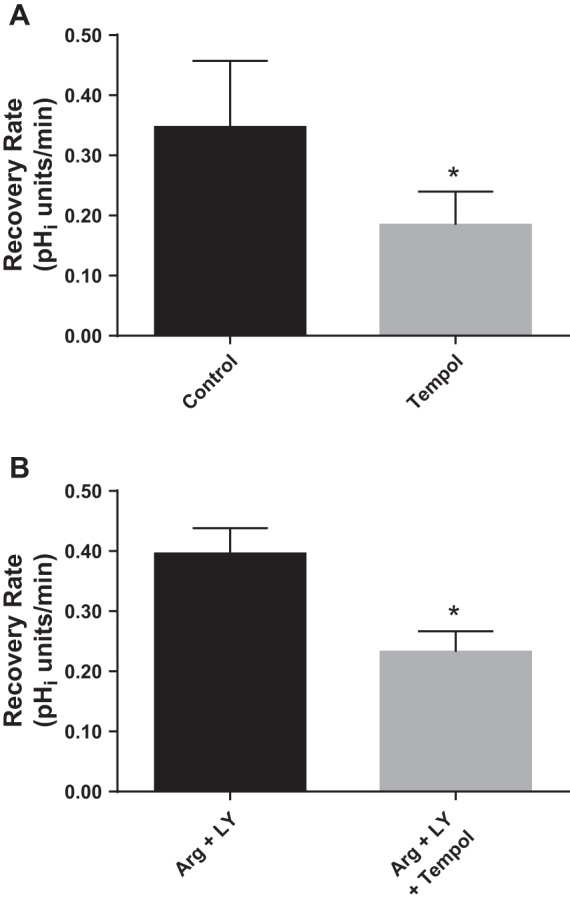
Effect of l-arginine (0.5 mM) in the presence of the guanylate cyclase inhibitor LY-83583 (LY; 10 μM) on tempol's (100 μM) effect on NHE activity as measured by pHi recovery rate after an acid load in flow-stimulated thick ascending limbs. A: effect of tempol alone. Con = control; *P < 0.04; n = 6. B: effect of tempol in the presence of l-arginine and LY-83583. *P < 0.0005; n = 6.
Next, we tested whether the cGMP analog db-cGMP could mimic the effect of l-arginine on the stimulatory effect of O2− on NHE activity. As shown in Fig. 5, db-cGMP (0.5 mM) blocked tempol's ability to reduce pHi recovery rate (0.150 ± 0.027 pHi U/min for db-cGMP alone vs. 0.145 ± 0.026 pHi U/min; Δ = −0.004 ± 0.002 pHi U/min for db-cGMP and tempol; n = 6). Taken together, these data suggest that NO reduces O2−'s effect on NHE activity in a cGMP-dependent manner rather than acting as a scavenger of O2−.
Fig. 5.

Effect of tempol (100 μM) on NHE activity as measured by pHi recovery rate after an acid load in flow-stimulated thick ascending limbs in the presence of dibutyryl-cGMP (db-cGMP; 0.5 mM); n = 6.
The increase in cGMP stimulated by NO production can activate a PKG signaling cascade. Therefore, we next studied whether NO's ability to diminish O2−-stimulated NHE activity was dependent on PKG. With the PKG inhibitor KT-5823 in the basolateral bath, we tested the ability of l-arginine to reduce the effect of tempol on NHE activity (Fig. 6). KT-5823 (5 μM) blocked l-arginine's effect, thereby restoring tempol's effect on pHi recovery rate to −43 ± 5% (0.299 ± 0.076 pHi U/min for KT-5823 and l-arginine vs. 0.161 ± 0.039 pHi U/min for KT-5823 and l-arginine plus tempol; Δ = −0.138 ± 0.041 pH U/min; n = 5; P < 0.03). These data suggest that the inhibitory effect of flow-induced endogenous NO on enhancement of NHE activity caused by flow-induced endogenous O2− is PKG-dependent and that scavenging of O2− by NO plays a minor role.
Fig. 6.

Effect of l-arginine (0.5 mM) in the presence of the PKG inhibitor KT-5823 (KT; 5 μM) on tempol's (100 μM) effect on NHE activity as measured by pHi recovery rate after an acid load in flow-stimulated thick ascending limbs. *P < 0.03; n = 5.
DISCUSSION
The effect of the interaction between endogenous, flow-stimulated NO and O2− on thick ascending limb NHE activity and the signaling pathway involved are unclear. Our hypothesis was that endogenous, flow-induced NO reduces the stimulation of NHE activity caused by endogenous, flow-induced O2− production, and this effect is due to a cGMP/PKG-dependent mechanism rather than scavenging.
To begin to test this hypothesis, we first measured the effect of l-arginine on NHE activity. We found that it caused ∼35% reduction in NHE activity. These results provide an explanation for our previous data showing that l-arginine inhibits thick ascending limb HCO3− transport (46). Our findings are also similar to our previous results with NO donors on apical NHE activity (20).
Next, we studied the effect of O2− on NHE activity. We found that tempol treatment caused ∼45% decrease in NHE activity, suggesting that O2− stimulates NHE activity. These data are in agreement with our previous results showing that exogenously added O2− stimulates apical NHE activity (32). In addition, these data are consistent with our recent report that endogenous, flow-induced O2− stimulates NHE activity (26).
To study the interaction between NO and O2−, we tested the effect of tempol on NHE activity in the presence of l-arginine, and found that tempol's effect was reduced by more than half to 19%. These data indicate that NO attenuates the stimulatory effect of O2− on NHE activity.
While our data show that endogenous NO inhibits the effect of endogenous O2− on NHE activity, it must be noted that the simple calculation performed above actually underestimates the real effect. To calculate the real effect of tempol in the presence of l-arginine, one must take into account that l-arginine alone reduces NHE activity to 65%. As a result, the basal rate of NHE activity in the absence of both l-arginine and tempol for the experiments depicted in Fig. 3 would be 0.886 pHi U/min (0.576/0.65 = 0.886). Thus, tempol only really reduces NHE activity by 12% rather than 19% in the presence of l-arginine (Δ0.113/0.886 × 100 = 12%). This calculation indicates that endogenous, flow-induced NO actually prevents nearly 90% of the stimulatory effect of O2− on NHE activity.
To study whether NO's ability to reduce O2−'s actions on NHE activity was due to scavenging or true inhibition, we used pharmacological inhibitors of components of the NO/cGMP/PKG pathway. The soluble guanylate cyclase inhibitor LY-83523 and the PKG inhibitor KT-5823 each blocked virtually all of NO's effect on O2−-stimulated NHE activity. Thus, endogenous, flow-induced NO reduces O2−-sensitive stimulation of NHE activity in thick ascending limbs and this process is cGMP- and PKG-dependent. This is the first study to show that endogenous, flow-induced NO and O2− interact to affect luminal NHE activity primarily by a nonscavenging process.
From the current data, we cannot conclude whether NO inhibits the ability of flow-induced O2− to stimulate NHE activity by: 1) a direct action on NHE; 2) an indirect effect on some other regulatory protein; or 3) PKG inhibiting O2− production by NADPH oxidase directly. However, the latter is most likely because of several previous studies. We showed that flow-stimulated O2− production by thick ascending limbs is due to activation of NADPH oxidase (27, 28) and that endogenous NO reduces flow-stimulated O2− production primarily via a PKG-mediated process (29). Additionally, Fujii et al. (17) found that in the renal cortex of Dahl salt-sensitive rats, arginine inactivates the NADPH oxidase subunit p47phox, which would reduce O2− production by preventing NADPH oxidase assembly. Muzaffar et al. (45) demonstrated in human vascular smooth muscle cells that NO acutely inhibits O2− production by blocking the translocation of p47phox via a PKG-dependent mechanism. Thus, it is possible that in thick ascending limbs PKG inhibits the activation of NADPH oxidase in a similar manner.
Protein kinase C (PKC) may also play a role in the effect of NO on O2−'s actions in the thick ascending limb. PKG phosphorylates (21) PKC in PC12 cells and it inhibits PKC (34) in vascular smooth muscle cells. PKC is required for assembly of p47phox with other subunits to form active NADPH oxidase (6, 59). Additionally, we found that PKC mediates flow-induced increases in O2− production in thick ascending limbs (30). Therefore, it is possible that NO increases cGMP and thereby PKG, which in turn phosphorylates and inhibits PKC. As a result p47phox activity and NADPH oxidase assembly are reduced to diminish flow-stimulated increases in O2− production.
We observed that endogenous, flow-induced NO diminishes but does not completely block O2−-stimulated NHE activity (Fig. 3). This finding is similar to our previous findings that showed flow-stimulated NO reduces flow-stimulated O2− production by thick ascending limbs primarily via PKG-mediated process rather than scavenging (29).
While this is the first study to demonstrate the effect of the interaction of flow-induced NO and O2− on thick ascending limb transport, it must be noted that the data gathered from in vitro experiments may not reflect what occurs in vivo. The in vivo system is more complex and several other variables may be involved. However, this study strengthens what has been ascertained previously with regard to NO and O2− interaction. Most importantly, this study shows the effect of flow-induced NO and O2− production on renal tubule transport, which had not previously been demonstrated. As is the case with any in vitro study, the limitation in terms of impact and interpretation in an in vivo system must be considered.
The effect of luminal flow on ion transport has been shown in several nephron segments. Increases in luminal flow enhance Na reabsorption in the proximal tubule (13, 62), thick ascending limb of the loop of Henle (52), and cortical collecting duct (16, 57). In proximal tubules, luminal flow stimulates bicarbonate reabsorption (2, 38) via changes in both NHE and H-ATPase activity (13). Flow also affects chloride reabsorption in proximal tubules (24, 65). In rabbit cortical collecting ducts, luminal flow regulates apical epithelial Na channels (57), enhances net Na absorption (16, 57) and BK channel-mediated K secretion (64). Increases in luminal flow also stimulate Na and Cl transport in avian thick ascending limbs (52).
Although several studies have implicated the interaction effects of NO and O2− on renal function (41, 42, 63, 68), most of the effects of NO and O2− interaction on ion transport within the kidney have been studied in the thick ascending limb. We found that tempol enhanced the NO-induced inhibition of Cl reabsorption by thick ascending limbs (47). Mori and Cowley (44) found that angiotensin II stimulates O2− production in thick ascending limbs via the NADPH oxidase pathway and that interactions of O2− and NO determine the effectiveness of cross-talk between the thick ascending limb and vasa recta. Recently, De Miguel et al. (11) showed that the interaction of NO and O2− during diabetes affects Na transport in thick ascending limbs.
Little is known about the effect of interactions of NO and O2− on transport in other nephron segments. Lu and Wang (39) found that the effect of NO on basolateral K channels in the collecting duct is modulated by O2−. NO stimulation of COX-2 in collecting duct cells appears to be mediated through mechanisms involving MAP kinase and O2− rather than a GMP (66).
In summary, we found that endogenous, flow-induced NO reduces the enhancement of NHE activity stimulated by endogenous, flow-induced O2− and this process is dependent on PKG. The interaction between these two reactive oxygen species is important in regulating renal water and salt reabsorption. Understanding the processes involved in maintaining the balance between NO and O2− may give insight into the pathogenesis and treatment of diseases associated with oxidative stress and Na retention.
GRANTS
This work was supported by grants from the National Institutes of Health (HL 70985) to J. L. Garvin.
DISCLOSURES
No conflicts of interest, financial or otherwise, are declared by the author(s).
AUTHOR CONTRIBUTIONS
Author contributions: N.J.H. performed experiments; N.J.H. analyzed data; N.J.H. and J.L.G. interpreted results of experiments; N.J.H. prepared figures; N.J.H. drafted manuscript; N.J.H. and J.L.G. edited and revised manuscript; N.J.H. and J.L.G. approved final version of manuscript; J.L.G. conception and design of research.
REFERENCES
- 1.Abe M, O'Connor P, Kaldunski M, Liang M, Roman RJ, Cowley AW Jr.. Effect of sodium delivery on superoxide and nitric oxide in the medullary thick ascending limb. Am J Physiol Renal Physiol 291: F350–F357, 2006. [DOI] [PubMed] [Google Scholar]
- 2.Alpern RJ, Cogan MG, Rector FC Jr.. Flow dependence of proximal tubular bicarbonate absorption. Am J Physiol Renal Fluid Electrolyte Physiol 245: F478–F484, 1983. [DOI] [PubMed] [Google Scholar]
- 3.Araujo M, Welch WJ. Oxidative stress and nitric oxide in kidney function. Curr Opin Nephrol Hypertens 15: 72–77, 2006. [DOI] [PubMed] [Google Scholar]
- 4.Arendshorst WJ, Beierwaltes WH. Renal tubular reabsorption in spontaneously hypertensive rats. Am J Physiol Renal Fluid Electrolyte Physiol 237: F38–F47, 1979. [DOI] [PubMed] [Google Scholar]
- 5.Baer PG, Bianchi G, Liliana D. Renal micropuncture study of normotensive and Milan hypertensive rats before and after development of hypertension. Kidney Int 13: 452–466, 1978. [DOI] [PubMed] [Google Scholar]
- 6.Bey EA, Xu B, Bhattacharjee A, Oldfield CM, Zhao X, Li Q, Subbulakshmi V, Feldman GM, Wientjes FB, Cathcart MK. Protein kinase C delta is required for p47phox phosphorylation and translocation in activated human monocytes. J Immunol 173: 5730–5738, 2004. [DOI] [PubMed] [Google Scholar]
- 7.Cabral PD, Garvin JL. TRPV4 activation mediates flow-induced nitric oxide production in the rat thick ascending limb. Am J Physiol Renal Physiol 307: F666–F672, 2014. [DOI] [PMC free article] [PubMed] [Google Scholar]
- 8.Cabral PD, Hong NJ, Garvin JL. ATP mediates flow-induced NO production in thick ascending limbs. Am J Physiol Renal Physiol 303: F194–F200, 2012. [DOI] [PMC free article] [PubMed] [Google Scholar]
- 9.Cabral PD, Hong NJ, Garvin JL. Shear stress increases nitric oxide production in thick ascending limbs. Am J Physiol Renal Physiol 299: F1185–F1192, 2010. [DOI] [PMC free article] [PubMed] [Google Scholar]
- 10.Cabral PD, Hong NJ, Hye Khan MA, Ortiz PA, Beierwaltes WH, Imig JD, Garvin JL. Fructose stimulates Na/H exchange activity and sensitizes the proximal tubule to angiotensin II. Hypertension 63: e68–73, 2014. [DOI] [PubMed] [Google Scholar]
- 11.De Miguel C, Foster JM, Carmines PK, Pollock JS. Interaction between NO synthase and NADPH oxidase in control of sodium transport by the renal thick ascending limb during diabetes. Acta Physiol (Oxf) 209: 148–155, 2013. [DOI] [PMC free article] [PubMed] [Google Scholar]
- 12.DiBona GF, Rios LL. Mechanism of exaggerated diuresis in spontaneously hypertensive rats. Am J Physiol 235: 409–416, 1978. [DOI] [PubMed] [Google Scholar]
- 13.Du Z, Yan Q, Duan Y, Weinbaum S, Weinstein AM, Wang T. Axial flow modulates proximal tubule NHE3 and H-ATPase activities by changing microvillus bending moments. Am J Physiol Renal Physiol 290: F289–F296, 2006. [DOI] [PubMed] [Google Scholar]
- 14.Dwyer TM, Schmidt-Nielsen B. The renal pelvis: machinery that concentrates urine in the papilla. News Physiol Sci 18: 1–6, 2003. [DOI] [PubMed] [Google Scholar]
- 15.Eitle E, Hiranyachattada S, Wang H, Harris PJ. Inhibition of proximal tubular fluid absorption by nitric oxide and atrial natriuretic peptide in rat kidney. Am J Physiol Cell Physiol 274: C1075–C1080, 1998. [DOI] [PubMed] [Google Scholar]
- 16.Flores D, Liu Y, Liu W, Satlin LM, Rohatgi R. Flow-induced prostaglandin E2 release regulates Na and K transport in the collecting duct. Am J Physiol Renal Physiol 303: F632–F638, 2012. [DOI] [PMC free article] [PubMed] [Google Scholar]
- 17.Fujii S, Zhang L, Igarashi J, Kosaka H. l-Arginine reverses p47phox and gp91phox expression induced by high salt in Dahl rats. Hypertension 42: 1014–1020, 2003. [DOI] [PubMed] [Google Scholar]
- 18.Garvin JL, Burg MB, Knepper MA. Active NH4+ absorption by the thick ascending limb. Am J Physiol Renal Fluid Electrolyte Physiol 255: F57–F65, 1988. [DOI] [PubMed] [Google Scholar]
- 19.Garvin JL, Hong NJ. Cellular stretch increases superoxide production in the thick ascending limb. Hypertension 51: 488–493, 2008. [DOI] [PMC free article] [PubMed] [Google Scholar]
- 20.Garvin JL, Hong NJ. Nitric oxide inhibits sodium/hydrogen exchange activity in the thick ascending limb. Am J Physiol Renal Physiol 277: F377–F382, 1999. [DOI] [PubMed] [Google Scholar]
- 21.Gatti A, Wang X, Robinson PJ. Protein kinase C-α is multiply phosphorylated in response to phorbol ester stimulation of PC12 cells. Biochim Biophys Acta 1313: 111–118, 1996. [DOI] [PubMed] [Google Scholar]
- 22.Good DW. Sodium-dependent bicarbonate absorption by cortical thick ascending limb of rat kidney. Am J Physiol Renal Fluid Electrolyte Physiol 248: F821–F829, 1985. [DOI] [PubMed] [Google Scholar]
- 23.Good DW, Knepper MA, Burg MB. Ammonia and bicarbonate transport by thick ascending limb of rat kidney. Am J Physiol Renal Fluid Electrolyte Physiol 247: F35–F44, 1984. [DOI] [PubMed] [Google Scholar]
- 24.Green R, Moriarty RJ, Giebisch G. Ionic requirements of proximal tubular fluid reabsorption flow dependence of fluid transport. Kidney Int 20: 580–587, 1981. [DOI] [PubMed] [Google Scholar]
- 25.Holstein-Rathlou NH, Marsh DJ. A dynamic model of the tubuloglomerular feedback mechanism. Am J Physiol Renal Fluid Electrolyte Physiol 258: F1448–F1459, 1990. [DOI] [PubMed] [Google Scholar]
- 26.Hong NJ, Garvin JL. Endogenous flow-induced superoxide stimulates Na/H exchange activity via PKC in thick ascending limbs. Am J Physiol Renal Physiol 307: F800–F805, 2014. [DOI] [PMC free article] [PubMed] [Google Scholar]
- 27.Hong NJ, Garvin JL. Flow increases superoxide production by NADPH oxidase via activation of Na-K-2Cl cotransport and mechanical stress in thick ascending limbs. Am J Physiol Renal Physiol 292: F993–F998, 2007. [DOI] [PubMed] [Google Scholar]
- 28.Hong NJ, Garvin JL. NADPH oxidase 4 mediates flow-induced superoxide production in thick ascending limbs. Am J Physiol Renal Physiol 303: F1151–F1156, 2012. [DOI] [PMC free article] [PubMed] [Google Scholar]
- 29.Hong NJ, Garvin JL. Nitric oxide reduces flow-induced superoxide production via cGMP-dependent protein kinase in thick ascending limbs. Am J Physiol Renal Physiol 296: F1061–F1066, 2009. [DOI] [PMC free article] [PubMed] [Google Scholar]
- 30.Hong NJ, Silva GB, Garvin JL. PKC-α mediates flow-stimulated superoxide production in thick ascending limbs. Am J Physiol Renal Physiol 298: F885–F891, 2010. [DOI] [PMC free article] [PubMed] [Google Scholar]
- 31.Juncos R, Garvin JL. Superoxide enhances Na-K-2Cl cotransporter activity in the thick ascending limb. Am J Physiol Renal Physiol 288: F982–F987, 2005. [DOI] [PubMed] [Google Scholar]
- 32.Juncos R, Hong NJ, Garvin JL. Differential effects of superoxide on luminal and basolateral Na+/H+ exchange in the thick ascending limb. Am J Physiol Regul Integr Comp Physiol 290: R79–R83, 2006. [DOI] [PubMed] [Google Scholar]
- 33.Kopkan L, Majid DS. Superoxide contributes to development of salt sensitivity and hypertension induced by nitric oxide deficiency. Hypertension 46: 1026–1031, 2005. [DOI] [PubMed] [Google Scholar]
- 34.Kumar R, Cartledge WA, Lincoln TM, Pandey KN. Expression of guanylyl cyclase-A/atrial natriuretic peptide receptor blocks the activation of protein kinase C in vascular smooth muscle cells. Role of cGMP and cGMP-dependent protein kinase. Hypertension 29: 414–421, 1997. [DOI] [PubMed] [Google Scholar]
- 35.Leyssac PP, Holstein-Rathlou NH. Effects of various transport inhibitors on oscillating TGF pressure responses in the rat. Pflügers Arch 407: 285–291, 1986. [DOI] [PubMed] [Google Scholar]
- 36.Leyssac PP, Karlsen FM, Holstein-Rathlou NH, Skott O. On determinants of glomerular filtration rate after inhibition of proximal tubular reabsorption. Am J Physiol Regul Integr Comp Physiol 266: R1544–R1550, 1994. [DOI] [PubMed] [Google Scholar]
- 37.Liang M, Berndt TJ, Knox FG. Mechanism underlying diuretic effect of l-NAME at a subpressor dose. Am J Physiol Renal Physiol 281: F414–F419, 2001. [DOI] [PubMed] [Google Scholar]
- 38.Liu FY, Cogan MG. Flow dependence of bicarbonate transport in the early (S1) proximal convoluted tubule. Am J Physiol Renal Fluid Electrolyte Physiol 254: F851–F855, 1988. [DOI] [PubMed] [Google Scholar]
- 39.Lu M, Wang WH. Reaction of nitric oxide with superoxide inhibits basolateral K+ channels in the rat CCD. Am J Physiol Cell Physiol 275: C309–C316, 1998. [DOI] [PubMed] [Google Scholar]
- 40.Majid DS, Kopkan L. Nitric oxide and superoxide interactions in the kidney and their implication in the development of salt-sensitive hypertension. Clin Exp Pharmacol Physiol 34: 946–952, 2007. [DOI] [PubMed] [Google Scholar]
- 41.Majid DS, Nishiyama A. Nitric oxide blockade enhances renal responses to superoxide dismutase inhibition in dogs. Hypertension 39: 293–297, 2002. [DOI] [PubMed] [Google Scholar]
- 42.Mattson DL, Lu S, Nakanishi K, Papanek PE, Cowley AW Jr.. Effect of chronic renal medullary nitric oxide inhibition on blood pressure. Am J Physiol Heart Circ Physiol 266: H1918–H1926, 1994. [DOI] [PubMed] [Google Scholar]
- 43.Molony DA, Reeves WB, Andreoli TE. Na+:K+:2Cl− cotransport and the thick ascending limb. Kidney Int 36: 418–426, 1989. [DOI] [PubMed] [Google Scholar]
- 44.Mori T, Cowley AW Jr.. Angiotensin II-NAD(P)H oxidase-stimulated superoxide modifies tubulovascular nitric oxide cross-talk in renal outer medulla. Hypertension 42: 588–593, 2003. [DOI] [PubMed] [Google Scholar]
- 45.Muzaffar S, Shukla N, Bond M, Sala-Newby G, Angelini GD, Newby AC, Jeremy JY. Acute inhibition of superoxide formation and Rac1 activation by nitric oxide and iloprost in human vascular smooth muscle cells in response to the thromboxane A2 analog, U46619. Prostaglandins Leukot Essent Fatty Acids 78: 247–255, 2008. [DOI] [PMC free article] [PubMed] [Google Scholar]
- 46.Ortiz PA, Garvin JL. Autocrine effects of nitric oxide on HCO3− transport by rat thick ascending limb. Kidney Int 58: 2069–2074, 2000. [DOI] [PubMed] [Google Scholar]
- 47.Ortiz PA, Garvin JL. Interaction of O2− and NO in the thick ascending limb. Hypertension 39: 591–596, 2002. [DOI] [PubMed] [Google Scholar]
- 48.Ortiz PA, Garvin JL. Superoxide stimulates NaCl absorption by the thick ascending limb. Am J Physiol Renal Physiol 283: F957–F962, 2002. [DOI] [PubMed] [Google Scholar]
- 49.Ortiz PA, Hong NJ, Garvin JL. Luminal flow induces eNOS activation and translocation in the rat thick ascending limb. Am J Physiol Renal Physiol 287: F274–F280, 2004. [DOI] [PubMed] [Google Scholar]
- 50.Ortiz PA, Hong NJ, Garvin JL. Luminal flow induces eNOS activation and translocation in the rat thick ascending limb. II. Role of PI3-kinase and Hsp90. Am J Physiol Renal Physiol 287: F281–F288, 2004. [DOI] [PubMed] [Google Scholar]
- 51.Ortiz PA, Hong NJ, Garvin JL. NO decreases thick ascending limb chloride absorption by reducing Na+-K+-2Cl− cotransporter activity. Am J Physiol Renal Physiol 281: F819–F825, 2001. [DOI] [PubMed] [Google Scholar]
- 52.Osono E, Nishimura H. Control of sodium and chloride transport in the thick ascending limb in the avian nephron. Am J Physiol Regul Integr Comp Physiol 267: R455–R462, 1994. [DOI] [PubMed] [Google Scholar]
- 53.Plato CF, Stoos BA, Wang D, Garvin JL. Endogenous nitric oxide inhibits chloride transport in the thick ascending limb. Am J Physiol Renal Physiol 276: F159–F163, 1999. [DOI] [PubMed] [Google Scholar]
- 54.Pollock CA, Lawrence JR, Field MJ. Tubular sodium handling and tubuloglomerular feedback in experimental diabetes mellitus. Am J Physiol Renal Fluid Electrolyte Physiol 260: F946–F952, 1991. [DOI] [PubMed] [Google Scholar]
- 55.Reckelhoff JF, Romero JC. Role of oxidative stress in angiotensin-induced hypertension. Am J Physiol Regul Integr Comp Physiol 284: R893–R912, 2003. [DOI] [PubMed] [Google Scholar]
- 56.Sakai T, Craig DA, Wexler AS, Marsh DJ. Fluid waves in renal tubules. Biophys J 50: 805–813, 1986. [DOI] [PMC free article] [PubMed] [Google Scholar]
- 57.Satlin LM, Sheng S, Woda CB, Kleyman TR. Epithelial Na+ channels are regulated by flow. Am J Physiol Renal Physiol 280: F1010–F1018, 2001. [DOI] [PubMed] [Google Scholar]
- 58.Schmidt-Nielsen B. The renal concentrating mechanism in insects and mammals: a new hypothesis involving hydrostatic pressures. Am J Physiol Regul Integr Comp Physiol 268: R1087–R1100, 1995. [DOI] [PubMed] [Google Scholar]
- 59.Shiose A, Sumimoto H. Arachidonic acid and phosphorylation synergistically induce a conformational change of p47phox to activate the phagocyte NADPH oxidase. J Biol Chem 275: 13793–13801, 2000. [DOI] [PubMed] [Google Scholar]
- 60.Silva GB, Ortiz PA, Hong NJ, Garvin JL. Superoxide stimulates NaCl absorption in the thick ascending limb via activation of protein kinase C. Hypertension 48: 467–472, 2006. [DOI] [PubMed] [Google Scholar]
- 61.Stoos BA, Garcia NH, Garvin JL. Nitric oxide inhibits sodium reabsorption in the isolated perfused cortical collecting duct. J Am Soc Nephrol 6: 89–94, 1995. [DOI] [PubMed] [Google Scholar]
- 62.Wang T. Flow-activated transport events along the nephron. Curr Opin Nephrol Hypertens 15: 530–536, 2006. [DOI] [PubMed] [Google Scholar]
- 63.Welch WJ, Tojo A, Wilcox CS. Roles of NO and oxygen radicals in tubuloglomerular feedback in SHR. Am J Physiol Renal Physiol 278: F769–F776, 2000. [DOI] [PubMed] [Google Scholar]
- 64.Woda CB, Bragin A, Kleyman TR, Satlin LM. Flow-dependent K+ secretion in the cortical collecting duct is mediated by a maxi-K channel. Am J Physiol Renal Physiol 280: F786–F793, 2001. [DOI] [PubMed] [Google Scholar]
- 65.Wong KR, Berry CA, Cogan MG. Flow dependence of chloride transport in rat S1 proximal tubules. Am J Physiol Renal Fluid Electrolyte Physiol 269: F870–F875, 1995. [DOI] [PubMed] [Google Scholar]
- 66.Yang T, Zhang A, Pasumarthy A, Zhang L, Warnock Z, Schnermann JB. Nitric oxide stimulates COX-2 expression in cultured collecting duct cells through MAP kinases and superoxide but not cGMP. Am J Physiol Renal Physiol 291: F891–F895, 2006. [DOI] [PubMed] [Google Scholar]
- 67.Zhang Y, Mircheff AK, Hensley CB, Magyar CE, Warnock DG, Chambrey R, Yip KP, Marsh DJ, Holstein-Rathlou NH, McDonough AA. Rapid redistribution and inhibition of renal sodium transporters during acute pressure natriuresis. Am J Physiol Renal Fluid Electrolyte Physiol 270: F1004–F1014, 1996. [DOI] [PubMed] [Google Scholar]
- 68.Zou AP, Li N, Cowley AW Jr.. Production and actions of superoxide in the renal medulla. Hypertension 37: 547–553, 2001. [DOI] [PubMed] [Google Scholar]
