



Abstract
Recently, epidemiological studies on the etiology of peripheral neuropathies have revealed that hyperlipidemia is a novel risk factor. Plasma lipid levels were confirmed to be associated with the incidence of many peripheral neuropathies including axonal distal polyneuropathy, vision and hearing loss, motor nerve system lesions and sympathetic nerve system dysfunction. Moreover, different lipid components such as cholesterol, triacylglycerols and lipoprotein are involved in the pathogenesis of these neuropathies. This review aimed to discuss the effect of hyperlipidemia on the peripheral nervous system and its association with peripheral neuropathies. Furthermore, a detailed discussion focusing on the explicit mechanisms related to hyperlipidemia-induced peripheral neuropathies is presented here. These mechanisms, including intracellular oxidative stress, inflammatory lesions, ischemia and dysregulation of local lipid metabolism, share pathways and interact mutually. In addition, we examined current information on clinical trials to prevent and treat peripheral neuropathies caused by hyperlipidemia, with a predictive discussion regarding the orientation of future investigations.
Keywords: hyperlipidemia, peripheral nervous system, neuropathy, reviews
INTRODUCTION
Hyperlipidemia (HL) is a kind of lipid metabolism or transport disturbance characterized by high plasma lipid levels, including cholesterol (hypercholesterolemia), triacylglycerols (hypertriglyceridemia) and lipoproteins. HL is common in quinquagenarians and closely correlates with diabetes and hypertension, which are frequently attributed to excessive energy intake or hereditary causes. Accompanied with the improvement of living conditions and alterations in dietetic patterns, the prevalence of HL has risen each year. HL markedly disrupts the regular functions of the cardiovascular system, and has been recognized as one of the most dangerous and predominant causes of atherosclerosis[1]. In addition, HL has been demonstrated to widely impair the function of various organs such as the pancreas, kidney, liver and brain[2,3,4]. However, its influence on the peripheral nervous system (PNS) has rarely been investigated.
Early in 1994, Chumasov et al[5] reported on the degeneration of neurons, synapses and the perineurium in dorsal root ganglions of chinchilla rabbits in experimental HL conditions. Recently, substantial clinical evidence indicated an association between HL and various peripheral neuropathies. These implied that HL has a detrimental effect on the PNS and plays an important role in processes of peripheral neuropathies. The exact mechanism by which HL causes peripheral neuropathies remains unclear. Therefore, further research necessitates a review of recent approaches. Here, we examine current information on the influence of HL on the PNS, with special focus on the explicit mechanisms underlying clinical symptoms.
DOES HL CONTRIBUTE TO PERIPHERAL NEUROPATHIES?
Several important discoveries have been made recently in various studies on peripheral neuropathies, including the finding that HL is closely associated with the incidence of many peripheral neuropathies, such as axonal distal polyneuropathy, visual and auditory impairment, and peripheral motor nerves and sympathetic nerve system dysfunction. A large quantity of volunteers have been involved in these retrospective or prospective studies to investigate the clinical relevance between HL and peripheral neuropathies in terms of epidemiology, and the results revealed a positive correlation between plasma lipid levels and the incidence of peripheral neuropathies. Here, we briefly discuss the impact of HL on the incidence of the principal peripheral neuropathies mentioned above in epidemiological studies.
Axonal distal polyneuropathy
Axonal distal polyneuropathy is defined as a chronic and symmetrical neuropathy that impairs the sensory and motor functions of the distal ends of limbs. It is generally characterized by prickle, numbness and motor dysfunction and has a complex etiology. Furthermore, axonal distal polyneuropathy is the principal complication of diabetes and is termed as diabetic neuropathy, which affects more than half of all patients with diabetes. With regard to diabetic neuropathy, hyperglycemia was previously thought to play a chief causative role in its development[6]. However, it should be noted that many patients with good glycemic control develop progressive diabetic neuropathy, which implies the presence of other pathogenic factors. Consequently, the focus of axonal distal polyneuropathy studies have now transferred from hyperglycemia to HL, which also frequently accompanies diabetes.
A previous study[7] investigated the influence of HL on the function of sensory nerve fibers. Recently, substantial epidemiological research performed on diabetic patients in a retrospective or prospective manner found that individuals with HL have a significantly higher incidence of axonal distal polyneuropathy[8,9,10], indicating HL is an independent risk factor of axonal distal polyneuropathy. Patients with pre-existing conditions known to cause neuropathy were excluded from this study to avoid selection bias. Consequently, this provides insights on why type II diabetes always accompanies earlier axonal distal polyneuropathy compared to type I diabetes, in which HL develops later. Rajabally et al[8] believes cholesterol precipitates axonal distal polyneuropathy independently when plasma levels exceed 5 mmol/L via impairing peripheral sensory nerves, whereas hypertriglyceridemia has no relevance on the occurrence of axonal distal polyneuropathy.
Vision degeneration
Age-related macular degeneration is the leading cause of irreversible severe visual loss in people over 50 years of age. The lack of an effective treatment and unknown etiology make the study of its risk factor essential. Recently, the epidemiological relevance between high fat intake and the incidence of age-related macular degeneration has been confirmed[11,12]. Plasma cholesterol levels were significantly increased in patients with age-related macular degeneration compared with the control group, and were considered to be an independent risk factor for age-related macular degeneration despite other factors, including diabetes. The mechanism underlying this outcome has been studied, which we will discuss in detail later.
In addition to age-related macular degeneration, maculopathy, another complication of diabetes, also has an association with serum lipid levels. Patients with diabetes were found to be at a high risk of developing maculopathy when their plasma levels of total lipids increased[13], and the severity of exudation and edema in the retina also positively correlated with total lipid levels in exudative lipids[14]. However, Benarous et al[15] revealed that HL was associated with clinically significant macular edema, but had no impact on other types of diabetic maculopathy. Further investigations in epidemiology are needed to elucidate the explicit influence of HL on the pathogenesis of maculopathy.
Hearing loss
Sudden sensorineural hearing loss is defined as acute inner ear impairment. The lesion site is generally localized in the cochlea or retrocochlear, especially the auditory sensor and neural fibers. To date, no clear cause for this disease has been identified, however, several high risk factors, such as diabetes and infections, have been implicated[16]. Recently, substantial epidemiological investigations performed on patients with sudden sensorineural hearing loss were found to have high total cholesterol levels and low density lipoprotein cholesterol concentrations. These results imply that HL, as well as diabetes, is an independent risk factor for sudden sensorineural hearing loss[16,17,18]. This evidence further supports the hypothesis that microvascular impairment, which could be caused by diabetes, HL and cardiovascular risk factors, play crucial roles in the pathology of sudden sensorineural hearing loss. Consequently, clinicians advised assessing plasma lipid levels in patients with this condition to implement appropriate preventive and therapeutic strategies.
Motor nerve system
Recent prospective studies on patients with hypertriglyceridemia found that HL could enhance the supramaximal stimulating current at which the maximal response of skeletal muscle contraction can be elicited, and delay its recovery following neuromuscular blockade induced by vecuronium[19,20]. This actually exaggerated the action of neuromuscular relaxants. Saiton believes the HL-induced impairment of motor nerve endings contributes to their dysfunction. To date, few studies have focused on this issue and it remains to be confirmed.
Sympathetic baroreflex sensitivity
The dispute about whether HL impairs the sympathetic baroreflex system and increases blood pressure in hypertensive patients remains undetermined[21,22], due to the limitations of clinical conditions, which can lead to discrepant results. However, a recent fundamental study has demonstrated that HL disturbs baroreflex sensitivity and impairs sympathetic nerves in experimental conditions employing animal models[23]. This basic research will provide a worthwhile reference to this clinical dispute. More epidemiological investigations with improved experimental design are needed to address this question.
MECHANISMS OF HL IMPAIRMENTS
Many factors impair the nervous system, for instance physical (such as prolapse of intervertebral disc), chemical, biological (such as venene), environmental and pharmic factors. As discussed above, many clinical PNS neuropathies occur simultaneously with HL, but how HL induces these impairments and the mechanisms involved remain to be elucidated. Consequently, much effort has been directed towards the processes resulting in impairment of the PNS following HL. It is believed that the mechanisms involved are not independent mechanisms, but partially share identical pathways and interact with each other.
Oxidative stress
Previous investigations have confirmed that hyperglycemia is harmful to dorsal root ganglion neurons via initiating the process of oxidative stress as reactive oxygen species (ROS), which are principally generated by mitochondrial overload, that eventually lead to the degeneration and death of neurons[6]. Recently, clinical and basic research findings revealed that HL converged with hyperglycemia and intracellular oxidative stress causing impairment of the PNS. It is believed that HL elevates plasma oxidized low-density lipoprotein (oxLDL) levels, which are recognized by oxLDL receptors on the membranes of neurons, and activate cellular NAD(P)H oxidase. NAD(P)H oxidase generates ROS in neurons, which elicits cellular oxidative stress.
OxLDLs are considered to be the critical molecules in HL that are responsible for oxidative stress impairment of neurons[24]. HL increases plasma low-density lipoprotein levels, which can be oxidized to oxLDLs via systemic oxidative stress caused by many factors, such as hyperglycemia. In addition, low-density lipoproteins are oxidized spontaneously in the presence of ROS to form oxLDLs. The high plasma lipid levels accompanied by increasing concentrations of oxLDLs in plasma trigger detrimental processes.
Accumulation of cellular ROS is the main cause of oxidative stress in cells. ROS have a detrimental effect on cells. First, ROS impair cell components directly, for example oxidation of DNA and RNA[25], several enzymatic components involved in glycolysis, lipid metabolism and the citric acid cycle. Second, excessive ROS generation further impairs the mitochondrial electron transport chain and enhances more ROS production and reduces ATP generation[26], which triggers a vicious cycle. Either intracellular ROS accumulation or a shortage of ATP can lead to dysfunction of ion channels on the plasma membrane, which disturbs cellular ion homeostasis and membrane potential. Although ROS can serve as secondary messengers that mediate many cellular activities, excess ROS can induce cell apoptosis via several major apoptotic signaling pathways, including activation of mitogen-activated protein kinase, caspase-3 and jun N-terminal kinase[27,28], which in turn initiate neuronal apoptosis.
NAD(P)H oxidase is considered to be the principal ROS generator during cellular oxidative damage. This enzyme continuously produces superoxide in dorsal root ganglion neurons exposed to elevated glucose, whereas the NAD(P)H oxidase inhibitor markedly reduces cellular ROS levels in neurons[29]. In addition to glucose, oxLDLs can significantly increase NAD(P)H oxidase concentrations and activity in dorsal root ganglion neurons in vitro[24], which increases the generation of ROS and neuronal lesion. However, how extracellular oxLDLs elicit the intracellular oxidative stress burst, which leads neuronal lesion remains unclear.
The action of oxLDLs is mediated by oxLDL receptors found on the cell membranes of cells such as endothelial cells, smooth muscle cells and macrophages. Lectin-like oxLDL receptor-1 is the principal receptor for oxLDLs. It is believed to mediate apoptosis of endothelial cells via intracellular oxidative stress and inflammation caused by oxLDLs, and be involved in the formation of foam cells, which are transformed from macrophages, that have been shown to uptake excessive oxLDLs during atherosclerosis[1]. Recent investigations have identified the expression of lectin-like oxLDL receptor-1 in peripheral neurons, implying a similar role for the receptor in peripheral neuropathies, for example recruitment of NAD(P)H oxidase subunits[24]. However, other scholars[30] challenged this hypothesis by performing studies in vitro on dorsal root ganglion neurons. They found that lectin-like oxLDL receptor-1 and toll-like receptor-4, another ox-LDL receptor, were both expressed in dorsal root ganglion neurons. Blockade of toll-like receptor-4 caused activation of jun N-terminal kinase and a significant decrease of cleaved caspase-3, which is an apoptotic indicator, whereas inhibition of lectin-like oxLDL receptor-1 had a contrary effect. Accordingly, they believe the detrimental impact of oxLDLs is mediated by toll-like receptor-4, but not lectin-like oxLDL receptor-1, on the membrane of neurons.
Inflammation
Several lipid products, such as oxLDLs and oxysterols, are known to stimulate inflammatory cytokines and the expression of adhesion molecules on endothelial cells, which play a role in the recruitment of monocytes and the initiation of local inflammatory lesions. Recent studies found that HL may also initiate local inflammation in the PNS, and lead to inflammatory lesions in the etiopathology of neuropathies[31].
In addition to direct damage, cellular oxidative stress in response to oxLDLs shares a partial identical pathway with respect to the pro-inflammatory response-the nuclear factor kappa B pathway[32,33]. Consequently, the burst of cellular oxidative stress may accompany the initiation of a local inflammatory response in the PNS. OxLDLs activate NADPH oxidase, resulting in ROS overproduction and cellular oxidative stress. ROS subsequently activate the nuclear factor kappa B pathway, in which ROS serve as intracellular secondary messengers[27]. Nuclear factor kappa B is activated by various stimuli and acts as a final pathway in regulating the expression of several genes, especially multiple inflammatory cytokines such as intercellular adhesion molecule-1 and monocyte chemoattractant protein-1[34]. Studies have shown the upregulation of nuclear factor kappa B in endothelial cells in the PNS and neurons exposed to oxLDLs[35,36], suggesting that HL initiates the inflammatory response that leads to peripheral neuropathies.
Monocyte chemoattractant protein-1 is a chemotactic factor for monocytes that is expressed by vascular cells involved in the inflammatory process. The expression and secretion of monocyte chemoattractant protein-1, accompanied with other inflammatory chemotactic factors such as vascular endothelial growth factor and interleukin-8, increased in peripheral nerve tissue that was exposed to oxidative lipids[37,38]. Furthermore, expression of vascular cellular adhesion molecule-1, in parallel with intercellular adhesion molecule-1, was upregulated by oxLDLs in vascular endothelial cells of the PNS[31]. Vascular cellular adhesion molecule-1 is a membrane protein used to anchor leucocytes to the vascular wall. The upregulation of its expression indicates dysfunction of endothelial cells and initiation of inflammation.
Characterized by increased expression of adhesion molecules and inflammatory cytokines leading to accumulation of leukocytes and subsequent breakdown of blood-nerve barrier and increased vascular permeability[39], HL that is accompanied with high oxLDLs levels may contribute to inflammatory lesions of the PNS. Furthermore, oxLDLs also influence recruited macrophages via the scavenger receptor (Scarb1/CD36) on macrophage membranes[32]. CD36 and the cellular inflammatory pathway in macrophages (i.e. the mitogen-activated protein kinase and nuclear factor kappa B signaling pathways) are activated when exposed to oxLDLs[33].
It is important to mention here that pigment epithelium-derived factor, a potent endogenous anti-inflammatory factor, suppresses the expression of monocyte chemoattractant protein-1 in vascular walls via inhibition of nuclear factor kappa B activation[36], which subsequently restrains the recruitment and activation of macrophages[40]. However, oxLDLs reduce pigment epithelium-derived factor expression and increase vascular endothelial growth factor in retinal pigment epithelium, reduce the pigment epithelium-derived factor to vascular endothelial growth factor ratio[41], restrain the anti-inflammatory effect and magnify the inflammatory response. This may link the inflammatory effect of oxLDLs to the etiology of macular edema, a universal peripheral neuropathy mediated by inflammation.
Ischemia
In addition to eliciting oxidative stress and inflammatory lesions to the nervous system directly, HL may lead to stenosis of the vascular lumen and disturb microcirculation, resulting in possible ischemia in peripheral nerves. Although systematic metabolic disturbance could impair blood supply to the PNS via several factors such as pro-inflammatory cytokines, some literature has focused on lipid-induced ischemia of peripheral nerve fibers. However, the HL-related ischemic impairment of the terminal sensor in the PNS, for example, the retina and auditory sensor, has been confirmed[42,43].
In addition to marked vascular lumen stenosis of the spiral modiolar artery, endothelial dysfunction characterized by reduction of nitric oxide generation in the cochlea was correlated with HL[42]. The spiral modiolar artery is a main terminal artery that supplies blood to the cochlea. Whereas nitric oxide is an endothelium-dependent vasoactive substance that regulates cochlear blood flow. Both pathological changes reduce blood supply and contribute to ischemia and hypoxia of auditory sensor and auditory nerve fibers, which lead to pathological changes varying from dysfunction to degeneration or apoptosis.
With respect to the retina, the process is more complex because of its unique structure. In addition to vascular changes, thickening of Bruch's membrane and retinal pigment epithelium dysfunction also contribute to ischemia of the retina, characterized by neuronal apoptosis, axonal degeneration, reactive gliosis and formation of glial scars in the retina[43]. Bruch's membrane is a thin layer of connective tissue located between the vascular membrane and retina, and is responsible for the transport of oxygen and nutrients to retinal neurons. HL gives rise to lipid deposits in Bruch's membrane and leads to Bruch's membrane thickening[44]. Moreover, lipid deposits establish a hydrophobic barrier in Bruch's membrane. Both of these changes decrease the permeability of Bruch's membrane, leading to retina ischemia and hypoxia. In contrast, oxLDLs impair the viability of retinal pigment epithelium[41], which is responsible for clearing lipid deposits in Bruch's membrane. The functional and constructional impairment of retinal pigment epithelium increases lipid deposits in Bruch's membrane, which exacerbate ischemic conditions in the retina.
Accumulation of the excitatory neurotransmitter glutamate in the extracellular matrix is believed to underlie neuronal ischemic damage. Hyperstimulation of glutamatergic receptors destroys cellular calcium homeostasis, leading to toxic calcium levels, which subsequently damage neurons[45]. Apart from inducing direct ischemic lesions in the PNS, HL also exaggerates the inflammatory response caused by ischemia in nerves[46]. Under these conditions, ischemia is always followed by inflammatory injury, especially ischemia-reperfusion injury. Metabolic disturbances, such as diabetes and HL, activate the nuclear factor kappa B pathway in the PNS[47], which subsequently upregulates the expression of the inflammatory mediators CD36 and monocyte chemoattractant protein-1 in the periphery[46]. These pro-inflammatory alterations make nerves vulnerable to ischemia, and exaggerate post-ischemic lesions via the inflammatory response, for instance macrophage recruitment and activation[48].
OxLDLs play a crucial role in these mechanisms, including oxidative stress[32] (Figure 1), inflammatory lesions and ischemia. OxLDLs damage neurons and axons directly via cellular oxidative stress. They also act on endothelial cells and recruit macrophages to the PNS, which elicits local inflammatory injury. Several identical cellular signaling pathways exist in these mechanisms, such as the nuclear factor kappa B pathway. Furthermore, when oxLDLs are deposited at vulnerable sites such as the sub-endothelium and Bruch's membrane, they may interrupt nutrient and oxygen supply to nerve tissue, leading to local ischemia and hypoxia.
Figure 1.
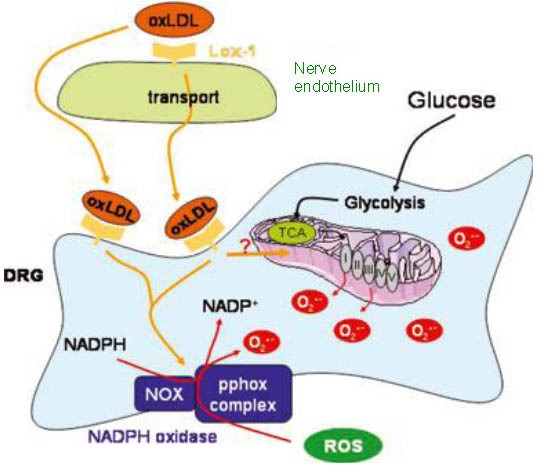
Effect of oxidized low-density lipoproteins (oxLDLs) binding to lectin-like oxLDL receptor-1 (LOX-1). LOX-1 on dorsal root ganglia (DRG) neurons binds to oxLDLs. OxLDLs may be endocytosed or transcytosed. Receptor binding initiates a signaling pathway leading to the activation of NAD(P)H oxidase and may also alter mitochondrial generation of reactive oxygen species (ROS). Glucose independently affects these same cellular targets[32].
NADPH: nicotinamide adenine dinucleotide phosphate hydratenucleotide; NADP+: oxidated NADPH; NOX: nitrogen oxides; pphox complex: phagocytic oxidase complex; TCA: tricarboxylicacidcycle.
Dysregulation of local lipid metabolism
Adipocytes are no longer regarded as a simple storage site for fat. More importantly, they have been discovered as an endocrine or paracrine organ, which secrete a series of hormones, collectively referred to as adipocytokines.
Early in 1997, Weigle[49] had reported the possible causative role of adipocytokines in various human diseases related to energy homeostasis, insulin action, host defense and reproduction. Recent studies have demonstrated that HL and other systematic metabolic disturbances can alter the expression levels of local adipocytokines in adipocytes distributed in many tissues[50]. This is evidence that HL plays a potential role in these diseases via the disturbance of local adipocytokines secretions that ultimately lead to clinical symptoms. This is also the case in the PNS. Adipocytokines play a critical role in the etiology of diabetic peripheral neuropathy[51]. Consequently, the precise mechanism of adipocytokines underlying the process of peripheral neuropathy caused by HL has become of great interest to many researchers.
An early study has detected the presence of adipocytes in the epineurium of peripheral nerves[52]. These adipocytes in nerves express various local lipid metabolic genes, such as Lpin1, which have been demonstrated to play a crucial role in maintaining the cellular function of the PNS[53]. Furthermore, these adipocytes regulate lipid metabolism of Schwann cells and neurons via secretion of several adipocytokines, for example Acrp30 and Resistin. Consequently, alteration of these processes leads to local dysregulation of lipid metabolism in nerves and the subsequent demyelination observed in peripheral neuropathies. Pande et al[33] confirmed the upregulation of adipocytokine signaling, fatty acid metabolism and lipid transport genes in mouse peripheral nerves when fed a high cholesterol diet. In sharp contrast, the axonogenesis genes were downregulated. However, the mechanisms of these alterations remain unknown. In addition to the disorder of lipid metabolism in Schwann cells and neurons, leptin, an adipocytokine secreted by adipocytes in the epineurium, could injure peripheral nerves via the recruitment and activation of macrophages that mediate events[54] such as matrix metalloproteinase secretion, oxidative stress and inflammatory lesions.
All of above evidence indicates an association of peripheral neuropathy with dysregulation of endoneural lipid metabolism caused by a systematic metabolism disturbance such as HL. However, the explicit mechanism underlying this process needs to be further elucidated.
CLINICAL PREVENTION AND TREATMENT
HL has been neglected as a high risk factor for peripheral neuropathy. Previously, hyperglycemia was believed to be the cause of diabetes via cellular oxidative stress[6]. However, a substantial number of patients with good glycemic control still develop neuropathy. Meanwhile, epidemiological investigations revealed that the incidence of neuropathy positively correlates with the concentration of plasma lipids in patients[8,9,10]. All of above indicates that HL, apart from hyperglycemia, may be a novel therapeutic target of neuropathy.
Consequently, both patients and experimental animals were treated with lipid-modulating drugs, such as statins and fenofibrate, to evaluate their clinical and experimental therapeutic effect on neuropathies. These studies revealed that both statins and fenofibrate significantly improved established diabetic neuropathy[55], whereas only fenofibrate had a therapeutic effect on diabetic retinopathy[56].
Atorvastatin is a synthetic 3-hydroxy-3-methylglutaryl-coenzyme A reductase inhibitor that can significantly inhibit endogenous cholesterol synthesis, and reduce plasma LDL and triglyceride levels, as well in patients with HL. This drug is used as a clinical preferred drug for HL. Fenofibrate is a broad spectrum lipid-lowering drug that markedly decreases plasma very-low-density lipoprotein and low-density lipoprotein levels, and increases high-density lipoprotein levels, however, its mechanisms of action remain to be elucidated. The action of fenofibrate on peroxisome proliferator activated receptors has been confirmed, and has been shown to reduce apolipoprotein C-III synthesis in the liver. In addition to treating developed neuropathy, these lipid-modulating drugs were also employed as preventive therapies for peripheral nerve complications in diabetes and revealed favorable results[57]. Furthermore, statins were used to treat sympathetic baroreflex impairment caused by HL, which may lead to hypertension[57,58]. The results showed that statins decrease sympathetic activity and increase baroreceptor reflex sensitivity, which protect against the development of hypertension in hypercholesteremic patients.
The therapeutic effects of the lipid-modulating drugs mentioned above do not only have a hypolipidemic effect, but also an anti-inflammatory, and anti-oxidative stress effect, and regulate endothelial cell processes. It has been reported that statins inhibit oxidative stress and reduce cell apoptosis in the sciatic nerve[59]. Statins also improve endothelial function, including modulating endothelial nitric oxide synthase, whereas increased nitric oxide production has been known to improve neurotransmitter function. Furthermore, statins have anti-inflammatory effects on nerves via inhibiting the migration and adhesion of leukocytes[60]. All of the above studies indicate that these lipid-modulating drugs are a novel and promising therapeutic method to treat or prevent against HL-induced peripheral neuropathy.
SUMMARY
This review examines current information on the harmful effects of HL on the PNS, such as axonal distal polyneuropathy, vision and hearing loss, motor nervous cells and the sympathetic nervous system, with a special focus on the mechanisms underlying impairment. These mechanisms, including intracellular oxidative stress, inflammatory lesions, ischemia and dysregulation of local lipid metabolism, play a part in a wide network in which these mechanisms interact with each other and have partial identical pathways. In addition to using lipid-lowering drugs, strategies are now focusing on intracellular target such as NAD(P)H oxidase, ROS and lectin-like oxLDL receptor-1. However, clinical results using drugs that target these molecules were not convincing. We can attribute this to a lack in knowledge regarding the explicit mechanisms of these pathways. Accordingly, further exhaustive studies are required to elucidate the mechanisms involved in PNS neuropathies caused by HL, which will provide the foundations for future clinical trials.
Footnotes
Conflicts of interest: None declared.
Funding: The study was supported by the National Natural Science Foundation of China, No. 81171461, 30900773; the Natural Science Foundation of Hunan Province, No. 10JJ3038, 11JJ2020; “125 Tenant Project” of the Third Xiangya Hospital.
(Edited by Jiang GH, Sun GX/Yang Y/Song LP)
REFERENCES
- [1].Aviram M. Interaction of oxidized low density lipoprotein with macrophages in atherosclerosis, and the antiatherogenicity of antioxidants. Eur J Clin Chem Clin Biochem. 1996;34(8):599–608. [PubMed] [Google Scholar]
- [2].Cameron JL, Crisler C, Margolis S, et al. Acute pancreatitis with hyperlipemia. Surgery. 1977;70(1):53–61. [PubMed] [Google Scholar]
- [3].Washio M, Okuda S, Ikeda M, et al. Hypercholesterolemia and the progression of the renal dysfunction in chronic renal failure patients. J Epidemiol. 1996;6(4):172–177. doi: 10.2188/jea.6.172. [DOI] [PubMed] [Google Scholar]
- [4].Wu S, Wang X, Zhang Y, et al. Effect of high-sugar and high-fat diet on the morphology of rabbit knee articular cartilage. Zhongguo Zuzhi Gongcheng Yanjiu yu Linchuang Kangfu. 2009;13(33):6433–6438. [Google Scholar]
- [5].Chumasov EI, Seliverstova VG, Svetikova KM. The ultrastructural changes in the sympatheic ganglion in experimental hypercholesterolemia. Morfologiia. 1994;106(4-6):92–100. [PubMed] [Google Scholar]
- [6].Vincent AM, McLean LL, Backus C, et al. Short-term hyperglycemia produces oxidative damage and apoptosis in neurons. FASEB J. 2005;19(6):638–640. doi: 10.1096/fj.04-2513fje. [DOI] [PubMed] [Google Scholar]
- [7].Teunissen LL, Franssen H, Wokke JH, et al. Is cardiovascular disease a risk factor in the development of axonal polyneuropathy? J Neurol Neurosurg Psychiatry. 2002;72(5):590–595. doi: 10.1136/jnnp.72.5.590. [DOI] [PMC free article] [PubMed] [Google Scholar]
- [8].Rajabally YA, Shah RS. Dyslipidaemia in chronic acquired distal axonal polyneuropathy. J Neurol. 2011;258(8):1431–1436. doi: 10.1007/s00415-011-5950-z. [DOI] [PubMed] [Google Scholar]
- [9].Wiggin TD, Sullivan KA, Pop-Busui R, et al. Elevated triglycerides correlate with progression of diabetic neuropathy. Diabetes. 2009;58(7):1634–1640. doi: 10.2337/db08-1771. [DOI] [PMC free article] [PubMed] [Google Scholar]
- [10].Al-Ani FS, Al-Nimer MS, Ali FS. Dyslipidemia as a contributory factor in etiopathogenesis of diabetic neuropathy. Indian J Endocrinol Metab. 2011;15(2):110–114. doi: 10.4103/2230-8210.81940. [DOI] [PMC free article] [PubMed] [Google Scholar]
- [11].Wierzbowska J, Figurska M, Stankiewicz A, et al. Risk factors in age-related macular degeneration and glaucoma--own observations. Klin Oczna. 2008;110(10-12):370–374. [PubMed] [Google Scholar]
- [12].Bialek-Szymanska A, Misiuk-Hojlo M, Witkowska K. Risk factors evaluation in age-related macular degeneration. Klin Oczna. 2007;109(4-6):127–130. [PubMed] [Google Scholar]
- [13].Ucgun NI, Yildirim Z, Kiliç N, et al. The importance of serum lipids in exudative diabetic macular edema in type 2 diabetic patients. Ann N Y Acad Sci. 2007;1100:213–217. doi: 10.1196/annals.1395.021. [DOI] [PubMed] [Google Scholar]
- [14].Golubovic-Arsovska M. Association of dyslipidaemia with macular oedema and hard exudates in diabetic maculopathy. Prilozi. 2007;28(2):149–160. [PubMed] [Google Scholar]
- [15].Benarous R, Sasongko MB, Qureshi S, et al. Differential association of serum lipids with diabetic retinopathy and diabetic macular edema. Invest Ophthalmol Vis Sci. 2011;52(10):7464–7469. doi: 10.1167/iovs.11-7598. [DOI] [PubMed] [Google Scholar]
- [16].Aimoni C, Bianchini C, Borin M, et al. Diabetes, cardiovascular risk factors and idiopathic sudden sensorineural hearing loss: a case-control study. Audiol Neurootol. 2010;15(2):111–115. doi: 10.1159/000231636. [DOI] [PubMed] [Google Scholar]
- [17].Shargorodsky J, Curhan SG, Eavey R, et al. A prospective study of cardiovascular risk factors and incident hearing loss in men. Laryngoscope. 2010;120(9):1887–1891. doi: 10.1002/lary.21039. [DOI] [PMC free article] [PubMed] [Google Scholar]
- [18].Cadoni G, Scorpecci A, Cianfrone F, et al. Serum fatty acids and cardiovascular risk factors in sudden sensorineural hearing loss: a case-control study. Ann Otol Rhinol Laryngol. 2010;119(2):82–88. doi: 10.1177/000348941011900203. [DOI] [PubMed] [Google Scholar]
- [19].Saitoh Y, Oshima T, Nakata Y. Recovery of neuromuscular blockade caused by vecuronium is delayed in patients with hypertriglyceridemia. J Anesth. 2008;22(1):89–92. doi: 10.1007/s00540-007-0566-2. [DOI] [PubMed] [Google Scholar]
- [20].Saitoh Y. Recovery from vecuronium is delayed in patients with hypercholesterolemia. Can J Anaesth. 2006;53(6):556–561. doi: 10.1007/BF03021845. [DOI] [PubMed] [Google Scholar]
- [21].Gadegbeku CA, Shrayyef MZ, Taylor TP, et al. Mechanism of lipid enhancement of alpha1-adrenoceptor pressor sensitivity in hypertension. J Hypertens. 2006;24(7):1383–1389. doi: 10.1097/01.hjh.0000234119.63519.5a. [DOI] [PubMed] [Google Scholar]
- [22].Monahan KD, Dyckman DJ, Ray CA. Effect of acute hyperlipidemia on autonomic and cardiovascular control in humans. J Appl Physiol. 2007;103(1):162–169. doi: 10.1152/japplphysiol.00167.2007. [DOI] [PubMed] [Google Scholar]
- [23].Ai J, Liang F, Zhou H, et al. Mechanism of impaired baroreflex sensitivity in Wistar rats fed a high-fat and -carbohydrate diet. Br J Nutr. 2010;104(2):291–297. doi: 10.1017/S0007114510000450. [DOI] [PubMed] [Google Scholar]
- [24].Vincent AM, Hayes JM, McLean LL, et al. Dyslipidemia-induced neuropathy in mice: the role of oxLDL/LOX-1. Diabetes. 2009;58(10):2376–2385. doi: 10.2337/db09-0047. [DOI] [PMC free article] [PubMed] [Google Scholar]
- [25].Nawrot B, Sochacka E, Düchler M. tRNA structural and functional changes induced by oxidative stress. Cell Mol Life Sci. doi: 10.1007/s00018-011-0773-8. in press. [DOI] [PMC free article] [PubMed] [Google Scholar]
- [26].Zorov DB, Juhaszova M, Sollott SJ. Mitochondrial ROS-induced ROS release: an update and review. Biochim Biophys Acta. 2006;1757(5-6):509–517. doi: 10.1016/j.bbabio.2006.04.029. [DOI] [PubMed] [Google Scholar]
- [27].Runchel C, Matsuzawa A, Ichijo H. Mitogen-activated protein kinases in mammalian oxidative stress responses. Antioxid Redox Signal. 2011;15(1):205–218. doi: 10.1089/ars.2010.3733. [DOI] [PubMed] [Google Scholar]
- [28].Cai W, Rudolph JL, Harrison SM, et al. An evolutionarily conserved Rit GTPase-p38 MAPK signaling pathway mediates oxidative stress resistance. Mol Biol Cell. 2011;22(17):3231–3241. doi: 10.1091/mbc.E11-05-0400. [DOI] [PMC free article] [PubMed] [Google Scholar]
- [29].Usui S, Oveson BC, Lee SY, et al. NADPH oxidase plays a central role in cone cell death in retinitis pigmentosa. J Neurochem. 2009;110(3):1028–1037. doi: 10.1111/j.1471-4159.2009.06195.x. [DOI] [PMC free article] [PubMed] [Google Scholar]
- [30].Nowicki M, Muller K, Serke H, et al. Oxidized low-density lipoprotein (oxLDL)-induced cell death in dorsal root ganglion cell cultures depends not on the lectin-like oxLDL receptor-1 but on the toll-like receptor-4. J Neurosci Res. 2010;88(2):403–412. doi: 10.1002/jnr.22205. [DOI] [PubMed] [Google Scholar]
- [31].Gustavsson C, Agardh CD, Zetterqvist AV, et al. Vascular cellular adhesion molecule-1 (VCAM-1) expression in mice retinal vessels is affected by both hyperglycemia and hyperlipidemia. PLoS One. 2010;5(9):e12699. doi: 10.1371/journal.pone.0012699. [DOI] [PMC free article] [PubMed] [Google Scholar]
- [32].Vincent AM, Hinder LM, Pop-Busui R, et al. Hyperlipidemia: a new therapeutic target for diabetic neuropathy. J Peripher Nerv Syst. 2009;14(4):257–267. doi: 10.1111/j.1529-8027.2009.00237.x. [DOI] [PMC free article] [PubMed] [Google Scholar]
- [33].Pande M, Hur J, Hong Y, et al. Transcriptional profiling of diabetic neuropathy in the BKS db/db mouse: a model of type 2 diabetes. Diabetes. 2011;60(7):1981–1989. doi: 10.2337/db10-1541. [DOI] [PMC free article] [PubMed] [Google Scholar]
- [34].Kowluru RA, Koppolu P. Diabetes-induced activation of caspase-3 in retina: effect of antioxidant therapy. Free Radic Res. 2002;36(9):993–999. doi: 10.1080/1071576021000006572. [DOI] [PubMed] [Google Scholar]
- [35].Du Z, Yu Q, Xiang Y. Expression of nuclear factor-kappa B p65 in hyperlipemia model of mice. Lin Chung Er Bi Yan Hou Tou Jing Wai Ke Za Zhi. 2010;24(7):289–292. [PubMed] [Google Scholar]
- [36].Zhang SX, Wang JJ, Dashti A, et al. Pigment epithelium-derived factor mitigates inflammation and oxidative stress in retinal pericytes exposed to oxidized low-density lipoprotein. J Mol Endocrinol. 2008;41(3):135–143. doi: 10.1677/JME-08-0011. [DOI] [PMC free article] [PubMed] [Google Scholar]
- [37].Dugas B, Charbonnier S, Baarine M, et al. Effects of oxysterols on cell viability, inflammatory cytokines, VEGF, and reactive oxygen species production on human retinal cells: cytoprotective effects and prevention of VEGF secretion by resveratrol. Eur J Nutr. 2010;49(7):435–446. doi: 10.1007/s00394-010-0102-2. [DOI] [PubMed] [Google Scholar]
- [38].Higgins GT, Wang JH, Dockery P, et al. Induction of angiogenic cytokine expression in cultured RPE by ingestion of oxidized photoreceptor outer segments. Invest Ophthalmol Vis Sci. 2003;44(4):1775–1782. doi: 10.1167/iovs.02-0742. [DOI] [PubMed] [Google Scholar]
- [39].Said G, Lacroix C, Lozeron P, et al. Inflammatory vasculopathy in multifocal diabetic neuropathy. Brain. 2003;126(2):376–385. doi: 10.1093/brain/awg029. [DOI] [PubMed] [Google Scholar]
- [40].Ho TC, Yang YC, Chen SL, et al. Pigment epithelium-derived factor induces THP-1 macrophage apoptosis and necrosis by the induction of the peroxisome proliferator-activated receptor gamma. Mol Immunol. 2008;45(4):898–909. doi: 10.1016/j.molimm.2007.08.004. [DOI] [PubMed] [Google Scholar]
- [41].Yin L, Wu X, Gong Y, et al. OX-LDL up-regulates the vascular endothelial growth factor-to-pigment epithelium-derived factor ratio in human retinal pigment epithelial cells. Curr Eye Res. 2011;36(4):379–385. doi: 10.3109/02713683.2010.537427. [DOI] [PubMed] [Google Scholar]
- [42].Guo Y, Zhang C, Du X, et al. Morphological and functional alterations of the cochlea in apolipoprotein E gene deficient mice. Hear Res. 2005;208(1-2):54–67. doi: 10.1016/j.heares.2005.05.010. [DOI] [PubMed] [Google Scholar]
- [43].Ramirez AI, Salazar JJ, De Hoz R, et al. Macroglial and retinal changes in hypercholesterolemic rabbits after normalization of cholesterol levels. Exp Eye Res. 2006;83(6):1423–1438. doi: 10.1016/j.exer.2006.07.023. [DOI] [PubMed] [Google Scholar]
- [44].Wang L, Li CM, Rudolf M, et al. Lipoprotein particles of intraocular origin in human Bruch membrane: an unusual lipid profile. Invest Ophthalmol Vis Sci. 2009;50(2):870–877. doi: 10.1167/iovs.08-2376. [DOI] [PMC free article] [PubMed] [Google Scholar]
- [45].Torres RJ, Maia M, Précoma DB, et al. Evaluation of early abnormalities of the sensory retina in a hypercholesterolemia experimental model: an immunohistochemical study. Arq Bras Oftalmol. 2009;72(6):793–798. doi: 10.1590/s0004-27492009000600010. [DOI] [PubMed] [Google Scholar]
- [46].Kim E, Tolhurst AT, Qin LY, et al. CD36/fatty acid translocase, an inflammatory mediator, is involved in hyperlipidemia-induced exacerbation in ischemic brain injury. J Neurosci. 2008;28(18):4661–4670. doi: 10.1523/JNEUROSCI.0982-08.2008. [DOI] [PMC free article] [PubMed] [Google Scholar]
- [47].Wang Y, Schmeichel AM, Iida H, et al. Enhanced inflammatory response via activation of NF-kappaB in acute experimental diabetic neuropathy subjected to ischemia-reperfusion injury. J Neurol Sci. 2006;247(1):47–52. doi: 10.1016/j.jns.2006.03.011. [DOI] [PubMed] [Google Scholar]
- [48].Nukada H, McMorran PD, Baba M, et al. Increased susceptibility to ischemia and macrophage activation in STZ-diabetic rat nerve. Brain Res. 2011;1373:172–182. doi: 10.1016/j.brainres.2010.11.084. [DOI] [PubMed] [Google Scholar]
- [49].Weigle DS. Leptin and other secretory products of adipocytes modulate multiple physiological functions. Ann Endocrinol (Paris) 1997;58(2):132–136. [PubMed] [Google Scholar]
- [50].Carroll PA, Healy L, Lysaght J, et al. Influence of the metabolic syndrome on leptin and leptin receptor in breast cancer. Mol Carcinog. 2011;50(8):643–651. doi: 10.1002/mc.20764. [DOI] [PubMed] [Google Scholar]
- [51].Matsuda M, Kawasaki F, Inoue H, et al. Possible contribution of adipocytokines on diabetic neuropathy. Diabetes Res Clin Pract. 2004;66(S1):S121–123. doi: 10.1016/j.diabres.2004.05.010. [DOI] [PubMed] [Google Scholar]
- [52].Sunderland S. The connective tissues of peripheral nerves. Brain. 1965;88(4):841–854. doi: 10.1093/brain/88.4.841. [DOI] [PubMed] [Google Scholar]
- [53].Verheijen MH, Chrast R, Burrola P, et al. Local regulation of fat metabolism in peripheral nerves. Genes Dev. 2003;17(19):2450–2464. doi: 10.1101/gad.1116203. [DOI] [PMC free article] [PubMed] [Google Scholar]
- [54].Maeda T, Kiguchi N, Kobayashi Y, et al. Leptin derived from adipocytes in injured peripheral nerves facilitates development of neuropathic pain via macrophage stimulation. Proc Natl Acad Sci U S A. 2009;106(31):13076–13081. doi: 10.1073/pnas.0903524106. [DOI] [PMC free article] [PubMed] [Google Scholar]
- [55].Davis TM, Yeap BB, Davis WA, et al. Lipid-lowering therapy and peripheral sensory neuropathy in type 2 diabetes: the Fremantle Diabetes Study. Diabetologia. 2008;51(4):562–566. doi: 10.1007/s00125-007-0919-2. [DOI] [PubMed] [Google Scholar]
- [56].Keech AC, Mitchell P, Summanen PA, et al. Effect of fenofibrate on the need for laser treatment for diabetic retinopathy (FIELD study): a randomised controlled trial. Lancet. 2007;370(9600):1687–1697. doi: 10.1016/S0140-6736(07)61607-9. [DOI] [PubMed] [Google Scholar]
- [57].Sinski M, Lewandowski J, Ciarka A, et al. Atorvastatin reduces sympathetic activity and increases baroreceptor reflex sensitivity in patients with hypercholesterolaemia and systemic arterial hypertension. Kardiol Pol. 2009;67(6):613–620. [PubMed] [Google Scholar]
- [58].Lewandowski J, Sinski M, Bidiuk J, et al. Simvastatin reduces sympathetic activity in men with hypertension and hypercholesterolemia. Hypertens Res. 2010;3(10):1038–1043. doi: 10.1038/hr.2010.137. [DOI] [PubMed] [Google Scholar]
- [59].Gurpinar T, Ekerbicer N, Harzadin N, et al. Statin treatment reduces oxidative stress-associated apoptosis of sciatic nerve in diabetes mellitus. Biotech Histochem. 2011;86(6):373–378. doi: 10.3109/10520295.2010.506159. [DOI] [PubMed] [Google Scholar]
- [60].Nakata S, Tsutsui M, Shimokawa H, et al. Statin treatment upregulates vascular neuronal nitric oxide synthase through Akt/NF-kappaB pathway. Arterioscler Thromb Vasc Biol. 2007;27(1):92–98. doi: 10.1161/01.ATV.0000251615.61858.33. [DOI] [PubMed] [Google Scholar]