



Abstract
Although immunomodulatory drugs (IMiDs), such as thalidomide, lenalidomide, and pomalidomide, are widely used in the treatment of multiple myeloma (MM), the molecular mechanism of IMiDs' action is largely unknown. In this review, we will summarize recent advances in the application of IMiDs in MM cancer treatment as well as their effects on immunomodulatory activities, anti-angiogenic activities, intervention of cell surface adhesion molecules between myeloma cells and bone marrow stromal cells, anti-inflammatory activities, anti-proliferation, pro-apoptotic effects, cell cycle arrest, and inhibition of cell migration and metastasis. In addition, the potential IMiDs' target protein, IMiDs' target protein's functional role, and the potential molecular mechanisms of IMiDs resistance will be discussed. We wish, by presentation of our naive discussion, that this review article will facilitate further investigation in these fields.
Keywords: immunomodulatory drugs, multiple myeloma, cancer treatment, cereblon, E3 ubiquitin ligase
Introduction
Multiple myeloma (MM) is a cancer of plasma cells originating in bone marrow (BM). Plasma cells are normally responsible for the production of antibodies [1]. In MM, accumulation of the abnormal plasma cells in bones results in bone lesions whereas accumulation in BM interferes with the production of normal blood cells, such as MM-associated anemia. In addition, MM, in most cases, features the production of a paraprotein, i.e. an ineffective abnormal monoclonal antibody from the clonal plasma cells that can cause kidney problems and interfere with the production of normal antibodies that lead to immunodeficiency [1]. Furthermore, common problems with MM include bone pain, radicular pain, weakness, confusion, fatigue, headache, visual changes, retinopathy, loss of bowel control or loss of bladder control, carpal tunnel syndrome, and other neuropathies.
MM is generally thought to be incurable, but remissions might be induced with steroids, chemotherapy, and stem cell transplants. In fact, the treatment of MM has a long history. The first reported attempt, including rhubarb pill and infusion of orange peel, was published in 1844 [2]. Then, phlebotomy was used as a maintenance therapy for MM [3] and urethane was used to decrease the number of myeloma cells [4]. Prednisone, which was isolated in 1950 and commercially synthesized in 1955, is a synthetic corticosteroid drug that is quite effective as an immunosuppressant drug and widely used to treat many different diseases including MM [5–7]. Dexamethasone (DEX) is another synthetic corticosteroid drug that is 27 fold more potent than the naturally occurring hormone cortisol and six times more potent than prednisone. DEX is used as a direct chemotherapeutic agent in certain hematological malignancies, especially in the treatment of MM, in which DEX is either given alone or in combination with other chemotherapeutic drugs [8–11]. The development of alkylating agent melphalan provides another chemotherapeutic agent to treat MM [12] and the combination of melphalan with prednisone yielded better outcomes than melphalan alone [13]. Bortezomib, a proteasome inhibitor that specifically inhibits the threonine proteases of the 20S proteasome subunit [14–16], was synthesized in 1995 and approved, due to the promising results derived from the study of uncontrolled myeloma managed with proteasome inhibition therapy (SUMMIT) [17], in the United States by the Food and Drug Administration (FDA) for use in the treatment of MM.
The anti-angiogenic activity of thalidomide found in a rabbit cornea micropocket assay prompted investigation of thalidomide as an anti-cancer drug [18]. Based on this finding, Singhal et al. [19] evaluated the efficacy of thalidomide in MM patients with refractory disease and found that thalidomide can induce marked and durable responses in some patients with MM, including those patients who relapse after high-dose chemotherapy. Thalidomide, based on its promising effects, was approved by FDA in 2006 in combination with DEX for the treatment of newly diagnosed MM. Due to adverse side-effects of thalidomide, such as dose-limiting toxicities including somnolence, constipation, neuropathy, and increased incidence of venothromboembolism, more potent and safer analogs, such as lenalidomide and pomalidomide, of thalidomide were developed. Lenalidomide, approved by FDA in 2006, and pomalidomide, approved by FDA in February 2013, are a series of synthetic compounds derived by modifying the chemical structure of thalidomide and have been found that both of them are more potent and safer than thalidomide.
In order to further improve the outcomes of the aforementioned drugs, multiple drug combinations, such as bortezomib+DEX [8–10]; bortezomib+DEX+thalidomide [11]; lenalidomide+DEX [20]; melphalan+prednisone+bortezomib [5,6]; melphalan+prednisone+thalidomide [7], were actively investigated. In this review, we will focus on the molecular mechanism of IMiDs' action in the treatment of MM.
Development of IMiDs
IMiDs, including thalidomide, lenalidomide, and pomalidomide at the moment, are a group of compounds consisting of two portions: phthalimide and glutarimide in which only the phthalimide portion was modified (Fig. 1). The first IMiD, i.e. thalidomide, was synthesized by the German pharmaceutical company Chemie Grunenthal in early 1950 and received patent approval in 1954. Thalidomide was prescribed in the 1950s to pregnant women as a treatment for their morning sickness. However, treatment with this sedative drug caused birth defects [21–23]. Due to this infamous teratogenic effect, thalidomide was withdrawn from the market in 1961.
Figure 1.
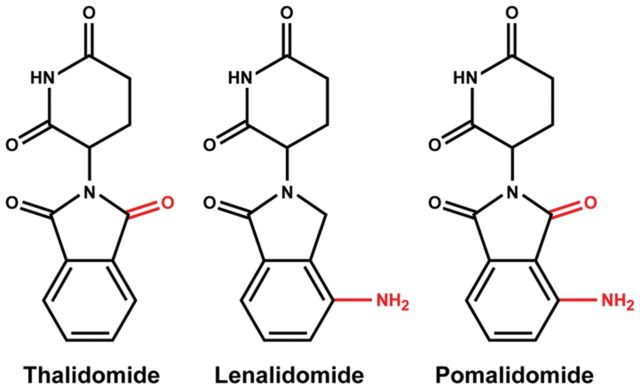
Diagram of immunomodulatory drugs including thalidomide, lenalidomide, and pomalidomideBlack shows the common structure whereas red shows the unique carboxyl group or amino group in each of these compounds.
After being removed from the pharmaceutical market, thalidomide has become the subject of the research in many fields, such as the treatment of the patients infected with human immunodeficiency virus [24] and the patients with an autoimmune skin disease actinic prurigo [25]. In 1964, thalidomide was used to treat a patient critically ill with leprosy. This treatment resulted in the discovery of its anti-inflammatory properties in the treatment of the patients with erythema nodosum leprosum (ENL), a complication of leprosy [26]. Subsequently, many years research and practice in this field resulted in the FDA's approval of using thalidomide to treat patients with ENL in 1998.
The use of thalidomide did not stop at the treatment of patients with ENL. Further investigation found that thalidomide possesses anti-angiogenic properties [18]. This finding triggered further investigation in the field of cancer treatment. Indeed, the research of thalidomide's effects on relapsed and refractory MM resulted in the discovery of its strong anti-cancer activity [19], leading to the FDA's approval of using thalidomide to treat the newly diagnostic MM patients.
Although thalidomide possesses strong anti-cancer activity, its adverse side-effects, such as teratogenesis, dose-limiting toxicities including somnolence, constipation, neuropathy, and increased incidence of venothromboembolism, cannot be ignored. In order to search for more potent and safer anti-cancer agents, a formal medicinal chemistry program was initiated by the Celgene Corporation. Basically, the structure of thalidomide was moderately modified to yield lenalidomide and pomalidomide (Fig. 1). Interestingly, these slightly modified compounds (thalidomide analogous), such as lenalidomide, are not only up to 50,000 fold more potent than thalidomide in terms of tumor necrosis factor α (TNFα) inhibition, but also much more potent than thalidomide in their ability to co-stimulate T-cells [27,28]. In addition, their adverse side-effects are much less severe than thalidomide [29,30]. Based on these criteria, lenalidomide was approved by FDA in 2006 whereas pomalidomide, in February 2013, for their use in the treatment of patients with MM.
Effects of IMiDs in the Treatment of MM
Immunomodulatory activities of IMiDs
IMiDs, such as thalidomide, lenalidomide, or pomalidomide, have a strong capacity to boost immune responses, therefore, being referred to as immunomodulatory drugs. It has been reported that in vitro exposure of stem cells to IMiDs resulted in the generation and activation of murine dendritic cells (DCs) [31]. DCs are cells that form part of the mammalian immune system. Immature DCs constantly sample the surrounding environment for pathogens, such as viruses or bacteria, performed through pattern recognition receptors, such as the toll-like receptors. Once the immature DCs phagocytose pathogens, these cells will degrade their proteins into small pieces and send them to their cell surface by using major histocompatibility complex molecules. During this activation process, these DCs up-regulate cell surface receptors that act as co-receptors, such as cluster of differentiation 80 (CD80), CD86, and CD40, in T-cell activation and also up-regulate chemokine receptor 7 that induces the DC to travel through the blood stream to the spleen or through the lymphatic system to a lymph node. In this process, they act as antigen-presenting cells and activate helper T-cells and killer T-cells as well as B-cells by presenting them with antigens derived from the pathogen, alongside non-antigen-specific co-stimulatory signals. Recent observations suggest that pomalidomide and lenalidomide enhance tumor antigen uptake by DCs with an increased efficacy of antigen presentation [32] and potentiate the immune response by restoring DC function and inhibiting T-cell regulatory activity, leading to the activation of T lymphocytes and natural killer T (NKT) cells by increasing the production of interleukin-2 (IL-2) and interferon gamma (IFN-γ) [33].
It has been reported that thalidomide is a potent co-stimulator of primary human T-cells, synergizing with stimulation via the T-cell receptor complex to increase IL-2-mediated T-cell proliferation and IFN-γ production [34]. Thalidomide and thalidomide analogous co-stimulating effects and induction of IL-2 and IFN-γ production were further confirmed [35–40]. Secretion of IL-2 and IFN-γ increases the number of natural killer (NK) cells, improves their function, and mediates lysis of MM cells. Further investigation indicated that IMiDs-induced augmentation of IL-2 production is mediated by the increase of activator protein 1 (AP-1) transcriptional activity [37–39]. AP-1 is a transcription factor that forms heterodimers with proteins belonging to the c-fos, c-Jun, ATF, and JDP families and regulates gene expression in response to a variety of stimuli, including cytokines, growth factors, stress, and bacterial or viral infections [41]. Suppressor of cytokine signaling 1 (SOCS1) is a member of the signal transduction and transcription (STAT)-induced STAT inhibitor family that functions downstream of cytokine receptors and takes part in a negative feedback loop to attenuate cytokine signaling. Interestingly, the treatment of MM cells with IMiDs down-regulated SOCS1 expression, demonstrating that modulation of SOCS1 may enhance immune response and efficacy of IMiDs in MM [42]. Cytotoxic T-cell antigen 4-immunoglobulin (CTLA-4-Ig) is a protein receptor that inhibits T-cell proliferation, via blocking the B7-CD28 co-stimulation pathway. Interestingly, IMiDs partially overcome the inhibitory effects of CTLA-4-Ig on T-cell proliferation and Epstein–Barr virus or influenza virus triggered IFN-γ secretion [40]. In addition, IMiDs triggered tyrosine phosphorylation of CD28 on T-cells and followed by activation of nuclear factor kappa B (NF-κB) [40]. Furthermore, IMiDs facilitated the nuclear translocation of nuclear factor of activated T cell-2 (NFAT2) and AP-1 via activation of phosphoinositide-3-kinase (PI3K) signaling, resulted in IL-2 secretion and T-cell proliferation [38]. Taking together, these data support the notion that IMiDs may mediate their anti-MM effect, at least in part, by modulating NK cell number and function.
NKT cells are a heterogeneous group of T-cells that recognize lipids and glycolipids presented by CD1d molecules. NKT cells, upon activation, produce large amounts of IFN-γ, IL-4, IL-2, IL-13, IL-17, IL-21, TNF-α, and granulocyte-macrophage colony-stimulating factor. Interestingly, lenalidomide enhances antigen-specific expansion of NKT cells in response to the NKT ligand α-galactosylceramide in both healthy donors and patients with MM [43]. NKT cells, activated in the presence of lenalidomide, have greater ability to secrete IFN-γ. Antigen-dependent activation of NKT cells was greater in the presence of DEX plus lenalidomide than with DEX alone. Therapy with IMiDs also led to an increase in NKT cells in vivo in patients with MM and del5q myelodysplastic syndrome [43]. Taking together, these data support the notion that IMiDs may mediate their anti-MM effect by modulating NKT cells.
Regulatory T-cells (Tregs) are a component of the immune system that suppresses immune responses of other cells. In other words, accumulation of Tregs will suppress immune responses whereas decreased Tregs will argument immune responses. Therefore, Tregs play an important role in ‘self-check’ built into the immune system. Tregs were elevated in patients with MM, leading to suppress the function of naive T-cells [44]. Regulatory function for Tregs is provided by the expression of the forkhead family transcription factor forkhead box p3 (FOXP3). It has been shown that lenalidomide and pomalidomide strongly inhibit Tregs proliferation via decreased FOXP3 mRNA expression [45]. Therefore, IMiDs may be ideal anti-cancer drugs showing features including marked immune stimulatory properties as well as being able to inhibit Tregs. Nevertheless, contradictory results have been observed, i.e. the treatment of the newly diagnosed (untreated) MM patients with IMiDs increased the number of Tregs cells [46,47]. Therefore, further investigation is needed to solve these controversial results.
Anti-angiogenic activities of IMiDs
Angiogenesis is a process of generating new blood vessels. In many cancers, this process can nurture tumor cells and increase the growth and metastasis of tumors. In MM, the interaction between the indigenous bone marrow stromal cells (BMSCs) and MM cells significantly increased the levels of pro-angiogenic cytokines, such as vascular endothelial growth factor (VEGF) and basic fibroblast growth factor (bFGF) [35,48–54]. VEGF and bFGF are growth factors that, once activated by binding to their receptors, mediate the formation of new blood vessels. In response to these factors stimulation, BMSCs and microvascular endothelial cells produce IL-6 that stimulates the growth of malignant plasma cells. It has been found that IMiDs decreased the expression of VEGF and bFGF [50], thereby inhibiting new blood vessel formation and decreasing the tumor growth. Indeed, microvessel growth in the IMiDs treated samples was significantly less than in the control [31,55–59]. From this point of view, the inhibition of tumor growth by anti-angiogenic properties of IMiDs is independent of their immunomodulatory effects [18,55,56].
Effects of IMiDs on the interaction between MM cells and BMSCs
MM is a cancer of malignant plasma cells residing in BM microenvironment by adhering to extracellular matrix (ECM) proteins and the proteins on BMSCs. The proteins involved in the interactions between MM cell and ECM or between MM cell and BMSCs include CD44, very late antigen 4 (VLA-4), VLA-5, leukocyte function-associated antigen 1 (LFA-1, CD11a), neural cell adhesion molecule (NCAM, CD56), intercellular adhesion molecule 1 (ICAM-1, CD54), vascular cell adhesion molecule 1 (VCAM-1, CD106), syndecan (CD138), and monocyte chemoattractant protein 1 [60].
The initial homing of MM cells to the BM milieu is mediated by binding of the stromal-derived growth factor (SDF-1α) in BM to its receptor C-X-C chemokine receptor type 4 (CXCR-4, CD184) located on MM cells. The interaction between MM cells and BMSCs promotes MM cell survival via cell–cell contact and cytokines. The interaction between MM cells and BMSCs leads to increased production of IL-6, a myeloma cell growth and survival factor, and other growth factors [61,62]. In addition, SDF-1α also modulates the expression of cell surface adhesion molecules VLA-4, LFA-1, VCAM-1, and ICAM-1 that favors the adhesion between MM cells and BMSCs. Furthermore, adhesion of MM cells to BMSCs enhanced NF-κB activity that further up-regulates IL-6 and VEGF [50,62,63]. TNFα, secreted by MM cells, enhances the expression and secretion of IL-6 from BMSCs [64]. TNFα also activates NF-κB and induces the expression of LFA1, ICAM-1, VCAM-1, VLA-4, and MUC-1 on MM cell lines as well as VCAM-1 and ICAM-1 on BMSCs [64].
It has been reported that IMiDs, such as thalidomide, in contrast to the co-stimulation effects in certain T lymphocytes [31,36,65–67], inhibited production of TNFα [28,68–79], suggesting that the treatment with IMiDs might decrease the production of IL-6 and the cell surface adhesion molecules between MM cells and BMSCs including LFA1, ICAM-1, VCAM-1, and VLA-4. Indeed, the expression of IL-6, upon treatment with IMiDs, was significantly decreased [28,50,80–102]. Furthermore, the expression of cell surface adhesion molecules, upon treatment with IMiDs, is also significantly decreased [103–113], meaning that IMiDs can inhibit the adhesion of MM cells to BMSCs and overcome cell surface adhesion-mediated drug resistance by down-regulating the expression of these adhesion molecules.
Anti-inflammatory effects of IMiDs
It has been found that IMiDs, such as thalidomide, inhibited the production of TNFα [28,68–79]. TNFα is a pro-inflammatory cytokine that affects a wide variety of cells to induce many similar inflammatory reactions, including fever, production of other cytokines, endothelial gene regulation, chemotaxis, leukocyte adherence, and activation of fibroblasts. In fact, IMiDs also inhibit the production of other pro-inflammatory cytokines, such as IL-1, IL-6, and IL-12, and increase the secretion of anti-inflammatory cytokines, such as IL-10 [28,37,114]. Furthermore, IMiDs are able to inhibit the expression of cyclooxygenase 2 (COX-2) [115], but not COX-1, in lipopolysaccharide-TNFα and IL-1β stimulated peripheral blood mononuclear cell (PBMC) [114]. COX-2 is an enzyme that catalyzes arachidonic acids into various pro-inflammatory prostaglandins (PGs). Thus, the decreased expression of COX-2 may lead to decreased production of PGs. Indeed, the treatment of PBMCs with IMiDs decreased the production of PGE2 [114]. Therefore, IMiDs possess significant anti-inflammatory effects.
Anti-proliferation effects of IMiDs
[3H]-thymidine uptake by human MM cell lines or cells derived from MM patients was significantly decreased upon treatment with thalidomide or its analog [51], suggesting that the cell proliferation might be inhibited by IMiDs or the cells might be killed by IMiDs. In considering the fact that: (i) IMiDs inhibit the production of TNFα [28,68–79], a factor that may not directly induce growth of neoplastic cells, but binds to a TNFα response element of the IL-6 promoter in BMSCs and induces expression of IL-6 [28,50,64,80–102], a growth factor for the proliferation of myeloma cells [116]; (ii) IMiDs inhibit the activity of NF-κB [101,102,110,117–137], a factor that is retained in the cytoplasm with IκBα as an inactive form and is activated by a wide variety of stimuli including stress, cytokines, free radicals, ultraviolet irradiation, and bacterial or viral antigens and followed by its translocation to the nucleus where it functions as transcription factor; (iii) IMiDs inhibit the activity of PI3K/Akt pathways [59,88,131,138–144] that plays a key role in multiple cellular processes including cell proliferation; it is most likely that the IMiDs possess anti-proliferation effects in MM cells. In addition, the treatment of MM cells with IMiDs down-regulated CCAAT/enhancer-binding protein β (C/EBPβ), resulting in abrogation of cell proliferation [145]. In fact, IMiDs did not alter C/EBPβ mRNA levels or protein stability, but blocked C/EBPβ translation through interfering eukaryotic translation initiation factor 4E (eIF4E) [145]. IMiD-induced decrease of C/EBPβ protein resulted in decreased production of interferon regulatory factor 4 (IRF4) [145], a transcription factor that is critical for MM cell growth and survival [146]. IMiD-mediated down-regulation of IRF4 was also observed by other investigators [147–151].
Pro-apoptosis effects of IMiDs
Apoptosis is triggered by either extrinsic signals, including toxins, hormones, growth factors, nitric oxide, or cytokines, or intrinsic signals such as radiation- or hypoxia-caused damage or increased intracellular calcium concentration. Multiple factors are involved in the apoptosis process. For example, pro-apoptotic factors, such as Bcl-2 antagonist of cell death (BAD), Bcl-2 associated X protein (BAX), and Bcl-2 antagonist killer 1 (BAK), can form a pore on mitochondria so that small mitochondria-derived activator of caspases and/or cytochrome c can be released from mitochondria to cytosol where they activate caspases that mediate apoptosis, whereas anti-apoptotic factors, such as B-cell lymphoma protein 2 (Bcl-2), Bcl-2 related protein, long isoform (Bcl-xL), and/or myeloid cell leukemia 1 (Mcl-1) inhibit the pore formation. Protein kinase B (or Akt) phosphorylates pro-apoptotic BAD protein on Ser136 that leads to BAD dissociation from the Bcl-2/Bcl-xL complex, resulted in preventing initiation of apoptotic process. Therefore, decreased Akt activity by IMiD will play a pro-apoptotic role. Akt can also activate NF-κB via regulating IκB kinase. Once NF-κB is activated, it enhances the expression of many genes involved in cell survival, such as inhibitor of apoptosis protein (IAP) [119,152] or cellular FLICE-like inhibitory protein (cFLIP) [119,152]. In addition, IL-6 enhanced the expression of anti-apoptotic factors Bcl-xL [153] and Mcl-1 [154,155]. Thus, the decreased NF-κB activity or the decreased expression of IL-6 by IMiD will also play a pro-apoptotic role. Furthermore, the fact that IMiDs triggered activation of caspase 3 [88,138,156–167], caspase 8 [119,158,162–164,167,168], caspase 9 [138,158,159,162–165,168], and caspase 12 [163], the increased expression of pro-apoptotic factors BAX and BAK [169] and the decreased expression of anti-apoptotic factors Bcl-2 [169], cFLIP, and Bcl-xL [170] indicates that IMiDs possess significant pro-apoptotic effects.
Cell cycle arrest effects of IMiDs
It has been reported that IMiDs up-regulated the expression of cyclin-dependent kinase (CDK) inhibitor 1 (CIP or p21/waf1) [149,164,171,172]. P21/waf1 is a key cell cycle regulator that modulates the activities of CDKs and reduces the phosphorylation of retinoblastoma proteins, thereby, causing cell cycle arrest at the G0/G1 phase. In addition, IMiD-mediated growth inhibition has been found to be associated with the induction of CDK inhibitors p15, p16, and p27 and tumor suppresser genes, such as early growth response protein 1 (Egr1), Egr2, and Egr3 [164]. The increased expression of p21/waf1 has been proved to be associated with a switch from methylated to acetylated histone H3 on p21/waf1 promoter region [172]. Although the mechanism of IMiD-mediated switch from methylated to acetylated histone H3 is unknown, the up-regulation of p21/waf1 correlated well with the inhibition of CDK2, CDK4, and CDK6 activities [171]. The inhibition of these CDKs resulted in cell cycle arrest [171] and this IMiD-mediated cell cycle arrest has also been found in a wide variety of cancer cells [51,142,147,160,165,169,173–181].
IMiDs' effects on cell migration and metastasis
Metastasis is a complex process involving cell dispersion from the primary site, migration, adhesion, and growth in the new sites (organs). It has been reported that the treatment with IMiDs, such as thalidomide or its analogs, inhibits or attenuates cancer metastasis process in animal models [109,124,141,182–186]. The detailed mechanisms for metastasis inhibition remain unclear. However, the effects of IMiDs on the factors involved in cancer cell migration and metastasis may provide a clue. Matrix metalloproteinases (MMPs) are a group of zinc-dependent endopeptidases that are thought to play a major role on cell behaviors including cell proliferation, dispersion, migration, adhesion, differentiation, angiogenesis, apoptosis, and host defense. Focal degradation of ECM, catalyzed by MMPs, is the first step in the invasion of cancer cells. It has been reported that the treatment with IMiDs, such as thalidomide or its analog, decreased the production of MMPs [130,167,187–190], thereby inhibiting the degradation of ECM. NFAT is a transcription factor that is implicated in the process of cell motility at the basis of metastasis formation. One such example is that NFAT3 functions as an inhibitor of cell motility [191]. IMiDs activate NFAT transcriptional pathways [125], thereby inhibiting cancer cell migration. In addition, the treatment with IMiDs decreased the expression of integrin subunits and/or integrin receptors [192–196]. Since integrins are crucial for cell–matrix interactions and mediate cell adhesion to endothelium, decreased the expression of integrins, upon treatment with IMiD, will result in inhibition of cell migration. Other cell adhesion molecules, such as ICAM, VCAM, NCAM, LFA, or VLA, which play an important role in the interactions between cancer cells and stromal cells, also contribute to cancer cell migration and metastasis process. Thereby, upon treatment with IMiDs, the altered expression of the cell adhesion molecules [103–106,108–113,193] will affect the cancer metastasis processes.
IMiDs' Target Protein in MM Cells
As mentioned in the previous section, the expression of many genes is altered upon treatment with IMiDs. We have found that 1036 genes were down-regulated whereas 1236 genes were up-regulated in MM cells upon treatment with lenalidomide [148]. Although the treatment with IMiDs affected so many genes, the molecular mechanism of the IMiD-mediated gene regulation in MM cells is not well elucidated.
By using thalidomide-conjugated ferrite-glycidyl methacrylate (FG) beads, Ito et al. [197] pulled down cereblon (CRBN) and damaged DNA-binding protein 1 (DDB1). They had also found that the development of pectoral fins and otic vesicles in thalidomide-treated zebrafish embryos was disturbed. The embryos injected with an anti-sense oligonucleotide against zebrafish Crbn yielded specific defects in fin and otic vesicle development, which is similar to those of the thalidomide-treated embryos. These defects were rescued by co-injection of zebrafish Crbn mRNA [197]. In addition, thalidomide treatment of zebrafish embryos over-expressing Y374A/W376A-mutated zebrafish Crbn, which prevents thalidomide binding, did not significantly affect otic vesicle size [197]. Thus, CRBN was considered as a direct target protein for thalidomide teratogenicity [197–200].
IMiDs, such as thalidomide, lenalidomide, or pomalidomide, are profoundly active in the treatment of MM and related diseases. What is the direct target protein of IMiDs in the treatment of these diseases? We have found that wild-type CRBN expression is required for the anti-myeloma activity of IMiDs [148]. By using thalidomide-conjugated FG beads, Lopez-Girona et al. [149] could pull down CRBN and DDB1 from U266 myeloma cell extracts and pre-incubation of the U266 cell extracts with either lenalidomide or pomalidomide completely blocked the pull-down. Thus, although whether CRBN is the sole IMiDs target protein remains unknown, CRBN is definitely an IMiDs' direct target protein in the treatment of patients with MM.
Functional Role of CRBN
CRBN and DDB1 were pulled down by using thalidomide-conjugated FG beads [149,197], indicating that CRBN directly binds DDB1 protein. The DDB1, CUL4, and really interesting new gene (RING) or ring box 1 (RBX1) or regulator of cullin 1 (ROC1) complex is an identified cullin-RING E3 ubiquitin ligase that regulates virtually all of the aspects of cellular function, such as DNA repair [201–207], DNA replication [208–211], and transcription [212]. Although DDB1 in this complex might directly recruit substrates to the E3 ubiquitin ligase, ubiquitination of several known substrates suggested that this ubiquitination process requires additional cellular factors [204,213]. In searching for additional cellular factors that might participate in ubiquitination in E3 ubiquitin ligase complex, CRBN, along with many other proteins, was identified as a potential factor or substrate receptor contributing to ubiquitination of cellular proteins and named as DDB1-CUL4-associated factor (DCAF) [214,215].
Although DCAF proteins were suggested to be factors serving as the substrate-recruiting modules or substrate receptors for the E3 ubiquitin ligase machinery [214–216], the functional role of CRBN in this complex is still unknown. Given the fact that CRBN also binds to a large-conductance Ca++-activated potassium channel (BKCa) α-subunit [217,218], a voltage-gated chloride channel-2 (ClC-2) [219], and an α1 subunit of AMP-activated protein kinase (AMPK) [220], it is possible that CRBN might function as a substrate receptor to bind to these proteins for ubiquitination by the E3 ubiquitin ligase machinery, leading to proteasome-mediated degradation.
However, even if it is the case that binding of BKCa, ClC-2, and AMPK to CRBN leads to ubiquitination and proteasome-mediated degradation, it is still not clear whether CRBN will directly bind to all those factors mentioned in the previous section or not. In other words, regardless of whether there is/are mono-target or multiple targets for IMiDs, the question of how IMiDs regulate so many genes remains unsolved. However, the results derived from IRF4, a transcription factor that is critical for MM cell growth and survival [146], may give us a clue. The treatment with IMiDs down-regulate the expression of IRF4 [147–151], perhaps via IMiD-induced decrease of C/EBPβ protein [145], meaning that CRBN may not directly bind to IRF4. It has been reported that knockdown of IRF4 with IRF4 small hairpin RNA (shRNA) altered the expression of a set of genes that were consistently down-regulated (435 genes) or up-regulated (410 genes) [221]. Thus, it is possible that some of the CRBN direct downstream substrates (Fig. 2) could be the factors associated with transcription (activation or suppression), RNA splicing, and/or translation and degradation of these factors, via ubiquitination by E3 ubiquitin ligase and proteasome-mediated degradation, might alter the expression of multiple sets of genes.
Figure 2.
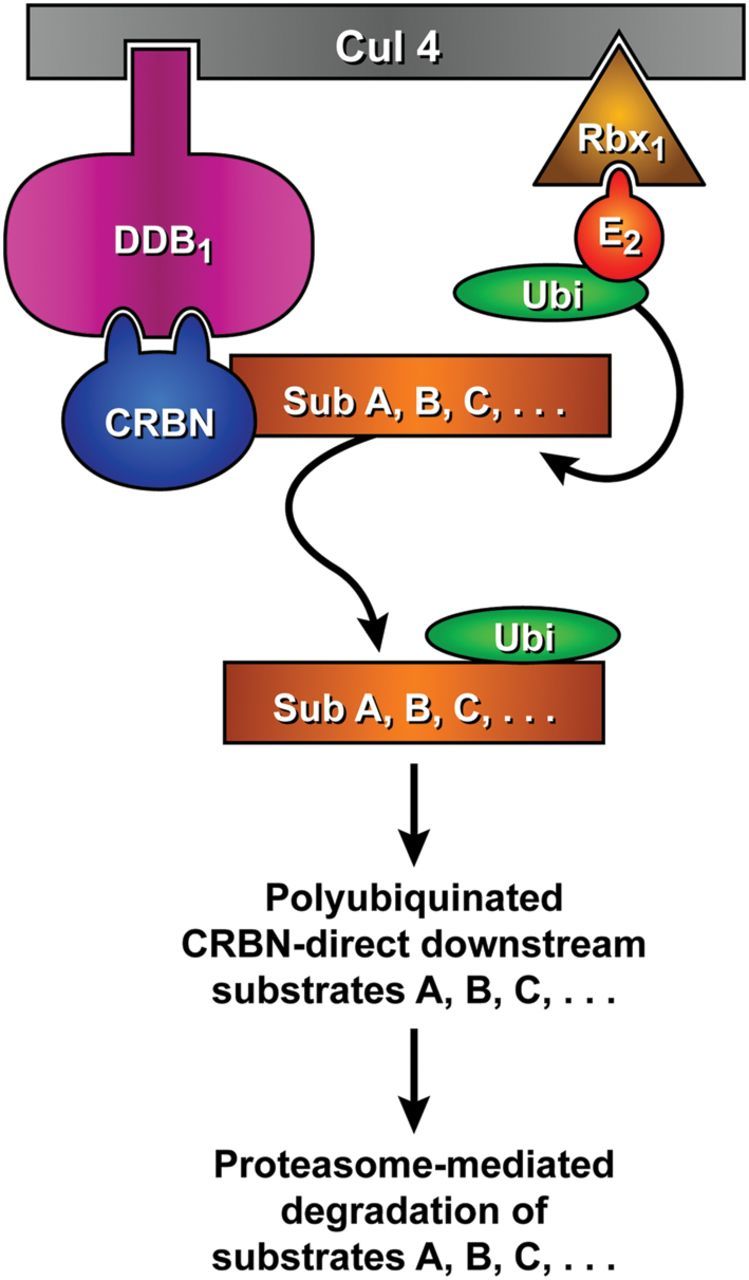
Diagram of E3 ubiquitin ligase complex-mediated degradation of CRBN direct downstream substratesCRBN recognizes its direct downstream substrates and recruit them for E3 ubiquitin ligase-mediated ubiquitination. These mono-ubiquitinated substrates will be further poly-ubiquitinated, leading to proteasome-mediated degradation. Cul 4 represents Cullin 4A or Cullin 4B; Rbx1, ring box 1; E2, E2 ubiquitin-conjugating enzyme; Ubi, ubiquitin; DDB1, damaged DNA-binding protein 1; CRBN, cereblon; Sub A, B, C, CRBN direct downstream substrates A, B, or C.
IMiDs Resistance in MM Cells
Although treatment with IMiDs has dramatically improved the survival for MM patients, majority of the MM patients treated with IMiDs develop resistance over time by mechanisms that remain unknown [222]. Fortunately, recent work has gradually uncovered the mechanism of the action of IMiDs. As discussed in the previous section, CRBN has been considered as one of the IMiDs' direct target proteins. We have found that the expression of IMiDs' target protein CRBN is required for their anti-myeloma activity [148]. It has also been reported that high expression of CRBN is associated with improved clinical response in patients with MM treated with IMiDs [223,224], further confirming that the expression of IMiDs' direct target protein CRBN is required for their anti-myeloma activity. Notably, CRBN shRNAs decreased the CRBN expression and conferred them resistant to IMiDs [148,149]. However, these cell lines had similar sensitivity to melphalan, DEX, and bortezomib [148], demonstrating a requirement of CRBN for the activity of IMiDs, but not other commonly employed anti-myeloma therapeutics. In addition, a majority of the lenalidomide-resistant MM patients expressed significantly lower CRBN level than the IMiDs sensitive patients [148,223], suggesting that the dysregulation of IMiDs' direct target protein CRBN (Fig. 3) confers them resistant to the IMiDs. Furthermore, introducing wild-type CRBN back to the IMiD-resistant MM cells restored their sensitivity to IMiDs (manuscript in preparation), further confirming that the expression of IMiDs' target protein CRBN is required for their anti-myeloma activity.
Figure 3.

Diagram of immunomodulatory drug (IMiD) effectsUpon IMiD binding, the binding of CRBN direct downstream substrates could be altered. If the binding of IMiD to CRBN decreases the binding of CRBN direct downstream substrates, it will prevent ubiquitination of these substrates, leading to accumulation of these CRBN direct downstream substrates. However, if the binding of IMiD to CRBN enhances the binding of CRBN direct downstream substrates (the diagram did not show this enhancement effect), it may facilitate ubiquitination of these substrates, leading to degradation of these CRBN direct downstream substrates. Altered steady state of the CRBN direct downstream substrates may affect the expression of CRBN indirect downstream factors that may elicit variant effects including immunomodulatory activity, anti-angiogenic activity, intervention of cell surface adhesion molecules, pro-apoptotic effect, cell cycle arrest, inhibition of cell migration and metastasis, anti-inflammatory activity and anti-proliferation activity, etc.
Of note, CRBN shRNAs decreased CRBN expression and also myeloma cell viability [148]. Interestingly, however, once a CRBN-knocked down cell line is established, the growth rate of these cells is similar to their parental cells, implying that the expression of CRBN direct downstream substrates and/or indirect downstream factors might be altered. This hypothesis is supported by the finding that some of the MM patients have high levels of CRBN, but resistant to IMiDs treatment [148], suggesting that the dysregulation of CRBN's indirect downstream factors (Fig. 3) might confer them resistant to IMiDs.
In fact, it has been reported that the over-expression of IRF4, a CRBN indirect downstream factor, confers the activated B-cell-like diffuse large B-cell lymphoma cells resistant to IMiDs [151,221]. We have also found that the over-expression of CRBN indirect downstream factors, such as IRF4 or Myc, in IMiD-sensitive MM cells reduced their sensitivity to IMiDs (manuscript in preparation). Over-expression of C/EBPβ, a transcription factor that is down-regulated by IMiDs, rescued MM cells from IMiD-induced inhibition of proliferation [145]. The treatment of MM cells with lenalidomide significantly increased the expression of β-catenin [225], suggesting that β-catenin might be an IMiDs' target protein's indirect downstream factor. Although the mechanism of lenalidomide mediated up-regulation of β-catenin remains unsolved, the over-expression of β-catenin conferred them resistant to IMiDs [225]. Furthermore, consequence of the enhanced β-catenin expression resulted in the over-expression of hyaluronan-binding protein CD44 [226] that conferred cell adhesion-mediated drug resistance.
All the data mentioned above support the notion that the dysregulation of IMiDs' direct target protein, such as CRBN, CRBN direct downstream substrates and/or CRBN indirect downstream factors might affect the sensitivity to IMiDs. Interestingly, down-regulation of CUL4A, a CRBN upstream factor that plays a scaffold role in the E3 ubiquitin ligase complex [214], conferred resistance to thalidomide, whereas ectopic CUL4A expression greatly enhanced the sensitivity to this drug [227], implying that the dysregulation of CRBN upstream factors, such as DDB1 and/or CUL4, might also affect the sensitivity to IMiDs.
Clarifying the molecular mechanisms of IMiDs' resistance might provide a possibility to overcome the corresponding IMiD resistance. As such, Bjorklund et al. [226] tested this possibility and found that blockade of CD44 with monoclonal antibodies, free hyaluronan, or CD44 knockdown reduced adhesion and sensitized them to lenalidomide. In addition, Wnt/β-catenin suppression by FH535, a reversible dual inhibitor of Wnt/β-catenin, enhanced the activity of lenalidomide [226]. Furthermore, all-trans-retinoic acid down-regulated β-catenin and CD44, reduced adhesion of lenalidomide-resistant myeloma cells, and enhanced the activity of lenalidomide in a lenalidomide-resistant murine xenograft model [226].
Concluding Remarks
The introduction of IMiDs, especially in combining with other anti-cancer drugs, into the MM treatment regimens dramatically improved the outcome of the patients with MM. Unfortunately, majority of the patients treated with IMiDs will eventually develop resistance to these drugs. Therefore, developing a novel therapeutic approach to overcome this drug resistance is urgently needed. Recent work [226] indicates that it is possible to overcome, by blockade of CRBN function, CRBN direct downstream substrates, and/or CRBN indirect downstream factors, the acquired IMiD resistance. Therefore, future dissection of CRBN direct downstream substrates and CRBN indirect downstream factors will help to delineate the underlying mechanisms of IMiD action and identify new biomarkers for prediction of IMiD response/resistance as well as developing a novel therapeutic approach to treat the patients with MM.
Funding
This work was supported by the Translational Research Grant from Leukemia & Lymphoma Society (LLS) (to X.C.).
References
- 1.Raab MS, Podar K, Breitkreutz I, Richardson PG, Anderson KC. Multiple myeloma. Lancet. 2009;374:324–339. doi: 10.1016/S0140-6736(09)60221-X. [DOI] [PubMed] [Google Scholar]
- 2.Solly S. Remarks on the pathology of mollities ossium; with cases. Med Chir Trans. 1844;27:435–461. doi: 10.1177/095952874402700129. 498-3-498-8. [DOI] [PMC free article] [PubMed] [Google Scholar]
- 3.Macintyre W. Case of Mollities and Fragilitas Ossium, accompanied with urine strongly charged with animal matter. Med Chir Trans. 1850;33:211–232. doi: 10.1177/095952875003300113. [DOI] [PMC free article] [PubMed] [Google Scholar]
- 4.Loge JP, Rundles RW. Urethane (ethyl carbamate) therapy in multiple myeloma. Blood. 1949;4:201–216. [PubMed] [Google Scholar]
- 5.San Miguel JF, Schlag R, Khuageva NK, Dimopoulos MA, Shpilberg O, Kropff M, Spicka I, et al. Bortezomib plus melphalan and prednisone for initial treatment of multiple myeloma. N Engl J Med. 2008;359:906–917. doi: 10.1056/NEJMoa0801479. [DOI] [PubMed] [Google Scholar]
- 6.Mateos MV, Richardson PG, Schlag R, Khuageva NK, Dimopoulos MA, Shpilberg O, Kropff M, et al. Bortezomib plus melphalan and prednisone compared with melphalan and prednisone in previously untreated multiple myeloma: updated follow-up and impact of subsequent therapy in the phase III VISTA trial. J Clin Oncol. 2010;28:2259–2266. doi: 10.1200/JCO.2009.26.0638. [DOI] [PubMed] [Google Scholar]
- 7.Mateos MV, Oriol A, Martinez-Lopez J, Gutierrez N, Teruel AI, de Paz R, Garcia-Larana J, et al. Bortezomib, melphalan, and prednisone versus bortezomib, thalidomide, and prednisone as induction therapy followed by maintenance treatment with bortezomib and thalidomide versus bortezomib and prednisone in elderly patients with untreated multiple myeloma: a randomised trial. Lancet Oncol. 2010;11:934–941. doi: 10.1016/S1470-2045(10)70187-X. [DOI] [PubMed] [Google Scholar]
- 8.Harousseau JL, Attal M, Leleu X, Troncy J, Pegourie B, Stoppa AM, Hulin C, et al. Bortezomib plus dexamethasone as induction treatment prior to autologous stem cell transplantation in patients with newly diagnosed multiple myeloma: results of an IFM phase II study. Haematologica. 2006;91:1498–1505. [PubMed] [Google Scholar]
- 9.Harousseau JL, Attal M, Avet-Loiseau H, Marit G, Caillot D, Mohty M, Lenain P, et al. Bortezomib plus dexamethasone is superior to vincristine plus doxorubicin plus dexamethasone as induction treatment prior to autologous stem-cell transplantation in newly diagnosed multiple myeloma: results of the IFM 2005-01 phase III trial. J Clin Oncol. 2010;28:4621–4629. doi: 10.1200/JCO.2009.27.9158. [DOI] [PubMed] [Google Scholar]
- 10.Avet-Loiseau H, Leleu X, Roussel M, Moreau P, Guerin-Charbonnel C, Caillot D, Marit G, et al. Bortezomib plus dexamethasone induction improves outcome of patients with t(4;14) myeloma but not outcome of patients with del(17p) J Clin Oncol. 2010;28:4630–4634. doi: 10.1200/JCO.2010.28.3945. [DOI] [PubMed] [Google Scholar]
- 11.Cavo M, Tacchetti P, Patriarca F, Petrucci MT, Pantani L, Galli M, Di Raimondo F, et al. Bortezomib with thalidomide plus dexamethasone compared with thalidomide plus dexamethasone as induction therapy before, and consolidation therapy after, double autologous stem-cell transplantation in newly diagnosed multiple myeloma: a randomised phase 3 study. Lancet. 2010;376:2075–2085. doi: 10.1016/S0140-6736(10)61424-9. [DOI] [PubMed] [Google Scholar]
- 12.Facon T, Mary JY, Hulin C, Benboubker L, Attal M, Pegourie B, Renaud M, et al. Melphalan and prednisone plus thalidomide versus melphalan and prednisone alone or reduced-intensity autologous stem cell transplantation in elderly patients with multiple myeloma (IFM 99-06): a randomised trial. Lancet. 2007;370:1209–1218. doi: 10.1016/S0140-6736(07)61537-2. [DOI] [PubMed] [Google Scholar]
- 13.Alexanian R, Haut A, Khan AU, Lane M, McKelvey EM, Migliore PJ, Stuckey WJ, Jr, et al. Treatment for multiple myeloma. Combination chemotherapy with different melphalan dose regimens. JAMA. 1969;208:1680–1685. doi: 10.1001/jama.208.9.1680. [DOI] [PubMed] [Google Scholar]
- 14.Seemuller E, Lupas A, Stock D, Lowe J, Huber R, Baumeister W. Proteasome from Thermoplasma acidophilum: a threonine protease. Science. 1995;268:579–582. doi: 10.1126/science.7725107. [DOI] [PubMed] [Google Scholar]
- 15.Stein RL, Melandri F, Dick L. Kinetic characterization of the chymotryptic activity of the 20S proteasome. Biochemistry. 1996;35:3899–3908. doi: 10.1021/bi952262x. [DOI] [PubMed] [Google Scholar]
- 16.Adams J, Behnke M, Chen S, Cruickshank AA, Dick LR, Grenier L, Klunder JM, et al. Potent and selective inhibitors of the proteasome: dipeptidyl boronic acids. Bioorg Med Chem Lett. 1998;8:333–338. doi: 10.1016/s0960-894x(98)00029-8. [DOI] [PubMed] [Google Scholar]
- 17.Adams J, Kauffman M. Development of the proteasome inhibitor Velcade (bortezomib) Cancer Invest. 2004;22:304–311. doi: 10.1081/cnv-120030218. [DOI] [PubMed] [Google Scholar]
- 18.D'Amato RJ, Loughnan MS, Flynn E, Folkman J. Thalidomide is an inhibitor of angiogenesis. Proc Natl Acad Sci USA. 1994;91:4082–4085. doi: 10.1073/pnas.91.9.4082. [DOI] [PMC free article] [PubMed] [Google Scholar]
- 19.Singhal S, Mehta J, Desikan R, Ayers D, Roberson P, Eddlemon P, Munshi N, et al. Antitumor activity of thalidomide in refractory multiple myeloma. N Engl J Med. 1999;341:1565–1571. doi: 10.1056/NEJM199911183412102. [DOI] [PubMed] [Google Scholar]
- 20.Rajkumar SV, Jacobus S, Callander NS, Fonseca R, Vesole DH, Williams ME, Abonour R, et al. Lenalidomide plus high-dose dexamethasone versus lenalidomide plus low-dose dexamethasone as initial therapy for newly diagnosed multiple myeloma: an open-label randomised controlled trial. Lancet Oncol. 2010;11:29–37. doi: 10.1016/S1470-2045(09)70284-0. [DOI] [PMC free article] [PubMed] [Google Scholar]
- 21.Miller MT, Stromland K. Teratogen update: thalidomide: a review, with a focus on ocular findings and new potential uses. Teratology. 1999;60:306–321. doi: 10.1002/(SICI)1096-9926(199911)60:5<306::AID-TERA11>3.0.CO;2-Y. [DOI] [PubMed] [Google Scholar]
- 22.Melchert M, List A. The thalidomide saga. Int J Biochem Cell Biol. 2007;39:1489–1499. doi: 10.1016/j.biocel.2007.01.022. [DOI] [PubMed] [Google Scholar]
- 23.Knobloch J, Ruther U. Shedding light on an old mystery: thalidomide suppresses survival pathways to induce limb defects. Cell Cycle. 2008;7:1121–1127. doi: 10.4161/cc.7.9.5793. [DOI] [PubMed] [Google Scholar]
- 24.Haslett P, Tramontana J, Burroughs M, Hempstead M, Kaplan G. Adverse reactions to thalidomide in patients infected with human immunodeficiency virus. Clin Infect Dis. 1997;24:1223–1227. doi: 10.1086/513665. [DOI] [PubMed] [Google Scholar]
- 25.Lovell CR, Hawk JL, Calnan CD, Magnus IA. Thalidomide in actinic prurigo. Br J Dermatol. 1983;108:467–471. doi: 10.1111/j.1365-2133.1983.tb04601.x. [DOI] [PubMed] [Google Scholar]
- 26.Iyer CG, Languillon J, Ramanujam K, Tarabini-Castellani G, De las Aguas JT, Bechelli LM, Uemura K, et al. WHO co-ordinated short-term double-blind trial with thalidomide in the treatment of acute lepra reactions in male lepromatous patients. Bull World Health Organ. 1971;45:719–732. [PMC free article] [PubMed] [Google Scholar]
- 27.Muller GW, Corral LG, Shire MG, Wang H, Moreira A, Kaplan G, Stirling DI. Structural modifications of thalidomide produce analogs with enhanced tumor necrosis factor inhibitory activity. J Med Chem. 1996;39:3238–3240. doi: 10.1021/jm9603328. [DOI] [PubMed] [Google Scholar]
- 28.Corral LG, Haslett PA, Muller GW, Chen R, Wong LM, Ocampo CJ, Patterson RT, et al. Differential cytokine modulation and T cell activation by two distinct classes of thalidomide analogues that are potent inhibitors of TNF-alpha. J Immunol. 1999;163:380–386. [PubMed] [Google Scholar]
- 29.Palumbo A, Rajkumar SV, Dimopoulos MA, Richardson PG, San Miguel J, Barlogie B, Harousseau J, et al. Prevention of thalidomide- and lenalidomide-associated thrombosis in myeloma. Leukemia. 2008;22:414–423. doi: 10.1038/sj.leu.2405062. [DOI] [PubMed] [Google Scholar]
- 30.Carrier M, Le Gal G, Tay J, Wu C, Lee AY. Rates of venous thromboembolism in multiple myeloma patients undergoing immunomodulatory therapy with thalidomide or lenalidomide: a systematic review and meta-analysis. J Thromb Haemost. 2011;9:653–663. doi: 10.1111/j.1538-7836.2011.04215.x. [DOI] [PubMed] [Google Scholar]
- 31.Reddy N, Hernandez-Ilizaliturri FJ, Deeb G, Roth M, Vaughn M, Knight J, Wallace P, et al. Immunomodulatory drugs stimulate natural killer-cell function, alter cytokine production by dendritic cells, and inhibit angiogenesis enhancing the anti-tumour activity of rituximab in vivo. Br J Haematol. 2008;140:36–45. doi: 10.1111/j.1365-2141.2007.06841.x. [DOI] [PubMed] [Google Scholar]
- 32.Henry JY, Labarthe MC, Meyer B, Dasgupta P, Dalgleish AG, Galustian C. Enhanced cross-priming of naive CD8+ T cells by DCs treated by the IMiDs((R)) immunomodulatory compounds lenalidomide and pomalidomide. Immunology. 2013;139:377–385. doi: 10.1111/imm.12087. doi:10.1111/imm.12087. [DOI] [PMC free article] [PubMed] [Google Scholar]
- 33.Castelli R, Cassin R, Cannavo A, Cugno M. Immunomodulatory drugs: new options for the treatment of myelodysplastic syndromes. Clin Lymphoma Myeloma Leuk. 2013;13:1–7. doi: 10.1016/j.clml.2012.09.016. [DOI] [PubMed] [Google Scholar]
- 34.Haslett PA, Corral LG, Albert M, Kaplan G. Thalidomide costimulates primary human T lymphocytes, preferentially inducing proliferation, cytokine production, and cytotoxic responses in the CD8+ subset. J Exp Med. 1998;187:1885–1892. doi: 10.1084/jem.187.11.1885. [DOI] [PMC free article] [PubMed] [Google Scholar]
- 35.Davies FE, Raje N, Hideshima T, Lentzsch S, Young G, Tai YT, Lin B, et al. Thalidomide and immunomodulatory derivatives augment natural killer cell cytotoxicity in multiple myeloma. Blood. 2001;98:210–216. doi: 10.1182/blood.v98.1.210. [DOI] [PubMed] [Google Scholar]
- 36.Marriott JB, Clarke IA, Dredge K, Muller G, Stirling D, Dalgleish AG. Thalidomide and its analogues have distinct and opposing effects on TNF-alpha and TNFR2 during co-stimulation of both CD4(+) and CD8(+) T cells. Clin Exp Immunol. 2002;130:75–84. doi: 10.1046/j.1365-2249.2002.01954.x. [DOI] [PMC free article] [PubMed] [Google Scholar]
- 37.Schafer PH, Gandhi AK, Loveland MA, Chen RS, Man HW, Schnetkamp PP, Wolbring G, et al. Enhancement of cytokine production and AP-1 transcriptional activity in T cells by thalidomide-related immunomodulatory drugs. J Pharmacol Exp Ther. 2003;305:1222–1232. doi: 10.1124/jpet.102.048496. [DOI] [PubMed] [Google Scholar]
- 38.Hayashi T, Hideshima T, Akiyama M, Podar K, Yasui H, Raje N, Kumar S, et al. Molecular mechanisms whereby immunomodulatory drugs activate natural killer cells: clinical application. Br J Haematol. 2005;128:192–203. doi: 10.1111/j.1365-2141.2004.05286.x. [DOI] [PubMed] [Google Scholar]
- 39.Payvandi F, Wu L, Naziruddin SD, Haley M, Parton A, Schafer PH, Chen RS, et al. Immunomodulatory drugs (IMiDs) increase the production of IL-2 from stimulated T cells by increasing PKC-theta activation and enhancing the DNA-binding activity of AP-1 but not NF-kappaB, OCT-1, or NF-AT. J Interferon Cytokine Res. 2005;25:604–616. doi: 10.1089/jir.2005.25.604. [DOI] [PubMed] [Google Scholar]
- 40.LeBlanc R, Hideshima T, Catley LP, Shringarpure R, Burger R, Mitsiades N, Mitsiades C, et al. Immunomodulatory drug costimulates T cells via the B7-CD28 pathway. Blood. 2004;103:1787–1790. doi: 10.1182/blood-2003-02-0361. [DOI] [PubMed] [Google Scholar]
- 41.Hess J, Angel P, Schorpp-Kistner M. AP-1 subunits: quarrel and harmony among siblings. J Cell Sci. 2004;117:5965–5973. doi: 10.1242/jcs.01589. [DOI] [PubMed] [Google Scholar]
- 42.Gorgun G, Calabrese E, Soydan E, Hideshima T, Perrone G, Bandi M, Cirstea D, et al. Immunomodulatory effects of lenalidomide and pomalidomide on interaction of tumor and bone marrow accessory cells in multiple myeloma. Blood. 2010;116:3227–3237. doi: 10.1182/blood-2010-04-279893. [DOI] [PMC free article] [PubMed] [Google Scholar]
- 43.Chang DH, Liu N, Klimek V, Hassoun H, Mazumder A, Nimer SD, Jagannath S, et al. Enhancement of ligand-dependent activation of human natural killer T cells by lenalidomide: therapeutic implications. Blood. 2006;108:618–621. doi: 10.1182/blood-2005-10-4184. [DOI] [PMC free article] [PubMed] [Google Scholar]
- 44.Muthu Raja KR, Kovarova L, Stossova J, Hajek R. Flow cytometric phenotyping and analysis of T regulatory cells in multiple myeloma patients. Klin Onkol. 2011;24:S30–S33. [PubMed] [Google Scholar]
- 45.Galustian C, Meyer B, Labarthe MC, Dredge K, Klaschka D, Henry J, Todryk S, et al. The anti-cancer agents lenalidomide and pomalidomide inhibit the proliferation and function of T regulatory cells. Cancer Immunol Immunother. 2009;58:1033–1045. doi: 10.1007/s00262-008-0620-4. [DOI] [PMC free article] [PubMed] [Google Scholar]
- 46.Muthu Raja KR, Kovarova L, Hajek R. Induction by lenalidomide and dexamethasone combination increases regulatory cells of patients with previously untreated multiple myeloma. Leuk Lymphoma. 2012;53:1406–1408. doi: 10.3109/10428194.2011.652106. [DOI] [PubMed] [Google Scholar]
- 47.Gupta R, Ganeshan P, Hakim M, Verma R, Sharma A, Kumar L. Significantly reduced regulatory T cell population in patients with untreated multiple myeloma. Leuk Res. 2011;35:874–878. doi: 10.1016/j.leukres.2010.11.010. [DOI] [PubMed] [Google Scholar]
- 48.Richardson PG, Schlossman RL, Weller E, Hideshima T, Mitsiades C, Davies F, LeBlanc R, et al. Immunomodulatory drug CC-5013 overcomes drug resistance and is well tolerated in patients with relapsed multiple myeloma. Blood. 2002;100:3063–3067. doi: 10.1182/blood-2002-03-0996. [DOI] [PubMed] [Google Scholar]
- 49.Bartlett JB, Dredge K, Dalgleish AG. The evolution of thalidomide and its IMiD derivatives as anticancer agents. Nat Rev Cancer. 2004;4:314–322. doi: 10.1038/nrc1323. [DOI] [PubMed] [Google Scholar]
- 50.Gupta D, Treon SP, Shima Y, Hideshima T, Podar K, Tai YT, Lin B, et al. Adherence of multiple myeloma cells to bone marrow stromal cells upregulates vascular endothelial growth factor secretion: therapeutic applications. Leukemia. 2001;15:1950–1961. doi: 10.1038/sj.leu.2402295. [DOI] [PubMed] [Google Scholar]
- 51.Hideshima T, Chauhan D, Shima Y, Raje N, Davies FE, Tai YT, Treon SP, et al. Thalidomide and its analogs overcome drug resistance of human multiple myeloma cells to conventional therapy. Blood. 2000;96:2943–2950. [PubMed] [Google Scholar]
- 52.Hicklin DJ, Ellis LM. Role of the vascular endothelial growth factor pathway in tumor growth and angiogenesis. J Clin Oncol. 2005;23:1011–1027. doi: 10.1200/JCO.2005.06.081. [DOI] [PubMed] [Google Scholar]
- 53.Li X, Liu X, Wang J, Wang Z, Jiang W, Reed E, Zhang Y, et al. Effects of thalidomide on the expression of angiogenesis growth factors in human A549 lung adenocarcinoma cells. Int J Mol Med. 2003;11:785–790. [PubMed] [Google Scholar]
- 54.Li X, Liu X, Wang J, Wang Z, Jiang W, Reed E, Zhang Y, et al. Thalidomide down-regulates the expression of VEGF and bFGF in cisplatin-resistant human lung carcinoma cells. Anticancer Res. 2003;23:2481–2487. [PubMed] [Google Scholar]
- 55.Lentzsch S, LeBlanc R, Podar K, Davies F, Lin B, Hideshima T, Catley L, et al. Immunomodulatory analogs of thalidomide inhibit growth of Hs Sultan cells and angiogenesis in vivo. Leukemia. 2003;17:41–44. doi: 10.1038/sj.leu.2402745. [DOI] [PubMed] [Google Scholar]
- 56.Dredge K, Marriott JB, Macdonald CD, Man HW, Chen R, Muller GW, Stirling D, et al. Novel thalidomide analogues display anti-angiogenic activity independently of immunomodulatory effects. Br J Cancer. 2002;87:1166–1172. doi: 10.1038/sj.bjc.6600607. [DOI] [PMC free article] [PubMed] [Google Scholar]
- 57.Noguchi T, Fujimoto H, Sano H, Miyajima A, Miyachi H, Hashimoto Y. Angiogenesis inhibitors derived from thalidomide. Bioorg Med Chem Lett. 2005;15:5509–5513. doi: 10.1016/j.bmcl.2005.08.086. [DOI] [PubMed] [Google Scholar]
- 58.Heere-Ress E, Boehm J, Thallinger C, Hoeller C, Wacheck V, Birner P, Wolff K, et al. Thalidomide enhances the anti-tumor activity of standard chemotherapy in a human melanoma xenotransplatation model. J Invest Dermatol. 2005;125:201–206. doi: 10.1111/j.0022-202X.2005.23830.x. [DOI] [PubMed] [Google Scholar]
- 59.Dredge K, Horsfall R, Robinson SP, Zhang LH, Lu L, Tang Y, Shirley MA, et al. Orally administered lenalidomide (CC-5013) is anti-angiogenic in vivo and inhibits endothelial cell migration and Akt phosphorylation in vitro. Microvasc Res. 2005;69:56–63. doi: 10.1016/j.mvr.2005.01.002. [DOI] [PubMed] [Google Scholar]
- 60.Martiniani R, Di Loreto V, Di Sano C, Lombardo A, Liberati AM. Biological activity of lenalidomide and its underlying therapeutic effects in multiple myeloma. Adv Hematol. 2012;2012:842945. doi: 10.1155/2012/842945. [DOI] [PMC free article] [PubMed] [Google Scholar]
- 61.Mitsiades CS, Mitsiades NS, Richardson PG, Munshi NC, Anderson KC. Multiple myeloma: a prototypic disease model for the characterization and therapeutic targeting of interactions between tumor cells and their local microenvironment. J Cell Biochem. 2007;101:950–968. doi: 10.1002/jcb.21213. [DOI] [PubMed] [Google Scholar]
- 62.Chauhan D, Uchiyama H, Akbarali Y, Urashima M, Yamamoto K, Libermann TA, Anderson KC. Multiple myeloma cell adhesion-induced interleukin-6 expression in bone marrow stromal cells involves activation of NF-kappa B. Blood. 1996;87:1104–1112. [PubMed] [Google Scholar]
- 63.Dankbar B, Padro T, Leo R, Feldmann B, Kropff M, Mesters RM, Serve H, et al. Vascular endothelial growth factor and interleukin-6 in paracrine tumor-stromal cell interactions in multiple myeloma. Blood. 2000;95:2630–2636. [PubMed] [Google Scholar]
- 64.Hideshima T, Chauhan D, Schlossman R, Richardson P, Anderson KC. The role of tumor necrosis factor alpha in the pathophysiology of human multiple myeloma: therapeutic applications. Oncogene. 2001;20:4519–4527. doi: 10.1038/sj.onc.1204623. [DOI] [PubMed] [Google Scholar]
- 65.Nishimura K, Hashimoto Y, Iwasaki S. Enhancement of phorbol ester-induced production of tumor necrosis factor alpha by thalidomide. Biochem Biophys Res Commun. 1994;199:455–460. doi: 10.1006/bbrc.1994.1250. [DOI] [PubMed] [Google Scholar]
- 66.Shibata Y, Shichita M, Sasaki K, Nishimura K, Hashimoto Y, Iwasaki S. N-Alkylphthalimides: structural requirement of thalidomidal action on 12-O-tetradecanoylphorbol-13-acetate-induced tumor necrosis factor alpha production by human leukemia HL-60 cells. Chem Pharm Bull (Tokyo) 1995;43:177–179. doi: 10.1248/cpb.43.177. [DOI] [PubMed] [Google Scholar]
- 67.Xu W, Celeridad M, Sankar S, Webb DR, Bennett BL. CC-4047 promotes Th1 cell differentiation and reprograms polarized human Th2 cells by enhancing transcription factor T-bet. Clin Immunol. 2008;128:392–399. doi: 10.1016/j.clim.2008.04.009. [DOI] [PubMed] [Google Scholar]
- 68.Sampaio EP, Sarno EN, Galilly R, Cohn ZA, Kaplan G. Thalidomide selectively inhibits tumor necrosis factor alpha production by stimulated human monocytes. J Exp Med. 1991;173:699–703. doi: 10.1084/jem.173.3.699. [DOI] [PMC free article] [PubMed] [Google Scholar]
- 69.Barnes PF, Chatterjee D, Brennan PJ, Rea TH, Modlin RL. Tumor necrosis factor production in patients with leprosy. Infect Immun. 1992;60:1441–1446. doi: 10.1128/iai.60.4.1441-1446.1992. [DOI] [PMC free article] [PubMed] [Google Scholar]
- 70.Moreira AL, Sampaio EP, Zmuidzinas A, Frindt P, Smith KA, Kaplan G. Thalidomide exerts its inhibitory action on tumor necrosis factor alpha by enhancing mRNA degradation. J Exp Med. 1993;177:1675–1680. doi: 10.1084/jem.177.6.1675. [DOI] [PMC free article] [PubMed] [Google Scholar]
- 71.Weglicki WB, Stafford RE, Dickens BF, Mak IT, Cassidy MM, Phillips TM. Inhibition of tumor necrosis factor-alpha by thalidomide in magnesium deficiency. Mol Cell Biochem. 1993;129:195–200. doi: 10.1007/BF00926368. [DOI] [PubMed] [Google Scholar]
- 72.Tramontana JM, Utaipat U, Molloy A, Akarasewi P, Burroughs M, Makonkawkeyoon S, Johnson B, et al. Thalidomide treatment reduces tumor necrosis factor alpha production and enhances weight gain in patients with pulmonary tuberculosis. Mol Med. 1995;1:384–397. [PMC free article] [PubMed] [Google Scholar]
- 73.Peterson PK, Hu S, Sheng WS, Kravitz FH, Molitor TW, Chatterjee D, Chao CC. Thalidomide inhibits tumor necrosis factor-alpha production by lipopolysaccharide- and lipoarabinomannan-stimulated human microglial cells. J Infect Dis. 1995;172:1137–1140. doi: 10.1093/infdis/172.4.1137. [DOI] [PubMed] [Google Scholar]
- 74.Schmidt H, Rush B, Simonian G, Murphy T, Hsieh J, Condon M. Thalidomide inhibits TNF response and increases survival following endotoxin injection in rats. J Surg Res. 1996;63:143–146. doi: 10.1006/jsre.1996.0237. [DOI] [PubMed] [Google Scholar]
- 75.Kroger H, Miesel R, Dietrich A, Ohde M, Rajnavolgyi E, Ockenfels H. Synergistic effects of thalidomide and poly (ADP-ribose) polymerase inhibition on type II collagen-induced arthritis in mice. Inflammation. 1996;20:203–215. doi: 10.1007/BF01487406. [DOI] [PubMed] [Google Scholar]
- 76.Shannon EJ, Sandoval F. Thalidomide can be either agonistic or antagonistic to LPS evoked synthesis of TNF-alpha by mononuclear cells. Immunopharmacol Immunotoxicol. 1996;18:59–72. doi: 10.3109/08923979609007110. [DOI] [PubMed] [Google Scholar]
- 77.Wnendt S, Finkam M, Winter W, Ossig J, Raabe G, Zwingenberger K. Enantioselective inhibition of TNF-alpha release by thalidomide and thalidomide-analogues. Chirality. 1996;8:390–396. doi: 10.1002/(SICI)1520-636X(1996)8:5<390::AID-CHIR6>3.0.CO;2-I. [DOI] [PubMed] [Google Scholar]
- 78.Rosinol L, Cibeira MT, Segarra M, Cid MC, Filella X, Aymerich M, Rozman M, et al. Response to thalidomide in multiple myeloma: impact of angiogenic factors. Cytokine. 2004;26:145–148. doi: 10.1016/j.cyto.2004.02.002. [DOI] [PubMed] [Google Scholar]
- 79.Vale ML, Cunha FQ, Brito GA, Benevides VM, Ferreira SH, Poole S, Ribeiro RA. Anti-nociceptive effect of thalidomide on zymosan-induced experimental articular incapacitation. Eur J Pharmacol. 2006;536:309–317. doi: 10.1016/j.ejphar.2006.02.051. [DOI] [PubMed] [Google Scholar]
- 80.Moreira AL, Tsenova-Berkova L, Wang J, Laochumroonvorapong P, Freeman S, Freedman VH, Kaplan G. Effect of cytokine modulation by thalidomide on the granulomatous response in murine tuberculosis. Tuber Lung Dis. 1997;78:47–55. doi: 10.1016/s0962-8479(97)90015-0. [DOI] [PubMed] [Google Scholar]
- 81.Moreira AL, Wang J, Sarno EN, Kaplan G. Thalidomide protects mice against LPS-induced shock. Braz J Med Biol Res. 1997;30:1199–1207. doi: 10.1590/s0100-879x1997001000010. [DOI] [PubMed] [Google Scholar]
- 82.Rowland TL, McHugh SM, Deighton J, Dearman RJ, Ewan PW, Kimber I. Differential regulation by thalidomide and dexamethasone of cytokine expression in human peripheral blood mononuclear cells. Immunopharmacology. 1998;40:11–20. doi: 10.1016/s0162-3109(98)00010-1. [DOI] [PubMed] [Google Scholar]
- 83.Dmoszynska A, Rolinski J, Bojarska-Junak A, Manko J, Jawniak D, Walter-Croneck A, Soroka-Wojtaszko M, et al. Influence of thalidomide on Bcl2 expression and proangiogenic cytokine levels in short-term culture of peripheral blood and bone marrow mononuclear cells of multiple myeloma patients. Pol J Pharmacol. 2001;53:709–713. [PubMed] [Google Scholar]
- 84.Thiele A, Bang R, Gutschow M, Rossol M, Loos S, Eger K, Tiegs G, et al. Cytokine modulation and suppression of liver injury by a novel analogue of thalidomide. Eur J Pharmacol. 2002;453:325–334. doi: 10.1016/s0014-2999(02)02423-8. [DOI] [PubMed] [Google Scholar]
- 85.Li J, Luo SK, Hong WD, Huang JQ. In vitro inhibition and mechanism of multiple myeloma cells growth by thalidomide. Zhongguo Shi Yan Xue Ye Xue Za Zhi. 2002;10:70–72. [PubMed] [Google Scholar]
- 86.Li J, Luo S, Hong W, Zhou Z, Zou W. Influence of thalidomide on interleukin-6 and its transmission in multiple myeloma patients. Zhonghua Zhong Liu Za Zhi. 2002;24:254–256. [PubMed] [Google Scholar]
- 87.Qian S, Somlo G, Zhou B, Yen Y. Therapeutic effects of thalidomide in myeloma are associated with the expression of fibroblast growth factor receptor 3. Ther Clin Risk Manag. 2005;1:231–241. [PMC free article] [PubMed] [Google Scholar]
- 88.Kumar S, Raje N, Hideshima T, Ishitsuka K, Roccaro A, Shiraishi N, Hamasaki M, et al. Antimyeloma activity of two novel N-substituted and tetraflourinated thalidomide analogs. Leukemia. 2005;19:1253–1261. doi: 10.1038/sj.leu.2403776. [DOI] [PubMed] [Google Scholar]
- 89.Tabata C, Tabata R, Kadokawa Y, Hisamori S, Takahashi M, Mishima M, Nakano T, et al. Thalidomide prevents bleomycin-induced pulmonary fibrosis in mice. J Immunol. 2007;179:708–714. doi: 10.4049/jimmunol.179.1.708. [DOI] [PubMed] [Google Scholar]
- 90.Shannon E, Noveck R, Sandoval F, Kamath B, Kearney M. Thalidomide suppressed interleukin-6 but not tumor necrosis factor-alpha in volunteers with experimental endotoxemia. Transl Res. 2007;150:275–280. doi: 10.1016/j.trsl.2007.05.003. [DOI] [PubMed] [Google Scholar]
- 91.Choe JY, Jung HJ, Park KY, Kum YS, Song GG, Hyun DS, Park SH, et al. Anti-fibrotic effect of thalidomide through inhibiting TGF-beta-induced ERK1/2 pathways in bleomycin-induced lung fibrosis in mice. Inflamm Res. 2010;59:177–188. doi: 10.1007/s00011-009-0084-9. [DOI] [PubMed] [Google Scholar]
- 92.Mantovani G, Maccio A, Madeddu C, Serpe R, Massa E, Dessi M, Panzone F, et al. Randomized phase III clinical trial of five different arms of treatment in 332 patients with cancer cachexia. Oncologist. 2010;15:200–211. doi: 10.1634/theoncologist.2009-0153. [DOI] [PMC free article] [PubMed] [Google Scholar]
- 93.Mantovani G. Randomised phase III clinical trial of 5 different arms of treatment on 332 patients with cancer cachexia. Eur Rev Med Pharmacol Sci. 2010;14:292–301. [PubMed] [Google Scholar]
- 94.Chaulet C, Croix C, Alagille D, Normand S, Delwail A, Favot L, Lecron JC, et al. Design, synthesis and biological evaluation of new thalidomide analogues as TNF-alpha and IL-6 production inhibitors. Bioorg Med Chem Lett. 2011;21:1019–1022. doi: 10.1016/j.bmcl.2010.12.031. [DOI] [PubMed] [Google Scholar]
- 95.Ch'ang HJ, Hsu C, Chen CH, Chang YH, Chang JS, Chen LT. Phase II study of concomitant thalidomide during radiotherapy for hepatocellular carcinoma. Int J Radiat Oncol Biol Phys. 2012;82:817–825. doi: 10.1016/j.ijrobp.2010.10.067. [DOI] [PubMed] [Google Scholar]
- 96.Melo CM, Morais TC, Tome AR, Brito GA, Chaves MH, Rao VS, Santos FA. Anti-inflammatory effect of alpha,beta-amyrin, a triterpene from Protium heptaphyllum, on cerulein-induced acute pancreatitis in mice. Inflamm Res. 2011;60:673–681. doi: 10.1007/s00011-011-0321-x. [DOI] [PubMed] [Google Scholar]
- 97.Zhang C, Zhang X, Ma L, Peng F, Huang J, Han H. Thalidomide inhibits adipogenesis of orbital fibroblasts in Graves' ophthalmopathy. Endocrine. 2012;41:248–255. doi: 10.1007/s12020-012-9600-8. [DOI] [PubMed] [Google Scholar]
- 98.Mazzoccoli L, Cadoso SH, Amarante GW, de Souza MV, Domingues R, Machado MA, de Almeida MV, et al. Novel thalidomide analogues from diamines inhibit pro-inflammatory cytokine production and CD80 expression while enhancing IL-10. Biomed Pharmacother. 2012;66:323–329. doi: 10.1016/j.biopha.2012.05.001. [DOI] [PubMed] [Google Scholar]
- 99.Puzik A, Thiel A, Faust K, Hartel C. Thalidomide has anti-inflammatory properties in neonatal immune cells. Innate Immun. 2013;19:42–52. doi: 10.1177/1753425912449881. [DOI] [PubMed] [Google Scholar]
- 100.Amirshahrokhi K, Ghazi-Khansari M. Thalidomide attenuates multiple low-dose streptozotocin-induced diabetes in mice by inhibition of proinflammatory cytokines. Cytokine. 2012;60:522–527. doi: 10.1016/j.cyto.2012.07.029. [DOI] [PubMed] [Google Scholar]
- 101.Oliva EN, Cuzzola M, Aloe Spiriti MA, Poloni A, Lagana C, Rigolino C, Morabito F, et al. Biological activity of lenalidomide in myelodysplastic syndromes with del5q: results of gene expression profiling from a multicenter phase II study. Ann Hematol. 2013;92:25–32. doi: 10.1007/s00277-012-1569-0. [DOI] [PubMed] [Google Scholar]
- 102.Li D, Xu LY, Chang ZJ, Zhao GJ, Nan C, Lu ZQ. Effect of thalidomide in a mouse model of paraquat-induced acute lung injury and the underlying mechanisms. Zhonghua Lao Dong Wei Sheng Zhi Ye Bing Za Zhi. 2013;31:178–183. [PubMed] [Google Scholar]
- 103.Geist C, Wohrmann T, Schneider J, Zwingenberger K. Effects of thalidomide on the local Shwartzman reaction in mice and rabbits. FEMS Immunol Med Microbiol. 1995;12:165–174. doi: 10.1111/j.1574-695X.1995.tb00189.x. [DOI] [PubMed] [Google Scholar]
- 104.Geitz H, Handt S, Zwingenberger K. Thalidomide selectively modulates the density of cell surface molecules involved in the adhesion cascade. Immunopharmacology. 1996;31:213–221. doi: 10.1016/0162-3109(95)00050-x. [DOI] [PubMed] [Google Scholar]
- 105.Settles B, Stevenson A, Wilson K, Mack C, Ezell T, Davis MF, Taylor LD. Down-regulation of cell adhesion molecules LFA-1 and ICAM-1 after in vitro treatment with the anti-TNF-alpha agent thalidomide. Cell Mol Biol (Noisy-le-grand) 2001;47:1105–1114. [PubMed] [Google Scholar]
- 106.Li J, Luo SK, Hong WD, Zhou ZH, Zou WY. Influence of thalidomide on bone marrow microenvironment in refractory and relapsed multiple myeloma. Ai Zheng. 2003;22:346–349. [PubMed] [Google Scholar]
- 107.Zeldis JB, Schafer PH, Bennett BL, Mercurio F, Stirling DI. Potential new therapeutics for Waldenstrom's macroglobulinemia. Semin Oncol. 2003;30:275–281. doi: 10.1053/sonc.2003.50078. [DOI] [PubMed] [Google Scholar]
- 108.Lv P, Paul SC, Xiao Y, Liu S, Luo H. Effects of thalidomide on the expression of adhesion molecules in rat liver cirrhosis. Mediators Inflamm. 2006;2006:93253. doi: 10.1155/MI/2006/93253. [DOI] [PMC free article] [PubMed] [Google Scholar]
- 109.Lin YC, Shun CT, Wu MS, Chen CC. A novel anticancer effect of thalidomide: inhibition of intercellular adhesion molecule-1-mediated cell invasion and metastasis through suppression of nuclear factor-kappaB. Clin Cancer Res. 2006;12:7165–7173. doi: 10.1158/1078-0432.CCR-06-1393. [DOI] [PubMed] [Google Scholar]
- 110.Lv P, Luo HS, Zhou XP, Xiao YJ, Paul SC, Si XM, Zhou YH. Reversal effect of thalidomide on established hepatic cirrhosis in rats via inhibition of nuclear factor-kappaB/inhibitor of nuclear factor-kappaB pathway. Arch Med Res. 2007;38:15–27. doi: 10.1016/j.arcmed.2006.09.006. [DOI] [PubMed] [Google Scholar]
- 111.Guirgis AA, Zahran MA, Mohamed AS, Talaat RM, Abdou BY, Agwa HS. Effect of thalidomide dithiocarbamate analogs on the intercellular adhesion molecule-1 expression. Int Immunopharmacol. 2010;10:806–811. doi: 10.1016/j.intimp.2010.04.023. [DOI] [PubMed] [Google Scholar]
- 112.Kim DH, Kim YJ, Chang SA, Lee HW, Kim HN, Kim HK, Chang HJ, et al. The protective effect of thalidomide on left ventricular function in a rat model of diabetic cardiomyopathy. Eur J Heart Fail. 2010;12:1051–1060. doi: 10.1093/eurjhf/hfq103. [DOI] [PubMed] [Google Scholar]
- 113.Zhang Y, Yang M, Yang Y, Zheng SL, Cai Y, Xia P, Chen WW, et al. Thalidomide attenuates graft arteriosclerosis of aortic transplant in a rat model. Transplant Proc. 2011;43:2022–2026. doi: 10.1016/j.transproceed.2011.03.086. [DOI] [PubMed] [Google Scholar]
- 114.Payvandi F, Wu L, Haley M, Schafer PH, Zhang LH, Chen RS, Muller GW, et al. Immunomodulatory drugs inhibit expression of cyclooxygenase-2 from TNF-alpha, IL-1beta, and LPS-stimulated human PBMC in a partially IL-10-dependent manner. Cell Immunol. 2004;230:81–88. doi: 10.1016/j.cellimm.2004.09.003. [DOI] [PubMed] [Google Scholar]
- 115.Fujimoto H, Noguchi T, Kobayashi H, Miyachi H, Hashimoto Y. Effects of immunomodulatory derivatives of thalidomide (IMiDs) and their analogs on cell-differentiation, cyclooxygenase activity and angiogenesis. Chem Pharm Bull (Tokyo) 2006;54:855–860. doi: 10.1248/cpb.54.855. [DOI] [PubMed] [Google Scholar]
- 116.Anderson KC. Lenalidomide and thalidomide: mechanisms of action—similarities and differences. Semin Hematol. 2005;42:S3–S8. doi: 10.1053/j.seminhematol.2005.10.001. [DOI] [PubMed] [Google Scholar]
- 117.Moreira AL, Friedlander DR, Shif B, Kaplan G, Zagzag D. Thalidomide and a thalidomide analogue inhibit endothelial cell proliferation in vitro. J Neurooncol. 1999;43:109–114. doi: 10.1023/a:1006202700039. [DOI] [PubMed] [Google Scholar]
- 118.Keifer JA, Guttridge DC, Ashburner BP, Baldwin AS., Jr Inhibition of NF-kappa B activity by thalidomide through suppression of IkappaB kinase activity. J Biol Chem. 2001;276:22382–22387. doi: 10.1074/jbc.M100938200. [DOI] [PubMed] [Google Scholar]
- 119.Mitsiades N, Mitsiades CS, Poulaki V, Chauhan D, Richardson PG, Hideshima T, Munshi NC, et al. Apoptotic signaling induced by immunomodulatory thalidomide analogs in human multiple myeloma cells: therapeutic implications. Blood. 2002;99:4525–4530. doi: 10.1182/blood.v99.12.4525. [DOI] [PubMed] [Google Scholar]
- 120.Hansen JM, Gong SG, Philbert M, Harris C. Misregulation of gene expression in the redox-sensitive NF-kappab-dependent limb outgrowth pathway by thalidomide. Dev Dyn. 2002;225:186–194. doi: 10.1002/dvdy.10150. [DOI] [PubMed] [Google Scholar]
- 121.DeCicco KL, Tanaka T, Andreola F, De Luca LM. The effect of thalidomide on non-small cell lung cancer (NSCLC) cell lines: possible involvement in the PPARgamma pathway. Carcinogenesis. 2004;25:1805–1812. doi: 10.1093/carcin/bgh210. [DOI] [PubMed] [Google Scholar]
- 122.Yagyu T, Kobayashi H, Matsuzaki H, Wakahara K, Kondo T, Kurita N, Sekino H, et al. Thalidomide inhibits tumor necrosis factor-alpha-induced interleukin-8 expression in endometriotic stromal cells, possibly through suppression of nuclear factor-kappaB activation. J Clin Endocrinol Metab. 2005;90:3017–3021. doi: 10.1210/jc.2004-1946. [DOI] [PubMed] [Google Scholar]
- 123.Pereira RM, Calegari-Silva TC, Hernandez MO, Saliba AM, Redner P, Pessolani MC, Sarno EN, et al. Mycobacterium leprae induces NF-kappaB-dependent transcription repression in human Schwann cells. Biochem Biophys Res Commun. 2005;335:20–26. doi: 10.1016/j.bbrc.2005.07.061. [DOI] [PubMed] [Google Scholar]
- 124.Kobayashi H, Yagyu T, Kondo T, Kurita N, Inagaki K, Haruta S, Kawaguchi R, et al. Suppression of urokinase receptor expression by thalidomide is associated with inhibition of nuclear factor kappaB activation and subsequently suppressed ovarian cancer dissemination. Cancer Res. 2005;65:10464–10471. doi: 10.1158/0008-5472.CAN-04-3789. [DOI] [PubMed] [Google Scholar]
- 125.Ge Y, Montano I, Rustici G, Freebern WJ, Haggerty CM, Cui W, Ponciano-Jackson D, et al. Selective leukemic-cell killing by a novel functional class of thalidomide analogs. Blood. 2006;108:4126–4135. doi: 10.1182/blood-2006-04-017046. [DOI] [PMC free article] [PubMed] [Google Scholar]
- 126.Paul SC, Lv P, Xiao YJ, An P, Liu SQ, Luo HS. Thalidomide in rat liver cirrhosis: blockade of tumor necrosis factor-alpha via inhibition of degradation of an inhibitor of nuclear factor-kappaB. Pathobiology. 2006;73:82–92. doi: 10.1159/000094492. [DOI] [PubMed] [Google Scholar]
- 127.Lv P, Luo HS, Zhou XP, Chireyath Paul S, Xiao YJ, Si XM, Liu SQ. Thalidomide prevents rat liver cirrhosis via inhibition of oxidative stress. Pathol Res Pract. 2006;202:777–788. doi: 10.1016/j.prp.2006.08.002. [DOI] [PubMed] [Google Scholar]
- 128.Genovese T, Mazzon E, Esposito E, Di Paola R, Caminiti R, Meli R, Bramanti P, et al. Effect of thalidomide on signal transduction pathways and secondary damage in experimental spinal cord trauma. Shock. 2008;30:231–240. doi: 10.1097/shk.0b013e318162d290. [DOI] [PubMed] [Google Scholar]
- 129.Ge Y, Byun JS, De Luca P, Gueron G, Yabe IM, Sadiq-Ali SG, Figg WD, et al. Combinatorial antileukemic disruption of oxidative homeostasis and mitochondrial stability by the redox reactive thalidomide 2-(2,4-difluoro-phenyl)-4,5,6,7-tetrafluoro-1H-isoindole-1,3(2H)-dione (CPS49) and flavopiridol. Mol Pharmacol. 2008;74:872–883. doi: 10.1124/mol.107.040808. [DOI] [PMC free article] [PubMed] [Google Scholar]
- 130.Zhang S, Li M, Gu Y, Liu Z, Xu S, Cui Y, Sun B. Thalidomide influences growth and vasculogenic mimicry channel formation in melanoma. J Exp Clin Cancer Res. 2008;27:60. doi: 10.1186/1756-9966-27-60. [DOI] [PMC free article] [PubMed] [Google Scholar]
- 131.Noman AS, Koide N, Hassan F, Iftakhar-E-Khuda I, Dagvadorj J, Tumurkhuu G, Islam S, et al. Thalidomide inhibits lipopolysaccharide-induced tumor necrosis factor-alpha production via down-regulation of MyD88 expression. Innate Immun. 2009;15:33–41. doi: 10.1177/1753425908099317. [DOI] [PubMed] [Google Scholar]
- 132.Noman AS, Koide N, Khuda II, Dagvadorj J, Tumurkhuu G, Naiki Y, Komatsu T, et al. Thalidomide inhibits lipopolysaccharide-induced nitric oxide production and prevents lipopolysaccharide-mediated lethality in mice. FEMS Immunol Med Microbiol. 2009;56:204–211. doi: 10.1111/j.1574-695X.2009.00567.x. [DOI] [PubMed] [Google Scholar]
- 133.Mondello S, Mazzon E, Di Paola R, Crisafulli C, Mondello P, Buemi M, Aloisi C, et al. Thalidomide suppresses sclerosing encapsulating peritonitis in a rat experimental model. Shock. 2009;32:332–339. doi: 10.1097/SHK.0b013e3181994974. [DOI] [PubMed] [Google Scholar]
- 134.Dong ZZ, Yao DF, Wu W, Yao M, Yu HB, Shen JJ, Qiu LW, et al. Delayed hepatocarcinogenesis through antiangiogenic intervention in the nuclear factor-kappa B activation pathway in rats. Hepatobiliary Pancreat Dis Int. 2010;9:169–174. [PubMed] [Google Scholar]
- 135.Knobloch J, Jungck D, Koch A. Apoptosis induction by thalidomide: critical for limb teratogenicity but therapeutic potential in idiopathic pulmonary fibrosis? Curr Mol Pharmacol. 2011;4:26–61. doi: 10.2174/1874467211104010026. [DOI] [PubMed] [Google Scholar]
- 136.Hernandez Mde O, Fulco Tde O, Pinheiro RO, Pereira Rde M, Redner P, Sarno EN, Lopes UG, et al. Thalidomide modulates Mycobacterium leprae-induced NF-kappaB pathway and lower cytokine response. Eur J Pharmacol. 2011;670:272–279. doi: 10.1016/j.ejphar.2011.08.046. [DOI] [PubMed] [Google Scholar]
- 137.Rance E, Tanner JE, Alfieri C. Inhibition of IkappaB kinase by thalidomide increases hepatitis C virus RNA replication. J Viral Hepat. 2012;19:e73–e80. doi: 10.1111/j.1365-2893.2011.01505.x. [DOI] [PubMed] [Google Scholar]
- 138.Gockel HR, Lugering A, Heidemann J, Schmidt M, Domschke W, Kucharzik T, Lugering N. Thalidomide induces apoptosis in human monocytes by using a cytochrome c-dependent pathway. J Immunol. 2004;172:5103–5109. doi: 10.4049/jimmunol.172.8.5103. [DOI] [PubMed] [Google Scholar]
- 139.Raje N, Kumar S, Hideshima T, Ishitsuka K, Chauhan D, Mitsiades C, Podar K, et al. Combination of the mTOR inhibitor rapamycin and CC-5013 has synergistic activity in multiple myeloma. Blood. 2004;104:4188–4193. doi: 10.1182/blood-2004-06-2281. [DOI] [PubMed] [Google Scholar]
- 140.Knobloch J, Schmitz I, Gotz K, Schulze-Osthoff K, Ruther U. Thalidomide induces limb anomalies by PTEN stabilization, Akt suppression, and stimulation of caspase-dependent cell death. Mol Cell Biol. 2008;28:529–538. doi: 10.1128/MCB.00553-07. [DOI] [PMC free article] [PubMed] [Google Scholar]
- 141.Lu L, Payvandi F, Wu L, Zhang LH, Hariri RJ, Man HW, Chen RS, et al. The anti-cancer drug lenalidomide inhibits angiogenesis and metastasis via multiple inhibitory effects on endothelial cell function in normoxic and hypoxic conditions. Microvasc Res. 2009;77:78–86. doi: 10.1016/j.mvr.2008.08.003. [DOI] [PubMed] [Google Scholar]
- 142.Gao S, Yang XJ, Zhang WG, Ji YW, Pan Q. Mechanism of thalidomide to enhance cytotoxicity of temozolomide in U251-MG glioma cells in vitro. Chin Med J (Engl) 2009;122:1260–1266. [PubMed] [Google Scholar]
- 143.Rafiee P, Stein DJ, Nelson VM, Otterson MF, Shaker R, Binion DG. Thalidomide inhibits inflammatory and angiogenic activation of human intestinal microvascular endothelial cells (HIMEC) Am J Physiol Gastrointest Liver Physiol. 2010;298:G167–G176. doi: 10.1152/ajpgi.00385.2009. [DOI] [PMC free article] [PubMed] [Google Scholar]
- 144.Cosenza M, Civallero M, Grisendi G, Marcheselli L, Roat E, Bari A, Sacchi S. Combination of low doses of enzastaurin and lenalidomide has synergistic activity in B-non-Hodgkin lymphoma cell lines. Ann Hematol. 2012;91:1613–1622. doi: 10.1007/s00277-012-1490-6. [DOI] [PubMed] [Google Scholar]
- 145.Li S, Pal R, Monaghan SA, Schafer P, Ouyang H, Mapara M, Galson DL, et al. IMiD immunomodulatory compounds block C/EBP{beta} translation through eIF4E down-regulation resulting in inhibition of MM. Blood. 2011;117:5157–5165. doi: 10.1182/blood-2010-10-314278. [DOI] [PMC free article] [PubMed] [Google Scholar]
- 146.Shaffer AL, Emre NC, Lamy L, Ngo VN, Wright G, Xiao W, Powell J, et al. IRF4 addiction in multiple myeloma. Nature. 2008;454:226–231. doi: 10.1038/nature07064. [DOI] [PMC free article] [PubMed] [Google Scholar]
- 147.Lopez-Girona A, Heintel D, Zhang LH, Mendy D, Gaidarova S, Brady H, Bartlett JB, et al. Lenalidomide downregulates the cell survival factor, interferon regulatory factor-4, providing a potential mechanistic link for predicting response. Br J Haematol. 2011;154:325–336. doi: 10.1111/j.1365-2141.2011.08689.x. [DOI] [PubMed] [Google Scholar]
- 148.Zhu YX, Braggio E, Shi CX, Bruins LA, Schmidt JE, Van Wier S, Chang XB, et al. Cereblon expression is required for the antimyeloma activity of lenalidomide and pomalidomide. Blood. 2011;118:4771–4779. doi: 10.1182/blood-2011-05-356063. [DOI] [PMC free article] [PubMed] [Google Scholar]
- 149.Lopez-Girona A, Mendy D, Ito T, Miller K, Gandhi AK, Kang J, Karasawa S, et al. Cereblon is a direct protein target for immunomodulatory and antiproliferative activities of lenalidomide and pomalidomide. Leukemia. 2012;26:2326–2335. doi: 10.1038/leu.2012.119. [DOI] [PMC free article] [PubMed] [Google Scholar]
- 150.Yang Y, Nie F, Xu D, Luo J, Zhuang Y, Pan Y. A multimedia retrieval framework based on semi-supervised ranking and relevance feedback. IEEE Trans Pattern Anal Mach Intell. 2012;34:723–742. doi: 10.1109/TPAMI.2011.170. [DOI] [PubMed] [Google Scholar]
- 151.Zhang LH, Kosek J, Wang M, Heise C, Schafer PH, Chopra R. Lenalidomide efficacy in activated B-cell-like subtype diffuse large B-cell lymphoma is dependent upon IRF4 and cereblon expression. Br J Haematol. 2013;160:487–502. doi: 10.1111/bjh.12172. [DOI] [PubMed] [Google Scholar]
- 152.Chu ZL, McKinsey TA, Liu L, Gentry JJ, Malim MH, Ballard DW. Suppression of tumor necrosis factor-induced cell death by inhibitor of apoptosis c-IAP2 is under NF-kappaB control. Proc Natl Acad Sci USA. 1997;94:10057–10062. doi: 10.1073/pnas.94.19.10057. [DOI] [PMC free article] [PubMed] [Google Scholar]
- 153.Catlett-Falcone R, Landowski TH, Oshiro MM, Turkson J, Levitzki A, Savino R, Ciliberto G, et al. Constitutive activation of Stat3 signaling confers resistance to apoptosis in human U266 myeloma cells. Immunity. 1999;10:105–115. doi: 10.1016/s1074-7613(00)80011-4. [DOI] [PubMed] [Google Scholar]
- 154.Puthier D, Bataille R, Amiot M. IL-6 up-regulates mcl-1 in human myeloma cells through JAK/STAT rather than ras/MAP kinase pathway. Eur J Immunol. 1999;29:3945–3950. doi: 10.1002/(SICI)1521-4141(199912)29:12<3945::AID-IMMU3945>3.0.CO;2-O. [DOI] [PubMed] [Google Scholar]
- 155.Jourdan M, Veyrune JL, De Vos J, Redal N, Couderc G, Klein B. A major role for Mcl-1 antiapoptotic protein in the IL-6-induced survival of human myeloma cells. Oncogene. 2003;22:2950–2959. doi: 10.1038/sj.onc.1206423. [DOI] [PMC free article] [PubMed] [Google Scholar]
- 156.Ezell TN, Maloney N, Githua JW, Taylor LD. Exposure to the anti-TNF-alpha drug thalidomide induces apoptotic cell death in human T leukemic cells. Cell Mol Biol (Noisy-le-grand) 2003;49:1117–1124. [PubMed] [Google Scholar]
- 157.Fujita K, Asami Y, Tanaka K, Akita M, Merker HJ. Anti-angiogenic effects of thalidomide: expression of apoptosis-inducible active-caspase-3 in a three-dimensional collagen gel culture of aorta. Histochem Cell Biol. 2004;122:27–33. doi: 10.1007/s00418-004-0669-x. [DOI] [PubMed] [Google Scholar]
- 158.Zhang M, Abe Y, Matsushima T, Nishimura J, Nawata H, Muta K. Selective cyclooxygenase 2 inhibitor NS-398 induces apoptosis in myeloma cells via a Bcl-2 independent pathway. Leuk Lymphoma. 2005;46:425–433. doi: 10.1080/10428190400015691. [DOI] [PubMed] [Google Scholar]
- 159.Shalapour S, Zelmer A, Pfau M, Moderegger E, Costa-Blechschmidt C, van Landeghem FK, Taube T, et al. The thalidomide analogue, CC-4047, induces apoptosis signaling and growth arrest in childhood acute lymphoblastic leukemia cells in vitro and in vivo. Clin Cancer Res. 2006;12:5526–5532. doi: 10.1158/1078-0432.CCR-06-0719. [DOI] [PubMed] [Google Scholar]
- 160.Iguchi T, Yachide-Noguchi T, Hashimoto Y, Nakazato S, Sagawa M, Ikeda Y, Kizaki M. Novel tubulin-polymerization inhibitor derived from thalidomide directly induces apoptosis in human multiple myeloma cells: possible anti-myeloma mechanism of thalidomide. Int J Mol Med. 2008;21:163–168. [PubMed] [Google Scholar]
- 161.Liu KH, Liao LM, Ro LS, Wu YL, Yeh TS. Thalidomide attenuates tumor growth and preserves fast-twitch skeletal muscle fibers in cholangiocarcinoma rats. Surgery. 2008;143:375–383. doi: 10.1016/j.surg.2007.09.035. [DOI] [PubMed] [Google Scholar]
- 162.Zhang L, Qian Z, Cai Z, Sun L, Wang H, Bartlett JB, Yi Q, et al. Synergistic antitumor effects of lenalidomide and rituximab on mantle cell lymphoma in vitro and in vivo. Am J Hematol. 2009;84:553–559. doi: 10.1002/ajh.21468. [DOI] [PubMed] [Google Scholar]
- 163.Chauhan D, Singh AV, Ciccarelli B, Richardson PG, Palladino MA, Anderson KC. Combination of novel proteasome inhibitor NPI-0052 and lenalidomide trigger in vitro and in vivo synergistic cytotoxicity in multiple myeloma. Blood. 2010;115:834–845. doi: 10.1182/blood-2009-03-213009. [DOI] [PMC free article] [PubMed] [Google Scholar]
- 164.Gandhi AK, Kang J, Capone L, Parton A, Wu L, Zhang LH, Mendy D, et al. Dexamethasone synergizes with lenalidomide to inhibit multiple myeloma tumor growth, but reduces lenalidomide-induced immunomodulation of T and NK cell function. Curr Cancer Drug Targets. 2010;10:155–167. doi: 10.2174/156800910791054239. [DOI] [PubMed] [Google Scholar]
- 165.Qian Z, Zhang L, Cai Z, Sun L, Wang H, Yi Q, Wang M. Lenalidomide synergizes with dexamethasone to induce growth arrest and apoptosis of mantle cell lymphoma cells in vitro and in vivo. Leuk Res. 2011;35:380–386. doi: 10.1016/j.leukres.2010.09.027. [DOI] [PubMed] [Google Scholar]
- 166.Jinesh GG, Lee EK, Tran J, Kamat AM. Lenalidomide augments the efficacy of bacillus Calmette-Guerin (BCG) immunotherapy in vivo. Urol Oncol. 2013;31:1676–1682. doi: 10.1016/j.urolonc.2012.05.007. [DOI] [PMC free article] [PubMed] [Google Scholar]
- 167.Slawinska-Brych A, Zdzisinska B, Mizerska-Dudka M, Kefer-Szerszen M. Induction of apoptosis in multiple myeloma cells by a statin-thalidomide combination can be enhanced by p38 MAPK inhibition. Leuk Res. 2013;37:586–594. doi: 10.1016/j.leukres.2013.01.022. [DOI] [PubMed] [Google Scholar]
- 168.Kuroda Y, Sakai A, Tsuyama N, Katayama Y, Munemasa S, Asaoku H, Okikawa Y, et al. Ectopic cyclin D1 overexpression increases chemosensitivity but not cell proliferation in multiple myeloma. Int J Oncol. 2008;33:1201–1213. [PubMed] [Google Scholar]
- 169.Marriott JB, Clarke IA, Czajka A, Dredge K, Childs K, Man HW, Schafer P, et al. A novel subclass of thalidomide analogue with anti-solid tumor activity in which caspase-dependent apoptosis is associated with altered expression of bcl-2 family proteins. Cancer Res. 2003;63:593–599. [PubMed] [Google Scholar]
- 170.Todaro M, Zerilli M, Triolo G, Iovino F, Patti M, Accardo-Palumbo A, di Gaudio F, et al. NF-kappaB protects Behcet's disease T cells against CD95-induced apoptosis up-regulating antiapoptotic proteins. Arthritis Rheum. 2005;52:2179–2191. doi: 10.1002/art.21145. [DOI] [PubMed] [Google Scholar]
- 171.Verhelle D, Corral LG, Wong K, Mueller JH, Moutouh-de Parseval L, Jensen-Pergakes K, Schafer PH, et al. Lenalidomide and CC-4047 inhibit the proliferation of malignant B cells while expanding normal CD34+ progenitor cells. Cancer Res. 2007;67:746–755. doi: 10.1158/0008-5472.CAN-06-2317. [DOI] [PubMed] [Google Scholar]
- 172.Escoubet-Lozach L, Lin IL, Jensen-Pergakes K, Brady HA, Gandhi AK, Schafer PH, Muller GW, et al. Pomalidomide and lenalidomide induce p21 WAF-1 expression in both lymphoma and multiple myeloma through a LSD1-mediated epigenetic mechanism. Cancer Res. 2009;69:7347–7356. doi: 10.1158/0008-5472.CAN-08-4898. [DOI] [PubMed] [Google Scholar]
- 173.Yata K, Otsuki T, Kurebayashi J, Uno M, Fujii T, Yawata Y, Takata A, et al. Expression of angiogenic factors including VEGFs and the effects of hypoxia and thalidomide on human myeloma cells. Int J Oncol. 2003;22:165–173. [PubMed] [Google Scholar]
- 174.Hattori Y, Iguchi T. Thalidomide for the treatment of multiple myeloma. Congenit Anom (Kyoto) 2004;44:125–136. doi: 10.1111/j.1741-4520.2004.00025.x. [DOI] [PubMed] [Google Scholar]
- 175.Gandhi AK, Kang J, Naziruddin S, Parton A, Schafer PH, Stirling DI. Lenalidomide inhibits proliferation of Namalwa CSN.70 cells and interferes with Gab1 phosphorylation and adaptor protein complex assembly. Leuk Res. 2006;30:849–858. doi: 10.1016/j.leukres.2006.01.010. [DOI] [PubMed] [Google Scholar]
- 176.Li PK, Pandit B, Sackett DL, Hu Z, Zink J, Zhi J, Freeman D, et al. A thalidomide analogue with in vitro antiproliferative, antimitotic, and microtubule-stabilizing activities. Mol Cancer Ther. 2006;5:450–456. doi: 10.1158/1535-7163.MCT-05-0254. [DOI] [PubMed] [Google Scholar]
- 177.Styczynski J, Czyzewski K, Wysocki M. Ex vivo activity of thalidomide in childhood acute leukemia. Leuk Lymphoma. 2006;47:1123–1128. doi: 10.1080/10428190500467891. [DOI] [PubMed] [Google Scholar]
- 178.Czyzewski K, Zaborowska A, Styczynski J. Thalidomide increases in vitro sensitivity of childhood acute lymphoblastic leukemia cells to prednisolone and cytarabine. Arch Immunol Ther Exp (Warsz) 2006;54:341–345. doi: 10.1007/s00005-006-0036-9. [DOI] [PubMed] [Google Scholar]
- 179.Wei S, Chen X, Rocha K, Epling-Burnette PK, Djeu JY, Liu Q, Byrd J, et al. A critical role for phosphatase haplodeficiency in the selective suppression of deletion 5q MDS by lenalidomide. Proc Natl Acad Sci USA. 2009;106:12974–12979. doi: 10.1073/pnas.0811267106. [DOI] [PMC free article] [PubMed] [Google Scholar]
- 180.Komrokji RS, List AF. Lenalidomide for treatment of myelodysplastic syndromes: current status and future directions. Hematol Oncol Clin North Am. 2010;24:377–388. doi: 10.1016/j.hoc.2010.02.013. [DOI] [PubMed] [Google Scholar]
- 181.Dawar R, Hernandez-Ilizaliturri F. The emerging role of lenalidomide in the management of mantle cell lymphoma (MCL) Best Pract Res Clin Haematol. 2012;25:185–190. doi: 10.1016/j.beha.2012.04.005. [DOI] [PubMed] [Google Scholar]
- 182.Mangiameli DP, Blansfield JA, Kachala S, Lorang D, Schafer PH, Muller GW, Stirling DI, et al. Combination therapy targeting the tumor microenvironment is effective in a model of human ocular melanoma. J Transl Med. 2007;5:38. doi: 10.1186/1479-5876-5-38. [DOI] [PMC free article] [PubMed] [Google Scholar]
- 183.Figg WD, Li H, Sissung T, Retter A, Wu S, Gulley JL, Arlen P, et al. Pre-clinical and clinical evaluation of estramustine, docetaxel and thalidomide combination in androgen-independent prostate cancer. BJU Int. 2007;99:1047–1055. doi: 10.1111/j.1464-410X.2007.06763.x. [DOI] [PubMed] [Google Scholar]
- 184.Liu WM, Henry JY, Meyer B, Bartlett JB, Dalgleish AG, Galustian C. Inhibition of metastatic potential in colorectal carcinoma in vivo and in vitro using immunomodulatory drugs (IMiDs) Br J Cancer. 2009;101:803–812. doi: 10.1038/sj.bjc.6605206. [DOI] [PMC free article] [PubMed] [Google Scholar]
- 185.Maria de Souza C, Fonseca de Carvalho L, da Silva Vieira T, Candida Araujo ESA, Teresa Paz Lopes M, Alves Neves Diniz Ferreira M, Passos Andrade S, et al. Thalidomide attenuates mammary cancer associated-inflammation, angiogenesis and tumor growth in mice. Biomed Pharmacother. 2012;66:491–498. doi: 10.1016/j.biopha.2012.04.005. [DOI] [PubMed] [Google Scholar]
- 186.Lin F, Cao J, Huang Z, Pei Z, Gu W, Fan S, Li K, et al. Effect of thalidomide on the proliferation of hepatoma cells assessed by osteopontin levels in nude mice. Exp Ther Med. 2013;5:1403–1407. doi: 10.3892/etm.2013.1010. [DOI] [PMC free article] [PubMed] [Google Scholar]
- 187.Gelati M, Corsini E, Frigerio S, Pollo B, Broggi G, Croci D, Silvani A, et al. Effects of thalidomide on parameters involved in angiogenesis: an in vitro study. J Neurooncol. 2003;64:193–201. doi: 10.1023/a:1025618022921. [DOI] [PubMed] [Google Scholar]
- 188.Amin EA, Welsh WJ. A preliminary in silico lead series of 2-phthalimidinoglutaric acid analogues designed as MMP-3 inhibitors. J Chem Inf Model. 2006;46:2104–2109. doi: 10.1021/ci0601362. [DOI] [PubMed] [Google Scholar]
- 189.Gordon JN, Prothero JD, Thornton CA, Pickard KM, Di Sabatino A, Goggin PM, Pender SL, et al. CC-10004 but not thalidomide or lenalidomide inhibits lamina propria mononuclear cell TNF-alpha and MMP-3 production in patients with inflammatory bowel disease. JCC. 2009;3:175–182. doi: 10.1016/j.crohns.2009.03.001. [DOI] [PubMed] [Google Scholar]
- 190.Segarra M, Lozano E, Corbera-Bellalta M, Vilardell C, Cibeira MT, Esparza J, Izco N, et al. Thalidomide decreases gelatinase production by malignant B lymphoid cell lines through disruption of multiple integrin-mediated signaling pathways. Haematologica. 2010;95:456–463. doi: 10.3324/haematol.2009.006395. [DOI] [PMC free article] [PubMed] [Google Scholar]
- 191.Fougere M, Gaudineau B, Barbier J, Guaddachi F, Feugeas JP, Auboeuf D, Jauliac S. NFAT3 transcription factor inhibits breast cancer cell motility by targeting the Lipocalin 2 gene. Oncogene. 2010;29:2292–2301. doi: 10.1038/onc.2009.499. [DOI] [PubMed] [Google Scholar]
- 192.Neubert R, Nogueira AC, Neubert D. Thalidomide derivatives and the immune system. I. Changes in the pattern of integrin receptors and other surface markers on T lymphocyte subpopulations of marmoset blood. Arch Toxicol. 1993;67:1–17. doi: 10.1007/BF02072029. [DOI] [PubMed] [Google Scholar]
- 193.Nogueira AC, Neubert R, Helge H, Neubert D. Thalidomide and the immune system. 3. Simultaneous up- and down-regulation of different integrin receptors on human white blood cells. Life Sci. 1994;55:77–92. doi: 10.1016/0024-3205(94)90099-x. [DOI] [PubMed] [Google Scholar]
- 194.Neubert R, Hinz N, Thiel R, Neubert D. Down-regulation of adhesion receptors on cells of primate embryos as a probable mechanism of the teratogenic action of thalidomide. Life Sci. 1996;58:295–316. doi: 10.1016/0024-3205(95)02290-2. [DOI] [PubMed] [Google Scholar]
- 195.McCarty MF. Thalidomide may impede cell migration in primates by down-regulating integrin beta-chains: potential therapeutic utility in solid malignancies, proliferative retinopathy, inflammatory disorders, neointimal hyperplasia, and osteoporosis. Med Hypotheses. 1997;49:123–131. doi: 10.1016/s0306-9877(97)90217-6. [DOI] [PubMed] [Google Scholar]
- 196.Breitkreutz I, Raab MS, Vallet S, Hideshima T, Raje N, Mitsiades C, Chauhan D, et al. Lenalidomide inhibits osteoclastogenesis, survival factors and bone-remodeling markers in multiple myeloma. Leukemia. 2008;22:1925–1932. doi: 10.1038/leu.2008.174. [DOI] [PubMed] [Google Scholar]
- 197.Ito T, Ando H, Suzuki T, Ogura T, Hotta K, Imamura Y, Yamaguchi Y, et al. Identification of a primary target of thalidomide teratogenicity. Science. 2010;327:1345–1350. doi: 10.1126/science.1177319. [DOI] [PubMed] [Google Scholar]
- 198.Ito T, Ando H, Handa H. Teratogenic effects of thalidomide: molecular mechanisms. Cell Mol Life Sci. 2011;68:1569–1579. doi: 10.1007/s00018-010-0619-9. [DOI] [PMC free article] [PubMed] [Google Scholar]
- 199.Ito T, Handa H. Deciphering the mystery of thalidomide teratogenicity. Congenit Anom (Kyoto) 2012;52:1–7. doi: 10.1111/j.1741-4520.2011.00351.x. [DOI] [PubMed] [Google Scholar]
- 200.Chang XB, Stewart AK. What is the functional role of the thalidomide binding protein cereblon? Int J Biochem Mol Biol. 2011;2:287–294. [PMC free article] [PubMed] [Google Scholar]
- 201.Nag A, Bondar T, Shiv S, Raychaudhuri P. The xeroderma pigmentosum group E gene product DDB2 is a specific target of cullin 4A in mammalian cells. Mol Cell Biol. 2001;21:6738–6747. doi: 10.1128/MCB.21.20.6738-6747.2001. [DOI] [PMC free article] [PubMed] [Google Scholar]
- 202.Chen X, Zhang Y, Douglas L, Zhou P. UV-damaged DNA-binding proteins are targets of CUL-4A-mediated ubiquitination and degradation. J Biol Chem. 2001;276:48175–48182. doi: 10.1074/jbc.M106808200. [DOI] [PubMed] [Google Scholar]
- 203.Sugasawa K, Okuda Y, Saijo M, Nishi R, Matsuda N, Chu G, Mori T, et al. UV-induced ubiquitylation of XPC protein mediated by UV-DDB-ubiquitin ligase complex. Cell. 2005;121:387–400. doi: 10.1016/j.cell.2005.02.035. [DOI] [PubMed] [Google Scholar]
- 204.Groisman R, Kuraoka I, Chevallier O, Gaye N, Magnaldo T, Tanaka K, Kisselev AF, et al. CSA-dependent degradation of CSB by the ubiquitin-proteasome pathway establishes a link between complementation factors of the Cockayne syndrome. Genes Dev. 2006;20:1429–1434. doi: 10.1101/gad.378206. [DOI] [PMC free article] [PubMed] [Google Scholar]
- 205.Groisman R, Polanowska J, Kuraoka I, Sawada J, Saijo M, Drapkin R, Kisselev AF, et al. The ubiquitin ligase activity in the DDB2 and CSA complexes is differentially regulated by the COP9 signalosome in response to DNA damage. Cell. 2003;113:357–367. doi: 10.1016/s0092-8674(03)00316-7. [DOI] [PubMed] [Google Scholar]
- 206.Kapetanaki MG, Guerrero-Santoro J, Bisi DC, Hsieh CL, Rapic-Otrin V, Levine AS. The DDB1-CUL4ADDB2 ubiquitin ligase is deficient in xeroderma pigmentosum group E and targets histone H2A at UV-damaged DNA sites. Proc Natl Acad Sci USA. 2006;103:2588–2593. doi: 10.1073/pnas.0511160103. [DOI] [PMC free article] [PubMed] [Google Scholar]
- 207.Wang H, Zhai L, Xu J, Joo HY, Jackson S, Erdjument-Bromage H, Tempst P, et al. Histone H3 and H4 ubiquitylation by the CUL4-DDB-ROC1 ubiquitin ligase facilitates cellular response to DNA damage. Mol Cell. 2006;22:383–394. doi: 10.1016/j.molcel.2006.03.035. [DOI] [PubMed] [Google Scholar]
- 208.Liu C, Powell KA, Mundt K, Wu L, Carr AM, Caspari T. Cop9/signalosome subunits and Pcu4 regulate ribonucleotide reductase by both checkpoint-dependent and -independent mechanisms. Genes Dev. 2003;17:1130–1140. doi: 10.1101/gad.1090803. [DOI] [PMC free article] [PubMed] [Google Scholar]
- 209.Higa LA, Mihaylov IS, Banks DP, Zheng J, Zhang H. Radiation-mediated proteolysis of CDT1 by CUL4-ROC1 and CSN complexes constitutes a new checkpoint. Nat Cell Biol. 2003;5:1008–1015. doi: 10.1038/ncb1061. [DOI] [PubMed] [Google Scholar]
- 210.Hu J, McCall CM, Ohta T, Xiong Y. Targeted ubiquitination of CDT1 by the DDB1-CUL4A-ROC1 ligase in response to DNA damage. Nat Cell Biol. 2004;6:1003–1009. doi: 10.1038/ncb1172. [DOI] [PubMed] [Google Scholar]
- 211.Bondar T, Ponomarev A, Raychaudhuri P. Ddb1 is required for the proteolysis of the Schizosaccharomyces pombe replication inhibitor Spd1 during S phase and after DNA damage. J Biol Chem. 2004;279:9937–9943. doi: 10.1074/jbc.M312570200. [DOI] [PubMed] [Google Scholar]
- 212.Wertz IE, O'Rourke KM, Zhang Z, Dornan D, Arnott D, Deshaies RJ, Dixit VM. Human De-etiolated-1 regulates c-Jun by assembling a CUL4A ubiquitin ligase. Science. 2004;303:1371–1374. doi: 10.1126/science.1093549. [DOI] [PubMed] [Google Scholar]
- 213.Liu C, Poitelea M, Watson A, Yoshida SH, Shimoda C, Holmberg C, Nielsen O, et al. Transactivation of Schizosaccharomyces pombe cdt2+ stimulates a Pcu4-Ddb1-CSN ubiquitin ligase. EMBO J. 2005;24:3940–3951. doi: 10.1038/sj.emboj.7600854. [DOI] [PMC free article] [PubMed] [Google Scholar]
- 214.Angers S, Li T, Yi X, MacCoss MJ, Moon RT, Zheng N. Molecular architecture and assembly of the DDB1-CUL4A ubiquitin ligase machinery. Nature. 2006;443:590–593. doi: 10.1038/nature05175. [DOI] [PubMed] [Google Scholar]
- 215.Lee J, Zhou P. DCAFs, the missing link of the CUL4-DDB1 ubiquitin ligase. Mol Cell. 2007;26:775–780. doi: 10.1016/j.molcel.2007.06.001. [DOI] [PubMed] [Google Scholar]
- 216.Zimmerman ES, Schulman BA, Zheng N. Structural assembly of cullin-RING ubiquitin ligase complexes. Curr Opin Struct Biol. 2010;20:714–721. doi: 10.1016/j.sbi.2010.08.010. [DOI] [PMC free article] [PubMed] [Google Scholar]
- 217.Jo S, Lee KH, Song S, Jung YK, Park CS. Identification and functional characterization of cereblon as a binding protein for large-conductance calcium-activated potassium channel in rat brain. J Neurochem. 2005;94:1212–1224. doi: 10.1111/j.1471-4159.2005.03344.x. [DOI] [PubMed] [Google Scholar]
- 218.Higgins JJ, Tal AL, Sun X, Hauck SC, Hao J, Kosofosky BE, Rajadhyaksha AM. Temporal and spatial mouse brain expression of cereblon, an ionic channel regulator involved in human intelligence. J Neurogenet. 2010;24:18–26. doi: 10.3109/01677060903567849. [DOI] [PubMed] [Google Scholar]
- 219.Hohberger B, Enz R. Cereblon is expressed in the retina and binds to voltage-gated chloride channels. FEBS Lett. 2009;583:633–637. doi: 10.1016/j.febslet.2009.01.018. [DOI] [PubMed] [Google Scholar]
- 220.Lee KM, Jo S, Kim H, Lee J, Park CS. Functional modulation of AMP-activated protein kinase by cereblon. Biochim Biophys Acta. 2011;1813:448–455. doi: 10.1016/j.bbamcr.2011.01.005. [DOI] [PubMed] [Google Scholar]
- 221.Yang Y, Shaffer AL, III, Emre NC, Ceribelli M, Zhang M, Wright G, Xiao W, et al. Exploiting synthetic lethality for the therapy of ABC diffuse large B cell lymphoma. Cancer Cell. 2012;21:723–737. doi: 10.1016/j.ccr.2012.05.024. [DOI] [PMC free article] [PubMed] [Google Scholar]
- 222.Stewart AK. Novel therapies for relapsed myeloma. Hematology Am Soc Hematol Educ Program. 2009:578–586. doi: 10.1182/asheducation-2009.1.578. [DOI] [PubMed] [Google Scholar]
- 223.Heintel D, Rocci A, Ludwig H, Bolomsky A, Caltagirone S, Schreder M, Pfeifer S, et al. High expression of cereblon (CRBN) is associated with improved clinical response in patients with multiple myeloma treated with lenalidomide and dexamethasone. Br J Haematol. 2013;161:695–700. doi: 10.1111/bjh.12338. [DOI] [PubMed] [Google Scholar]
- 224.Broyl A, Kuiper R, van Duin M, van der Holt B, el Jarari L, Bertsch U, Zweegman S, et al. High cereblon expression is associated with better survival in patients with newly diagnosed multiple myeloma treated with thalidomide maintenance. Blood. 2013;121:624–627. doi: 10.1182/blood-2012-06-438101. [DOI] [PubMed] [Google Scholar]
- 225.Bjorklund CC, Ma W, Wang ZQ, Davis RE, Kuhn DJ, Kornblau SM, Wang M, et al. Evidence of a role for activation of Wnt/beta-catenin signaling in the resistance of plasma cells to lenalidomide. J Biol Chem. 2011;286:11009–11020. doi: 10.1074/jbc.M110.180208. [DOI] [PMC free article] [PubMed] [Google Scholar]
- 226.Bjorklund CC, Baladandayuthapani V, Lin HY, Jones RJ, Kuiatse I, Wang H, Yang J, et al. Evidence of a role for CD44 and cell adhesion in mediating resistance to lenalidomide in multiple myeloma: therapeutic implications. Leukemia. 2013 doi: 10.1038/leu.2013.174. doi:10.1038/leu.2013.174. [Epub ahead of prt]. [DOI] [PMC free article] [PubMed] [Google Scholar]
- 227.Ren S, Xu C, Cui Z, Yu Y, Xu W, Wang F, Lu J, et al. Oncogenic CUL4A determines the response to thalidomide treatment in prostate cancer. J Mol Med (Berl) 2012;90:1121–1132. doi: 10.1007/s00109-012-0885-0. [DOI] [PMC free article] [PubMed] [Google Scholar]