



Dear Editor,
Cervical cancer is one of the leading causes of cancer death in women (Munoz et al., 2004), and current treatment strategies though effective still possess limitations. Thus, identification of more molecular-targeted therapeutics for cervical cancer is urgently needed. We recently identified an isoform of mixed lineage leukemia 5 (MLL5β, 503 amino acids) that is specifically expressed in HPV16/18+ cervical cancer cell lines and patient samples (Yew et al., 2011). MLL5β was found to regulate E6/E7 oncogene transcription activation through its interaction with AP-1 at the 5′ segment of the HPV16/18-long control region (LCR). With no known DNA-binding motifs on MLL5β, interaction of MLL5β with AP-1 (c-Fos/c-Jun, AP-1 dimer) was thought to be essential for its recruitment to the HPV16/18-LCR (Yew et al., 2011). As E6 and E7 are the main pathological factors of HPV16/18+ cervical cancer, the development of new therapeutics for this type of cancer has been focused on the inhibition of E6/E7 expression (Butz et al., 2003; Putral et al., 2005). The identification of the essential role of MLL5β in E6/E7 transcriptional regulation (Yew et al., 2011) poses MLL5β as an attractive molecular target. A further understanding of the molecular mechanisms underlying recruitment and assembly of the MLL5β–AP-1 transcriptional activation complex to the HPV16/18-LCR could provide new insights into MLL5β-targeted therapeutics. Here, we report the essential role of MLL5β O-GlcNAcylation in MLL5β–AP-1 complex assembly at the HPV16/18-LCR and the selective cytotoxic effects of O-GlcNAcylation inhibition on HPV16/18+ cervical cancer cells. Our findings highlight the potential of targeting MLL5β O-GlcNAcylation as a novel therapeutic approach for HPV16/18+ cervical cancer.
Several studies have proposed that O-GlcNAcylation is important in mediating histone-modifying activity of SET domain-containing transcription complexes and their subsequent effects on transcription activation (Deplus et al., 2013; Zhou et al., 2013). To establish the role of O-GlcNAcylation in MLL5β-mediated E6/E7 transcriptional activation, we determined the effects of O-GlcNAcylation inhibition or activation, by utilizing known O-GlcNAcylation inhibitor Azaserine and activator PUGNAc, respectively, on E6/E7 expression in SiHa (HPV16+) and HeLa (HPV18+) cells. We found that inhibition of O-GlcNAcylation decreased E6/E7 levels and activation of O-GlcNAcylation increased E6/E7 expression (Figure 1A). These were linked to MLL5β O-GlcNAcylation levels and MLL5β assembly into the MLL5β–AP-1 complex at the HPV16/18-LCR. While Azaserine inhibited MLL5β O-GlcNAcylation and its ability to associate with AP-1 and the LCR, enhancement of MLL5β O-GlcNAcylation by PUGNAc was accompanied by increased association with AP-1 and the LCR in co-immunoprecipitation (co-IP) and Chromatin-IP (ChIP) assays (Figure 1B and C). To further determine whether O-GlcNAcylated MLL5β was indeed recruited to the HPV16/18-LCR, a re-ChIP assay was performed where O-GlcNAcylated proteins were first immunoprecipitated with anti-O-GlcNAc antibody and eluted. Elutes were then subjected to a second IP with anti-Flag antibody, and the amount of bound DNA was analyzed by quantitative PCR. The results confirmed that O-GlcNAcylated MLL5β was indeed recruited to the LCR, and the modulation of O-GlcNAcylation affected the amount of O-GlcNAcylated MLL5β associated with the LCR (Figure 1D). We also examined effects of direct OGT inhibition with OGT-siRNA (siOGT) on MLL5β O-GlcNAcylation status and its recruitment to the MLL5β–AP-1 complex at the LCR. OGT knockdown inhibited MLL5β O-GlcNAcylation resulting in loss of MLL5β–AP-1 interaction and MLL5β recruitment to the LCR (Figure 1E and F), cumulating to the downregulation of E6/E7 (Figure 1G). Interestingly, OGT was noted to be a part of the complex (Figure 1E), suggesting that it was required for E6/E7 transcription activation. To understand the role of MLL5β O-GlcNAcylation in MLL5β–AP-1 complex assembly at the HPV16/18-LCR, we went on to identify the key O-GlcNAcylation site on MLL5β that was essential for the complex assembly. Initial analysis of MLL5β protein sequence using a O-GlcNAcylation site prediction software (http://cbsb.lombardi.georgetown.edu/OGAP.html) identified four potential O-GlcNAcylation sites in MLL5β (Supplementary Figure S1A). Site-directed mutagenesis of these sites to alanine residues followed by immunoblotting with anti-O-GlcNAc antibody of the immunoprecipitated Flag-tagged mutants indicated T440 as the key O-GlcNAcylation site in MLL5β (Figure 1H). Computational modeling further suggested the location of T440 in the solvent-exposed flexible loop of the MLL5β-SET domain, which was predicted to have a similar fold to the MLL1-SET domain (Supplementary Figure S1B). This concurred with a recent report that O-GlcNAcylation preferentially occurred at the solvent flexible loop of 22 proteins with known crystal structures (Liu et al., 2014). To further delineate the role of O-GlcNAcylation at T440 in MLL5β–AP-1 complex assembly at the HPV16/18-LCR, we studied the ability of MLL5β-T440A and MLL5β phosphomimetic mutant MLL5β-T440E to assemble into the MLL5β–AP-1 complex at the HPV16/18-LCR. The T440E mutant was generated to exclude the role of phosphorylation in the recruitment process, as O-GlcNAcylation had been widely reported to compete directly with phosphorylation at the same Ser/Thr residue. As shown in Figure 1I and J, both mutants lost their ability to assemble into the MLL5β–AP-1 complex at the HPV16/18-LCR, highlighting the key role of MLL5β O-GlcNAcylation in the assembly of the MLL5β–AP-1 transcription activation complex. Next, we examined whether MLL5β O-GlcNAcylation at T440 also affected E6/E7 transcription activation in HeLa cells. Only exogenous wild-type MLL5β was able to maintain E6/E7 expression in MLL5β knockdown cells, while both T440A and T440E mutants could not (Figure 1K). As expected, treatment with PUGNAc did not enhance the ability of cells expressing T440A and T440E mutations to maintain E6/E7 levels after MLL5β knockdown (Supplementary Figure S2), suggesting that T440 is the key O-GlcNAcylation site essential for successful E6/E7 transcription activation. As T440 is located in the MLL5β-SET domain, we also examined whether O-GlcNAcylation at T440 affected the histone methyltransferase (HMT) activity of MLL5β. The HMT enzymatic activities of MLL5β-T440A and SET mutants harboring catalytically dead SET-domain mutations C411A (Rea et al., 2000) and Y358A (Yew et al., 2011) were tested in vitro. While the T440A mutation in MLL5β had no significant effect on H3K4me3 levels in vitro, C411A and Y358A mutations reduced the ability of MLL5β to tri-methylate core histones (Supplementary Figure S3). Taken together, these data suggest that O-GlcNAcylation at T440 of MLL5β plays a major role in the recruitment and assembly of the MLL5β–AP-1 transcription activation complex at the HPV16/18-LCR.
Figure 1.
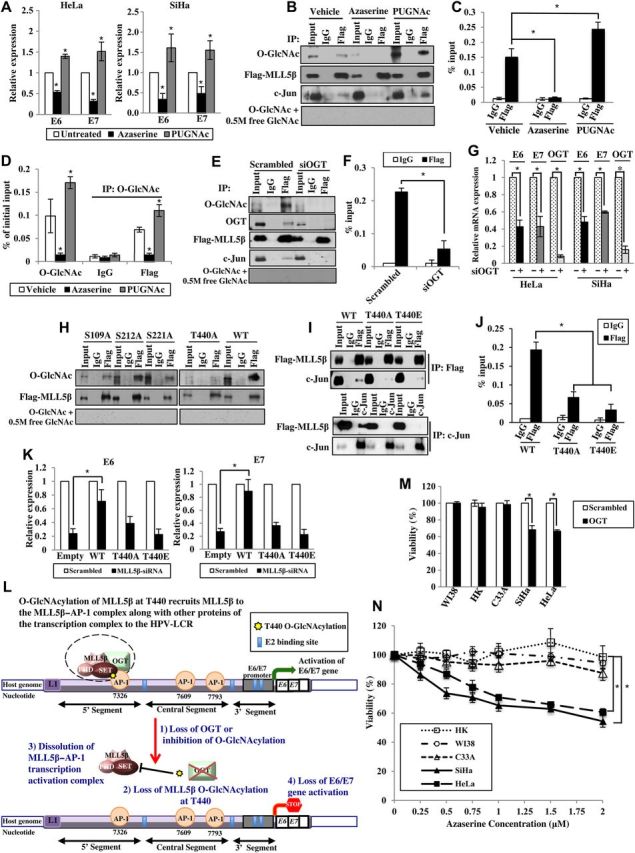
O-GlcNAcylation is critical for MLL5β–AP-1 recruitment to the HPV16/18-LCR and inhibition of O-GlcNAcylation exhibits selective cytotoxicity to HPV16/18+ cells. (A) O-GlcNAcylation inhibitor Azaserine (45 μM, 20 h) downregulated E6/E7 levels, while O-GlcNAcylation activator PUGNAc (150 μM, 20 h) upregulated E6/E7 levels in HeLa and SiHa cells. (B) Azaserine decreased MLL5β O-GlcNAcylation levels resulting in the loss of MLL5β–AP-1 interaction, while PUGNAc increased MLL5β O-GlcNAcylation and MLL5β–AP-1 interaction in co-immunoprecipitation (IP) assays. Competition blots using 0.5 M free GlcNAc were included to control for the specificity of the anti-O-GlcNAc antibody. (C) Azaserine decreased MLL5β recruitment to the LCR, while PUGNAc increased MLL5β–LCR interaction in quantitative chromatin IP (qChIP) assays. (D) Re-ChIP assay of vehicle-, Azaserine-, or PUGNAc-treated cells with O-GlcNAc IP followed by Flag-MLL5β IP. (E and F) Knockdown of OGT decreased MLL5β O-GlcNAcylation levels and inhibited MLL5β–AP-1 interaction (co-IP) and MLL5β recruitment to the LCR (qChIP). (G) Relative E6/E7 transcription levels in OGT-siRNA (siOGT)-treated HeLa and SiHa cells. (H) Site-directed mutagenesis of predicted O-GlcNAcylation sites to alanine in MLL5β followed by immunoblotting with anti-O-GlcNAc antibody identified T440 as the key O-GlcNAcylation site. (I) MLL5β-T440A and MLL5β-T440E were not able to co-IP c-Jun. (J) Inability of MLL5β-T440A and MLL5β-T440E to immunoprecipitate the HPV18-LCR as indicated by qChIP. (K) HeLa cells expressing exogenously introduced MLL5β-WT but not MLL5β-T440A or MLL5β-T440E were able to maintain E6/E7 levels in MLL5β knockdown cells. (L) A schematic model summarizing the role of O-GlcNAcylation at T440 of MLL5β in the assembly of the MLL5β–AP-1 transcription complex at the HPV16/18-LCR (upper panel) and the proposed action of O-GlcNAcylation inhibitors on complex recruitment (lower panel). (M and N) MLL5β-expressing SiHa (HPV16+) and HeLa (HPV18+) cells showed more prominent loss of cell viability, compared with MLL5β-negative C33A, primary human keratinocytes (HK), and normal diploid fibroblast WI38, at 72 h after OGT knockdown (M) and Azaserine treatment (N) as determined by MTT assays. All results are reported as mean ± SD. All qChIP data are reported as % of input chromatin. A P-value <0.05 indicates statistically significant (*P < 0.05).
Figure 1L summarizes the key finding in this study that O-GlcNAcylation at T440 of the MLL5β-SET domain is crucial for the initiation of MLL5β–AP-1 transcriptional complex assembly at the HPV16/18-LCR and subsequent activation of E6/E7 transcription (upper panel). Inhibiting this posttranslational modification (PTM) by siOGT or O-GlcNAcylation inhibitors resulted in dissolution of the MLL5β–AP-1 complex at the HPV16/18-LCR and subsequent loss of E6/E7 expression (lower panel). Given the specificity of MLL5β expression in HPV16/18+ cervical cancer, we further explored the potential of inhibiting MLL5β O-GlcNAcylation as a novel therapeutic approach for HPV16/18+ cervical cancer, by measuring cell viability upon O-GlcNAcylation inhibition in HPV16/18-positive SiHa and HeLa cells, normal diploid fibroblast WI38, primary human keratinocytes (HK), and HPV16/18-negative C33A. OGT knockdown by siOGT showed significant reduction in the viability of SiHa and HeLa cells after 72 h, compared with WI38, HK, and C33A (Figure 1M). Similarly, treatment with O-GlcNAcylation inhibitor Azaserine showed significant loss of cell viability in SiHa and HeLa (solid markers) when compared with three HPV-negative cell lines (open markers) (Figure 1N). It is worth mentioning that the doses of Azaserine have been titrated to determine the best selective cytotoxicity to HPV16/18+ cells at 72 h for clinical relevance. The enhanced susceptibility of HPV16/18+ cells to O-GlcNAcylation inhibition by both siOGT and Azaserine was correlated to the downregulation of the E6/E7 oncogene levels (Figure 1G and Supplementary Figure S4). This could be attributed to the inhibited MLL5β recruitment to the HPV16/18-LCR region. Our data, coupled with recent reports suggesting that non-transformed cells are less sensitive to O-GlcNAcylation inhibition (Lynch et al., 2012; Ma et al., 2013), strongly favor the proposed use of such inhibitors as a potential therapeutic agent for HPV16/18+ cervical cancer with higher specificity to HPV16/18+ cancer cells.
In summary, we are the first to show that O-GlcNAcylation of MLL5β at T440 residue is critical for MLL5β recruitment to the HPV16/18-LCR through its interaction with AP-1. Our data suggest that MLL5β O-GlcNAcylation at T440 is an important initiation step in a multistep process required for E6/E7 transcription activation regulated by the HPV16/18-LCR. Finally, we report the selective cytotoxicity of O-GlcNAcylation inhibition to HPV16/18+ cervical cancer cells, highlighting the potential of applying O-GlcNAcylation inhibitors in HPV16/18+ cervical cancer therapy.
[Supplementary material is available at Journal of Molecular Cell Biology online. We would like to thank Dr Michael Raghunath (Department of Biochemistry, National University of Singapore) for kindly providing the primary human keratinocytes. This work was supported by National Medical Research Council (NMRC)-A*STAR, Singapore (Grant R-183-000-293-213 to L.-W.D.) and the National Institute of Health (NIH-Grant GM101664 to T.G.K.).]
Supplementary Material
References
- Butz K., Ristriani T., Hengstermann A., et al. (2003). siRNA targeting of the viral E6 oncogene efficiently kills human papillomavirus-positive cancer cells. Oncogene 22, 5938–5945. [DOI] [PubMed] [Google Scholar]
- Deplus R., Delatte B., Schwinn M., et al. (2013). TET2 and TET3 regulate GlcNAcylation and H3K4 methylation through OGT and SET1/COMPASS. EMBO J. 32, 645–655. [DOI] [PMC free article] [PubMed] [Google Scholar]
- Liu X., Li L., Wang Y., et al. (2014). A peptide panel investigation reveals acceptor specificity of O-GlcNAc transferase. FASEB J. 28, 3362–3372. [DOI] [PubMed] [Google Scholar]
- Lynch T., Ferrer C., Jackson S., et al. (2012). Critical role of O-Linked β-N-acetylglucosamine transferase in prostate cancer invasion, angiogenesis, and metastasis. J. Biol. Chem. 287, 11070–11081. [DOI] [PMC free article] [PubMed] [Google Scholar]
- Ma Z., Vocadlo D., Vosseller K. (2013). Hyper-O-GlcNAcylation is anti-apoptotic and maintains constitutive NF-κB activity in pancreatic cancer cells. J. Biol. Chem. 288, 15121–15130. [DOI] [PMC free article] [PubMed] [Google Scholar]
- Munoz N., Bosch F.X., Castellsague X., et al. (2004). Against which human papillomavirus types shall we vaccinate and screen? The international perspective. Int. J. Cancer 111, 278–285. [DOI] [PubMed] [Google Scholar]
- Putral L.N., Bywater M.J., Gu W., et al. (2005). RNA interference against human papillomavirus oncogenes in cervical cancer cells results in increased sensitivity to cisplatin. Mol. Pharmacol. 68, 1311–1319. [DOI] [PubMed] [Google Scholar]
- Rea S., Eisenhaber F., O'Carroll D., et al. (2000). Regulation of chromatin structure by site-specific histone H3 methyltransferases. Nature 406, 593–599. [DOI] [PubMed] [Google Scholar]
- Yew C.W., Lee P., Chan W.K., et al. (2011). A novel MLL5 isoform that is essential to activate E6 and E7 transcription in HPV16/18-associated cervical cancers. Cancer Res. 71, 6696–6707. [DOI] [PubMed] [Google Scholar]
- Zhou P., Wang Z., Yuan X., et al. (2013). Mixed Lineage Leukemia 5 (MLL5) protein regulates cell cycle progression and E2F1-responsive gene expression via association with Host Cell Factor-1 (HCF-1). J. Biol. Chem. 288, 17532–17543. [DOI] [PMC free article] [PubMed] [Google Scholar]
Associated Data
This section collects any data citations, data availability statements, or supplementary materials included in this article.