



Abstract
We show that the recent experimental realization of spin-orbit coupling in ultracold atomic gases can be used to study different types of spin spiral order and resulting multiferroic effects. Spin-orbit coupling in optical lattices can give rise to the Dzyaloshinskii-Moriya (DM) spin interaction which is essential for spin spiral order. By taking into account spin-orbit coupling and an external Zeeman field, we derive an effective spin model in the Mott insulator regime at half filling and demonstrate that the DM interaction in optical lattices can be made extremely strong with realistic experimental parameters. The rich finite temperature phase diagrams of the effective spin models for fermions and bosons are obtained via classical Monte Carlo simulations.
The interplay between ferroelectric and ferromagnetic order in complex multiferroic materials presents a set of compelling fundamental condensed matter physics problems with potential multifunctional device applications1,2,3,4. Ferroelectric and ferromagnetic order compete and normally cannot exist simultaneously in conventional materials. While in some strongly correlated materials, such as the perovskite transition metal oxides5,6,7,8,9,10, these two phenomena can occur simultaneously due to strong correlation. Nowadays construction and design of high- magnetic ferroelectrics is still an open and active area of research11. These materials incorporate different types of interactions, including electron-electron interactions, electron-phonon interactions, spin-orbit (SO) couplings, lattice defects, and disorder, making the determination of multiferroic mechanisms a remarkable challenge for most materials12,13. In this context an unbiased and direct method to explore multiferroic behavior in an ideal setting is highly appealing.
On the other hand, the realization of a superfluid to Mott insulator transition of ultracold atoms in optical lattices14 opens fascinating prospects15 for the emulation of a large variety of novel magnetic states16,17,18 and other strongly correlated phases found in solids because of the high controllability and the lack of disorder in optical lattices. For instance, it has been shown16,17 that the effective Hamiltonian of spin-1/2 atoms in optical lattices is the XXZ Heisenberg model in the deep Mott insulator regime. On the experimental side, superexchange interactions between two neighboring sites have already been demonstrated19 and quantum simulation of frustrated classical magnetism in triangular optical lattices has also been realized20. These experimental achievements mark the first steps towards the quantum simulation of possible magnetic phase transitions in optical lattices.
In this paper, we show that the power of optical lattice systems to emulate magnetism can be combined with recent experimental developments21,22,23,24 realizing SO coupling to emulate multiferroic behavior. Recently, SO coupled optical lattices have been realized in experiments for both bosons25 and fermions26, where interesting phenomena such as flat band26,27,28 can be observed. The main findings of this work are the following: (I) We incorporate spin-orbit and Zeeman coupling into an effective Hamiltonian for spin-1/2 fermions and bosons in optical lattices in the large interaction limit. We show that SO coupling leads to an effective in-plane Dzyaloshinskii-Moriya (DM) term, an essential ingredient in models of spiral order and multiferroic effects in general. The DM term is of the same order as the Heisenberg coupling constant. (II) We study the finite temperature phase diagram of the effective spin model using classical Monte Carlo (MC). We find that competing types of spiral order depend strongly on both SO and effective Zeeman coupling strength. (III) We find that the critical temperature for the spiral order can be of the same order as the Heisenberg coupling constant. Thus, if magnetic quantum phase transitions can be emulated in optical lattices, then spiral order and multiferroic-based models can also be realized in the same setup with the inclusion of SO coupling.
Results
Effective Hamiltonian
We consider spin-1/2 ultracold atoms loaded into a two-dimensional (2D) square optical lattice. We restrict ourselves to the deep Mott insulator regime where the charge/mass degree of freedom is frozen while the spin degree of freedom remains active. Here the atomic hyperfine levels map onto effective spin states. The scattering length between atoms in optical lattices can be controlled by a Feshbach resonance. Certain atoms, e.g., 40K, exhibit considerable tunability29. To derive the inter-spin interaction in this regime we first consider a two-site tight-binding model,
 |
where  creates a particle (either a boson or a fermion) in a Wannier state,
  , localized at a site
  and in a spin state
  .
.  is the number operator. The tunneling and interaction matrix elements are
  and
and  , respectively, where
  is the interaction strength between species
  and
and  ,
,  is the mass of the atom, and
  is a lattice potential. Here
  denotes normal ordering. For a general theory the tunneling is assumed to be spin dependent, which is a feature unique to ultracold atom systems17,18. The second term is the Rashba SO coupling30, written in the continuum as
  . But on a lattice it can be written as
 |
where  ,
,  denotes Pauli matrices, and
  is the SO coupling strength.
  is the vector from a site at position
  to a site at
  , where
  and
and  . Eq. 2 describes the tunneling between neighboring sites paired with a spin flip. The magnitude and sign of
  can be tuned in experiments using coherent destructive tunneling methods31. The third term is the external Zeeman field
  with
with  .
.
In the deep Mott insulator regime, the degeneracy in spin configurations is lifted by second order virtual processes. The effective Hamiltonian  can be obtained using perturbation theory. We take the Mott insulator as the unperturbed state and derive the corrections of the effective Hamiltonian by the standard Schrieffer-Wolf transformation17,32. The Schrieffer-Wolf transformation applies a canonical transformation
  to obtain the second order Hamiltonian
 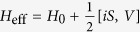 by eliminating the first order term using
  . In the spin representation we define
  , and extend the two-site model to the whole lattice, yielding
 |
The first two terms are Heisenberg exchange and Zeeman terms, respectively, while the last two terms arise from SO coupling. In solid state systems the third term is called the DM interaction33,34, which is believed to drive multiferroic behavior. The definition of the D vector and the Γ tensor will be presented below. The structure of these terms can be derived from basic symmetry analyses but the coefficients must be computed microscopically. In the following we derive the coefficients in Eq. 3 by considering the coupling between four internal degenerate ground states  through the spin independent and dependent tunnelings
  and
and  . The couplings are different for fermions and bosons, as illustrated in Fig. 1.
Figure 1. Transition processes due to different tunneling mechanisms.

Spin-conserving tunneling (solid lines,  terms) and SO coupling mediated tunneling (dashed lines,
  terms) are plotted for spin-1/2 fermions (a) and spin-1/2 bosons (b)
  is the chemical potential. The lowest 4 levels are ground states, and the higher energy levels are the excited states.
Fermionic atoms
For fermionic atoms, there are only two possible excited states  =
=  and
and  , as shown schematically in Fig. 1(a). We find
  ,
,  , and
, and  , with
  . The DM interaction coefficient is
  , and the effective Zeeman field contains
  . Note that without SO coupling the model reduces to the well-known XXZ Heisenberg model with rotational symmetry16,17. However, this symmetry is broken by the SO coupling, yielding an XYZ-type Heisenberg model. Similar results are also observed for bosons.
Bosonic atoms
For bosonic atoms, there are six excited states  =
=  ,
,  ,
,  ,
, ,
,  ,
,  , as shown in Fig. 1(b). Without SO coupling, the only allowed inter-state second-order transition is between
  and
and  , similar to the fermionic case. The presence of SO coupling permits other inter-state transitions, therefore the bosonic case is much more complex than the fermionic case. For simplicity we only show the results for
  , which yields


The last term in Eq. 3 reads as  , where
  for fermions (bosons). This term arises from the coupling between states
  and
and  ,
,  . Here the real part contributes asymmetric terms to the Heisenberg model, while the imaginary part contributes to Γij. In a square lattice with
  , this term vanishes. However, for tilted lattices, such as triangular and honeycomb, this term should be significant.
Lattice parameters
We estimate the possible parameters that can be achieved in a square optical lattice  , where
  . We define the lattice depth
  in units of he recoil energy
  , where
  is the wavevector of the laser. The SO coupling coefficient is given by
  ,
,  is the wavevector of the external Raman lasers, and
  in most cases. The Raman lasers are pure plane waves, and serve as a perturbation to the hopping between adjacent sites.
We use the Wannier functions of the lowest band without SO coupling to calculate the tight binding parameters  and
and  . In a square lattice, coordinates decouple and the Bloch functions are Mathieu functions. The Wannier functions can be obtained from the Fourier transform of the Bloch functions. Our numerical results are presented in Fig. 2(a). The large
  limit,
  , is also plotted for comparison. Note that
  is in general much larger than
  and can be controlled through a Feshbach resonance independently.
Figure 2. Tunable parameters in an optical lattice.

(a) Tunneling amplitudes as a function of lattice depth.  is the hopping due to the kinetic energy,
  is the analytic expression derived in the deep lattice regime, and
  is the SO mediated hopping strength. (b) Plot of
  as a function of
  for
for  ,
,  .
.
In Fig. 2(b) we plot  as a function of
  for
for  ,
,  .
.  reaches the maximum value of 1.0 at
  . This is in sharp contrast to models of weak multiferroic effects in solids with
  , which is generally induced by small atomic displacements35. Optical lattices, by contrast, can be tuned to exhibit either weak or strong DM terms. This enhanced tunability enables optical lattice systems to single out the effects of strong DM interactions and study the impact of the DM term.
There are notable differences between our model and corresponding models in solids ( ) In solids the SO coupling arises from intrinsic (atomic) SO coupling and
  is generally along the
  direction (out of plane). However, in our model
  is in the plane and the out of plane component is zero. (
 ) In our effective spin model,
  depends on the direction of the bond (
 ) and the SO coupling strength, while in solids
  is independent of SO coupling due to its negligible role.
Spiral order and multiferroics in 2D optical lattices
We now explore the rich phase diagrams of the effective spin Hamiltonian using classical MC simulations. Classical MC has been widely used to explore the phase diagrams of the Heisenberg model with DM interactions in the context of solids11,36,37,38 (thus weak DM interactions). This method may not be used to determine the precise boundaries between different phases but can be an efficient tool to determine different possible phases. Due to the unique features of our effective model (e.g., strong DM interactions) the phase diagrams we present here are much more rich and comprehensive than those explored in the context of solids. We focus on the regime where  ,
,  (spin independent), and
  , and define
  as the energy scale. The rescaled effective Hamiltonian becomes
 |
where  ,
,  ,
,  ,
,  , and
, and  .
.
Eq. 4 hosts a variety of magnetic and spin spiral phases, which are generally characterized by the magnetic and spiral order parameters39,40
 |
where  is the number of sites. However, these two order parameters do not fully characterize the phase diagrams because in some cases there are still local magnetic or spiral orders although both
  and
and  are vanishingly small. In these cases, we also take into account the spin structure factor:
 |
 shows peaks at different positions in momentum space for different phases. For instance, the peak of the spin structure factor is at
  for ferromagnetic phases,
  for antiferromagnetic phases, and
  (or
(or  ) for the flux spiral phase (
 but with nontrivial local spin structure). General spiral orders correspond to other
  . We obtain the phase diagrams by analyzing both the order parameters and spin structure factors. We have not checked for long range order in the spin structure factor. We expect quasi-long range order to accompany magnetized phases at low
  , e.g., a ferromagnetic phase for
  .
.
The phase diagrams of an  lattice in Fig. 3 show a rich interplay between magnetic orders and spin spiral orders. For instance, for fermions with small SO coupling (
 ), the ground states are anti-ferromagnetic states with zero (non-zero) magnetization for a Zeeman field
  (
( ). While for large SO coupling (
 ), the ground states are either nonmagnetic or magnetic flux spiral phases (similar to the flux phase with a small spiral order
  ). For
  the DM term is not important because
  , therefore the pure flux phase with zero spiral order can be observed. Similarly, the increasing SO coupling for bosonic atoms gives rise to a series of transitions from simply magnetic (ferromagnetic at small
  ) order to simply magnetic spiral order (with zero total spiral order but local spiral structure), then to magnetic spiral orders (or non-magnetic spiral orders) and finally to flux spiral orders. The emergence of the spiral order and flux order with increasing SO coupling can be clearly seen from the change of the spin structure factors in Fig. 4, which shift from
  or
or  to
to  and
and  .
.
Figure 3. Phase diagrams of 2D optical lattices.

Classical Monte Carlo simulations are performed for an  lattice with fermions (a) and bosons (b) at temperature
  . The phases diagrams are determined by the magnetization order, the spiral order, and the spin structure factor. Different regions correspond to:
  ,
,  for green,
  ,
,  for grey,
  for cyan, and
  ,
,  for red. The abbreviations are: (a) AF: antiferromagnetic phase with zero total magnetization; MAF: antiferromagnetic phase with non-zero total magnetization; NMS: zero magnetization spiral order; MS: magnetic spiral order; NMFS: nonmagnetic flux spiral phase; MFS: magnetic flux spiral phase. In (b) SM: simply magnetic order; SMS: simply magnetic spiral order: Other abbreviations are the same as in (a) The dashed lines are guides to the eye. The spin structure factors of the points marked by plus signs are shown in Fig. 4.
Figure 4. Spin structure factors for different quantum phases marked by plus signs in.

Fig. 3. The upper panels show the results for fermions at  , while the lower panels show the results for bosons at
  .
.
The spin spiral order phase transition temperature is comparable to the magnetic phase transition temperature,  . In Fig. 5(a), we plot the spin configuration of fermions at
  ,
,  and
and  (MS phase), which shows clear spiral ordering. The corresponding order parameters
  and
and  are plotted in Fig. 5(b) as a function of temperature. The inset shows the susceptibility
  . We see a phase transition at
  , which is comparable to the magnetic critical temperature17 (In 2D, the Heisenberg model has a critical temperature
  in mean-field theory). Note that spiral order can also exist in the frustrated model without SO coupling, however, the critical temperature is generally much smaller than the magnetic phase transition temperature11,41. Our results therefore show that SO coupling in the absence of frustration provides an excellent platform to search for spiral order and multiferroics-based states in optical lattices.
Figure 5. Spin configurations and phase transitions.

(a) The spin configuration of fermions in an  lattice at
  ,
,  and
and  . The corresponding magnetization and spiral order as a function of temperature is shown in (b) The inset plots
  vs. temperature, which indicates a phase transition at
  . Similar features can also been found for bosons with the same parameters.
Discussion
Finally we note that different spiral orders may be observed using optical Bragg scattering methods42, which probe different spin structure factors for different spiral orders. Similar methods have been widely used in solid state systems. Furthermore, in optical lattices, the local spin magnetization at each lattice site (thus the magnetic order  ) as well as the local spin-spin correlations (thus the spiral order
  ) can be measured directly43,44, which provides a powerful new tool for understanding the physics of spiral orders and multiferroic effects in optical lattices.
Note added
During the preparation of this manuscript (the initial version is available at arXiv:1205.6211) we became aware of work45,46,47 on similar topics.
Methods
The phase diagrams of an  lattice are computed by classical MC methods for both fermions and bosons. The results are obtained after
  thermalization steps followed by
  sampling steps in each MC run at low temperature (
 ). We have checked that for lower temperatures the phase diagrams do not change quantitatively. We also verify that similar phase diagrams can be obtained for larger system sizes, however, the spiral orders in a larger optical lattice become more complicated, and the boundary between different quantum phases is shifted.
Additional Information
How to cite this article: Gong, M. et al. Dzyaloshinskii-Moriya Interaction and Spiral Order in Spin-orbit Coupled Optical Lattices. Sci. Rep. 5, 10050; doi: 10.1038/srep10050 (2015).
Acknowledgments
M.G. thanks S. Liang for numerical assistance with classical MC simulations. This work is supported by AFOSR (FA9550-11-1-0313), ARO (W911NF-12-1-0334), DARPA-YFA (N66001-11-1-4122), and the Jeffress Memorial Trust (J-992). M.G. is also supported by Hong Kong RGC/GRF Projects (No. 401011, No. 401213 and No. 2130352), University Research Grant (No. 4053072) and The Chinese University of Hong Kong (CUHK) Focused Investments Scheme.
Footnotes
Author Contributions M.G. and C.Z. conceived the idea, M.G., Y.Q. and M.Y. performed the calculation, with input from V.W.S. and C.Z. V.W.S. and C.Z. supervised the whole research project. All authors analyzed and discussed the results and contributed in writing the manuscript. All authors have given approval to the final version of the manuscript.
References
- Fiebig M. Revival of the magnetoelectric effect. J. Phys. D: Appl. Phys. 38, R123 (2005). [Google Scholar]
- Dawber M., Rabe K. M. & Scott J. F. Physics of thin-film ferroelectric oxides. Rev. Mod. Phys. 77, 1083 (2005). [Google Scholar]
- Basov D. N. et al. Electrodynamics of correlated electron materials. Rev. Mod. Phys. 83, 471 (2011). [Google Scholar]
- Catalan G., Seidel J., Ramesh R. & Scott J. F. Domain wall nanoelectronics. Rev. Mod. Phys. 84, 119 (2012). [Google Scholar]
- Tokura Y. & Seki S. Multiferroics with spiral spin orders. Adv. Mater. 22, 1554 (2010). [DOI] [PubMed] [Google Scholar]
- Kimura T. Spiral magnets as magnetoelectrics. Annu. Rev. Mater. Res. 37, 387–413 (2007). [Google Scholar]
- Cheong S.-W. & Mostovoy M. Multiferroics: a magnetic twist for ferroelectricity. Nature Materials 6, 13 (2007). [DOI] [PubMed] [Google Scholar]
- Ramesh R. & Spaldin N. A. Multiferroics: progress and prospects in thin films. Nature Materials 6, 21 (2007). [DOI] [PubMed] [Google Scholar]
- Eerenstein W., Mathur N. D. & Scott J. F. Multiferroic and magnetoelectric materials. Nature 442, 759 (2006). [DOI] [PubMed] [Google Scholar]
- Tokura Y. Multiferroics as quantum electromagnets. Science 312, 1481 (2006). [DOI] [PubMed] [Google Scholar]
- Jin G., Cao K., Guo G.-C. & He L. Origin of ferroelectricity in high-Tc magnetic ferroelectric CuO. Phys. Rev. Lett. 108, 187205 (2012). [DOI] [PubMed] [Google Scholar]
- Sergienko I. A. & Dagotto E. Role of the Dzyaloshinskii-Moriya interaction in multiferroic perovskites. Phys. Rev. B 73, 094434 (2006). [Google Scholar]
- Katsura H., Nagoasa N. & Balatsky A. V. Phys. Rev. Lett. 95, 057205 (2005). [DOI] [PubMed] [Google Scholar]
- Greiner M., Mandel O., Esslinger T., Hänsch T. W. & Bloch I. Quantum phase transition from a superfluid to a Mott insulator in a gas of ultracold atoms. Nature 415, 39 (2002). [DOI] [PubMed] [Google Scholar]
- Bloch I., Dalibard J. & Zwerger W. Many-body physics with ultracold gases. Rev. Mod. Phys. 80, 885 (2008). [Google Scholar]
- Kuklov A. B. & Svistunov B. V. Counterflow superfluidity of two-species ultracold atoms in a commensurate optical lattice. Phys. Rev. Lett. 90, 100401 (2003). [DOI] [PubMed] [Google Scholar]
- Duan L. -M., Demler E. & Lukin M. D. Controlling spin exchange interactions of ultracold atoms in optical lattices. Phys. Rev. Lett. 91, 090402 (2003). [DOI] [PubMed] [Google Scholar]
- Altman E., Hofstetter W., Demler E. & Lukin M. D. Phase diagram of two-component bosons on an optical lattice. New Journal of Physics 5, 113, (2003). [Google Scholar]
- Trotzky S. et al. Time-resolved observation and control of superexchange interactions with ultracold atoms in optical lattices. Science 319, 295 (2008). [DOI] [PubMed] [Google Scholar]
- Struck J. et al. Quantum simulation of frustrated classical magnetism in triangular optical lattices. Science 333, 996 (2011). [DOI] [PubMed] [Google Scholar]
- Lin Y.-J., Jimenez-Garcia K. & Spielman I. B. Spinorbit-coupled BoseEinstein condensates. Nature 471, 83 (2011). [DOI] [PMC free article] [PubMed] [Google Scholar]
- Chen S. et al. Collective dipole oscillations of a spin-orbit coupled Bose-Einstein condensate. Phys. Rev. Lett. 109, 115301 (2012). [DOI] [PubMed] [Google Scholar]
- Fu Z., Wang P., Chai S., Huang L. & Zhang J. Bose-Einstein condensate in a light-induced vector gauge potential using 1064-nm optical-dipole-trap lasers. Phys. Rev. A 84, 043609 (2011). [Google Scholar]
- Wang P. et al. Spin-orbit coupled degenerate Fermi gases. Phys. Rev. Lett. 109, 095301 (2012). [DOI] [PubMed] [Google Scholar]
- Jiménez-Garca K. et al. Peierls Substitution in an Engineered Lattice Potential. Phys. Rev. Lett. 108, 225303 (2012). [DOI] [PubMed] [Google Scholar]
- Cheuk L. W. et al. Spin-Injection Spectroscopy of a Spin-Orbit Coupled Fermi Gas. Phys. Rev. Lett. 109, 095302 (2012) [DOI] [PubMed] [Google Scholar]
- Zhang Y. & Zhang C. Bose-Einstein condensates in spin-orbit-coupled optical lattices: Flat bands and superfluidity. Phys. Rev. A 87, 023611 (2013) [Google Scholar]
- Lin F., Zhang C. & Scarola V. W. Emergent Kinetics and Fractionalized Charge in 1D Spin-Orbit Coupled Flatband Optical Lattices Phys. Rev. Lett. 112, 110404 (2014). [DOI] [PubMed] [Google Scholar]
- Köhl Khl M., Moritz H., Stferle T., Günter K. & Esslinger T. Fermionic atoms in a 3D optical lattice, Phys. Rev. Lett. 94, 080403 (2005). [DOI] [PubMed] [Google Scholar]
- Zhang Y. & Zhang C. Mean-field dynamics of spin-orbit coupled Bose-Einstein condensates. Phys. Rev. Lett. 108, 035302 (2012). [DOI] [PubMed] [Google Scholar]
- Zhang Y., Chen G. & Zhang C. Tunable spin-orbit coupling and quantum phase transition in a trapped Bose-Einstein condensate. Sci. Rep. 3, 1937 (2013) [DOI] [PMC free article] [PubMed] [Google Scholar]
- Hewson A. C. The Kondo Problems to Heavy Fermions. (Cambridge University Press, Cambridge, England, 1997). [Google Scholar]
- Dzyaloshinskii I. E. Theory of helicoidal structures in antiferromagnets. I. nonmetals. Sov. Phys. JETP 19, 960 (1964). [Google Scholar]
- Moriya T. Anisotropic superexchange interaction and weak ferromagnetism. Phys. Rev. 120, 91 (1960). [Google Scholar]
- Sergienko I. A. & Dagotto E. Role of the Dzyaloshinskii-Moriya interaction in multiferroic perovskites. Phys. Rev. B 73, 094434 (2006). [Google Scholar]
- Sen C., Liang S. & Dagotto E. Complex state found in the colossal magnetoresistance regime of models for manganites. Phys. Rev. B 85, 174418 (2012). [Google Scholar]
- Liang S., Daghofer M., Dong S., Sen C. & Dagotto E. Emergent dimensional reduction of the spin sector in a model for narrow-band manganites. Phys. Rev. B 84, 024408 (2011). [Google Scholar]
- Dong S. et al. Exchange bias driven by the Dzyaloshinskii-Moriya interaction and ferroelectric polarization at G-type antiferromagnetic perovskite interfaces. Phys. Rev. Lett. 103, 127201 (2009). [DOI] [PubMed] [Google Scholar]
- Mostovoy M. Ferroelectricity in Spiral Magnets. Phys. Rev. Lett. 96, 067601 (2006). [DOI] [PubMed] [Google Scholar]
- Katsura H., Nagaosa N. & Balatsky A. Spin Current and Magnetoelectric Effect in Noncollinear Magnets. Phys. Rev. Lett. 95, 057205 (2005). [DOI] [PubMed] [Google Scholar]
- Blake G. R. et al. Spin structure and magnetic frustration in multiferroic RMn2O5(R=Tb, Ho, Dy). Phys. Rev. B 71, 214402 (2005). [Google Scholar]
- Corcovilos T. A., Baur S. K., Hitchcock J. M., Mueller E. J., & Hulet R. G. Detecting antiferromagnetism of atoms in an optical lattice via optical Bragg scattering Phys. Rev. A 81, 013415 (2010). [Google Scholar]
- Bakr W. S., Gillen J. I., Peng A., Fölling S. & Greiner M. A quantum gas microscope for detecting single atoms in a Hubbard-regime optical lattice. Nature 462, 74 (2009). [DOI] [PubMed] [Google Scholar]
- Weitenberg C. et al. Single-spin addressing in an atomic Mott insulator. Nature 471, 319 (2011). [DOI] [PubMed] [Google Scholar]
- Radic J., Di Ciolo A., Sun K. & Galitski V. Exotic quantum spin models in spin-orbit-coupled Mott insulators Phys. Rev. Lett. 109, 085303 (2012) (also available at arXiv:1205.2110). [DOI] [PubMed] [Google Scholar]
- Cole W. S., Zhang S. Z., Paramekanti A. & Trivedi N. Bose-Hubbard models with synthetic spin-orbit coupling: Mott insulators, spin textures, and superfluidity. Phys. Rev. Lett. 109, 085302 (2012) (also available at arXiv:1205.2319). [DOI] [PubMed] [Google Scholar]
- Cai Z., Zhou X., Wu C. Magnetic phases of bosons with synthetic spin-orbit coupling in optical lattices. Phys. Rev. A 85, 061605(R) (2012) (also available at arXiv:1205.3116). [Google Scholar]