



Abstract
Background: The patient-centered focus of clinical pharmacy practice which demands nuanced application of specialized knowledge and skills targeted to meeting patient-specific therapeutic needs warrant that the training strategy used for PharmD graduates must empower with the ability to use the higher level cognitive processes and critical thinking effectively in service delivery. However, the historical disposition to learning in the Middle East and among Saudi students appeared heavily focused on rote memorization and recall of memorized facts. Objectives: To assess the impact of active pedagogic strategies such as self-reflection and peer assessment on pharmacy students’ academic performance and metacognitive skills, and evaluate students’ feedback on the impact of these active pedagogic strategies on their overall learning experience. Method: An exploratory prospective cohort study was conducted among 4th year students at the College of Clinical Pharmacy, King Faisal University, Saudi Arabia to assess the impact of self-reflection and peer-assessment in a semester-wide assessment tasks in two compulsory first semester 4th year courses (Therapeutics-3 and Pharmacoeconomics). An end-of-course evaluation survey with a pre-tested 5-item open-ended questionnaire was also conducted to evaluate students’ feedback on the impact of active pedagogic strategies on their overall learning experience. Result: Male students (study group) constituted 40.7% of the cohort while 59.3% were females (control group) with mean ± SD age of 23.2 ± 5.6 and 22.1 ± 4.9 years respectively. The mean ± SD scores for quizzes, mid-term and final exams, and the overall percentage pass were significantly higher in the study group for both courses (P < 0.001). The majority of the students in the study group opined that the exposure to active pedagogic strategies enabled them to improve their use of critical thinking, facilitated deeper engagement with their learning and improved their clinical decision-making and discussion skills. Conclusion: The use of active pedagogic strategies such as self-reflection and peer-assessment appeared to significantly improve examination performance, facilitate deep and constructive engagement with learning and fostered students’ confidence in the use of critical thinking and clinical decision-making.
Keywords: Self-reflection, Peer-assessment, Metacognition, Active pedagogic strategies, Saudi Arabia
1. Introduction
The momentous shift of the practice paradigm from a product-oriented to patient-centered focus that emphasizes pharmacists’ direct involvement in the provision, monitoring and assessment of outcomes of pharmacotherapy in a multidisciplinary setting was a critical factor in the adoption of the doctor of pharmacy (PharmD) curricular for the training of clinical pharmacists (Blouin et al., 2009). Graduates of PharmD program are expected to be highly skilled at the provision of effective and efficient direct patient care services in collaboration with other healthcare professionals (CAPE, 2013). The American College of Clinical Pharmacists affirmed that direct patient care provision by pharmacists include direct observation of patients and active participation in the selection, modification and monitoring of patient-specific drug therapy (Murphy et al., 2006). The patient-centered focus of PharmD training requires nuanced application of varieties of specialized knowledge and skills targeted to identifying and meeting patient-specific therapeutic needs. This warrant that the training strategy used for PharmD students must empower with the ability to use in an effective manner the higher level cognitive processes and critical thinking in service delivery (Jungnickel et al., 2009; Stewart et al., 2011). Critical thinking harnesses the in-built brain power to have a deep understanding of a concept, identify and analyze the relationship between the various components or units within a concept, apply the concept and assess the impact of the application in the real world of practice (CAPE, 2013; Peeters, 2011; Oderda et al., 2010). Furthermore, critical thinking also enables pharmacists to contribute to knowledge through the process of linking theory with practice within a reflexive framework. It is therefore clear that for students to develop critical thinking skills, the learning process must move from the surface, reproductive and regurgitative realm to a deep, constructive and transformative level (Linnenbrink and Pintrich, 2004; Prince, 2004; Gleason et al., 2011). This will enable PharmD graduates to adopt an intellectually rigorous paradigm as practice template for direct patient care services such as pharmaceutical care, clinical pharmacokinetic service, medication management, evidence-based pharmacotherapy services and patient counseling/drug information services at the individual and societal levels.
The routine or regular use of the higher level cognitive processes is strongly associated with a strong metacognitive skill (Taylor, 1991). Metacognition is rooted in rigorous self-analysis of the learning process (by students) with a view to ensuring that learning is deep, constructive and outcomes-focused (Gourgey, 1997). Hence, there is a constant on-going reflexive process of self-reflection on the progress made with learning, self-identification of probable gaps impeding the achievement of the defined learning outcomes and self-driven effort to fill the identified gaps with appropriate intervention to ensure achievement of the learning outcomes. The metacognitive process thus broadly consists of self-reflection, self-regulation and subsequent achievement of self-efficacy by learners (Taylor, 1991). The development of metacognitive skills by learners can be facilitated through varieties of classroom-based student-centered strategies such as self-reflective session and peer assessment. Self-reflective sessions especially among peers in a classroom setting provides learners opportunities to develop the soft skills of self-identification of gaps which must be filled to make progress in the zone of proximal development (ZPD). The ZPD is an individual clear path in the learning zone which provides an audit trail of learner’s progress toward the goal of learning (Vigotsky, 1978). Hence, learners become cognizant of the gaps they must close between where they are (current situation) and where they want to get to (learning outcomes) in their learning journey. The use of peer assessment and self-reflection sessions is a good combination of learning strategies that quicken the process of development of metacognitive skills among learners (Oderda et al., 2010; Kasiar and Lanfear, 2003). This is because peer assessment often leverage on social pressure associated with learners not wanting to lose face in front of their peers. Learners are thus motivated to focus on the process of self-reflection and self-regulation to avoid the embarrassment of having their colleagues openly identify the probable gaps in their learning among their peers. Hence, ab initio the combination of self-reflection and peer assessment of the students’ self-reflections may goad learners to continuously engage with their learning with a view to avoid losing face among their peers (Weimer, 2003).
The disposition to learning in the Middle East and especially among Saudi students appeared heavily influenced by historical and cultural attitude that is rooted in rote memorization and recall or regurgitation of memorized facts (Rugh, 2002; Cassidy, 2003). Hence, attitude to learning is generally superficial and reproductive. This historical attitude to learning appeared to have contributed to the inadequate skills at self-monitoring and management of learning and lack of commitment to life-long self-directed reflective practices (Allison, 2006). In addition, this may also be underlining the perceived inadequate study habits, complacency with doing the minimum just to get by, and a general lassie faire attitude to deep and constructive learning among Saudi students (Cassidy, 2003; Yousif et al., 2014). Furthermore, the increasing affluence among Saudis appears to generally affect student commitment and drive to learn in a constructive manner (Al-Wazaify et al., 2006). However, we opine that this attitude to learning can be changed with the use of teaching and assessment strategies that is focused on deep and constructive learning and, facilitate the culture of self-reflection, self-regulation and subsequent self-efficacy among learners. This is particularly warranted because of the adoption of the PharmD curriculum as the model for the training of pharmacists in Saudi Arabia (Asiri, 2011). The use of a transformative teaching strategy is more likely to help students acquire the relevant competencies and skills needed to function optimally as clinical pharmacists in Saudi Arabia.
The positive impact of the use of teaching strategies that foster deep and constructive learning and improve exam performance and overall learning experience among pharmacy students are well documented in developed setting (Stewart et al., 2011; Gleason et al., 2011). However, there is paucity of published data about this pedagogic phenomenon in developing settings including the Middle East. This is despite the increase in the number of developing countries shifting from the product-oriented BPharm curriculum to patient-centered and direct care-focused PharmD curriculum for the training of pharmacists. This curricular shift ab initio demands that pedagogic strategies used in pharmacy schools must be active, constructive and sharpen Saudi pharmacy students’ skills at using the self-directed higher-order thinking and problem solving processes. This is likely to contribute to a more positive and productive learning experience, facilitate meaning-making and prepare pharmacists for a fulfilling career in the real world of practice. Hence, perspectives from a developing setting such Saudi Arabia is warranted and may also provide a useful insight and significant addition to global knowledge in the study area. The objectives of the study were to (1) assess the impact of the use of self-reflection (rapporteuring) and peer-assessment on pharmacy students’ performance at examinations; (2) assess students’ feedback on the impact of these active teaching strategies on their overall learning experience.
2. Methods
2.1. Study setting
The College of Clinical Pharmacy (COCP) at King Faisal University, established on the 10th of June, 2002 is the first college which offers a six year PharmD programme in the Kingdom of Saudi Arabia. The vision of COCP is to produce clinical pharmacists that are nationally and internationally acknowledged as role models in pharmacy practice, education/training, research and community engagement. This vision is the driving force behind the mission of achieving excellence in pharmacy education/training, practice, research through effective community engagement. The vision was also fundamentally the main driver of the COCP’s international certification by the Accreditation Council for Pharmacy Education (ACPE) of the United States, and the international accreditation by the Canadian Council for Accreditation of Pharmacy Programmes (CCAPP) in the 2013/2014 academic session. The six-year PharmD program comprises of 5 years of didactic courses in the Department of Pharmaceutical Sciences, Biomedical Sciences and Pharmacy Practice. Furthermore, students are exposed to compulsory summer experiential training in the community and institutional setting in the second and third professional years (3rd and 6th semesters respectively). The fifth and last professional year (9th and 10th semesters) mainly consist of Advance Pharmacy Practice Experience (APPE) involving intensive and structured clinical training at selected APPE sites (Table 1).
Table 1.
The five-year PharmD programme at the College of Clinical Pharmacy, King Faisal University.
| Course no. | Course title | Lectures | Practical | Credit hours | Contact hours | Prerequisite |
|---|---|---|---|---|---|---|
| First semester | ||||||
| 2030111 | Pharmacy Orientation | 2 | 0 | 2 | 2 | – |
| 2010111 | Fundamentals of Pharmaceutics | 2 | 1 | 3 | 5 | – |
| 2010112 | Pharm Organic Chemistry-1 | 3 | 1 | 4 | 6 | – |
| 2020111 | Physiology-1 | 2 | 1 | 3 | 5 | – |
| 2020112 | Anatomy & Histology-1 | 1 | 1 | 2 | 4 | – |
| 2020113 | Biochemistry-1 | 2 | 0 | 2 | 2 | – |
| 7401101 | Islamic Faith | 2 | 0 | 2 | 2 | – |
| Second semester | ||||||
| 2010121 | Physical Pharmacy | 2 | 1 | 3 | 5 | 2010111 |
| 2010122 | Pharmaceutical Analytical Chemistry | 2 | 1 | 3 | 5 | 2010112 |
| 2010123 | Pharm Organic Chemistry-2 | 3 | 0 | 3 | 3 | 2010112 |
| 2020121 | Physiology-2 | 2 | 0 | 2 | 2 | 2020111 |
| 2020122 | Anatomy & Histology-2 | 1 | 1 | 2 | 4 | 2020112 |
| 2020123 | Biochemistry-2 | 2 | 1 | 3 | 5 | 2020113 |
| 2010124 | Pharmacology-1 | 2 | 0 | 2 | 2 | 2020111 |
| Third semester | ||||||
| 2010211 | Pharmacology-2 | 2 | 1 | 3 | 5 | 2010124 |
| 2010212 | Medicinal Chemistry-1 | 3 | 0 | 3 | 3 | 2010123 |
| 2020211 | Pathophysiology-1 | 2 | 0 | 2 | 2 | 2020111 |
| 2010213 | Pharmacognosy | 2 | 1 | 3 | 5 | – |
| 2020212 | Clinical Biochemistry & Nutrition | 2 | 1 | 3 | 5 | 2020123 |
| 2020213 | Molecular Biology | 2 | 0 | 2 | 2 | – |
| 740130 | Contemporary Cultural issues | 2 | 0 | 2 | 2 | – |
| Fourth semester | ||||||
| 2010221 | Pharmacology-3 | 3 | 0 | 3 | 3 | 2020121 |
| 2010222 | Medicinal Chemistry-2 | 3 | 0 | 3 | 3 | 2010212 |
| 2010223 | Pharmaceutical Dosage Forms | 2 | 1 | 3 | 5 | 2010111 |
| 2020221 | Pathophysiology-2 | 2 | 0 | 2 | 2 | 2020121 |
| 2020222 | Immunology | 2 | 0 | 2 | 2 | 2020121 |
| 2020223 | Microbiology | 3 | 1 | 4 | 6 | 2020211 |
| 2030221 | Pharmaceutical Care-1 | 0 | 1 | 1 | 3 | – |
| IPPE-1 summer training | ||||||
| 2030231 | Introductory Pharmacy Practice Experience in Community Pharmacy (4 weeks, 160 h) | 0 | 2 | 2 | 6 | – |
| Fifth semester | ||||||
| 2010311 | Pharmacology-4 | 3 | 0 | 3 | 3 | 2020121 |
| 2010312 | Pharmaceutical Delivery System | 2 | 0 | 2 | 2 | 2010223 |
| 2010313 | Medicinal Chemistry-3 | 2 | 0 | 2 | 2 | 2010222 |
| 2010314 | Bio-pharmaceutics | 2 | 1 | 3 | 5 | – |
| 2030311 | Therapeutics-1 | 4 | 1 | 5 | 7 | 2010211 |
| 2030312 | Pharmaceutical Care-2 | 2 | 1 | 3 | 5 | 2030221 |
| Sixth semester | ||||||
| 2030321 | Therapeutics-2 | 4 | 1 | 5 | 7 | 2010221 |
| 2030322 | Pharmaceutical Care-3 | 2 | 0 | 2 | 2 | 2030312 |
| 2030323 | Institutional Pharmacy Practice | 1 | 0 | 1 | 1 | – |
| 2030324 | First Aid and Emergency Medicine | 0 | 1 | 1 | 3 | 2020121 |
| 2010325 | Research Methodology & Biostatistics | 2 | 1 | 3 | 5 | 2020213 |
| 2010321 | Natural Products & Herbal Medicine | 2 | 0 | 2 | 2 | 2010213 |
| 2010322/2010323 | Industrial Pharmacy or Principles of Drug Design (Electives) | 2 | 0 | 2 | 2 | 2010223/2010313 |
| IPPE-2 summer training | ||||||
| 2030331 | Introductory Pharmacy Practice Experience in Community Pharmacy (4 weeks, 160 h) | 0 | 2 | 2 | 6 | – |
| Seventh semester | ||||||
| 2030411 | Law & Ethics in Pharmacy Practice | 1 | 0 | 1 | 1 | 2030111 |
| 2030412 | Therapeutics-3 | 4 | 1 | 5 | 7 | 2010221 |
| 2030413 | Drug Information Services | 2 | 1 | 3 | 5 | 2030311 |
| 2030414 | Clinical Pharmacokinetics | 2 | 1 | 3 | 5 | 2010314 |
| 2030415 | Parenteral Nutrition | 1 | 0 | 1 | 1 | 2020212 |
| 2030416 | Pharmacoeconomics | 1 | 0 | 1 | 1 | – |
| Elective Islamic Course | 2 | 0 | 2 | 2 | – | |
| Eighth semester | ||||||
| 2010421 | Clinical Toxicology | 2 | 0 | 2 | 2 | 2010124 |
| 2030421 | Therapeutics-4 | 4 | 1 | 5 | 7 | 2010311 |
| 2030422 | Pharmacy management | 2 | 0 | 2 | 2 | 2030323 |
| 2030423 | Pharm. D. Seminar | 0 | 1 | 1 | 3 | 2030325 |
| 2030424 | Self-care & Nonprescription Drugs | 2 | 0 | 2 | 2 | 2010312 |
| 2030425 | Pharmacoepidemiology | 1 | 0 | 0 | 1 | 2030414 |
| 2020421/2030426 | Pharmaceutical Biotechnology/Pharmacogenomics: Elective | 2 | 0 | 2 | 2 | 2020213/2020213 |
| APPE-1 summer training | ||||||
| 2030431 | Advanced Pharmacy Practice Experience-1 | 0 | 5 | 5 | 40 | – |
| Ninth semester | ||||||
| 2030511 | Advanced Pharmacy Practice Experience-2 | 0 | 15 | 15 | 120 | – |
| Tenth semester | ||||||
| 2030521 | Advanced Pharmacy Practice Experience-3 | 0 | 15 | 15 | 120 | – |
2.2. Study design
An exploratory prospective cohort study of the fifty-five 4th year students (study: 22, control: 33) at the COCP in King Faisal University was conducted between 31st August 3013 and 15th January 2014 to assess the impact of the use of active teaching strategies such as self-reflection by students (rapporteuring) and peer assessment (of reflective sessions) on academic performance in a semester-wide assessment tasks including 2 quizzes, mid-term and final exams in two compulsory first semester 4th year courses (Therapeutics-3 and Pharmacoeconomics). The study was conceived as a pilot to assess if Saudi students who are perceived as superficial and reproductive in their attitude learning can be made to actively and deeply engage with their learning through the use of active pedagogic strategies that can facilitate constructive engagement. Therapeutics-3 is a compulsory 5 credit unit course (4 + 1) (4 h of lectures + 3 h of practical per week) offered in the first semester (15 weeks) at the 4th year level. The total contact hours for both male and female students were 165 h (lectures and practical). The course objectives for Therapeutics-3 include:
-
A.
Describe and correlate the pathophysiology with the clinical presentations and pharmacotherapy of specific diseases consistent with the course curriculum (endocrine, metabolic, neurological disorders, contraception, psychiatry).
-
B.
Constitute appropriate therapeutic objectives and identify appropriate treatment plan for specific diseases based on appropriate clinical and laboratory data.
-
C.
Write and present given clinical cases using the SOAP documentation format.
The course objectives for Pharmacoeconomics, a compulsory 1 credit unit course, include:
-
A.
Describe the basic principles, concepts and methods of pharmacoeconomics and its applications in pharmacy practice.
-
B.
Explain the relationship between the concepts and methods of pharmacoeconomics, and its application in decision-making at the individual, institutional and societal levels.
The semester-wide engagements by the course facilitator (KBY) with the study (males) and control (females) groups for Therapeutics-3 and Pharmacoeconomics were separate as this is an important component of the organizational culture in King Faisal University. Male students are separated from females and teaching, learning and assessment activities are conducted separately. Furthermore, classrooms for lectures/discussion sessions for female students are designed to ensure that male academic staff teaching female students are separated by a translucent glass barrier which disallows male academic staff from seeing the female students. However, the teacher can clearly hear female students during class discussions and/or questions and answers sessions. The female students are able to see through the glass barrier from their section of the classroom and clearly hear and see the academic staff and, the white board mounted at the teacher’s section of the class during class discussions. The peculiar culture of separating male and female students necessitated the selection of male students, where no separating barrier exists, as the study group while the female students were designated as the control group. All the teaching and assessment strategies, apart from students’ self-reflection and peer assessment, were applied in equal measure by the academic staff (KBY) that facilitated both Therapeutics-3 and Pharmacoeconomics for both the study (males) and control (females) groups. The course plan for both courses detailing the course objectives, course outline, intended learning outcomes, and teaching and assessment strategies was shared with all students and copies of the document provided at the beginning of the courses.
2.3. Data collection and analysis
The 22 male students in the study group were randomly divided into two groups: rapporteurs (self-reflection sessions) and peer assessors at the beginning of the semester. The students who were initially assigned into the group for rapporteurs were switched over into the peer assessor’s group at the end of their self-reflection sessions. Hence, all the 22 students participated as either rapporteurs or peer assessors at some point before the end of the semester. The three key indicators used by peer assessors to assess the students’ self-reflection session were discussed and agreed with all the 22 students. These indicators include: Completeness of content of self-reflection (3 marks), Correctness of the content of self-reflection (3 marks) and Response to questions on the content of self-reflection from peers (4 marks). Each student’s self-reflection session was assessed by two peer-assessors while the course facilitator (KBY) served as the third assessor for all the self-reflection sessions for Therapeutics-3 and Pharmacoeconomics. Each self-reflection and peer-assessment session lasted for 25 min and was conducted during the scheduled period for the class discussions for both courses on the College’s official time-table. The 2 rapporteurs were questioned initially by the scheduled peer-assessors and subsequently by other members of the class. The marks assigned for each rapporteur by peer-assessors is added to the assessment of the course facilitator and an average is calculated for each rapporteur. The maximum mark obtainable for each rapporteur was 10 and this constituted 10% of the final grade for each of the two courses.
A 5-item open-ended questionnaire was used to obtain written feedback from the students in the study and control group separately at the end of the semester. The process of questionnaire development consisted of initial construction of 8 questions after a thorough review of the literature on students’ end-of-course feedback on learning experience. The final 5 questionnaire items were selected based on face and content validity, and relevance to the study objective. Face and content validity of the questionnaire were assessed through in-depth discussion with two experienced academic colleagues who are members of the Quality Management Unit at COCP. In addition, the final draft of the questionnaire was pre-tested on a sample of five 3rd year students at COCP to assure completeness of data capture and reduce ambiguity. This resulted in minor modification of the final instrument. Data collected during pre-testing were not included in the final results. The main objective of obtaining the feedback was to identify and compare perception of the learning experience of students in the study and control groups for both Therapeutics-3 and Pharmacoeconomics. This was with a view to assess the probable impact of the self-reflection and peer-assessment semester-wide sessions on the learning experience of students in the study group. The questionnaire was structured as follows:
-
1.
Describe your overall experience with the course.
-
2.
In what ways has this course influence your thinking and learning experience.
-
3.
What do you like most about how the course was conducted this semester.
-
4.
What would you like to change about how the course was conducted this semester.
-
5.
What do you consider the major strengths of this course.
Data analysis was conducted with the Statistical Package for Social Science (SPSS) version 16 for Windows (SPSS Inc, Chicago, IL). Descriptive statistics such as mean ± SD, frequencies, percentages and histograms were used to make comparisons between students in the study and control groups. Student t-test was used to compare means while Chi-square statistics was use proportions. An a priori level of statistical significance of P < 0.05 was used for all comparisons. Students’ written response to the 5-item questionnaire was grouped manually and thematic analysis was used to assess the feedbacks students in the study and control groups on their specific learning experience with Therapeutic-3 and Pharmacoeconomics courses. The assessment of students’ end-of-course feedback was exempted from Institutional Board review as the Quality Management Unit within the College Clinical Pharmacy consider this as an important component of the process of continuous reflection on teaching and assessment practice for all academic staff.
3. Results
Male students (study group) constituted 40.7% (22) of the cohort while 59.3% were females (control group) with mean ± SD age of 23.2 ± 5.6 and 22.1 ± 4.9 years respectively. The mean ± SD scores for quizzes, mid-term and final exams for Therapeutic-3 and Pharmacoeconomics for the study (males) and control (female) groups are as shown in Table 2. The means scores for all the examinations were significantly higher among the students in the study group (P < 0.05). In addition, the percentage pass (100%) was significantly higher in the study group for both courses (P < 0.001) (Table 2). A comparison of the various grades obtained by students in the study and control groups for the two courses is as shown in Table 2. Notwithstanding that the highest grade of A was obtained by one and two students in the control group for Pharmacoeconomics and Therapeutics-3 respectively, the total percentage of students who obtained the highest grades (A and B) was significantly higher in the study group for Pharmacoeconomics and Therapeutics-3 (36.4% and 31.8% respectively) (P < 0.001) (Table 2). A comparison of the histograms and grade distribution curve for both the study and control groups for Therapeutics-3 and Pharmacoeconomics is as shown in Fig. 1. The histograms and grade distribution curve were skewed to the left (higher grade range) for the study group, while they were skewed to the right (lower grade range) for both courses for the students in the control group. Grouping and thematic analysis of the written feedbacks for Therapeutics-3 and Pharmacoeconomics from students in the study and control groups are as shown in Tables 3 and 4.
Table 2.
Academic achievements among students in the study and control groups.
| Therapeutics-3 |
P-values | ||
|---|---|---|---|
| Items | Study group (n = 22) | Control group (n = 31) | |
| Quizzes (mean ± SD) | 8.2 ± 2.1 | 7.6 ± 1.8 | 0.03a |
| Mid-term exam (mean ± SD) | 18.5 ± 3.7 | 16.9 ± 3.1 | 0.01a |
| Final exam (mean ± SD) | 29.5 2.6 | 27.5 1.9 | 0.01a |
| Total for all assessment tasks | 73.5 ± 3.1 | 69.7 ± 2.8 | 0.01a |
| Percentage pass | 100% | 87.1% | 0.001b |
| Grades obtained (n (%)) | |||
| A | 0 (0) | 2 (6.5) | 0.001b |
| B | 7 (31.8) | 3 (9.6) | |
| C | 9 (40.9) | 16 (51.6) | |
| D | 6 (27.2) | 6 (19.4) | |
| F | 0 (0) | 4 (12.9) | |
| Pharmacoeconomics | P-values | ||
| Study group (n = 22) | Control group (n = 32) | ||
| Quizzes (mean ± SD) | 7.2 ± 1.3 | 6.3 ± 2.9 | 0.02a |
| Mid-term exam (mean ± SD) | 31.2 ± 2.4 | 29.3 ± 3.1 | 0.01a |
| Final exam (mean ± SD) | 35.7 ± 3.8 | 32.6 ± 4.2 | 0.01a |
| Total for all assessment tasks | 74.3 ± 4.3 | 68.5 ± 3.6 | 0.001a |
| Percentage pass | 100% | 84.4% | 0.001b |
| Grades obtained (n (%)) | |||
| A | 0 (0) | 1 (3.1) | 0.001b |
| B | 8 (36.4) | 4 (12.5) | |
| C | 10 (45.5) | 10 (31.3) | |
| D | 4 (18.2) | 12 (37.5) | |
| F | 0 (0) | 5 (15.6) | |
P ⩽ 0.05 = significant difference.
Grade descriptors: A: 90–100, B: 80–89, C: 70–79, D: 60–69, F: <60.
Independent t-test.
Chi-square test.
Figure 1.
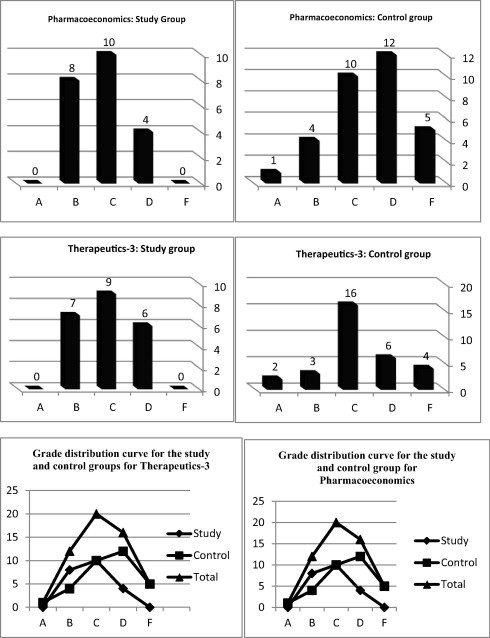
Histograms and grade distribution curve for students in the study and control groups for Pharmacoeconomics and Therapeutics-3. Grade descriptors: A: 90–100, B: 80–89, C: 70–79, D: 60–69, F: <60.
Table 3.
End-of-course written feedbacks from students for Therapeutics-3 in the study and control groups.
| Items | n (%) |
|---|---|
| Study group (n = 41) | |
| Developed skills at clinical decision-making and therapeutic planning | 16 (39) |
| Improved critical thinking, greater engagement with the course materials and communication skills | 12 (29.3) |
| Improved knowledge of therapeutics and application of pharmacology in patient management | 11 (26.8) |
| Great but heavy and stressful which sometimes negatively affect social life | 2 (4.9) |
| Control group (n = 42) | |
| Good knowledge of pathophysiology, clinical features and improved ability to recommend appropriate treatments | 13 (31) |
| Improved ability to link pathophysiology with clinical features | 9 (21.4) |
| Best learning experience thus far with therapeutics | 9 (21.4) |
| Better focus on understanding rather focus only on memorizing | 6 (14.3) |
| Stressful experience due to heavy content | 4 (9.5) |
| Cleared previous misunderstanding of therapeutics as a course | 1 (2.3) |
Table 4.
End-of-course written feedbacks from students for Pharmacoeconomics in the study and control groups.
| Items | n (%) |
|---|---|
| Study group (n = 59) | |
| Improved confidence in making drug therapy decisions based on costs and outcomes analysis | 21 (35.6) |
| Developed ability to think in a step-wise manner and make correct decisions | 10 (16.9) |
| Improved communication skills during self-reflections among colleagues | 10 (16.9) |
| Developed my ability to assess other students | 9 (15.3) |
| Good understanding rather than memorizing only | 7 (11.9) |
| Preference for increasing the credit hours for the course to 2 | 2 (3.4) |
| Control group (n = 64) | |
| Good knowledge of pharmacoeconomic methods and costs assessment | 20 (31.3) |
| Improved discussion skills with participation in the analysis of pharmacoeconomic studies | 12 (18.8) |
| Improved awareness of the hidden costs of diseases and treatment options | 11 (17.2) |
| More emphasis on the analysis of pharmacoeconomic studies | 9 (14.1) |
| Interesting, practical and easy to follow | 7 (10.9) |
| Enabled linkage of theory with practice | 3 (4.7) |
| Course content should be increased and want to learn more | 2 (3) |
4. Discussion
Our findings generally suggest that active rather than passive learners-centered teaching and assessment strategies that gently goad students to actively engage with learning materials, construct their own learning and create a positive self-image during self-reflection sessions; and leverages on social pressure associated with peer-assessment may have significantly contributed to the relatively better academic performance observed among the students in the study group. In addition, the learning opportunities provided by the semester-wide self-reflection sessions appeared to also have contributed appreciably. The seemingly positive impact of the use of active and learner-centered pedagogic strategies on students’ academic performance is consistent with reports from previous studies especially in relatively more developed settings (Gleason et al., 2011). Ernst and Colthorpe (2008) reported that the use of active learning pedagogic strategies enhanced the examination scores in students exposed to these strategies relative to historical control. Earl investigated the impact of cooperative learning- an active learning strategy- on students’ engagement with the analysis of tertiary drug information sources in a literature evaluation course and concluded that students’ grades in the assignment and final assessment tasks improved after the implementation of the pedagogic intervention. Furthermore, Darbishire et al. (2009) assessed the impact of the use of active learning pedagogy to teach diabetic care to pharmacy students and reported that students’ knowledge of and confidence in the area assessed improved significantly. The authors concluded that active learning strategies proved useful in engaging students deeply with their learning and improved their critical and higher order thinking skills. Reddy (2000) reported that the use of an active learning strategy in a pharmaceutic course was associated with a significantly higher score in the midterm and final examinations for students exposed to this intervention relative to students who were not. The author also concluded that exposure to active learning tasks was helpful to students in developing critical thinking and problem-solving abilities. However, it is noteworthy that published reports of the positive impact of active learning pedagogic interventions on students’ academic performance in particular and learning experience in general are few and far between in developing setting including Saudi Arabia. This is important especially in Saudi Arabia because of the perception that Saudi students may be incapable of actively engaging in a deep and constructive manner with their learning due to the pervasive culture of rote memorization and regurgitative learning which are strong features of the Saudi educational system. The findings of our study appear to suggest that irrespective of students’ location and despite previous attitude to learning and assessment practices, students can be gently goaded through the use of appropriate mix of teaching and assessment strategies to actively engage with their learning in a deep and constructive manner. This is more likely to enable students to achieve stronger academic performance and acquire relevant knowledge and skills that will be critical to a rewarding and fulfilling career experience in the real world of practice (Kuh et al., 2008; Gleason et al., 2011).
The relatively better academic performance in the study group appeared to also confirm the established fact that teaching and assessment practices are indeed the most significant tool for changing students’ attitude to their learning. The generous and continuous use of such strategies becomes the main driver of the desired positive change in students’ learning (Gibbs, 1991). Pedagogic strategies thus essentially become a tool that students embrace and use to improve their learning rather than dread and perceived as only a diagnostic tool used to distinguish one student from another (Kember and Gow, 1994). Hence, continuous use of active and constructive pedagogic strategies may encourage learners to see assessment tasks as tools for learning rather that of learning (Berry et al., 2004). The better academic grades obtained by the majority of students in the study group may also improve their self-confidence, self-efficacy and academic/learning experience. This is subsequently likely to contribute to self-assuredness, sure-footedness and an overall positive mental outlook among students. These are qualities that will become extremely critical and useful for students as they start their APPE clinical rotations and subsequent career as clinical pharmacists within a multi-disciplinary team of healthcare professionals.
A comparison of the thematic analysis of the end-of-course feedback from both the study and control groups suggest that students appeared to generally have a favorable and positive view of their learning experience with the two courses used for this initial exploratory study. However, a fundamental difference appeared to exist between the feedbacks in the study group relative to the control group. For instance, it is noteworthy that majority of the students from the study group opined that their learning engagements enabled them to improve their use of critical thinking, greater engagement with the course materials and improve their discussion skills. The learning opportunities provided by the semester-wide self-reflection and peer assessment sessions may have significantly contributed to this positive feedback, and it is unsurprising that none of the students in the control group provided any such written feedback. Furthermore, a sizeable proportion of the students in the study group opined that their learning engagements afforded them the opportunity to develop their skills at clinical decision-making. While this positive feedback may not be wholly attributable to the pedagogic intervention in the study group, it certainly appeared to have contributed to helping students cultivate self-confidence, self-efficacy and positive self-image that may contribute to a stronger academic performance and favorable learning experience (Peeters, 2011).
The result of this study is limited by the fact that study participants were sampled at a College of Clinical Pharmacy in Saudi Arabia. However, the choice of COCP at KFU was because it is a major site established purposely for the training of PharmD graduates in Saudi Arabia. In addition, it is currently internationally accredited by the Canadian Council for the Accreditation of Pharmacy Programmes and also granted international certification by the Accreditation Council for Pharmacy Programmes in the United States. Hence, its major role in advancing the training of PharmD graduates in Saudi Arabia was strongly considered. Furthermore, the relatively better performance at the examinations for Therapeutis-3 and Pharmacoeconomics by students in the study group may or may not have been confounded by other factors which were probably not adjusted for especially due to peculiar local factors. Notwithstanding, this study provides probably the first initial good insight into the educational impact and benefits of the use a student-centered active pedagogic strategies that may facilitate constructive and deep learning among Saudi students who were hitherto regarded as complacent with the use of a regurgitative learning based on rote memorization.
5. Conclusion
The use of an active and learner-centered teaching and assessment strategies such as students’ self-reflection and peer-assessment of the self-reflection sessions appeared to significantly improve academic achievement, facilitate deep and constructive engagement with learning and fostered students’ confidence in the use of critical thinking and clinical decision-making.
Acknowledgment
We acknowledge the guidance and support of Professor Fola Tayo (Retired Professor of Clinical Pharmacy), Health Systems Management Consultants Limited, No. 1, Jubilee road, Magodo G.R.A. Phase II, Lagos, Nigeria.
Footnotes
Peer review under responsibility of King Saud University.
References
- Allison A. Preparing our graduates for a lifetime of learning. Am. J. Pharm. Educ. 2006;70(1) doi: 10.5688/aj700115. Article 15. [DOI] [PMC free article] [PubMed] [Google Scholar]
- Al-Wazaify M., Matowe L., Albsoul-Younes A., Al-Omran O.A. Pharmacy education in Jordan, Saudi Arabia and Kuwait. Am. J. Pharm. Educ. 2006;70(1) doi: 10.5688/aj700118. Article 18. [DOI] [PMC free article] [PubMed] [Google Scholar]
- Asiri Y.A. Emerging frontiers of pharmacy education in Saudi Arabia: the metamorphosis in the last fifty years. Saudi Pharm. J. 2011;19:1–8. doi: 10.1016/j.jsps.2010.10.006. [DOI] [PMC free article] [PubMed] [Google Scholar]
- Berry T.M., Gleason B.L., Butler A.D. Utilizing self-assessment to foster self-learning and improve performance-do students perceive any value? Am. J. Pharm. Educ. 2004;68(2) Article 54. [Google Scholar]
- Blouin R.A., Riffee W.H., Robinson E.T., Beck D.E., Green C., Joyner P.U., Persky A.M., Pollack G.M. AACP curricular change summit supplement: roles of innovation in education delivery. Am. J. Pharm. Educ. 2009;73(8) doi: 10.5688/aj7308154. Article 154. [DOI] [PMC free article] [PubMed] [Google Scholar]
- Cassidy, T.J., 2003. Education in the Arab states: preparing to compete in the global economy. In: Schwab, Klaus, Cornelius, Peter (Eds.), The Arab World Competitiveness Report, World Economic Forum, Geneva, pp. 218–234
- Darbishire P.L., Plake K.S., Nash C.L., Shepler B.M. Active-learning laboratory session to teach the four M’s of diabetes care. Am. J. Pharm. Educ. 2009;73(2) doi: 10.5688/aj730222. Article 22. [DOI] [PMC free article] [PubMed] [Google Scholar]
- Educational Outcomes, 2013, American Association of Colleges of Pharmacy, Centre for the Advancement of Pharmacy Education <http://www.accp.org/documents/CAPEoutcomes071213.pdf> (accessed 13.09.14)
- Ernst H., Colthorpe K. Expanding voluntary active-learning opportunities. Am. J. Pharm. Educ. 2008;72(2) doi: 10.5688/aj720228. Article 28. [DOI] [PMC free article] [PubMed] [Google Scholar]
- Gibbs, G., 1991. Using assessment strategically to change the way students learn. In: Brown, S., Glasner, A. (Eds.), Assessment matters in Higher Education, SRHE and Open Univ. Press, Bukingham
- Gleason B.L., Peeters M.J., Resman-Targoff B.H., Karr S., McBane S., Kelley K., Thomas T., Denetclaw T.H. An active-learning strategies primer for achieving ability-based educational outcomes. Am. J. Pharm. Educ. 2011;75(9) doi: 10.5688/ajpe759186. Article 186. [DOI] [PMC free article] [PubMed] [Google Scholar]
- Gourgey A.F. Getting students to think about their own thinking in an integrated verbal- mathematics course. Res. Teach. Dev. Educ. 1997;14:49–56. [Google Scholar]
- Jungnickel P., Kelley K., Hammer D., Haines S., Marlowe K. Addressing competencies for the future in the professional classroom. Am. J. Pharm. Educ. 2009;73(8) doi: 10.5688/aj7308156. Article 156. [DOI] [PMC free article] [PubMed] [Google Scholar]
- Kasiar J.B., Lanfear S.L. Using peer assessment to develop ability outcomes. Am. J. Pharm. Educ. 2003;67(3):27S. [Google Scholar]
- Kember D., Gow L. Orientations to teaching and their effect on the quality of student learning. J. Higher Educ. 1994;65(1):58–74. [Google Scholar]
- Kuh G.D., Cruce T.M., Shoup R., Kinze J., Gonyea R.M. Unmasking the effects of student engagement on first-year college grades and persistence. J. Higher Educ. 2008;79(5):540–563. [Google Scholar]
- Linnenbrink E.A., Pintrich P.R. Role of affect in cognitive processing in academic contexts. In: Dai D.Y., Sternburg R.J., editors. Motivation, Emotion, and Cognition. Lawrence Erlbaum Associates; Mahwah, NJ: 2004. pp. 57–87. [Google Scholar]
- Murphy J.E., Nappi J.M., Bosso J.A., Saseen J.J., Hemstreet B.A., Halloran M.A., Spinler S.A., Welty T.E., Dobesh P.P., Chan L.N., Garvin C.G., Grunwald P.E., Kamper C.A., Sanoski C.A., Witkowski P.L. American college of clinical pharmacy’s vision of the future: postgraduate pharmacy residency training as a prerequisite for direct patient care practice. Pharmacotherapy. 2006;26(5):722–733. doi: 10.1592/phco.26.5.722. [DOI] [PubMed] [Google Scholar]
- Oderda G.M., Zavod R.M., Carter J.T., Early J.L., Joyner P.U., Kirschenbaum H., Mack E.J., Traynor A.P., Plaza C.M. An environmental scan on the status of critical thinking and problem-solving skills in colleges/schools of pharmacy: report of the 2009–2010 Academic Affairs Standing Committee. Am. J. Pharm. Educ. 2010;74(10) doi: 10.5688/aj7410s6. Article S6. [DOI] [PMC free article] [PubMed] [Google Scholar]
- Peeters M.J. Cognitive development of learners in pharmacy. Curr. Pharm. Teach. Learn. 2011;3(3):224–229. [Google Scholar]
- Prince M. Does active learning work? A review of the research. J. Eng. Educ. 2004;93(3):223–231. [Google Scholar]
- Reddy I.K. Implementation of pharmaceutics course in a large class through active learning using quick-thinks and case-based learning. Am. J. Pharm. Educ. 2000;64(4):348–354. [Google Scholar]
- Rugh W.A. Arab education: tradition, growth, and reform. Middle East J. 2002;56(3):396–414. [Google Scholar]
- Stewart D.W., Brown S.D., Clavier C.W., Wyatt J. Active-learning processes used in US pharmacy education. Am. J. Pharm. Educ. 2011;75(4) doi: 10.5688/ajpe75468. Article 68. [DOI] [PMC free article] [PubMed] [Google Scholar]
- Taylor S. Better learning through better thinking: developing students’ metacognitive abilities. J. Coll. Read. Learn. 1991;30(1):34ff. [Google Scholar]
- Vigotsky L.S. Harvard University Press; Cambridge, Mass: 1978. Mind in Society: The Development of Higher Psychological Processes. [Google Scholar]
- Weimer M. Focus on learning transforms teaching. Change. 2003;35(5):49–54. [Google Scholar]
- Yousif M.A., Eldalo A.S., Abd Allah MA1, Al-Sawat M.A., Al-Wahaibi H.M., Al-Osaimi A.A., Al-Gethami S.H. Pharmacy education instruction: preference and practices, Saudi students’ perception. Saudi Pharm. J. 2014;22(4):309–314. doi: 10.1016/j.jsps.2013.06.005. [DOI] [PMC free article] [PubMed] [Google Scholar]