



Abstract
Loxosceles rufescens, commonly known as the Mediterranean Recluse or Mediterranean Fiddle-Back Spider is recorded from Iran for the first time. The genus Loxosceles contains 103 accepted species, two of them (including L. rufescens) are cosmopolitan. All Loxosceles species tested so far possess necrotic venoms, which is a unique characteristic among the Order Araneae. Considering this characteristic, it is of medical importance to determine a specific geographical distribution of these spiders. Collecting methods include visual inspection and direct hand collecting. All of the specimens were collected in Tehran.
Six specimens of both sexes were collected from parks, houses and apartments. The characteristics of the genus, which are the unique arrangement of six eyes in three diads, the violin shaped mark on the cephalothorax, and the short tibia of adult male palpi with narrow base and it’s embolus which is about as long as the width of the globular bulb were observed and recorded. Having the cytotoxicity of the venom and its urban distribution in mind, L. rufescens is probably among the more important spider species of Iran. Since there are no reports of loxoscelism from Iran, we assume that the bites are either infrequent or misdiagnosed. Therefore further studies are needed to clarify the medical importance degree of this species.
Keywords: cytotoxicity, arachnidism, loxoscelism, distribution, faunistics
Introduction
Among all animal Orders, with more than 40,000 described species, Araneae (Spiders) ranks seventh in the global diversity (Mirshamsi Kakhki 2005). With more than 244 recorded species (Ghavami 2006), Iran's araneofauna is very poorly known. In the latest published checklist of spiders of Iran (Ghavami 2006), it is declared that an unidentified Loxosceles species was reported from Tehran by Goodarzi (1994). The genus Loxosceles consists of 103 species, several of which have been the subject of medical and biological research due to their necrotic venom, which may produce a set of symptoms known as loxoscelism (Appel et al. 2005). Loxoscelism is the only proven cause of arachnogenic necrosis in humans (Swanson and Vetter 2006). Once these spiders were placed in their own family, Loxoscelidae (Gertsch 1949, Gertsch and Ennik 1983) and in Scytodidae (Gertsch 1967), but now, along with Sicarius spiders, they are placed in the family Sicariidae (Simon 1893).
Out of 103 described species of Loxosceles spiders, two are reported to have been transported to numerous parts of the world (Harvey 1996). One of them is the Chilean Recluse Spider L. laeta (Nicolet, 1849), which is originally from South America, but studies have shown their presence in California and Finland as well (Gertsch and Ennik 1983), and the other one, is the more widely distributed L. rufescens (Dufour, 1820). The latter originated from Mediterranean countries, but now can be found in regions including USA, East Asia, Australia and many others (Bonnet 1957, Gertsch and Ennik 1983, Platnick 1989, Platnick 1993) and it is now considered as a cosmopolitan species (Platnick 2012). The aim of this study was to declare the presence of L. rufescens in Iran for the first time.
Materials and Methods
Study area
This study was based on the specimens that were collected from different parts of Tehran province, the capital of Iran. Tehran is geographically located at 35.7117°N 51.4070°E in the northern parts of the central plateau of Iran, below the southern slopes of Alborz Mountains.
Spiders
Since these spiders are ground dwelling and usually live inside apartments, under rocks and fallen tree logs, discovery of all L. rufescens specimens was a result of visual inspections and direct hand collecting between years 2010–2013. Indoor specimens were found on the walls or were captured while they were foraging on the ground. Outdoor specimens were found under large rocks and in the leaf litter. Six specimens were collected (first one: 35°45′N, 51°24′E second one: 35°43′N, 51°25′E third one: 35°43′N, 51°25′E fourth one: 35°21′N, 51°22′E fifth one: 35°34′N, 51°02′E and sixth one: 35°46′N, 51°20′E) (Fig. 1), preserved in 75 % ethanol and deposited in senior author’s personal collection. Half of the specimens were found in apartments/ houses and the rest of them were found in parks. Various stereo-microscopic photos of specimens and their structures were captured using a light stereo-microscope, plus a Sony DSC-TX10 camera. Publication of Gertsch and Ennik (1983) was used as an identification key.
Fig. 1.

Tehran, Iran. The collecting site for L. rufescens
Results
Laboratory examinations clarified that two adult males and four subadult females were collected.
Description
Medium-sized, haplogyne, six-eyed spiders. Males have simple palpal organs, females without sclerotized epigyne. Total body length 7–7.5 mm in both sexes (Fig. 2, 3).
Fig. 2.
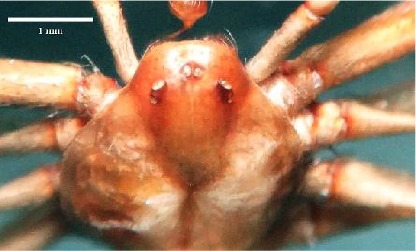
Male's cephalothorax, dorsal view. The characteristics of the genus, arrangement of six eyes in three pairs and also the violin shaped mark on the cephalothorax are visible
Fig. 3.

Female's cephalothorax, dorsal view. The characteristics of the genus, arrangement of six eyes in three pairs and also the violin shaped mark on the cephalothorax are visible
As in most spiders, the most definite key for identifying to the species level is the form of the adult male palpi and female genitalia (Gertsch and Ennik 1983). In L. rufescens, the tibia of male’s palpus is short, thick, and its base is narrow and not very prolonged. The embolus is about as long as the width of the globular bulb (Greene et al. 2009) (Fig. 4).
Fig. 4.

Right male palpus, lateral view. Note that the tibia is short, thick, and its base is narrow and the embolus is about as long as the width of the globular bulb
In female L. rufescens, the spermathecae is white and dimpled, and its parts are near each other at the midline and are identified by a single, large rounded lobe (Greene et al. 2009).
Discussion
Loxosceles spiders are infamous for their ability to cause severe skin necrosis, and in some cases, highly damaging systematic effects (Greene et al. 2009). There are several reports of loxoscelism caused by L. rufescens in numerous parts of the world; such as in western Asia, it was blamed for an outbreak of skin lesions in orchard workers (Borkan et al. 1995), in Turkey, a case of loxoscelism which after 20 days caused severe necrosis has been reported (Yigit et al. 2008) and other reports from Greece (Stefanidou et al. 2006), Jordan (Amr 1988) and Palestine (Wong et al. 1987). Considering several other medically important spiders of Iran which all possess neurotoxic venoms (including Latrodectus tredecimguttatus (Rossi, 1790), L. dahli Levi, 1959, L. hasseltii Thorell, 1870 and etc.), having the cytotoxicity of the venom and its urban distribution in mind, L. rufescens is probably among the more important species of Iran and should be added to the list of Iranian spiders of medical importance. Since there are no confirmed reports of loxoscelism from Iran, we assume that the bites are either infrequent or misdiagnosed, which probably the latter would be the case. Therefore further studies are needed to clarify the medical importance degree of this species.
Acknowledgements
Many thanks to Dr Rick Vetter and Biology Scientific Board members of University of Tehran for their assistance and reviewing the article, Mr Barbod Safaei Mahroo and Mr Parham Beyhaghi for their help in photographing and Mrs Zohre Mirzaee, Mrs Zahra Taghavi and Mrs Afsaneh Ghaffari for their collecting aids. The authors declare that there is no conflict of interest.
References
- 1. Amr ZS. ( 1988) Arthropods of medical importance in Jordan. Jordan Med J. 22 ( 2): 125– 137. [Google Scholar]
- 2. Appel MH, Bertoni da Silveira R, Gremksi W, Veiga SS. ( 2005) Insights into brown spider and loxoscelism. Invertebrate Surviv J. 2( 2): 152– 158. [Google Scholar]
- 3. Bonnet P. ( 1957) Bibliographia Araneorum. Vol. 2( 3). Les Frères Douladoure, Toulouse. [Google Scholar]
- 4. Borkan J, Gross E, Lubin Y, Oryan I. ( 1995) An outbreak of venomous spider bites in a citrus grove. Am J Trop Med Hyg. 52: 228– 230. [DOI] [PubMed] [Google Scholar]
- 5. Gertsch WJ. ( 1949) American Spiders. D Van Nostrand, New York. [Google Scholar]
- 6. Gertsch WJ. ( 1967) The spider genus Loxosceles in South America (Araneae, Scytodidae). Bull Am Mus Nat Hist. 175: 264– 360. [Google Scholar]
- 7. Gertsch WJ, Ennik F. ( 1983) The spider genus Loxosceles in North America, Central America and the West Indies (Araneae, Loxoscelidae). Bull Am Mus Nat Hist. 175: 264– 360. [Google Scholar]
- 8. Ghavami S. ( 2006) Renew checklist of spiders (Aranei) of Iran. Pak J Biol Sci. 9( 10): 1839– 1851. [Google Scholar]
- 9. Goodarzi HR. ( 1994) An introduction to the identification and classification of Iranian spiders. [MSc Thesis]. Plant Pest and Disease Research Institute, Tehran, Iran. [Google Scholar]
- 10. Greene A, Breisch NL, Boardman T, Pegac Jr BB, Kunickis E, Howes RK, Brown PV. ( 2009) The Mediterranean Recluse Spider, Loxosceles rufescens (Dufour), an abundant but cryptic inhabitant of deep infrastructure in the Washington, DC area (Arachnida: Araneae: Sicariidae). Am Entomol. 55( 3): 158– 169. [Google Scholar]
- 11. Harvey M. ( 1996) The first record of the Fiddle-Back Spider Loxosceles rufescens (Araneae: Sicariidae) from Western Australia. Rec Aus Mus. 18: 223– 224. [Google Scholar]
- 12. Mirshamsi Kakhki O. ( 2005) Faunistic study of spiders in Khorasan Province, Iran (Arachnida: Araneae). IJAB. 1( 1): 55– 66. [Google Scholar]
- 13. Platnick NI. ( 1989) Advances in spider taxonomy 1981–1987. Manchester University Press, Manchester. [Google Scholar]
- 14. Platnick NI. ( 1993) Advances in spider taxonomy 1999–1991 with synonymies and transfers 1940–1980. New York Entomological Society, New York. [Google Scholar]
- 15. Platnick NI. ( 2012) The world spider catalog, version 13. American Museum of Natural History, New York, USA: Available at: http://research.amnh.org/iz/spiders/catalog. [Google Scholar]
- 16. Simon E. ( 1983) Histoire Naturelles des Araignees. Vol. 2( 1). Libraire Encyclopedique de Roret, Paris. [Google Scholar]
- 17. Stefanidou MP, Chatzaki M, Lasitihiotakis KG, Ioannidou DJ, Tosca AD. ( 2006) Necrotic arachnidism from Loxosceles rufescens harbored in Crete, Greece. J Eur Acad Dermatol. 20( 4): 486– 487. [DOI] [PubMed] [Google Scholar]
- 18. Swanson DL, Vetter RS. ( 2006) Loxoscelism. Clin Dermatol. 24( 3): 213– 221. [DOI] [PubMed] [Google Scholar]
- 19. Wong RC, Hughes SE, Voorhees JJ. ( 1987) Spider bites. Arch Dermatol. 123( 1): 98– 110. [PubMed] [Google Scholar]
- 20. Yigit N, Bayram A, Ulasoglu D, Danisman T, Corakocal L, Sancak Z. ( 2008) Loxosceles spider bite in Turkey ( Loxosceles rufescens, Sicariidae, Araneae). J Venom Anim Toxins. 14( 1): 178– 187. [Google Scholar]