



In the Journal of Arrhythmia, we previously reported the case of a 55-year-old woman with variant angina who was implanted with a pacemaker to treat cardiopulmonary arrest due to complete atrioventricular block and pulseless electrical activity [1]. In this report, we follow the clinical outcome of the pacemaker implantation in this patient. Upon implantation, we simulated the proper and effective response of the pacemaker to prepare for the possibility that the patient might encounter coronary ischemia-induced bradycardia. A high output setting was selected in order to prevent pacing failure and a rate drop response (RDR) setting was selected both to ensure efficient pacing in the case of an angina attack and to conserve battery power during periods when there was no angina.
Three years have passed since the pacemaker was implanted. During this time, the patient appears to have been in remission of vasospastic activity and the patient is doing well without symptomatic angina. We also evaluated the pacemaker data and found that an episode of paroxysmal atrioventricular block occurred asymptomatically and that the RDR response was functioning appropriately (Fig. 1). Finally, the ventricular pacing rate was 0.4% and the average battery longevity was 11.5 years (range, 9.5–13 years), which was longer than that of the ordinary setting.
Fig. 1.
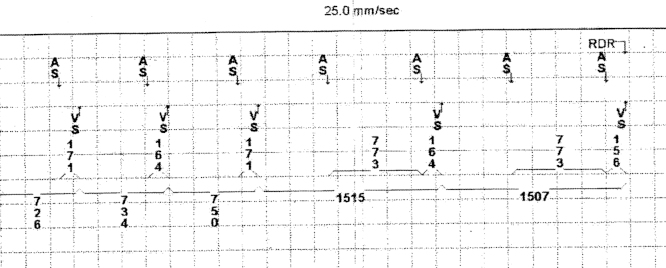
The pacemaker electrocardiogram; a rate drop response (RDR) was activated after an episode of paroxysmal atrioventricular block.
Conflict of interest
Authors have no conflict of interest to declare.
Reference
- 1.Kamishima K., Yamada Y., Kawarai H. A case of variant angina treated with a pacemaker for cardiopulmonary arrest due to complete atrioventricular block and pulseless electrical activity. J Arrhythm. 2013;29:275–280. doi: 10.1016/j.joa.2014.06.003. [DOI] [PMC free article] [PubMed] [Google Scholar]