


Abstract
The functional results after a Girdlestone's excision arthroplasty of the hip are unpredictable with high patient dissatisfaction and complication rates. We report such a case of symptomatic patient, which was managed successfully with a megaprosthesis of the hip with constrained acetabular liner. The use of megaprosthesis for a failed and symptomatic Girdlestone's excision arthroplasty of the hip has not been reported before.
Keywords: Excision arthroplasty, Instability, Hip, Total hip replacement (THR), Revision
1. Background
Girdlestone's excision arthroplasty was first described by Girdlestone1 as a salvage procedure for tuberculosis of the hip. The resection arthroplasty usually results in significant alteration of the hip function alone with shortening and instability2 which is usually very disabling to the patient. This had lead to its decreased popularity amongst the patients and orthopaedic surgeons until advent of total hip replacement (THR), which again lead to the resurgence of Girdlestone's resection arthroplasty for the salvage of infected THRs. Chronic infection in the hip after THR is a devastating complication and is conventionally managed in staged manner, firstly eradicating the infection by excision arthroplasty, followed by re-implantation of THR. Conversion of Girdlestone arthroplasty to a revision THR is fraught with possibility of complications, including re-infection and dislocation etc.3,4 Revision THR poses a significant challenge in these patients, as many a times the bone stock and soft tissues are deficient, hence conventional THR may not be possible, in all cases. Since, the prevention of infection is of major concern to the surgeon in revision surgery, the functional outcome and parameters influencing function after conversion have been more or less neglected.4 We describe a successful salvage procedure using a megaprosthesis with a constrained acetabular liner, in such a patient along with a satisfactory post-operative functional score.
2. Case presentation
A 73 years old frail lady, who was a known case of Ankylosing Spondylitis (AS) for 33 years presented with a painful and unstable left hip for the last 1 year. This was associated with difficulty in walking, as the left hip became unstable and would rotate outwards and she had to drag her foot to walk. There was a history of left total hip replacement (THR) 14 years ago, which failed due to late onset of infection and she then underwent Girdlestone's excision arthroplasty of the hip, 3 years later. Physical examination revealed pallor, fixed flexed posture of the neck and lower back (Fig. 1). Left lower limb was short by 3 inches and there was telescopy present in the left hip. The left lower limb had a tendency to roll and deform into internal rotation (Fig. 2). Chest expansion was significantly reduced. Investigations revealed anemia (Hb: 8 gm%), and vitamin D deficiency (S. Vit D, 25-Hydroxy: <25 nmol/L). Pelvis X ray (Fig. 3) and CT scan (Fig. 4) confirmed the absence of left femoral head, neck and trochanter with proximal migration of the femur and irregularly deficient acetabulum. There was associated severe osteoporosis of the femur and pelvic bones.
Fig. 1.

Typical kyphotic deformity of ankylosing spondylitis of the spine.
Fig. 2.
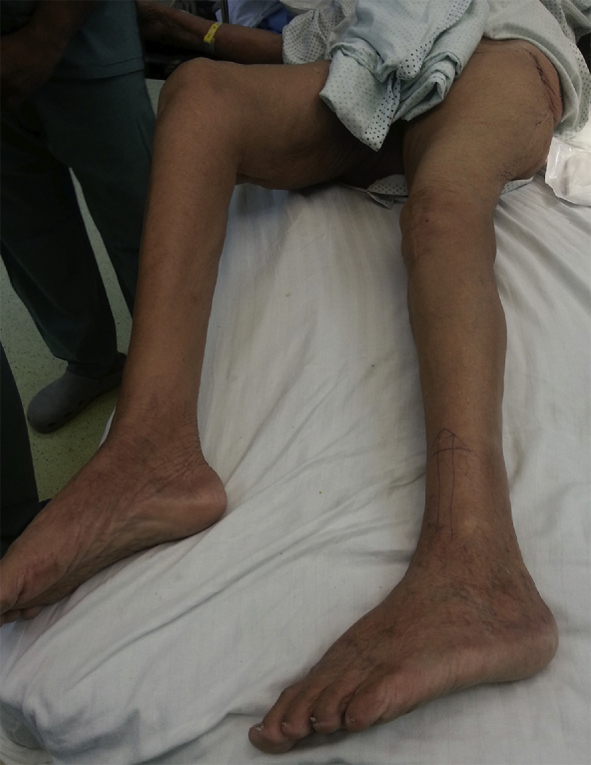
Internal rotation deformity on left lower limb with failed Girdlestone's excision arthroplasty of the hip.
Fig. 3.

AP radiograph of the pelvis, showing typical changes of ankylosing spondylitis with excision arthroplasty of the left hip.
Fig. 4.

3-D CT reconstruction image of the pelvis showing excision arthroplasty of the left hip with gross deficiency in the acetabulum and proximal femur.
3. Treatment
The patient underwent left THR (Fig. 5), using cemented megaprosthesis (XLO, India). Intra-operatively, we encountered significant scarring of the soft tissues, very soft (osteoporotic) bones and grossly distorted anatomy of the acetabulum and proximal femur, with absent abductor muscles. An appropriate resection of the proximal femur was done to accommodate the megaprosthetic femoral component (80 mm long resection hip spacer with 12 mm stem), which was cemented in the femoral canal. 32 mm statinless steel femoral head (size 0) was used. The acetabulum was found deficient centrally and was reinforced with a stainless steel medial wall mesh (large) and then a 56 mm cemented constrained acetabular cup (Stryker) was used. The anemia and vitamin D deficiency were corrected by 5 units of blood transfusion and oral supplementation of vitamin D granules (60,000 I.U./week) respectively.
Fig. 5.

Post op radiograph of the left hip showing megaprosthetic replacement.
4. Outcome & follow up
At 12 months follow up, the patient had a painless, stable hip and could walk with a walking frame, without any problems and perform her activities of daily living adequately. The limb length discrepancy was also almost fully corrected after the surgery. At 1 year follow up, the Harris's hip score5 was 77.6 (compared to pre op score of 22.6 only).
5. Discussion
Excision arthroplasty of the hip is a well known surgical procedure for the treatment of chronic infections of the hip joint. It was first described by an English surgeon, Girdlestone and hence traditionally known as Girdlestone's procedure.1 Here, an excision of the femoral head and neck is performed resulting in a pseudoarthrosis of the hip joint. Although it is considered to be an effective means of eradicating infection and alleviating pain, still the patient satisfaction and complications related to this surgery are not well highlighted.6,7 The main problems related to this procedure include walking difficulties, residual shortening and instability etc.8 The walking after excision arthroplasty is not only difficult but ungainly too. Waters et al.9 analyzed the walking patterns and energy expenditure in patients after excision arthroplasty of the hip and found that majority of patients not only required bilateral crutches or a walking frame, but their walking was also slow and associated with shorter stride length and increased energy expenditure. Residual shortening after excision arthroplasty of the hip is inevitable and can sometimes be significant. This also contributes to walking difficulties and is cosmetically not acceptable to many patients.
Hence, conversion to a THR is appealing to address these problems, as it offers a functional arthroplasty. Since the number of THR is increasing worldwide, the incidence of prosthesis related infections are likely to rise, requiring resection arthroplasty and subsequent re-implantation of THR.3,10 However, complications associated with revision of THR after resection arthroplasty for the treatment of an infected hip are not reported well, in the literature. Charlton et al.3 reported 11.4% dislocation rate and 39% persistent limp. Since the anatomy of bones and soft tissues of the hip is grossly distorted and damaged by infection and also by the resection of proximal femur in Girdlestone's procedure, THR is not only challenging to perform but has higher incidence of complication rates. Kessler2 had reported of a successful conversion surgery using subtrochanteric shortening osteotomy. When the proximal femur is grossly deficient, and the abductor muscles are missing (like in our case), conventional THR is not possible to perform. In such cases, we believe that a megaprosthesis (similarly used after tumor excision) can be a suitable answer to this challenging problem. On the search of literature, we have not come across with its use for this indication before. However, the use of megaprosthesis for the knee has been reported for non tumorous conditions. We have also published a series of its use in resistant non union of the distal femur with secondary osteoarthosis in elderly patients.11 The functional outcome of revision THR following excision arthroplasty is often difficult to predict.4 The most noted complications could be related to recurrence of infection, difficulty in restoring the hip function and recurrent dislocation of the implanted hip. To minimize the problem of dislocation of the prosthesis, we recommend the use of constrained acetabular liners which can limit the freedom of the femoral head and thus prevent instability of the hip.
Conflicts of interest
All authors have none to declare.
References
- 1.Horan F.T. Robert Jones, Gathorne Girdlestone and excision arthroplasty of the hip. J Bone Jt Surg Br. 2005;87-B:104–106. [PubMed] [Google Scholar]
- 2.Kessler S. Extensive subtrochanteric shortening osteotomy enables the conversion of a long lasting resection arthroplasty to a total hip replacement. Acta chirurgie orthopaedicae et traumatologiae Cechoslavaca. 2008;75:306–307. [PubMed] [Google Scholar]
- 3.Charlton W.P., Hozack W.J., Teloken M.A. Complications associated with reimplantation after girdlestone arthroplasty. Clin Orthop Relat Res. 2003 Feb;407:119–126. doi: 10.1097/00003086-200302000-00019. [DOI] [PubMed] [Google Scholar]
- 4.Rittmeister M.E., Manthei L., Hailer N.P. Prosthetic replacement in secondary Girdlestone arthroplasty has an unpredictable outcome. Int Orthop (SICOT) 2005;29:145–148. doi: 10.1007/s00264-005-0635-9. [DOI] [PMC free article] [PubMed] [Google Scholar]
- 5.Harris W.H. Traumatic arthritis of the hip after dislocation and acetabular fractures: treatment by mold arthroplasty. An end-result study using a new method of result evaluation. J Bone Jt Surg Am. 1969;51:737–755. [PubMed] [Google Scholar]
- 6.Bittar E.S., Petty W. Girdlestone arthroplasty for infected total hip arthroplasty. Clin Orthop Relat Res. 1982 Oct;170:83–87. [PubMed] [Google Scholar]
- 7.Stoklas J., Rozkydal Z. Resection of head and neck of the femoral bone according to Girdlestone. Acta Chir Orthop Traumatol Cech. 2004;71:147–151. [Article in Czech] [PubMed] [Google Scholar]
- 8.Hudec T., Jahoda D., Sosna A. Resection hip arthroplasty–mid- and long-term results. Acta Chir Orthop Traumatol Cech. 2005;72:287–292. [PubMed] [Google Scholar]
- 9.Waters R.L., Perry J., Conaty P., Lusford B., O'Meara P. The energy cost of walking with arthritis of the hip and knee. Clin Orthop. 1987;214:278–284. [PubMed] [Google Scholar]
- 10.Molfetta L., Bassetti M., Benvenuti M. Analysis of clinical data in patients with Girdlestone arthroplasty: a new score. Hip Int. 2007;17:170–175. doi: 10.1177/112070000701700309. [DOI] [PubMed] [Google Scholar]
- 11.Vaishya R., Singh A.P., Hasija R. Treatment of resistant nonunion of supracondylar fractures femur by megaprosthesis. Knee Surg Sports Traumatol Arthrosc. 2011;19:1137–1140. doi: 10.1007/s00167-011-1416-1. [DOI] [PubMed] [Google Scholar]