



Abstract
The verification of topological superconductivity has become a major experimental challenge. Apart from the very few spin-triplet superconductors with p-wave pairing symmetry, another candidate system is a conventional, two-dimensional (2D) s-wave superconductor in a magnetic field with a sufficiently strong Rashba spin-orbit coupling. Typically, the required magnetic field to convert the superconductor into a topologically non-trivial state is however by far larger than the upper critical field Hc2, which excludes its realization. In this article, we argue that this problem can be overcome by rotating the magnetic field into the superconducting plane. We explore the character of the superconducting state upon changing the strength and the orientation of the magnetic field and show that a topological state, established for a sufficiently strong out-of-plane magnetic field, indeed extends to an in-plane field orientation. We present a three-band model applicable to the superconducting interface between LaAlO3 and SrTiO3, which should fulfil the necessary conditions to realize a topological superconductor.
While topologically non-trivial superconducting (SC) states have been established theoretically in numerous systems1,2,3,4,5,6, an experimental verification of such a state is still awaited. This is largely a consequence of the required conditions, which tend to counteract superconductivity itself. A topologically non-trivial state is generally described by a non-zero momentum space Berry phase γ = 2πC with an integer C whenever there is an energy gap separating occupied from unoccupied states1. The superconducting state can acquire a finite Berry phase through a chiral order parameter, and also via gapping a chiral normal-metal state upon entering a conventional SC state. Examples of the former case are selected spin-triplet states, e.g., the A-phase of superfluid 3He 1 and most likely the superconducting phase of Sr2RuO47,8. Very recently, a similar topological character was also proposed for the superconducting state in strongly underdoped cuprates9 in which a gap exists even along the nodal direction of a d-wave order parameter10. These proposals are built on states of matter, where the topological nature is an intrinsic property. The chiral order parameter however requires a very special pairing interaction; the p-wave states are rare in nature and pose considerable experimental challenges.
On the other hand, if the material provides a chiral band structure by itself, a conventional BCS superconductor with an s-wave order parameter can be topologically non-trivial as well. Most often discussed is an s-wave superconductor with a Rashba type spin-orbit coupling (SOC) in two dimensions5. On the two Fermi surface sheets generated by Rashba SOC the electron spins wind around in opposite directions (see Fig. 1 or e.g. ref. 11). Therefore, in order to reach a state with a finite overall Berry phase, an additional Zeeman field is needed which is strong enough to depopulate one of the SOC split bands. The topological character of the resulting SC state is equivalent to the quantum-Hall state. Such states are classified by a topological invariant, the so-called TKNN integer C (after Thouless, Kohmoto, Nightingale, and Nijs)12. If the magnetic field is perpendicular to the plane of the 2D superconductor, the minimal Zeeman splitting required to reach the topological phase is 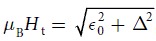 , where
  measures the distance of the band energy at k = 0 to the Fermi energy, and Δ is the SC energy gap5. The obstacle for realizing this topological state experimentally is to find a system which remains superconducting in the required high magnetic fields. Suggested model systems are, e.g., neutral ultra-cold atoms in an optical trap5, or heterostructures where Cooper pairs are induced through the proximity effect2,13,14,15,16.
Figure 1. Energy bands  (pink) and
  (blue) and Fermi surfaces with α > 0 and magnetic filed |H| < Ht.
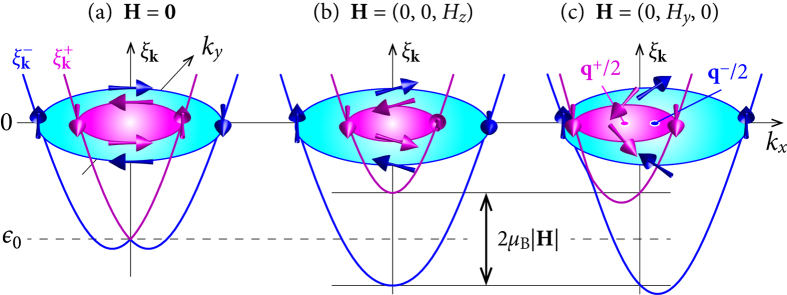
(a) For H = 0, the two bands touch at k = 0. (b,c) For |H| > 0, the band splitting at k = 0 is equal to the Zeeman splitting 2μB|H|. The centers of the shifted Fermi surfaces in (c) are at the momenta momenta q+/2 = (q+/2, 0) and q−/2 = (q−/2, 0), respectively. Although q+ ≈ −q−, their absolute values are in general different. In (c), the spins on the kx-axis orient according to the magnetic field rather than according to the SOC, if Hy > α|sin kF|. Note that the Fermi energy is somewhat larger than |ε0| because of the SOC induced band splitting.
The problem of realizing the topological s-wave state has two distinct aspects: (i) μBHt must be larger than Δ. While the presence of the Rashba SOC allows in principle s-wave superconductivity in a Zeeman field larger than Δ, the orbital critical field Hc2 is typically much smaller. (ii) The superconductor must have ε0 smaller than the Zeeman splitting. This requires a low band filling and, therefore, superconductivity must be stabilized by yet another band with larger filling. In this article, we address both of these aspects and demonstrate that the problems can be overcome in real solid-state systems.
A simple way to circumvent the orbital critical field Hc2 is to rotate the magnetic field into the plane of the 2D superconductor. The in-plane field however leads to an unusual type of pairing. In the presence of Rashba SOC, an in-plane magnetic field shifts the Fermi surfaces out of the Brillouin-zone center (cf. Fig. 1), and the electron pairs thereby acquire a finite center-of-mass momentum (COMM)11. Edge states in an in-plane magnetic field have recently been investigated for p-wave superconductors, but with zero COMM4,17. As we show here, the inclusion of a finite COMM in such a field geometry is indispensable for the discussion of topology. Specifically, we analyze the topological properties of an s-wave superconductor under rotation of the magnetic field within a fully self-consistent treatment of the SC order parameter. It is verified that the topological state reached in out-of-plane fields indeed persists to in-plane field orientations, if the COMM is appropriately chosen to minimize the free energy. For in-plane fields the energy gap closes, accompanied by a topological transition. Nevertheless, chiral edge modes remain even for a regime with a closed gap.
We discuss the experimental realizability of a topological s-wave superconductor in a nearly in-plane magnetic field. As a candidate system, which can possibly fulfil the required conditions, we consider the metallic LaAlO3-SrTiO3 (LAO-STO) interface18,19. For this system, several models are proposed for a topologically non-trivial superconducting state, which rely on an unconventional order parameter20,21,22. Assuming instead an s-wave pairing state, we demonstrate that a multi-band model involving the titanium t2g orbitals allows for a topologically non-trivial superconductor in a realistic parameter regime for the LAO-STO interface. We suggest that it may be achieved with the currently used experimental setups.
Results
In order to investigate the magnetic-field dependence of an s-wave superconductor with Rashba SOC in transparently simple terms, we use a one-band tight-binding model on a square lattice in the x-y-plane at zero temperature. In our analysis of the topology upon rotating the magnetic field H into the plane, we include the Zeeman coupling of the electrons to the magnetic field, but neglect the orbital coupling. This approximation is well justified for the nearly in-plane field orientation on which we focus here; but orbital effects are necessarily important for the superconducting state in an out-of-plane magnetic field.
The Rashba SOC and the Zeeman coupling to the magnetic field H are combined into
 |
with s = ±1, the Bloch vector hk = αgk + μBH, and gk = (sin ky, −sin kx, 0); σ is the vector with the Pauli matrices as components. The strength of the Rashba SOC α derives originally from the Dirac Hamiltonian, but may have other sources in multi-band systems (see section “Discussion”). Diagonalizing the kinetic energy together with  gives the two chiral energy bands
  , where
  with the nearest-neighbor hopping amplitude t and the chemical potential μ (thus
  ). In these bands, the spin is either parallel or antiparallel to hk and has a component which rotates either counter-clockwise or clockwise upon circulating the Fermi surfaces (see Fig. 1).
Out-of-plane magnetic field
For an out-of-plane magnetic field with Hx = Hy = 0, the topological properties of the superconducting state are readily established (see e.g. Ref. 5). Its Hamiltonian  is represented by the 4 × 4 matrix
 |
with  and σ0 is the 2 × 2 unit matrix; the pairing field Δ is calculated self-consistently from Eq. (7) (with q = 0). The four eigenenergies Ek,n obtained from diagonalizing (2) are generally the solutions of a 4th order polynomial, but simplify to
 |
for kx = ky = 0, since gk=0 = 0. The number n labels the four combinations of the plus and minus signs. It follows that the energy gap closes at k = 0 for  , which thereby allows for a topological transition5,6.
The topological character of the SC state is given by the TKNN number
 |
where
 |
is the z-component of the Berry curvature12. The sum over n runs over the occupied bands Ek,n < 0 and λ = 1, …, 4 labels the components of the eigenvectors un(k) of the matrix Hk. The number C is integer valued, if the occupied energy levels are separated by a finite gap from the unoccupied levels. The value of C and therefore the topology of the quantum state changes when the energy gap closes at |Hz| = Ht. For magnetic fields |Hz| > Ht, the energy gap opens again. This reopening of a gap, above the paramagnetic limiting field μB|Hz| = Δ, is tied to the presence of SOC, which protects the spin-singlet pairing channel. (In the presence of SOC, the spin susceptibility χS of the spin-singlet superconductor remains finite down to T = 0. In particular, if Δ ≪ α, χS is almost equal the Pauli susceptibility of the normal state. Therefore, the Clogston-Chandrasekhar paramagnetic limit  23 does also not apply.)
Only the momenta k for which  lie within a window Δ below the Fermi energy contribute to C. The sign of this contribution reflects the winding direction of the x–y components of the spin
 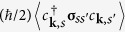 in momentum space (see Fig. 1). If |Hz| < Ht, the k-integrated Berry curvatures in the vicinity of the two normal-state Fermi surfaces cancel exactly [Fig. 2(a)] and consequently C = 0.
Figure 2. z-component of the Berry curvature Ω(k) for an out-of-plane magnetic field Hz in the SC state.

Ω(k) is finite within the window Δ below the Fermi energy. (a) In the topologically trivial state, (here:  ,
,  and Δ is fixed to 0.1 t), the total Berry curvature integrates to zero over the Brillouin zone. (b) In the topological situation (B) (see main text,
  and
and  ), the Berry curvature integrates to 2πC = 4π over the Brillouin zone.
The topological state emerging for |Hz| > Ht is of different nature in two distinct density regimes:
small electron density (μ < −2t): the condition |Hz| > Ht leads to
 for all k and therefore the
  -band is empty and does not contribute, i.e., the pink (positive) contributions to C in Fig. 2(a) vanish. Consequently, the superconducting state is characterized by
  , depending on the sign of Hz. This situation is realized for small band fillings.
densities near half-filling (|μ| < 2t): in this regime, two separate topological transitions are possible. At a magnetic field
 , the character of the
  -band changes from particle- to hole-like and thereby reverses the sign of Ω(k) in the vicinity of the corresponding Fermi surface [Fig. 2(b)]. Therefore, a topological transition to C = ±2 occurs, depending on the sign of Hz, with both, the
  - and the
  -band, partially occupied. A realization of this superconducting state close to half filling is however unlikely due to possibly competing orders. For an even larger magnetic field μB|Hz| > Ht, the
  -band is again lost, and C changes to = ±1. The topological properties of both cases, (A) and (B), correspond to those described in ref. 4 in the context of spin-triplet superconductors.
A special characteristic feature of s-wave superconductivity in the presence of Rashba SOC is that the magnetic field induces an inter-band pairing contribution where a quasi-particle of the  -band is paired with one from the
  -band at opposite momentum. This pairing contribution induces interior energy gaps above and below the Fermi energy (clearly visible e.g. in the spectra presented below, cf. ref. 24). A more detailed discussion of the relation between intra- and inter-band pairing is given in the Supplementary Informations.
In-plane magnetic field
For a finite in-plane magnetic-field component  , the Fermi surfaces are shifted out of the Brillouin-zone center in opposite directions perpendicular to
  [Fig. 1(c)], since
  . The pairing of electrons with momenta k and −k is thereby suppressed. Instead, pairs are formed in which electrons have momenta k and −k + q±, respectively, where the COMMs q± account for the Fermi surface shifts11,25,26,27 (see Supplementary Informations, Sec. B).
The SC ground state with an in-plane magnetic field component therefore contains in general two order parameters  and
and  . These enter the generalized on-site pairing term as
 |
where q = q+, q− 28. The singlet order parameter for COMM q is calculated self-consistently from
 |
where V is the strength of the pairing-interaction. With increasing in-plane magnetic-field strength  , the difference |q+ − q−| grows. Such a finite COMM state is spatially non-uniform28 with lines of zero pair density, similar to the SC state proposed by Larkin and Ovchinnikov for a singlet superconductor in a strong Zeeman field29. Characteristic for this state is a mixing of intra- and inter-band pairing and the absence of a full energy gap (see Supplementary Informations)11,28.
For  , the topological characterization is more involved. In situation (B), close to half-filling, both bands
  and
and  are partially occupied and consequently two COMMs q± appear. Therefore no full energy gap is present, which implies that C is not an integer and therefore unsuitable to characterize the topology (nevertheless, edge modes may still occur, see Supplementary Informations). For this reason, we focus below on situation (A) when only the lower band
  is occupied and therefore only electron pairs with COMM q− form. Such a state is spatially uniform and similar to the state introduced by Fulde and Ferrell30, but it carries a finite charge current perpendicular to
  . If also Hz ≠ 0, it exhibits a full energy gap and therefore C is integer-valued, except for a limited crossover region
  discussed below. Equation (3) and therefore the definition of Ht is valid as well in the presence of an in-plane magnetic field component whereby Hz is replaced by |H|.
If |H| > Ht, one finds that α|gk| < μB|H| for all occupied momenta k in the  -band. Furthermore, if H is strictly in-plane, say along the y-axis, hk is parallel to H on the kx-axis and therefore the spins are parallel (
 -band) or anti-parallel (
 -band) to H as well [Fig. 1(c)]. As a consequence, no intra-band pairing in the singlet channel is possible for ky = 0, i.e., the intra-band energy gap closes at the two Fermi points with ky = 0. This gap closing for an in-plane field orientation corresponds to a topological transition from C = −1 to C = 1.
The topological phase of situation (A) with an in-plane magnetic field component is described by the same Hamiltonian as in Eq. (2) replacing Δ by  . In the following we show that the topological state found for a sufficiently strong out-of-plane magnetic field can persist when the field is rotated — even down to an in-plane field orientation with arbitrarily small Hz.
Phase diagram and edge states
We start the analysis of the SC state with the discussion of the self-consistent solutions of the SC order parameter. Figure 3 shows the magnetic-field dependence of  for different angles θ of the field direction. The Rashba SOC ensures the presence of a finite in-plane spin component which allows for singlet pairing. Therefore the Zeeman coupling to a field in z-direction (θ = 0° and q− = 0) cannot wipe out superconductivity completely (pink curve) when orbital depairing is not included. A finite in-plane field component leads instead to a finite critical magnetic field Hc(θ), above which there are no solutions for
  .
.
Figure 3. Self-consistent solutions of the SC order parameter  for three magnetic-field directions and V = 4 t, α = 0.5 t and a constant electron density n = 0.05.

This value of n corresponds to  . For such low densities, a large interaction strength V is required to obtain a reasonably large order parameter. For each value of |H|, q− = (q, 0) is obtained by minimizing the free energy. The red circles indicate the magnetic field strength above which a finite COMM q ≠ 0 is present.
An interesting result is the somewhat larger value for Δq in an in-plane magnetic field  than in an out-of-plane magnetic field of the same magnitude. Consequently, the magnetic field Ht(θ) at which the energy gap closes, grows with increasing angle θ and is maximal for an in-plane direction. Likewise, the field
  above which the energy gap opens again and the topological state emerges, is maximal for θ = 90°, whereas
  . The resulting phase diagram for different magnetic-field orientations is qualitatively drawn in Fig. 4. The topologically trivial SC state (C = 0) is bounded by the ellipse given by Ht(θ), which itself is within the slightly larger ellipse formed by
  . The white regime in between separates the state with C = 0 from the states with C = ±1. In this crossover region the energy gap is closed and C is not an integer. A further topological transition occurs for the in-plane field orientation θ = 90° and
  : if θ sweeps through 90°, the out-of-plane field component Hz changes sign and, accordingly, C changes from −1 to 1. As discussed above, the energy gap is closed as well along this transition line.
Figure 4. Phase diagram showing the topologically different SC states as a function of out-of-plane magnetic field Hz and in-plane magnetic field Hy, not including orbital coupling to the magnetic field.

The blue circles (a–e) mark the Hy − Hz-points for which the energy spectra are shown in Fig. 5. The dashed lines indicate the transition from zero COMM to finite COMM pairing.
The importance of finite-COMM pairing for the topological properties of the SC state is illustrated using the energy spectra shown in Fig. 5. These spectra are calculated for a stripe geometry with open boundary conditions in y-direction, which allows for in-gap edge modes (drawn in red and green). We choose the in-plane magnetic-field component in the y-direction and thereby obtain a shift of the Fermi surfaces out of the Brillouin-zone center in kx-direction. Therefore a COMM q− = (q, 0) (q ≥ 0 for Hy > 0) has to be taken into account for pairing in the  -band. The free energy of the SC state is minimized for the smallest q which is still large enough to avoid an indirect closing of the energy gap (see Fig. 5(a–c) and Sec. B of the Supplementary Informations). The TKNN number C thereby remains well defined up to the magnetic-field direction θ = 90°. For θ → 90° [Fig. 5(c)], the energy gap closes at two kx-points, and a topological transition occurs. The magnetic field strength, above which a finite q− is required (dashed line in Fig. 4), depends on the angle θ. In the limit θ → 90°, it is necessarily smaller than Ht and approaches Ht for vanishing SOC. For every change in the field orientation the COMM q− has to be recalculated self-consistently. Since the calculations are performed on a finite lattice, q− evolves necessarily in discrete steps, determined by the system size, upon sweeping the angle θ. Up to this unavoidable discreteness, the onset of a finite q− is a smooth transition, across which the energy gap evolves continuously.
Figure 5. Energy spectra En(kx) for a stripe geometry with 600 × 100 sites, open boundary conditions and in-plane magnetic field component in y-direction, and parameters V, α, and n as in Fig. 3.

(a–c) The evolution of the edge modes (green line: upper edge, red line: lower edge) upon rotating the magnetic field is shown for (a)  , (b)
, (b)  , (c)
, (c)  , and
, and  . The self-consistently calculated order parameters
  and COMMs q− are (a)
  , (b)
, (b)  , and (c)
  . (d,e) illustrate the crossover regime
  : (d)
: (d)  and
and  , and (e)
  and
and  . The black arrows in (d) indicate the partial occupation of states originating from the
  -band. The opacity of each point encodes the weight with which the corresponding state contributes to the density of states.
Eventually, Fig. 5 also shows the evolution of the in-gap edge modes (green and red lines) under the rotation of the magnetic field. (Note that for θ > 0, the direction of the in-plane field component relative to the boundary is important. If the in-plane field is orthogonal to the boundary (here: y-direction), the kx-dispersion of the edge mode is unperturbed and remains gapless. If there is a field component parallel to the boundary (in x-direction), the edge-mode disperses in y-direction as well. Since the dispersion in y-direction is quantized through the edges, the edge modes acquire an energy gap around the Fermi energy (also observed for the edge modes in chiral p-wave superconductors4,17). This mesoscopic energy gap is of the size of the normal-state level spacing around EF and vanishes like 1/M in the thermodynamic limit, where M is the number of lattice sites in y-direction.) Starting from θ = 0°, the energy difference  grows for increasing θ and thus the dispersion of the two opposite edge modes becomes asymmetric [Fig. 5(b)]. Upon approaching θ = 90°, the energy gap closes at two kx points [Fig. 5(c)]. Consequently, q must be chosen to ensure that these closing points are located at the Fermi energy in order to prevent the energy bands above and below from overlapping. In this situation, the two edge modes are degenerate. Indeed, the two modes carry edge currents flowing in the same direction opposite to the flow of the bulk current. These modes are similar to the edge modes found for p-wave superconductors in an in-plane magnetic field17,31,32, except for the presence of a finite COMM pairing due to the Rashba SOC.
Figure 5(d,e) illustrate the gap closing and the emergence of edge modes in the regime  . At Hy = Ht(90°), the energy gap closes at kx = 0 [Fig. 5(d)]. However, the minimum of the
  -band is at a momentum kx < 0 and somewhat below the Fermi energy (indicated by the left black arrow), whereas the maximum of its mirrored hole-band is at a momentum kx > 0 somewhat above the Fermi energy (right black arrow). Thus, the
  -band and its mirrored hole band
  overlap indirectly. Superconductivity nevertheless persists because of the gain of condensation energy from the
  -band. In the regime
  , a direct gap opens again around kx = 0 with two gap-crossing edge modes, although they are no longer protected by topology [Fig. 5(e)].
For magnetic fields  , all states of the
  -band are above the Fermi energy. In this regime an infinitesimally small out-of-plane magnetic-field component Hz is sufficient to remove the two gap-closing points and ensure well defined TKNN numbers C = ±1. Eventually, superconductivity breaks down at Hy = Hc(θ): Above this critical magnetic field, the two gap-closing points move into the continuum of the energy bands above and below the Fermi energy. The upper and lower bands therefore overlap and the self-consistent solution for the SC order parameter is lost. Although
  depends only weakly on the SOC strength α, the critical magnetic field Hc(θ) grows with increasing α. In order to obtain
  , it is required that α > μBHy.
Discussion
How can the above topologically non-trivial SC state be realized in a solid-state system? We infer that an ideal candidate system would consist of several partially filled energy bands with a sizable Rashba SOC. Such a model33,34 was proposed e.g. to describe the physics of the conducting interface between LaAlO3 and SrTiO318,19.
The condition 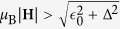 for C ≠ 0 implies that the lower limit for the Zeeman splitting is given by Δ. The corresponding magnetic field is typically larger than the upper critical field Hc2 above which orbital depairing destroys superconductivity. Therefore the topological state is not accessible with a magnetic field oriented along the z-axis. The topological state can be reached only for a nearly in-plane field orientation with Hz < Hc2 but
  . This excludes the situation (B) with a close to half-filled band, because of the presence of two different COMMs q± as discussed above. The alternative situation, on the other hand, requires that
  , which is close to the Fermi energy EF in a one-band model. For a band filling large enough to allow for a SC state (for a reasonable interaction strength V), EF for this partially filled band must be at least several meV. The magnetic field required to overcome this energy would be far too large for experimental realizations.
In a multi-band setup,  refers to the energy of the degeneracy point of a spin-orbit coupled doublet hosting the possibly topological state (see Fig. 6), relative to EF. The necessity of stabilizing a superconducting state with
  requires the presence of at least two bands at EF: A lower band provides the electron density for a sufficient gain of condensation energy in the superconducting state, whereas a second band has a minimum close enough to the Fermi energy so that it can be emptied or partially filled through an external control parameter.
Figure 6. Band structure of the three-band model for ky = 0.

In order to ensure  (red dashed line), the Fermi energy should be at the degeneracy point of the upper, Rashba-like doublet. The parameters are here:
  , Δ0 = t,
  .
.
A model which implements these features, and additionally also a strong Rashba-like SOC, recently emerged from the theoretical description of the LAO-STO interface. At this interface, the intrinsic electrostatic potential in LAO induces a nearly 2D electron liquid, which resides mainly in the titanium 3d t2g orbitals of the first TiO2 layer19,35. The band-structure of this oxide interface provides a prototype for a class of similar interface systems that we introduce here by constructing a tight-binding Hamiltonian  for the three t2g bands dxy, dxz, and dyz, following refs 33,34. The free kinetic energy is given by
 |
where σ0 is the 2 × 2 unity matrix and  . The hopping matrix elements
  for the dxy band are identical in the x- and y-direction, whereas they are different for the dxz and dyz bands:
  . Furthermore, the in-plane dxy orbital is lowered in energy by Δ0 relative to the out-of-plane dxz and dyz orbitals because of the symmetry breaking interface.
The spin-orbit coupling on the Ti atoms is described by  , where the angular momentum operator L for l = 2 is represented in the {dxz, dyz, dxy} basis33. This term intermixes the t2g orbitals and generates three doublets; the upper two doublets are split by 2ΔSO (see Fig. 6). In addition, the deformation of the t2g orbitals due to the interface potential leads to a hybridization of the dxz, dyz orbitals with the dxy orbital, parameterized by
 |
The k-dependence in  splits the three otherwise doubly degenerate doublets. For small momenta kx and ky, this splitting acts on the lowest and the highest doublet exactly like a Rashba term in a one-band model. This source of an effective Rashba-like band splitting can be several orders of magnitude larger than the splitting through the relativistic term and thereby is able to explain qualitatively the spin splitting observed at the LAO-STO interface36,37. Further, if the Fermi energy is tuned to Δ0 + ΔSO by an external gate voltage36,
  is fulfilled for the highest doublet (see Fig. 6). The SC state can be stabilized by the two lower doublets, whereas the highest generates a non-trivial topological number C = ±1.
This three-band model is likely the minimal model which fulfils the requirements discussed above for the realization of topological s-wave superconductivity in a solid. Various interface systems with a similar setup are conceivable, however, the formation of a topological SC state is viable only in a restricted parameter range: The Rashba-like band splitting, which is controlled by the parameter α in the one-band model, is replaced in the three-band model by αR = 2ΔSOΔz/Δ034. Although the magnetic field  , above which C ≠ 0 is possible, varies little with αR, the magnetic field range
  vanishes when αR approaches zero. To ensure a wide magnetic field range for the topological state, the parameter αR should therefore be larger than the Zeeman splitting and thus also larger than the SC energy gap.
In the following we estimate that the above criteria are indeed satisfied in the candidate system LAO-STO. The interface superconducts below a critical temperature of about 300 mK 38,39 and exhibits an energy gap Δ of about 40 μeV with most likely s-wave symmetry40. The Rashba parameter αR was experimentally estimated to be in the range 20–100 meV36, which is compatible with αR determined from the three-band model using Δ0, ΔSO, and Δz from the band-structure calculations of ref. 34. Assuming that  can be adjusted to zero by a suitable gate voltage, the necessary Zeeman splitting μB|H| > Δ is far smaller than αR and corresponds to a magnetic field Ht ≈ 600 mT (the in-plane Ht might be somewhat larger). While the measured out-of-plane critical field is Hc(0) ≈ 200 mT38 and therefore smaller than Ht, the observed in-plane critical field is
  41.
41.
The other important parameter defining Ht is  , which is controlled by the electron density n at the interface. The electron density can be tuned between 1 × 10⁻¹³ cm−1 and 6 × 10⁻¹³ cm−1
35,39,40. Using Δ0 ≈ 50 meV as in ref. 33 and ΔSO ≈ 20 meV34, we find that setting
, which is controlled by the electron density n at the interface. The electron density can be tuned between 1 × 10⁻¹³ cm−1 and 6 × 10⁻¹³ cm−1
35,39,40. Using Δ0 ≈ 50 meV as in ref. 33 and ΔSO ≈ 20 meV34, we find that setting  , i.e. EF = Δ0 + ΔSO (see Fig. 6), requires
  . This lies well within reach by a gate voltage. A precise prediction for the electron density at which the topological state should first develop is however difficult, since the value of Δ0 and the position of the higher bands is under debate. Density-functional calculations provide rather a value Δ0 ≈ 250 meV34. However, to account for the low electron densities measured experimentally, the dxy electrons are likely to be localized in this scenario. The Fermi energy is in this case measured relative to the lower edge of the dxz, dyz orbitals, i.e.,
  for EF = 2ΔSO. This is realizable as well within the range of charge densities tunable through a gate voltage.
The verification of a parameter regime which allows for a topological superconducting state could come from measuring the Knight shift in the nuclear magnetic resonance (NMR) frequency, e.g. of the La-nuclei in the first LAO layer. Due to the band splitting generated through the Rashba-type SOC, the superconductor magnetizes in a magnetic field, with a spin susceptibility χS remaining finite down to T = 0. Therefore, if a Rashba SOC with strength αR ≫ Δ is indeed present at the LAO-STO interface, the drop of the Knight shift at Tc must be far smaller than expected for a standard s-wave superconductor. Further, a kink in χS upon changing the gate voltage might reveal the voltage at which the highest doublet starts to get occupied and the search for topological edge states is most promising.
Additional Information
How to cite this article: Loder, F. et al. Route to Topological Superconductivity via Magnetic Field Rotation. Sci. Rep. 5, 15302; doi: 10.1038/srep15302 (2015).
Supplementary Material
Acknowledgments
The authors gratefully acknowledge discussions with Hans Boschker, Daniel Braak, Peter Fulde, Jochen Mannhart, Christoph Richter, Jonathan Ruhman and Kevin Steffen. This work was supported by the DFG through TRR 80.
Footnotes
Author Contributions F.L. did the calculations and prepared the figures. F.L., A.P.K. and T.K. wrote the manuscript.
References
- Qi X.-L. & Zhang S.-C. Topological insulators and superconductors. Rev. Mod. Phys. 83, 1057–1110 (2011). [Google Scholar]
- Sau J. D., Lutchyn R. M., Tewari S. & Das Sarma S. Generic new platform for topological quantum computation using semiconductor heterostructures. Phys. Rev. Lett. 104, 040502 1–4 (2010). [DOI] [PubMed] [Google Scholar]
- Alicea J. Majorana fermions in a tunable semiconductor device. Phys. Rev. B 81, 125318 1–10 (2010). [Google Scholar]
- Sato M. & Fujimoto S. Topological phases of noncentrosymmetric superconductors: edge states, Majorana fermions, and non-Abelian statistics. Phys. Rev. B 79, 094504 1–16 (2009). [Google Scholar]
- Sato M., Takahashi Y. & Fujimoto S. Non-Abelian topological order in s-wave superfluids of ultracold fermionic atoms. Phys. Rev. Lett. 103, 020401 1–4 (2009). [DOI] [PubMed] [Google Scholar]
- Bernevig B. A. & Hughes T. L. in Topological Insulators and Topological Superconductors, Ch. 16–18, 193–235 (Princeton University Press, 2013). [Google Scholar]
- Sigrist M. et al. The chiral p-wave state in Sr2RuO4. J. Phys. Soc. Jpn. 69, 127–132 (2000). [Google Scholar]
- Mackenzie A. P. & Maeno Y. The superconductivity of Sr2RuO4 and the physics of spin-triplet pairing. Rev. Mod. Phys. 75, 657–712 (2003). [Google Scholar]
- Lu Y.-M., Xiang T. & Lee D.-H. Underdoped superconducting cuprates as topological superconductors. Nature Phys. 10, 634–637 (2014). [Google Scholar]
- Vishik I. M. et al. Phase competition in trisected superconducting dome. Proc. Natl. Acad. Sci. USA 109, 18332–18337 (2012). [DOI] [PMC free article] [PubMed] [Google Scholar]
- Loder F., Kampf A. P. & Kopp T. Superconductivity with Rashba spinorbit coupling and magnetic field. J. Phys.: Condens. Matter 25, 362201 1–9 (2013). [DOI] [PubMed] [Google Scholar]
- Thouless D. J., Kohmoto M., Nightingale M. P. & Den Nijs M. Quantized hole conductance in a two-dimensional periodic potential. Phys. Rev. Lett. 49, 405–408 (1982). [Google Scholar]
- Kitaev A. Yu. Unpaired Majorana fermions in quantum wires. Phys. Usp. 44, 131–136 (2001). [Google Scholar]
- Lutchyn R. M., Sau J. D. & Das Sarma S. Majorana fermions and a topological phase transition in semiconductor-superconductor heterostructures. Phys. Rev. Lett. 105, 077001 1–4 (2010). [DOI] [PubMed] [Google Scholar]
- Oreg Y., Refael G. & Von Oppen F. Helical liquids and majorana bound states in quantum wires. Phys. Rev. Lett. 105, 177002 1–4 (2010). [DOI] [PubMed] [Google Scholar]
- Zyuzin A. A., Rainis D., Klinovaja J. & Loss D. Correlations between Majorana fermions through a superconductor. Phys. Rev. Lett. 111, 056802 1–5 (2013). [DOI] [PubMed] [Google Scholar]
- Wong C. L. M., Liu J. L., Law K. T. & Lee P. A. Majorana flat bands and unidirectional Majorana edge states in gapless topological superconductors. Phys. Rev. B 88, 060504(R) 1–5 (2013). [Google Scholar]
- Ohtomo A. & Hwang H. Y. A high-mobility electron gas at the LaAlO3/SrTiO3 heterointerface. Nature 427, 423–426 (2004). [DOI] [PubMed] [Google Scholar]
- Thiel S., Hammerl G., Schmehl A., Schneider C. W. & Mannhart J. Tunable quasitwo-dimensional electron gases in oxide heterostructures. Science 313, 1942–1945 (2006). [DOI] [PubMed] [Google Scholar]
- Fidkowski L., Lutchyn R. M., Nayak C. & Fisher M. P. A. Majorana zero modes in one-dimensional quantum wires without long-ranged superconducting order. Phys. Rev. B 84, 195436 1–14 (2011). [Google Scholar]
- Fidkowski L., Jiang H.-C., Lutchyn R. M. & Nayak C. Magnetic and superconducting ordering in one-dimensional nanostructures at the LaAlO3/SrTiO3 interface. Phys. Rev. B 87, 014436 1–11 (2013). [Google Scholar]
- Scheurer M. S. & Schmalian J. Topological superconductivity and unconventional pairing in oxide interfaces. preprint arXiv:1404.4039. [DOI] [PubMed]
- Clogston A. M. Upper limit for the critical field in hard superconductors. Phys. Rev. Lett. 9, 266–267 (1962). [Google Scholar]
- Liu W. V. & Wilczek F. Interior gap superfluidity. Phys. Rev. Lett. 90, 047002 1–4 (2003). [DOI] [PubMed] [Google Scholar]
- Barzykin V. & Gor’kov L. P. Inhomogeneous stripe phase revisited for surface superconductivity. Phys. Rev. Lett. 89, 227002 1–4 (2002). [DOI] [PubMed] [Google Scholar]
- Kaur R. P., Agterberg D. F. & Sigrist M. Helical vortex phase in the noncentrosymmetric CePt3Si. Phys. Rev. Lett. 94, 137002 1–4 (2005). [DOI] [PubMed] [Google Scholar]
- Michaeli K., Potter A. C. & Lee P. A. Superconducting and ferromagnetic phases in SrTiO3/LaAlO3 oxide interface structures: possibility of finite momentum pairing. Phys. Rev. Lett. 108, 117003 1–5 (2012). [DOI] [PubMed] [Google Scholar]
- Loder F., Kampf A. P. & Kopp T. Superconducting state with a finite-momentum pairing mechanism in zero external magnetic field. Phys. Rev. B 81, 020511(R) 1–4 (2010). [Google Scholar]
- Larkin A. I. & Ovchinnikov Yu. N. Inhomogeneous state of superconductors. Sov. Phys. JETP 20, 762–769 (1965). [Google Scholar]
- Fulde P. & Ferrell R. A. Superconductivity in a strong spin-exchange field. Phys. Rev. 135, A550–A563 (1964). [Google Scholar]
- Schnyder A. P. & Ryu S. Topological phases and surface flat bands in superconductors without inversion symmetry. Phys. Rev. B 84, 060504(R) 1–4 (2011). [Google Scholar]
- Queiroz R. & Schnyder A. P. Stability of flat-band edge states in topological superconductors without inversion center. Phys. Rev. B 89, 054501 1–10 (2014). [Google Scholar]
- Joshua A., Pecker S., Ruhman J., Altman E. & Ilani S. A universal critical density underlying the physics of electrons at the LaAlO3/SrTiO3 interface. Nat. Commun. 3, 1129 1–7 (2012). [DOI] [PubMed] [Google Scholar]
- Zhong Z., Tóth A. & Held K. Theory of spin-orbit coupling at LaAlO3/SrTiO3 interfaces and SrTiO3 surfaces. Phys. Rev. B 87, 161102(R) 1–5 (2013). [Google Scholar]
- Breitschaft M. et al. Two-dimensional electron liquid state at LaAlO3-SrTiO3 interfaces. Phys. Rev. B 81, 153414 1–4 (2010). [Google Scholar]
- Caviglia A. D. et al. Tunable Rashba spin-orbit interaction at oxide interfaces. Phys. Rev. Lett. 104, 126803 1–4 (2010). [DOI] [PubMed] [Google Scholar]
- Fête A., Gariglio S., Caviglia A. D., Triscone J.-M. & Gabay M. Rashba induced magnetoconductance oscillations in the LaAlO3-SrTiO3 heterostructure. Phys. Rev. B 86, 201105(R) 1–4 (2012). [Google Scholar]
- Reyren N. et al. Superconducting interfaces between insulating oxides. Science 317, 1196–1199 (2007). [DOI] [PubMed] [Google Scholar]
- Caviglia A. D. et al. Electric field control of the LaAlO3/SrTiO3 interface ground state. Nature 456, 624–627 (2008). [DOI] [PubMed] [Google Scholar]
- Richter C. et al. Interface superconductor with gap behaviour like a high-temperature superconductor. Nature 502, 528–531 (2013). [DOI] [PubMed] [Google Scholar]
- Reyren N. et al. Anisotropy of the superconducting transport properties of the LaAlO3/SrTiO3 interface. Appl. Phys. Lett. 94, 112506 1–3 (2009). [Google Scholar]
Associated Data
This section collects any data citations, data availability statements, or supplementary materials included in this article.