



Abstract
School nurses are responsible for providing and supervising school nursing services for children with complex health concerns. Given school nurses frequently practice in isolation and may have limited access to clinical practice changes, they can benefit from up-to-date, evidence-based resources. Additionally, the resources must account for the fact that the nursing procedures will be performed in the unique setting of a school building and in many cases, will be performed by school personnel who have limited formal education in health care. This article provides an overview of a newly developed, easy to use, online school nursing procedures website for school nurses and other school personnel.
Keywords: website, nursing procedures, best practice
Around 14 percent of U.S. children have special health care needs that require a range of school health services (U.S. Department of Health and Human Services, 2008). These school health services can vary in clinical intensity. For instance, asthma medications are one of the most common medications children receive at school and school nurses report feeling competent in administering them (Allen, et al., 2012; Borgmeyer, et al., 2005, Olympia, et al., 2005). Although less common but equally important, central venous lines, gastrostomies, and tracheotomies are also part of the practice of school nurses. Given the limited exposure to recent technological and clinical practice changes, school nurses may feel less competent in caring for these students (McKee, 2011). Considering the fact that school nurses often practice in isolation and have limited interaction with other school nurses, they need access to resources that provide the most up-to-date information relating to performing unfamiliar procedures and supporting research. The resources also must include information on the variables unique to the school setting, such as lack of other medical professionals to assist in perform procedures and the non-medical setting where procedures are performed.
Additionally, as schools work to care for students with complex medical issues, they may employ unlicensed assistive personnel (UAP). NASN (2010) supports delegation of nursing procedures in the school setting by the school nurse when it is based on the nursing definition of delegation and in compliance with state nursing legal parameters. Delegating nursing procedures to a UAP requires increased diligence by the school nurse to ensure that the UAP knows specifically how to perform the procedure. Research has shown that step-by-step procedure lists assist in ensuring procedures are done correctly (Hales & Pronovost, 2006; Shannon & Kubelka, 2013).
Consequently, school nursing procedure resources need to be developed for use by multiple providers. The resources must account for the fact that these complex nursing procedures will be performed in the unique setting of a school building and in many cases, will be performed by school personnel who have limited formal education in health care.
Background
The WISHeS: Wisconsin Improving School Health Services Project is a 5-year grant initiative funded by the Healthier Wisconsin Partnership Program. The goal of the project is to increase the competency of school district staff and the capacity of local school health services systems. This is accomplished by drafting, piloting, finalizing, implementing and evaluating a school health services assessment tool, which will is then complemented by resources, templates and educational materials to address priorities identified through the assessment results. The WISHeS School Health Services Assessment Tool was disseminated to all 426 Wisconsin public school districts in Spring of 2012. The assessment tool was completed by 117 (27%) districts. While the assessment results reflect 27% of the districts in the state, statistical analysis indicates that the responding districts are a representative sample of all districts regarding the characteristics of rural/urban, number of schools in the district, total enrollment in the district, and enrollment by race and ethnicity.
The assessment results indicated that Wisconsin school districts were strong in the following areas:
Individualized Education Program (IEP) development and involvement of the school nurse.
Number of Cardio Pulmonary Resuscitation (CPR)/Automatic External Defibrillator (AED)-trained staff in each school.
AEDs were in over 90% of schools in the responding districts.
77% of the Registered Nurses in the responding districts were Bachelors or Masters prepared. (If the district had more than one registered nurse the respondent choose the education level of the majority of nurses.)
Over 75% of schools or districts have a policy on asthmatic inhaler self-carry and allow the students to self-carry and administer metered dose inhaler or dry powder inhaler.
The assessment results also indicated that there were significant areas of need. Approximately one-half or fewer districts:
Have a policy and protocol manual for emergency nursing services provided during after school hours (extra-curricular and sporting events).
Annually review their emergency nursing services.
Have a policy and procedures on medication errors.
Have a policy regarding medication disposal.
Provide continuing education for life threatening emergencies.
Have a nursing procedure manual, developed by an RN, which provides instructions for skilled nursing services.
The assessment results were used to guide the development of a number of resources and tools, all of which can be found at www.wishesproject.org. This article will focus on the development of the School Nurse Procedure website.
School Nurse Procedure Manuals
An extensive environmental scan was conducted in 2012–13 prior to the development of the WISHeS School Nurse Procedure website. Project staff identified a number of school nurse procedure manuals available on the internet. The majority of the nursing procedure guidelines were developed by state school nurse associations, state departments of health or education or by individual school districts. Although the manuals contained the most commonly performed school nurse procedures, the manuals had a number of limitations, including adaptability, evidence/quality, and relevance to the school setting.
Accessibility
Although the procedure manuals contained step-by-step instructions on how to perform the nursing procedure, they were only available in PDF or Microsoft Word for download. A barrier to this format is limited availability and accessibility for timely updates. Additionally, many school nurses may download the document, print and store it in the health room and may not have access to the step-by-step procedure when it is needed. This prevents easy and timely access to the procedure lists. Having access to procedure lists can increase the likelihood that the procedure is being performed using best practices and evidence-based care (Hales & Pronovost, 2006; Shannon & Kubelka, 2013) and ultimately improve student safety.
Quality
Ensuring that health services are being provided using evidence-based practices (EBP) is a priority to all healthcare professions, including school nurses. A study conducted by Adams (2009) found that 96.3% of the responding school nurses agreed or strongly agreed that use of EBP was important to them personally but only 74.7% stated they actively sought EBP information to guide their practice and 77.3% stated they knew where to find this information. Seventeen school nurse manuals were identified through the environmental scan. Of those 17 manuals, seven contained procedures that were included on the WISHeS website. Only two of the manuals contained references for the procedures. Given that many of the school nursing procedure manuals lacked references, it was difficult to validate that evidence-based practices had been used in the development of the procedures.
Relevance
Finally, some nursing procedure applications (apps) were available for purchase (e.g., Nursing Procedures Checklist by FA Davis Mobile, Nursing Central by Unbound Medicine), but they failed to contextualize the nursing procedure from a school nursing perspective.
Development of the WISHeS School Nurse Procedure Website
Interdisciplinary Team
The WISHeS project’s Core Partners and Community Advisory Committee, with representatives from child advocacy, parent and teacher organization, the state school board association, pediatric medicine and children with special health care needs, guided the development of the WISHeS resources. It was decided early on in the discussion that an online electronically accessible nursing procedure manual was crucial.
Addressing Quality and Accessibility
School nurses frequently work in isolation and do not have the luxury of consulting a colleague in the hallway so it is vital that the school health resources are evidence-based and current. Given the rapidity of changes in the healthcare system, an online resource provides a venue for frequent review and updating. The ability to access up-to-date nursing procedures has the ability to not only improve the health of students but also enhance the practice of school nursing (Bergren & Murphy, 2005; Rosenblum, & Sprague-McRae, 2014; Suszka-Hildebrandt, 2001). Since many school nurses provide services to children with complex health needs and can be responsible for multiple schools covering a wide geographical area, school nurses need up to date, easily accessible information (Anderson & Enge, 2012).
An extensive literature review for the latest research and practice guidelines related to the following areas was conducted:
Gastrostomy, jejunostomy and nastogastric tubes
Colostomies
Urinary catheterization
Tracheostomy care
Administering oxygen
Inhaler and nebulizer
Pulse oximeter monitoring
Glucose monitoring
Ketone testing
Central venous line care
A group of 20 healthcare professionals including 11 school nurses with over 100 years of combined school nursing experience, and health professionals specializing in urinary, respiratory, digestive, endocrine, and cardiovascular health, assisted in the development and review of the nursing procedures.
Design and Functionality
Given the demanding schedule of school nurses, one of the project’s priorities was to create a website that is easy to use. The School Nurse Procedure website includes videos, written steps for nursing procedures, preparation information, and general tips. The nursing procedures are categorized by body system, allowing the user to quickly find the information they are seeking. One click on a Procedure takes the user to the procedure page. Each procedure contains section tabs at the top of the page for easy navigation, allowing the user to quickly find information on the needed supplies, factors to consider, references and resources for that specific procedure.
School nurses typically do not spend their day at one school building and are frequently not sitting by the computer when they are completing a nursing procedure. The WISHeS Nurse Procedure website is a responsive website that detects if the user is on a desktop, a tablet, or smartphone and provides an optimized version of the website based on the device. Although a website developer was contracted for the initial development of the website, the resource was built in WordPress, which offers an easy to use content management system. Having an easy to use format allows for easy editing and revising of the content.
Nearly every nursing procedure performed in a school setting has accompanying medical orders that provide the necessary information regarding the prescribed intervention. For example, medical orders for a student who requires a gastrostomy tube feeding would include:
the type of formula
amount of formula
infusion type and rate
frequency and timing of administration
amount of water used to flush the tube
how to manage a blocked tube
The medical orders do not include instructions on how gastrostomy tube feeding is performed, such as how to prime the tubing or set the pump to the prescribed rate. Typically, school nurses will develop a student specific nursing procedure document that contains this information. To support the school nurses’ efficiency, each procedure, on the WISHeS site, has a download feature. The school nurse can download the procedure into a Microsoft Word document and edit the procedure based on a particular student’s orders. This creates a printable step-by-step procedure to include with the student’s individualized health plan that the school nurse or a UAP can use each time they are performing the procedure. Additionally, the form can also be used as a UAP competency check off sheet to document training and return demonstration of the procedure.
Medical procedures, by their very nature, are frequently complex and nuanced. The project surveyed Wisconsin school nurses to inquire what procedures would most benefit from an accompanying video. School nurses felt having videos of the more intricate and less often performed procedures, such as tracheostomy suctioning and gastrostomy tube feedings, would assist in ensuring the student’s safety. School nurses also felt it was important to include videos of more common procedures, such as nebulizer and glucose monitoring, as those procedures are frequently delegated to UAPs. Having the step-by-step video, with accompanying editable written information, is uniquely suited to provide guidance and training on procedures for school nurses and other school health services personnel.
A unique feature of the WISHeS website is the “Considerations” section. Given the non-healthcare setting where these nursing procedures are being performed, there are many relevant factors that the school nurse or UAP needs to consider prior to completing the procedure. Each procedure on the website includes a considerations section. A number of the procedures also have a yellow “Please Read” box that highlights important safety or significant procedure information that the user needs to be aware of prior to completing the procedure. The yellow “Please Read” box appears at the top of every page so the user is certain to review the information.
The value of having an internet based School Nurse Procedure Manual is the ability to respond to changes in healthcare practice and quickly update the resource. The project staff maintains daily review of pertinent research through literature review alerts. They also conduct more extensive literature reviews every six months in addition to monthly review of school health literature. The hyperlinked resources available on the website are also monitored every six months to ensure they are still active. A plan to sustain the resources developed as part of the WISHeS project has been discussed since the inception of the project. Is the intent of the project staff that the nursing procedure website will be available after the grant period has ended. The project staff are in the process of identifying how the website will be sustained. Included in the sustainability plan will be identifying who will be responsible for conducting website content and resource review and scheduled literature reviews.
Performing nursing procedures in the school setting can be challenging and complex given the unique and isolated setting. The WISHeS School Nurse Procedure Website is a free resource that can assist school nurses in ensuring they are providing the most up-to-date, evidence based care to children. Although the website was developed to improve the care provided to Wisconsin children, the website can be accessed by school nurses across the country and internationally. One consideration for school nurses in other states would be to review their state’s nurse practice act and school district policies to evaluate which procedures they are allowed to delegate. School nurses can utilize the website, which provides guidance specifically related to nursing procedures in the school setting, to enhance their own knowledge on how to perform certain nursing procedures or use the site as a training tool for UAPs, thus improving overall care to children in school settings.
Additional WISHeS Resources
In addition to the WISHeS School Nurse Procedure Website, the project staff have developed a number of other resources that can be found at www.wishesproject.org. These resources include:
Injury and Illness Protocols, which are meant to serve as basic first aid and illness management and be used by staff without medical/nursing training, when a nurse or other medical professional is not available.
Sample Policies and Procedures related to Medication Administration, Nursing Services and Concussion Management.
Care of the Student with Special Healthcare Needs, which is an online training for unlicensed assistive personnel (UAP). The intent of the interactive training is to provide UAPs with the basic knowledge required to care for students who are in need of these interventions while at school.
Figure 1.

WISHeS Nursing Procedures Screen Snapshot Organized by Body System
Figure 2.

Procedure Example with Available Video and Capability for Download
Figure 3.
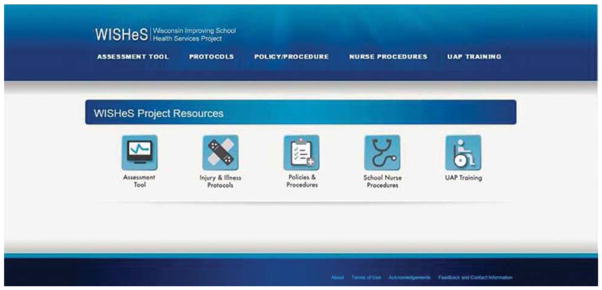
Additional WISHeS Resources
Acknowledgments
Special acknowledgments go to the project funder: Healthier Wisconsin Partnership Program (HWPP), a component of the Advancing a Healthier Wisconsin endowment at the Medical College of Wisconsin, and the WISHeS Core Partners who have helped to guide the project (in alphabetical order): Medical College of Wisconsin, Wisconsin Association of Local Health Departments and Boards, Wisconsin Association of School Nurses, Wisconsin Department of Public Instruction, Wisconsin Division of Public Health, and Wisconsin Public Health Association. Statistical analysis of the WISHeS School Health Services Assessment Tool data was supported, IN PART, by grant 1UL1RR031973 from the Clinical and Translational Science Award (CTSI) program of the National Center for Research Resources, National Institutes of Health.
References
- Adams S. Use of Evidence-Based Practice in School Nursing: Survey of School Nurses at a National Conference. Journal of School Nursing. 2009;25(4):302–313. doi: 10.1177/1059840509335008. [DOI] [PubMed] [Google Scholar]
- Allen K, Henselman K, Laird B, Quiñones A, Reutzel T. Potential Life-Threatening Events in Schools Involving Rescue Inhalers, Epinephrine Autoinjectors, and Glucagon Delivery Devices: Reports From School Nurses. The Journal of School Nursing. 2012;28(1):47–55. doi: 10.1177/1059840511420726. [DOI] [PubMed] [Google Scholar]
- Bergren MD, Murphy EA. Handheld Computer Software for School Nurses. The Journal of School Nursing. 2005;21(6):356–60. doi: 10.1177/10598405050210061101. [DOI] [PubMed] [Google Scholar]
- Borgmeyer A, Jamerson P, Gyr P, Westhus N, Glynn E. The School Nurse Role in Asthma Management: Can the Action Plan Help? The Journal of School Nursing. 2005;21(1):23–30. doi: 10.1622/1059-8405(2005)021[0023:tsnria]2.0.co;2. [DOI] [PubMed] [Google Scholar]
- Hales BM, Pronovost PJ. The checklist—a tool for error management and performance improvement. Journal of Critical Care. 2006;21:231– 235. doi: 10.1016/j.jcrc.2006.06.002. [DOI] [PubMed] [Google Scholar]
- McKee S, Bultas M, Ahearn T. School Nurse Survival. Reviewing Clinical Skills in the Simulation Laboratory. NASN School Nurse. 2011:251–56. doi: 10.1177/1942602X11409419. [DOI] [PubMed] [Google Scholar]
- National Association of School Nurses. Delegation [Position statement] 2010 Available at: http://www.nasn.org/Portals/0/positions/2010psdelegation.pdf.
- Olympia RP, Wan E, Avner JR. The Preparedness of Schools to Respond to Emergencies in Children: A National Survey of School Nurses. Pediatrics. 2005;116(6):e738–45. doi: 10.1542/peds.2005-1474. [DOI] [PubMed] [Google Scholar]
- Rosenblum RK, Sprague-McRae J. Using Principles of Quality and Safety Education for Nurses in School Nurse Continuing Education. The Journal of School Nursing. 2014;30(2):97–102. doi: 10.1177/1059840513489710. [DOI] [PubMed] [Google Scholar]
- Shannon RA, Kubelka S. Reducing the Risks of Delegation: Use of Procedure Skills Checklists for Unlicensed Assistive Personnel. NASN School Nurse. 2013;28:222–26. doi: 10.1177/1942602X13490030. [DOI] [PubMed] [Google Scholar]
- Suszka-Hildebrandt S. Handheld Computing: The Next Technology Frontier for School Nurses. The Journal of School Nursing. 2001;17(2):98–102. doi: 10.1177/105984050101700207. [DOI] [PubMed] [Google Scholar]
- U.S. Department of Health and Human Services, Health Resources and Services Administration, Maternal and Child Health Bureau. The National Survey of Children with Special Health Care Needs Chartbook 2005–2006. Rockville, Maryland: U.S. Department of Health and Human Services; 2008. Available at: http://mchb.hrsa.gov/cshcn05/ [Google Scholar]