



Abstract
There is an increasing interest regarding the use of electroencephalography (EEG) in social commerce and electronic commerce (e-commerce) research. There are several reviews in the field of social commerce or e-commerce; these have great potential value and mining them is fundamental and significant. To our knowledge, EEG is rarely applied to study these. In this study, we examined the neural correlates of social commerce reviews (SCRs) and e-commerce reviews (ECRs) by using them as stimuli to evoke event-related potentials. All SCRs were from friends through a social media platform, whereas ECRs were from strangers through an e-commerce platform. The experimental design was similar to that of a priming paradigm, and included 40 pairs of stimuli consisting of product information (prime stimulus) and reviews (target stimulus). The results showed that the P300 component was successfully evoked by SCR and ECR stimuli. Moreover, the P300 components elicited by SCRs had higher amplitudes than those elicited by ECRs. These findings indicate that participants paid more attention to SCRs than to ECRs. In addition, the associations between neural responses and reviews in social commerce have the potential to assist companies in studying consumer behaviors, thus permitting them to enhance their social commerce strategies.
Keywords: Event-related potentials, Reviews, Social commerce, Electronic commerce, Friend, Stranger
Introduction
Following the rapid development of Web 2.0, online shopping has become an important part of modern life. When consumers shop on an online platform, often, behavioral science method is used to analyze consumer purchase intention. However, with the development in the field of cognitive neuroscience, an increasing number of researchers have started using cognitive neuroscience tools to solve behavioral science questions (Layne et al. 2007; Pakhomov and Sudin 2013). For example, Kong et al. (2013) used cognitive neuroscience to study the influence of video commercials on consumers on the basis of impression index, and Farwell and Richardson (2013) used brain fingerprinting to detect concealed information stored in the brain by measuring brainwave responses. Therefore, it is possible to explore cognitive neuroscience tools to study consumer purchase intentions in online shopping. In this study, we mainly focus on exploring the different neural mechanisms between the social commerce reviews (SCRs) and electronic commerce reviews (ECRs).
Social commerce is a subset of electronic commerce (e-commerce) that uses social media to assist the online buying and selling of products or services (Liang and Turban 2011). SCRs focus on sharing the information with friends on social networking sites. For example, the product reviews were communicated in the form of comments from friends on Facebook. This is very different from traditional ECRs, which are shared with unknown online shoppers (Liang et al. 2011). The product reviews on Amazon mostly come from strangers. Studies have shown that reviews from friends significantly affect human behavior (Park et al. 2007; Zhu et al. 2010; Lu et al. 2013). They suggest that social relationship information, which is implied in reviews by friends and absent in e-commerce, is a key dimension in social commerce. As mentioned above, it is well known that SCRs or ECRs significantly influence consumers’ purchasing intentions (Zheng et al. 2013). These studies are based on questionnaires or sharing information (such as electronic word of mouth), which are both forms of behavioral data. However, because of privacy and subjectivity, behavior analysis would not guarantee the quality of results. On the other hand, cognitive neuroscience theories and methods [e.g., eye movement (Seong and Lee 2013), fMRI (Dimoka et al. 2011; Dimoka et al. 2012)] can verify the results based on the behavioral data or help get a more in-depth understanding about the consumer’s online purchasing intention. In addition, new problems in e-commerce could also be explored and solved by using neuroscience tools. By using EEG activity, Kuan et al. (2014) argued that “buy” information is associated with EEG activity that is generally linked to negative emotions and “like” information is associated with EEG activity that is generally linked to positive emotions to induce purchasing in group buying sites. By using functional magnetic resonance imaging tools, Riedl et al. found that most of the brain areas that encode trustworthiness differ between women and men. They captured the brain activity of 10 female and 10 male participants simultaneously to decisions on trustworthiness of eBay offers and found that more brain areas were activated in women than in men (Riedl et al. 2010). This motivated us to study the brain responses elicited by SCR and ECR stimuli.
This report describes an exploration experiment and focuses on analyzing the ERP component changes in the environment ECRs and SCRs. We aimed to collect evidence to support the findings of prior behavior research that participants pay more attention to SCRs that include reviews from friends than to ECRs that include reviews from strangers. In other words, we aimed to show that ERP signals of SCRs from friends and of ECRs from strangers are significantly different. This data can be used to guide the Website or platform designers to improve their platform functions such as encouraging consumers to share their shopping experience in form of reviews to improve the consumer’s perception of products.
Methods
Participants
Nineteen right-handed undergraduates at Beihang University (7 women, age range 21–35 years, mean 25.5 years) volunteered and were paid (50 RMB, about $8) to participate in this study. They were all native Chinese speakers who reported that they had normal or corrected-to-normal vision with no history of neurological or psychiatric diseases. They were unaware of the purpose of this experiment. A written informed consent was obtained from each participant before participation. The evaluation procedures in the study were carried out with the ethical approval of the institutional review board (Beihang University, Beijing, China) and in compliance with the Helsinki Declaration. For the participant data, if a single sample’s available trial number, which could be automatically detected by Net Station Software (Version 4.3.1, EGI, USA) tools, were less than 50 % of the total trials, it would be marked as an unavailable sample and removed. Among the 19 subjects, trial numbers of two men and one woman were automatically detected below 50 %, hence, the three participants were removed from the analyses, and the data of the remaining 16 participants were used for final analyses.
Stimuli
A priming experimental paradigm with a prime stimulus (S1) and a target stimulus (S2) was used in this experiment (Naccache et al. 2002). Each stimulus was a picture digitized at 620 × 600 pixels. For S1, each picture included product information. For S2, each picture consisted of the name of an individual and that individual’s reviews for the product shown in S1.
For S1, information about 20 tablet computers was chosen from the Chinese “best-selling list” of ZOL.com (the largest digital product e-store in China). For each product, two pictures and six parameters including screen size, central processing unit, wireless type, hard drive, memory, operating system, and weight were selected. It should be noted that these parameters were regarded as being culturally familiar to the participants, as all six parameters1 are very often carefully considered when consumers intend to buy tablet computers. In this experiment, every parameter was described using less than 8 Chinese characters. A picture of the product and the six parameters were used as S1. An example stimulus is shown in Fig. 1a.
Fig. 1.

a Example of a prime stimulus. b Example of a target stimulus
Each S2 consisted of two items: personal information and reviews from two different individuals, as shown in Fig. 1b. The personal information included the individual’s name and head portrait obtained from Renren.com (Chinese Facebook). The reviews of the product were obtained from ZOL.com. From the review information, the experiment could not ensure that all volunteers knew the users who provided the reviews of the product. Therefore, it should be noted that the personal information and reviews were artificially combined with the photographs as S2. The volunteers were students in the School of Economics and Management, Beihang University. Therefore, before the experiment, the information (Name, Student ID, Class, etc.) of all the volunteers could be identified. In the run-up to the experiment, the head portraits and names of reviewers in SCRs were replaced with those of the volunteers’ classmates by image-processing tools (Photoshop V7.0) and all of the head portraits and names of reviewers in ECRs were replaced with those of strangers. In addition, the reviews were all from random individuals and were paired with photos/names of friends. The personal information was divided into two categories: 20 individuals, who were all Renren group members, were classmates of the participants in the experiment, and the other 20 individuals were strangers to the participants. During the experiment, the participant knew whether the reviews came from friends or strangers by looking at the name and photograph of the person who provided the reviews.
The stimuli consisted of 40 pairs of product information (S1) and reviews (S2). These pairs were divided into two groups: (1) 20 pairs of product information and reviews from classmates (regarded as SCRs); (2) 20 pairs of product information and reviews from strangers (regarded as ECRs). In other words, to reveal the differential brain responses between SCRs and ECRs, the reviews for both groups were similar, but the individuals providing the reviews were either friends of the participants (SCRs) or strangers to the participants (ECRs).
Experimental paradigm
The experimental paradigm is depicted in Fig. 2. Each trial began by presenting a fixation point (+) for 1500 ms. After a 500-ms black screen, S1 was shown for 1500 ms. Then, after another 500-ms black screen, S2 was shown for 4000 ms. Finally, the participants decided whether to buy the product or not; they pressed the “f” button on a keyboard to buy and the “j” button to not buy. The stimulus pairs (S1–S2) were randomly presented on a 20″ computer monitor screen located 1 m in front of the subjects (visual angle of 10°). During the experiment, the participants sat in a comfortable chair in a shielded room and were instructed to attend to the stimuli, while avoiding eye blinks or moving their eyes and heads. Stimulus presentation and behavioral response collection were controlled by E-prime 2.0 software (Psychology Software Tools Inc., PA).
Fig. 2.

Schematic depiction of the procedure
Electroencephalogram (EEG) recordings and ERP data processing
EEGs were continuously recorded (band-pass filter, 0.1–100 Hz) with a 64-channel HydroCel Geodesic Sensor Net, Net Amps 300 amplifier (Electrical Geodesics Inc., Eugene, OR), which was mounted on the scalp according to the International 10–20 system (Towle et al. 1993). Electrode impedances were maintained below 50 kΩ throughout the experiment. EEGs were stored on a computer disk at the sample rate of 500 Hz, using the vertex sensor (Cz) as the reference electrode.
Off-line data processing for extracting event-related potentials (ERPs) was performed by Net Station Software, MATLAB (Version 7.0, MathWorks, USA) and EEGLAB. The continuous EEG was re-referenced to an average reference, digitally filtered with a high-pass 1-Hz filter and a low-pass 30-Hz filter (24 dB/Octave) (Luck 2005). After filtering, the data were segmented by the stimulus sequence into 800-ms stimulus-locked epochs from −200 ms (before S2 onset) to 600 ms (after S2 onset). The mean of the pre-stimulus period formed the baseline, which was subsequently removed. Single trials that included significant vertical and horizontal eye movements and eye blinks were rejected. In this study, we have used two steps to process the electrooculographs (EOGs). Firstly, we use Net Station Software tools to eliminate EOGs. The tools automatically detect vertical eye movements (eye blinks; ±140 μV) and horizontal eye movements (±55 μV), then mark them as EOGs and reject them. Secondly, after importing the filtered and segmented data into EEGLAB under MATLAB, we detected all the trials artificially, and rejected the trials, which included obvious eye-movement and eye-blink.2 Additionally, if a recording segment contained more than 10 bad channels, it was rejected. Individual bad channels were replaced using spherical interpolation based on all the remaining sensors for the given trial. After artifact correction and rejection, 88.33 % of the 640 trials were retained for further analyses.
The trial numbers (ECRs vs. SCRs) of the sixteen participants are shown in Table 1.
Table 1.
Trial number (ECRs vs. SCRs) of the sixteen participants
| 1 | 2 | 3 | 4 | 5 | 6 | 7 | 8 | 9 | 10 | 11 | 12 | 13 | 14 | 15 | 16 | |
|---|---|---|---|---|---|---|---|---|---|---|---|---|---|---|---|---|
| ECRs | 17 | 20 | 17 | 17 | 18 | 17 | 19 | 16 | 17 | 17 | 18 | 18 | 19 | 18 | 18 | 19 |
| SCRs | 16 | 19 | 17 | 16 | 17 | 18 | 17 | 18 | 16 | 18 | 20 | 17 | 18 | 16 | 17 | 20 |
From Table 1, we know that the total data segments of ECRs are 285 (M = 17.81, σ = 1.05), and the total data segments of SCRs are 280 (M = 17.50, σ = 1.32). We performed a paired t test between trial numbers of ECR and SCR to show that the data segments between ECRs and SCRs were not significant (t[15] = 0.960, P > 0.05). This results show that the trial numbers were similar between the two conditions (ECRs vs. SCRs), and therefore, trial number was not a factor that biased the ERP results.
Subsequently, the remaining trials for each participant and each stimulus condition were averaged to produce the ERP waveforms. However, since the number of trials for averaging was limited due to the experimental design, we further filtered the averaged EEGs by an appropriate wavelet filter. Indeed, wavelet filters have been widely applied to reduce noise in ERP data (Cong et al. 2012; Quiroga and Garcia 2003). In this study, we used a reverse biorthogonal wavelet with the order of 6.8. This wavelet has been successfully applied to filter ERPs (Astikainen et al. 2013; Cong et al. 2011). For our ERP data, the number of levels for wavelet decomposition in the wavelet filter was 9, and the coefficients of levels 5, 6, 7, and 8 were used for wavelet reconstruction in the wavelet filter. The frequency responses of the wavelet filter are shown in Fig. 3. The method used to compute the frequency response of the wavelet filter is in terms of the Fourier transform of the impulse response of the wavelet filter (Cong et al. 2013). When the input of the wavelet filter is the unit impulse, the output of the wavelet filter is the impulse response of the wavelet filter. Previous publications provide the rational of such a wavelet filter (Cong et al. 2012; Astikainen et al. 2013; Cong et al. 2011).
Fig. 3.

a Magnitude response. b Phase response
ERP data analysis
Since the stimulus consisted of a picture that included words and photographs in this study, it was considered a visual stimulus. Therefore, we decided to analyze ERPs at nine electrode sites: P1, Pz, P2, PO3, POz, PO4, O1, Oz, and O2. We found a positive evident peak after 300 ms (shown in Fig. 4). Consequently, the mean amplitude over 350–420 ms was calculated as the mean amplitude of the ERP. This time window was determined in terms of the grand average of the ERP waveforms (see Fig. 4). The ERP without this noise-reduction procedure (the wavelet filter) are shown in Fig. 5.
Fig. 4.
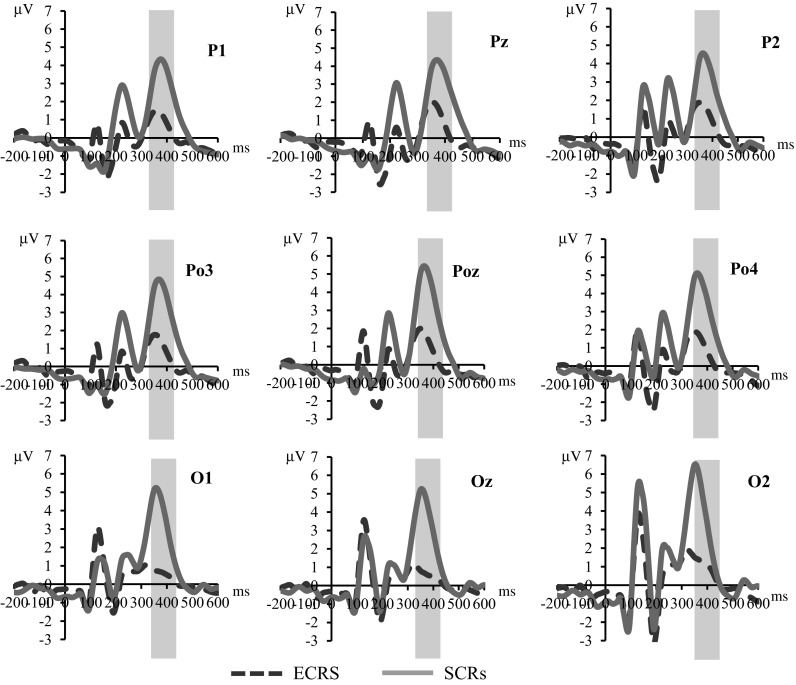
Grand-average event-related potential waveforms at P1, Pz, P2; Po3, POz, PO4; O1, Oz, O2. The yellow bar indicated the duration used to quantify the ERP (from 350 to 420 ms). ECRs electronic commerce reviews, SCRs social commerce reviews
Fig. 5.

The ERP waveforms without noise-reduction procedure at P1, Pz, P2; Po3, POz, PO4; O1, Oz, O2. ECRs electronic commerce reviews, SCRs social commerce reviews
For statistical analysis, the mean amplitudes were measured at P1, Pz, P2, PO3, POz, PO4, O1, Oz, and O2 for each participant and each condition. Subsequently, two-way analyses of variance (ANOVA; within-subjects, repeated measures) were performed to examine the interaction between two factors, which were the location of the electrode and experimental condition. For the location, there were three levels: Pz, POz, and Oz; for the experimental condition, there were two levels: ECRs and SCRs. In order to further investigate the differences among/between levels of one factor, t tests were applied.
Results
ERPs
Figure 4 shows the grand-average ERP waveforms at three central electrode points: Pz, POz, and Oz. The locations where the ERP components were elicited by visual stimuli were clearly identified in this study. Figure 6 shows the topography of the ERPs for each condition. The topography was based on the average across multiple time points (~350–420 ms). According to the recommendation from the ERP textbook by Luck (Luck 2005), this method is relatively robust. Based on the properties of the P300 component in the time and space domains (Luck 2005; Salvaris and Sepulveda 2010), we can discern that the P300 was successfully elicited in our experiment.
Fig. 6.

Topography of the P300 component in terms of the grand-average event-related potential waveforms (~350–420 ms)
Figure 6 shows the brain topography, which was based on the average across multiple time points (~350–420 ms), including that of the posterior-parietal and occipital channels. These brain regions are important to be included in the EEG for determining the product information-related cognitive processing in marketing research (Wang and Han 2014; Ma et al. 2008). Therefore, in Fig. 5, we show the grand-averaged ERP waveforms in the posterior-parietal (P1, Pz, P2, PO3, POz, PO4) and occipital (O1, Oz, O2) channels. We then compared the mean P300 amplitudes (350–420 ms) in the two conditions with a 2 (ECRs and SCRs) × 3 (three scalp channels: Pz, Poz, and Oz) within participants. In the time between 350 and 420 ms, the results showed that the P300 amplitudes in response to SCRs (Pz = 4.87 ± 0.86 µV; Poz = 5.86 ± 1.14 µV; Oz = 5.71 ± 0.80 µV) were larger than those in response to ECRs (Pz = 2.34 ± 1.39 µV; Poz = 2.19 ± 1.42 µV; Oz = 1.80 ± 1.45 µV);
The main effect of the experimental condition was significant (F(1,15) = 87.74; P < 0.001; η2p = 0.854) along with a significant main effect of the electrode location (F(2,14) = 7.60; P < 0.05; η2p = 0.521). The interaction effects between the location and condition were significant (F(2,14) = 17.64; P < 0.001; η2p = 0.716).
In addition, the simple effect analysis indicated that the effect of ECRs on the electrode location did not reveal a significant difference in these pairs of channels: Pz vs. Poz (P > 0.05), Pz vs. Oz (P > 0.05), Poz vs. Oz (P > 0.05), and the effect of SCRs on the electrode location did not reveal a significant difference between the Poz and Oz locations (P > 0.005). On the other hand, significant differences in the other pairs of channels were as follows: Pz vs. Poz (P < 0.001), Pz vs. Oz (P < 0.05). The electrode location effect on the experimental condition revealed a significant difference (P < 0.001).
In the same way, on analyzing the latent period, the results showed that the latent period of SCRs condition (Pz = 351.13 ± 18.59 ms; Poz = 338.25 ± 21.18 ms; Oz = 333.87 ± 22.77 ms) were later than those in ECRs condition (Pz = 375.50 ± 21.67 ms; Poz = 365.88 ± 14.60 ms; Oz = 356.75 ± 14.731 ms). The main effect of the experimental condition was significant (F(1,15) = 23.41; P < 0.001; η2p = 0.609) with a significant main effect of electrode location (F(2,14) = 10.84; P < 0.05; η2p = 0.608), but the interaction effects between the location and condition were not significant (F(2,14) = 0.165; P > 0.05; η2p = 0.023).
ERPs and consumer behavior
Table 1 describes the behavioral findings from the 16 participants’ data. The relationship between the ERPs and consumer behavior is particularly noteworthy. In the present study, the P300 components elicited in the SCR condition had larger amplitudes compared to those elicited in the ECR condition. Interestingly, we found a similar relationship for the behavioral data of SCRs and ECRs. More than 68 % of participants decided to purchase the tablet computer (selected “buy this product” during the experiment) when they viewed the SCR stimuli. For the ECR condition, only 31 % of participants chose to buy the product.
Discussion
Experimental design
This experimental paradigm is different from the conventional paradigms used to elicit ERPs in the field of cognitive neuroscience (Luck 2005), for example, the Go-NoGo and cue-target paradigms. Furthermore, unlike many conventional visual ERP studies that use either words or picture stimuli, the visual stimuli used in this study included both words and pictures. Despite differences between our experimental paradigm and conventional paradigms, it is still important to examine ERPs in response to reading SCRs and ECRs. However, the complex information of the stimuli pictures also can cause more EOG contamination, which should be considered while designing the experiment.
Our experimental procedure, which involved participants reading and analyzing the reviews and deciding whether to buy the product or not, was repeated many times, and was congruent with an event-related design in cognitive neuroscience. In this paper, “congruent” and “incongruent” mean the familiar and unfamiliar degree of information presented (S1 and S2) to the participants. Because all participants were invited to the experiment for the first time, information about tablet computer (S1) shown in experiment was unfamiliar to them. Moreover, when showing the reviews, the head portrait and name of the reviewer included in ECRs were unfamiliar to subjects too. Both the ECR information and tablet computer information are unfamiliar information to the participants, and hence regarded as congruent information. However, reviewer’s head portrait and name incorporated in SCRs were familiar to the participants, and considered incongruent with the tablet computer information.
In this experiment, the EOG issue is worthy discussing, and should be noted by future researchers. In our experimental design, the stimulus size (S2) was at 10° visual angle and each stimulus was a picture digitized at 620 × 600 pixels. Both visual angle and stimulus size are so large that it could cause EOG contamination. In S1, the stimulus pictures contained the picture and six attributes of the product, while in S2, the target stimulus pictures contained head portrait, name, and comment information, which evoked participants’ horizontal and vertical eye movements when the participants viewed the stimulus information in the experiment. In addition, in the process of designing this experiment, the long presentation time of the target stimulus, 4000 ms, would cause eyestrain easily, increasing the frequency of blinking in participants and produces some EOG contamination.
Therefore, in the process of designing such consumer purchase decision experiments, especially with the stimulus information from the internet, the designer should avoid such problems using these two aspects: (1) Design appropriate visual angle and stimulus size before the experiment. (2) In the experimental design, referencing and using the method of Kutas and Hillyard (1980), which is a typical presentation of complex stimuli and adopts a serial presentation of smaller stimuli to relieve the concern of EOG, can simultaneously achieve ERP data integrity and stimulus reality.
During the experimental design, the stimulus presentations were randomly displayed. The participants could press the “f” button on a keyboard to buy and the “j” button to not buy at the end of each trial. However, we did not counterbalance the hand, which may cause the participants to mechanically press the keyboard without thinking about the review information. We will improve this design in the future studies.
Experimental results
The present study replicates and extends prior ERP research work (Gray et al. 2004; Meuwese et al. 2013; Lakey et al. 2011) on image processing by characterizing the brain responses to reviews from unknown or known individuals. Moreover, the current results suggest that the brain responses when processing SCRs and ECRs are significantly different. SCRs elicited a more pronounced P300. Overall, the current results show that the personal information within a stimulus (SCR vs. ECR) will evoke attentional and cognitive processes in the brain, which all lead to consumer purchasing behavior (Dimoka 2010). Indeed, the ERP component is sufficient to warrant its continued use in the study of consumer purchasing intentions and business decisions in the social commerce environment.
In our study, we identified the P300, which was evoked by the SCR and ECR conditions, in terms of its latency and topography (see Figs. 4, 6). In this study, the stimuli included SCRs, ECRs, and information about the tablet computers. SCRs were from friends, ECRs were from strangers, and the information about the tablet computers was provided by the manufacturer. The experimental results showed that the latent period of the SCR condition was greater than that in the ECR condition, and the amplitude of the SCR condition was larger than that of the ECR condition. Possible reasons are as follows: firstly, when the participants view the unknown persons’ head portrait and name, they would stay more alert and rapidly process and deal with those unknown information. Participants’ reaction to unfamiliar face is faster than their reaction to familiar face (Ge et al. 2009; Levin 1996). This may lead to the latent period of the ECR condition earlier than the SCR condition. Secondly, when the SCR stimuli (S2) are displayed,participants can identify the product reviewer through friends’ name and head portrait, and thus, may pay more attention and trust to friends’ reviews than strangers. This may have resulted in the larger P300 amplitudes evoked by the SCRs (Polich 2007).
In addition to the review information, it will evoke attentional processing and more cognitive capability to accept/learn that information. Specifically, there is an intrinsic reflection of emotional processing when viewing the information of friends. In research using random product reviews information presentation, the lager P300 component evoked by the SCR stimuli compared with the ECR stimuli appear to be an intrinsic reflection of emotional processing. The head portraits and names of friends, which come from review pictures, are all associated with affective information. In addition, when the participants see the information in the reviews from friends, the emotional images is aroused automatically to elicit similar motivational activation, which can elicit a lower-level perceptual processing in brain regions. The brain processes those activations to regulate emotion and guide behaviors. The current study implies that the subjects have emotional changes depending on the information in the sequential stimuli from friends in the social commerce environment. Specifically, the head portrait and name information of friends can attract the attention of consumers better than stranger information, which influences consumers’ purchase intentions and decisions.
Practical implications and future research
SCRs could cause much bigger P300 component than ECRs, which implies that the information of friends in SCRs could attract more attention and affect consumers purchase intention. Therefore, these discoveries could help organizations or web/system designers to design characteristic or socialized e-commerce platform.
First, from the results we can conclude that compared with ECRs, SCR information can attract more consumers’ attention. Therefore, organizations or web/system designers should increase the social function of e-commerce platforms. For example, the platform may add a function for sharing consumer review information on social websites (Facebook, etc.), or add a function for increasing discussion among consumers. By adding social sharing reviews and discussion function, when consumers are shopping online and finding the information shared by their friends, their product cognition and purchase intention will be improved and enhanced.
Second, users should be encouraged to use real head portraits when sharing shopping experience and review information to attract other friends. In our experiment, SCRs are designed to include friends’ head portraits and names, and the results also show that the reviews including some real information about the reviewers can attract more subjects’ attention, resulting in more trust in users. One major difference between ECRs (reviews in Amazon) and SCRs is that there is some real information in SCRs, such as real head portraits and names, and by supplementing these information, consumers will trust the e-commerce platform more, leading to more purchase intention.
Third, in the experiment, when subjects see their friends’ head portraits and names and pay more attention to these, it can form a consumers’ friendship network. The platform may build a consumers friendship network by data mining technology, and when a user logs in an e-commerce platform, it could recommend review information of friends from their browsing history, in order to increase consumers’ perception on the product. Now, most e-commerce platforms recommend products to users by referring to their browsing history. If a user wants to purchase a product, and related product information from his/her friend can be delivered to him/her via the platform, this information will be valuable and have an influence on the user’s purchase intention and decision. Unfortunately, this kind of user relationship network on e-commerce platform is not available, however, it is feasible to transfer the relationship network on social network such as Facebook to e-commerce platform to promote product recommendation and marketing, which will also be helpful for the sales of the product.
In future studies, it would be interesting to investigate the brain responses to positive/negative comments from unknown/known persons. In our study, only the relationship between consumers and reviews from known and unknown persons was considered, showing that SCRs can attract more user attention than ECRs. However, in the current e-commerce platforms, most reviews are from unknown persons. Therefore, in further studies, the theory and method of neurocognitive science should be first used to research the effect of positive/negative comments on users, aiming to discover the brain cognitive processes behind positive/negative comments. This would help to explain the conformity and counter-conformity psychology of consumers and probably find some influential support (for example, negative comments have a larger behavioral (and neurological) response on a product than a positive comment). Second, we can conduct experiments to investigate the influence of positive/negative comments from known and unknown persons on consumers. Specifically, by combinatory analysis of the role of positive/negative comments from a known or an unknown person on a user’s decision to buy or not, may help to discover more differences between SCRs and ECRs. We hope to explain certain phenomena in e-commerce from the perspective of neurocognitive science by a series of investigations.
Another important topic for future research is the ability to predict consumer behavior based on brain responses. Additionally, it will be useful to include both eye-tracking and EEGs for this purpose, for example, using eye-tracking equipment to analyze the attention difference between man and woman in the purchasing process using heat map and visual trace, and applying EEGs to distinguish product cognition between man and woman. Furthermore, the combination of eye-tracking and EEGs to analyze the user’s purchasing behavior is likely to yield better results.
Conclusions
In this study, we focused on analyzing ERPs elicited by the product reviews of unknown and known individuals and their association to consumer behavior. The ERPs (e.g., P300) revealed that participants allocated more attention to the SCR stimuli than to the ECR stimuli. Furthermore, this attention effect in participants influenced their purchasing intentions.
Acknowledgments
This work has been supported by the Natural Science Foundation of China (Project No. 71271012, 71071006, 71332003), and by the Fundamental Research Funds for the Central Universities (China, DUT14RC(3)037).
Footnotes
During the design of the experiment, tablet computer’s six parameters stimulated by S1 were obtained through experiments. First, the first 15 parameters of tablet computers were selected on ZOL.com, and these parameters were printed on a piece of A4 paper after being randomly sorted. Second, 150 college students, who were selected randomly, sorted the 15 parameters (each student got 10 RMB). Finally, the top six parameters were chosen as the experimental parameters.
We performed interpolation after rejection. If the data of EOG appeared at other channels, it would be replaced by the average of the data on the surrounding channels. For example, in the data of the eighth subject, the data of the AF4 channel was replaced by the average of the data of the FP2, F2, F4, and F6 channel.
References
- Astikainen P, Cong F, Ristaniemi T, Hietanen JK. Event-related potentials to unattended changes in facial expressions: detection of regularity violations or encoding of emotions? Front Hum Neurosci. 2013;7:1–10. doi: 10.3389/fnhum.2013.00557. [DOI] [PMC free article] [PubMed] [Google Scholar]
- Cong F, Leppänen PH, Astikainen P, Hämäläinen J, Hietanen JK, Ristaniemi T. Dimension reduction: additional benefit of an optimal filter for independent component analysis to extract event-related potentials. J Neurosci Methods. 2011;201:269–280. doi: 10.1016/j.jneumeth.2011.07.015. [DOI] [PubMed] [Google Scholar]
- Cong F, Huang Y, Kalyakin I, Li H, Huttunen-Scott T, Lyytinen H, Ristaniemi T. Frequency-response-based wavelet decomposition for extracting children’s mismatch negativity elicited by uninterrupted sound. J Med Biol Eng. 2012;32:205–214. doi: 10.5405/jmbe.908. [DOI] [Google Scholar]
- Cong F, He Z, Hämäläinen J, Leppänen PH, Lyytinen H, Cichocki A, Ristaniemi T. Validating rationale of group-level component analysis based on estimating number of sources in EEG through model order selection. J Neurosci Methods. 2013;212:165–172. doi: 10.1016/j.jneumeth.2012.09.029. [DOI] [PubMed] [Google Scholar]
- Dimoka A. What does the brain tell us about trust and distrust? Evidence from a functional neuroimaging study. MIS Q. 2010;34:373–396. [Google Scholar]
- Dimoka A, Pavlou PA, Davis FD. Research commentary-NeuroIS: the potential of cognitive neuroscience for information systems research. Inf Syst Res. 2011;22:687–702. doi: 10.1287/isre.1100.0284. [DOI] [Google Scholar]
- Dimoka A, Banker RD, Benbasat I, Davis FD, Dennis AR, Gefen D, Gupta A, Ischebeck A, Kenning PH, Pavlou PA. On the use of neurophysiological tools in IS research: developing a research agenda for NeurosIS. MIS Q. 2012;36:619–679. [Google Scholar]
- Farwell LA, Richardson DC. Brain fingerprinting field studies comparing P300-MERMER and P300 brainwave responses in the detection of concealed information. Cogn Neurodyn. 2013;7:263–299. doi: 10.1007/s11571-012-9230-0. [DOI] [PMC free article] [PubMed] [Google Scholar]
- Ge L, Zhang H, Wang Z, et al. Two faces of the other-race effect: recognition and categorisation of Caucasian and Chinese faces. Perception. 2009;38:1199–1210. doi: 10.1068/p6136. [DOI] [PubMed] [Google Scholar]
- Gray HM, Ambady N, Lowenthal WT, Deldin P. P300 as an index of attention to self-relevant stimuli. J Exp Soc Psychol. 2004;40:216–224. doi: 10.1016/S0022-1031(03)00092-1. [DOI] [Google Scholar]
- Kong WZ, Zhao XX, Hu SQ, Vecchiato G, Babilon F. Electronic evaluation for video commercials by impression index. Cogn Neurodyn. 2013;7:531–535. doi: 10.1007/s11571-013-9255-z. [DOI] [PMC free article] [PubMed] [Google Scholar]
- Kuan YKK, Zhong Y, Chau KPY. Informational and normative social influence in group-buying: evidence from self-reported and EEG data. J Manag Inf Syst. 2014;4:151–178. doi: 10.2753/MIS0742-1222300406. [DOI] [Google Scholar]
- Kutas M, Hillyard SA. Reading senseless sentences: brain potentials reflect semantic incongruity. Science. 1980;207(4427):203–205. doi: 10.1126/science.7350657. [DOI] [PubMed] [Google Scholar]
- Lakey CE, Berry DR, Sellers EW. Manipulating attention via mindfulness induction improves P300-based brain–computer interface performance. J Neural Eng. 2011;2:1–7. doi: 10.1088/1741-2560/8/2/025019. [DOI] [PMC free article] [PubMed] [Google Scholar]
- Layne KM, Van MJ, Zeffiro AT. The influences of task difficulty and response correctness on neural systems supporting fluid reasoning. Cogn Neurodyn. 2007;1:71–84. doi: 10.1007/s11571-006-9007-4. [DOI] [PMC free article] [PubMed] [Google Scholar]
- Levin D (1996) Classifying faces by race: the structure of face categories. J Exp Psychol Learn Mem Cognit 22:1364–1382
- Liang T, Turban E. Introduction to the special issue social commerce: a research framework for social commerce. Int J Electron Commer. 2011;16:5–14. doi: 10.2753/JEC1086-4415160201. [DOI] [Google Scholar]
- Liang T, Ho Y, Li Y, Turban E. What drives social commerce: the role of social support and relationship quality. Int J Electron Commer. 2011;16:69–90. doi: 10.2753/JEC1086-4415160204. [DOI] [Google Scholar]
- Lu X, Ba S, Huang L, Feng Y. Promotional marketing or word-of-mouth? Evidence from online restaurant reviews. Inf Syst Res. 2013;24:596–612. doi: 10.1287/isre.1120.0454. [DOI] [Google Scholar]
- Luck SJ. An introduction to the event-related potential technique. Cambridge: MIT press; 2005. [Google Scholar]
- Ma QG, Wang XX, Shu LC, Dai SY. P300 and categorization in brand extension. Neurosci Lett. 2008;431:57–61. doi: 10.1016/j.neulet.2007.11.022. [DOI] [PubMed] [Google Scholar]
- Meuwese JD, Post RA, Scholte HS, Lamme VA. Does perceptual learning require consciousness or attention? J Cogn Neurosci. 2013;25:1579–1596. doi: 10.1162/jocn_a_00424. [DOI] [PubMed] [Google Scholar]
- Naccache L, Blandin E, Dehaene S. Unconscious masked priming depends on temporal attention. Psychol Sci. 2002;13:416–424. doi: 10.1111/1467-9280.00474. [DOI] [PubMed] [Google Scholar]
- Pakhomov A, Sudin N. Thermodynamic view on decision-making process: emotions as a potential power vector of realization of the choice. Cogn Neurodyn. 2013;6:449–463. doi: 10.1007/s11571-013-9249-x. [DOI] [PMC free article] [PubMed] [Google Scholar]
- Park D, Lee J, Han I. The effect of on-line consumer reviews on consumer purchasing intention: the moderating role of involvement. Int J Electron Commer. 2007;11:125–148. doi: 10.2753/JEC1086-4415110405. [DOI] [Google Scholar]
- Polich J. Updating P300: an integrative theory of P3a and P3b. Clin Neurophysiol. 2007;118:2128–2148. doi: 10.1016/j.clinph.2007.04.019. [DOI] [PMC free article] [PubMed] [Google Scholar]
- Quiroga RQ, Garcia H. Single-trial event-related potentials with wavelet denoising. Clin Neurophysiol. 2003;114:376–390. doi: 10.1016/S1388-2457(02)00365-6. [DOI] [PubMed] [Google Scholar]
- Riedl R, Riedl M, Kenning P. Are there neural gender differences in online trust? An fMRI study on the perceived trustworthiness of eBay offers. MIS Q. 2010;2:397–428. [Google Scholar]
- Salvaris M, Sepulveda F. Classification effects of real and imaginary movement selective attention tasks on a P300-based brain–computer interface. J Neural Eng. 2010;7:1–10. doi: 10.1088/1741-2560/7/5/056004. [DOI] [PubMed] [Google Scholar]
- Seong WC, Lee KC. Exploring the effect of the human brand onconsumers’ decision quality in online shopping: an eye-tracking approach. Online Inf Rev. 2013;1:83–100. [Google Scholar]
- Towle VL, Bolanos J, Suarez D, Tan K, Grzeszczuk R, Levin DN, Cakmur R, Frank SA, Spire J. The spatial location of EEG electrodes: locating the best-fitting sphere relative to cortical anatomy. Electroencephalogr Clin Neurophysiol. 1993;86:1–6. doi: 10.1016/0013-4694(93)90061-Y. [DOI] [PubMed] [Google Scholar]
- Wang J, Han WW. The impact of perceived quality on online buying decisions: an event-related potentials perspective. NeuroReport. 2014;25(14):1091–1098. doi: 10.1097/WNR.0000000000000233. [DOI] [PubMed] [Google Scholar]
- Zheng X, Zhu S, Lin Z. Capturing the essence of word-of-mouth for social commerce: assessing the quality of online e-commerce reviews by a semi-supervised approach. Decis Support Syst. 2013;56:211–222. doi: 10.1016/j.dss.2013.06.002. [DOI] [Google Scholar]
- Zhu L, Benbasat I, Jiang Z. Let’s shop online together: an empirical investigation of collaborative online shopping support. Inf Syst Res. 2010;21:872–891. doi: 10.1287/isre.1080.0218. [DOI] [Google Scholar]