



Abstract
Background
Though often used to control outbreaks, the efficacy of ward closure is unclear. This systematic review sought to identify studies defining and describing ward closure in outbreak control and to determine impact of ward closure as an intervention on outbreak containment.
Methods
We searched these databases with no language restrictions: MEDLINE, 1946 to 7 July 2014; EMBASE, 1974 to 7 July 2014; CINAHL, 1937 to 8 July 2014; and Cochrane Database of Systematic Reviews, 2005 to May 2014. We also searched the following: IndMED; LILACS; reference lists from retrieved articles; conference proceedings; and websites of the CDCP, the ICID, and the WHO. We included studies of patients hospitalized in acute care facilities; used ward closure as a control measure; used other control measures; and discussed control of the outbreak(s) under investigation. A component approach was used to assess study quality.
Results
We included 97 English and non-English observational studies. None included a controlled comparison between ward closure and other interventions. We found that ward closure was often used as part of a bundle of interventions but could not determine its direct impact separate from all the other interventions whether used in parallel or in sequence with other interventions. We also found no universal definition of ward closure which was widely accepted.
Conclusions
With no published controlled studies identified, ward closure for control of outbreaks remains an intervention that is not evidence based and healthcare personnel will need to continue to balance the competing risks associated with its use, taking into consideration the nature of the outbreak, the type of pathogen and its virulence, mode of transmission, and the setting in which it occurs. Our review has identified a major research gap in this area.
Electronic supplementary material
The online version of this article (doi:10.1186/s13643-015-0131-2) contains supplementary material, which is available to authorized users.
Background
While significant progress has been made in preventing device and procedure-related healthcare-associated infections (HAI), the threat of antimicrobial resistant organisms (ARO) and Clostridium difficile continues. In the USA, the prevalence rate of HAI was 4 % in 2011 [1], and it has been estimated that there are at least two million ARO-related infections and 23,000 deaths each year [2], resulting in $26–$33 billion additional medical costs [3]. An estimated 220,000 HAI and 8000 related deaths occur in Canada per year [4]. Healthcare-associated C. difficile and vancomycin-resistant Enterococci infections increased from 2007 to 2012, and carbapenemase-producing organisms appeared in 2010 [5]. The cost of readmissions alone due to nosocomial C. difficile-associated diarrhea is estimated to be at least $128,200 CDN per year per facility [6]. These observations highlight the need for more effective prevention and control practices and better therapy.
Outbreaks of HAI in healthcare facilities are not only serious clinical events when affecting vulnerable patient populations but are highly disruptive to care delivery. Closure of affected clinical areas typically involves suspending new patient admissions and has been used as a means of controlling HAI outbreaks [7]. However, ward closures restrict patient access to necessary care, may lead to detrimental outcomes, and can be extremely expensive to implement. Consequently, the role of ward closure in outbreak control should be better understood.
Complete ward closures are typically exercised when other outbreak measures have failed, or in the setting of highly virulent organisms, or those known to spread rapidly [8]. However, whether ward closure is a necessary control intervention is not clearly established in the literature.
A number of studies have described the use of ward closure for the purpose of outbreak control. One systematic review of worldwide HAI epidemics published in the Worldwide Database of Nosocomial Outbreaks between 1965 and 2005 found that some level of ward closure was used in 194 outbreaks, with a median closure time of 14 days and closure rate of 12.4 % [8]. Geriatric units were significantly more likely to be closed due to outbreaks compared to pediatric wards, and infectious pathogens were significantly more likely to lead to ward closure compared to contaminated medical equipment. Two specific groups of pathogens were most often associated with ward closure: norovirus (for 44.1 % of ward closures) and influenza/parainfluenza virus (for 38.5 % of ward closures).
The literature generally suggests that ward closure is a necessary control intervention as part of a bundle [9–11] versus a bundle that does not include ward closure [12, 13]. However, an analysis of a large standardized data set from 2009–2012 from the Hospital Norovirus Outbreak Reporting Scheme in the UK found that in instances where no ward closure was used, the length of outbreaks was similar to those where wards were closed but with fewer patients and healthcare workers (HCW) affected (in total and per day of outbreak) [14].
To gain a better understanding of the role of ward closure in controlling outbreaks, we systematically reviewed the published academic literature examining the use and impact of ward closure for controlling outbreaks in the acute care hospital setting. In addition to this review, we developed a web-based environmental scan survey that was distributed to IP&C practitioners and physicians at acute care sites across Canada. The present systematic review had two objectives: (1) to identify studies that describe ward closure as an outbreak control measure in sufficient detail to determine how ward closure was defined and what was done and (2) to determine the impact of ward closure on outbreak control by answering the following question: In hospitalized patients of all ages, does the use of partial or complete hospital ward closure have a significant impact on the control of an outbreak due to invasive infection or colonization by pathogenic microbes with the potential for spread, as compared to not using hospital ward closure, with or without the use of other infection control interventions and/or practices? These two questions guided the protocol development, which then informed the screening and selection process.
Methods
This review is not registered with PROSPERO.
Search strategy and selection criteria
To identify relevant references for this review, we searched the following databases with no language restrictions or other limits: Ovid MEDLINE, including In-Process & Other Non-Indexed Citations, 1946 to 7 July 2014; Ovid EMBASE, 1974 to 7 July 2014; CINAHL Plus with Full Text, 1937 to 8 July 2014; and Cochrane Database of Systematic Reviews, 2005 to May 2014. Our search consisted of selected subject headings and keywords related to the use of ward closure, combined with terms for outbreaks of infectious diseases (see Additional file 1). We also searched IndMED, using the same keywords, and LILACS, using a combination of the keywords in English and some of their Spanish and Portuguese equivalents. In addition, we searched reference lists from retrieved articles and journals, conference proceedings, and the websites of the Centers for Disease Control and Prevention, the International Centre for Infectious Diseases, and the World Health Organization.
Two authors independently reviewed the title and abstract of all articles resulting from the searches and the retrieved full texts of the relevant articles. The reviewers appraised the published full-text articles for inclusion according to the five criteria described below; articles were rejected if they did not meet all of the criteria. Disagreements during title and abstract screening and full-text review were resolved through third-party adjudication.
Only those articles that were outbreak investigation studies of hospitalized patients at acute care hospitals/facilities, including teaching and specialized institutions, were included. Studies set in a long-term acute care hospital were also included; however, studies set in a long-term care facility, rehabilitative setting, or outpatient clinic at a tertiary acute care hospital/facility were excluded. To be included, studies needed to identify ward closure (complete or partial) for at least 48 h (or length not specified) as an intervention to help control outbreaks. We defined “complete ward closure” as the application of ward closure across all beds on a ward/unit and “partial ward closure” as the application of ward closure to some, but not all, of the beds on a ward/unit. “Ward closure” included any or all of the following: no new patients admitted to the area; no transfers to other units within the healthcare facility allowed unless required for ongoing care; and no transfers to other healthcare facilities, including long-term care, with no restrictions on discharge home [14]. “Ward closure” was also assumed if the following synonyms and word variants were used: “unit closure,” “wing closure,” “partial hospital closure,” “halt new admissions,” “partial hospital closure,” “no new admission,” “closure,” “limited admissions,” “delayed admissions,” and “department closure.” Studies were also included only if a comparison intervention or another infection control intervention other than ward closure was applied and if they discussed control of the outbreak(s) under investigation as an outcome. We adopted the Alberta Health Services definition of outbreak: “the perceived, or true occurrence of more cases of a communicable disease than expected in a given area, or among a specific group of people over a defined period of time” [15]. Measures of this outcome included narrative accounts of outbreak control, number of cases of illnesses, number of colonized or infected inpatients, attack rates, relapse rates, and number of deaths attributable to the causative pathogen. Only original research studies were included, but conference abstracts were reviewed for relevance; if an abstract was deemed relevant, the corresponding author was contacted by one of the librarians for the published full text. We also excluded studies that used surveys, secondary data analysis, non-original reports, grey literature, editorials, letters, cost analyses, and reviews.
Data extraction and analysis
The included studies were systematically reviewed and relevant data was extracted from each article on the following parameters: study design, setting and population characteristics, causative pathogen(s), details of ward closure, details of other outbreak control interventions, outcomes relevant to the review, including the number of patients colonized and/or infected, and the role of ward closure for controlling the outbreak were extracted and recorded by one of the authors. Data from non-English full-text articles were extracted by a researcher who was a native or fluent speaker of the language and had knowledge of data extraction for systematic reviews. Relevant extracted data were collated in a descriptive summary and tabular format based on the findings from the parameters listed above.
We adopted Juni and colleagues’ [16] component approach to assess the quality of each study included in this review. Six evaluative criteria were adapted from components of the GRADE approach [17] and the Downs and Black checklist [18] to develop an aggregate measure for “confidence in the estimate of effect of the body of evidence,” as done by Hsu and colleagues [19] using GRADE. The first five criteria were taken from the Downs and Black’s checklist for measuring study quality and the sixth criterion was developed by the authors to assess the accuracy (reliability and validity) of the outcome measures: (1) Are the characteristics of the patients included in the study clearly described? (2) Is the intervention of interest clearly described? (3) Are the main findings of the study clearly described? (4) Were the main outcome measures used accurate (valid and reliable)? (5) Did the authors address the issue of confounding in the analyses from which the main findings were drawn? (6) Did the authors confirm cases using acceptable diagnostic methods? For each criteria, a score of “0” was assigned if the criteria was not met and “1” if the criteria was met, providing a summated score between 0 and 6 for each article, where 0–1 indicates very low quality; 2–3 indicates low quality; 4–5 moderate quality; and 6 indicates high quality.
Results
From the 2095 references gathered from all the sources searched, a total of 97 English and non-English articles in Dutch, French, German, Japanese, and Spanish were accepted for inclusion (Fig. 1).
Fig. 1.
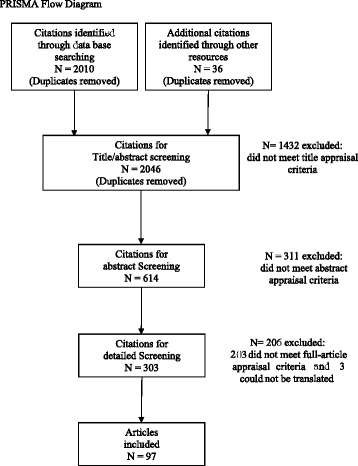
PRISMA flow diagram
Of the 97 included studies, 67 were case series, 14 were case–control studies, 5 were cohort studies, 5 were before-and-after studies, 5 were interrupted time series studies, and 1 was a time series study. As there were no studies that included a controlled comparison between ward closure and other interventions, the studies included in this review only allowed us to fulfill our first objective. Thus, this review purely focused on studies that described how ward closure was used as an outbreak control intervention and its impact on the outbreak.
From the details provided within the context of the setting and population, the studies were organized firstly by the organ system(s) affected and secondly by the genus of the causative pathogen within each of these organ system categories. The organ system and genus categorization lent itself very well to an additional categorization by the mode of transmission, which is the basis for infection prevention and control precautions. The organ system categories included: “gastrointestinal,” consisting of 17 studies; “respiratory,” consisting of 11 studies; and “multiple/mixed,” which includes the central nervous system, skin/soft tissue, urinary tract, eye, abdominal, and vascular or when more than one system is affected simultaneously and consisting of 63 studies. Of the studies in the third category, eight studies described predominant colonization, 12 studies described predominant infection, and 43 studies described a combination of colonization and infection. A sixth category included six studies that described the impact of infection control policies and of specific interventions on outbreak control. The modes of transmission relevant to our study included contact (both direct person-to-person and indirect via fomites and inanimate objects), droplet (via large droplets within a 1–2 m radius of the individual), and airborne (via small droplet nuclei capable of spreading over distance of greater than 2 m through the air [20]).
Gastrointestinal system (Table 1)
Table 1.
Summary table for accepted studies—gastrointestinal system
| Setting (beds); country | Definition of ward closure (length) | Other measures | Inpatient outcomes (includes index case(s))a | Controlled (Y, N, NA) | Due tob | |
|---|---|---|---|---|---|---|
| Clostridium difficile | ||||||
| Cherifi et al. [28] | 4 geriatric wards (97 total) at a teaching hospital (758); Belgium | No new admissions; no transfers (10d) | 8 | 21/92 in total: 11 (52 %) died; 6 (29 %) relapsed | Y | All |
| Hastie et al. [23] | Urological ward; England | No new admissions (1m) | 5 | 17/42 in total: all infected; 4 (24 %) relapsed | NA | Multiple |
| Ratnayake et al. [25] | Vascular acute surgery ward (24); Scotland | No new admissions (2w) | 7 | 9 in total: 2 (22 %) died | Y | All |
| Norovirus | ||||||
| Fretz et al. [22] | Internal medicine, intensive care, surgery, and orthopedics departments at a general hospital (176); Austria | No new admissions (3 occasions: 11d, 9d, 9d) | 3 | 56 in total | NA | All |
| Hoffmann et al. [36] | 34 wards at a teaching hospital; Germany | Limited transfers (6d) | 3 | 116 in total | Y | NA |
| Kanerva et al. [34] | 23 wards at a tertiary hospital (504); Finland | No new admissions; limited transfers | 5 | 240 in total: 181 (75 %) positive; 9 (4 %) died | NA | Multiple |
| McCall and Smithson [31] | Acute elderly care ward; Ireland | No new admissions; no transfers; limited discharges (3d) | 9 | 20 in total: 6 (30 %) positive, 14 (70 %) assumed | Y | All |
| Russo et al. [35] | 3 extended care (30 each), acute care (37) wards at an elderly extended care facility (380); Australia | No new admissions; limited discharges; (2 occasions: 22d, 13d) | 10 | 58 in total | N: seemed to limit the outbreak | Uncertain |
| Stevenson et al. [32] | 11 wards at a geriatric hospital (300); England | Stage 1: unspecified closure | Stage 1: 4 Stage 2: 3 Stage 3: 1 |
95 in total | N: outbreak declared over but new cases | All |
| Stage 2: no new admissions; no transfers; limited discharges (12d) | ||||||
| Weber et al. [26] | Pediatric psychiatric unit (10) at a teaching hospital; USA | No new admissions (9d) | 6 | 3/4 in total | Y | All |
| Zingg et al. [30] | 2 internal medicine wards at a tertiary hospital (960); Switzerland | No new admissions; no transfers | 6 | 16/115 in total: 12 (75 %) positive, 3 (19 %) assumed, 1 (6 %) symptomatic | N: reduced number of new cases | All |
| Rotavirus | ||||||
| Clark et al. [21] | Infectious disease (10) and general infant (16) wards; England | No new admissions (5d) | 3 | 20 in total | Y | All |
| Srinivasan et al. [37] | Neonatal unit; USA | Unspecified closure of transitional nursery | 5 | 23/28 in total: 5 (22 %) positive; 18 infected (78 %) | Y | Multiple |
| Widdowson et al. [27] | Neonatal medium care unit (15), and pediatric and maternity wards at a general hospital; The Netherlands | Closure 1: no new admissions and discharge of all cases | Wave 1: 2 Wave 2: 5 End of outbreak: 2 |
56/358 in total | Y: relapse after 2w | Multiple |
| Closure 2: no admissions and emptied of all patients (2 closures: 3d, 7d) | ||||||
| Salmonella panama | ||||||
| Kienitz et al. [24] | Pediatric ward in a specialty hospital; Germany | No new admissions | 3 | 16 in total | N: new cases after closure | NA |
| Small round structured virus | ||||||
| Green et al. [29] | Wards and a day hospital at a mentally infirm hospital; England | No new admissions; no transfers (17d) | 5 | 13/21 in total | N: new cases after measures | NA |
| Small round structured virus and small round featureless virus | ||||||
| Cunney et al. [33] | Geriatric, general, and neighboring wards; Ireland | No new admissions; limited transfers (15d) | 5 | 47 in total: 1 (2 %) died | Y | All |
d days, w weeks, m months, y years
aIncludes deaths directly, indirectly, and attributable to infection
bMultiple includes ward closure
We identified 17 studies [21–37] on outbreaks involving C. difficile, norovirus, rotavirus, Salmonella panama, small round structured virus, or small round structured virus and small round featureless virus. The primary mode of transmission for all these pathogens is direct person-to-person contact and indirect contact with contaminated surfaces [20]. The outbreaks occurred at single facilities, of which four occurred at the facility-wide level, and resulted in gastrointestinal system colonization and/or infection among 3–116 inpatients. Between two and ten intervention strategies were used in conjunction with ward closure to control the outbreaks.
The definition of ward closure varied across the studies, and ward closure lasted between 3 days and 1 month among the studies that reported length of closure. Six studies defined ward closure as prohibiting new admissions to the affected clinical area (i.e., unit/ward/bay) [21–26]. Widdowson and colleagues reported on a study that utilized a phased approach, first halting new admissions and discharging all cases, then halting all admissions and discharging all patients from the area [27]. Three studies described completely stopping both admissions and transfers [28–30]. New admissions and transfers were stopped and transfers were limited in the studies by McCall and Smithson and by Stevenson and colleagues [31, 32]. In addition to stopping new admissions, transfers were limited in two studies [33, 34] and discharges were limited in one study [35]. In Hoffman and colleagues’ study, only transfers were limited [36]. One study did not specifically describe their definition of closure [37].
Of nine studies that reported achieving outbreak containment, six attributed it to all the measures used [21, 25, 26, 28, 31, 33], two studies attributed it to multiple, but not all the measures used [27, 37], and one study did not specify which measures contributed to the outcome [36]. In two studies, the reduced number of new cases of colonization and infection was attributed to all the measures used [30, 32]. In two other studies, the authors were uncertain which measures contributed to the reduced number of new cases in one [35], while authors of the other did not report which measures contributed to the reduced number of new cases [29]. Kienitz and colleagues reported that new cases continued to be identified until the pediatric ward was closed; however, newly admitted patients became infected until commercial milk was found to be the source of the outbreak [24]. In three studies, the authors did not report whether the outbreaks were controlled; however, they reported that either all or a number of the measures that were used could be effective at achieving outbreak control [22, 23, 34].
Respiratory system (Table 2)
Table 2.
Summary table for accepted studies—respiratory system
| Study | Setting (beds); country | Definition of ward closure (length) | Other measures | Inpatient outcomes (includes index case(s))a | Controlled (Y, N, NA) | Due tob |
|---|---|---|---|---|---|---|
| Influenza A | ||||||
| Horcajada et al. [40] | Infectious disease and AIDS wards (23) at a tertiary care hospital (800); Spain | No new admissions (2w) | 7 | 8/23 in total | Y | All |
| Risa et al. [43] | Adult behavioral health unit (26) at a veterans hospital; USA | No new admissions | 9 | 8/26 in total | Y | Multiple |
| Sartor et al. [44] | Internal medicine unit (19) at a medical school affiliate (700); France | No new admissions | 3 | 9/22 in total: 2 (22 %) positive | Y | NA |
| Wong et al. [47] | General medical ward, 3 bays (30); Hong Kong, China | No new admissions; no transfers (8d) | 5 | 9/60 in total | Y | All |
| Parainfluenza | ||||||
| Moisiuk et al. [42] | Tertiary obstetric-neonatal facility (20); Canada | No new admissions (3w) | 8 | 12/19 in total: | Y | Hand hygiene |
| 6 (50 %) positive | ||||||
| Parainfluenza and respiratory syncytial virus | ||||||
| Jalal et al. [41] | Adult hematology unit (58) at a teaching hospital; UK | No new admissions (2m) | 5 | 30 in total (19 PIV-3, 7 RSV, 4 with both): 11 (37 %) died | Y | Multiple |
| Severe acute respiratory syndrome | ||||||
| Gopalakrishna et al. [46] | 3 tertiary hospitals (1400, 1600, unknown); Singapore | Hospital 1: hospital-wide undefined closure | Hospital 1: 7 | Hospital 1: 11 in total | Y (all 3 hospitals) | All (all 3 hospitals) |
| Hospital 2: no new admissions and discharges | Hospital 2: 4 | Hospital 2: 12 in total | ||||
| Hospital 3: no new admissions and discharges (10d) | Hospital 3: 1 | Hospital 3: 6 in total | ||||
| Liu et al. [48] | Primary and tertiary care at a referral medical center (2300); Taiwan, China | Undefined closure | 12 | 16 in total: 4 (25 %) died | Y | All |
| Owolabi and Kwolek [38] | Obstetrical unit at a general hospital; Canada | SARS 1: limited new admissions | SARS 1 (27d): 8 | NA | Y | NA |
| SARS 2: no new admissions (45d) | Days 5–49: 3 | |||||
| Streptococcus pneumoniae | ||||||
| Subramanian et al. [45] | ENT ward at a teaching hospital; UK | No new admissions; no discharges (1w) | 4 | 7 in total | Y | NA |
| Streptococcus pneumoniae and Streptococcus | ||||||
| Denton et al. [39] | Adult oncology unit (34); UK | No new admissions (11d) | 5 | 8 in total | Y | Closure |
d days, w weeks, m months, y years
aIncludes deaths directly, indirectly, and attributable to infection
bMultiple includes ward closure
Eleven studies examined outbreaks of influenza A, parainfluenza, parainfluenza and respiratory syncytial virus, severe acute respiratory syndrome, Streptococcus pneumoniae, or Streptococcus pneumoniae and Streptococcus spp. [38–48] The primary mode of transmission for these pathogens is via the combination of both droplet through respiratory secretions and direct and indirect contact [20]. The outbreaks occurred in one to multiple wards/units at single facilities, of which two were at the facility-wide level, and one was at multiple hospitals. The outbreaks resulted in respiratory system infection and/or colonization among 7–30 inpatients; the number of affected patients was not reported in one study [38]. In addition to ward closure, one to nine other interventions were used to control the outbreaks.
The affected clinical area was closed to new admissions in six studies [39–44]. New admissions were stopped in addition to discharges in two studies [45, 46] and transfers in another [47]. Liu and colleagues reported that construction work was undertaken during closure; however, they did not specify the details and length of closure [48]. In the study reported by Owolabi and Kwolek, admissions were initially limited then completely stopped [38]. Ward closure lasted from 1 week to 2 months in six studies; the length was not clear in two studies.
In the studies that achieved outbreak containment, this outcome was attributed to all the measures used in four studies [40, 46–48], and multiple, but not all the measures used in two others [41, 43]. Outbreak containment was attributed specifically to closure in one study [39] and hand hygiene in another [42]. In three studies, the authors did not report which measures contributed to outbreak control [38, 44, 45].
Other and multiple/mixed systems: predominant colonization (Table 3)
Table 3.
Summary table for accepted studies—other and multiple/mixed systems with predominant colonization
| Study | Setting (beds); country | Definition of ward closure (length) | Other measures | Inpatient outcomes (includes index case(s))a | Controlled (Y, N, NA) | Due tob |
|---|---|---|---|---|---|---|
| Enterococcus | ||||||
| Delamare et al. [49] | Adult ICU (16); France | Limited transfer; 4 ICU beds closed (8w) | 4 | 15 in total | Y | Multiple |
| Iosifidis et al. [53] | Pediatric oncology department (16) at a teaching hospital; Greece | No new admissions (3m) | 9 | 21/32 in total: 1 (5 %) died | Y | All |
| van der Steen et al. [54] | Internal medicine/nephrology and dialysis ward; The Netherlands | No new admissions (12d) | 7 | 12/91 in total: all positive | Y | All |
| Escherichia coli | ||||||
| Giuffrè et al. [52] | NICU (16) at a teaching hospital; Italy | No new admissions (3m) | 4 | 15/103 in total | Y | All |
| van der Zwet et al. [55] | Surgical ward in a specialty hospital; The Netherlands | No new admissions (~3d) | 5 | 8 in total | N: 3 patients colonized after | NA |
| Klebsiella pneumoniae | ||||||
| Rettedal et al. [50] | NICU (21) at a teaching hospital; Norway | No new admissions; limited transfers (70d) | 11 | 59 in total: 1 (2 %) infection | Y | All |
| Staphylococcus aureus | ||||||
| Barrett [51] | 2 adjacent orthopedic wards; England | Unspecified closure | 6 | 15 in total: all positive | Y | Antibiotic treatment |
| Troelstra et al. | A military hospital; The Netherlands | No new admissions (29d) | 4 | 3 in total | Y | Environmental disinfection |
d days, w weeks, m months, y years
aIncludes deaths directly, indirectly, and attributable to infection
bMultiple includes ward closure
The mode of transmission for the microbes described within this category is via contact [20]. Eight studies reported on outbreaks of Enterococcus, Escherichia coli, Klebsiella pneumoniae, or Staphylococcus aureus that resulted predominantly in colonization and involved 3–59 patients at single facilities [49–56]. Between 4 and 11 other interventions were used in addition to ward closure to control the outbreaks.
In six studies, no new admissions were permitted to the affected clinical area. Ward closure entailed limiting transfers and partial closure of four beds in the outbreak described by Delmare and colleagues [49] and restricting admissions and limiting transfers in the outbreak described by Rettedal and colleagues [50]. The length of closure ranged from approximately 3 days to 3 months. Barrett and colleagues did not specify their use of closure [51].
The authors of four studies attributed outbreak containment to all the measures implemented [50, 52–54]. Delamare and colleagues attributed control to multiple measures [49]. Barrett and colleagues attributed control to treating nasal carriers with nasal mupirocin [51], and van der Zwet and colleagues attributed control to cohorting of colonized patients [55]. Additional patients became colonized after control measures were implemented in one study [55].
Other and multiple/mixed systems: predominant infection (Table 4)
Table 4.
Summary table for accepted studies—other and multiple/mixed systems with predominant infection
| Study | Setting (beds); country | Definition of ward closure (length) | Other measures | Inpatient outcomes (includes index case(s))a | Controlled (Y, N, NA) | Due tob |
|---|---|---|---|---|---|---|
| Acinetobacter baumannii | ||||||
| Zanetti et al. [62] | Burn ICU (7); Switzerland | No new admissions (Phase 2: 2.5 m) | Phase 1: 4 | 5 in total (Phase 1: 2/3; Phase 2: 6/9) | Y | NA |
| Phase 2: 3 | ||||||
| Adenovirus | ||||||
| Finn et al. [58] | Intensive (16) and intermediate (18) care at a teaching hospital; USA | No new admission (ICN: 19d; MCN: 2w) | 8 | 9/34 in total (2, 7): 3 (33 %) positive, 2 (22 %) died | Y | All |
| Fujiwara et al. [65] | Ophthalmology ward at a teaching hospital; Japan | Limited then no new admissions (16d) | 5 | 17 in total | Y | All |
| Hamada et al. [67] | Ophthalmology unit at a teaching hospital; Japan | Closure undefined | 5 | 18 in total | Y | All |
| Kaneko et al. [64] | Ophthalmology ward at a teaching hospital; Japan | Limited admissions (1m) | 8 | 47 in total | Y | Environmental disinfection |
| Echo 19 virus | ||||||
| Purdham et al. [61] | Neonatal unit; England | No new admissions (9d) | 6 | 12 in total: 1 (8 %) died | Y | NA |
| Enterobacter cloacae | ||||||
| Dalben et al. [57] | Neonatal unit (63) at a teaching hospital (2200); Brazil | No new admissions | 5 | 7 in total: 4 (57 %) died | Y | Multiple, excluding closure |
| Escherichia coli | ||||||
| Lahoucine et al. [66] | Adult, pediatric hematology, oncology ward (36); Morocco | Closure undefined (1w) | 1 | 6 in total: 5 (83 %) died | Y | NA |
| Klebsiella pneumoniae | ||||||
| Moodley et al. [60] | Intensive care/high care area (34) at a regional hospital; USA | No new admissions | 4 | 26 in total: 22 (85 %) died | Y: after other measures | Multiple, excluding closure |
| Pseudomonas aeruginosa | ||||||
| Gupta et al. [59] | NICU; India | No new admissions | 5 | 48/2177 in total over 6 outbreaks: 11 (23 %) died | N: reduced cases | All |
| Zawacki et al. [63] | NICU (18) at a pediatric hospital; USA | No new admissions | 11 | 4 in total: 2 (50 %) died | Y | Treating HCW carriage |
| Staphylococcus aureus | ||||||
| Noone and Griffiths [7] | Gynecological, neurosurgical, gastroenterological, 2 acute general surgical wards; England | No new admissions | 4 | 28 in total (25 prior to cleaning ward, 3 after cleaning) | Y | Do not know |
d days, w weeks, m months, y years
aIncludes deaths directly, indirectly, and attributable to infection
bMultiple includes ward closure
The major mode of transmission for the microbes described within this category is via contact with the exception of adenovirus and the echovirus where both contact and droplet transmission occur [20]. We identified 12 studies that reported on outbreaks of Acinetobacter baumannii, adenovirus, echo 19 virus, Enterobacter cloacae, Escherichia coli, Klebsiella pneumoniae, Pseudomonas aeruginosa, or Staphylococcus aureus that resulted predominantly in infection among 4–48 patients [7, 57–67]. The authors reported using 1–11 interventions in addition to ward closure.
Ward closure involved closing the affected clinical area to new admissions in eight studies [7, 57–63]. Admissions to the affected clinical area were limited in two studies [64]. In the study reported by Fujiwara and colleagues [65], admissions were first limited and then completely stopped. Two studies did not define the closure used during the outbreak [66, 67]. Ward closure lasted from 1 to 10 weeks in seven studies that reported the length of closure.
Authors reported achieving outbreak control in 11 studies. This outcome was attributed to all the measures used in three studies [57, 65, 67]. Successful containment was attributed to multiple measures, excluding ward closure, in two studies [57, 60] and the treatment of HCW carriers in another [63]. How outbreak containment was achieved was unknown in three studies [7, 61, 62]. Gupta and colleagues attributed the reduction of new cases to all measures instituted [59]. Kaneko and colleagues attributed control specifically to environmental disinfection [64]. One study did not identify which measure(s) contributed to control [66].
Other and multiple/mixed systems: combination of colonization and infection (Table 5)
Table 5.
Summary table for accepted studies—other and multiple/mixed systems with combination of colonization and infection
| Study | Setting (beds); country | Definition of ward closure (length) | Other measures | Inpatient outcomes (includes index case(s))a | Controlled (Y, N, NA) | Due tob |
|---|---|---|---|---|---|---|
| Acinetobacter baumannii | ||||||
| Alfandari et al. [97] | ICU (16) and infectious diseases unit at a general hospital (400); France | Second outbreak: no new admissions | Stage 1: 8 Stage 2: 2 |
20 in total: 15 infected (75 %), 6 died (30 %) | Y | Multiple, particularly equipment disinfection |
| Ayraud-Thévenot et al. [69] | Surgical (15), medical (12), and intermediate care units (6) at a teaching hospital (1500); France | First outbreak: undefined partial and complete closure (1 m) Second outbreak: no new admissions |
First outbreak: 7 Second outbreak: 3 |
First outbreak: 20 in total: 16 (80 %) asymptomatic, 4 (20 %) infected, 1 (5 %) died Second outbreak: 7 in total: 3 (43 %) asymptomatic, 4 (57 %) infected |
Y | Closure |
| Enoch et al. [102] | Neurosciences critical care unit (21) and general ICU (14) at a teaching hospital (1100); UK | Phase 2: limited transfers (16d) | Phase 1: 5 | 19 in total (16, 3): 8 (42 %) died; 9 (47 %) positive; 10 (53 %) infected | Y | All |
| Phase 2: 6 | ||||||
| Phase 3: 5 | ||||||
| Koeleman et al. [76] | Surgical ward at a teaching hospital; The Netherlands | Stage 3: no new admissions (12d) | Stage 1: 2 | 13 in total: 8 (62 %) infected, 5 (38 %) colonized | Y | Closure for disinfection |
| Stage 2: 3 | ||||||
| Stage 3: 2 | ||||||
| Landelle et al. [77] | 5 ICUs: 4 surgical and 1 medical (95 total) at a teaching hospital (860); France | No new admissions | Phase 1: 5 | 86 in total | Y | Multiple excluding closure |
| Phase 2: 2 | ||||||
| Phase 3: 3 | ||||||
| Phase 4: 1 | ||||||
| Phase 5: 4 | ||||||
| Simor et al. [92] | Burn unit (14) at a teaching hospital; Canada | No new admissions (1w) | 8 | 31/247 in total: 18 (58 %) infected; 7 (23 %) died | Y | Multiple |
| Wagenvoort et al. [100] | ICU in a specialty hospital; The Netherlands | Limited admissions | 3 | 66 in total | Y | All |
| Coxsackie virus | ||||||
| Konjajev et al. [110] | Neonatal unit, Yugoslavia | Unspecified closure | 2 | 6 in total | Y | Closure |
| Enterobacter aerogenes | ||||||
| Piagnerelli et al. [109] | Geriatric acute unit (30); Belgium | Unspecified (20d) | 4 | 12 in total | Y | Closure |
| Enterococcus faecium | ||||||
| Bartley et al. [70] | Renal unit (30), infectious diseases unit at a teaching hospital (800); Australia | No new admissions (pre- and during outbreak) | Prior to outbreak: 5 | 47 in total | Y | Multiple |
| Outbreak: 11 | ||||||
| Ergaz et al. [73] | NICU (16); Israel | No new admissions (1m) | 6 | 11/18 in total: 3 (27 %) infections; 8 (73 %) positive | Y | Multiple |
| Liu et al. [80] | Surgical (15) and emergency (10) ICUs at a teaching hospital (1500); China | No new admission area (2w) | 5 | 8 in total | Y | All |
| Moretti et al. [83] | Gastroenterology clinic and several units at a teaching hospital; Brazil | No new admissions (15d) | Phase 1: 5 | 321 in total: 16 (5 %) infected | N: significant (p < 0.001) reduction in cases | Multiple |
| Phase 2: 3 | ||||||
| Sample et al. [95] | Hematology–oncology unit (32) at a teaching hospital (1100); Canada | Stage 1: limited admissions | 5 | 16 in total: 3 (23 %) died | Y | All |
| Stage 2: no new admissions | ||||||
| Enterobacter cloacae | ||||||
| Donkers et al. [72] | NICU at a teaching hospital; Holland | No new admissions (<1m) | 5 | 26 in total: 2 (8 %) died | Y | Dedicated and disposable equipment |
| Modi et al. [81] | NICU at a maternity hospital; England | No new admissions | 3 | 12 in total: 6 (50 %) positive; 6 (50 %); 2 (17 %) died | Y | All |
| van den Berg et al. [94] | NICU(15) at a tertiary hospital (950); The Netherlands | No new admissions | Stage 1: 5 | 32 in total: 2 (6 %) infected | Y | Mainly equipment disinfection |
| Stage 2: 5 | ||||||
| Escherichia coli | ||||||
| Moissenet et al. [82] | Neonatal ward (30) at a children’s teaching hospital; France | Phase 2: no new admissions (1w ≥ 2w) Phase 3: no new admissions (1w ≥ 2w) |
Phase 1: 5 | 26/59 in total | Y | Ward closure |
| Phase 2: 3 | ||||||
| Phase 4: 4 | ||||||
| Quinet et al. [85] | Neonatal unit (30); France | Limiting admissions to infants born at the hospital; no new admissions (6w) | 6 | 27/59 neonatal patients affected | Y | Closure |
| Klebsiella pneumoniae | ||||||
| Carbonne et al. [101] | Seven hospitals; France | All 7 hospitals: limited transfers | 7 | 13 in total: 4 (31 %) infected; 9 (69 %) positive | Y | All |
| Grogan et al. [103] | Pediatric intensive care; Ireland | No new admissions; limited discharges (1w) | 10 | 3 in total | Y | Multiple |
| Kassis-Chikhani et al. [104] | Abdominal surgery care center (81) in a teaching hospital (716); France | Limited new admissions; limited transfers | First 7m: 5 | 8 in total (6, 2); 4 (50 %) died | Y | Multiple |
| Next 4.5m: 6 | ||||||
| Laurent et al. [105] | 4 ICUs (6, 6, 8, 1) at a teaching hospital (858); Belgium | Limited transfers, no new admissions | 11 | 30 in total: 9 (30 %) infected; 3 (10 %) died | Y | All |
| Macrae et al. [106] | Intensive care section (8) and special care section (15) at a neonatal unit; UK | Stage 1: limited transfers (10d) Stage 2: no new admissions (39d) |
Stage 1: 5 Stage 2: 11 |
22 in total: 15 (68 %) positive; 1 (14 %) died | Y | Temporary ward opened so infected ward could be closed for disinfection |
| McKee Jr. et al. [75] | Intensive care nursery (30) at a teaching children’s hospital; USA | No new admissions (2w) | 6 | 26/232 in total: 21 (81 %) positive; 5 (19 %) infected; 1 (4 %) died | Y | All |
| Reish et al. [89] | NICU at a tertiary care center; Israel | No new admissions | 3 | 8 in total: 5 (63 %) infected; 3 (37 %) positive; 3 (37 %) died | Y | All |
| Ritter et al. [90] | Surgical ward in a specialty hospital; The Netherlands | No new admission | 4 | 11 (10 %) infected; 4 (36 %) died | Y | Disinfection during closure |
| Parvovirus | ||||||
| Pillay et al. [99] | General pediatric ward; England | Limited admissions | 5 | 9 in total: 2 (22 %) patients infected | Y | All |
| Seng et al. [91] | Adult surgical unit (28); England | No new admissions | 3 | 3/6 in total: 3 (50 %) positive; 3 (50 %) infected | Y | Author does not know |
| Salmonella | ||||||
| Newman [98] | NICU (18) at a teaching hospital; Ghana | Limited admissions | 3 | 21/72 in total | Y | Aseptic measures and closure |
| Serratia marcescens | ||||||
| Assadian et al. [68] | NICU (8) at a teaching hospital (2168); Austria | No new admissions (10d) | First outbreak: 4 | 8 in total: 5 (63 %) infected; 3 (37 %) positive | N: 2 of different isolates after 41d | NA |
| Second outbreak: 2 | ||||||
| Lewis et al. [78] | Neonatal; England | No new admissions (7w) | 9 | 13/24 in total: 2 (15 %) died | Y | Closure |
| Maragakis et al. [79] | NICU (36) at a tertiary care hospital (926); USA | No new admissions | 9 | 18 in total | Y | Closing beds to enable cohorting |
| Staphylococcus aureus | ||||||
| Boyce et al. [107] | Burn unit (4) at a teaching hospital (580); USA | Stage 1: restricted admissions (3 occasions) | 5 | 245 in total: 151 infections; 40 (26 %) deaths | N: new cases until permanent closure | Permanent closure |
| Stage 2: permanently closed | ||||||
| Danchivijitr et al. [96] | Burn unit; Thailand | Phase 1: No new admission (2m) | Phase 1: 3 | 19/29 in total: 14 (74 %) infected; 5 (26 %) positive; 5 (26 %) died | N | NA |
| Phase 2: 2 | ||||||
| Hill and Ferguson [74] | Special baby care unit (24) at a university hospital; UK | Stage 1: no new admissions (2 occasions: 10d, 2w) | 9 | 35/315 in total: 2 (6 %) infected; 1 (3 %) died | N | NA |
| Kluytmans et al. [108] | Hematology unit and surgical unit at a teaching hospital; The Netherlands | Undefined closure | Outbreak 1: 5 | 27 in total: 24 (89 %) infected; 5 (19 %) died | Y | Mainly external cohort isolation |
| Outbreak 2: 4 | ||||||
| Price et al. [84] | Neonatal medical and surgical unit; England | No new admissions | 13 | 11 in total: 2 (18 %) infected; 1 (9 %) died | Y | All |
| Rampling et al. [87] | Male surgical (37) and female surgical (32) wards; UK | Closure of one bay at a time; no new admissions | Phase 1: 7 | 69 in total (66, 3) | Y | Closure and environmental disinfection |
| Phase 2: 5 | ||||||
| Rashid et al. [88] | Burn unit (12) at a regional hospital; Ireland | No new admissions (2w) | 7 | 18/ 176 in total: 3 (17 %) infected | Y | All |
| Teare et al. [93] | Burn unit (20) and plastics unit (84); England | No new admission | Stage 1: 1 | 19 in total | Y | Treatment for HCW |
| Stage 2: 2 | ||||||
| Stage 3: 3 | ||||||
| Stage 4: 5 | ||||||
| Streptococcus | ||||||
| Deutscher et al. [71] | Long-term acute care hospital; USA | No new admissions (26d) | 9 | 19 in total: 8 (42 %) positive; 3 (16 %) assumed; 8 (42 %) asymptomatic; 2 (15 %) died | Y | All |
| Ramage et al. [86] | Medical unit (24) at a community hospital (235); Canada | No new admissions | 6 | 3/25 in total: 3 (100 %) died | Y | HCW treatment and infected inpatient deaths |
d days, w weeks, m months, y years
aIncludes deaths directly, indirectly, and attributable to infection
bMultiple includes ward closure
Of the remaining studies, 43 reported outbreaks that affected other or multiple organ systems and resulted in both of infection and colonization [68–110]. The major mode of transmission for the microbes described within this category is via contact with the exception of Coxsackie virus and parvovirus where both contact and droplet transmission occur [20]. The studies reported on outbreaks of the following: Acinetobacter baumannii, Coxsackie virus, Enterobacter aerogenes, Enterobacter cloacae, Enterococcus faecium, Escherichia coli, Klebsiella pneumoniae, parvovirus, Salmonella, Serratia marcescens, Staphylococcus aureus, or Streptococcus. For all but one study that involved a total of seven hospitals, the outbreaks occurred at one facility and affected a total of 3–245 patients.
Among these studies, the definition of ward closure varied widely and lasted from 1 week to 2 months in 19 studies that reported the length of closure. Ward closure was defined as limiting and then not accepting new admissions to the affected clinical area in 30 studies [68–97], limiting admissions in three studies [98–100] and limiting transfers in two studies [101, 102]. Ward closure entailed both stopping new admissions to the affected clinical area(s) and limiting transfers or discharges in four studies [103–106]. Boyce and colleagues reported that permanent closure of a burn unit was necessary to control a MRSA (methicillin-resistant Staphylococcus aureus) outbreak that could not be controlled by the use of other measures, including temporary closure on three occasions [107]. Three studies did not provide specifics of their use of ward closure [108–110].
Successful outbreak containment was reported in the vast majority of the studies. This outcome was attributed to multiple measures in five of the studies [70, 73, 92, 103, 104], multiple measures, excluding ward closure in one study [77], and to all the measures used in 13 of the studies [71, 75, 80, 81, 84, 88, 89, 95, 99–102, 105]. Other studies attributed outbreak control specifically to the closure of the affected ward(s) [69, 78, 82, 85, 109, 110], provision of dedicated and disposable equipment [72], disinfection of equipment [94, 97], construction of a cohort isolation ward outside of the affected hospital [108], disinfection of the affected clinical area(s) during closure [76, 87, 90, 98, 106], cohorting enabled by ward closure [79], and treatment of healthcare workers for carriage [93], as well as death of the infected inpatients [86]. Seng and colleagues reported not knowing which measure(s) contributed to outbreak containment [91]. While the authors of three studies reported unsuccessful containment [68, 74, 96]. Boyce and colleagues reported that permanent closure of the burn unit, the source unit, was necessary to control a MRSA outbreak on other units [107]. Moretti and colleagues reported that a combination of measures contributed to a statistically significant reduction (p < 0.001) in the number of cases of colonization and infection [83].
Studies on infection prevention and control policies or specific interventions (Table 6)
Table 6.
Summary table for accepted studies—infection prevention and control policies and specific interventions
| Setting (beds); country | Study length | Definition of ward closure | Main interventions | Outcomes | |
|---|---|---|---|---|---|
| Gastrointestinal: norovirus | |||||
| Haill et al. [13] | Teaching hospital (1200); England | 2005–2011 | Unspecified closure | 2005–2007: ward closure; meet criteria before reopening; terminal cleaning | Many norovirus outbreaks can be controlled by bay closures when combined with adequate infection control support |
| 2007–2011: isolation and cohorting in bays to facilitate disinfection | New policy led to reduction in: duration of closure from 6d to 5d and bed-days lost from 180 to 96 | ||||
| Illingworth et al. [12] | Teaching hospital (1100); England | 2006–2010 | Unspecified bay closures | 2006–2008: Early ward closure | New policy led to significant reduction in: length of closure (p < 0 .041) and in bed-days lost (p < 0.001) |
| 2008–2010: Closure of ward bays; architectural installation; environmental disinfections; enlarged infection control team | |||||
| Other and multiple/mixed systems with predominant infection Acinetobacter baumannii | |||||
| García et al., 2009 [114] | 2 ICUs (30, 24) at a tertiary hospital (934); Spain | 2006–2007 | Unspecified sequential closure | Cleaning/disinfection (intervention); clinical procedures limited; isolation; dedicated HCW; contact precautions; HCW and environmental screening; education | Cleaning/disinfection led to a decrease from 3.2 to 1.6 episodes per 100 patients, and incidence density of 9.2 to 5 infections per 1000d of stay |
| Other and multiple/mixed systems with combination of colonization and infection: Staphylococcus aureus | |||||
| Farrington et al. [111] | Teaching hospital (1000); England | 1985–1997 | No new admissions; limited transfers | 1985–1994: MRSA screening upon admission to ICU; isolation; ward closure; disinfection | Relaxation of policy and increase MRSA upon admission led to an increased in MRSA cases from 1 to 2 in 1994 to 74 cases in 1997 |
| 1994–1997: relaxed closure/reopen and screening criteria | |||||
| Selkon et al. [112] | General hospital (1000 beds); England | 1967–1978 | Unspecified closure | 1967–1972: ward closure; standard barrier nursing methods | Ward closure and barrier nursing did not control the outbreaks |
| 1972–1978: limited transfer; construction of a isolation unit with control ventilation | New policy led to reduction in incidence rate of MRSA infection from 6.57 to 5.08 cases per 1000 admissions; from 130 to 14 cases of infection | ||||
| Combination of colonization and infection: Clostridium difficile and Staphylococcus aureus | |||||
| Stone et al. [113] | Acute medical wards (66) at an acute geriatrics hospital; England | 1994–1996 | Unspecified closure | 1994–1995: ward closure; national guidelines | Ward closure and national guidelines did not control the outbreaks |
| 1995–1996: hand hygiene; education/ communication; antimicrobial treatment restricted | New policy led to reduction in: incidence rate of C. difficile infection from 3.35 cases to 1.94 cases per 100 admissions (p < 0.05), and MRSA incidence from 3.95 to 194 cases per 100 admissions (p < 0.01) | ||||
d days, w weeks, m months, y years
We identified six studies that focused on the impact of specific infection prevention and control policies or a control intervention [12, 13, 111–114]. The mode of transmission for the microbes described within this category is via contact [20]. All the studies involved new policies and/or interventions that influenced ward closure prerequisites, ward re-opening criteria, and impact of alternate measures to that of ward closure on outbreak control. Recorded outcomes of the new policies and interventions include duration of closure in two studies [12, 13], bed-days lost in two studies [12, 13], and rate of new infection cases in four studies [111–114].
In two studies reporting on norovirus outbreak(s), bay closures supplemented with other measures were reported to have a greater impact on the reduction of closure length and bed-days lost than ward closure as a primary intervention [12, 13]. Although a number of other interventions were used, Garcia and colleagues attributed a reduction in the episodes and incidence density of infections to cleaning and disinfection during sequential closure of affected clinical areas [114]. In two other studies, the authors indicated that successful containment could not be achieved when ward closure was used as part of the control strategy. In their 11-year study, Selkon and colleagues found that a dedicated isolation unit with controlled ventilation was crucial to reducing the incidence rate of nosocomial MRSA infections [112]. Stone and colleagues observed a significant decrease in the incidence rates of C. difficile infection and MRSA when a new policy entailing hand hygiene, education, and restriction on antimicrobial treatment was implemented [113]. Lastly, Farrington and colleagues reported on the incidence of MRSA during the application of a MRSA control policy aimed at eradication over 10.5 years and relaxation of the same policy for the next 1.5 years [111]. The authors reported a notable increase in MRSA incidence following the relaxation period; however, the authors noted that the increase could not be solely attributed to the relaxation of the policy as there was also an increase in admission of MRSA carriers.
Risk of bias
Owing to the nature of the studies included in this review, a number of potential confounders and sources of bias were identified. Firstly, none of the studies controlled for confounding, and the majority of them did not address the confounding factor bias when discussing the impact of the interventions used. All of the studies used ward closure in combination with other interventions, and as such, the impact of each measure on outbreak containment could not be determined. Relatedly, there may also have been a potential for a dose–response relationship in studies that increased the extent of ward closure, for example, from closing the unit to select admissions to closing to all admissions. Secondly, there is the potential for selection bias in studies that did not use epidemiological typing and, subsequently, could not confirm that all affected patients were colonized or infected with the same strain of the causative pathogen. Another source of bias stems from the selection of specific outcomes. Furthermore, some of the case definitions relied on the presence of symptoms and did not confirm cases with any diagnostic method or epidemiological typing, resulting in case finding bias. The studies could have also been subject to recall bias as the vast majority of articles are retrospective. As all the articles included in this study reported on successfully controlled outbreaks, it is highly likely that the reviewed literature is vulnerable to publication bias. Many of the articles failed to address these potential sources of bias that may have contributed to the main findings and, particularly, the impact of ward closure on containing the outbreaks. This failure may be attributed to the retrospective and observational nature of outbreak investigation studies. Fourthly, definitions of ward closure were varied between studies, potentially creating bias in understanding the impact of ward closure and in determining whether the studies used complete or partial closure.
Discussion
We sought to identify studies that describe the use of ward closure as an intervention in outbreak control and determine its importance. Our systematic review expands on existing work by providing an extensive review of the epidemiological literature on the use of ward closure as an intervention to control outbreaks of pathogenic microbes among inpatients hospitalized in acute care settings. We identified 97 studies that described the use of ward closure as part of a bundled approach to their strategy. None of the studies used ward closure in a setting where it was able to be isolated as a singular control measure, limiting our assessment of the direct efficacy of ward closure on outbreak containment, which was one of our primary objectives.
It was not possible to draw any firm conclusions about the impact or effect of ward closure from the studies for a number of reasons. Firstly, the use of “ward closure” varied considerably within the papers included in the review. Our review was unable to identify whether partial or complete closure was instituted in the vast majority of the studies, as precise definitions were not used to describe the type or nature of ward closure. The results suggest that there is not a universal definition of “ward closure”; rather, ward closure refers to restrictions on patient movement into and out of a unit/ward or a facility and could encompass a number of qualities and multiple phases and/or degrees of application. Secondly, with the exception of the prevention and control policy and intervention studies, all of the studies of the included papers were reports or descriptions of outbreak investigations. As investigators could not manipulate exposures (i.e., the outbreak), all outbreak studies were observational in nature and the results were thus susceptible to a number of potential confounders. The vast majority of the included articles did not record these potential confounders or were not adjusted accordingly in any type of additional analysis. The studies were vulnerable to multiple biases, including confounding factor bias, publication bias, and recall bias, and none of them reported taking measures to prevent them or address their source. As Cooper and colleagues [115] noted, these studies generally did not meet standards of planned research as most, if not all, outbreak reports were written retrospectively. Thus, the majority of the included studies were considered to be of poor quality as the nature of outbreak investigation reports rendered the use of high-quality study designs such as randomized controlled trials unfeasible. Thirdly, all of the studies used combinations of measures in an attempt to reduce or terminate transmission. As a result, the relative contribution of each measure, and especially ward closure, could not be determined. The lack of attribution could be due to the reporting style, as many authors listed all the measures used without providing information on whether they were instituted consecutively or concurrently. Overall, ward closure was generally used at a late stage in conjunction with other measures, primarily hygienic and disinfection measures. Finally, considerable variability across the studies limits the generalizability and comparability of the outcomes of the studies. Thus, we considered the conclusions to be very weak when authors stated that the containment of an outbreak could be attributed to any one of the measures used as potential alternative factors accounting for the main findings could not be dismissed.
Our review highlights potential areas for further research on the role of ward closure as an intervention measure for managing and terminating outbreaks. Improving the quality of reporting can be a first step to addressing the difficulties in assessing the applicability and generalizability of these studies [116]. Given the complexities of outbreak investigations and the nature of the studies, clear and detailed reporting enables greater understanding of the context of the outbreak, the outbreak itself, and the control measures used, which may or may not include ward closure. Reports of outbreaks that use ward closure should include a clear definition or description of ward closure, timing of ward closure, and at which point it was used in the investigation. Given the nature of outbreak investigations, an experimental design would not be feasible. However, since the role if any of ward closure in containing outbreaks is unknown, quasi-experimental design is ethically unacceptable. Future research can improve the rigor and internal validity by using study designs of higher quality such as prospective cohort studies and cluster randomized trials. For example, a cluster randomized design study of ward closure, or no ward closure plus a defined bundle of other interventions for specified outbreak organisms, could be conducted.
Further, formal assessment of the frequency and outcomes of unit closure versus no unit closure during an outbreak could be undertaken. This should include gathering information on the type of outbreak where a unit is closed, duration of the outbreak, whether or not the unit is closed, and the impact on patient flow, examining both admission and discharge. While there are some inconsistencies in the quality and format of reporting, there are some metrics that are consistently reported, including number of beds, length of closure, and bed-days lost. This information could inform an economic study using modeling to predict the cost of implementing ward closure. Finally, there are potential ethical and legal considerations in deciding whether to implement closure of care settings during outbreaks that are not addressed in the literature reviewed nor within this review. On the one hand, failure to restrict admissions implies that new and unaffected patients are knowingly admitted to an area known to have ongoing transmission of a potential pathogen; on the other hand, closure of a clinical area may reduce access to care.
While this review was undertaken with rigor and in accordance with the requirements of systematic review methodology, it is important to note its limitations. Firstly, for the majority of articles, data were extracted by a single reviewer; however, initial screening was undertaken rigorously by two reviewers, and disagreements were resolved with a third-party adjudicator. Secondly, the literature available for this review could report a positive effect of ward closure, as it is possible that there are many outbreaks that were controlled without using ward closure and were never published. Similarly, outbreaks where interventions failed to control transmission leading to endemic transmission are less likely to be published. For example, it is common for long-term care facilities to use ward (or facility) closure (along with other interventions) to control gastrointestinal and respiratory outbreaks, and these are seldom published. While the outbreaks are generally controlled and the ward (or facility) is re-opened, the key question is whether ward closure is necessary and effective. Lastly, the review is based on the last electronic search which was completed in July 2014, and as such the review may not be entirely up to date.
It can be concluded that ward closure for containment of outbreaks remains an intervention that is not evidence based in the traditional sense; however, this review demonstrates that ward closure is frequently used and was always used as part of a bundled approach, whether as part of a sequence of, or in parallel with, other interventions, and in this sense, is similar to other public health responses. However, it was interesting to observe that in the majority of the studies in this review, ward closure was applied in the late stages of the overall outbreak response rather than as a first measure. In addition, in 16 studies, despite the use of ward closure, additional cases continued to be reported, suggesting that ward closure was not an effective intervention in these settings. Other than general wards, which were not described well, burn units (n = 3), geriatric wards (n = 3), and neonatal intensive care units (n = 2) were reported more than once (Tables 1, 3, 4, 5, and 6). The most frequently recorded mode of transmission was contact with viral gastrointestinal-associated viruses (four norovirus and one small round structured virus) and bacterial (S. panama, C. difficile, E. faecium, and E. coli), making up 56 % of the pathogenic species. These pathogens are known for their persistence within environmental niches and relative resistance to commonly used disinfectants.
There are also potential ethical considerations in the closure of wards during outbreaks that are not addressed within the context of the reviewed studies and would need to be taken into consideration by infection control personnel and hospital administrators. Admitting new and unaffected individuals to a hospital ward that is known to have ongoing transmission of a potential pathogen, particularly if associated with a high case fatality rate, warrants careful deliberation. The risk of new transmissions needs to be juxtaposed against the failure to contain the outbreak despite closure, the disruption of care delivery, and lack of access to care for other patients and overloading other care units, particularly emergency departments, where the risks of overcrowding and delayed care present other challenges.
With no published controlled studies associated with a benefit from ward closure, infection control practitioners and hospital administrators will need to continue to balance the competing risks, taking into consideration the nature of the outbreak, the type of pathogen and its virulence, mode of transmission, and the setting in which it occurs and take reasonable steps to protect patients, and since ward closure has been used in the past, it will likely continue to be used as an intervention strategy until better quality evidence is available.
Conclusions
The present systematic review could not ascertain the impact of ward closure on outbreak containment for any of the included studies based on our primary objective. Ward closure was commonly reported as an intervention during the course of a wide range of outbreaks, and outbreak control was described in most settings with the use of ward closure, usually in the late stages of the outbreak and was always used in parallel or in sequence with other interventions. Our results highlight that there is no universal definition of ward closure, as it has been defined in various and imprecise ways in the included studies. Since the published literature to date consists of uncontrolled observational study designs that were vulnerable to a number of potential confounders and biases, the actual impact of ward closure could not be determined. Our review has identified a number of research gaps and new opportunities for future investigations. In particular, the ability to determine the generalizability and applicability of ward closure as a control intervention could be improved by standardizing outbreak investigation reporting to include information on the use, role, precision of definition, and timing of ward closure.
Acknowledgements
We also acknowledge Audrey Groeneveld for contributing to the design of the review, Wrechelle Ocampo for assisting with data analysis, Murtaza Dahodwala for assistance with organizing the paper, and Julie Stromer, Satchan Takaya, Garielle Brown, Alissa Staples, and Dr. Maria Santana for translating the non-English articles.
Abbreviations
- AIDS
acquired immunodeficiency syndrome
- ARO
antibiotic-resistant organism
- CDCP
Centers for Disease Control and Prevention
- HAI
healthcare-acquired infections
- HCW
healthcare worker
- ICN
intensive care nursery
- ICU
intensive care unit
- MCN
Intermediate care nursery
- MRSA
methicillin-resistant Staphylococcus aureus
- NICU
neonatal intensive care unit
- PIV
parainfluenza virus
- RSV
respiratory syncytial virus
- SARS
severe acute respiratory syndrome
- WHO
World Health Organization
Additional file
MEDLINE Search Strategy. (DOCX 23 kb)
Footnotes
Competing interests
AJ, GT, BM, WG, and JC are physicians who work within, but are not employees of, Alberta Health Services and were part of the review to provide clinical expertise in this area. CP is an employee of Alberta Health Services and was part of the review to provide clinical expertise in this area. None of the listed authors have any conflicts of interest, financial or otherwise.
Authors’ contributions
All authors made substantial contributions to this review, writing of the manuscript and/or revision of the final draft. Specific author contributions are as follows: HW and KE assisted with protocol development, analyzed the data analysis, and drafted the manuscript. JJ and AI analyzed the data and drafted the manuscript. YK and SP assisted with protocol development, provided library support, including conducting the literature search, and revised the manuscript. RG contributed to the development of the protocol, provided project management of the review, and revised the manuscript JG, MS, AJ, GD, BM, CP, WG, and JC contributed to the development of the protocol and revised the manuscript. JC provided overall supervision. All authors read and approved the final manuscript.
References
- 1.Magill SS, Edwards JR, Bamberg W, Beldavs ZG, Dumyati G, Kainer MA, et al. Multistate point-prevalence survey of health care-associated infections. N Engl J Med. 2014;370(13):1198–208. doi: 10.1056/NEJMoa1306801. [DOI] [PMC free article] [PubMed] [Google Scholar]
- 2.Antibiotic resistance threats in the United States, 2013. U.S. Department of Health and Human Services. Centers for Disease Control and Prevention. Available from: http://www.cdc.gov/drugresistance/threat-report-2013/. Accessed Oct 30 2015.
- 3.Khabbaz RF, Moseley RR, Steiner RJ, Levitt AM, Bell BP. Challenges of infectious diseases in the USA. Lancet. 2014;384(9937):53–63. doi: 10.1016/S0140-6736(14)60890-4. [DOI] [PMC free article] [PubMed] [Google Scholar]
- 4.Zoutman DE, Ford BD, Bryce E, Gourdeau M, Hébert G, Henderson E, et al. The state of infection surveillance and control in Canadian acute care hospitals. Am J Infect Control. 2003;31(5):266–73. doi: 10.1067/mic.2003.88. [DOI] [PubMed] [Google Scholar]
- 5.Munk S, Jensen NJF, Andersen I, Kehlet H, Hansen TB. Effect of compression therapy on knee swelling and pain after total knee arthroplasty. Knee Surg Sports Traumatol Arthrosc. 2013;21(2):388–92. doi: 10.1007/s00167-012-1963-0. [DOI] [PubMed] [Google Scholar]
- 6.Miller MA, Hyland M, Ofner-Agostini M, Gourdeau M, Ishak M. Morbidity, mortality, and healthcare burden of nosocomial Clostridium difficile-associated diarrhea in Canadian hospitals. Infect Control Hosp Epidemiol. 2002;23(3):137–40. doi: 10.1086/502023. [DOI] [PubMed] [Google Scholar]
- 7.Noone P, Griffiths RJ. The effect on sepsis rates of closing and cleaning hospital wards. J Clin Pathol. 1971;24(8):721–5. doi: 10.1136/jcp.24.8.721. [DOI] [PMC free article] [PubMed] [Google Scholar]
- 8.Hansen S, Stamm-Balderjahn S, Zuschneid I, Behnke M, Rüden H, Vonberg RP, et al. Closure of medical departments during nosocomial outbreaks: data from a systematic analysis of the literature. J Hosp Infect. 2007;65(4):348–53. doi: 10.1016/j.jhin.2006.12.018. [DOI] [PMC free article] [PubMed] [Google Scholar]
- 9.Key infection control recommendations for the control of norovirus outbreaks in healthcare settings. U.S. Department of Health and Human Services. Centers for Disease Control and Prevention. 2011. Available from: http://www.cdc.gov/hai/pdfs/norovirus/229110A-NorovirusControlRecomm508A.pdf. Accessed Oct 30 2015.
- 10.Royal Cornwall Hospitals. NHS Trust. Ward Clsoure Policy. V3.0 http://www.rcht.nhs.uk/DocumentsLibrary/RoyalCornwallHospitalsTrust/Clinical/InfectionPreventionAndControl/WardClosures.pdf. acessed Oct 30 2015
- 11.MacCannell T, Umscheid C, Agarwal R, Lee I, Kuntz G, Stevenson K, et al. Guideline for the prevention and control of norovirus gastroenteritis outbreaks in healthcare settings. Infect Control Hosp Epidemiol. 2011;32(10):939–69. doi: 10.1086/662025. [DOI] [PubMed] [Google Scholar]
- 12.Illingworth E, Taborn E, Fielding D, Cheesbrough J, Diggle PJ, Orr D. Is closure of entire wards necessary to control norovirus outbreaks in hospital? Comparing the effectiveness of two infection control strategies. J Hosp Infect. 2011;79(1):32–7. doi: 10.1016/j.jhin.2011.04.024. [DOI] [PubMed] [Google Scholar]
- 13.Haill CF, Newell P, Ford C, Whitley M, Cox J, Wallis M, et al. Compartmentalization of wards to cohort symptomatic patients at the beginning and end of norovirus outbreaks. J Hosp Infect. 2012;82(1):30–5. doi: 10.1016/j.jhin.2012.05.015. [DOI] [PubMed] [Google Scholar]
- 14.Harris JP, Adak GK, O’Brien SJ. To close or not to close? Analysis of 4 year’s data from national surveillance of norovirus outbreaks in hospitals in England. BMJ. 2014;4(1) doi: 10.1136/bmjopen-2013-003919. [DOI] [PMC free article] [PubMed] [Google Scholar]
- 15.Alberta Health Services. Guidelines for outbreak prevention, control and management in acute care and facility living sites. AHS Population, Public and Aboriginal Health, Infection Prevention and Control, Workplace Health and Safety. 2015Available from: http://www.albertahealthservices.ca/Diseases/hi-dis-flu-prov-hlsl.pdf. Accessed Oct 30 2015.
- 16.Jüni P, Altman DG, Egger M. Assessing the quality of controlled clinical trials. BMJ. 2001;323(7303):42–6. doi: 10.1136/bmj.323.7303.42. [DOI] [PMC free article] [PubMed] [Google Scholar]
- 17.GRADEpro. Cochrane informatics and knowledge management department. [February 2014]; Available from: http://tech.cochrane.org/revman/other-resources/gradepro/resources. Accessed Oct 30 2015.
- 18.Downs SH, Black N. The feasibility of creating a checklist for the assessment of the methodological quality both of randomised and non-randomised studies of health care interventions. J Epidemiol Community Health. 1998;52(6):377–84. doi: 10.1136/jech.52.6.377. [DOI] [PMC free article] [PubMed] [Google Scholar]
- 19.Hsu J, Santesso N, Mustafa R, Brozek J, Chen YL, Hopkins JP, et al. Antivirals for treatment of influenza: a systematic review and meta-analysis of observational studies. Ann Intern Med. 2012;156(7):512–24. doi: 10.7326/0003-4819-156-7-201204030-00411. [DOI] [PMC free article] [PubMed] [Google Scholar]
- 20.Public Health Agency of Canada. Routine practices and additional precautions for preventing the transmission of infections in healthcare settings. Public Health Agency of Canada; 2012. Available from: http://www.ipac-canada.org/pdf/2013_PHAC_RPAP-EN.pdf. Accessed Oct 30 2015.
- 21.Clark JD, Hill SM, Phillips AD. Investigation of hospital-acquired rotavirus gastroenteritis using RNA electrophoresis. J Med Virol. 1988;26(3):289–99. doi: 10.1002/jmv.1890260309. [DOI] [PubMed] [Google Scholar]
- 22.Fretz R, Schmid D, Jelovcan S, Tschertou R, Krassnitzer E, Schirmer M, et al. An outbreak of norovirus gastroenteritis in an Austrian hospital, winter 2006–2007. Wien Klin Wochenschr. 2009;121(3–4):137–43. doi: 10.1007/s00508-008-1135-x. [DOI] [PubMed] [Google Scholar]
- 23.Hastie KJ, Weymont G, Lewis DA. An outbreak of Clostridium difficile-associated diarrhoea in urological practice: a potential consequence of excessive antibiotic prophylaxis? J R Coll Surg Edinb. 1989;34(3):146–8. [PubMed] [Google Scholar]
- 24.Kienitz M, Licht W, Richter M. Kleinraumepidemie durch Salmonella panama im bereich einer pflegeeinheit. Med Klin. 1977;72(18):806–8. [PubMed] [Google Scholar]
- 25.Ratnayake L, McEwen J, Henderson N, Nathwani D, Phillips G, Brown D, et al. Control of an outbreak of diarrhoea in a vascular surgery unit caused by a high-level clindamycin-resistant Clostridium difficile PCR ribotype 106. J Hosp Infect. 2011;79(3):242–7. doi: 10.1016/j.jhin.2011.06.013. [DOI] [PubMed] [Google Scholar]
- 26.Weber DJ, Sickbert Bennett EE, Vinjé J, Brown VM, MacFarquhar JK, Engel JP, et al. Lessons learned from a norovirus outbreak in a locked pediatric inpatient psychiatric unit. Infect Control Hosp Epidemiol. 2005;26(10):841–3. doi: 10.1086/502504. [DOI] [PubMed] [Google Scholar]
- 27.Widdowson M, van Doornum GJ, van der Poel WH, de Boer AS, van de Heide R, Mahdi U, et al. An outbreak of diarrhea in a neonatal medium care unit caused by a novel strain of rotavirus: investigation using both epidemiologic and microbiological methods. Infect Control Hosp Epidemiol. 2002;23(11):665–70. doi: 10.1086/501991. [DOI] [PubMed] [Google Scholar]
- 28.Cherifi S, Delmee M, van Broeck J, Beyer I, Byl B, Mascart G. Management of an outbreak of Clostridium difficile-associated disease among geriatric patients. Infect Control Hosp Epidemiol. 2006;27(11):1200–5. doi: 10.1086/507822. [DOI] [PubMed] [Google Scholar]
- 29.Green J, Wright PA, Gallimore CI, Mitchell O, Morgan-Capner P, Brown DWG. The role of environmental contamination with small round structured viruses in a hospital outbreak investigated by reverse-transcriptase polymerase chain reaction assay. J Hosp Infect. 1998;39(1):39–45. doi: 10.1016/S0195-6701(98)90241-9. [DOI] [PubMed] [Google Scholar]
- 30.Zingg W, Colombo C, Jucker T, Bossart W, Ruef C. Impact of an outbreak of norovirus infection on hospital resources. Infect Control Hosp Epidemiol. 2005;26(3):263–7. doi: 10.1086/502537. [DOI] [PubMed] [Google Scholar]
- 31.McCall J, Smithson R. Rapid response and strict control measures can contain a hospital outbreak of Norwalk-like virus. Commun Dis Public Health. 2002;5(3):243–6. [PubMed] [Google Scholar]
- 32.Stevenson P, McCann R, Duthie R, Glew E, Ganguli L. A hospital outbreak due to norwalk virus. J Hosp Infect. 1994;26(4):261–72. doi: 10.1016/0195-6701(94)90016-7. [DOI] [PubMed] [Google Scholar]
- 33.Cunney RJ, Costigan P, McNamara EB, Hayes B, Creamer E, LaFoy M, et al. Investigation of an outbreak of gastroenteritis caused by norwalk-like virus, using solid phase immune electron microscopy. J Hosp Infect. 2000;44(2):113–8. doi: 10.1053/jhin.1999.0671. [DOI] [PubMed] [Google Scholar]
- 34.Kanerva M, Maunula L, Lappalainen M, Mannonen L, von Bonsdorff CH, Anttila VJ. Prolonged norovirus outbreak in a Finnish tertiary care hospital caused by GII.4-2006b subvariants. J Hosp Infect. 2009;71(3):206–13. doi: 10.1016/j.jhin.2008.11.016. [DOI] [PubMed] [Google Scholar]
- 35.Russo PL, Spelman DW, Harrington GA, Jenney AWJ, Gunesekere IC, Wright PJ, et al. Hospital outbreak of norwalk-like virus. Infect Control Hosp Epidemiol. 1997;18(8):576–9. doi: 10.2307/30141270. [DOI] [PubMed] [Google Scholar]
- 36.Hoffmann D, Seebach J, Foley BT, Frösner G, Nadas K, Protzer U, et al. Isolated norovirus GII.7 strain within an extended GII.4 outbreak. J Med Virol. 2010;82(6):1058–64. doi: 10.1002/jmv.21755. [DOI] [PubMed] [Google Scholar]
- 37.Srinivasan G, Azarcon E, Muldoon MRL, Jenkins G, Polavarapu S, Kallick CA, et al. Rotavirus infection in normal nursery: Epidemic and surveillance. Infect Control. 1984;5(10):478–81. doi: 10.1017/s0195941700060884. [DOI] [PubMed] [Google Scholar]
- 38.Owolabi T, Kwolek S. Managing obstetrical patients during severe acute respiratory syndrome outbreak. J Obstet Gynaecol Can. 2004;26(1):35–41. doi: 10.1016/S1701-2163(16)30694-6. [DOI] [PMC free article] [PubMed] [Google Scholar]
- 39.Denton M, Hawkey PM, Hoy CM, Porter C. Co-existent cross-infection with Streptococcus pneumoniae and group B streptococci on an adult oncology unit. J Hosp Infect. 1993;23(4):271–8. doi: 10.1016/0195-6701(93)90144-O. [DOI] [PubMed] [Google Scholar]
- 40.Horcajada JP, Pumarola T, Martínez JA, Tapias G, Bayas JM, de la Prada M, et al. A nosocomial outbreak of influenza during a period without influenza epidemic activity. Eur Respir J. 2003;21(2):303–7. doi: 10.1183/09031936.03.00040503. [DOI] [PubMed] [Google Scholar]
- 41.Jalal H, Bibby DF, Bennett J, Sampson RE, Brink NS, MacKinnon S, et al. Molecular investigations of an outbreak of parainfluenza virus type 3 and respiratory syncytial virus infections in a hematology unit. J Clin Microbiol. 2007;45(6):1690–6. doi: 10.1128/JCM.01912-06. [DOI] [PMC free article] [PubMed] [Google Scholar]
- 42.Moisiuk SE, Robson D, Klass L, Kliewer G, Wasyliuk W, Davi M, et al. Outbreak of parainfluenza virus type 3 in an intermediate care neonatal nursery. Pediatr Infect Dis J. 1998;17(1):49–53. doi: 10.1097/00006454-199801000-00011. [DOI] [PubMed] [Google Scholar]
- 43.Risa KJ, McAndrew JM, Muder RR. Influenza outbreak management on a locked behavioral health unit. Am J Infect Control. 2009;37(1):76–8. doi: 10.1016/j.ajic.2008.05.008. [DOI] [PubMed] [Google Scholar]
- 44.Sartor C, Zandotti C, Romain F, Jacomo V, Sophie S, Atlan-Gepner C, et al. Disruption of services in an internal medicine unit due to a nosocomial influenza outbreak. Infect Control Hosp Epidemiol. 2002;23(10):615–9. doi: 10.1086/501981. [DOI] [PubMed] [Google Scholar]
- 45.Subramanian D, Sandoe JAT, Keer V, Wilcox MH. Rapid spread of penicillin-resistant Streptococcus pneumoniae among high-risk hospital inpatients and the role of molecular typing in outbreak confirmation. J Hosp Infect. 2003;54(2):99–103. doi: 10.1016/S0195-6701(03)00110-5. [DOI] [PubMed] [Google Scholar]
- 46.Gopalakrishna G, Choo P, Leo YS, Tay BK, Lim YT, Khan AS, et al. SARS transmission and hospital containment. Emerg Infect Dis. 2004;10(3):395. doi: 10.3201/eid1003.030650. [DOI] [PMC free article] [PubMed] [Google Scholar]
- 47.Wong BCK, Lee N, Li Y, Chan PKS, Qiu H, Luo Z, et al. Possible role of aerosol transmission in a hospital outbreak of influenza. Clin Infect Dis. 2010;51(10):1176–83. doi: 10.1086/656743. [DOI] [PMC free article] [PubMed] [Google Scholar]
- 48.Liu JW, Lu SN, Chen SS, Yang KD, Lin MC, Wu CC, et al. Epidemiologic study and containment of a nosocomial outbreak of severe acute respiratory syndrome in a medical center in Kaohsiung, Taiwan. Infect Control Hosp Epidemiol. 2006;27(5):466–72. doi: 10.1086/504501. [DOI] [PubMed] [Google Scholar]
- 49.Delamare C, Lameloise V, Lozniewski A, Perrin M, Baudin C, Sellies J, et al. Épidémie en réanimation médicochirurgicale d’Enterococcus faecium résistants aux glycopeptides (ERG) avec cocirculation de deux clones différents. Pathol Biol. 2008;56(7–8):454–60. doi: 10.1016/j.patbio.2008.07.034. [DOI] [PubMed] [Google Scholar]
- 50.Rettedal S, Löhr IH, Natås O, Giske CG, Sundsfjord A, Øymar K. First outbreak of extended-spectrum β-lactamase-producing Klebsiella pneumoniae in a Norwegian neonatal intensive care unit; associated with contaminated breast milk and resolved by strict cohorting. Acta Pathol Microbiol Immunol Scand. 2012;120(8):612–21. doi: 10.1111/j.1600-0463.2012.02879.x. [DOI] [PubMed] [Google Scholar]
- 51.Barrett SP. The value of nasal mupirocin in containing an outbreak of methicillin-resistant Staphylococcus aureus in an orthopaedic unit. J Hosp Infect. 1990;15(2):137–42. doi: 10.1016/0195-6701(90)90122-5. [DOI] [PubMed] [Google Scholar]
- 52.Giuffrè M, Cipolla D, Bonura C, Geraci DM, Aleo A, Di Noto S, et al. Outbreak of colonizations by extended-spectrum beta-lactamase-producing Escherichia coli sequence type 131 in a neonatal intensive care unit, Italy. Antimicrob Resist Infect Control. 2013;2(1):8. doi: 10.1186/2047-2994-2-8. [DOI] [PMC free article] [PubMed] [Google Scholar]
- 53.Iosifidis E, Karakoula K, Protonotariou E, Kaperoni M, Matapa E, Pournaras S, et al. Polyclonal outbreak of vancomycin-resistant Enterococcus faecium in a pediatric oncology department. J Pediatr Hematol Oncol. 2012;34(7):511–6. doi: 10.1097/MPH.0b013e318257a5d3. [DOI] [PubMed] [Google Scholar]
- 54.van der Steen LFBM, Harssema-Poot JJC, Willems R, Gaillard CA. Uitbraak van cancomycinresistente Enterococcus faecium op een afdeling nefrologie. Epidemiologische mededelingen. 2000;144(53):2568–72. [PubMed] [Google Scholar]
- 55.van der Zwet WC, van Riessen N, Bergervoet PWM, van der Laan JR, Savelkoul PHM, Sebens FW. Multiresistente Escherichia coli-epidemie op een chirurgische afdeling: verloop, maatregelen en consequenties voor toekomstige opnamen van besmette patiënten. Nederl Tijdschr Geneesk. 2005;149(41):2281. [PubMed] [Google Scholar]
- 56.Troelstra A, Kamp-Hopmans TE, Wessels FJ, Bilkert-Mooiman MA, Verhoef J, Mascini EM. Epidemic of methicillin-resistant Staphylococcus aureus due to the transfer of 2 Dutch burn patients from a hospital outside of the Netherlands; who suffers the consequences? Ned Tijdschr Geneeskd. 2002;146(46):2204–7. [PubMed] [Google Scholar]
- 57.Dalben M, Varkulja G, Basso M, Krebs VLJ, Gibelli MA, van der Heijden I, et al. Investigation of an outbreak of Enterobacter cloacae in a neonatal unit and review of the literature. J Hosp Infect. 2008;70(1):7–14. doi: 10.1016/j.jhin.2008.05.003. [DOI] [PubMed] [Google Scholar]
- 58.Finn A, Anday E, Talbot GH. An epidemic of adenovirus 7a infection in a neonatal nursery: Course, morbidity, and management. Infect Control Hosp Epidemiol. 1988;9(9):398–404. doi: 10.2307/30144306. [DOI] [PubMed] [Google Scholar]
- 59.Gupta AK, Shashi S, Mohan M, Lamba IMS, Gupta R. Epidemiology of Pseudomonas aeruginosa infections in a neonatal intensive care unit. J Trop Pediatr. 1993;39(1):32–6. doi: 10.1093/tropej/39.1.32. [DOI] [PubMed] [Google Scholar]
- 60.Moodley P, Coovadia YM, Sturm AW. Intravenous glucose preparation as the source of an outbreak of extended-spectrum b-lactamase-producing Klebsiella pneumoniae infections in the neonatal unit of a regional hospital in KwaZulu-Natal: original article. SAMJ. 2005;95(11):861–4. [PubMed] [Google Scholar]
- 61.Purdham DR, Purdham PA, Wood BS, George RH, Martin AJ. Severe echo 19 virus infection in a neonatal unit. Arch Dis Child. 1976;51(8):634–6. doi: 10.1136/adc.51.8.634. [DOI] [PMC free article] [PubMed] [Google Scholar]
- 62.Zanetti G, Blanc DS, Federli I, Raffoul W, Petignat C, Maravic P, et al. Importation of Acinetobacter baumannii into a burn unit: a recurrent outbreak of infection associated with widespread environmental contamination. Infect Control Hosp Epidemiol. 2007;28(6):723–5. doi: 10.1086/517956. [DOI] [PubMed] [Google Scholar]
- 63.Zawacki A, O’Rourke E, Potter-Bynoe G, Macone A, Harbarth S, Goldmann D. An outbreak of Pseudomonas aeruginosa pneumonia and bloodstream infection associated with intermittent otitis externa in a healthcare worker. Infect Control Hosp Epidemiol. 2004;25(12):1083–9. doi: 10.1086/502348. [DOI] [PubMed] [Google Scholar]
- 64.Kaneko H, Kondo T, Fujiwara T, Iida T, Miura R, Nakajima H, et al. Clinical and virological studies of nosocomial conjunctivitis infection caused by adenovirus type 37 variant. Nippon Ganka Gakkai Zasshi. 2005;109(8):489–96. [PubMed] [Google Scholar]
- 65.Fujiwara O, Mitamura Y, Tagawa H, Ohba M, Hashimoto M, Suzuki Y, et al. Epidemic nosocomial keratoconjunctivitis caused by adenovirus type 4. Nippon Ganka Gakkai Zasshi. 2003;107(7):388–92. [PubMed] [Google Scholar]
- 66.LA Lahoucine M, Mhamed H, Quessar A, Benbachir M, Benchekroun S. Les germes producteurs de beta lactamases a spectre etendu: Epidemie dans un service d’hemato-oncologie. Tunis Med. 2004;82(11):1006–11. [PubMed] [Google Scholar]
- 67.Hamada N, Gotoh K, Hara K, Iwahashi J, Imamura Y, Nakamura S, et al. Nosocomial outbreak of epidemic keratoconjunctivitis accompanying environmental contamination with adenoviruses. J Hosp Infect. 2008;68(3):262–8. doi: 10.1016/j.jhin.2007.12.012. [DOI] [PubMed] [Google Scholar]
- 68.Assadian O, Berger A, Aspöck C, Mustafa S, Kohlhauser C, Hirschl AM. Nosocomial outbreak of Serratia marcescens in a neonatal intensive care unit. Infect Control Hosp Epidemiol. 2002;23(8):457–61. doi: 10.1086/502085. [DOI] [PubMed] [Google Scholar]
- 69.Ayraud-Thévenot S, Huart C, Mimoz O, Taouqi M, Laland C, Bousseau A, et al. Control of multi-drug-resistant Acinetobacter baumannii outbreaks in an intensive care unit: feasibility and economic impact of rapid unit closure. J Hosp Infect. 2012;82(4):290–2. doi: 10.1016/j.jhin.2012.08.016. [DOI] [PubMed] [Google Scholar]
- 70.Bartley PB, Schooneveldt JM, Looke DFM, Morton A, Johnson DW, Nimmo GR. The relationship of a clonal outbreak of Enterococcus faecium vanA to methicillin-resistant Staphylococcus aureus incidence in an Australian hospital. J Hosp Infect. 2001;48(1):43–54. doi: 10.1053/jhin.2000.0915. [DOI] [PubMed] [Google Scholar]
- 71.Deutscher M, Schillie S, Gould C, Baumbach J, Mueller M, Avery C, et al. Investigation of a group A Streptococcal outbreak among residents of a long-term acute care hospital. Clin Infect Dis. 2011;52(8):988–94. doi: 10.1093/cid/cir084. [DOI] [PubMed] [Google Scholar]
- 72.Donkers LE, van Furth AM, van der Zwet WC, Fetter WP, Roord JJ, Vandenbroucke-Grauls CM. Enterobacter cloacae epidemic on a neonatal intensive care unit due to the use of contaminated thermometers. Ned Tijdschr Geneeskd. 2001;145(13):643–7. [PubMed] [Google Scholar]
- 73.Ergaz Z, Arad I, Bar-Oz B, Peleg O, Benenson S, Minster N, et al. Elimination of vancomycin-resistant enterococci from a neonatal intensive care unit following an outbreak. J Hosp Infect. 2010;74(4):370–6. doi: 10.1016/j.jhin.2009.08.017. [DOI] [PubMed] [Google Scholar]
- 74.Hill SF, Ferguson D. Multiply-resistant Staphylococcus aureus (Bacteriophage type 90) in a special care baby unit. J Hosp Infect. 1984;5(1):56–62. doi: 10.1016/0195-6701(84)90101-4. [DOI] [PubMed] [Google Scholar]
- 75.McKee KT, Jr, Cotton RB, Stratton CW, Lavely GB, Wright PF, Shenai JP, et al. Nursery epidemic due to multiply-resistant Klebsiella pneumoniae: epidemiologic setting and impact on perinatal health care delivery. Infect Control. 1982;3(2):150–6. doi: 10.1017/s0195941700055934. [DOI] [PubMed] [Google Scholar]
- 76.Koeleman JG, Parlevliet GA, Dijkshoorn L, Savelkoul PH, Vandenbroucke-Grauls CM. Nosocomial outbreak of multi-resistant Acinetobacter baumannii on a surgical ward: epidemiology and risk factors for acquisition. J Hosp Infect. 1997;37(2):113–23. doi: 10.1016/S0195-6701(97)90181-X. [DOI] [PubMed] [Google Scholar]
- 77.Landelle C, Legrand P, Lesprit P, Cizeau F, Ducellier D, Gouot C, et al. Protracted outbreak of multidrug-resistant Acinetobacter baumannii after intercontinental transfer of colonized patients. Infect Control Hosp Epidemiol. 2013;34(2):119–24. doi: 10.1086/669093. [DOI] [PubMed] [Google Scholar]
- 78.Lewis DA, Hawkey PM, Watts JA, Speller DCE, Primavesi RJ, Fleming PJ, et al. Infection with netilmicin resistant Serratia marcescens in a special care baby unit. Br Med J (Clin Res Ed) 1983;287(6406):1701–5. doi: 10.1136/bmj.287.6406.1701. [DOI] [PMC free article] [PubMed] [Google Scholar]
- 79.Maragakis L, Winkler A, Tucker MG, Cosgrove SE, Ross T, Lawson E, et al. Outbreak of multidrug-resistant Serratia marcescens infection in a neonatal intensive care unit. Infect Control Hosp Epidemiol. 2008;29(5):418–23. doi: 10.1086/587969. [DOI] [PubMed] [Google Scholar]
- 80.Liu Y, Cao B, Gu L, Liu K, Feng Z. Successful control of vancomycin-resistant Enterococcus faecium nosocomial outbreak in a teaching hospital in China. Am J Infect Control. 2012;40(6):568–71. doi: 10.1016/j.ajic.2011.08.004. [DOI] [PubMed] [Google Scholar]
- 81.Modi N, Damjanovic V, Cooke RW. Outbreak of cephalosporin resistant Enterobacter cloacae infection in a neonatal intensive care unit. Arch Dis Child. 1987;62(2):148–51. doi: 10.1136/adc.62.2.148. [DOI] [PMC free article] [PubMed] [Google Scholar]
- 82.Moissenet D, Salauze B, Clermont O, Bingen E, Arlet G, Denamur E, et al. Meningitis caused by Escherichia coli producing TEM-52 extended-spectrum β-lactamase within an extensive outbreak in a neonatal ward: Epidemiological investigation and characterization of the strain. J Clin Microbiol. 2010;48(7):2459–63. doi: 10.1128/JCM.00529-10. [DOI] [PMC free article] [PubMed] [Google Scholar]
- 83.Moretti ML, de Oliveira Cardoso LG, Levy CE, Von Nowakosky A, Bachur LF, Bratfich O, et al. Controlling a vancomycin-resistant enterococci outbreak in a Brazilian teaching hospital. Eur J Clin Microbiol Infect Dis. 2011;30(3):369–74. doi: 10.1007/s10096-010-1095-8. [DOI] [PubMed] [Google Scholar]
- 84.Price EH, Brain A, Dickson JAS. An outbreak of infection with a gentamicin and methicillin-resistant Staphylococcus aureus in a neonatal unit. J Hosp Infect. 1980;1(3):221–8. doi: 10.1016/0195-6701(80)90059-6. [DOI] [PubMed] [Google Scholar]
- 85.Quinet B, Mitanchez D, Salauze B, Carbonne A, Bingen E, Fournier S, et al. Description et investigation d’une épidémie nosocomiale de colonisations et d’infections à Escherichia coli producteur d’une bêta-lactamase à spectre étendu dans un service de néonatologie. Arch Pediatrie. 2010;17(Supplement 4(0)):S145–S9. doi: 10.1016/S0929-693X(10)70916-7. [DOI] [PubMed] [Google Scholar]
- 86.Ramage L, Green K, Pyskir D, Simor AE. An outbreak of fatal nosocomial infections due to group A Streptococcus on a medical ward. Infect Control Hosp Epidemiol. 1996;17(7):429–31. doi: 10.2307/30141152. [DOI] [PubMed] [Google Scholar]
- 87.Rampling A, Wiseman S, Davis L, Hyett AP, Walbridge AN, Payne GC, et al. Evidence that hospital hygiene is important in the control of methicillin-resistant Staphylococcus aureus. J Hosp Infect. 2001;49(2):109–16. doi: 10.1053/jhin.2001.1013. [DOI] [PubMed] [Google Scholar]
- 88.Rashid A, Solomon LK, Lewis HG, Khan K. Outbreak of epidemic methicillin-resistant Staphylococcus aureus in a regional burns unit: management and implications. Burns. 2006;32(4):452–7. doi: 10.1016/j.burns.2005.10.016. [DOI] [PubMed] [Google Scholar]
- 89.Reish O, Ashkenazi S, Naor N, Samra Z, Merlob P. An outbreak of multiresistant Klebsiella in a neonatal intensive care unit. J Hosp Infect. 1993;25(4):287–91. doi: 10.1016/0195-6701(93)90115-G. [DOI] [PubMed] [Google Scholar]
- 90.Ritter E, Bauerfeind A, Becker-Boost E, Fiehn A, Stocker H, Wirsing-von-Konig CH, et al. Ausbruch einer nosokomialen Infecktion durch SHV2-Betalaktamase-bildende Klebsiella-pneumoniae-Stamme in einer operative Intensivstation. Immun Infekt. 1992;20(1):3–6. [PubMed] [Google Scholar]
- 91.Seng C, Watkins P, Morse D, Barrett S, Zambon M, Andrews N, et al. Parvovirus B19 outbreak on an adult ward. Epidemiol Infect. 1994;113(02):345–53. doi: 10.1017/S0950268800051773. [DOI] [PMC free article] [PubMed] [Google Scholar]
- 92.Simor AE, Lee M, Vearncombe M, Jones-Paul L, Barry C, Gomez M, et al. An outbreak due to multiresistant Acinetobacter baumannii in a burn unit: risk factors for acquisition and management. Infect Control Hosp Epidemiol. 2002;23(5):261–7. doi: 10.1086/502046. [DOI] [PubMed] [Google Scholar]
- 93.Teare L, Shelley OP, Millership S, Kearns A. Outbreak of Panton–Valentine leucocidin-positive meticillin-resistant Staphylococcus aureus in a regional burns unit. J Hosp Infect. 2010;76(3):220–4. doi: 10.1016/j.jhin.2010.04.023. [DOI] [PubMed] [Google Scholar]
- 94.van den Berg RWA, Claahsen HL, Niessen M, Muytjens HL, Liem K, Voss A. Enterobacter cloacae outbreak in the NICU related to disinfected thermometers. J Hosp Infect. 2000;45(1):29–34. doi: 10.1053/jhin.1999.0657. [DOI] [PubMed] [Google Scholar]
- 95.Sample M, Gravel D, Oxley C, Toye B, Garber G, Ramotar K. An outbreak of vancomycin-resistant Enterococci in a hematology–oncology unit: Control by patient cohorting and terminal cleaning of the environment. Infect Control Hosp Epidemiol. 2002;23(8):468–70. doi: 10.1086/502088. [DOI] [PubMed] [Google Scholar]
- 96.Danchivijitr S, Chokloikaew S, Chantrasakul C, Trakoolsomboon S. An outbreak of methicillin-resistant Staphylococcus aureus (MRSA) in a burn unit. J Med Assoc Thai. 1995;78:S11–4. [PubMed] [Google Scholar]
- 97.Alfandari S, Gois J, Delannoy P-Y, Georges H, Boussekey N, Chiche A, et al. Management and control of a carbapenem-resistant Acinetobacter baumannii outbreak in an intensive care unit. Med Mal Infect. 2014. [DOI] [PubMed]
- 98.Newman MJ. Multiple-resistant Salmonella group G outbreak in a neonatal intensive care unit. West Afr J Med. 1995;15(3):165–9. [PubMed] [Google Scholar]
- 99.Pillay D, Kibbler CC, Griffiths PD, Hurt S, Patou G. Parvovirus B19 outbreak in a children’s ward. Lancet. 1992;339(8785):107–9. doi: 10.1016/0140-6736(92)91009-W. [DOI] [PubMed] [Google Scholar]
- 100.Wagenvoort JHT, de Grauwer CHW, Klaassen AWH, Krings CJ, van der Linden HJM, Toenbreker AV. Controlling an epidemic with multi-resistance Acinetobactor baumannii. Hyg Med. 2006;31:94–102. [Google Scholar]
- 101.Carbonne A, Thiolet JM, Fournier S, Fortineau N, Kassis-Chikhani N, Boytchev I, et al. Control of a multi-hospital outbreak of KPC-producing Klebsiella pneumoniae type 2 in France, September to October 2009. Euro Surveill. 2010;15(48):19734. doi: 10.2807/ese.15.48.19734-en. [DOI] [PubMed] [Google Scholar]
- 102.Enoch DA, Summers C, Brown NM, Moore L, Gillham MI, Burnstein RM, et al. Investigation and management of an outbreak of multidrug-carbapenem-resistant Acinetobacter baumannii in Cambridge, UK. J Hosp Infect. 2008;70(2):109–18. doi: 10.1016/j.jhin.2008.05.015. [DOI] [PubMed] [Google Scholar]
- 103.Grogan J, Murphy H, Butler K. Extended-spectrum beta-lactamase-producing Klebsiella pneumoniae in a Dublin paediatric hospital. Br J Biomed Sci. 1998;55(2):111–7. [PubMed] [Google Scholar]
- 104.Kassis-Chikhani N, Saliba F, Carbonne A, Neuville S, Decre D, Sengelin C, et al. Extended measures for controlling an outbreak of VIM-1 producing imipenem-resistant Klebsiella pneumoniae in a liver transplant centre in France, 2003–2004. Euro Surveill. 2010;15(46):10–7. doi: 10.2807/ese.15.46.19713-en. [DOI] [PubMed] [Google Scholar]
- 105.Laurent C, Rodriguez-Villalobos H, Rost F, Strale H, Vincent JL, Deplano A, et al. Intensive care unit outbreak of extended-spectrum β-lactamase-producing Klebsiella Pneumoniae controlled by cohorting patients and reinforcing infection control measures. Infect Control Hosp Epidemiol. 2008;29(6):517–24. doi: 10.1086/588004. [DOI] [PubMed] [Google Scholar]
- 106.Macrae MB, Shannon KP, Rayner DM, Kaiser AM, Hoffman PN, French GL. A simultaneous outbreak on a neonatal unit of two strains of multiply antibiotic resistant Klebsiella pneumoniae controllable only by ward closure. J Hosp Infect. 2001;49(3):183–92. doi: 10.1053/jhin.2001.1066. [DOI] [PubMed] [Google Scholar]
- 107.Boyce JM, Landry M, Deetz TR, DuPont HL. Epidemiologic studies of an outbreak of nosocomial methicillin-resistant Staphylococcus aureus infections. Infect Control. 1981;2(2):110–6. doi: 10.1017/s0195941700053881. [DOI] [PubMed] [Google Scholar]
- 108.Kluytmans J, van Leeuwen W, Goessens W, Hollis R, Messer S, Herwaldt L, et al. Food-initiated outbreak of methicillin-resistant Staphylococcus aureus analyzed by pheno- and genotyping. J Clin Microbiol. 1995;33(5):1121–8. doi: 10.1128/jcm.33.5.1121-1128.1995. [DOI] [PMC free article] [PubMed] [Google Scholar]
- 109.Piagnerelli M, Kennes B, Brogniez Y, Deplano A, Govaerts D. Outbreak of nosocomial multidrug-resistant Enterobacter aerogenes in a geriatric unit: failure of isolation contact, analysis of risk factors, and use of pulsed-field gel electrophoresis. Infect Control Hosp Epidemiol. 2000;21(10):651–3. doi: 10.1086/501704. [DOI] [PubMed] [Google Scholar]
- 110.Konjajev Z, Mozetic M, Erjavec M. An epidemic of infection with Coxsackie B5. G Mal Infett Parassit. 1976;28(8):473–6. [Google Scholar]
- 111.Farrington M, Redpath C, Trundle C, Coomber S, Brown NM. Winning the battle but losing the war: methicillin-resistant Staphylococcus aureus (MRSA) infection at a teaching hospital. Q J Med. 1998;91(8):539–48. doi: 10.1093/qjmed/91.8.539. [DOI] [PubMed] [Google Scholar]
- 112.Selkon JB, Stokes ER, Ingham HR. The role of an isolation unit in the control of hospital infection with methicillin-resistant staphylococci. J Hosp Infect. 1980;1(1):41–6. doi: 10.1016/0195-6701(80)90030-4. [DOI] [PubMed] [Google Scholar]
- 113.Stone SP, Beric V, Quick A, Balestrini AA, Kibbler CC. The effect of an enhanced infection-control policy on the incidence of Clostridium difficile infection and methicillin-resistant Staphyloccocus aureus colonization in acute elderly medical patients. Age Ageing. 1998;27(5):561–8. doi: 10.1093/ageing/27.5.561. [DOI] [PubMed] [Google Scholar]
- 114.García MJS, Sánchez JAG, Pérez FA. Evaluación del efecto de una intervención de limpieza desinfección sobre la incidencia de infecciones por microorganismos multirresistentes en un Unidad de Cuidados Intensivos. Enferm Intensiva. 2009;20(1):27–34. doi: 10.1016/S1130-2399(09)70664-9. [DOI] [PubMed] [Google Scholar]
- 115.Cooper B, Stone S, Kibbler C, Cookson B, Roberts J, Medley G, et al. Systematic review of isolation policies in the hospital management of methicillin-resistant Staphylococcus aureus: a review of the literature with epidemiological and economic modelling. Health Technol Assess. 2003;7(39):1–194. doi: 10.3310/hta7390. [DOI] [PubMed] [Google Scholar]
- 116.Stone SP, Cooper BS, Kibbler CC, Cookson BD, Roberts JA, Medley GF, et al. The ORION statement: guidelines for transparent reporting of outbreak reports and intervention studies of nosocomial infection. Lancet Infect Dis. 2007;7(4):282–8. doi: 10.1016/S1473-3099(07)70082-8. [DOI] [PubMed] [Google Scholar]