



Abstract
Circumcision is an easy commonly performed surgical procedure in childhood. However, it is not free of a low number of complications, (1-5-5%). Here we report a case of a 3-year-old boy with glans superficial necrosis after circumcision, managed with topical (nitroglycerin, gentamicin), oral (pentoxifylline) and epidural (urgent caudal block with bupivacaine) treatment. A review of the literature and the different treatments reported by other authors was done. After 7 days of treatment, local signs of ischemia and severe pain disappeared, without adverse events related to treatment. Although the ischemia or necrosis of the glans after circumcision are rare, we may suspect them in case of presence of severe acute pain or dark color. We report the successful management of this complication.
Keywords: Circumcision, glans, necrosis, nerve block
INTRODUCTION
Circumcision is an easy commonly performed surgical procedure in childhood. However, it is not totally free of a low number of complications (1.5-5%).[1]
Penile dorsal nerve block was firstly described by Bateman in 1975[2] and since then, it has gained increasing popularity due to the ease of performance and perceived safety. It has an estimated complication rate of 0.18%[3] and the complications described include urethral injuries, accidental injection of an incorrect drug, ischial osteomyelitis and ischemia and necrosis of the glans penis. The reported failure incidence was of 4-7%.[4]
The exact etiology of the ischemia and vascular insult in most cases remains unclear. However, multiple possible causes are described and include veno/vasospasm at the glans, secondary to surgery or the dorsal penile nerve block, vascular obstruction secondary to the mass effect of anesthetic solution, or hematoma at the site of injection, perforation of a vein or artery, resulting in endothelial injury and delayed necrosis.[5]
3-year-old boy with glans necrosis after circumcision and the treatment used to solve it. A review of the literature and the different treatments reported by other authors was done.
CASE REPORT
3-year-old boy with 18 kg of weight, referred to our hospital 48 h after a circumcision. The boy had ongoing pain and examination revealed a significantly ischemic, poorly perfused, almost black, glans [Figure 1]. Surgical procedure had been classically performed without incidents. A dorsal penile nerve block was performed with local anesthesia to decrease postoperative discomfort. Described as 2 sub-pubic symmetrical 2 mL injections of 1% mepivacaine without adrenalin, 1 cm lateral to the midline and just below the lower border of the pubis symphysis.
Figure 1.
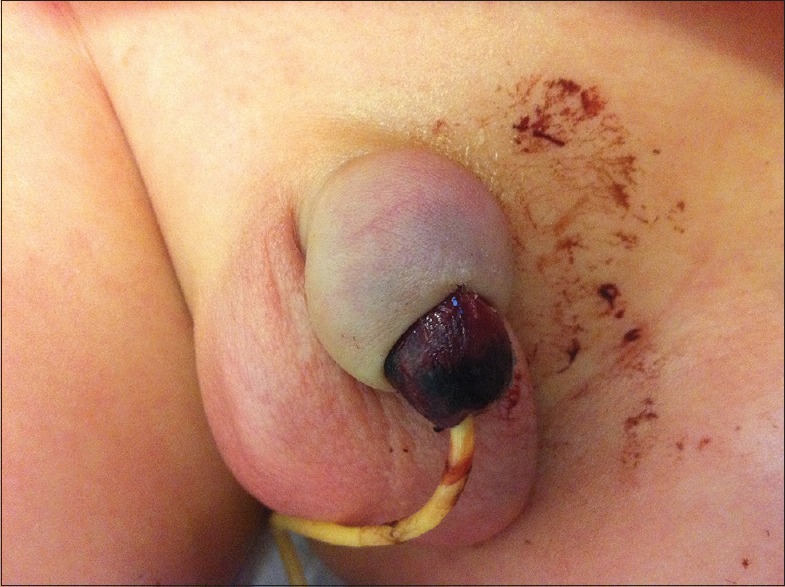
Initial image of patient penis with important edema and ischemic glans signs
Blood analysis showed important increase of white blood cells count > 25000/mm3.
In spite of a good micturition, a 8 Ch bladder Foley catheter was placed to prevent future urethral stenosis.
Under general anesthesia, surgical exploration and liberation of the suture was performed, with a posterior therapeutic caudal block using a 20G (0.9 mm × 50 mm) Tuohy-Weiss needle and 24G multiperforate catheter (Perifix ONE System, BRAUN©), with bupivacaine 0.25% 1 mL/kg in extreme sterility conditions, in order to reduce sympathetic tone and improve arterial supply, as well as venous drainage. After that, topic treatment with nitroglycerin and gentamicin and oral administration of pentoxifylline 60 mg/8 h and during were started and mantained hospital stay. Patient outcoming was very impressive with nearly total resolution of the black glans coloration and local pain [Figure 2]. The patient was discharged at 7 days without sequelae.
Figure 2.
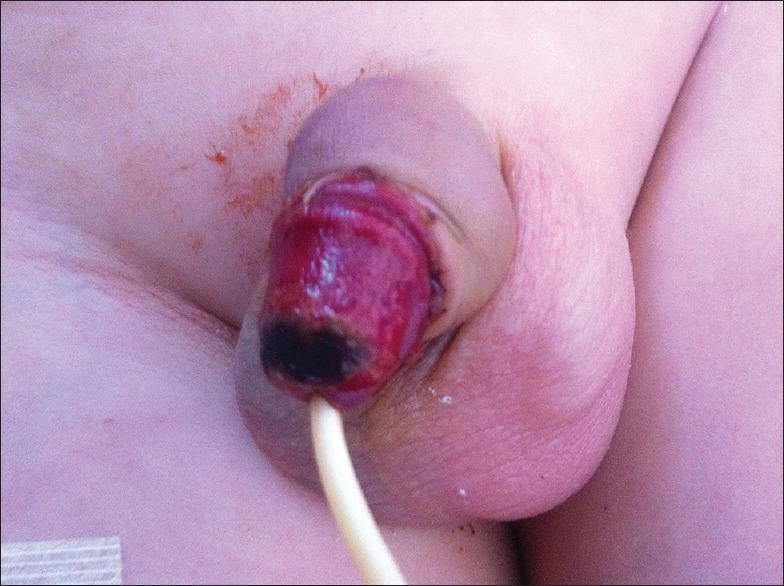
Image of patient penis 48 h after initiation of the treatment
DISCUSSION
The treatment of choice for glanular necrosis has not yet been established. Several treatments were reported and used with successful results. Final objective of all of them was vasodilation to increase arterial flow and venous drainage, allowing revascularization of the ischemic tissues.
The study by Aminsharifi et al.[6] used topical 10% testosterone undecanoate twice during 1 month in 2 patients with total recovery in glans appearance. The urethra sloughed partially and became hypospadic in one case. Ozzeybek et al.[7] reported the use of intracavernous glycerol trinitrate (3 mg/kg, 2 mL) and Bupivacaine 0.0625% administered epidurally for 5 days with total recovery on the 7th day. Other authors, like Burke et al.[8] treated one patient with temporary ischemia of the glans after dorsal penile nerve block (0.75% ropivacaine) by an intravenous infusion of iloprost (a PGI2 analog) with a dosage of 0.52 μg/h, with total recovery at 43 h. Sara and Lowry described ischemia to the glans penis 24 h after penile block using bupivacaine 0.5% treated using a low-dose heparin infusion (25 units/kg/h) for 4 days with no adverse effects. In a study by Kaplanian et al.[4] recommend urgent caudal block with 15 mL of 0.25% bupivacaine (15 mL) with significant improvement in the color and perfusion of the glans within few minutes.
Tzeng et al. and Aslan et al.,[9,10] and more recently Elemen et al.[1] reported 2 patients of 5 and 33 years old treated with intravenous pentoxifylline (10 mg/kg) divided in four daily doses, together with hyperbaric oxygen with 2.5 atm of pressure for 90 min-long sessions. Total reverse of the ischemia was observed in both cases.
As a conclusion, an unexpected degree of pain after the block, or any evidence of possible vascular trauma at the time of the block, should alert staff to potential ischaemic injury and mandate close monitoring of penile perfusion.
Footnotes
Source of Support: Nil
Conflict of Interest: None.
REFERENCES
- 1.Elemen L, Topçu K, Gürcan Nİ, Akay A. Successful treatment of post circumcision glanular ischemia-necrosis with hyperbaric oxygen and intravenous pentoxifylline. Actas Urol Esp. 2012;36:200–1. doi: 10.1016/j.acuro.2011.06.008. [DOI] [PubMed] [Google Scholar]
- 2.Bateman DV. Correspondence. Anaesthesia. 1975;30:101. [Google Scholar]
- 3.Soh CR, Ng SB, Lim SL. Dorsal penile nerve block. Paediatr Anaesth. 2003;13:329–33. doi: 10.1046/j.1460-9592.2003.01033.x. [DOI] [PubMed] [Google Scholar]
- 4.Kaplanian S, Chambers NA, Forsyth I. Caudal anaesthesia as a treatment for penile ischaemia following circumcision. Anaesthesia. 2007;62:741–3. doi: 10.1111/j.1365-2044.2007.05060.x. [DOI] [PubMed] [Google Scholar]
- 5.Sara CA, Lowry CJ. A complication of circumcision and dorsal nerve block of the penis. Anaesth Intensive Care. 1985;13:79–82. doi: 10.1177/0310057X8501300111. [DOI] [PubMed] [Google Scholar]
- 6.Aminsharifi A, Afsar F, Tourchi A. Delayed glans necrosis after circumcision: Role of testosterone in salvaging glans. Indian J Pediatr. 2013;80:791–3. doi: 10.1007/s12098-012-0820-y. [DOI] [PubMed] [Google Scholar]
- 7.Ozzeybek D, Koca U, Elar Z, Olguner M, Hakgüder G. Glycerol trinitrate plus epidural sympathetic block in the ischemia of glans penis. Anesth Analg. 1999;89:1066. doi: 10.1097/00000539-199910000-00053. [DOI] [PubMed] [Google Scholar]
- 8.Burke D, Joypaul V, Thomson MF. Circumcision supplemented by dorsal penile nerve block with 0.75% ropivacaine: A complication. Reg Anesth Pain Med. 2000;25:424–7. doi: 10.1053/rapm.2000.7594. [DOI] [PubMed] [Google Scholar]
- 9.Tzeng YS, Tang SH, Meng E, Lin TF, Sun GH. Ischemic glans penis after circumcision. Asian J Androl. 2004;6:161–3. [PubMed] [Google Scholar]
- 10.Aslan A, Karagüzel G, Melikoglu M. Severe ischemia of the glans penis following circumcision: A successful treatment via pentoxifylline. Int J Urol. 2005;12:705–7. doi: 10.1111/j.1442-2042.2005.01129.x. [DOI] [PubMed] [Google Scholar]