



Abstract
Anthrax is a lethal disease caused by the gram-positive spore-producing bacterium Bacillus anthracis. Live attenuated vaccines, such as the nonencapsulated Sterne strain, do not meet the safety standards mandated for human use in the Western world and are approved for veterinary purposes only. Here we demonstrate that disrupting the htrA gene, encoding the chaperone/protease HtrA (High Temperature Requirement A), in the virulent Bacillus anthracis Vollum strain results in significant virulence attenuation in guinea pigs, rabbits and mice, underlying the universality of the attenuated phenotype associated with htrA knockout. Accordingly, htrA disruption was implemented for the development of a Sterne-derived safe live vaccine compatible with human use. The novel B. anthracis SterneΔhtrA strain secretes functional anthrax toxins but is 10–104-fold less virulent than the Sterne vaccine strain depending on animal model (mice, guinea pigs, or rabbits). In spite of this attenuation, double or even single immunization with SterneΔhtrA spores elicits immune responses which target toxaemia and bacteremia resulting in protection from subcutaneous or respiratory lethal challenge with a virulent strain in guinea pigs and rabbits. The efficacy of the immune-protective response in guinea pigs was maintained for at least 50 weeks after a single immunization.
Anthrax is a severe disease caused by the gram-positive spore-producing bacterium Bacillus anthracis. Spores, which represent the infective form of the bacteria, are characterized by a strong resistance to environmental insults1. In nature, the spores mainly infect grazing herbivores by ingestion or inhalation. Human cases of anthrax due to exposure to infected animals or animal products were frequent in the past but are currently extremely rare in the Western world. However, the development of countermeasures for the prevention and treatment of anthrax has increased in recent years because of the potential malicious use of B. anthracis spores as a bio-terror weapon. This concern placed B. anthracis at the top of the CDC list of select agents (http://www.bt.cdc.gov/agent/agentlist-category.asp).
Anthrax virulence factors
The most lethal manifestation of Bacillus anthracis infection is represented by the respiratory form of the disease: the inhaled spores are transported by alveolar macrophages and dendritic cells to lymph nodes where they germinate into fast growing vegetative bacilli2. The lethality of anthrax results from the bacterial exotoxins as well as the remarkable ability of the bacteria to proliferate in the host. B. anthracis secretes Lethal Toxin (LT) and Edema Toxin (ET), which are composed of binary combinations of the three proteins Protective Antigen (PA), Lethal Factor (LF) and Edema Factor (EF). These three proteins are encoded by genes located on pXO1, one of the two virulence plasmids naturally harboured by B. anthracis. PA, the common subunit of both toxins, is harmless by itself but plays the essential role of intracellular translocation of the lethal subunits of the toxin complex-LF (a zinc protease, which together with PA forms the exotoxin LT) and EF (an adenylate cyclase, which together with PA constitutes the exotoxin ET). An additional virulence factor is the poly D-glutamate anti-phagocytic capsule synthesized by enzymes encoded by genes located on the second native plasmid pXO23,4.
The HtrA (High Temperature Requirement A) protein of B. anthracis
We have previously conducted functional-genomic and proteomic global surveys, combined with serological evaluation of B. anthracis antigens, for the identification of novel virulence factors as well as vaccine and diagnostic marker candidates among extracellular (secreted or membrane) proteins. These studies revealed a list of novel antigens (other than the classic exotoxins LT and ET) for further evaluation based on their immunogenicity, abundance under various culture conditions, and functional relatedness to infection5,6,7,8,9,10,11,12. HtrA, one of the B. anthracis proteins that emerged from these screens, is a secreted and membrane-associated bifunctional chaperone/protease encoded by a chromosomal gene. HtrA was subsequently shown to be abundantly expressed during infection and was consequently able to serve as an early disease-biomarker of anthrax13. Our recent study of the phenotype associated with directed disruption of the htrA gene14,15 demonstrated that HtrA is necessary for tolerance to a variety of stress stimuli and for the secretion of several major extracellular proteins. Most notably, htrA gene disruption in the fully virulent toxinogenic and capsular Vollum strain resulted in a dramatic attenuation in the guinea pig model following subcutaneous or intranasal exposure in spite of the fact that the mutated bacteria were able to express the PA, LF and EF toxin subunits as well as the anti-phagocytic capsule15. The extent of the virulence attenuation associated with htrA disruption was significantly higher than that promoted by disruption of any other reported B. anthracis virulence determinants (other than the LT and ET toxins and the capsule biosynthetic operon themselves), which were suggested to play a role in bacterial pathogenesis (examples of such factors are listed in Table 1). As shown in Table 1, the impact on virulence associated with a particular mutation was not manifested in all the animal models employed and by all the routes of exposure. Here, it is shown that this is not the case with the htrA disruption: infection studies of the htrA-disrupted B. anthracis fully virulent Vollum strain in three rodent models of anthrax demonstrate the universality of the attenuated phenotype.
Table 1. Examples of reported B. anthracis virulence attenuation values associated with disruption of genes not associated with classical virulence factors (see text).
| Gene(s) disrupted | Function | Parental strain | Animal model | Infection route | Attenuation Index (LD50Δ/LD50WT) | Reference |
|---|---|---|---|---|---|---|
| aro | Aromatic acid synthesis | Sterne | Mouse | SC | >10,000 | 27 |
| nos | Oxidative Stress | Sterne | Mouse | SC | 1,000 | 51 |
| sod15, sodA1, sodC, sodA2 | Superoxide detoxification | Sterne | Mouse | IN | 100 | 52 |
| clpX | Proteolytic quality control | Sterne Sterne Ames | Mouse Mouse GP Mouse | SC IN IP IP | 10–100 10–100 1,000 1 | 53 |
| purH | Purine biosynthesis | Ames | Mouse Rabbit GP | IN SC IM | 1 1 1,000 | 54 |
| bslA | Adhesion | Ames | GP | SC | 200 | 55 |
| Vollum | GP | SC | 1 | 12 | ||
| mntA | Mn(II) transport | Vollum | GP | SC IN | 10,000 1 | 43 |
| isdC isdJ isdK | Acquisition of iron | Vollum | GP | SC | 1 | 42 |
| codY | Transcription regulator | 9602 | Mouse GP | SC | 20 10,000 | 56 |
| htrA | Stress tolerance, proteolysis | Vollum | GP GP | SC IN | 3,000,000 > 10,000 | 15 |
Immunization of guinea pigs with sub-lethal doses of the htrA-disrupted B. anthracis Vollum strain elicited an immune response that conferred protection to a subsequent lethal challenge15. These results suggested that HtrA is a major virulence factor essential for manifestation of B. anthracis pathogenesis and that htrA-gene disruption may represent the basis for the development of novel prophylactics against B. anthracis infection.
Anthrax vaccines
Because PA, the non-detrimental toxin subunit, is a very potent immunogen and its neutralization by the humoral immune response prevents the onset of the disease, all anthrax vaccine preparations contain PA3,16. The anthrax protein vaccines that are licensed for human use include partially purified PA preparations potentiated by various adjuvants.
In general, live attenuated vaccines are considered to promote superior protective immunity compared to sub-unit vaccines owing to the notion that exposure of the host to the infective micro-organism in the context of infection (i) elicits a response against a wide range of antigens rather than a unique immunogen, and/or (ii) involves a variety of immune and inflammatory mechanisms rather than a limited humoral response to one particular antigen. Attenuated toxin-producing live bacteria (such as the nonencapsulated Sterne strain, pXO1+; pXO2−) have been used worldwide as effective veterinary vaccines since the 1930 s and in the past were used for human vaccination. While millions of people were vaccinated with the Sterne-like live vaccine (known as the STI strain)17 between 1950 and 1980 in the former Soviet Union, the potential reactogenicity of the Sterne vaccine as indicated by animal experimentation, precluded use in humans in the Western world. Consequently, on grounds of toxicity, these live attenuated vaccines do not meet the safety standards mandated for human use and are suitable for veterinary purposes only. Yet, the protection conferred by administration of the Sterne attenuated live vaccine to experimental animals appeared to be superior to that provided by vaccination with PA in terms of the longevity of the protective response, efficacy against a broad spectrum of B. anthracis strains and the need for less administrations (1–2 injections, compared to the initial cumbersome 6-dose vaccination schedule with the subunit PA vaccine)18. Therefore, further attenuation of a Sterne vaccine strain could be a beneficial step in the development of next-generation live anthrax vaccines for human use.
The present study demonstrates, in three animal models, that disruption of the htrA gene in the B. anthracis Sterne-vaccine platform is sufficient to generate a highly attenuated strain that preserves its ability to induce a protective immune response.
Results
Virulence attenuation of the Vollum ΔhtrA strain in various animal models of anthrax
To determine whether disruption of the htrA gene is associated with virulence attenuation not only in guinea pigs15 (see also Fig. 1, inset) but also in other animal models, studies assessing the survival of experimental animals following administration of the VollumΔhtrA strain were carried out in mice and rabbits. The experiments consisted of subcutaneous (SC) administration of increasing doses of either one of 3 strains of bacteria: the parental wild-type Vollum strain (pXO1+, pXO2+), its mutated ΔhtrA derivative strain and the HtrA trans-complemented strain VollumΔhtrA/HtrA. The results depicted in Fig. 1 and summarized in Table 2 clearly demonstrate that in all three animal models the disruption of the htrA gene is associated with a substantial decrease of virulence. The attenuation indices (ratio between the LD50 values of the mutant and the wild-type parental strains) promoted by the htrA disruption in the Vollum strain background ranged from 104 in mice to greater than 107 in rabbits. These attenuation values are comparable to those observed in guinea pigs (Table 2). The extent of the virulence attenuation in mice is a rather unexpected result considering the fact that ICR out-bred mice exhibit high sensitivity to B. anthracis (as opposed to some other in-bred murine strains19) and that mice in general are notoriously sensitive to the poly-D glutamic acid capsule, the synthesis of which is not affected in the Vollum mutant strain15. This observation strongly supports the notion that HtrA is essential for the manifestation of B. anthracis virulence and underlines the dominant nature of the htrA mutation as a means for virulence attenuation. In the rabbit system, which is considered to represent a suitable animal anthrax model that more faithfully emulates the human disease3,20, none of the animals succumbed upon administration of as much as 5 × 10⁸ spores (higher doses were not attempted, therefore the LD50 value is considered to be above this dose). The virulence attenuation phenotype of VollumΔhtrA was restored to levels comparable to those of the parental Vollum strain upon expression of HtrA in the trans-complemented strains VollumΔhtrA/HtrA (Fig. 1).
Figure 1. Survival profiles of mice and rabbits infected subcutaneously (SC) with the Vollum, VollumΔhtrA and transcomplemented VollumΔhtrA/HtrA strains.

The animal groups (10 mice or 5 rabbits per experimental group) were inoculated SC with increasing spore doses of the parental Vollum (black circles), mutated VollumΔhtrA (white squares) and transcomplemented VollumΔhtrA/HtrA (grey diamonds/grey dotted line) strains. Animal survival was followed for 3 weeks. In the experiment carried out in rabbits, only the 104 spore dose of the transcomplemented VollumΔhtrA/HtrA strain was tested, and all the animals in this experimental group succumbed to the infection. Upper-right inset: The results of a published previously similar experiment carried out with guinea-pigs15. A horizontal 50% survival dotted line in the “Mice” and “Rabbits” survival-profile panels indicates the estimated LD50 values of the various strains. Lower-right inset: Anti-HtrA Western blot analysis of the secretomes of the three strains demonstrating complete elimination of HtrA expression in the mutated strain and restoration of the HtrA level in the trans-complemented strain is shown.
Table 2. LD50 values of various B. anthracis strains and their respective ΔhtrA mutants (SC administration).
| B. anthracis strain | ||||
|---|---|---|---|---|
| Vollum (pXO1+/pXO2+) | Sterne (pXO1+/pXO2−) | |||
| WT | ΔhtrA | WT | ΔhtrA | |
| Animal Model Mice (ICR) | 10 | 3 × 10⁵ | 1.6 × 10² | 6 × 10⁵ |
| Guinea Pigs | 50–100 | 3 × 10⁸ | 8 × 10⁵ | >1010 |
| Rabbits | 50–100 | >5 × 10⁸ | 5 × 10⁸ | >5 × 10⁹ |
Generation and phenotypic characterization of the SterneΔhtrA strain
We reasoned that elimination of the htrA gene may extend the safety of the Sterne vaccine by decreasing its virulence. Consequently, a novel Sterne ΔhtrA strain was generated by disruption of the htrA locus (NCBI locus tag GBAS_3995). The chromosomal context of the htrA gene in the Sterne strain is identical to that in the Vollum strain with htrA encoded as a monocistronic gene (Fig. 2a). Therefore, the gene targeting manipulation for disruption of the gene in the Sterne strain was carried out by allelic-exchange approaches (Fig. 1a, see also Materials and Methods) based on the upstream and downstream target homology sequences, which are identical to those employed for the disruption of the htrA gene in the Vollum strain15. The disruption was confirmed by direct sequencing of the mutated htrA locus as well as by Western blot analysis, which demonstrated the complete abrogation of HtrA expression (Fig. 2b). In addition, we have also generated a transcomplemented strain, SterneΔhtrA/HtrA, by introducing an extrachromosomal HtrA expression plasmid into the mutated strain, which restored HtrA synthesis to levels similar to those observed in the parental Sterne strain (Fig. 2b).
Figure 2. Generation and phenotypic characterization of the SterneΔhtrA strain.

(a) The genomic loci of the htrA gene in B. anthracis Vollum and Sterne strains is shown. The functional domains of the htrA gene (The trypsin-like domain is necessary for the proteolytic activity of the protein, and the PDZ domain is necessary for the chaperone activity) and the signal peptide, which mediates export of the protein, are depicted in the boxed panel. Disruption of the htrA gene in the Sterne strain was achieved via two approaches: (i) introduction into the coding region of a kanamycin resistance gene (KmR) to generate the strain SterneΔhtrA IIBR-BA104KR; and (ii) marker-less replacement of the same coding region with the indicated DNA-sequence to generate the strain SterneΔhtrA IIBR-BA106. The DNA sequence disrupting the htrA gene in strain IIBR-BA106 is indicated, the novel SpeI restriction site present in this strain is indicated in bold and underlined, and the two stop codons in the sequence are boxed and marked STOP. (b) The Western blot analysis using the anti-HtrA antibodies of the secreted (Secreted) and membrane proteins (Cell associated) collected from cultures of the parental Sterne strain (WT), the SterneΔhtrA strain and the trans-complemented SterneΔhtrA/HtrA strain is shown and demonstrates the complete elimination of htrA expression in the mutated strain and its restoration in the trans-complemented strain. (c) The growth profiles in BHI media are shown. The black and grey curves describe the growth profiles of the parental Sterne and SterneΔhtrA strain, respectively, which was evaluated in 3 independent experiments. The error bars indicate SD. (d) The in-vitro production of the toxin components PA, LF and EF by the SterneΔhtrA and parental (WT) strains was demonstrated by Western blot analysis of proteins secreted in the NBY-CO2 cultures (18 hrs post-inoculation) of both strains using anti-HtrA, anti-PA, anti-LF and anti-EF antibodies, as indicated. (e) The PA levels in the serum of individual guinea pigs 3 days post-inoculation via the SC route with various doses of SterneΔhtrA spores was determined, as indicated. The analyses described in (b–e) employed the SterneΔhtrA IIBR-BA104KR clone. The two SterneΔhtrA disrupted mutants, IIBR-BA104KR and IIBR-BA106, were indistinguishable in all the comparative phenotypic studies.
No growth differences were observed between the ΔhtrA strain and the parental Sterne strain cultures (Fig. 2c). Furthermore, the Sterne and the SterneΔhtrA strains were indistinguishable with respect to their ability to germinate and sporulate (Supplementary Fig. S1, online). The phenotype of the mutated strain was determined in vitro with respect to the characteristics and hallmarks previously determined for the htrA-mutated B. anthracis Vollum strain15 and other bacteria21,22,23,24. These phenotypic characterizations, which included growth under temperature and oxidative stress conditions as well as expansion in cultured macrophages, are documented in Supplementary Figs S2 and S3 (online). Compared to the parental strain, the SterneΔhtrA strain demonstrated a limited ability to grow at high temperature, an increased sensitivity to oxidative stress caused by hydrogen peroxide (Supplementary Fig. S2, online) and a delay (of more than 8 hours) in the J774-macrophage infection assay (Supplementary Fig. S3, online). All these phenotypic alterations could be restored to the parental-like levels by trans-complementation in strain SterneΔhtrA/HtrA, which demonstrates that these characteristics are directly related to the disruption of the htrA gene.
Production of toxins by the SterneΔhtrA strain
Considering the fact that HtrA is a chaperone involved in the secretion machinery25,26, the efficacy of a live vaccine based on the SterneΔhtrA strain could be compromised by a decreased ability of the mutated strain to synthesize and/or to secrete the B. anthracis toxins PA, LF and EF. Direct evaluation by Western blot analysis of the toxin level clearly demonstrated that the mutation did not appear to affect the level of PA, LF or EF produced by the SterneΔhtrA mutant strain (Fig. 2d). Both of the toxic subunits of the exotoxins, LF and EF, were secreted by the mutated strain and appeared to be indistinguishable from those secreted by the parental strain in a macrophage-lysis assay, which probes the functional integrity of LF (Supplementary Fig. S4, online) and in an ATP-depletion assay, which probes the functional integrity of EF (Supplementary Fig. S4, online). Furthermore, substantial levels of PA could be detected in the circulation of guinea pigs 72 hrs following SC injection of spores from the SterneΔhtrA strain (Fig. 2e), suggesting that the administered spores could germinate and secrete the bacterial toxin in vivo in the host, a prerequisite for the use of the mutated strain as a vaccine (see next section and Supplementary Fig. S5, on line, for a comparison of the PA levels detected in the circulation of guinea pigs infected with the ΔhtrA mutant and the parental Sterne strains).
In vivo pathogenicity studies in animal models of anthrax
The impact of the htrA deletion on the virulence of the B. anthracis Sterne strain was evaluated in mice, guinea pigs and rabbits by SC administration of increasing doses of mutant spores in comparison to administration of Sterne parental-strain spores. The results depicted in Fig. 3 demonstrated that the virulence of the SterneΔhtrA bacteria was significantly attenuated (see Table 2 for the LD50 values of the mutated bacteria). The virulence attenuation index was almost 4 orders of magnitude in mice and guinea pigs. Furthermore, an increased dose-dependent mean-time to death (MTTD) was observed for the animals infected with the mutant SterneΔhtrA strain in the murine model. While for mice the MTTD for the Sterne parental strain was 4 days (for a dose of 105 spores) and 2.5 days (for a dose of 108 spores), in the case of the mutant SterneΔhtrA strain, the MTTD ranged from 8 days (for a dose of 105 spores) to 3 days (for a dose of 108 spores). Of note, the virulence attenuation could be alleviated by expression of HtrA in the transcomplemented strain SterneΔhtrA/HtrA, which was indistinguishable from the parental strain in the murine system (Fig. 3). In guinea pigs, 95% of the animals (19 out of 20) survived a dose of 109 spores SterneΔhtrA, but 100% of animals (10 of 10) survived a higher dose of 1010. We therefore estimate the LD50 of SterneΔhtrA in guinea pigs to be greater than 1010. In rabbits, no animals succumbed upon administration of 5 × 10⁹ spores (higher doses were not attempted for practical reasons); therefore, the exact LD50 value could not be determined. (We note that the LD50 value of the parental Sterne strain in rabbits is approximately 5 × 10⁸ spores with occasional lethality at doses as low as 107).
Figure 3. Survival profiles of mice, guinea pigs and rabbits infected subcutaneously with the Sterne and SterneΔhtrA strains.
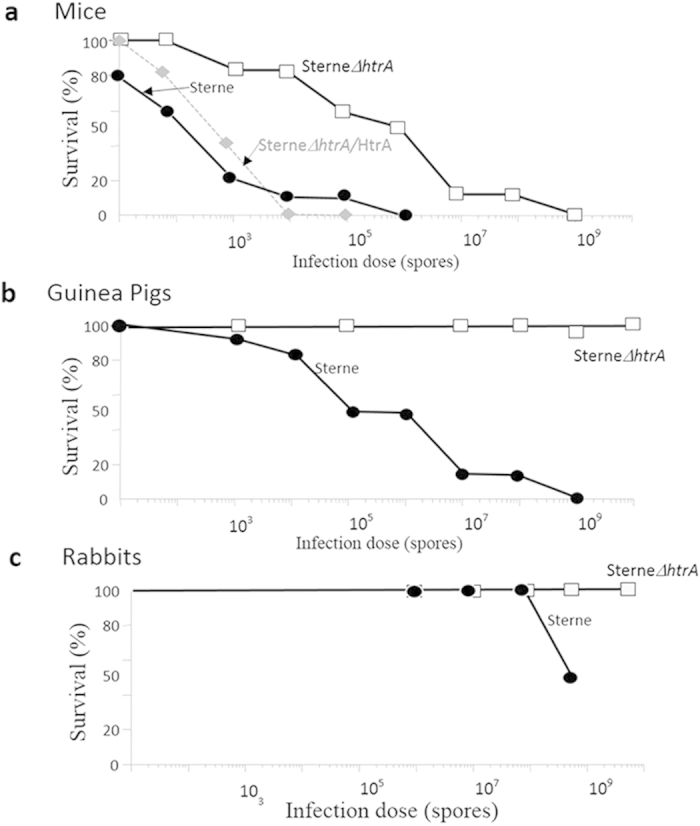
The animal groups (10 ICR mice, 20 guinea pigs or 5 rabbits per experimental group) were inoculated via the SC route with increasing spore doses of the parental Sterne strain (black circles), the mutated SterneΔhtrA strain (white squares) and the transcomplemented SterneΔhtrA/HtrA strain (tested in mice grey diamonds/grey dotted line). The survival of the animals was followed for 3 weeks. Table 2 shows the LD50 values calculated for the various strains in the three animal models. The experiments described employed the SterneΔhtrA IIBR-BA106 strain, but similar results were observed with the SterneΔhtrA IIBR-BA104KR strain (not shown). In the guinea pig experiment, 19 of 20 animals survived a dose of 109 SterneΔhtrA spores, but all the animals survived a dose of 1010 spores.
As high doses of the spores (e.g., 109 spores/animal) could be administered to guinea pigs, relatively high serum levels of PA could be reached in infected animals 72 hours after SC infection with SterneΔhtrA (Supplementary Figure S5, online). Similar high levels could not be attained following vaccination with the parental Sterne due to the limit of tolerable doses for immunization (less than 107 spores). The bacterial loads detected in the spleens of infected animals (Supplementary Figure S5, online) indicate that the mutated bacteria can migrate to the spleens of the guinea pigs. However, 32 days after SC administration, no bacteria could be detected in the spleens of animals infected with doses as high as 109 spores.
Immunization with SterneΔhtrA spores confers efficient protection against anthrax
To evaluate the potential use of the SterneΔhtrA strain as an efficient anthrax vaccine, both guinea pigs and rabbits were immunized with different doses, and their humoral immune response elicited by the immunization was evaluated. In addition, we evaluated the ability of the vaccinated animals to withstand a lethal challenge by a subcutaneous (SC) or respiratory (IN) exposure at a spore dose of 100 × LD50 of the fully virulent B. anthracis Vollum strain (see schematic description of the experiments in Figs 4a and 5a). The experiments in guinea pigs included SC administrations of a single immunization (106–109 spores/animal, Fig. 4) or two immunization doses 4-weeks apart (5 × 10⁶–109 spores/animal, Fig. 5). Both immunization regimens elicited protective immune responses as depicted in Figs 4, 5, 6. Following the single immunization, we found that all vaccinated animals developed substantial titres of antibodies directed against total B. anthracis proteins (Fig. 6a) as well as antibodies against PA (Fig. 6b). These effects were dose-dependent. Significant titres of toxin neutralizing antibodies (TNA) could be detected in animals vaccinated with 107 or more spores (Fig. 6c). In the double-immunization experimental groups, the humoral response was 1–2 orders of magnitude higher than that observed after a single immunization with the same dose (compare Fig. 6b–e and Fig. 6c–f). These observations underline the efficient boost effect promoted by a second dose of the vaccine spores administered 4 weeks after the initial immunization.
Figure 4. Protective immunity experiments in guinea pigs vaccinated by a single immunization with various doses of the SterneΔhtrA spores.
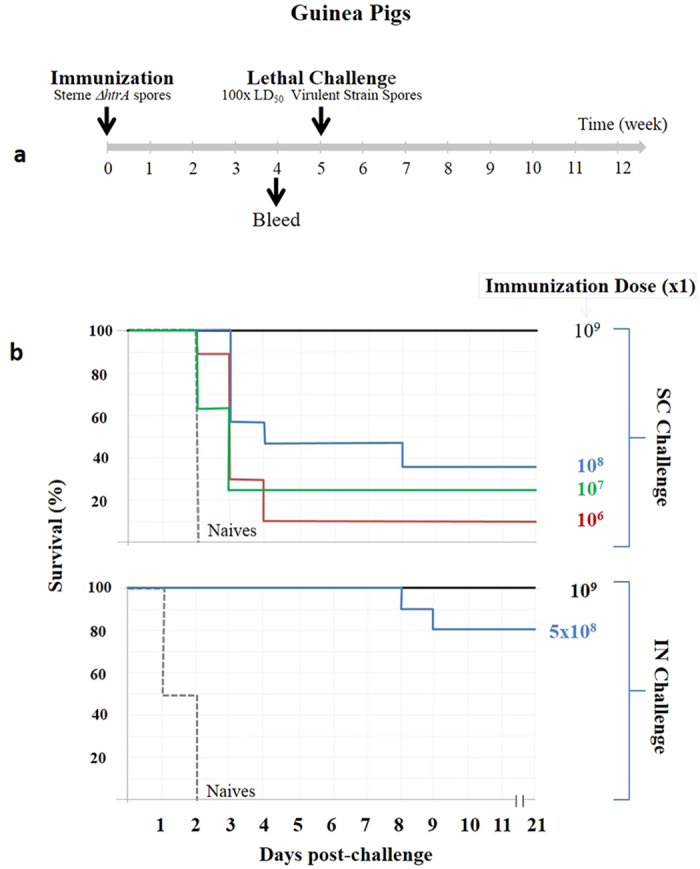
(a) A Schematic representation of the single-immunization experiments is shown. (b) The Kaplan-Meier survival profiles of guinea pigs immunized with the indicated doses of SterneΔhtrA spores is shown. The animals (at least 10 per group) were challenged 5 weeks post-immunization with 100 × LD50 of fully virulent Vollum spores (pXO1+; pXO2+) by SC infection (104 spores/animal, upper panel) or respiratory IN exposure (106 spores/animal, lower panel). See Fig. 6 for the anti-PA, anti-bacterial antigens and neutralizing antibody titres measured in the pre-challenged blood samples. The experiments described in this and all subsequent figures employed the SterneΔhtrA IIBR-BA106 strain.
Figure 5. Protective immunity experiments in guinea pigs vaccinated with 2 immunizations of various SterneΔhtrA spore doses.
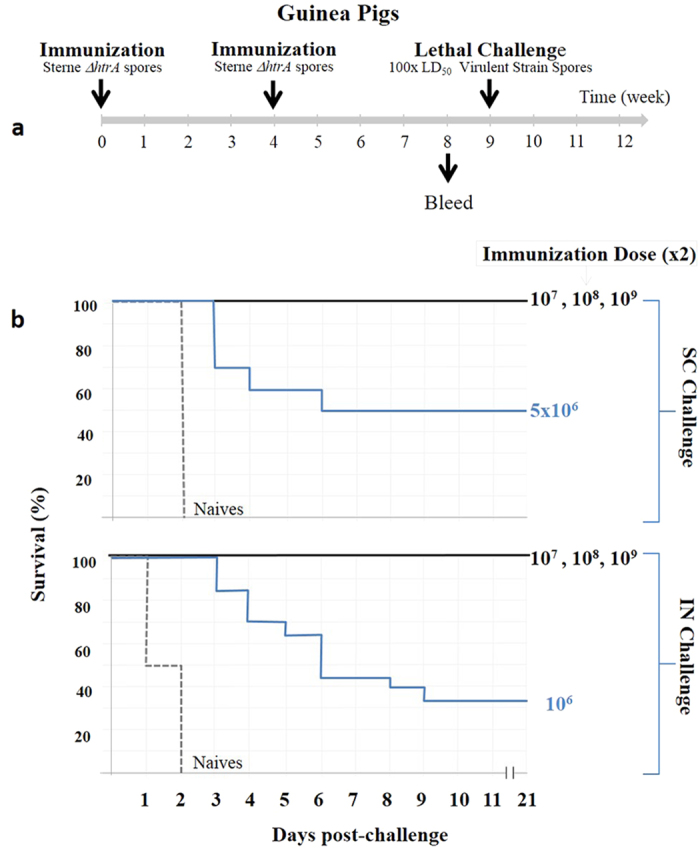
(a) A schematic representation of the double-immunization experiments is shown. (b) The Kaplan-Meier survival profiles of the guinea pigs (at least 10 guinea pigs/group) immunized with the indicated doses of SterneΔhtrA spores is shown. The animals were challenged 5 weeks after the second immunization (boost) with 100 × LD50 of the fully virulent Vollum spores (pXO1+; pXO2+) by SC infection (104 spores/animal, upper panel) or IN exposure (106 spores/animal, lower panel). See Fig. 6 for the pre-challenge anti-PA, anti-bacterial antigens and neutralizing antibody titres.
Figure 6. Antibody titres determined in guinea pigs 4 weeks after SC immunization with various SterneΔhtrA spore doses.

Panels (a–c) Single-dose immunization data are shown (see also Fig. 4). Panels (d–f): Double-dose immunization data are shown (0 and 4 weeks; see also Fig. 5). Each dot represents the titre of one individual animal in the respective experimental group. The white and black dots indicate titres in individual animals that survived or did not survive the challenge, respectively. The grey histograms represent the GMT values of the indicated antibodies measured in the blood samples of each group. Panels (a,d): The titres of antibodies against total B. anthracis antigens other than those expressed from pXO1 or pXO2 (see material and methods) are shown; panels (b,e): anti-PA antibody titres; panels (c,f): toxin neutralizing antibody titres.
Vaccination of guinea pigs with the SterneΔhtrA strain could protect animals from a subsequent SC or IN challenge with 100 × LD50 of the fully virulent B. anthracis Vollum strain (Figs 4 and 5). We observed that 80% of the animals vaccinated once with 5 × 10⁸ spores survived IN challenge, and 100% of the animals vaccinated with 109 spores were protected (Fig. 4). Full protection was also observed in animals vaccinated twice with more than 107 spores (Fig. 5), a dose that was 3 orders of magnitude lower than the calculated LD50 of the SterneΔhtrA vaccine strain in guinea pigs ( > 1010, Fig. 3 and Table 2).
The protective value of the vaccine was further confirmed in rabbits. We observed that administration of one dose of 5 × 10⁸ spores of the SterneΔhtrA strain resulted in a strong humoral anti-toxin and antibacterial response, which promoted full protection of animals in a subsequent IN challenge (Fig. 7). Again this immunization dose is at least 10-fold lower than the lowest possible LD50 dose of the SterneΔhtrA mutant (note that none of the rabbits died after exposure to the highest infection dose tested, see Table 2).
Figure 7. Protective immunity experiments in rabbits following a single immunization with various SterneΔhtrA spore doses.
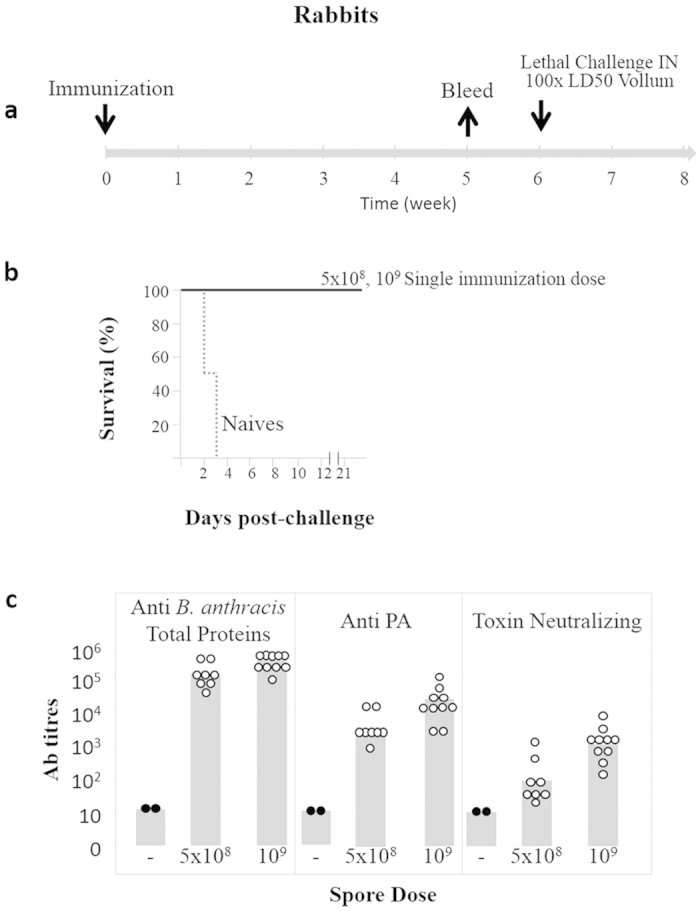
(a) A schematic representation of the immunization experiments is shown. (b): The Kaplan-Meyer survival profiles of rabbits immunized with the indicated doses of SterneΔhtrA spores is shown. The animals were challenged (5 weeks post-immunization) with 100 × LD50 of fully virulent Vollum spores (pXO1+; pXO2+) by IN exposure (106 spores/animal). (c) The pre-challenge antibodies titres (against total-bacterial antigens, PA and anti-toxin neutralizing antibodies) were determined in guinea pigs (at least 8 animals per group) 4 weeks after immunization with the various doses of the SterneΔhtrA spores. The white and black dots indicate titres in individual animals that survived or did not survive the challenge, respectively. The grey histograms represent the GMT values of the indicated antibodies measured in the blood samples of each group.
The longevity of the immune state was addressed in guinea pigs vaccinated with one dose (109) or two doses (108, 4 weeks apart) of SterneΔhtrA spores. In these experiments, the antibody titres of randomly selected animals from the various vaccination groups were determined at different time points following the last immunization. The data in Supplementary Table S1 (online) show that the humoral response declined gradually yet was maintained at a sufficiently high protective level in both immunization modes, and provided complete protection to all animals (20 animals/group) against an IN lethal challenge (100 × LD50) 52 weeks after vaccination.
The results presented above clearly demonstrate that disruption of the htrA gene can be implemented for the development of a safe live-attenuated anthrax vaccine without compromising the protective characteristic exhibited by the parental Sterne vaccine strain.
Discussion
The currently licensed human anthrax vaccines contain filtered supernatants of avirulent B. anthracis strains potentiated by various adjuvants3,16. The active ingredient of these formulations is the toxin subunit PA. Although these vaccines were demonstrated as efficient and safe, they suffer from a cumbersome vaccination schedule that involves multiple initial administrations and yearly boost immunizations. Efforts to improve the sub-unit vaccine by bacterial additives or adjuvants3 are paralleled by the alternative approach, which relies on live attenuated strains as a basis for a next-generation vaccine. For example, several studies explored the possibility of using non-virulent mutated strains of B. anthracis as vaccines27,28,29 or even heterologous platforms, such as vaccinia virus, Bacillus subtillis or Salmonella typhimurium30,31,32,33, expressing recombinant forms of PA. In the past, we developed a nontoxinogenic and nonencapsulated recombinant spore vaccine based on a pXO1 and pXO2 cured variant of the nonproteolytic V770-NPI-R strain34,35,36. In the present study, we report on a novel live attenuated vaccine strain based on the existing Sterne veterinary vaccine strain (currently precluded from human use in the Western world, see Introduction) that is attenuated for virulence through deletion of the htrA gene. HtrA is a bifunctional chaperone and protease that was shown to be essential for the manifestation of B. anthracis virulence possibly owing to its role in protein quality control, which is necessary for overcoming the stress insults encountered by the bacteria in the host15,37. Here, we demonstrated in three animal models that extensive attenuation of the virulent Vollum strain, as well as that of the Sterne vaccine strain, can be achieved by disruption of htrA (Figs 1 and 3 and Table 2).
The success of a live attenuated vaccine encompasses a delicate balance between low virulence (hence amenable with human use) and the ability to promote a protective immune response. Virulence attenuation may lower the pathogenicity of the micro-organism to the extent that its interaction with the host results in an immune response insufficient to promote protection in a subsequent encounter with the fully virulent strain (a central theme in vaccine development38). The observations reported here clearly demonstrate that in spite of its markedly reduced virulence, the SterneΔhtrA strain elicits robust protection against a lethal challenge with the fully virulent Vollum strain administered via the SC or IN routes in vaccinated guinea pigs and rabbits (Figs 4, 5, 6, 7 and Supplementary Table S1, online). Furthermore, inspection of the anti-PA, anti-bacterial proteins and toxin-neutralizing antibody titres in vaccinated animals demonstrates that the immune response following vaccination with the Sterne ΔhtrA strain (Figs 6 and 7 and Supplementary Table S1, online) targets both the toxin and other bacterial antigens. Therefore, this response addresses both toxaemia and the bacteremia, which are both associated with B. anthracis infection. Of note, full-protection of rabbits vaccinated with a PA sub-unit vaccine correlates with at least 3-fold higher levels of neutralizing antibodies39,40 compared to the antibodies in the fully protected animals following SterneΔhtrA vaccination. Similarly, in the guinea pig immunization experiments (Fig. 6), some animals exhibited very low levels of protective toxin neutralizing antibodies and yet were fully protected against a lethal challenge dose of 100 × LD50. These results suggest that the immune response elicited by additional antigens present in the live attenuated vaccine provides a significant added value to the protective anti-PA response. The observations reported here are in line with previous studies showing that vaccination of experimental animals with the Sterne strain is more efficient than the sub-unit PA vaccination18,41. Finally, the survival of all the guinea pigs immunized with a single dose of SterneΔhtrA after a lethal challenge at 52 weeks post-vaccination is a clear indication of the extensive potency and efficacy of this live attenuated vaccine (Supplementary Table S1, online).
The observations discussed above indicate that the novel SterneΔhtrA vaccine exhibits (i) significantly improved safety as manifested by its dramatic virulence attenuation, and (ii) high efficacy in protecting against infection by a fully virulent B. anthracis strain. The balance between these two parameters determines the value of the live attenuated vaccine, which may be quantified and fully appreciated by determining the “therapeutic window” of the vaccine in guinea pigs. This is schematically visualized by comparing the LD50 and the PD50 (Protective Dose 50%) as exhibited in guinea pigs by the parental Sterne strain and the novel SterneΔhtrA strain (Fig. 8). The conclusion from this presentation is that in the case of the Sterne vaccine, survival from a lethal challenge can be achieved after immunization at doses that are close to the LD50 value (thus with a minimal “therapeutic window” ratio of LD50 to PD50 of only 8.0). However, in the case of the SterneΔhtrA vaccine, administration of as little as 10−2 × LD50 (for single dose immunization) or even 10−3 × LD50 (for the double-dose immunization) is sufficient to promote over 50% survival after challenge (Fig. 8). This calculation estimates that the “therapeutic window” of the novel SterneΔhtrA is at least two orders of magnitude higher compared to that of the parental Sterne veterinary vaccine, which supports the conclusion that the former is a substantially safer vaccine.
Figure 8. Extension of the therapeutic window of the live attenuated SterneΔhtrA spore vaccine compared to the Sterne parental vaccine strain in guinea pigs.

This figure is based on results summarized in Table 2, Figs 4, 5, and 6 and on the Sterne vaccinated guinea pig protection data; a, upper panel: Sterne strain; lower panel: SterneΔhtrA strain. The red line (black triangles) represents the survival profile of guinea pigs immunized with increasing doses of spores as indicated on the left y-axis (red text). The blue dotted line represents the survival after challenge of the guinea pigs immunized with the indicated single or double spore doses. Note: (i) Not all the animals immunized with Sterne spores at doses lower than the LD50 survived the lethal challenge of Vollum, and 50% survival after such a challenge (Protective Dose 50%, PD50) is achieved by administration of a Sterne dose close to the LD50 value of the strain. (ii) Unlike the Sterne vaccine, 100% survival can be achieved with the SterneΔhtrA vaccine strain at a vaccination dose much lower than the LD50 value of the Sterne ΔhtrA vaccine. Panel b: The calculated “therapeutic window” was determined from the ratio between the safety (LD50) and the efficacy (PD50) values of the two vaccine strains. Note that for SterneΔhtrA, only a lower limit of the LD50 was determined (Fig. 3 and Table 2), and therefore, the therapeutic window may be even wider than has been estimated in this figure.
In conclusion, the immunization of guinea pigs and rabbits by a single or double administration of this novel SterneΔhtrA live-attenuated spore vaccine at doses well below the LD50 of the vaccine strain elicits full protection against subcutaneous or airway infection of a fully virulent anthrax strain. Therefore, the SterneΔhtrA strain can serve as an appropriate platform for a next-generation human anthrax vaccine.
Materials and Methods
Bacterial strains, media, growth conditions and stress treatments
The B. anthracis strains used in this study are listed in the online Supplementary Table S3. The cells were cultured either in FAG media34, Brain-Heart Infusion (BHI, DIFCO/Becton Dickinson, MD, USA) or NBY media (0.8% [w/vol] Nutrient Broth [Difco], 0.3% Yeast extract [Difco] and 0.5% Glucose) at 37 °C with vigorous agitation. For the identification of CO2-induced proteins, the cells were grown at 37 °C in NBY supplemented with 0.9% NaHCO3 in hermetically sealed flasks without agitation (referred hereafter as NBY-CO2). NBY-CO2 media promotes efficient toxin production9,14,42. The spores were prepared in Schaeffer’s sporulation media (SSM) at 34 °C for 72 hours with vigorous shaking. In all the cases, the cultures were initiated with a starter inoculum diluted to a final OD (660 nm) of 0.1. For the H2O2 stress test, the cells were allowed to grow under optimal conditions for 2.5–3 hours (typically the time needed to enter logarithmic phase) and were then split into BHI cultures containing the indicated final concentrations of H2O2. The growth rate μ (expressed in hr−1) was calculated as 60 × [ln(OD2/OD1)]/(t2–t1), where OD1 and OD2 are the optical densities (at 600 nm) measured at two time-points (t1 and t2 expressed in minutes) along the logarithmic growth phase.
Escherichia coli strains (Supplementary Table S2, online) were used for plasmid construction. The antibiotic concentrations used for selection in Luria-Bertani (LB, Difco) agar/broth were as follows: for E. coli strains, ampicillin (Ap, 100 μg ml−1); for B. anthracis strains, kanamycin (Km, 10 μg ml−1), chloramphenicol (Cm, 7.5 μg ml−1) and erythromycin (Em, 5 μg ml−1).
Plasmid and strain construction
The plasmids and oligonucleotide primers used in this study are summarized in Supplementary Table S2 (online). The oligonucleotide primers were designed according to the genomic sequence of B. anthracis “Ames ancestor” strain (accession number AE017334, GI 50082967) and were prepared using the Expedite synthesizer (Applied Biosystems). The sequence identity of the htrA locus in the Vollum and Sterne strains was verified by whole-genome sequencing. Genomic DNA was extracted as previously described42,43. The PCR amplifications were performed using the Taq (Qiagen) or Expand High Fidelity (Roche) systems. The DNA sequences were determined by the ABI rhodamine termination reaction (ABI310 Genetic Analyzer, Applied Biosystems). The plasmid used for generation of the htrA-disrupted strains and the trans-complementation plasmids for extrachromosomal HtrA expression were previously described15. All the plasmids transformed into the Vollum or Sterne strains were first propagated in the methylation-deficient E. coli strain GM2929. B. anthracis cells were electro-transformed as previously described34. To disrupt the htrA gene by one-step homologous recombination, an allelic exchange technique was performed as follows: plasmid pEO-htrA was introduced into competent cells of the Sterne strain, and the transformants were selected for KmR at 30 °C. The integrants were recovered by growing the transformants in LB broth at 30 °C for 1.5 h, shifting to 38 °C (non-permissive temperature) for 6 h, plating serial dilutions on LB plates containing Km and were then incubated at 38 °C for 12–16 h. Single colonies were selected, resuspended in 0.1 ml LB broth, spotted (5 μl) on duplicate LB plates containing Km or Em, and then the twin plates were incubated either at 42 °C or 30 °C for 12–16 h. The deletion mutants were isolated as KmR EmS clones that failed to grow at 42 °C (as expected from the phenotype associated with htrA-gene disruption). The deletion of the internal fragment of htrA and insertion of the KmR cassette into the chromosome were confirmed by PCR using flanking chromosomal primers and primers derived from the Km cassette (primers used: HTRA9/KANA2C and KANA1/HTRA12C for the upstream and downstream integration htrA/Km junctions, respectively) and by sequencing of the htrA locus. The above approach generated a SterneΔhtrA strain that carries kanamycin resistance (IIBR collection BA104KR). A two-step gene-disruption technique was implemented for the generation of an additional htrA-disrupted strain devoid of antibiotic resistance. This technique, which is based on the activity of the I-SceI recombinase, was previously reported44. The B. anthracis cells are first transfected with the plasmid pEGS-htrA, which contains the same upstream and downstream htrA gene homology regions as the plasmid pEO-htrA, an I SceI recombinase recognition site at the 5’ of the downstream htrA homology region, an erythromycin resistance gene and a GFPuv gene45,46. The transfection results in the generation of a strain exhibiting a single cross-over integrant that is further resolved to the desired double cross-over markerless disrupted strain by expression of the I SceI recombinase (from the transfected pXX-I SceI plasmid). The above marker-less allelic exchange approach generated a SterneΔhtrA strain devoid of antibiotic resistance (designated in the IIBR collection BA106). The two SterneΔhtrA strains, BA104KR and BA106, were phenotypically indistinguishable. Throughout this report, the strain used for the various experiments is indicated in the relevant figure legend (see Fig. 2a for a schematic description of the disrupted htrA gene). Complementation was accomplished by transforming pASCHtrA into the htrA mutant strain.
SDS-PAGE, Western blot analyses, antibodies, and ELISA
SDS-PAGE was carried out on 4–12% NuPAGE® Bis-Tris gels (Invitrogen). For comparisons between proteins secreted by different strains, equal amounts of protein (50 μg) from the corresponding strains were loaded side by side on SDS-PAGE. The Western blots were generated using the Nitrocellulose Western iBlot Gel Transfer Semi-dry system (Invitrogen). Visualization of the immunoreactive bands was accomplished using an ECL (electrochemiluminescence) reaction (Pierce SuperSignal® West Pico Chemiluminescent substrate kit, Thermo Scientific) mediated by peroxidase-conjugated secondary antibodies (Amersham) detected by the FUJIFILM LAS-3000 detection system. The following antibodies were used in this study: (i) Specific anti-HtrA antibodies, which were obtained by DNA immunization with the pCI-htrA plasmid in female outbred ICR mice using the Helios Gene Gun System (Bio-Rad) as previously described47; (ii) Rabbit anti-PA antibodies35,48; (iii) Anti-LF and (iv) anti-EF mouse antibodies34,36. The primary and secondary antibodies were used at 1:1000 and 1:5000 dilutions, respectively.
The ELISA tests for the quantification of PA in sera samples and the detection of anti-PA antibodies in the serum of infected animals were carried out as previously described34,36,48,49,50.
The ELISAs for the quantification of anti-bacterial antibody titres in the circulation of vaccinated animals were carried out on microtitre plates coated with a B. anthracis urea-extracted proteinous preparation8 as previously described50. The proteinous extracts were prepared from a nonvirulent, non-toxinogenic and non-encapsulated ΔVollum strain (pXO1−, pXO2−). Therefore, the ELISA test monitors the humoral response elicited against B. anthracis chromosomally encoded exposed proteins and does not include the anti-toxin response nor the capsular antigens (any antigen encoded by pXO1 or pXO2 is absent).
Quantification of the toxin-neutralizing antibody (TNA) titres in the circulation of vaccinated animals was carried out by a J774A.1 macrophage-lysis inhibition assay in the presence of excess PA and LF as previously described36.
Dilution drop assays
Ten-fold serial dilutions were generated from logarithmic growth phase bacteria (0.5 OD600) and were dropped (50 μl) in duplicate on LB agar plates that were incubated overnight at 37 °C or 42 °C.
LF and EF functional assay
Bacteria (0.1 OD, 600 nm) were used to inoculate 1 ml cultures of DMEM (Biological Industries, Bet Haemek, Israel) supplemented with 10% FCS in 24-well microtitre plates and were incubated for 16 hrs at 37 °C in a 10% CO2 atmosphere. The culture supernatant was collected by centrifugation (5 min; 4,000 × g) and was filtered twice through a 0.22-μm filter. LF activity in the culture was assayed by layering the two-fold dilutions of the filtered supernatant in the presence of 0.25 μg/ml PA on sub-confluent monolayers of J774A.1 cells (plated in 96-well microtitre plates at a density of 5 × 10⁴ cells/ml one day prior to assay). The cells were incubated for approximately 4 hrs at 37 °C under 5% CO2 until the cytopathic effect was observed microscopically. Visualization of the cell lysis was achieved by addition of XTT-reagent (Cell Proliferation Kit, Biological Industries, Bet Haemek, Israel), and the lysis was quantified using a spectrophotometer (Novaspec Plus, Amersham). A luminescent ATP-depletion EF functional assay based on the calmodulin-dependent adenylate cyclase activity of EF was developed. This assay is based on the strict dependence of a luminescent luciferase reaction on ATP, which can be efficiently converted to cAMP by adenylate cyclases. In brief, the DMEM culture supernatants (as above) were concentrated 5 times using the Microcon concentration/buffer exchange system (Millipore YM-10, Merck, Ireland). For the ATP depletion, 10 μl of the concentrated supernatant (containing 3–5 ng of EF as quantified by ELISA) was added to 50 μl of the luciferase assay reagent (Promega, Madison, WI, USA) containing 1 mM Calmodulin (Sigma) and 0.5 mM CaCl2 (Merck) and was incubated in a polysorp fluoroNunc microtitre plate (Nunc) at 30 °C for 2.5 hrs. QuantiLum recombinant luciferase (Promega) was added to the reaction mixture, and the luminescence was measured immediately with a luminometer (VICTOR3TM, Perkin Elmer).
Evaluation of sporulation and germination efficiency
To determine the sporulation efficiency, bacteria were sampled from cultures grown in SSM (at 34 °C with shaking at 200 rpm), and the percentage of spores was determined by viable plating before and after a 20 min heat incubation step (70 °C). While both vegetative cells and spores are equally efficient in generating colonies, after heat incubation only the heat-resistant spores are able to generate colonies. The spore percentage was calculated as the ratio between the CFU count after heat treatment divided by the CFU count before heat treatment (x 100). The germination efficiency was determined in BHI media inoculated with heat-treated spores at a final OD600 of 0.5 by spectrophotometrically following the decrease in the optical absorbance at 600 nm, which is characteristic of spore depletion in the culture (Alvarez et al., 2010). The percentage of spores was calculated by comparing the optical absorbance before ( = 100% spores) and at the various time points after the initiation of germination. The results were confirmed by viable counting before and after a heat treatment step (70 °C, 20 min).
Macrophage infection assay
The macrophage infections were carried out as previously described43,49. In brief, J774.1 murine macrophages grown in DMEM supplemented with 10% foetal calf serum (37 °C; 5% CO2 atmosphere) were seeded at a concentration of 105 cells/well in a 24-wells plate one day prior to infection. The cells were incubated for 1 hour in the presence of 5 × 10⁵ B. anthracis spores/well, were washed extensively with DMEM supplemented with 2.5 μg/ml−1 gentamycin, were incubated for 3 hrs in the presence of 2.5 μg/ml gentamycin and were washed again and layered with fresh media. Under these conditions, essentially all the bacteria that are not internalized are removed (as tested by viable bacterial counts). The supernatants from identically treated wells were harvested at various time points, and the viable bacterial counts were determined. Macrophage lysis as a consequence of the multiplication of the bacteria was monitored by assaying the accumulated lactate dehydrogenase (LDH) released in the media from the damaged cells at the harvesting times using a standard LDH-L kit (Thermo-Fisher Scientific, Middletown, VA, USA).
Dissemination of bacteria to spleens of infected guinea pigs
Female Hartley guinea pigs (Charles River Laboratories), weighting 220 to 250 g were infected SC with various doses of Sterne or Sterne ΔhtrA spores. At various time points (1–35 days) post-infection three randomly selected animals were euthanized and their spleens were removed, homogenized and plated in 10-fold serial dilutions for determining the total bacterial load. Similar samples were plated after heat-shock (70 °C, 20 minutes) to determine the percentage of spores in the organs.
Infection of experimental animals
Female Hartley guinea pigs (220 to 250 g, Charles River Laboratories), ICR mice (20–25 g, Harlan) and NZ rabbits (2.5 kg, Charles River Laboratories) were infected with various spore preparations. Prior to infection, the spore preparations were heat-shocked (70 °C, 20 min) to kill the residual vegetative bacteria and were serially diluted 10-fold in saline to produce spore suspensions within the range 102–1011 per ml. A 0.1 ml spore dose volume was administered subcutaneously (SC) to each guinea pig or mouse. A total of 5–10 guinea pigs per dose-strain were used. The rabbits were injected subcutaneously with 1 ml of PBS containing the desired amount of spores. The remaining spore dose suspensions were plated for total viable counts (CFU ml−1) to confirm the dose administered to the animals. The attenuation index is defined as the ratio between the LD50 exhibited by the mutated strain and the WT parental ancestor. At seventy-two hours after infection, some of the guinea pigs were bled by cardiac puncture to determine the levels of PA in the peripheral circulation. The animals were observed daily for 21 days. Four weeks post-infection, the surviving guinea pigs or rabbits were bled by cardiac puncture or from the ear vein, respectively, for serological studies. In the guinea pig and rabbit immunization experiments, at 5 weeks post-infection (or 52 weeks in the immune longevity experiments) the animals were challenged SC or IN with the indicated lethal dose of the parental B. anthracis Vollum strain (SC-LD50 = approximately 100 spores, IN-LD50 = approximately 104 spores). The IN infection was performed following anaesthesia of the guinea pigs or rabbits by nasal instillation of 100 μl PBS (guinea pigs) or 500 μl PBS (rabbits) containing the desired dose (guinea pigs: 50 μl/nostril; rabbits 250 μl/nostril). The spore lethal dose required to kill 50% (LD50) of the animals was calculated by non-linear fit regression using the GraphPad Prism (version 5) statistical analysis software (San Diego, CA).
Longevity of the immunological status in vaccinated guinea pigs
Anti-PA, anti-bacteria and toxin-neutralizing (TNA) titres in the blood samples of vaccinated guinea pigs were determined at various time points post-immunization. The blood samples were collected from 5 randomly selected animals from each group, and their antibody titres were determined. Therefore, the titre values (in all time-points except the last time-point preceding challenge, Supplementary Table S1, online) represent the response of 5 different animals from the same experimental group. At fifty weeks post-immunization, blood samples were collected from all animals for the evaluation of antibody titres. At fifty-two weeks post-immunization, all the animals were challenged with 100 × LD50 of the fully virulent B. anthracis Vollum strain by IN infection. Unlike the vaccinated animals, all five naïve control animals (kept in similar conditions for the same 52 week time period) succumbed to the 100 × LD50 IN challenge.
Statistical analysis
Kaplan-Meier analyses and dose-dependent survival analyses were used for survival evaluation. The survival data were analysed using GraphPad Prism (version 5) statistical analysis software. A t-test was used to compare the mean survival time between the groups. A two-tailed log rank test was used to determine the statistical significance of differences between groups. A p value of <0.05 was considered statistically significant.
All the animal experiments were approved by the IIBR committee for animal research. The experimental animals were handled according to the National Research Council 1996 Guide for the Care and Use of Laboratory Animals and regulations of the IIBR Animal Use Committee.
Additional Information
How to cite this article: Chitlaru, T. et al. Next-Generation Bacillus anthracis Live Attenuated Spore Vaccine Based on the htrA- (High Temperature Requirement A) Sterne Strain. Sci. Rep. 6, 18908; doi: 10.1038/srep18908 (2016).
Supplementary Material
Acknowledgments
The studies described in this report were funded in part by the DOD-US/MOD-Israel Project Agreement DT-PA-IS-0002. We are grateful to Yossi Shlomovitch, Gila Friedman and Heela Cohen for their excellent technical support.
Footnotes
Author Contributions T.C., M.I., E.B.-H., U.E., S.R., S.E. and O.C. performed the studies. T.C. and A.S. conceived the study and wrote the manuscript text. All of the authors reviewed the manuscript.
References
- Driks A. The Bacillus anthracis spore. Mol Aspects Med 30, 368–373 (2009). [DOI] [PubMed] [Google Scholar]
- Friedlander A. M. et al. Postexposure prophylaxis against experimental inhalation anthrax. J Infect Dis 167, 1239–1243 (1993). [DOI] [PubMed] [Google Scholar]
- Chitlaru T., Altboum Z., Reuveny S. & Shafferman A. Progress and novel strategies in vaccine development and treatment of anthrax. Immunol Rev 239, 221–236 (2011). [DOI] [PubMed] [Google Scholar]
- Koehler T. M. Bacillus anthracis physiology and genetics. Mol Aspects Med 30, 386–396 (2009). [DOI] [PMC free article] [PubMed] [Google Scholar]
- Ariel N. et al. Search for potential vaccine candidate open reading frames in the Bacillus anthracis virulence plasmid pXO1: in silico and in vitro screening. Infect Immun 70, 6817–6827 (2002). [DOI] [PMC free article] [PubMed] [Google Scholar]
- Ariel N. et al. Genome-based bioinformatic selection of chromosomal Bacillus anthracis putative vaccine candidates coupled with proteomic identification of surface-associated antigens. Infect Immun 71, 4563–4579 (2003). [DOI] [PMC free article] [PubMed] [Google Scholar]
- Chitlaru T. & Shafferman A. Proteomic studies of Bacillus anthracis. Future Microbiol 4, 983–998 (2009). [DOI] [PubMed] [Google Scholar]
- Chitlaru T. et al. Identification of chromosomally encoded membranal polypeptides of Bacillus anthracis by a proteomic analysis: prevalence of proteins containing S-layer homology domains. Proteomics 4, 677–691 (2004). [DOI] [PubMed] [Google Scholar]
- Chitlaru T., Gat O., Gozlan Y., Ariel N. & Shafferman A. Differential proteomic analysis of the Bacillus anthracis secretome: distinct plasmid and chromosome CO2-dependent cross talk mechanisms modulate extracellular proteolytic activities. J Bacteriol 188, 3551–3571 (2006). [DOI] [PMC free article] [PubMed] [Google Scholar]
- Chitlaru T., Gat O., Grosfeld H., Inbar I., Gozlan Y. & Shafferman A. Identification of in vivo-expressed immunogenic proteins by serological proteome analysis of the Bacillus anthracis secretome. Infect Immun 75, 2841–2852 (2007). [DOI] [PMC free article] [PubMed] [Google Scholar]
- Gat O. et al. Search for Bacillus anthracis potential vaccine candidates by a functional genomic-serologic screen. Infect Immun 74, 3987–4001 (2006). [DOI] [PMC free article] [PubMed] [Google Scholar]
- Shafferman A. et al. Reverse Vaccinology in Bacillus anthracis Bacillus anthracis. In: The Challenge of Highly Pathogenic Microorganisms (ed^(eds Shafferman A., Ordentlich A., Velan B. ). Springer: Netherlands, (2010). [Google Scholar]
- Sela-Abramovich S., Chitlaru T., Gat O., Grosfeld H., Cohen O. & Shafferman A. Novel and unique diagnostic biomarkers for Bacillus anthracis infection. Appl Environ Microbiol 75, 6157–6167 (2009). [DOI] [PMC free article] [PubMed] [Google Scholar]
- Chitlaru T., et al. Proteomic Studies of Bacillus anthracis Reveal In Vitro CO2-Modulation and Expression During Infection of Extracellular Proteases. In: The Challenge of Highly Pathogenic Microorganisms (eds Shafferman A., Ordentlich A., Velan B. ). Springer: Netherlands, (2010). [Google Scholar]
- Chitlaru T., Zaide G., Ehrlich S., Inbar I., Cohen O. & Shafferman A. HtrA is a major virulence determinant of Bacillus anthracis. Mol Microbiol 81, 1542–1559 (2011). [DOI] [PubMed] [Google Scholar]
- Friedlander A. M. & Little S. F. Advances in the development of next-generation anthrax vaccines. Vaccine 27 Suppl 4, D28–32 (2009). [DOI] [PubMed] [Google Scholar]
- Shlyakhov E. N. & Rubinstein E. Human live anthrax vaccine in the former USSR. Vaccine 12, 727–730 (1994). [DOI] [PubMed] [Google Scholar]
- Little S. F. & Knudson G. B. Comparative efficacy of Bacillus anthracis live spore vaccine and protective antigen vaccine against anthrax in the guinea pig. Infect Immun 52, 509–512 (1986). [DOI] [PMC free article] [PubMed] [Google Scholar]
- Welkos S. L., Keener T. J. & Gibbs P. H. Differences in susceptibility of inbred mice to Bacillus anthracis. Infect Immun 51, 795–800 (1986). [DOI] [PMC free article] [PubMed] [Google Scholar]
- Goossens P. L. Animal models of human anthrax: the Quest for the Holy Grail. Mol Aspects Med 30, 467–480 (2009). [DOI] [PubMed] [Google Scholar]
- Rigoulay C. et al. Comparative analysis of the roles of HtrA-like surface proteases in two virulent Staphylococcus aureus strains. Infect Immun 73, 563–572 (2005). [DOI] [PMC free article] [PubMed] [Google Scholar]
- Pallen M. J. & Wren B. W. The HtrA family of serine proteases. Mol Microbiol 26, 209–221 (1997). [DOI] [PubMed] [Google Scholar]
- Biswas S. & Biswas I. Role of HtrA in surface protein expression and biofilm formation by Streptococcus mutans. Infect Immun 73, 6923–6934 (2005). [DOI] [PMC free article] [PubMed] [Google Scholar]
- Cortes G., de Astorza B., Benedi V. J. & Alberti S. Role of the htrA gene in Klebsiella pneumoniae virulence. Infect Immun 70, 4772–4776 (2002). [DOI] [PMC free article] [PubMed] [Google Scholar]
- Antelmann H. et al. The extracellular proteome of Bacillus subtilis under secretion stress conditions. Mol Microbiol 49, 143–156 (2003). [DOI] [PubMed] [Google Scholar]
- Clausen T., Kaiser M., Huber R. & Ehrmann M. HTRA proteases: regulated proteolysis in protein quality control. Nat Rev Mol Cell Biol 12, 152–162 (2011). [DOI] [PubMed] [Google Scholar]
- Ivins B. E., Welkos S. L., Knudson G. B. & Little S. F. Immunization against anthrax with aromatic compound-dependent (Aro-) mutants of Bacillus anthracis and with recombinant strains of Bacillus subtilis that produce anthrax protective antigen. Infect Immun 58, 303–308 (1990). [DOI] [PMC free article] [PubMed] [Google Scholar]
- Pezard C., Weber M., Sirard J. C., Berche P. & Mock M. Protective immunity induced by Bacillus anthracis toxin-deficient strains. Infect Immun 63, 1369–1372 (1995). [DOI] [PMC free article] [PubMed] [Google Scholar]
- Barnard J. P. & Friedlander A. M. Vaccination against anthrax with attenuated recombinant strains of Bacillus anthracis that produce protective antigen. Infect Immun 67, 562–567 (1999). [DOI] [PMC free article] [PubMed] [Google Scholar]
- Coulson N. M., Fulop M. & Titball R. W. Bacillus anthracis protective antigen, expressed in Salmonella typhimurium SL 3261, affords protection against anthrax spore challenge. Vaccine 12, 1395–1401 (1994). [DOI] [PubMed] [Google Scholar]
- Iacono-Connors L. C., Welkos S. L., Ivins B. E. & Dalrymple J. M. Protection against anthrax with recombinant virus-expressed protective antigen in experimental animals. Infect Immun 59, 1961–1965 (1991). [DOI] [PMC free article] [PubMed] [Google Scholar]
- Ivins B. E. & Welkos S. L. Cloning and expression of the Bacillus anthracis protective antigen gene in Bacillus subtilis. Infect Immun 54, 537–542 (1986). [DOI] [PMC free article] [PubMed] [Google Scholar]
- Welkos S. L. & Friedlander A. M. Comparative safety and efficacy against Bacillus anthracis of protective antigen and live vaccines in mice. Microb Pathog 5, 127–139 (1988). [DOI] [PubMed] [Google Scholar]
- Cohen S. et al. Attenuated nontoxinogenic and nonencapsulated recombinant Bacillus anthracis spore vaccines protect against anthrax. Infect Immun 68, 4549–4558 (2000). [DOI] [PMC free article] [PubMed] [Google Scholar]
- Gat O. et al. Use of a promoter trap system in Bacillus anthracis and Bacillus subtilis for the development of recombinant protective antigen-based vaccines. Infect Immun 71, 801–813 (2003). [DOI] [PMC free article] [PubMed] [Google Scholar]
- Mendelson I. et al. Efficacious, nontoxigenic Bacillus anthracis spore vaccines based on strains expressing mutant variants of lethal toxin components. Vaccine 23, 5688–5697 (2005). [DOI] [PubMed] [Google Scholar]
- Skorko-Glonek J. et al. HtrA protease family as therapeutic targets. Curr Pharm Des 19, 977–1009 (2013). [DOI] [PubMed] [Google Scholar]
- Galen J. E. & Curtiss R. 3rd. The delicate balance in genetically engineering live vaccines. Vaccine 32, 4376–4385 (2014). [DOI] [PMC free article] [PubMed] [Google Scholar]
- Little S. F. et al. Duration of protection of rabbits after vaccination with Bacillus anthracis recombinant protective antigen vaccine. Vaccine 24, 2530–2536 (2006). [DOI] [PubMed] [Google Scholar]
- Chawla A., Midha S. & Bhatnagar R. Efficacy of recombinant anthrax vaccine against Bacillus anthracis aerosol spore challenge: preclinical evaluation in rabbits and Rhesus monkeys. Biotechnol J 4, 391–399 (2009). [DOI] [PubMed] [Google Scholar]
- Ivins B. E. & Welkos S. L. Recent advances in the development of an improved, human anthrax vaccine. Eur J Epidemiol 4, 12–19 (1988). [DOI] [PubMed] [Google Scholar]
- Gat O. et al. Characterization of Bacillus anthracis iron-regulated surface determinant (Isd) proteins containing NEAT domains. Mol Microbiol 70, 983–999 (2008). [DOI] [PubMed] [Google Scholar]
- Gat O. et al. The solute-binding component of a putative Mn(II) ABC transporter (MntA) is a novel Bacillus anthracis virulence determinant. Mol Microbiol 58, 533–551 (2005). [DOI] [PubMed] [Google Scholar]
- Janes B. K. & Stibitz S. Routine markerless gene replacement in Bacillus anthracis. Infect Immun 74, 1949–1953 (2006). [DOI] [PMC free article] [PubMed] [Google Scholar]
- Levy H. et al. Differential contribution of Bacillus anthracis toxins to pathogenicity in two animal models. Infect Immun 80, 2623–2631 (2012). [DOI] [PMC free article] [PubMed] [Google Scholar]
- Levy H. et al. The effect of deletion of the edema factor on Bacillus anthracis pathogenicity in guinea pigs and rabbits. Microb Pathog 52, 55–60 (2012). [DOI] [PubMed] [Google Scholar]
- Gat O., Grosfeld H. & Shafferman A. In vitro screen of bioinformatically selected Bacillus anthracis vaccine candidates by coupled transcription, translation, and immunoprecipitation analysis. Methods Mol Biol 375, 211–233 (2007). [DOI] [PubMed] [Google Scholar]
- Kobiler D. et al. Protective antigen as a correlative marker for anthrax in animal models. Infect Immun 74, 5871–5876 (2006). [DOI] [PMC free article] [PubMed] [Google Scholar]
- Weiss S., Levy H., Fisher M., Kobiler D. & Altboum Z. Involvement of TLR2 in innate response to Bacillus anthracis infection. Innate Immun 15, 43–51 (2009). [DOI] [PubMed] [Google Scholar]
- Aloni-Grinstein R., Gat O., Altboum Z., Velan B., Cohen S. & Shafferman A. Oral spore vaccine based on live attenuated nontoxinogenic Bacillus anthracis expressing recombinant mutant protective antigen. Infect Immun 73, 4043–4053 (2005). [DOI] [PMC free article] [PubMed] [Google Scholar]
- Shatalin K. et al. Bacillus anthracis-derived nitric oxide is essential for pathogen virulence and survival in macrophages. Proc Natl Acad Sci USA 105, 1009–1013 (2008). [DOI] [PMC free article] [PubMed] [Google Scholar]
- Cybulski R. J. Jr., Sanz P., Alem F., Stibitz S., Bull R. L. & O’Brien A. D. Four superoxide dismutases contribute to Bacillus anthracis virulence and provide spores with redundant protection from oxidative stress. Infect Immun 77, 274–285 (2009). [DOI] [PMC free article] [PubMed] [Google Scholar]
- McGillivray S. M. et al. ClpX contributes to innate defense peptide resistance and virulence phenotypes of Bacillus anthracis. J Innate Immun 1, 494–506 (2009). [DOI] [PMC free article] [PubMed] [Google Scholar]
- Jenkins A., Cote C., Twenhafel N., Merkel T., Bozue J. & Welkos S. Role of purine biosynthesis in Bacillus anthracis pathogenesis and virulence. Infect Immun 79, 153–166 (2011). [DOI] [PMC free article] [PubMed] [Google Scholar]
- Kern J. & Schneewind O. BslA, the S-layer adhesin of B. anthracis, is a virulence factor for anthrax pathogenesis. Mol Microbiol 75, 324–332 (2010). [DOI] [PMC free article] [PubMed] [Google Scholar]
- Chateau A., van Schaik W., Six A., Aucher W. & Fouet A. CodY regulation is required for full virulence and heme iron acquisition in Bacillus anthracis. FASEB J . 25, 4445–4456 (2011). [DOI] [PubMed] [Google Scholar]
Associated Data
This section collects any data citations, data availability statements, or supplementary materials included in this article.