



Abstract
Ackee apple fruit is a native fruit to Jamaica and some parts of west Africa. Its toxicity known as “Jamaican vomiting sickness” dates back to the nineteenth century. However, there is a dearth of reported published data on toxicity from Nigeria where it is popularly known in the southwest as “ishin.” We report a case series of eight previously well Nigerian siblings who presented at various intervals after ingestion of roasted seeds and aril of the ackee fruit.
Introduction
Ackee fruit poisoning is caused by ingestion of the unripe arils of the ackee fruit, its seeds, and husks. It is characterized by acute gastrointestinal illness and hypoglycemia. In severe cases, central nervous system (CNS) depression can occur.1 Reports of ackee toxicity are rare in this part of the world where the consumption of the seed is strange and its arils are not part of routine diet. We discuss the dose, age-related symptoms, and eventual outcome of ackee fruit toxicity in eight siblings who presented at various intervals at the Emergency Pediatric Unit (EPU) of the University of Ilorin Teaching Hospital, north central Nigeria.
Case Report
A 9-year-old girl presented with lethargy and altered consciousness of 21 hours duration. Her symptoms had started 2 hours after ingestion of six roasted seeds and arils of ackee fruit. Loss of consciousness was preceded by vomiting and extreme body weakness. She was taken to a private hospital where she was resuscitated with intravenous fluids (normal saline) and had a random blood sugar (RBS) done, which was 2.5 mmol/L. She subsequently presented at the EPU 23 hours after ingestion, drowsy with a Glasgow Coma Score of 9. Her repeat RBS at presentation was 2.1 mmol/L while hematocrit was 31%. Liver function test, electrolytes, and urea were normal. Correction for hypoglycemia was commenced with 10% intravenous dextrose, and intravenous vitamin B complex was also administered. She had frequent monitoring of vital signs and was discharged on the sixth day of admission after full recovery.
Presentation of other affected children.
Seven other children, siblings of the index case, ate the ackee fruits. Two of the children ate six and four roasted ackee seeds. The former was a 4-year-old girl who was brought in dead to the emergency unit 23 hours post-ingestion after similar symptoms of vomiting, weakness, and loss of consciousness noticed 2 hours after ingestion. The latter was a 9-year-old girl who had been admitted at the same private hospital 48 hours post-ingestion with extreme prostration. She was eventually discharged from hospital after 4 days of supportive therapy.
The remaining five children aged between 4 and 10 years were brought in for evaluation after requests by the managing team. They had each consumed two to three roasted seeds and aril. They were asymptomatic and were managed as out patients until 4 days post-ingestion when they developed intermittent abdominal pain and passage of loose, mucoid stools. There was no fever or vomiting. Results of urinalysis, liver function tests, electrolyte, and urea were also normal. They received intravenous fluids and vitamin B complex and spent 2 days on admission. All the patients recovered fully and are being followed up.
Discussion
The term ackee, is derived from “anke” and “akye-fufuo,” which are used to describe the ackee apple fruit in west Africa, where it is commonly found.2 In southwest Nigeria, it is called “Ishin.” It is the national fruit in Jamaica where the toxicity is endemic.3,4 Ackee fruit is known scientifically as Blighia sapida belonging to the sapindaceae family.2 It consists of the pod, the seeds, and the fleshy covering or aril. It undergoes various stages of immaturity and when mature, the fruit opens up spontaneously to reveal the seeds and the fleshy aril. The aril is edible when fully mature but highly toxic when immature while the seeds are known to be poisonous.5
Ackee fruit toxicity has been known since the nineteenth century and popularly called “Jamaican vomiting sickness” because of the characteristic severe bouts of vomiting.4 Toxicity is dose dependent and usually manifests within 6–48 hours of ingestion with recovery usually within 1 week.5 Symptoms begin with intense vomiting, followed by a quiescent phase and then subsequently more vomiting, seizures, and coma. In fatal cases, death usually occurs within 48 hours of ingestion.5,6 Hypoglycemia, hepatic injury, and aciduria have been found to accompany the clinical manifestations.5
Hassel and Reyle in 1954 first isolated the two toxic constituents, hypoglycin A and B from the arils and seeds of the unripe ackee, respectively.7 These toxic constituents were called hypoglycin because of their ability to induce severe hypoglycemia. Hypoglycin A is metabolized by the liver to methylene cyclopropyl acetic acid, a toxic metabolite that inhibits the transport of long-chain fatty acids into mitochondria, suppressing their oxidation. This impairs gluconeogenesis resulting in hypoglycemia after glycogen stores are exhausted. Hypoglycin A also inhibits the dehydrogenation of several acyl-coenzyme A, causing an accumulation of serum fatty acids.8 Hepatotoxicity that may occur is related to the metabolites of the toxin while CNS manifestations are attributable to direct toxic effect and hypoglycemia. The unripe ackee fruit contains hypoglycin A in a concentration 100 times higher than those in the ripe ackee fruit, whereas hypoglycin B found only in the seeds of the fruit has a less-potent hypoglycemic activity than A.9,10 The aril of a self-opened (mature) ackee fruit has been found to be quite safe for consumption.11
No reports of toxicity have been made from Nigeria. However, there are reports from some parts of west Africa. An outbreak reported in Burkina Faso resulted in deaths mostly among children.5 Children aged 2–10 years are most vulnerable to the disease probably due to ignorance and this is manifested in this report.8 This age group has also been found to be most susceptible to severe toxicity that leads to death. Malnutrition has been reported as a predisposition to death from the poison.4–6
There is presently no standardized form of management. Treatment is essentially supportive, focusing on rehydration, electrolyte replacement, and maintenance of normal blood glucose levels. Riboflavin and glycine have been thought to be useful in management as they have been found to antagonize the effects of hypoglycin A intoxication.
These eight siblings had varying degrees of toxicity with hypoglycemia seen in the severe cases. None of them had hepatotoxicity or aciduria. They consumed the unripe fruit as well as the roasted ackee seeds (Figure 1 ). It is unknown if the roasting of seeds could have modified the clinical manifestations of these children in any way. It is probable that the higher doses of the poisonous fruits ingested worsened the toxicity. The children in this report who ate the most seeds had the worst symptoms. Riboflavin was not readily available and vitamin B complex was substituted in the hope that riboflavin present in it could be helpful.
Figure 1.
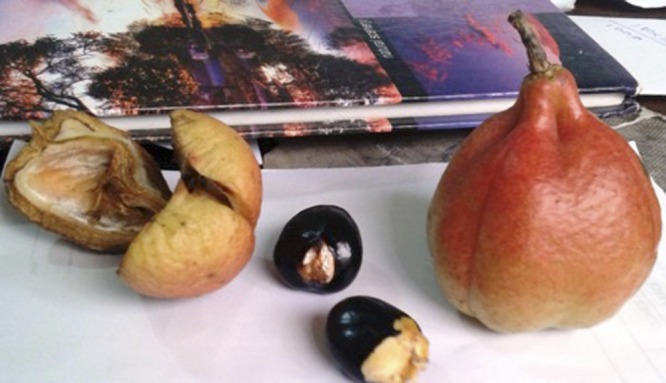
Ackee apple—aril, seeds, and fruit ingested by the children.
Conclusion
Awareness of the potential toxicity of ackee fruit is key to early recognition of symptoms and prompt management. There is a need for public enlightenment to prevent future occurrences of such toxicity.
Footnotes
Authors' addresses: Oludolapo Sherifat Katibi, Mohammed Baba Abdulkadir, and Rasheedah Mobolaji Ibraheem, Department of Paediatrics and Child Health, University of Ilorin, Kwara State, Nigeria, and Department of Paediatrics and Child Health, University of Ilorin Teaching Hospital, Kwara State, Nigeria, E-mails: sherikatibi@yahoo.com, docmohng@yahoo.com, and rasheedahbidmus@yahoo.com. Rasaq Olaosebikan, Department of Paediatrics and Child Health, University of Ilorin Teaching Hospital, Kwara State, Nigeria, and Department of Pediatrics, University of Nebraska Medical Center, Omaha, NE, E-mail: laoshrsk@yahoo.com. Taofik Oluwaseun Ogunkunle and Rukayat Murtala, Department of Paediatrics and Child Health, University of Ilorin Teaching Hospital, Kwara State, Nigeria, E-mails: taopheeqsheun@yahoo.com and drpetal@yahoo.com.
References
- 1.Grunes DE, Scordi-bello I, Suh M, Florman S, Yao J, Fiel MI, Thung SN. Fulminant hepatic failure attributed to ackee fruit ingestion in a patient with sickle cell trait. Case Rep Transplant. 2012;2012:739238. doi: 10.1155/2012/739238. [DOI] [PMC free article] [PubMed] [Google Scholar]
- 2.Atolani O, Olatunji GA, Fabiyi OA. Blighia sapida; the plant and its hypoglycins: an overview. J Sci Res. 2009;XXXIX:15–25. [Google Scholar]
- 3.Emanuel MA, Benkeblia N. Adding Value to Tropical Fruits—The Case of the Jamaican Ackee Industry: Lessons for Policy and Practice. Wageningen, The Netherlands: Knowledge for Development; 2012. [Google Scholar]
- 4.Barceloux DG. Ackee fruit and Jamaican vomiting sickness (Blighia sapida Köenig) Dis Mon. 2009;55:318–326. doi: 10.1016/j.disamonth.2009.03.002. [DOI] [PubMed] [Google Scholar]
- 5.Meda HA, Diallo B, Buchet J, Lison D, Barennes H, Ouangré A, Sanou M, Cousens S, Tall F, Van de Perre P. Epidemic of fatal encephalopathy in preschool children in Burkina Faso and consumption of unripe ackee (Blighia sapida) fruit. Lancet. 1999;353:536–540. doi: 10.1016/S0140-6736(99)01088-0. [DOI] [PubMed] [Google Scholar]
- 6.Joskow R, Belson M, Vesper H, Backer L, Rubin C. Ackee fruit poisoning: an outbreak investigation in Haiti 2000–2001 and review of the literature. Clin Toxicol. 2006;44:267–273. doi: 10.1080/15563650600584410. [DOI] [PubMed] [Google Scholar]
- 7.Hassal CH, Reyle K. Hypoglycin A and B, two biologically active polypeptides from Blighia sapida. Biochem J. 1955;60:334–339. doi: 10.1042/bj0600334. [DOI] [PMC free article] [PubMed] [Google Scholar]
- 8.Tanaka K, Kean EA, Johnson B. N Engl J Med. 1976;295:461–467. doi: 10.1056/NEJM197608262950901. [DOI] [PubMed] [Google Scholar]
- 9.Golden KD, Williams OJ. High-performance liquid chromatographic analysis of amino acids in ackee fruit with emphasis on the toxic amino acid hypoglycin A. J Chromatogr Sci. 2002;40:441–446. doi: 10.1093/chromsci/40.8.441. [DOI] [PubMed] [Google Scholar]
- 10.Kean EA, Hare ER. γ-Glutamyl transpeptidase of the ackee plant. Phytochemistry. 1980;19:199–203. [Google Scholar]
- 11.Adepoju AJ, Esan AO, Bello MO. Variation in the chemical parameters of oil extracted from arils of Blighia sapida (ackee) with the degree of fruit ripeness. Int J Basic Appl Sci. 2013;2:109–114. [Google Scholar]