



Abstract
Objective: To investigate the effects and the potential mechanisms of RKIP on cell migration, invasion and proliferation in human glioma cell lines in vitro. Methods: The RKIP over-expressing and RKIP knockdown human U87 glioma cells were used to reveal the effects of RKIP on human glioma cells migration, invasion and proliferation. After the recombinant plasmid pcDNA3.0-RKIP or RKIP-shRNA was transfected into the cell lines U87 by the means of liposome assay, the cells migration, invasion and proliferation were detected by wound healing, Transwell and MTT assay. Then, the levels of RKIP, MMP-3, MMP-9 and HMGA2 mRNA transcription were measured by means of RT-qPCR and levels of proteins expressions were determined using Western blot. Results: The results of MTT assay suggested that the PKIP have little inhibitive effects on glioma cells proliferation (P>0.05). The present paper showed that the migration distances in the group of RKIP-shRNA were markedly increased compared to the pcDNA3.0-RKIP and control. Similarly, the results showed that the numbers of invasion cells in RKIP-shRNA were remarkably increased than the pcDNA3.0-RKIP group and control group. Western blot and RT-qPCR suggested that over-expressions of RKIP lessened the MMP-2, MMP-9 and HMGA2 expression, however, turning down the RKIP expression showed the inverse effects. Conclusion: RKIP inhibits the cells migrations and invasions. Meanwhile, RKIP might inhibit the glioma cells through inhibiting MMPs and HMAG2 expression. Therefore, we demonstrated that RKIP is an underlying target for the treatment of glioma.
Keywords: Raf kinase inhibitor protein (RKIP), glioma, HMGA2, migration, invasion
Introduction
Glioma is a common kind of tumors in nervous system, which generates from the glial cell [1]. Glioma has a high migration and invasion character which frequently metastasize into surrounding brain tissues [2]. Metastasis of glioma into surrounding nervous tissues makes it hard to get an efficient treatment [3]. To get full appreciation of all the treatment strategies, more than 97% of glioma patients died less than five years after being diagnosed [4]. The capable abilities of migration and invasion in glioma cell may be responsible for the rate of mortality. Although there were mass of achievements for glioma, the potential fundamental mechanism and characteristic biomarker in glioma migration and invasion are much or a lot unclear. As a result, a volume of efforts should be done to explore and reveal the potential fundamental mechanism and characteristic biomarker targets in glioma cell migration and invasion for novel treatment strategy.
Raf Kinase Inhibitory Protein (RKIP) play important roles in inhibition of key signal transduction including MAPK and NF-κB pathway [5]. Meanwhile, RKIP also adjusts cell proliferations and differentiations [6]. RKIP play vital roles in a large amount of processes of cell, for examples membranes synthesis, neurodevelopment and tumors metastases [7-9]. A lot of researches reported that RKIP inhibited the cells metastases of cancers. Zheng Fu et al. performed immunohistochemistry to detect RKIP expression in primary prostate tumor cells and metastases of prostate carcinoma. Over-expression of RKIP cells was established and ability of cells proliferation, and in vitro cell invasion were detected. The results showed that over-expression of RKIP cells were associated with decreased in vitro cells invasion and RKIP over-expressing in prostate tumor cell reduced metastasis of tumor in vivo [10].
The extracellular matrix (ECM) is a crucial role in glioma cells metastasis because that the tumors cell lives in it [11,12]. As we know that MMPs is a positive factor in degradation of ECM. As a result, matrix metalloproteases (MMPs) have been known as vital factors in cancer cells invasion and migration. The mechanisms that RKIP inhibit tumors invasion and metastasis may negative regulation for MMPs expressions by means of suppression of NF-κB signaling [13-15].
Although RKIP had been reported to be an inhibitor in cell migration and invasion, there is little paper research the effects of RKIP on cell migration and invasion of glioma cells. In present research, we detected the effects of RKIP on cell migration and invasion of human U87 glioma cells and explore to reveal the potential mechanism.
Materials and methods
Cell cultures and transfections
The human glioma cell line U87 were pursued from The Second Affiliated Hospital of Harbin Medical University and were cultured in DEME (Boster Biology Co., Wuhan, China) supplemented with 10% FBS. All cells were incubated in a 37°C atmosphere of 5% CO2 and cell cultures were broken down with 0.1% trypsin. RKIP open reading frame clones were cloned into pcDNA3.0 vector for building the RKIP-overexpressing cell. According to the RNA interference theory, the RKIP knockdown cell was constructed as a negative control of the RKIP over-expressing one which was built using the scrambled shRNA. LipofectamineTM 2000 (Life Technologies) was used to transient transfections.
Wound healing assay
The wound healing assay was used to detect the ability of glioma cell migration and performed as previous paper described [16]. Forty-eight hours after transfection, the plastic micropipette tip was used to make a cell-blank scratch. Then, the cells were washed using PBS in order to wipe off the trashy cells. The remnant glioma cells were maintained in DEME serum for another 24 h. The distances that the cells moved were observed and recorded.
Transwell assay
In order to detect the invasion ability of glioma cells, the Transwell assay was carried out as previous reported [17]. Forty-eight hours after transfection, cell suspension (1×10⁵ cell/well) at a volume of 100 μL was added to every upper champers and DEME of 600 μL was added to the bottom cell well. After incubation at 37°C in a 5% CO2 incubator for 24 h, the cells that grow on the polycarbonate membranes were wiped off using tampons. Then, the polycarbonate membranes were handled with 4% paraformaldehyde for 30 mins. After that, the polycarbonate membranes were washed using PBS for twice and placed on the cell plate well which filled with trypan flue for cell straining. The cells number that had cross through the polycarbonate membranes was recorded and analyzed.
RT-qPCR
Cellular total RNA was extracted using the TRIZOL reagent (Invitrogen, USA) according to the manufacturer’s instruction. 2 μg of RNA were annealed to oligo(dT) at 65°C for 10 min. The samples were cooled at 24°C. Reverse transcriptase and dNTPs were added to the RNA oligo(dT) mixture and the reactions were carried out at 43°C for 1 h. Primers used are listed as below. RKIP: forward: 5’-GTAAAGCTTTTAACTGCACTCGGGACTCG-3’, reverse: 5’-GTACTCGAGTACGACTTGACTGTACTGTG-3’; MMP-3: forward: 5’-AGTGGAGGAAAACCCACCTT-3’, reverse: 5’-CCAGGTCCATCAAAAGGGTA-3’; MMP-9: forward: 5’-CATCGTCATCCAGTTTGGTG-3’, reverse: 5’-TCGAAGATGAAGGGGAAGTG-3’; HMGA2: forward: 5’-CGAAAGGTGCTGGGCAGCTCCGG-3’, reverse: 5’-CCATTTCCTAGGTCTGCCTCTTG-3’; GAPDH: forward: 5’-CGGAGTCAACGGATTTGGTCGTAT-3’, reverse: 5’-AGCCTTCTCCATGGTGGTGAAGAC-3’. GAPDH was used as the loading control. PCR reaction was stopped after 25 cycles.
Protein extraction and Western blotting
Glioma cells was lysed and homogenized in lysis buffer (2% deoxycholic acid, 5 mM EDTA, 150 mM NaCl, 0.1% SDS, 0.5% Triton X-100, 10 mM Tris-HCl, pH 7.2). After gel electrophoresis, proteins were blotted onto nitrocellulose membranes. The membranes were blocked with 5% bovine serum albumin in phosphate-buffered saline and incubated at 4°C for a night with primary antibodies against RKIP (1:500 dilution), MMP-2 (1:500 dilution), MMP-9 (1:500 dilution), HMGA2 (1:500 dilution) or GAPDH (1:1000 dilution). This was followed by incubation with secondary antibody (1 hour at room temperature). Relative density of the bands of protein of interest to GAPDH band was analyzed using the Image Pro Plus image analysis system.
Statistical analysis
Data are shown as mean ± standard deviation. The GraphPad Prism 5 (GraphPad Software Inc., USA) was used for statistical analysis. The one-way ANOVA was used for multiple comparisons, while the Student’s t test was used to test the differences between two groups. P<0.05 was considered as a statistically significant result.
Results
Effects of RKIP on human glioma cells migration
Forty-eight hours after transfection, U87 glioma cell migration was detected by wound healing assay. Our results showed that the migration distances in RKIP-shRNA group were significantly increased than the pcDNA3.0-RKIP group and control group after transfection of 12 h, 24 h and 48 h (Figure 1). The results suggested that the over-expression of RKIP could inhibit the glioma cell migrantion.
Figure 1.

Effects of RKIP on cells migration in human U87 glioma cell by means of wound healing assay. The relative distance was ratio of experimental group distance vs. the distance of the cell-blank scratch at 12 h, 14 h and 48 h after transfection. *P<0.05, **P<0.01.
Effects of RKIP on human glioma cells invasion
Then, the Transwell assay was carried out to determine the effects of RKIP on glioma cell invasion. Similarly, the results showed that the numbers of invasion cells in RKIP-shRNA group were significantly increased than the pcDNA3.0-RKIP and control (Figure 2). The RKIP over-expressing cells showed an inhibiting invasive ability. These results revealed that RKIP can suppress the ability of glioma cell invasion.
Figure 2.
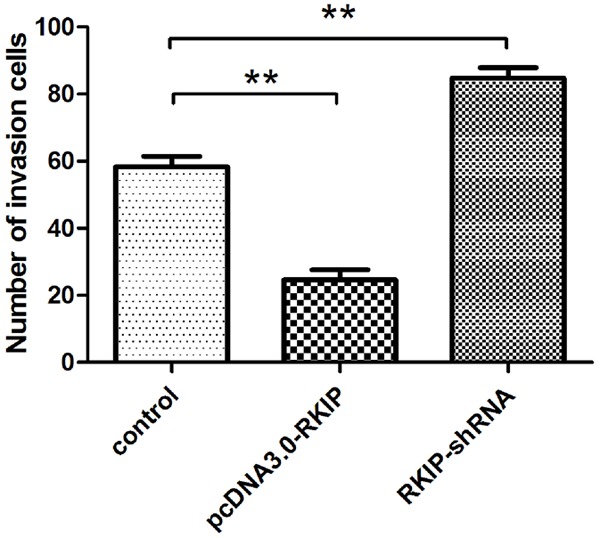
Effects of RKIP on cells invasion in human U87 glioma cell by means of Transwell assay. The number of glioma cells cross through the membrane was recorded. *P<0.05, **P<0.01.
Effects of RKIP on human glioma cells proliferation
To determine the effects of RKIP on the ability of proliferation in U87 cells, the MTT assay was carried out to measure the proliferation of cells that over-expressing or down regulating of RKIP. Our data suggested that RKIP had not have the ability of inhibitory ability of proliferation (Figure 3).
Figure 3.

The effects of RKIP on the proliferation of U87 glioma cells. To determine the effects of RKIP on the ability of proliferation in U87 cells, the MTT assays were carried out to detected the proliferations of cells that over-expressing or down regulating of RKIP. The results showed that RKIP had little effects on the proliferation of U87 glioma cells.
RKIP regulate the mRNA and protein expression of related migration and invasion related proteins
In order to explore the mechanisms that the RKIP regulate the migrations and invasions of glioma cell, we performed RT-qPCR and Western blot analysis to measure the mRNA and protein expressions of MMP-2, MMP-9 and HMGA2. As we can see in Figures 4A, 5A and 5B, the mRNA and protein expressions of RKIP in the pcDNA3.0-RKIP group was remarkably increased comparing to the control ones (P<0.01). On the contrary, in the PKIP-shRNA group, the mRNA and protein expression of RKIP had a significant reduction (P<0.01). We can also see that the mRNA and protein expression of MMP-2 and MMP-9 in group of pcDNA3.0-RKIP was remarkably higher than the control group (P<0.01) (Figures 4B, 4C and 5B). However, those in group of PKIP-shRNA conversely had a significant reduction. Our results also showed that the mRNA and protein expression of HMGA2 was remarkably lower in the pcDNA3.0-RKIP and significantly higher comparing to the control (P<0.01, respectively) (Figures 4D and 5B). As we know that MMPs protein and HMGA2 play vital roles in migration and invasion of many kinds of cancers, our results suggests that RKIP inhibit glioma cell invasion through down regulating the MMPs and HMGA2 expression.
Figure 4.

Effects of over-expressing and knockdown RKIP on mRNA expressions in human U87 glioma cells. A. The RKIP mRNA relative expressions (vs. GAPDH), B. The MMP-2 mRNA relative expression (vs. GAPDH), C. The MMP-9 mRNA relative expressions (vs. GAPDH), D. The HMGA2 mRNA relative expression (vs. GAPDH), *P<0.05, **P<0.01.
Figure 5.

Effects of over-expressing and knockdown RKIP on protein expression in human U87 glioma cells. A. The RKIP protein relative expressions (vs. GAPDH), B. The protein relative expression of MMP-2, MMP-9 and HMGA2, *P<0.05, **P<0.01.
Discussion
Glioma is one of the common malignant tumors in human which has a very low level of survival rate. The primary reason on the low efficiency of existing treatments is the high ability of glioma cell invasion [18-20]. As a result, it is important and necessary to explore the mechanism of the glioma cell migrations and invasions. There are many previous researches reveal the molecular mechanisms of glioma cell migration and invasion. Zhou et al. reported that knockdown of GOLPH3 expressions led to decreases of glioma cells migrations and invasions [21]. Gao et al. revealed that over-expression of SERPINB1 inhibited the migration and invasion of glioma cells, however, knockdown expression of SERPINB1 promoted those effects. In addition, SERPINB1 inhibited glioma migration and invasion probably by inhibiting MMP-2 expression [22]. Tian et al. demonstrated that let-7b/i inhibit the glioma cell invasion through inhibiting the expression of IKBKE and promoting the expression of E-cadherin [16].
RKIP was known as a member of phosphatidyl ethanolamine binding protein. Then, it was regarded as a blocker of Raf kinase activation in MEK pathway. Lots of papers had proved that RKIP regulates NF-κB pathway [23-25]. A volume of researches had reported that overexpression of RKIP could inhibit the cell migration and invasion in many kinds of cancers. H. Xinzhou et al. revealed the effects of RKIP on cells proliferations, migration and invasion in human prostate cancer PC-3M cells model. Their results suggested that RKIP did not have an inhibitive effect on proliferations of PC-3M cells, however, RKIP could inhibit the cell migration and invasion in PC-3M cell system. In their research, the molecular mechanisms that PKIP inhibited the cell invasion by downregulating the expression of MMPs was also reported [26]. The evidences suggest that RKIP may be a novel targets for the treatments of cancers. But the effects of RKIP on glioma cell migration and invasion were little known.
Migration and invasion of cells are tanglesome courses including cytoskeletal-reorganizations and degradations of ECM [27]. Normally, degradations of ECM are primary steps of cancer cell invasions. MMP-2 and MMP-9 may be the mediations of these courses. MMP-2 and MMP-9 degraded native collagen type IV, promoting degradations of the ECM, which helps the cancer cells to run away from the primary sites and motivate cell invasion [28-31]. The high mobility group AT-hook 2 (HMGA2) are involved in many biological events including developments of several cancers [32]. HMGA2 is highly expressed in lots of cancers including rectal carcinoma, breast cancer, and gastric carcinoma. Therefore, HMGA2 play vital roles in the developments of cancers [33,34]. Liu et al. found that the over-expression HMGA2 could promote proliferations and invasions in gastric cancer cells [33].
In our present paper, we revealed roles of RKIP in U87 cell migrations and invasions. Our results showed that over-expression of RKIP lessened cell migration and invasion, however, turning down the RKIP expression showed the inverse effect. Therefore, we demonstrated that RKIP is an underlying target for the treatment of glioma.
Acknowledgements
This work was Supported by Scientific Research Fund of Heilongjiang Provincial Education Department (NO. 12541350). This work was supported by grants from Heilongjiang Province Health Department Project (Grant No. 2013047).
Disclosure of conflict of interest
None.
References
- 1.Abrams DA, Hanson JA, Brown JM, Hsu FP, Delashaw JB Jr, Bota DA. Timing of surgery and bevacizumab therapy in neurosurgical patients with recurrent high grade glioma. J Clin Neurosci. 2015;22:35–39. doi: 10.1016/j.jocn.2014.05.054. [DOI] [PubMed] [Google Scholar]
- 2.Afshordel S, Kern B, Clasohm J, Konig H, Priester M, Weissenberger J, Kogel D, Eckert GP. Lovastatin and perillyl alcohol inhibit glioma cell invasion, migration, and proliferation--impact of Ras-/Rho-prenylation. Pharmacol Res. 2015;91:69–77. doi: 10.1016/j.phrs.2014.11.006. [DOI] [PubMed] [Google Scholar]
- 3.Ahmed R, Oborski MJ, Hwang M, Lieberman FS, Mountz JM. Malignant gliomas: current perspectives in diagnosis, treatment, and early response assessment using advanced quantitative imaging methods. Cancer Manag Res. 2014;6:149–170. doi: 10.2147/CMAR.S54726. [DOI] [PMC free article] [PubMed] [Google Scholar]
- 4.Yang L, Gao S, Asghar S, Liu G, Song J, Wang X, Ping Q, Zhang C, Xiao Y. Hyaluronic acid/chitosan nanoparticles for delivery of curcuminoid and its in vitro evaluation in glioma cells. Int J Biol Macromol. 2015;72:1391–1401. doi: 10.1016/j.ijbiomac.2014.10.039. [DOI] [PubMed] [Google Scholar]
- 5.Escara-Wilke J, Keller JM, Ignatoski KM, Dai J, Shelley G, Mizokami A, Zhang J, Yeung ML, Yeung KC, Keller ET. Raf kinase inhibitor protein (RKIP) deficiency decreases latency of tumorigenesis and increases metastasis in a murine genetic model of prostate cancer. Prostate. 2015;75:292–302. doi: 10.1002/pros.22915. [DOI] [PubMed] [Google Scholar]
- 6.Al-Mulla F, Bitar MS, Taqi Z, Yeung KC. RKIP: much more than Raf kinase inhibitory protein. J Cell Physiol. 2013;228:1688–1702. doi: 10.1002/jcp.24335. [DOI] [PubMed] [Google Scholar]
- 7.Zuo H, Lin T, Wang D, Peng R, Wang S, Gao Y, Xu X, Zhao L, Su Z. RKIP Regulates Neural Cell Apoptosis Induced by Exposure to Microwave Radiation Partly Through the MEK/ERK/ CREB Pathway. Mol Neurobiol. 2015;51:1520–9. doi: 10.1007/s12035-014-8831-5. [DOI] [PubMed] [Google Scholar]
- 8.Zhang XM, Zhou C, Gu H, Yan L, Zhang GY. Correlation of RKIP, STAT3 and cyclin D1 expression in pathogenesis of gastric cancer. Int J Clin Exp Pathol. 2014;7:5902–5908. [PMC free article] [PubMed] [Google Scholar]
- 9.Yousuf S, Duan M, Moen EL, Cross-Knorr S, Brilliant K, Bonavida B, LaValle T, Yeung KC, Al-Mulla F, Chin E, Chatterjee D. Raf kinase inhibitor protein (RKIP) blocks signal transducer and activator of transcription 3 (STAT3) activation in breast and prostate cancer. PLoS One. 2014;9:e92478. doi: 10.1371/journal.pone.0092478. [DOI] [PMC free article] [PubMed] [Google Scholar] [Retracted]
- 10.Fu Z, Smith PC, Zhang L, Rubin MA, Dunn RL, Yao Z, Keller ET. Effects of raf kinase inhibitor protein expression on suppression of prostate cancer metastasis. J Natl Cancer Inst. 2003;95:878–889. doi: 10.1093/jnci/95.12.878. [DOI] [PubMed] [Google Scholar]
- 11.Ramaswamy P, Aditi Devi N, Hurmath Fathima K, Dalavaikodihalli Nanjaiah N. Activation of NMDA receptor of glutamate influences MMP-2 activity and proliferation of glioma cells. Neurol Sci. 2014;35:823–829. doi: 10.1007/s10072-013-1604-5. [DOI] [PubMed] [Google Scholar]
- 12.Chen Z, Cheng Q, Ma Z, Xi H, Peng R, Jiang B. Overexpression of RKIP inhibits cell invasion in glioma cell lines through upregulation of miR-98. Biomed Res Int. 2013;2013:695179. doi: 10.1155/2013/695179. [DOI] [PMC free article] [PubMed] [Google Scholar]
- 13.Yesilkanal AE, Rosner MR. Raf kinase inhibitory protein (RKIP) as a metastasis suppressor: regulation of signaling networks in cancer. Crit Rev Oncog. 2014;19:447–454. doi: 10.1615/critrevoncog.2014012000. [DOI] [PMC free article] [PubMed] [Google Scholar]
- 14.Wu Z, Fu C, Shi L, Ruan L, Lin D, Guo C. Structural basis for RKIP binding with its substrate Raf1 kinase. Biotechnol Lett. 2014;36:1869–1874. doi: 10.1007/s10529-014-1558-6. [DOI] [PubMed] [Google Scholar]
- 15.Sun M, Gomes S, Chen P, Frankenberger CA, Sankarasharma D, Chung CH, Chada KK, Rosner MR. RKIP and HMGA2 regulate breast tumor survival and metastasis through lysyl oxidase and syndecan-2. Oncogene. 2014;33:3528–3537. doi: 10.1038/onc.2013.328. [DOI] [PMC free article] [PubMed] [Google Scholar]
- 16.Tian Y, Hao S, Ye M, Zhang A, Nan Y, Wang G, Jia Z, Yu K, Guo L, Pu P, Huang Q, Zhong Y. MicroRNAs let-7b/i suppress human glioma cell invasion and migration by targeting IKBKE directly. Biochem Biophys Res Commun. 2015;458:307–312. doi: 10.1016/j.bbrc.2015.01.105. [DOI] [PubMed] [Google Scholar]
- 17.He X, Huang Q, Qiu X, Liu X, Sun G, Guo J, Ding Z, Yang L, Ban N, Tao T, Wang D. LAP3 promotes glioma progression by regulating proliferation, migration and invasion of glioma cells. Int J Biol Macromol. 2015;72:1081–1089. doi: 10.1016/j.ijbiomac.2014.10.021. [DOI] [PubMed] [Google Scholar]
- 18.Leng TD, Li MH, Shen JF, Liu ML, Li XB, Sun HW, Branigan D, Zeng Z, Si HF, Li J, Chen J, Xiong ZG. Suppression of TRPM7 inhibits proliferation, migration, and invasion of malignant human glioma cells. CNS Neurosci Ther. 2015;21:252–261. doi: 10.1111/cns.12354. [DOI] [PMC free article] [PubMed] [Google Scholar]
- 19.Fan YC, Zhu YS, Mei PJ, Sun SG, Zhang H, Chen HF, Chen C, Miao FA. Cullin1 regulates proliferation, migration and invasion of glioma cells. Med Oncol. 2014;31:227. doi: 10.1007/s12032-014-0227-x. [DOI] [PubMed] [Google Scholar]
- 20.Mao J, Zhang M, Zhong M, Zhang Y, Lv K. MicroRNA-204, a direct negative regulator of ezrin gene expression, inhibits glioma cell migration and invasion. Mol Cell Biochem. 2014;396:117–128. doi: 10.1007/s11010-014-2148-6. [DOI] [PubMed] [Google Scholar]
- 21.Zhou X, Zhan W, Bian W, Hua L, Shi Q, Xie S, Yang D, Li Y, Zhang X, Liu G, Yu R. GOLPH3 regulates the migration and invasion of glioma cells though RhoA. Biochem Biophys Res Commun. 2013;433:338–344. doi: 10.1016/j.bbrc.2013.03.003. [DOI] [PubMed] [Google Scholar]
- 22.Huasong G, Zongmei D, Jianfeng H, Xiaojun Q, Jun G, Sun G, Donglin W, Jianhong Z. Serine protease inhibitor (SERPIN) B1 suppresses cell migration and invasion in glioma cells. Brain Res. 2015;1600:59–69. doi: 10.1016/j.brainres.2014.06.017. [DOI] [PubMed] [Google Scholar]
- 23.Bonavida B. RKIP-mediated chemo-immunosensitization of resistant cancer cells via disruption of the NF-kappaB/Snail/YY1/RKIP resistance-driver loop. Crit Rev Oncog. 2014;19:431–445. doi: 10.1615/critrevoncog.2014011929. [DOI] [PMC free article] [PubMed] [Google Scholar]
- 24.Liu H, Li P, Li B, Sun P, Zhang J, Wang B, Jia B. RKIP promotes cisplatin-induced gastric cancer cell death through NF-kappaB/Snail pathway. Tumour Biol. 2015;36:1445–1453. doi: 10.1007/s13277-014-2496-6. [DOI] [PubMed] [Google Scholar]
- 25.Wu K, Bonavida B. The activated NFkappaB-Snail-RKIP circuitry in cancer regulates both the metastatic cascade and resistance to apoptosis by cytotoxic drugs. Crit Rev Immunol. 2009;29:241–254. doi: 10.1615/critrevimmunol.v29.i3.40. [DOI] [PubMed] [Google Scholar]
- 26.Xinzhou H, Ning Y, Ou W, Xiaodan L, Fumin Y, Huitu L, Wei Z. RKIp inhibits the migration and invasion of human prostate cancer PC-3M cells through regulation of extracellular matrix. Mol Biol (Mosk) 2011;45:1004–1011. [PubMed] [Google Scholar]
- 27.Cheng X, Lu SH, Cui Y. ECRG2 regulates ECM degradation and uPAR/FPRL1 pathway contributing cell invasion/migration. Cancer Lett. 2010;290:87–95. doi: 10.1016/j.canlet.2009.09.001. [DOI] [PubMed] [Google Scholar]
- 28.Watanabe A, Hoshino D, Koshikawa N, Seiki M, Suzuki T, Ichikawa K. Critical role of transient activity of MT1-MMP for ECM degradation in invadopodia. PLoS Comput Biol. 2013;9:e1003086. doi: 10.1371/journal.pcbi.1003086. [DOI] [PMC free article] [PubMed] [Google Scholar]
- 29.Reeves CV, Wang X, Charles-Horvath PC, Vink JY, Borisenko VY, Young JA, Kitajewski JK. Anthrax toxin receptor 2 functions in ECM homeostasis of the murine reproductive tract and promotes MMP activity. PLoS One. 2012;7:e34862. doi: 10.1371/journal.pone.0034862. [DOI] [PMC free article] [PubMed] [Google Scholar]
- 30.Hoshino D, Koshikawa N, Suzuki T, Quaranta V, Weaver AM, Seiki M, Ichikawa K. Establishment and validation of computational model for MT1-MMP dependent ECM degradation and intervention strategies. PLoS Comput Biol. 2012;8:e1002479. doi: 10.1371/journal.pcbi.1002479. [DOI] [PMC free article] [PubMed] [Google Scholar]
- 31.Galvez BG, Matias-Roman S, Yanez-Mo M, Sanchez-Madrid F, Arroyo AG. ECM regulates MT1-MMP localization with beta1 or alphavbeta3 integrins at distinct cell compartments modulating its internalization and activity on human endothelial cells. J Cell Biol. 2002;159:509–521. doi: 10.1083/jcb.200205026. [DOI] [PMC free article] [PubMed] [Google Scholar]
- 32.Sheen YS, Liao YH, Lin MH, Chu CY, Ho BY, Hsieh MC, Chen PC, Cha ST, Jeng YM, Chang CC, Chiu HC, Jee SH, Kuo ML. IMP-3 Promotes Migration and Invasion of Melanoma Cells by Modulating the Expression of HMGA2 and Predicts Poor Prognosis in Melanoma. J Invest Dermatol. 2015;135:1065–1073. doi: 10.1038/jid.2014.480. [DOI] [PubMed] [Google Scholar]
- 33.Liu H, Li P, Li B, Sun P, Zhang J, Wang B, Jia B. RKIP inhibits gastric cancer cell survival and invasion by regulating the expression of HMGA2 and OPN. Tumour Biol. 2014;35:11949–11958. doi: 10.1007/s13277-014-2486-8. [DOI] [PubMed] [Google Scholar]
- 34.Mu G, Liu H, Zhou F, Xu X, Jiang H, Wang Y, Qu Y. Correlation of overexpression of HMGA1 and HMGA2 with poor tumor differentiation, invasion, and proliferation associated with let-7 down-regulation in retinoblastomas. Hum Pathol. 2010;41:493–502. doi: 10.1016/j.humpath.2009.08.022. [DOI] [PubMed] [Google Scholar]