



Abstract
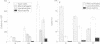
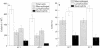
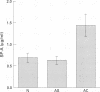
BACKGROUND: Surfactant protein A (SP-A) acts as an immune system modulator in the lungs and may therefore be involved in the pathogenesis of hypersensitivity pneumonitis. METHODS: The levels of SP-A in bronchoalveolar lavage (BAL) fluid were measured in 20 subjects with acute farmer's lung, 16 asymptomatic dairy farmers, and 14 normal controls. Eight patients had a second evaluation after one month of treatment by either contact avoidance (n = 3) or oral prednisolone (20 or 25 mg/day, n = 5). Chest radiographs and lung function measurements were also obtained in all farmers, twice in those re-evaluated after treatment. RESULTS: Patients with acute farmer's lung had significantly higher levels of SP-A than asymptomatic farmers and normal controls (p = 0.005) with mean (SE) values of 1.43 (0.29) micrograms/ml, 0.62 (0.09) microgram/ml, and 0.68 (0.11) microgram/ml, respectively. In eight subjects tested after one month of treatment the level of SP-A was unchanged although all were clinically improved. No correlations were seen between levels of SP-A in BAL fluid and numbers of BAL cells, lung function measurements, or chest radiographic scores. CONCLUSION: Although the level of SP-A is increased in the BAL fluid of patients with acute farmer's lung, it is not correlated with clinical abnormalities of this disease.
Full text
PDF


Images in this article

Selected References
These references are in PubMed. This may not be the complete list of references from this article.
- Ansfield M. J., Kaltreider H. B., Benson B. J., Caldwell J. L. Immunosuppressive activity of canine pulmonary surface active material. J Immunol. 1979 Mar;122(3):1062–1066. [PubMed] [Google Scholar]
- Blau H., Riklis S., Kravtsov V., Kalina M. Secretion of cytokines by rat alveolar epithelial cells: possible regulatory role for SP-A. Am J Physiol. 1994 Feb;266(2 Pt 1):L148–L155. doi: 10.1152/ajplung.1994.266.2.L148. [DOI] [PubMed] [Google Scholar]
- Catanzaro A., Richman P., Batcher S., Hallman M. Immunomodulation by pulmonary surfactant. J Lab Clin Med. 1988 Dec;112(6):727–734. [PubMed] [Google Scholar]
- Cormier Y., Bélanger J., Tardif A., Leblanc P., Laviolette M. Relationships between radiographic change, pulmonary function, and bronchoalveolar lavage fluid lymphocytes in farmer's lung disease. Thorax. 1986 Jan;41(1):28–33. doi: 10.1136/thx.41.1.28. [DOI] [PMC free article] [PubMed] [Google Scholar]
- Gruchow H. W., Hoffmann R. G., Marx J. J., Jr, Emanuel D. A., Rimm A. A. Precipitating antibodies to farmer's lung antigens in a Wisconsin farming population. Am Rev Respir Dis. 1981 Oct;124(4):411–415. doi: 10.1164/arrd.1981.124.4.411. [DOI] [PubMed] [Google Scholar]
- Guzman J., Wang Y. M., Kalaycioglu O., Schoenfeld B., Hamm H., Bartsch W., Costabel U. Increased surfactant protein A content in human alveolar macrophages in hypersensitivity pneumonitis. Acta Cytol. 1992 Sep-Oct;36(5):668–673. [PubMed] [Google Scholar]
- Hamm H., Lührs J., Guzman y Rotaeche J., Costabel U., Fabel H., Bartsch W. Elevated surfactant protein A in bronchoalveolar lavage fluids from sarcoidosis and hypersensitivity pneumonitis patients. Chest. 1994 Dec;106(6):1766–1770. doi: 10.1378/chest.106.6.1766. [DOI] [PubMed] [Google Scholar]
- Hawgood S., Benson B. J., Schilling J., Damm D., Clements J. A., White R. T. Nucleotide and amino acid sequences of pulmonary surfactant protein SP 18 and evidence for cooperation between SP 18 and SP 28-36 in surfactant lipid adsorption. Proc Natl Acad Sci U S A. 1987 Jan;84(1):66–70. doi: 10.1073/pnas.84.1.66. [DOI] [PMC free article] [PubMed] [Google Scholar]
- Juers J. A., Rogers R. M., McCurdy J. B., Cook W. W. Enhancement of bactericidal capacity of alveolar macrophages by human alveolar lining material. J Clin Invest. 1976 Aug;58(2):271–275. doi: 10.1172/JCI108468. [DOI] [PMC free article] [PubMed] [Google Scholar]
- Lesur O., Bernard A. M., Bégin R. O. Clara cell protein (CC-16) and surfactant-associated protein A (SP-A) in asbestos-exposed workers. Chest. 1996 Feb;109(2):467–474. doi: 10.1378/chest.109.2.467. [DOI] [PubMed] [Google Scholar]
- Lesur O., Mancini N. M., Janot C., Chabot F., Boitout A., Polu J. M., Gérard H. Loss of lymphocyte modulatory control by surfactant lipid extracts from acute hypersensitivity pneumonitis: comparison with sarcoidosis and idiopathic pulmonary fibrosis. Eur Respir J. 1994 Nov;7(11):1944–1949. [PubMed] [Google Scholar]
- Lesur O., Veldhuizen R. A., Whitsett J. A., Hull W. M., Possmayer F., Cantin A., Bégin R. Surfactant-associated proteins (SP-A, SP-B) are increased proportionally to alveolar phospholipids in sheep silicosis. Lung. 1993;171(2):63–74. doi: 10.1007/BF00542334. [DOI] [PubMed] [Google Scholar]
- Manz-Keinke H., Plattner H., Schlepper-Schäfer J. Lung surfactant protein A (SP-A) enhances serum-independent phagocytosis of bacteria by alveolar macrophages. Eur J Cell Biol. 1992 Feb;57(1):95–100. [PubMed] [Google Scholar]
- McMahan M. J., Mimouni F., Miodovnik M., Hull W. M., Whitsett J. A. Surfactant associated protein (SAP-35) in amniotic fluid from diabetic and nondiabetic pregnancies. Obstet Gynecol. 1987 Jul;70(1):94–98. [PubMed] [Google Scholar]
- Solal-Céligny P., Laviolette M., Hébert J., Cormier Y. Immune reactions in the lungs of asymptomatic dairy farmers. Am Rev Respir Dis. 1982 Dec;126(6):964–967. doi: 10.1164/arrd.1982.126.6.964. [DOI] [PubMed] [Google Scholar]
- Weaver T. E., Whitsett J. A. Function and regulation of expression of pulmonary surfactant-associated proteins. Biochem J. 1991 Jan 15;273(Pt 2):249–264. doi: 10.1042/bj2730249. [DOI] [PMC free article] [PubMed] [Google Scholar]
- van Iwaarden F., Welmers B., Verhoef J., Haagsman H. P., van Golde L. M. Pulmonary surfactant protein A enhances the host-defense mechanism of rat alveolar macrophages. Am J Respir Cell Mol Biol. 1990 Jan;2(1):91–98. doi: 10.1165/ajrcmb/2.1.91. [DOI] [PubMed] [Google Scholar]
- van Iwaarden J. F., van Strijp J. A., Ebskamp M. J., Welmers A. C., Verhoef J., van Golde L. M. Surfactant protein A is opsonin in phagocytosis of herpes simplex virus type 1 by rat alveolar macrophages. Am J Physiol. 1991 Aug;261(2 Pt 1):L204–L209. doi: 10.1152/ajplung.1991.261.2.L204. [DOI] [PubMed] [Google Scholar]