



Abstract
Foreign body in the urinary bladder is a relatively rare occurrence. A variety of foreign bodies, majority of which were mostly self-inflicted for autoerotic reasons, have been reported in the literature. Here, we report a case of self-inserted electric wire in the bladder and review the literature.
Keywords: Foreign body, Bladder, Urethra, Self-infliction, Autoerotism, Electric wire, Endoscopic management
Introduction
Foreign bodies of the lower urinary tract, though uncommon, are being increasingly reported in the literature. A whole host of foreign bodies are self-inserted for various reasons, most common being for autoerotic reasons. Such patients do not seek medical help till complications like infection or bleeding occur. The hesitancy to report to a doctor is possibly due to feelings of guilt or embarrassment. We report one such case of self-insertion of electric wire by an electrician on anti-depressants, to cure himself of his perceived urethral obstruction and also discuss the various scenarios for such self-inflictions and the management strategies.
Case Report
A young, 30-year-old unmarried male, on anti-depressants presented to us with complaints of dysuria, difficulty in voiding and hematuria. He gave a history of having inserted a feet and half long, electrical wire into his urethra few days ago, to cure himself of an imaginary urethral obstruction. Further on questioning, he said, having inserted three-fourth length of the wire, he could not pull it out. He then pushed the rest of the wire into the bladder with another wire. After a week, he presented to the urology department with hematuria.
Physical examination was unremarkable. An X-ray of the bladder region showed the electric wire coiled within the bladder with a knot in the prostatic urethra (Fig. 1).
Fig. 1.
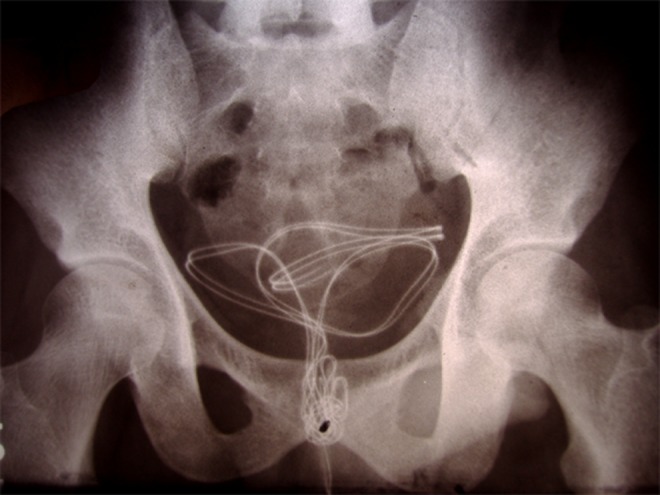
X-ray of the bladder region showing the coils of electric wire and knot in the prostatic urethra
Cystoscopic removal failed as the wire had knotted within the bladder. A 32 F suprapubic access was then developed after serial dilatation and Amplatz sheath insertion. The entire length of the wire was removed, after pulling and cutting each loop of the wire into smaller pieces, till the knot could be pulled out intact through the sheath (Fig. 2). Suprapubic catheter was inserted, which was removed after 48 h.
Fig. 2.
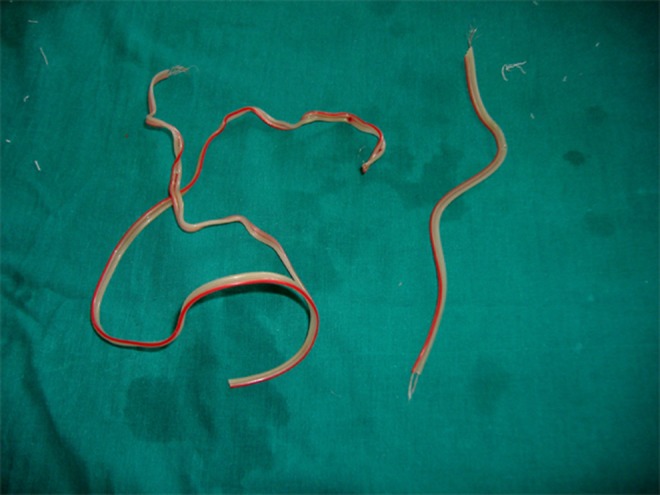
Fragments of the electric wires salvaged through suprapubic percutaneous access
While being in the ward, the psychiatric colleagues were consulted, put him back on the anti-depressants and discharged him on the fourth postoperative day. After a follow-up of 2 years without any complaints, he was instructed to continue follow-up with psychiatric colleagues.
Discussion and Review of Literature
Foreign body in the lower urinary tract is a relatively uncommon condition. Various easily accessible household materials are self-inserted mostly for autoerotic reasons.
The spectrum of foreign bodies found in the lower urinary tract varies from sharp objects (pins, needles, ball point pens, pen lids, safety pins); wire-like objects (telephone cables, rubber tubes, feeding tubes, straws); tooth brushes, household batteries and thermometers [1]; vegetables (cucumbers, beans, hay, bamboo sticks, leaves); animal parts (leaches, fish bones); powders like cocaine and fluids like glue and hot wax [2, 3]. The self-infliction is commoner in men with a ratio of 1.7: 1 [4].
The motivation for self-infliction in most instances is autoerotic [2, 5, 6], other reasons being psychiatric disorders, mental confusion arising out of drugs and inherent diseases, narcotic drug intoxications [2, 5], attempt to cure oneself of urinary symptoms [7] and in children out of inherent curiosity. Co-morbidities reported include sexual exotic impulses, schizoid personality and borderline personality disorders [6, 8]. Guilt overrides the necessity of seeking help, till a resultant complication forces them to seek medical help.
Few psychoanalytical theories are postulated for self-infliction. Amongst the foremost are Kenny’s and Wise’s theories.
Kenny’s theory postulates that after an initiating event of accidentally discovered pleasurable stimulation of urethra will be followed by repetition of the same action using different objects of unknown danger. The urge to derive the same pleasurable sensation is driven by a psychological predisposition for sexual gratification [9].
Wise considered urethral manipulation as a paraphilia combining sadomasochistic and fetishist elements, where the orgasm of a particular individual depends on the presence of a fetish. He theorizes that it shows a regression to urethral stage of erotism, due to a traumatic event or a libidinal drive [10].
Others consider these as acts of an impulsive behaviour that is self-punishing in nature and could aggravate to suicidal tendencies. Hence, psychiatric evaluation is strongly recommended [2]. But such a recommendation is controversial as many of these, at presentation, could be psychologically normal.
In women, foreign bodies are self-inserted or by others to terminate pregnancies out of ignorance, lack of medical help or due to illegitimacy [11]. Yiu MK, Yiu TF and Chan AY have reported of a thermometer having been inserted in a misguided attempt at measuring core temperature, ending up as foreign body! [12].
Patients with foreign bodies present with features of acute cystitis and urethritis. Some present with swelling of external genitalia, obstructive symptoms and urinary retention [3]. A long forgotten, self-inflicted foreign body can lead to complications like chronic and recurrent urinary tract infections, encrustations and its attendant complications like obstructive uropathy, vesico-vaginal fistulas, periurethral abscesses, sepsis and even squamous cell carcinoma [3, 13].
Dissuading the clinician to examine external genitalia could be a pointer to a urethral foreign body [3]. Diagnosis is frequently made by a detailed history and physical examination. Those objects superficial to the urogenital diaphragm are palpable. Radio-opaque foreign bodies are visualized on X-ray KUB region but sonography is useful, detecting the radiolucent foreign bodies [2, 3, 14, 15]. The radiological evaluation is done to know the size, location, number and associated complications and to plan therapeutic interventions.
The main objectives of intervention should be removal of the foreign body, with minimal damage to the urethra or bladder, and to treat the complications if any. Immediate management consists of providing symptomatic relief, starting broad-spectrum antibiotics and to relieve the urinary retention [3].
Definitive managements aim at complete removal of foreign body with minimal trauma to the urethra, bladder and surrounding organs. Though some recently inserted objects, which are smaller than the urethral lumen, are expelled spontaneously, most require surgical intervention. Optimal intervention is based upon the type, size, location of the objects and associated urinary tract injuries [14].
Those objects, smaller than the urethral lumen, can be retrieved cystoscopically, in toto with use of graspers and baskets, but often, it is necessary to push the object back into the bladder before retrieval. Wise K L and King LR have used magnetic graspers to retrieve metal objects like safety pins [16].
Objects, larger than the urethral lumen, are pushed into the bladder and removed piecemeal, either cystoscopically or suprapubically. Impacted foreign bodies, associated with complications, need urethrotomy or meatotomy.
Paraffin and wax objects like candles and crayons as foreign bodies pose a challenge for removal. Solvents like xylol, benzene and even kerosene which were used to dissolve the objects are no longer used, as they are carcinogenic. Endoscopic removal is challenging as these float on water. Some have reported carbon dioxide insufflation cystoscopy for their removal [3].
Wyatt and others reported using Holmium-YAG, to cut wire-like objects in the bladder to be removed cystoscopically with minimal morbidity [17].
One can use percutaneous suprapubic access for removing stiffer and longer foreign bodies. Metal wires introduced into the bladder get curled up in the bladder forming a knot. Such cases which were earlier removed by open surgeries can now be salvaged endoscopically by transurethral or suprapubic routes [18].
Ejstrud and Poulsen used intravesical laparoscopy to untie the knots and retrieve electric wire [19].
In females, foreign body is usually retrieved endoscopically because of ease of access; only sharp objects are requiring open surgical removal [7].
The size of paediatric urethra poses a considerable challenge for endoscopic retrieval in children and removal by open method is the norm. Reddy and Daniel used intravesical laparoscopy to remove a blue tack from a bladder [20].
With better techniques and instrumentation, open surgical removal of foreign bodies we hope will become obsolete.
A regular follow-up with psychiatric consultation is necessary to prevent recurrence and also suicidal tendencies.
Conclusion
Foreign bodies in the lower urinary tract are a rare morbidity and can be managed with minimally invasive technique for better outcome.
Acknowledgments
Conflict of Interest
None declared.
Consent
Written consent was taken from the patient for publication of the case details and use of photographs.
References
- 1.Scriven JM, Patterson JE. Extraction of an intravesical thermometer using a flexible cystoscope. Br J Urol. 1995;76:815. [PubMed] [Google Scholar]
- 2.Van Ophoven A, de Kernion JB. Clinical management of foreign bodies of the genitourinary tract. J Urol. 2000;164:274–287. doi: 10.1016/S0022-5347(05)67342-9. [DOI] [PubMed] [Google Scholar]
- 3.Rafique M. Intravesical foreign bodies. Review and current management strategies. Urol J. 2008;5:223–231. [PubMed] [Google Scholar]
- 4.Nakatani T, Senju M, Iseki T, Sugimoto T, Nishio S, Maekawa M. Stastistic study of 1,272 cases of foreign bodies in the bladder or urethra. Hinyokika Kiyo. 1983;29:1363–1368. [PubMed] [Google Scholar]
- 5.Rahman NU, Elliott SP, McAninch J. Self-inflicted male urethral foreign body insertion; endoscopic management and complications. BJU Int. 2004;94:1051–1053. doi: 10.1111/j.1464-410X.2004.05103.x. [DOI] [PubMed] [Google Scholar]
- 6.Sukkarieh T, Smaldone M, Shah B. Multiple foreign bodies in the anterior and posterior urethra. Int Braz J Urol. 2004;30:219–220. doi: 10.1590/S1677-55382004000300009. [DOI] [PubMed] [Google Scholar]
- 7.Kochakarn W, Pummanagura W. Foreign bodies in the female urinary bladder: 20-year experience in Ramathibodi hospital. Asian J Surg. 2008;31:130–133. doi: 10.1016/S1015-9584(08)60073-1. [DOI] [PubMed] [Google Scholar]
- 8.Costa G, Di Tonno F, Capodieci S, Laurini L, Casagrande R, Lavelli D. Self-introduction of foreign bodies into the urethra: a multidisciplinary problem. Int Urol Nephrol. 1993;25:77–81. doi: 10.1007/BF02552258. [DOI] [PubMed] [Google Scholar]
- 9.Kenney RD. Adolescent males who insert genitourinary foreign bodies: is psychiatric referral required? Urology. 1988;32:127–129. doi: 10.1016/0090-4295(88)90313-5. [DOI] [PubMed] [Google Scholar]
- 10.Wise TN. Urethral manipulation: an unusual paraphilia. J Sex Marital Ther. 1982;8:222–227. doi: 10.1080/00926238208405824. [DOI] [PubMed] [Google Scholar]
- 11.Sharma UK, Rauniyar D, Shah WF. Intravesical foreign body: case report. Kathmandu Univ Med J. 2006;4:342–344. [PubMed] [Google Scholar]
- 12.Yiu MK, Yiu TF, Chan AY. Extraction of an intravesical thermometer using a flexible cystoscope. Br J Urol. 1995;76:143–144. doi: 10.1111/j.1464-410X.1995.tb07855.x. [DOI] [PubMed] [Google Scholar]
- 13.Pec J, Straka S, Novomesky F, Kliment J, Pec M, Lazarova Z. Mechanical urethritis and ascendant genitourinary infections due to sexual stimulation of the urethra by inserted foreign bodies. Genitourin Med. 1992;68:399–400. doi: 10.1136/sti.68.6.399. [DOI] [PMC free article] [PubMed] [Google Scholar]
- 14.Trehan RK, Haroon A, Memon S, Turner D. Successful removal of a telephone cable, a foreign body through the urethra into the bladder: a case report. J Med Case Rep. 2007;1:153. doi: 10.1186/1752-1947-1-153. [DOI] [PMC free article] [PubMed] [Google Scholar]
- 15.Barzilai M, Cohen I, Stein A. Sonographic detection of a foreign body in the urethra and urinary bladder. Urol Int. 2000;64:178–180. doi: 10.1159/000030524. [DOI] [PubMed] [Google Scholar]
- 16.Wise KL, King LR. Magnetic extraction of intravesical foreign body. Urology. 1989;33:62–63. doi: 10.1016/0090-4295(89)90071-X. [DOI] [PubMed] [Google Scholar]
- 17.Wyatt J, Hammontree LN. Use of Holmium: YAG laser to facilitate removal of intravesical foreign bodies. J Endourol. 2006;20:672–674. doi: 10.1089/end.2006.20.672. [DOI] [PubMed] [Google Scholar]
- 18.Younesi M, Ahmedani H, Asl Zare M. An unusual foreign body in the bladder and percutaneous removal. Urol J. 2004;1:126–127. [PubMed] [Google Scholar]
- 19.Ejstrud P, Poulsen J. Laparoscopic removal of an electric wire from the bladder. Br J Urol. 1997;80:336. doi: 10.1046/j.1464-410X.1997.00422.x. [DOI] [PubMed] [Google Scholar]
- 20.Reddy BS, Daniel RD. A novel technique for removal of foreign bodies from urinary bladder using carbon dioxide insufflations. Surg Laparosc Endosc Percutan Tech. 2004;14:238–239. doi: 10.1097/01.sle.0000136683.07990.7f. [DOI] [PubMed] [Google Scholar]