



Abstract
Reading-related skills of youth with intellectual disability (ID) were compared with those of typically developing (TD) children of similar verbal ability level. The group with ID scored lower than the TD group on word recognition and phonological decoding, but similarly on orthographic processing and rapid automatized naming (RAN). Further, phonological decoding significantly mediated the relation between group membership and word recognition, whereas neither orthographic processing nor RAN did so. The group with ID also underperformed the TD group on phonological awareness and phonological memory, both of which significantly mediated the relation between group membership and phonological decoding. These data suggest that poor word recognition in youth with ID may be due largely to poor phonological decoding, which in turn may be due largely to poor phonological awareness and poor phonological memory. More focus on phonological skills in the classroom may help students with ID to develop better word recognition skills.
Keywords: Intellectual disability, Reading skills, Phonological decoding, Orthographic processing, Rapid automatized naming
1. Introduction
Individuals with intellectual disabilities (ID) often struggle with learning to read. In a recent large-scale survey, reading difficulties were named the most common secondary condition of ID, with 67% of the sample reporting reading as a secondary problem area (Koritsas & Iacono, 2011). Interestingly, researchers commonly define secondary conditions as those that are preventable (Koritsas & Iacono, 2011; Turk, 2006). This implies that, given sufficient knowledge about reading skills and implementation of appropriate training programs, reading difficulties should be somewhat preventable for those with ID. However, until recently, literacy education for students with ID has been largely overlooked by researchers and educators alike (Katims, 2000). As we now know that many children with ID can learn to read but are still struggling, researchers must explore how they learn to read. This is a necessary step toward designing effective interventions and reading training programs for students with ID. This can be accomplished by first identifying patterns of strength and weakness in reading skill development.
The purpose of the present study is to identify both strengths and weaknesses in reading skills of students with ID. To do this, we look to the skills that are important in learning to read in the typically developing (TD) population. The well-known Simple View of Reading proposed by Gough and Tunmer (1986) suggests that there are two main components of reading: word recognition (identifying words in print) and language comprehension (extracting meaning from the words). Whereas both components are important, the relative significance of each changes across development (Gough, Hoover, & Peterson, 1996; Vellutino, Tunmer, Jaccard, & Chen, 2007). The focus of early readers is often word recognition. Later in reading development, the focus usually shifts toward comprehension. Because the sample in our study consists of students who are struggling to read at the beginning stages, our focus is on word-level reading rather than comprehension.
In the literature on TD readers, researchers have identified three primary skills that are used in word recognition: phonological decoding (Kirby, Parrila, & Pfeiffer, 2003; Parrila, Kirby, & McQuarrie, 2004; Wagner et al., 1997), orthographic processing (Barker, Torgesen, & Wagner, 1992; Cunningham, Perry, & Stanovich, 2001; Cunningham & Stanovich, 1990), and rapid automatized naming (RAN; Kirby et al., 2003; Parrila et al., 2004; Wolf & Bowers, 1999). These three skills, described in detail below, are unique contributors to word recognition in TD children but have not been fully examined in participants with ID.
1.1. Phonological decoding
Phonological decoding refers to the process of sounding out words by making grapheme–phoneme (visual–sound) correspondences. It is often used by readers when they encounter unfamiliar or novel words; consequently, nonword reading tests are commonly used to measure decoding ability. The process of phonological decoding utilizes other phonological skills, such as phonological awareness and phonological memory (see Wagner & Torgesen, 1987). In the literature on TD children, there is an established link between such phonological skills and reading outcome skills such as word recognition and reading comprehension (Kirby et al., 2003; Parrila et al., 2004; Wagner et al., 1997).
Not surprisingly, the literature on phonological decoding skills in those with ID is more sparse (Conners, 2003; Saunders, 2007). However, researchers have found that decoding ability as measured by nonword reading performance is correlated with reading ability in children and adults with ID of mixed etiology (Saunders & DeFulio, 2007; Wise, Sevcik, Romski,& Morris, 2010) as well as in those with Down and Williams syndromes (e.g., Cardoso-Martins, Peterson, Olson, & Pennington, 2009; Fowler, Doherty, & Boynton, 1995; Laing, Hulme, Grant, & Karmiloff-Smith, 2001; Levy, Smith, & Tager-Flusberg, 2003).
Additional support for the important role of phonological decoding in reading for youth with ID comes from training studies. Phonological decoding based intervention programs have been successful in improving reading-related skills in samples with mixed-etiology ID (Bradford, Shippen, Alberto, Houchins, & Flores, 2006; Cohen, Heller, Alberto, & Fredrick, 2008; Conners, Rosenquist, Sligh, Atwell, & Kiser, 2006; Hoogeveen, Smeets, & Lancioni, 1989; Neville & Vandever, 1973; Vandever & Neville, 1976) as well as syndrome-specific (e.g., Down syndrome) samples with ID (Baylis & Snowling, 2012; Burgoyne et al., 2012; Lemons & Fuchs, 2010a).
Although the above-mentioned studies are promising because they showed that individuals with ID can develop reading skills via phonological-based instruction of decoding and related skills, it is possible that poor phonological decoding skills could be one of the primary reasons why those with ID struggle with reading. One study by Jenkinson (1992) found that children with ID scored lower than mental age-matched TD children on a measure of nonword reading but not on word recognition. Poor nonword reading skills relative to developmental level or word recognition level have also been reported in groups with Down syndrome (see meta-analysis by Næss, Melby-Lervåg, Hulme, & Lyster, 2012a, 2012b) and Williams syndrome (e.g., Menghini, Verucci, & Vicari, 2004). If weakness in phonological decoding is general to ID and not syndrome-specific, similar results should appear in the present study, replicating Jenkinson’s (1992) findings.
To examine phonological decoding in more detail, we considered two of its subskills: phonological awareness and phonological memory (see Lonigan et al., 2009). Phonological awareness encompasses a variety of skills that allow one to differentiate among speech sounds, including the ability to both segment sounds within words and combine them to produce words. It is primarily an oral language skill (Wagner & Torgesen, 1987). Phonological memory refers to the ability to hold speech sounds in working memory (Baddeley, 1986) and in the context of reading, to remember them long enough to sound out words (Wagner & Torgesen, 1987).
In samples of individuals with mixed-etiology ID, phonological awareness is related to both word recognition and nonword reading measures (Saunders & DeFulio, 2007; Wise et al., 2010). Wise et al. (2010) studied children with mixed-etiology ID who were identified as struggling to learn to read. They found that phonological awareness skills predicted both word and nonword recognition, after accounting for age and vocabulary. Saunders and DeFulio (2007) obtained similar results for adults with nonspecific etiologies of ID. They found significant partial correlations between phonological awareness and measures of word and nonword reading, after accounting for verbal IQ. Findings from both of these studies fit with the literature on TD readers, suggesting that phonological awareness is also core to reading development in individuals with ID (see National Institute of Child Health and Human Development, 2000; Snow, Burns, & Griffin, 1998). However, neither study included a TD comparison group. Although these studies have established an important link between phonological awareness and word-level reading in individuals with ID, there is still a need for basic comparisons of such reading subskills between mixed-etiology ID and TD samples.
Relatively more phonological awareness research has been conducted in etiology-specific ID samples than in mixed-etiology ID samples. Several studies have shown that individuals with Down syndrome (DS) have weak phonological awareness skills compared to TD children of similar developmental level (Fletcher & Buckley, 2002; Kay-Raining Bird, Cleave, & McConnell, 2000; Kennedy & Flynn, 2002; Roch & Jarrold, 2008; Verucci, Menghini, & Vicari, 2006; see Abbeduto, Warren, & Conners, 2007; Lemons & Fuchs, 2010b), and it is thought that this is one reason why they are also poor decoders (Roch & Jarrold, 2008). There is also evidence that at least some aspects of phonological awareness are especially weak in Williams syndrome (e.g., Menghini et al., 2004; see also Laing et al., 2001; Levy et al., 2003 for correlations with reading measures). It is not known, however, whether these patterns are specific to these etiologies or are common to groups with ID regardless of etiology.
Phonological memory also plays an important role in decoding (see Gathercole & Baddeley, 1993). Several studies have found deficits in aspects of phonological memory in children with ID compared to mental-age or skill-level matched TD children (Conners, Carr, & Willis, 1998; Henry & Winfield, 2010; Rosenquist, Conners, & Roskos-Ewoldsen, 2003; Schuchardt, Maehler, & Hasselhorn, 2011). Not surprisingly, some studies have linked phonological memory deficits with decoding ability in those with ID (Conners, Atwell, Rosenquist, & Sligh, 2001; Henry & Winfield, 2010; Numminen et al., 2000). In one study, after accounting for age, phonological memory was the only significant difference between groups of poor and good decoders with ID (Conners et al., 2001). In another study, phonological memory was significantly lower among children with ID than among younger TD children matched on mental age (Henry & Winfield, 2010), accounting for a significant amount of variance in reading skills in the group with ID. A similar finding has also been reported in a sample of adults with ID (Numminen et al., 2000). Thus, phonological memory is another important component of reading and may also explain phonological decoding problems in individuals with ID.
Some findings from studies on etiology-specific causes of ID also support the idea that phonological memory may be an area of weakness in this population (see Conners, Moore, Loveall, & Merrill, 2011). Studies have shown that individuals with DS perform particularly poorly on measures of phonological memory (see Baddeley & Jarrold, 2007; Jarrold, Baddeley, & Phillips, 1999; Næss, Halaas Lyster, Hulme, & Melby-Lervåg, 2011). Longitudinal studies of DS have found that phonological memory is a significant predictor of reading, up to 4 or 5 years later, even after accounting for developmental factors such as chronological age and mental age (Kay-Raining Bird et al., 2000; Laws & Gunn, 2002). Additionally, there is a bit of evidence for especially poor phonological memory in those with fragile X syndrome as well (Munir, Cornish, & Wilding, 2000). In the present study, we proposed that, along with phonological awareness, phonological memory difficulties would account for differences between ID and TD groups in phonological decoding.
1.2. Orthographic processing
Orthographic processing involves recognizing visual patterns of letters combined to make words and recognizing what words tend to look like. It is a skill that allows individuals to acquire, maintain, and recognize orthographic (visual) representations when reading (Stanovich & West, 1989). In the literature on TD children, orthographic processing has been shown to contribute to word recognition, even after controlling for phonological processing abilities (Barker et al., 1992; Berninger, Cartwright, Yates, Swanson, & Abbott, 1994; Cunningham et al., 2001). However, compared to phonological skills, orthographic processing has received less attention in the TD reading literature.
Compared to phonological processing, there is even less research examining orthographic processing in the ID population. Allington (1981) showed that among children with ID, those who were better readers could reliably distinguish between letter strings that were more or less word-like (pokerson vs. bhdtunkqk), whereas those who were weaker readers could not. This suggests that the better readers had some internalized knowledge about common orthographic patterns. However, they may have done well on this type of task using a sounding out strategy, given that the word-like strings were more pronounceable. This study did not include a TD comparison group.
In the TD literature, the self-teaching hypothesis (Jorm & Share, 1983; Share, 1995, 1999) is a dominant framework for understanding orthographic learning (how individuals acquire knowledge about the orthographic structure of words). This hypothesis suggests that orthographic learning is attained as a byproduct of phonological decoding. That is, when individuals sound out new words, they incidentally learn the orthographic structure of those words. Based on self-teaching research, it could be that the strength of orthographic skills in general is linked to experience and/or strength in phonological decoding. Loveall and Conners (in press) recently used a self-teaching approach to compare young people with mixed-etiology ID (ages 13–33 years) to TD children matched on verbal mental age. Both groups showed better orthographic recognition of nonwords after phonologically decoding the nonwords vs. repeating them, demonstrating the self-teaching effect. Further, the self-teaching effect was equally strong in the two groups. Loveall and Conners concluded that young people with ID acquire orthographic skills during phonological decoding activities just as TD children of the same verbal level do so Thus, it is possible that broader orthographic skill level in those with ID is poor to the extent that their phonological skill level is poor. However, there is a bit of evidence from the DS literature suggesting that, in spite of poor phonological skills, individuals with DS can perform at their developmental level on measures of irregular word reading, which requires a visual-orthographic strategy (Roch & Jarrold, 2008; Verucci et al., 2006). Thus, it may be possible that orthographic processing is an area of relative strength in ID.
1.3. Rapid automatized naming (RAN)
Rapid automatized naming (RAN) is the ability to quickly name familiar stimuli that are presented visually, such as colors, numbers, letters, or objects (Denckla & Rudel, 1974). In TD children, RAN is a significant predictor of reading ability even after accounting for phonological processing ability (Ackerman & Dykman, 1993; Manis, Seidenberg, & Doi, 1999). Studies have indicated that faster performances on measures of RAN are related to better word recognition (Manis et al., 1999), reading comprehension, accuracy, fluency (Schatschneider, Fletcher, Francis, Carlson, & Foorman, 2004), and phonological decoding (Compton, 2000). Thus, RAN is yet another skill vital to successful reading development.
The research on RAN in populations with ID is sparse. One study of adults with nonspecific mild ID examined the relationship between RAN of letters and pictures, word recognition, and nonword reading (Saunders & DeFulio, 2007). Both measures of RAN were correlated with word recognition and nonword reading, but the stronger correlations were found between RAN of letters and the reading outcome measures. This study was important in establishing the relationship between RAN and other reading measures in individuals with ID. However, due to the lack of a TD comparison group, the question remains whether RAN is an area of strength or weakness in general ID.
A few syndrome-specific studies on reading skills have included rapid naming measures. These studies have found that individuals with Williams syndrome perform as well as reading and mental age-matched TD peers on rapid naming of digits and pictures (Laing et al., 2001) as well as colors, letters, and words (Ypsilanti, Grouios, Zikouli, & Hatzinikolaou, 2006; see also Levy et al., 2003 for correlations with reading skills measures). Furthermore, Ypsilanti and colleagues found that individuals with DS also performed on par with the reading/mental age-matched TD group on the same rapid naming measures. These studies provide some evidence suggesting that rapid naming may be an area of relative strength for those with ID. The present study will extend these findings to youth with mixed-etiology ID.
1.4. Present study
From the literature discussed above, it seems that little is known regarding strengths and weaknesses in specific skills of word recognition in individuals with mixed-etiology ID. There is only slight evidence to suggest that they may show relative weakness in phonological aspects of reading (Jenkinson, 1992) and relative strength in the visual/orthographic aspects (Loveall & Conners, in press). Somewhat more evidence from syndrome-specific studies also converges with this pattern (i.e., Conners et al., 2011; Lemons & Fuchs, 2010b; Roch & Jarrold, 2008; Verucci et al., 2006) and suggests a possible relative strength in RAN as well (Laing et al., 2001; Ypsilanti et al., 2006). It is clear that there is a need for direct comparisons between mixed-etiology ID and TD samples on these skills, but no study has yet measured all three of these skills in the same sample.
The present study seeks to fill this gap in the literature by identifying relative strengths and weaknesses in word recognition skills and subskills in a sample of children and adolescents with mixed-etiology ID compared with a sample of TD children of similar verbal ability level. In addition, the present study examines plausible causal relations among subskills using mediation analysis. For example, if identified, a group difference indicating a weakness in word recognition in the ID group could be followed up by mediation analysis to determine whether performance in phonological decoding, orthographic processing, and/or RAN mediates the relation between group and word recognition. Also, if identified, a weakness in phonological decoding could be followed up by a mediation analysis to determine whether performance in phonological awareness and/or phonological memory mediates the relation between group and phonological decoding. Significant mediators would suggest plausible causal relations.
To accomplish this, a sample of youth with ID and a comparison sample of TD children matched on verbal ability level completed tests of word recognition, phonological decoding, orthographic processing, and RAN. They also completed tests of phonological awareness and phonological memory. Group comparisons and mediation analyses were completed. We hoped to reveal patterns of both strength and weakness in reading skill development in youth with ID. With this information, future training programs and interventions can pinpoint more specific areas on which to focus their efforts.
2. Method
2.1. Participants
Participation criteria included the use of speech to communicate, English as a first language, a verbal mental age (VMA) score of at least 5 years on the Verbal scale of the Kaufman Brief Intelligence Test, 2nd edition (KBIT-2), and the ability to correctly identify at least one word on the Word Identification subtest of the Woodcock Reading Mastery Tests – Revised (WRMT-R). In addition, TD participants were only enrolled in the study if they were not eligible for special education services, including services for ID, learning/reading disability, speech/language/hearing, or giftedness. All participants were recruited from a local public school district in Alabama and were tested individually by an examiner. Teachers gave parental consent forms to students in these target groups, and those who returned signed consent forms were tested.
A total of 23 participants with mixed-etiology ID in grades 6–11 were tested for the present study. Five of these did not meet the eligibility criterion of at least 5 years VMA on the KBIT-2 and were excluded from data analysis. Another one participant was a “nonreader” (could not read any words on the WRMT-R Word Identification subtest) and was also excluded. Thus, a total of 17 participants with mixed-etiology ID completed the study and were included in data analysis (mean age in years = 15.88, SD = 1.72, range = 12.58–19.25; mean IQ = 55.12, SD = 12.62, range = 40–75; mean VMA = 7.41, SD = 1.83, range = 5.17–10.67). Two participants did not have data on one or both of the orthographic processing tasks due to computer failure (1) or difficulty understanding the instructions (1). In addition, three participants’ data on one or both of the orthographic tasks were judged to be invalid due to very clear response patterns (e.g., always choosing the same response). Also, one participant had no data on the RAN tasks due to extreme difficulty scanning and naming. The 17 participants with ID included 6 males and 11 females; 47% percent were Caucasian-American, 41% African-American, and 12% Asian-American. These participants were not restricted in terms of etiology. Although there may be specific patterns of strengths and weaknesses in reading skills associated with etiology, the present study focused on strengths and weaknesses that are common regardless of etiology in mild to moderate ID.
A sample of 57 TD children in grades 2–4 were also tested to serve as a comparison group. The larger TD sample allowed for a selection of 17 TD participants to be individually matched to the ID participants based on VMA. First, KBIT-2 VMA was calculated for each of the 17 participants with ID. Next, for each ID participant’s VMA, an equivalent KBIT-2 VMA was found from the TD sample, creating a pair of participants matched on VMA. A total of 17 TD children were selected as individual matches for the 17 ID participants (mean age in years = 8.62, SD = .88, range = 7.75–10.17; mean IQ = 96.65, SD = 10.63, range = 80–118; mean VMA = 7.43, SD = 1.54, range = 5.17–11.0). The additional 40 TD participants were not included in data analyses. One of the 17 TD participants selected did not complete the orthographic processing tasks due to time constraints during testing. Of the 17 TD participants, there were 9 males and 8 females, and 47% were Caucasian-American, 41% African-American, and 12% were Other/Unknown. For some ID participants, an exact match was not possible; in these cases, the closest possible match was used. This individual-level matching allowed for increased power to detect an effect in the main analysis.
2.2. Procedure
Participants were tested individually in their school or in a university-based research laboratory. Both parent consent and participant assent were obtained. Before beginning the battery of tasks, participants were told the purpose of the study was to help researchers learn what is hard and what is easy about reading for different kinds of kids. Then, participants received the tasks with the order predetermined, in the order of measures listed below. A few additional measures were included in the larger battery of tasks that are not related to the focus of the present paper and not reported here. The entire testing battery was divided into 2–3 sessions which took place within the same 2-week period. Total testing time for the full battery was approximately 2.5–3 h.
2.3. Measures
2.3.1. Kaufman Brief Intelligence Test, 2nd edition (KBIT-2)
The KBIT-2 (Kaufman & Kaufman, 2004) is a standardized, brief IQ measure for ages 4–90 years. It includes two verbal subtests (Verbal Knowledge and Riddles) and one nonverbal subtest (Matrices). In Verbal Knowledge, participants were required to respond to pictures representing vocabulary words that were spoken aloud by the examiner. In Riddles, the examiner read aloud descriptive clues about an object, and the participant identified the target object. In Matrices, participants were presented with visual puzzles or patterns and asked to complete the picture by pointing to the correct choice. Each subtest became increasingly more difficult as the test progressed.
All three subtests were included to calculate an overall IQ score which was used to describe the two samples. Because verbal ability is more relevant to reading skills than either nonverbal ability or overall IQ, verbal mental age (VMA) scores were used to determine eligibility and to individually match participants for data analysis. VMA was calculated with the Verbal Knowledge and Riddles subtests. For the age range used in the present study, KBIT-2 reported reliability ranges from α= .84–.95 for the entire test and .85–.95 for the verbal portion. Also, the KBIT-2 has been reported to correlate substantially with the WISC-IV (Pearson’s r = .77 for the entire tests and .79 for the verbal portions; Kaufman & Kaufman, 2004).
2.3.2. Comprehensive Test of Phonological Processing (CTOPP)
The CTOPP (Wagner, Torgesen, & Rashotte, 1999) is commonly used in research on children’s reading and language abilities and is normed for ages 5–24 years. The CTOPP was used in the present study to measure phonological awareness (Elision and Blending Words), phonological memory (Memory for Digits and Nonword Repetition), and RAN (Rapid Digit Naming and Rapid Letter Naming).
The phonological awareness subtests measured participants’ ability to break apart (Elision) or put together (Blending) individual speech sounds in words that were presented orally by the examiner. For each subtest, participants were given items that progressed in difficulty until the participant met his or her ceiling score. A phonological awareness raw score composite (sum of raw scores for Elision and Blending) was used in data analyses.
The phonological memory portion of the CTOPP measured participants’ ability to repeat a series of either numbers (Memory for Digits) or nonwords (Nonword Repetition) presented orally by a recorded voice on the computer. It measured memory span for each type of information by providing participants with increasingly longer spans of digits or nonwords until the participant reached his or her ceiling score. A phonological memory raw score composite (sum of raw scores from Memory for Digits and Nonword Repetition) was used in data analyses.
The RAN portion provided a measure of participants’ ability to quickly retrieve phonological information that maps onto information presented visually. In each RAN subtest, participants were asked to verbally label, as quickly as possible, either numbers (Rapid Digits) or letters (Rapid Letters) that were presented in rows on a page. Participants were presented with a total of two pages per subtest, and total naming time was measured by the examiner with a stopwatch and recorded and aggregated across the two pages. However, if a participant made more than four naming errors on a page, administration was discontinued and his or her score was not used. A RAN composite score was created by converting naming times for each of the RAN subtests to Z-scores (based on means and standard deviations from the larger TD sample) and then averaging the Z-scores. This RAN composite score was used in data analyses. The reported reliability of the CTOPP ranges from α= .67 to .97 for the subtests included in the present study. Also, the CTOPP has been reported to correlate with several major reading tests and differentiate groups with and without reading problems (Wagner et al., 1999).
2.3.3. Orthographic skills tasks
Two computerized measures of orthographic skills were used. The Orthographic Choice Task (Olson, Forsberg, & Wise, 1994) measures the ability to quickly recognize the valid spelling patterns of words. Pairs of items appeared on a computer screen, one at a time (e.g., rume – room), and participants were directed to choose the correctly spelled item as fast as possible. There were 8 practice trials and 80 experimental trials. The Homophone Choice Task (after Olson, Forsberg, Wise, & Rack, 1994) measures the ability to discriminate specific orthographic sequences in words. On each trial, it presented an audio-recorded question (e.g., “Which is a fruit?”), and one second later a homophone pair appeared on the computer screen (e.g., pear – pair). Participants were asked to work as fast as possible to choose the correctly spelled word based on the presented question. There were 5 practice trials and 40 experimental trials.
For each orthographic task, accuracy was the primary measure, and the correct/incorrect status of each response was recorded on the computer. Raw scores (number of items correct) were later converted to Z-scores to create task composites (based on means and standard deviations from the larger TD sample), which were then aggregated to form an Orthographic Choice-Homophone Choice (OCHC) composite score that was used in data analyses. There was a wide range of scores on these tasks, and there were no floor or ceiling effects in our present sample.
2.3.4. Woodcock Reading Mastery Tests – Revised (WRMT-R)
A widely used norm-referenced battery appropriate for ages 5 years and older, the WRMT-R (Woodcock, 1998) measures a variety of reading skills. The present study utilized its measures of word recognition (Word Identification subtest) and phonological decoding (Word Attack subtest). Each subtest began with the examiner presenting participants with basic items which increased in difficulty. For Word Identification, participants were presented with lists of real words on a page, and they read each one aloud until they reached a ceiling score. They received one raw point for every correct word. For Word Attack, participants were presented with lists of nonwords on a page, and again, they read each one aloud until reaching a ceiling criterion. They received one raw point for every correct nonword. Raw scores (total points) for each subtest were used in data analyses. Reported split-half reliability of the WRMT-R for the grades represented in the present sample varies from α= .92–.99 overall and .84–.98 for the subtests used. Reported Pearson’s r correlations of the WRMT-R with the Woodcock–Johnson Psycho-educational Battery range between .85 and .91.
3. Results
3.1. Preliminary analyses
Means, standard deviations, and ranges of each group’s performance on the measures are presented in Table 1. There was one statistical outlier in the TD group (>3 SD below the mean) on the Orthographic Choice task. This participant’s score was adjusted to fit within 3 standard deviations from the mean (see Tabachnick & Fidell, 2001).
Table 1.
Group means, standard deviations (SD), and ranges for key measures in the paired samples.
| ID group (n = 17)
|
TD group (n = 17)
|
|||||
|---|---|---|---|---|---|---|
| Mean | SD | Range | Mean | SD | Range | |
| Phonological awareness | ||||||
| Elision, Blending (raw composite) | 12.29 | 6.14 | 3–26 | 23.24 | 7.32 | 14–37 |
| Phonological Memory | ||||||
| Digits, Nonword (raw composite) | 15.76 | 4.78 | 7–23 | 20.82 | 5.10 | 10–32 |
| Rapid naming | ||||||
| RAN digits (sec.) | 44.01 | 17.48 | 22–75 | 38.90 | 9.40 | 25–66 |
| RAN letters (sec.) | 48.92 | 23.48 | 21–93 | 43.46 | 9.46 | 32–68 |
| RAN composite | .52 | 2.08 | −2.1 to 4.5 | −.03 | .95 | −1.2 to 2.6 |
| Orthographic processing | ||||||
| Orthographic choice (raw) | 58.42 | 9.45 | 39–68 | 59.88 | 5.60 | 49–70 |
| Homophone choice (raw) | 29.20 | 6.33 | 19–38 | 29.81 | 3.85 | 24–36 |
| OCHC composite | −.09 | 1.66 | −3.1 to 1.8 | .07 | .84 | −1.0 to 1.4 |
| Word identification | ||||||
| Word identification (raw) | 44.12 | 20.99 | 7–77 | 57.24 | 10.94 | 43–84 |
| Phonological decoding | ||||||
| Word attack (raw) | 10.59 | 11.22 | 0–33 | 23.59 | 7.76 | 10–37 |
Because participants were individually matched on VMA in pairs, a paired samples t-test was used to compare groups on Word Identification. Results indicated that the ID group scored significantly lower than the TD group, t(16) = 2.70, p = .02, Cohen’s d = .78. Thus, the three subskills of word recognition were examined across groups as planned. To test differences between groups on each of the three reading skill outcome measures (phonological processing, orthographic processing, and RAN), a series of t-tests was conducted using the paired samples participants. All assumptions for paired-samples t-tests, including level of measurement, random sampling, independence of observations, normal distribution, and homogeneity of variance, were met.
3.2. Subskills of word recognition
Before running group comparisons on each of the three subskills of word recognition, we conducted a simple linear regression analysis to determine whether the subskills accounted for significant variance in word recognition, as would be expected. Phonological decoding, orthographic processing (using the OCHC composite), and RAN (using the RAN composite) were entered as independent variables, with word recognition (from the WRMT-R Word Identification) as the dependent variable. Together, the independent variables accounted for 79% of the variance in word recognition, F(3,23) = 28.77, p < .001, R2 = .79. Betas for phonological decoding and OCHC were significant, β = .60, t = 5.30, p < .001; β = .41, t = 3.71, p = .001, respectively, though the Beta for RAN was not significant, β = −.12, t = .97, p = .35. Thus, the variability in word recognition was largely captured by the subskills.
Next, we used paired samples t-tests to compare the groups’ performance on each of the three subskills of word recognition (see Table 1 for group means). For the OCHC composite, there was no significant difference between groups t(11) = .20, p = .85, with a very small effect size (Cohen’s d = .08), suggesting equivalent orthographic processing skills in both groups. For RAN, there was also no significant difference between groups, t(15) = .89, p = .39, with a small/medium effect size (Cohen’s d = .32), suggesting similar rapid naming skills in both groups. Finally, for phonological decoding, there was a significant difference, t(16) = 4.06, p = .001, with a very large effect size (Cohen’s d = 1.35), such that the ID group performed more poorly than the TD group on Word Attack, the phonological decoding/nonword reading task.
The regression analysis along with the group comparisons suggest the possibility that poor phonological decoding skills by participants with ID may be an important cause of their poor word recognition skills. In statistical terminology, phonological decoding may be an important mediator of the relation between group and word recognition. Thus, we conducted a multiple mediation analysis examining phonological decoding, orthographic processing, and RAN as possible mediators of the relation between group and word recognition (Fig. 1). Bootstrapping (Preacher & Hayes, 2008) was used to test our multiple mediation model because it is appropriate for small sample sizes. This statistical analysis takes random samples from the data set and generates estimated mediated effects. It does this 5000 times, generating 5000 mediated effects, outputting the average effect across these repetitions. It also provides a 95% confidence interval for the average mediating effect. If the 95% confidence interval does not include zero, the mediating effect is considered significant at p < .05. In this analysis, phonological decoding significantly mediated the relation between group and word recognition (point estimate = −7.56, CI = −16.73 to −1.67). However, neither orthographic processing (point estimate = −.18, CI = −6.70 to 3.43) nor RAN (point estimate = −.05, CI = −2.91 to 1.26) were significant mediators of this effect. After accounting for the variance due to the potential mediators, the effect of group on word recognition was not significant (p = .41), consistent with full mediation.
Fig. 1.
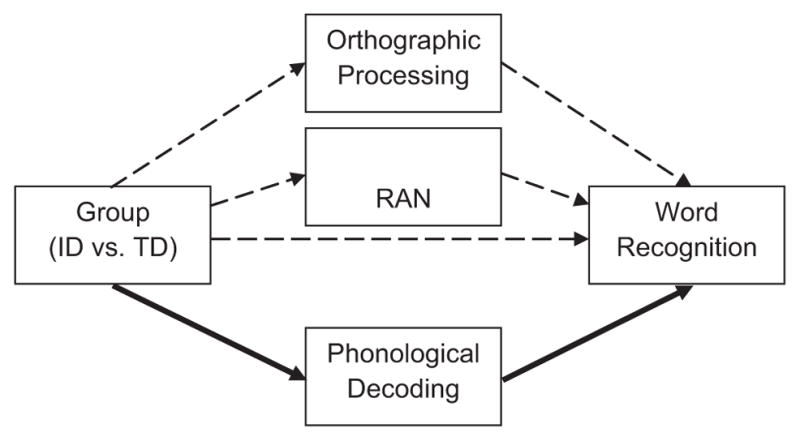
Multiple mediation model testing three potential mediators of the relation between group membership and word recognition. The bold arrows indicate that phonological decoding was a significant mediator. The mediation rendered the direct relation between group and word recognition below the level of significance, consistent with full mediation.
3.3. Subskills of phonological decoding
Based on the above analyses, phonological decoding was the subskill of word recognition on which the ID and TD groups diverged. To further explore this area of weakness in youth with ID, the contributions of phonological awareness and phonological memory to the group difference in phonological decoding were examined. First, a simple linear regression analysis was conducted, with phonological awareness and phonological memory as independent variables and phonological decoding as the dependent variable. Phonological awareness and phonological memory together contributed significant variance in phonological decoding F(2,31) = 19.80, p < .001, R2 = .56. The contribution of phonological awareness was clearly significant, β = .56, t = 3.78, p = .001, whereas the contribution of phonological memory fell short of statistical significance, β = .26, t = 1.73, p = .09. Thus, the variability in phonological decoding was largely accounted for by phonological awareness and also phonological memory.
A paired samples t-test revealed that the group with ID performed significantly lower on the phonological awareness composite than the TD group, t(16) = 5.43, p < .001, Cohen’s d = 1.62. Similarly, a second paired samples t-test indicated that the group with ID performed significantly lower on the phonological memory composite, t(16) = 2.88, p = .01, Cohen’s d = 1.02. In both cases, the effect size was very large; thus, the ID participants performed substantially more poorly than the TD participants on both subskills of phonological decoding.
These regression and group comparison results suggested the possibility that poor phonological decoding in the group with ID could be due to weaknesses in phonological awareness and/or phonological memory. In other words, either or both of these skills could be mediating the effect of group on phonological decoding skills. To test this possibility, a second multiple mediation model (Fig. 2) was tested via bootstrapping (Preacher & Hayes, 2008). In this analysis, both phonological awareness (point estimate = −6.98, CI = −15.25 to −1.41) and phonological memory (point estimate = −2.54, CI = −8.25 to −.01) significantly mediated the relation between group and phonological decoding. Further, both skills mediated independently of one another; in other words, each mediator provided significant unique variance to the model. After accounting for the mediated variance, the effect of group on phonological decoding was no longer significant (p = .34), consistent with full mediation.
Fig. 2.

Multiple mediation model testing two potential mediators of the relation between group membership and phonological decoding. The bold arrows indicate that phonological awareness and phonological memory were each significant mediators. The mediation rendered the direct relation between group and phonological decoding below the level of statistical significance, consistent with full mediation.
4. Discussion
The present study examined a variety of reading skills related to word recognition in students with ID individually matched to TD children of the same verbal mental age. The first finding was that students with ID performed more poorly than TD children on word recognition itself. That is, for the same level of general verbal ability, participants with ID could not read as many individual words as younger TD children, even though they had on average approximately seven more years of schooling. This discrepancy points out the great need for more attention to reading skills of youth with ID. To some degree, the discrepancy could be due to inadequate reading instruction over the years for the participants with ID in our sample. Possibly, reading was not emphasized in their classrooms, and as a result, by middle/high school these students’ word recognition level was behind that of TD second/third graders in the same school district. Unfortunately, we did not have a measure of reading instruction history for the present study, so we are not able to address this possibility.
A second possibility is that intellectual disability creates cognitive barriers to reading acquisition that are more challenging than we might expect. Possibly, there are subskills of word recognition that are particularly difficult for youth with ID to learn. In the present study, we examined three basic subskills of word recognition: phonological decoding, orthographic processing, and RAN.
Orthographic processing was highly similar in the two groups. On Orthographic Choice, the groups averaged within 1.5 raw score points of one another, and on Homophone Choice, they averaged within 1 raw score point of one another. On the composite OCHC measure, the group effect was very small. Although orthographic processing was related to word recognition in the regression analysis, it clearly did not mediate the relation between group and word recognition. Thus, it does not help explain why the group with ID performed more poorly than the TD group in word recognition.
In the present study, orthographic processing appears to be a reading skill that is consistent with verbal ability level but is not a specific barrier to the acquisition of reading skills. These findings are consistent with those of Loveall and Conners (in press), which showed similarities in orthographic learning between similar groups with and without ID matched on verbal ability. Whereas Loveall and Conners focused on the process of acquiring new orthographic knowledge, the present study focused on orthographic knowledge accumulated over the years. Both studies are consistent in suggesting that orthographic skills of youth with ID are commensurate with verbal ability level. It should be noted, however, that cumulative orthographic skills are believed to be sensitive to print exposure, more so than are phonological skills (Cunningham & Stanovich, 1990, 1998). If participants with ID had an average of seven more years of print exposure than TD participants, perhaps their similar performance on orthographic tasks should be considered discouraging. In any case, orthographic skills appear to be strong relative to phonological skills in students with ID.
Similar to orthographic processing, there was also no significant group difference in RAN. Although the group difference was not significant, the group with ID performed on average 11–12% slower than the TD group. This effect was small to medium in size and not statistically detectable with the sample size of the present study. We recommend further examination of RAN skills in ID groups using larger sample sizes and including covariates such as articulation speed and general processing speed. The present results suggest that RAN skills of youth with ID are on a level fairly similar to their verbal skills. These results are consistent with those of Laing et al. (2001) and Ypsilanti et al. (2006) based on participants with Williams syndrome and Down syndrome. In the present study, of the three subskills of word recognition, RAN is the one that did not contribute significantly to word recognition in the regression analysis. There is some controversy over exactly how RAN relates to phonological and orthographic skills (see Denckla & Cutting, 1999; Logan, Schatschneider, & Wagner, 2011), and it is likely that its shared variance with each of these rendered its unique contribution to word recognition below the level of statistical significance. Similar to orthographic processing, RAN did not help explain the group difference in word recognition in the multiple mediation analysis. It appears that weaknesses in word recognition in youth with ID are not clearly attributable to weaknesses in RAN.
In contrast to orthographic processing and RAN, phonological decoding was highly related to word recognition in our regression analysis, distinguishing clearly between groups and mediating the relation between group membership and word recognition. The group with ID performed much more poorly than the TD group on Word Attack, which is consistent with previous studies using samples with mixed-etiology ID (Jenkinson, 1992; Saunders & DeFulio, 2007) or Down syndrome (see Næss et al., 2012a, 2012b). Further, as expected, phonological decoding was strongly related to word recognition in the regression analysis; in fact, it was the strongest predictor of the three subskills of word recognition. Finally, phonological decoding was the only subskill of the three that emerged as a significant mediator of the group difference in word recognition. Interestingly, this was a full mediation effect, suggesting that after accounting for the variance due to the potential mediators, there was no longer a relation between group and word recognition. We suggest caution in interpreting this finding due to the sample size in the present study. Nevertheless, phonological decoding appears to be a particularly challenging skill for young people with ID which may be blocking their acquisition of word recognition skills.
In the present study, we took a more in-depth look at phonological decoding by examining subskills of phonological awareness and phonological memory. These were both areas of weakness for participants with ID, whose performance on both measures was significantly and substantially below that of TD participants. These results are consistent with those of prior studies (e.g., Henry & Winfield, 2010; Lemons & Fuchs, 2010b; Menghini et al., 2004; Næss et al., 2011).
In the present study, both phonological awareness and phonological memory were related to phonological decoding skill, though the unique contribution of phonological memory was not quite statistically significant. Regardless, both types of phonological skill mediated the group effect on phonological decoding. Because these two mediation effects were independent of one another in the same multiple mediation model, each phonological skill mediated separate variance between group membership and phonological decoding. This suggests that poor phonological awareness by individuals with ID is partly responsible for their poor phonological decoding skills, and poor phonological memory is also partly responsible. In the current sample, phonological awareness and phonological memory together fully mediated the group difference in phonological decoding, suggesting that there are no other factors contributing significantly. Caution is warranted in making this inference, however, because of the small sample size in the present study.
The results of the present study suggest that, to increase word recognition skills of adolescents with ID, more emphasis on phonological decoding skills in the classroom is necessary. The pattern of skills in the present study suggests that students with ID do not use their relatively good orthographic and RAN skills alone to support development of word recognition skills. Their very poor phonological decoding skills most likely limit their ability to advance in word recognition. Several studies have already shown that it is possible to enhance phonological decoding skills of students with ID using intense and specialized interventions (e.g., Conners et al., 2006; Cupples & Iacono, 2002; see Saunders, 2007 for a review). More research is needed on how to maximize the impact of such interventions and how to bring them effectively into classrooms on a regular basis.
The present study’s results also suggest that, to increase phonological decoding skills of youth with ID, more emphasis is needed on building skills in phonological awareness and phonological memory. Several reading intervention studies incorporating phonological awareness training for youth with ID have been conducted (e.g., see Lemons & Fuchs, 2010b). These studies have included oral blending of words, onset-rime segments, and individual phonemes; clapping or tapping syllables and phonemes; identifying first, middle, and last sounds; and segmenting words into phonemes (Allor, Mathes, Roberts, Cheatham, & Champlin, 2010; Baylis & Snowling, 2012; Bradford et al., 2006; Browder, Ahlgrim-Delzell, Courtade, Gibbs, & Flowers, 2008; Burgoyne et al., 2012; Cohen et al., 2008; Cologon, Cupples, & Wyver, 2011; Conners et al., 2006; Cupples & Iacono, 2002; Goetz et al., 2008; Lemons & Fuchs, 2010a).
However, to our knowledge, no reading intervention study has yet incorporated explicit instruction in phonological memory skills for youth with ID. Little is known about how to improve phonological memory skills in the ID population, though it appears to be possible (Conners, Rosenquist, Arnett, Moore, & Hume, 2008). Because the present results indicate an important role of phonological memory in phonological decoding for youth with ID, we recommend future research in this area. Exercises to expand phonological memory could be added to the early phases of reading interventions, as has been done with phonological awareness exercises. An alternate approach is to provide supports that minimize the burden on phonological memory, such as picture cues (e.g., Browder et al., 2008; Burgoyne et al., 2012; Cohen et al., 2008; Cologon et al., 2011; Cupples & Iacono, 2002; Goetz et al., 2008; Hoogeveen et al., 1989; Lemons & Fuchs, 2010a). An often-raised question about intervention is whether to focus on the “deficit” area that seems so important to the higher skill, or try to bypass the weakness and build areas of relative strength instead. Because reading acquisition is so challenging for children with ID, a combination of these approaches may lead to the best possible outcome.
The present study has several limitations that warrant mention. One that we have already mentioned is the sample size. We were able to detect medium-to-large effects given the sample size, but not small-to-medium effects. Another limitation is that we did not have extensive background information on the participants in either group, so we did not know etiologies of ID (if known), vision or hearing acuity, socioeconomic status, or co-occurring conditions. Also, we had only one measure for each of two key constructs in the study (word recognition and phonological decoding, measured by the WRMT-R Word Identification and Word Attack subtests). Although these measures are well-known and often used, there is always the possibility with single measures that idiosyncrasies will influence the results. Finally, the present study was limited in the scope of reading-related measures it included. A host of other cognitive, language, motivational, and environmental factors contribute to reading skills in TD children, and ultimately these need to be studied in youth with ID as well. In spite of its limitations, the results of the present study provide some direction for design of reading intervention efforts for students with ID and lay the groundwork for future larger-scale studies.
Acknowledgments
We thank the participants as well as their parents, teachers, and administrators for supporting the study. We also thank Laura Hume and Dale Maddox for assistance with task construction and data collection. The findings from this study were presented at the 2009 meeting of the Society for the Scientific Study of Reading and the 2010 Gatlinburg Conference on Intellectual and Developmental Disabilities. Some data from the larger typically developing group were published in 2011 in Journal of Experimental Child Psychology, 108, 402–410.
Contributor Information
Marie Moore Channell, Email: marie.channell@ucdmc.ucdavis.edu.
Susan J. Loveall, Email: sjloveall@crimson.ua.edu.
Frances A. Conners, Email: fconners@as.ua.edu.
References
- Abbeduto L, Warren SF, Conners FA. Language development in Down syndrome: From the prelinguistic period to the acquisition of literacy. Mental Retardation and Developmental Disabilities Research Reviews. 2007;13:247–261. doi: 10.1002/mrdd.20158. [DOI] [PubMed] [Google Scholar]
- Allington RL. Sensitivity to orthographic structure in educable mentally retarded children. Contemporary Educational Psychology. 1981;6:135–139. [Google Scholar]
- Allor JH, Mathes PG, Roberts JK, Cheatham JP, Champlin TM. Comprehensive reading instruction for students with intellectual disabilities: Findings from the first three years of a longitudinal study. Psychology in the Schools. 2010;47:445–466. [Google Scholar]
- Ackerman PT, Dykman RA. Phonological processes, confrontation naming, and immediate memory in dyslexia. Journal of Learning Disabilities. 1993;26:597–609. doi: 10.1177/002221949302600910. [DOI] [PubMed] [Google Scholar]
- Baddeley A. Working memory. New York: Oxford University Press; 1986. [Google Scholar]
- Baddeley A, Jarrold C. Working memory and Down syndrome. Journal of Intellectual Disability Research. 2007;51:925–931. doi: 10.1111/j.1365-2788.2007.00979.x. [DOI] [PubMed] [Google Scholar]
- Barker TA, Torgesen JK, Wagner RK. The role of orthographic processing skills on five different reading tasks. Reading Research Quarterly. 1992;27:335–345. [Google Scholar]
- Baylis P, Snowling MJ. Evaluation of a phonological reading programme for children with Down syndrome. Child Language Teaching and Therapy. 2012;28:39–56. [Google Scholar]
- Berninger VW, Cartwright AC, Yates CM, Swanson HL, Abbott RD. Developmental skills related to writing and reading acquisition in the intermediate grades: Shared and unique functional systems. Reading and Writing. 1994;6:161–196. [Google Scholar]
- Bradford S, Shippen ME, Alberto P, Houchins DE, Flores M. Using systematic instruction to teach decoding skills to middle school students with moderate intellectual disabilities. Education and Training in Developmental Disabilities. 2006;41:333–343. [Google Scholar]
- Browder DM, Ahlgrim-Delzell L, Courtade G, Gibbs SL, Flowers C. Evaluation of the effectiveness of an early literacy program for students with significant developmental disabilities. Exceptional Children. 2008;75:33–52. [Google Scholar]
- Burgoyne K, Duff FJ, Clarke PJ, Buckley S, Snowling MJ, Hulme C. Efficacy of a reading and language intervention for children with Down syndrome: A randomized controlled trial. Journal of Child Psychology and Psychiatry. 2012;53:1044–1053. doi: 10.1111/j.1469-7610.2012.02557.x. [DOI] [PMC free article] [PubMed] [Google Scholar]
- Cardoso-Martins C, Peterson R, Olson R, Pennington B. Component reading skills in Down syndrome. Reading and Writing. 2009;23:277–292. [Google Scholar]
- Cohen ET, Heller KW, Alberto P, Fredrick LD. Using a three-step decoding strategy with constant time delay to teach word reading to students with mild and moderate mental retardation. Focus on Autism and Other Developmental Disabilities. 2008;23:67–78. [Google Scholar]
- Cologon K, Cupples L, Wyver S. Effects of targeted reading instruction on phonological awareness and phonic decoding in children with Down syndrome. American Journal on Intellectual and Developmental Disabilities. 2011;116:111–129. doi: 10.1352/1944-7558-116.2.111. [DOI] [PubMed] [Google Scholar]
- Compton DL. Modeling the response of normally achieving and at-risk first grade children to word reading instruction. Annals of Dyslexia. 2000;50:53–84. doi: 10.1007/s11881-000-0017-3. [DOI] [PubMed] [Google Scholar]
- Conners FA. Reading skills and cognitive abilities of individuals with ID. In: Abbeduto L, editor. International review of research in mental retardation. Vol. 27. San Diego: Academic Press; 2003. pp. 191–229. [Google Scholar]
- Conners FA, Atwell JA, Rosenquist CJ, Sligh AC. Abilities underlying decoding differences in children with intellectual disability. Journal of Intellectual Disability Research. 2001;45:292–299. doi: 10.1046/j.1365-2788.2001.00319.x. [DOI] [PubMed] [Google Scholar]
- Conners FA, Carr MD, Willis S. Is the phonological loop responsible for intelligence-related differences in forward digit span? American Journal of Mental Retardation. 1998;103:1–11. doi: 10.1352/0895-8017(1998)103<0001:ITPLRF>2.0.CO;2. [DOI] [PubMed] [Google Scholar]
- Conners FA, Moore MS, Loveall SJ, Merrill EC. Memory profiles of Down, Williams, and Fragile X syndromes: Implications for reading development. Journal of Developmental and Behavioral Pediatrics. 2011;32:405–417. doi: 10.1097/DBP.0b013e3182168f95. [DOI] [PubMed] [Google Scholar]
- Conners FA, Rosenquist CJ, Arnett LT, Moore MS, Hume LE. Improving working memory in children with Down syndrome. Journal of Intellectual Disability Research. 2008;52:244–255. doi: 10.1111/j.1365-2788.2007.01015.x. [DOI] [PubMed] [Google Scholar]
- Conners FA, Rosenquist CJ, Sligh AC, Atwell JA, Kiser T. Acquisition of phonological reading skills in children with mental retardation. Research in Developmental Disabilities. 2006;27:121–137. doi: 10.1016/j.ridd.2004.11.015. [DOI] [PubMed] [Google Scholar]
- Cunningham AE, Perry KE, Stanovich KE. Converging evidence for the concept of orthographic processing. Reading and Writing. 2001;14:549–568. [Google Scholar]
- Cunningham AE, Stanovich KE. Assessing print exposure and orthographic processing skill in children: A quick measure of reading experience. Journal of Educational Psychology. 1990;82:733–740. [Google Scholar]
- Cunningham AE, Stanovich KE. The impact of print exposure on word recognition. In: Metsala JL, editor. Word recognition in beginning literacy. Mahwah, NJ: Lawrence Erlbaum; 1998. pp. 235–262. [Google Scholar]
- Cupples L, Iacono T. The efficacy of ‘whole word’ versus ‘analytic’ reading instruction for children with Down syndrome. Reading and Writing. 2002;15:549–574. [Google Scholar]
- Denckla MB, Cutting LE. History and significance of rapid automatized naming. Annals of Dyslexia. 1999;49:29–42. [Google Scholar]
- Denckla MB, Rudel RG. Rapid automatized naming of pictures objects, colors, letters and numbers by normal children. Cortex. 1974;10:186–202. doi: 10.1016/s0010-9452(74)80009-2. [DOI] [PubMed] [Google Scholar]
- Fletcher H, Buckley S. Phonological awareness in children with Down syndrome. Down Syndrome Research and Practice. 2002;8:11–18. doi: 10.3104/reports.123. [DOI] [PubMed] [Google Scholar]
- Fowler AE, Doherty BJ, Boynton L. The basis of reading skill in young adults with Down syndrome. In: Nadel L, Rosenthal D, editors. Down syndrome: Living and learning in the community. New York: Wiley & Sons; 1995. pp. 182–196. [Google Scholar]
- Gathercole SE, Baddeley AD. Phonological working memory: A critical building block for reading development and vocabulary acquisition? European Journal of Psychology of Education. 1993;8:259–272. [Google Scholar]
- Goetz K, Hulme C, Brigstocke S, Carroll JM, Nasir L, Snowling M. Training reading and phoneme awareness skills in children with Down syndrome. Reading and Writing. 2008;21:395–412. [Google Scholar]
- Gough PB, Hoover WA, Peterson CL. Some observations on a simple view of reading. In: Cornoldi C, Oakhill J, editors. Reading comprehension difficulties: Processes and intervention. Mahwah, NJ: Lawrence Erlbaum Associates; 1996. pp. 1–13. [Google Scholar]
- Gough PB, Tunmer WE. Decoding, reading, and reading disability. Remedial and Special Education. 1986;7:6–10. [Google Scholar]
- Henry L, Winfield J. Working memory and educational achievement in children with intellectual disabilities. Journal of Intellectual Disability Research. 2010;54:354–365. doi: 10.1111/j.1365-2788.2010.01264.x. [DOI] [PubMed] [Google Scholar]
- Hoogeveen FR, Smeets PM, Lancioni GE. Teaching moderately mentally retarded children basic reading skills. Research in Developmental Disabilities. 1989;10:1–18. doi: 10.1016/0891-4222(89)90025-5. [DOI] [PubMed] [Google Scholar]
- Jarrold C, Baddeley AD, Phillips C. Down syndrome and the phonological loop: The evidence for, and importance of, a specific verbal short-term memory deficit. Down Syndrome Research and Practice. 1999;6:61–75. doi: 10.3104/reviews.97. [DOI] [PubMed] [Google Scholar]
- Jenkinson JC. The use of letter position cues in the visual processing of words by children with an intellectual disability and nondisabled children. International Journal of Disability, Development and Education. 1992;39:61–76. [Google Scholar]
- Jorm AF, Share DL. Phonological recoding and reading acquisition. Applied Psycholinguistics. 1983;4:103–147. [Google Scholar]
- Katims DS. Literacy instruction for people with mental retardation: Historical highlights and contemporary analysis. Education and Training in Mental Retardation and Developmental Disabilities. 2000;35:3–15. [Google Scholar]
- Kaufman AS, Kaufman NL. Kaufman brief intelligence test. 2. Circle Pines, MN: AGS Publishing; 2004. [Google Scholar]
- Kay-Raining Bird E, Cleave PL, McConnell L. Reading and phonological awareness in children with Down syndrome: A longitudinal study. American Journal of Speech-Language Pathology. 2000;9:319–330. [Google Scholar]
- Kennedy EJ, Flynn MC. Early phonological awareness and reading skills in children with Down syndrome. Down Syndrome Research and Practice. 2002;8:100–109. doi: 10.3104/reports.136. [DOI] [PubMed] [Google Scholar]
- Kirby JR, Parrila RK, Pfeiffer SL. Naming speed and phonological awareness as predictors of reading development. Journal of Educational Psychology. 2003;95:453–464. [Google Scholar]
- Koritsas S, Iacono T. Secondary conditions in people with developmental disability. American Journal on Intellectual and Developmental Disabilities. 2011;116:36–47. doi: 10.1352/1944-7558-116.1.36. [DOI] [PubMed] [Google Scholar]
- Laing E, Hulme C, Grant J, Karmiloff-Smith A. Learning to read in Williams syndrome: Looking beneath the surface of atypical reading development. Journal of Child Psychology and Psychiatry. 2001;42:729–739. doi: 10.1111/1469-7610.00769. [DOI] [PubMed] [Google Scholar]
- Laws G, Gunn D. Relationships between reading, phonological skills and language development in individuals with Down syndrome: A five year follow-up study. Reading and Writing. 2002;15:527–548. [Google Scholar]
- Lemons CJ, Fuchs D. Modeling response to reading intervention in children with Down syndrome: An examination of predictors of differential growth. Reading Research Quarterly. 2010a;45:134–168. [Google Scholar]
- Lemons CJ, Fuchs D. Phonological awareness of children with Down syndrome: Its role in learning to read and the effectiveness of related interventions. Research in Developmental Disabilities. 2010b;31:316–330. doi: 10.1016/j.ridd.2009.11.002. [DOI] [PubMed] [Google Scholar]
- Levy Y, Smith J, Tager-Flusberg H. Word reading and reading-related skills in adolescents with Williams syndrome. Journal of Child Psychology and Psychiatry. 2003;44:576–587. doi: 10.1111/1469-7610.00146. [DOI] [PubMed] [Google Scholar]
- Logan JA, Schatschneider C, Wagner RK. Rapid serial naming and reading ability: The role of lexical access. Reading and Writing. 2011;24:1–25. doi: 10.1007/s11145-009-9199-1. [DOI] [PMC free article] [PubMed] [Google Scholar]
- Lonigan CJ, Anthony JL, Phillips BM, Purpura DJ, Wilson SB, McQueen JD. The nature of preschool phonological processing abilities and their relations to vocabulary, general cognitive abilities, and print knowledge. Journal of Educational Psychology. 2009;101:345–358. doi: 10.1037/a0013837. [DOI] [PMC free article] [PubMed] [Google Scholar]
- Loveall SJ, Conners FA. Individuals with intellectual disability can self-teach in reading. American Journal on Intellectual and Developmental Disabilities. doi: 10.1352/1944-7558-118.2.108. in press. [DOI] [PubMed] [Google Scholar]
- Manis FR, Seidenberg MS, Doi LM. See Dick RAN: Rapid naming and the longitudinal prediction of reading subskills in first and second graders. Scientific Studies of Reading. 1999;3:129–157. [Google Scholar]
- Menghini D, Verucci L, Vicari S. Reading and phonological awareness in Williams syndrome. Neuropsychology. 2004;18:29–37. doi: 10.1037/0894-4105.18.1.29. [DOI] [PubMed] [Google Scholar]
- Munir F, Cornish KM, Wilding J. Nature of the working memory deficit in fragile-X syndrome. Brain and Cognition. 2000;44:387–401. doi: 10.1006/brcg.1999.1200. [DOI] [PubMed] [Google Scholar]
- Næss KAB, Halaas Lyster SA, Hulme C, Melby-Lervåg M. Language and verbal short-term memory skills in children with Down syndrome: A meta-analytic review. Research in Developmental Disabilities. 2011;32:2225–2234. doi: 10.1016/j.ridd.2011.05.014. [DOI] [PubMed] [Google Scholar]
- Næss KAB, Melby-Lervåg M, Hulme C, Lyster SAH. Corrigendum to “Reading skills in children with Down syndrome: A meta-analytic review”. Research in Developmental Disabilities. 2012a;33:1039–1040. doi: 10.1016/j.ridd.2011.09.019. [DOI] [PubMed] [Google Scholar]
- Næss KAB, Melby-Lervåg M, Hulme C, Lyster SAH. Reading skills in children with Down syndrome: A meta-analytic review. Research in Developmental Disabilities. 2012b;33:737–747. doi: 10.1016/j.ridd.2011.09.019. [DOI] [PubMed] [Google Scholar]
- National Institute of Child Health and Human Development. Teaching children to read: An evidence-based assessment of the scientific research literature on reading and its implications for reading instruction. Washington, DC: U.S. Government Printing Office; 2000. Report of the National Reading Panel. NIH Publication No. 00-4769. [Google Scholar]
- Neville D, Vandever TR. Decoding as a result of synthetic and analytic presentation for retarded and nonretarded children. American Journal of Mental Deficiency. 1973;77:533–537. [PubMed] [Google Scholar]
- Numminen H, Service E, Ahonen T, Korhonen T, Tolvanen A, Patja K, et al. Working memory structure and intellectual disability. Journal of Intellectual Disability Research. 2000;44:579–590. doi: 10.1046/j.1365-2788.2000.00279.x. [DOI] [PubMed] [Google Scholar]
- Olson RK, Forsberg H, Wise B. Genes, environment, and the development of orthographic skills. In: Berninger VW, editor. Varieties of orthographic knowledge, Vol. 1: Theoretical and developmental issues. Dordrecht, The Netherlands: Kluwer; 1994. pp. 27–71. [Google Scholar]
- Olson RK, Forsberg H, Wise B, Rack J. Measurement of word recognition, orthographic, and phonological skills. In: Lyon GR, editor. Frames of reference for the assessment of learning disabilities: New views on measurement issues. Baltimore: Paul H. Brookes; 1994. pp. 243–277. [Google Scholar]
- Parrila R, Kirby JR, McQuarrie L. Articulation rate, naming speed, verbal short-term memory, and phonological awareness: Longitudinal predictors of early reading development? Scientific Studies of Reading. 2004;8:3–26. [Google Scholar]
- Preacher KJ, Hayes AF. Asymptotic and resampling strategies for assessing and comparing indirect effects in multiple mediator models. Behavior Research Methods. 2008;40:879–891. doi: 10.3758/brm.40.3.879. [DOI] [PubMed] [Google Scholar]
- Roch M, Jarrold C. A comparison between word and nonword reading in Down syndrome: The role of phonological awareness. Journal of Communication Disorders. 2008;41:305–318. doi: 10.1016/j.jcomdis.2008.01.001. [DOI] [PubMed] [Google Scholar]
- Rosenquist C, Conners FA, Roskos-Ewoldsen B. Phonological and visuo-spatial working memory in individuals with intellectual disability. American Journal of Mental Retardation. 2003;108:403–413. doi: 10.1352/0895-8017(2003)108<403:PAVWMI>2.0.CO;2. [DOI] [PubMed] [Google Scholar]
- Saunders KJ. Word-attack skills in individuals with mental retardation. Mental Retardation and Developmental Disabilities Research Reviews. 2007;13:78–84. doi: 10.1002/mrdd.20137. [DOI] [PubMed] [Google Scholar]
- Saunders KJ, DeFulio A. Phonological awareness and rapid naming predict word attack and word identification in adults with mild mental retardation. American Journal of Mental Retardation. 2007;112:155–166. doi: 10.1352/0895-8017(2007)112[155:PAARNP]2.0.CO;2. [DOI] [PubMed] [Google Scholar]
- Schatschneider C, Fletcher JM, Francis DJ, Carlson CD, Foorman BR. Kindergarten prediction of reading skills: A longitudinal comparative analysis. Journal of Educational Psychology. 2004;96:265–282. [Google Scholar]
- Schuchardt K, Maehler C, Hasselhorn M. Functional deficits in phonological working memory in children with intellectual disabilities. Research in Developmental Disabilities. 2011;32:1934–1940. doi: 10.1016/j.ridd.2011.03.022. [DOI] [PubMed] [Google Scholar]
- Share DL. Phonological recoding and self-teaching: Sine qua non of reading acquisition. Cognition. 1995;55:151–218. doi: 10.1016/0010-0277(94)00645-2. [DOI] [PubMed] [Google Scholar]
- Share DL. Phonological recoding and orthographic learning: A direct test of the self-teaching hypothesis. Journal of Experimental Child Psychology. 1999;72:95–129. doi: 10.1006/jecp.1998.2481. [DOI] [PubMed] [Google Scholar]
- Snow CE, Burns MS, Griffin P. Preventing reading difficulties in young children. Washington, DC: National Academy Press; 1998. [Google Scholar]
- Stanovich KE, West RF. Exposure to print and orthographic processing. Reading Research Quarterly. 1989;24:402–433. [Google Scholar]
- Tabachnick BD, Fidell LS. Using multivariate statistics. 4. New York: HarperCollins; 2001. [Google Scholar]
- Turk MA. Secondary conditions and disability. In: Field MJ, Jette AM, Martin L, editors. Workshop on disability in America: A new look – Summary and background papers. Washington, DC: National Academies Press; 2006. pp. 185–193. [Google Scholar]
- Vandever TR, Neville DD. Transfer as a result of synthetic and analytic reading instruction. American Journal of Mental Deficiency. 1976;80:498–503. [PubMed] [Google Scholar]
- Vellutino FR, Tunmer WE, Jaccard JJ, Chen R. Components of reading ability: Multivariate evidence for a convergent skills model of reading development. Scientific Studies of Reading. 2007;11:3–32. [Google Scholar]
- Verucci L, Menghini D, Vicari S. Reading skills and phonological awareness acquisition in Down syndrome. Journal of Intellectual Disability Research. 2006;50:477–491. doi: 10.1111/j.1365-2788.2006.00793.x. [DOI] [PubMed] [Google Scholar]
- Wagner RK, Torgesen JK. The nature of phonological processing and its causal role in the acquisition of reading skills. Psychological Bulletin. 1987;101:192–212. [Google Scholar]
- Wagner R, Torgesen J, Rashotte C. Comprehensive test of phonological processing. Austin, TX: ProEd; 1999. [Google Scholar]
- Wagner RK, Torgesen JK, Rashotte CA, Hecht SA, Barker TA, Burgess SR, et al. Changing relations between phonological processing abilities and word-level reading as children develop from beginning to skilled readers: A 5-year longitudinal study. Developmental Psychology. 1997;33:468–479. doi: 10.1037//0012-1649.33.3.468. [DOI] [PubMed] [Google Scholar]
- Wise JC, Sevcik RA, Romski MA, Morris RD. The relationship between phonological processing skills and word and nonword identification performance in children with mild intellectual disabilities. Research in Developmental Disabilities. 2010;31:1170–1175. doi: 10.1016/j.ridd.2010.08.004. [DOI] [PubMed] [Google Scholar]
- Wolf M, Bowers PG. The double-deficit hypothesis for the developmental dyslexias. Journal of Educational Psychology. 1999;91:415–438. [Google Scholar]
- Woodcock R. Woodcock reading mastery tests – Revised – Normative update. Circle Pines, MN: AGS Resources; 1998. [Google Scholar]
- Ypsilanti A, Grouios G, Zikouli A, Hatzinikolaou K. Speed of naming in children with Williams and Down syndromes. Journal of Intellectual and Developmental Disability. 2006;31:87–94. doi: 10.1080/13668250600710872. [DOI] [PubMed] [Google Scholar]