



Abstract
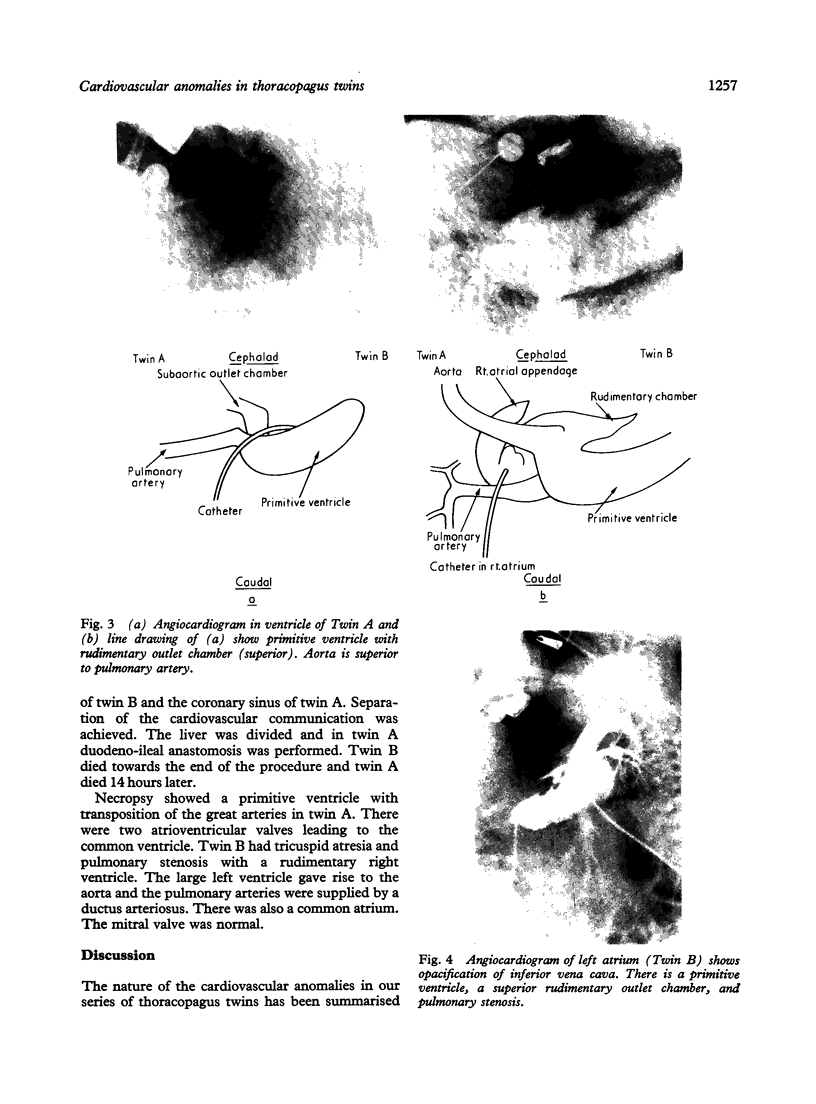
Four pairs of thoracopagus twins have been described. Cardiac catheterisation was performed in all the cases. Angiocardiographic and necropsy findings suggest that the most common abnormality was some form of univentricular heart. The communication between the 2 hearts was at atrial level in 2 cases. Separation was performed in 1 of these cases but only 1 of the twins survived for 14 hours after operation. It is suggested that full cardiac catheterisation with selective angiocardiogram is essential before separation is considered. Identical heart rates were observed in each pair and there was invariably a major communication between the hearts of the twins.
Full text
PDF



Images in this article


Selected References
These references are in PubMed. This may not be the complete list of references from this article.
- Amiel G. J. Conjoined entire twins: a case of thoraco-omphalopagus with discussion on nomenclature, obstetric management and anatomical note. Br J Clin Pract. 1967 Mar;21(3):141–146. [PubMed] [Google Scholar]
- Mulcare R. J., Bhokakul P., Potitung P., Wheeler B. The surgical separation of the thoracopagus conjoined twins of Korat, Thailand. Ann Surg. 1970 Jul;172(1):91–97. [PMC free article] [PubMed] [Google Scholar]
- Simpson J. S., Mustard W. T., Moes C. A., Izukawa T. Emergency separation of thoracopagus (twins conjoined at thorax) in the newborn period: importance of careful preoperative cardiac evaluation. Surgery. 1970 Apr;67(4):697–702. [PubMed] [Google Scholar]
- Tandon R., Sterns L. P., Edwards J. E. Thoracopagus twins. Report of a case. Arch Pathol. 1974 Oct;98(4):248–251. [PubMed] [Google Scholar]