



Abstract
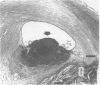
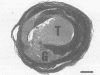
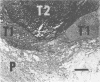
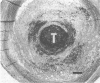
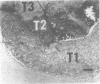
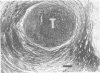
The mechanisms of thrombus formation in atherosclerotic cerebral arteries are still controversial, although intraplaque haemorrhage and rupture of the atheromatous plaques have been proposed. A histopathological analysis of segments of the thrombosed large intracranial arteries was carried out on eight patients who died within 28 days after brain infarction. The study revealed occlusive thrombi in six and mural thrombi in two, developing mostly at the site of greatest stenosis or just distal to it. The histological characteristics of the thrombosed arteries were plaque rupture in three, intramural haemorrhage in one, ulceration in one, and thrombosis in the absence of plaque rupture or intramural haemorrhage in three. Occlusive emboli distal to the site of cerebral artery thrombosis (intracranial artery-to-artery thromboembolism) were observed in two. The following conclusions were drawn from the study: 1) plaque rupture or intraplaque haemorrhage is not a sine qua non for cerebral artery thrombosis; 2) occlusions occur at the site of greatest luminal compromise or just distal to it, and 3) non-occlusive mural thrombosis can occur in the absence of plaque rupture and eventually lead to local occlusion or distal embolisation.
Full text
PDF


Images in this article
Selected References
These references are in PubMed. This may not be the complete list of references from this article.
- Constantinides P. Pathogenesis of cerebral artery thrombosis in man. Arch Pathol. 1967 May;83(5):422–428. [PubMed] [Google Scholar]
- Davies M. J., Thomas A. C. Plaque fissuring--the cause of acute myocardial infarction, sudden ischaemic death, and crescendo angina. Br Heart J. 1985 Apr;53(4):363–373. doi: 10.1136/hrt.53.4.363. [DOI] [PMC free article] [PubMed] [Google Scholar]
- Davies M. J., Thomas T. The pathological basis and microanatomy of occlusive thrombus formation in human coronary arteries. Philos Trans R Soc Lond B Biol Sci. 1981 Aug 18;294(1072):225–229. doi: 10.1098/rstb.1981.0101. [DOI] [PubMed] [Google Scholar]
- Davies M. J. Thrombosis in acute myocardial infarction and sudden death. Cardiovasc Clin. 1987;18(1):151–159. [PubMed] [Google Scholar]
- Falk E. Plaque rupture with severe pre-existing stenosis precipitating coronary thrombosis. Characteristics of coronary atherosclerotic plaques underlying fatal occlusive thrombi. Br Heart J. 1983 Aug;50(2):127–134. doi: 10.1136/hrt.50.2.127. [DOI] [PMC free article] [PubMed] [Google Scholar]
- Friedman M. The coronary thrombus: its origin and fate. Hum Pathol. 1971 Mar;2(1):81–128. doi: 10.1016/s0046-8177(71)80022-9. [DOI] [PubMed] [Google Scholar]
- Heusch G. Alpha-adrenergic mechanisms in myocardial ischemia. Circulation. 1990 Jan;81(1):1–13. doi: 10.1161/01.cir.81.1.1. [DOI] [PubMed] [Google Scholar]
- Horie T., Sekiguchi M., Hirosawa K. Coronary thrombosis in pathogenesis of acute myocardial infarction. Histopathological study of coronary arteries in 108 necropsied cases using serial section. Br Heart J. 1978 Feb;40(2):153–161. doi: 10.1136/hrt.40.2.153. [DOI] [PMC free article] [PubMed] [Google Scholar]
- Masuda J., Ogata J., Yutani C., Miyashita T., Yamaguchi T. Artery-to-artery embolism from a thrombus formed in stenotic middle cerebral artery. Report of an autopsy case. Stroke. 1987 May-Jun;18(3):680–684. doi: 10.1161/01.str.18.3.680. [DOI] [PubMed] [Google Scholar]
- Masuda J., Ross R. Atherogenesis during low level hypercholesterolemia in the nonhuman primate. I. Fatty streak formation. Arteriosclerosis. 1990 Mar-Apr;10(2):164–177. doi: 10.1161/01.atv.10.2.164. [DOI] [PubMed] [Google Scholar]
- Sadoshima S., Fukushima T., Tanaka K. Cerebral artery thrombosis and intramural hemorrhage. Stroke. 1979 Jul-Aug;10(4):411–414. doi: 10.1161/01.str.10.4.411. [DOI] [PubMed] [Google Scholar]
- Wilcox J. N., Smith K. M., Schwartz S. M., Gordon D. Localization of tissue factor in the normal vessel wall and in the atherosclerotic plaque. Proc Natl Acad Sci U S A. 1989 Apr;86(8):2839–2843. doi: 10.1073/pnas.86.8.2839. [DOI] [PMC free article] [PubMed] [Google Scholar]