



Abstract
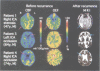
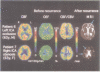
OBJECTIVES--In major cerebral arterial occlusive diseases, patients with inadequate blood supply relative to metabolic demand (misery perfusion) may be at increased risk for cerebral ischaemia. This study investigated whether patients showing misery perfusion on PET have a high risk of recurrent ischaemic stroke. METHODS--The relation between the regional haemodynamic status of cerebral circulation and the subsequent risk of recurrent stroke was prospectively evaluated in 40 patients with symptomatic internal carotid or middle cerebral arterial occlusive diseases who underwent PET. Patients were divided into two haemodynamic categories according to the mean hemispheric value of oxygen extraction fraction in the hemisphere supplied by the artery with symptomatic disease: patients with normal oxygen extraction fraction and those with increased oxygen extraction fraction (misery perfusion). All patients were followed up for at least 12 months. RESULTS--The one year incidence of ipsilateral ischaemic strokes for patients with normal oxygen extraction fraction and those with increased oxygen extraction fraction were two of 33 and four of seven patients respectively. A significantly higher incidence of ipsilateral strokes was found in patients with increased oxygen extraction fraction (Fisher's exact test; P = 0.005). In patients with increased oxygen extraction fraction, three of four strokes were watershed infarctions and the location of the infarction corresponded with the area of increased oxygen extraction fraction. CONCLUSION--These findings contradict conclusions of a previous study and suggest that patients with major cerebral arterial occlusive diseases and misery perfusion have a high risk for recurrent ischaemic stroke.
Full text
PDF


Images in this article
Selected References
These references are in PubMed. This may not be the complete list of references from this article.
- Baron J. C., Bousser M. G., Rey A., Guillard A., Comar D., Castaigne P. Reversal of focal "misery-perfusion syndrome" by extra-intracranial arterial bypass in hemodynamic cerebral ischemia. A case study with 15O positron emission tomography. Stroke. 1981 Jul-Aug;12(4):454–459. doi: 10.1161/01.str.12.4.454. [DOI] [PubMed] [Google Scholar]
- Bogousslavsky J., Regli F. Borderzone infarctions distal to internal carotid artery occlusion: prognostic implications. Ann Neurol. 1986 Sep;20(3):346–350. doi: 10.1002/ana.410200312. [DOI] [PubMed] [Google Scholar]
- Frackowiak R. S., Lenzi G. L., Jones T., Heather J. D. Quantitative measurement of regional cerebral blood flow and oxygen metabolism in man using 15O and positron emission tomography: theory, procedure, and normal values. J Comput Assist Tomogr. 1980 Dec;4(6):727–736. doi: 10.1097/00004728-198012000-00001. [DOI] [PubMed] [Google Scholar]
- Fukuyama H., Kimura J., Yamaguchi S., Yamauchi H., Ogawa M., Doi T., Yonekura Y., Konishi J. Pharmacological effects of ibudilast on cerebral circulation: a PET study. Neurol Res. 1993 Jun;15(3):169–173. doi: 10.1080/01616412.1993.11740130. [DOI] [PubMed] [Google Scholar]
- Gibbs J. M., Wise R. J., Leenders K. L., Jones T. Evaluation of cerebral perfusion reserve in patients with carotid-artery occlusion. Lancet. 1984 Feb 11;1(8372):310–314. doi: 10.1016/s0140-6736(84)90361-1. [DOI] [PubMed] [Google Scholar]
- Herold S., Brown M. M., Frackowiak R. S., Mansfield A. O., Thomas D. J., Marshall J. Assessment of cerebral haemodynamic reserve: correlation between PET parameters and CO2 reactivity measured by the intravenous 133 xenon injection technique. J Neurol Neurosurg Psychiatry. 1988 Aug;51(8):1045–1050. doi: 10.1136/jnnp.51.8.1045. [DOI] [PMC free article] [PubMed] [Google Scholar]
- Hirano T., Minematsu K., Hasegawa Y., Tanaka Y., Hayashida K., Yamaguchi T. Acetazolamide reactivity on 123I-IMP single photon emission computed tomography in patients with major cerebral artery occlusive disease: correlation with positron emission tomography parameters. J Cereb Blood Flow Metab. 1994 Sep;14(5):763–770. doi: 10.1038/jcbfm.1994.97. [DOI] [PubMed] [Google Scholar]
- Irie K., Yamaguchi T., Minematsu K., Omae T. The J-curve phenomenon in stroke recurrence. Stroke. 1993 Dec;24(12):1844–1849. doi: 10.1161/01.str.24.12.1844. [DOI] [PubMed] [Google Scholar]
- Kanno I., Uemura K., Higano S., Murakami M., Iida H., Miura S., Shishido F., Inugami A., Sayama I. Oxygen extraction fraction at maximally vasodilated tissue in the ischemic brain estimated from the regional CO2 responsiveness measured by positron emission tomography. J Cereb Blood Flow Metab. 1988 Apr;8(2):227–235. doi: 10.1038/jcbfm.1988.53. [DOI] [PubMed] [Google Scholar]
- Kleiser B., Widder B. Course of carotid artery occlusions with impaired cerebrovascular reactivity. Stroke. 1992 Feb;23(2):171–174. doi: 10.1161/01.str.23.2.171. [DOI] [PubMed] [Google Scholar]
- Kuroda S., Kamiyama H., Abe H., Houkin K., Isobe M., Mitsumori K. Acetazolamide test in detecting reduced cerebral perfusion reserve and predicting long-term prognosis in patients with internal carotid artery occlusion. Neurosurgery. 1993 Jun;32(6):912–919. doi: 10.1227/00006123-199306000-00005. [DOI] [PubMed] [Google Scholar]
- Powers W. J. Cerebral hemodynamics in ischemic cerebrovascular disease. Ann Neurol. 1991 Mar;29(3):231–240. doi: 10.1002/ana.410290302. [DOI] [PubMed] [Google Scholar]
- Powers W. J., Press G. A., Grubb R. L., Jr, Gado M., Raichle M. E. The effect of hemodynamically significant carotid artery disease on the hemodynamic status of the cerebral circulation. Ann Intern Med. 1987 Jan;106(1):27–34. doi: 10.7326/0003-4819-106-1-27. [DOI] [PubMed] [Google Scholar]
- Powers W. J., Tempel L. W., Grubb R. L., Jr Influence of cerebral hemodynamics on stroke risk: one-year follow-up of 30 medically treated patients. Ann Neurol. 1989 Apr;25(4):325–330. doi: 10.1002/ana.410250403. [DOI] [PubMed] [Google Scholar]
- Sadato N., Yonekura Y., Senda M., Iwasaki Y., Matoba N., Tamaki N., Sasayama S., Magata Y., Konishi J. PET and the autoradiographic method with continuous inhalation of oxygen-15-gas: theoretical analysis and comparison with conventional steady-state methods. J Nucl Med. 1993 Oct;34(10):1672–1680. [PubMed] [Google Scholar]
- Samson Y., Baron J. C., Bousser M. G., Rey A., Derlon J. M., David P., Comoy J. Effects of extra-intracranial arterial bypass on cerebral blood flow and oxygen metabolism in humans. Stroke. 1985 Jul-Aug;16(4):609–616. doi: 10.1161/01.str.16.4.609. [DOI] [PubMed] [Google Scholar]
- Senda M., Tamaki N., Yonekura Y., Tanada S., Murata K., Hayashi N., Fujita T., Saji H., Konishi J., Torizuka K. Performance characteristics of Positologica III: a whole-body positron emission tomograph. J Comput Assist Tomogr. 1985 Sep-Oct;9(5):940–946. doi: 10.1097/00004728-198509000-00018. [DOI] [PubMed] [Google Scholar]
- Sgouropoulos P., Baron J. C., Samson Y., Bousser M. G., Comar D., Castaigne P. Sténoses serrées et occlusions persistantes de l'artère cérébrale moyenne: conséquences hémodynamiques et métaboliques étudiées par tomographie à positons. Rev Neurol (Paris) 1985;141(11):698–705. [PubMed] [Google Scholar]
- Widder B., Kleiser B., Krapf H. Course of cerebrovascular reactivity in patients with carotid artery occlusions. Stroke. 1994 Oct;25(10):1963–1967. doi: 10.1161/01.str.25.10.1963. [DOI] [PubMed] [Google Scholar]
- Yamaguchi S., Fukuyama H., Yonekura Y., Konishi J. Effect of brovincamine on cerebral circulation and metabolism in internal carotid artery occlusion examined by positron emission tomography. Eur Neurol. 1992;32(6):314–317. doi: 10.1159/000116851. [DOI] [PubMed] [Google Scholar]
- Yamauchi H., Fukuyama H., Fujimoto N., Nabatame H., Kimura J. Significance of low perfusion with increased oxygen extraction fraction in a case of internal carotid artery stenosis. Stroke. 1992 Mar;23(3):431–432. doi: 10.1161/01.str.23.3.431. [DOI] [PubMed] [Google Scholar]
- Yamauchi H., Fukuyama H., Kimura J., Ishikawa M., Kikuchi H. Crossed cerebellar hypoperfusion indicates the degree of uncoupling between blood flow and metabolism in major cerebral arterial occlusion. Stroke. 1994 Oct;25(10):1945–1951. doi: 10.1161/01.str.25.10.1945. [DOI] [PubMed] [Google Scholar]
- Yamauchi H., Fukuyama H., Kimura J., Konishi J., Kameyama M. Hemodynamics in internal carotid artery occlusion examined by positron emission tomography. Stroke. 1990 Oct;21(10):1400–1406. doi: 10.1161/01.str.21.10.1400. [DOI] [PubMed] [Google Scholar]
- Yamauchi H., Fukuyama H., Ogawa M., Ouchi Y., Kimura J. Hemodilution improves cerebral hemodynamics in internal carotid artery occlusion. Stroke. 1993 Dec;24(12):1885–1890. doi: 10.1161/01.str.24.12.1885. [DOI] [PubMed] [Google Scholar]
- Yonas H., Smith H. A., Durham S. R., Pentheny S. L., Johnson D. W. Increased stroke risk predicted by compromised cerebral blood flow reactivity. J Neurosurg. 1993 Oct;79(4):483–489. doi: 10.3171/jns.1993.79.4.0483. [DOI] [PubMed] [Google Scholar]