



Abstract
Potential consequences of lowering voting age to 16 have been discussed in recent scientific and public debates. This article examines turnout of young voters aged 16 to 17 in Austria, the first European country that lowered the general voting age to 16. For this purpose we use unique data taken from electoral lists of two recent Austrian regional elections. The results support the idea that the so-called “first-time voting boost” is even stronger among the youngest voters as turnout was (a) higher compared to 18- to 20-year-old first-time voters and (b) not substantially lower than the average turnout rate. We conclude that our findings are encouraging for the idea of lowering voting age as a means to establish higher turnout rates in the future.
1. Introduction
There is overwhelming evidence from various countries that electoral turnout among young voters is significantly and substantially lower than in the overall electorate (e.g. Arzheimer, 2006; Bhatti & Hansen, 2012b; Blais et al., 2004; Blais & Rubenson, 2013; Electoral Commission, 2002; Fieldhouse et al., 2007; Gallego, 2009; Milner, 2009; Rubenson et al., 2004; Topf, 1995; Wass, 2007; Wattenberg, 2002, 2008). More precisely, the relation between turnout and age is a curvilinear relationship (e.g. Fieldhouse et al., 2007; Verba & Nie, 1972), where turnout is relatively lower at the beginning of one's voting career and falls off again for the elderly (around 65 years and above). Recently, several studies have also tried to clarify the peculiar pattern of a so-called “first-time voter boost”. First time voters, usually 18- to 19-year-olds, vote more often than 20- to 21-year-olds who exhibit a markedly low turnout rate (see Bhatti & Hansen, 2012a; Bhatti et al., 2012; Konzelmann et al., 2012).
In this article we add empirical evidence to extend these findings for 16- and 17-year-old first-time voters. This article explores young voters' turnout for the case of Austria, which is the first of the EU member states and one of only a few countries in the world having a general voting age of 16 for all elections. We describe electoral turnout of young voters based upon electoral lists in two recent Austrian regional elections. Thus, for the first time this article presents evidence on turnout rates of 16- and 17-year-olds in a European country using official data. In particular, we will address two key questions: (1) Can the first-time voter boost also be observed for 16- and 17-year-old first-time voters? (2) Is the turnout rate of 16- and 17-year-olds higher than for other first-time voters?
The findings of this article will thus contribute to the larger debate on further lowering the voting age to 16, which is now debated in public in several European countries – among them Denmark, the UK and Norway.
2. Turnout of Young Voters
Why does age matter for turnout? It has been argued that the age between 18 and the mid-twenties is a critical phase in one's lifecycle and, thus the “political biography”. In young adulthood people have to make many important decisions that influence their whole life, such as deciding on an educational career, finding a job, choosing a partner, starting a family or moving to a new town. Therefore young people simply seem to be too preoccupied to worry about politics (Strate et al., 1989) and often exhibit lower political interest and civic duty (Blais et al., 2004; Blais & Rubenson, 2013). Moreover, several authors argued that social embeddedness is a driving factor in this context. While some young adults are still living at home, others have left their parents' household to start their “own life”. For instance, it has been shown that moving out of one's parents' home decreases turnout in the short run (Highton & Wolfinger, 2001), as the influence of parents decreases, while at the same time the influence of peers with weak voting habits increases (Bhatti & Hansen, 2012a). Mobility additionally increases the costs of voting, as young voters have to inform themselves about the political “supply” or orient themselves in new situations in life after secondary education (e.g. Blais, 2000). According to these findings, voting at the age of 18 or 19 seems to be easier and thus results in higher turnout rates than voting at the age of 20 to the mid-twenties. This pattern can be observed as the first-time voter boost (Bhatti & Hansen, 2012a; Bhatti et al., 2012; Konzelmann et al., 2012).
Anticipating these findings, Franklin (2004) pointed out that a first-time voting age of 18 was exceptionally disadvantageous. Given a four- or five-year electoral cycle, people experience their first election at 20 or 21 on the average, which – as pointed out above – is an inconvenient time to start one's voting career. The general decline of turnout in many Western democracies can partly be traced back to those cohorts that started with low turnout rates at their first elections when voting ages were lowered from 21 to 18 or 19 in many countries (Franklin, 2004; Franklin et al., 2004). Franklin's (2004) main argument in the debate on youth suffrage therefore was that one can expect higher levels of turnout among voters younger than 18 years, as life is still more “simple” and people are not yet that preoccupied positioning themselves in new social realities and they are primarily embedded in the social surroundings of family and school. At the same time, because of being strongly embedded in schools and families, young voters would hence “learn to vote” in a more sheltered environment. In particular, school attendance is seen as important factor in providing a stable social environment and also relevant information, which are, in general, the basis for political participation. This is of particular importance, bearing in mind the hypothesis that the first election leaves a footprint in one's voting biography and fosters voting as a habit (Dinas, 2012; Gerber et al., 2003; Plutzer, 2002). It is easier to repeat a learned behaviour that has already been performed than to override it with new behavioural patterns (Aldrich et al., 2011). Simply speaking, he who starts his electoral biography as a voter is likely to stay a voter. Hence, the lowering of voting age is also considered a possibility to restore higher levels of turnout in the long run (Franklin, 2004), assuming that younger first-time voters will maintain higher turnout rates.
However, the assumption that 16- and 17-year-olds will show a higher turnout level is not shared throughout the literature. The scientific controversy revolving around lowering the voting age has accumulated various arguments in favour or against such a reform. The arguments against foremost cover such concerns as the lack of political maturity, political interest and political knowledge of young voters which might lead to an uninformed vote choice (e.g. Bergh, 2013; Chan & Clayton, 2006; Electoral Commission, 2002, 2004; Hofer et al., 2008). Political maturation is assumed to increase when people grow older. Moreover, 16- and 17-year-olds are considered to be less interested and, hence, less likely to participate in an election than older first-time voters. Following this line, possible low turnout rates of 16- and 17-year-olds are thus used to strengthen the case against youth suffrage.
The arguments in favour, on the other hand, provide evidence that 16- and 17-year-olds are as ready to vote as are older voters in terms of political involvement (Hart & Atkins, 2011; Wagner et al., 2012; Wattenberg, 2008). Wagner et al. (2012) as well as Hart and Atkins (2011) argue that they are in no way inferior in their ability (e.g. quality of vote choice and knowledge) and willingness to participate in politics compared to other age groups. Still, regarding actual turnout rates empirical evidence is yet scarce. “Trial elections” that were held in Norwegian municipalities confirmed that turnout of 16- and 17-year-old enfranchised people was lower than overall turnout but higher than turnout of older first-time voters, which confirms Franklin's assumption. However, these findings do not necessarily apply to “real” elections, primarily because the municipalities participating in the trial elections volunteered to do so and were described as municipalities that were particularly engaged in youth politics (Bergh, 2013).
Our study will thus (a) explicitly test Franklin's (2004) hypothesis that turnout of the youngest voters is higher than for older first-time voters and (b) overcome some of the shortcomings of previous studies on youth turnout.
3. Case Selection: Austrian Regional Elections
Austria is known to be a country with traditionally high turnout rates. Even before the voting age was lowered, young Austrians were said to be comparable in terms of turnout to young people in countries such as Denmark, Sweden, Germany and the Netherlands (Milner, 2009). Some Austrian regions started lowering the voting age to 16 in regional and local elections in the first years of the millennium. Eventually, the federal electoral reform of 2007 included a general voting age of 16 for all elections, including federal elections, presidential elections and elections for the European Parliament, as well as referenda and all forms of plebiscites (Hofer et al., 2008). Meanwhile, the electoral law reform in Austria was accompanied by a bundle of measures for young voters, including an awareness-raising campaign and enhancing the status of civic and citizenship education in schools. It is safe to say that, at that time, first-time voters were also encouraged to participate in elections as schools were strongly engaged in preparing 16- and 17-year-olds for the federal elections of 2008, for instance (Schwarzer & Zeglovits, 2013).
So far, studies conducted in Austria found an increase in political interest among 16- and 17-year-olds after the time voting age was lowered (Zeglovits & Zandonella, 2013). As political interest can be regarded as an important motivational factor that increases participation (Verba et al., 1995), this finding would also suggest high turnout rates. In turn, the turnout intention of Austrian voters aged less than 18 in the weeks before the European Parliament elections of 2009 was lower than for voters that are aged 30 or older (Wagner et al., 2012). Consequently, this would suggest that turnout of 16- and 17-year-olds is, at least, lower than the average turnout rate.
Unfortunately, reliable data for the last federal elections in 2008 are not available. On the one hand, Austria is more restrictive in terms of data policy. Therefore no official registers of voters and factual participation in an election are available. On the other hand, surveys are usually biased by “overreporting” of voter turnout (e.g. Holbrook & Krosnick, 2010; for Austria see also Zeglovits & Kritzinger, 2013), and standard errors in surveys prevent one from detecting small group differences. This is why we examine turnout in two recent Austrian regional elections, where we were able to get access to electoral lists: the 2010 election in Vienna, 1 the capital of Austria, and the 2012 election in Krems, a small sized town in Lower Austria. Choosing these elections has several advantages. First, both elections were already the second elections after lowering the voting age, so we do not expect much of an impact of “novelty” effects, as excitement should fade over time. Still, it should be mentioned that both elections are so-called “second order” elections. It is known that turnout rates and interest in these elections will be lower, in general. Moreover, one has to take into account that electoral turnout of young voters who have not yet developed a habit of voting is particularly low in second order elections (Franklin & Hobolt, 2011). So, we expect the importance to participate to be even lower and any differences in turnout to be even more noteworthy than in a first order election.
4. Data
For examining turnout among 16- and 17-year-olds we use electoral lists. Electoral lists include all eligible voters, that is, residents 2 who are 16 years and older and have Austrian citizenship, and whether a voter did cast a ballot. The list has three possible outcomes: (1) voted, (2) registered as absentee voter, and (3) did not vote.
As turnout of persons who registered for absentee voting is not known, calculations were done twice when analysing turnout in the Vienna elections: First, we assume that all absentee voters (9.8% of eligible voters in the age group examined) did cast their vote (to be referred to as “maximum turnout”). Thus, maximum turnout will somewhat overestimate factual turnout. This is why we also tested our results against a more conservative estimator, which takes into account that the total number of voters in Vienna who registered for absentee voting was 162,039, while the total number of absentee votes was 129,332 or 79.8%. Since registered absentee voters can also cast their vote directly in the polling station, the figure only serves as a lower limit for turnout of absentee voters across all ages. Thus, the “low-rated turnout” estimator assumes that four out of five absentee voters cast their vote and will most likely underestimate turnout of young voters. It is approximately two percentage points lower than maximum turnout. However, substantive conclusions on Vienna presented below are not affected by the turnout estimate. The absentee voting phenomenon is, however, negligible in Krems as the total share of absentee voters was much lower (2.1%). This is why we also use the “maximum turnout” approach for Krems. As a robustness check we additionally ran all analyses again excluding absentee voters. Results do not change substantially.
The total age group of interest is 16- to 25-year-old voters. This allows for the comparison of all first-time voters and older (second-time) voters in the election, leading to the birth cohorts of 1985–1994 for the elections in Vienna 2010, and birth cohorts of 1987–1996 for the elections in Krems 2012. 3 The age of the youngest birth cohort is limited by a due date for reaching age 16 before the election. However, as only the year of birth is included in the electoral lists, for some voters one cannot distinguish whether they were (older) first-time voters or (younger) second-time voters (see Table 1). When comparing 16- and 17-year-old first-time voters to older first-time voters, we will thus omit the oldest first-time voters (aged 21) from the analysis.
Table 1. Sample or population size by birth cohort.
| Year of birth | Age (approx.) | Year of first election | n |
|---|---|---|---|
| Vienna | Sample size | ||
| 1994 | 16 | 2010 | 337 |
| 1993 | 17 | 2010 | 473 |
| 1992 | 18 | 2010 | 482 |
| 1991 | 19 | 2010 | 498 |
| 1990 | 20 | 2010 | 582 |
| 1989 | 21 | 2010 or 2005 | 617 |
| 1988 | 22 | 2005 | 560 |
| 1987 | 23 | 2005 | 638 |
| 1986 | 24 | 2005 | 619 |
| 1985 | 25 | 2005 | 605 |
| Total | 16–25 | 5,411 | |
| Krems | Population size | ||
| 1996 | 16 | 2012 | 198 |
| 1995 | 17 | 2012 | 234 |
| 1994 | 18 | 2012 | 276 |
| 1993 | 19 | 2012 | 288 |
| 1992 | 20 | 2012 | 348 |
| 1991 | 21 | 2012 or 2007 | 397 |
| 1990 | 22 | 2007 | 420 |
| 1989 | 23 | 2007 | 398 |
| 1988 | 24 | 2007 | 406 |
| 1987 | 25 | 2007 | 339 |
| Total | 16–25 | 3,304 |
We had to limit ourselves to a sample procedure in Vienna 4 (approx. 1,145,000 eligible residents). For this purpose we drew a two-stage stratified clustered sample within 59 polling stations, including n=5,411 eligible voters born between 1985 and 1994. All data analyses concerning Vienna take into account the clustered structure of the sample and standard errors are adjusted accordingly (Kish, 1995). In contrast, a full census was conducted in Krems, since the city is considerably smaller in size (approx. 23,000 eligible residents). For the city of Krems we examined all eligible voters born between 1987 and 1996 (n=3,304).
5. Results
Figure 1 and Figure 2 examine the levels of turnout by age. Figure 1 illustrates that, in Vienna, the turnout of 16- and 17-year-olds was not significantly lower than the overall turnout of 67.6%. 5 This finding is robust, also if the low-rated turnout estimator is used (estimated turnout decreases by about 1.3 to 2.5 percentage points, depending on the share of absentee voters in each birth cohort). A similar phenomenon can be observed for the election in Krems (Figure 2): Turnout of 16- and 17-year-olds was only slightly lower than the overall turnout of 62.6%. 6
Figure 1.
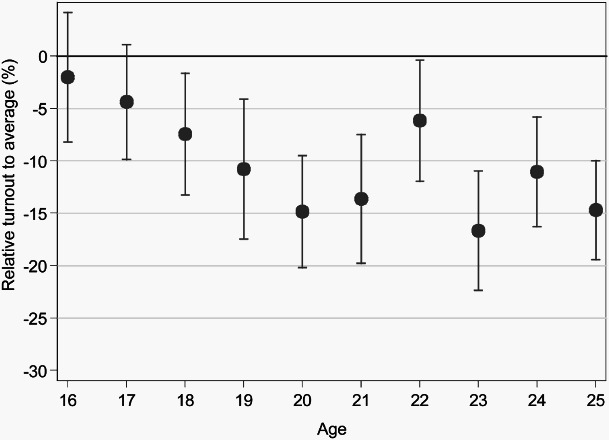
Turnout rate by age in Vienna using the maximum turnout estimator, relative to average turnout (67.6%).
Note: Graph for Vienna shows confidence intervals for the proportion (+/–1.96*S.E.); total n=5,411 within 59 clusters.
Figure 2.
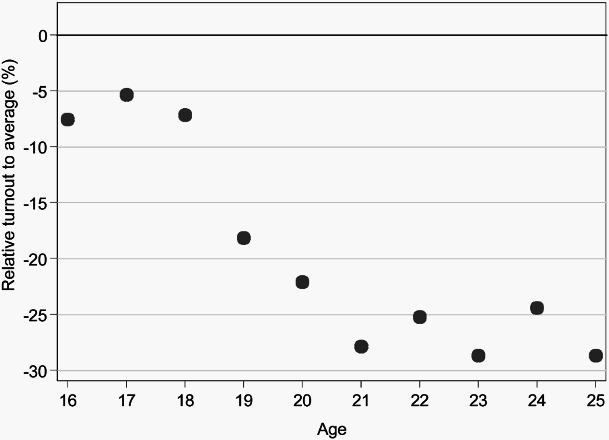
Turnout rate by age in Krems using the maximum turnout estimator, relative to average turnout (62.6%).
Note: Graph for Krems shows proportions of census data; total n=3,304.
With our data, the common finding that turnout of young voters is significantly and substantially lower than the overall turnout can be replicated, as long as only people aged 18 to 25 are concerned. Turnout of 16- and 17-year-olds rather resembles overall turnout.
Looking at the first-time voting boost in more detail, however, we observe that turnout decreases with increasing age from 16 to 20. In Vienna, this downturn is nearly linear: The older the first-time voter, the lower the turnout. In Krems, in contrast, 16- to 18-year-olds do not differ substantially in their turnout rate, but we see a sharp decline of turnout between age 18 and 19, similar to the decline described by Bhatti and Hansen (2012a) or Konzelmann et al. (2012). The first-time voting boost is thus found to be progressively less for older first-time voters.
In order to test Franklin's (2004) conjecture we next compare the overall turnout of 16- to 17-year-olds to the turnout of older first-time voters that are aged 18 to 20 (Tables 2 and 3). In fact, turnout of 16- to 17-year-olds in Vienna (Table 2) was estimated to be 64.2% and thus significantly and substantially higher than the turnout of 18–20-year-olds, which was 56.3%. In Krems turnout of 16- and 17-year-olds was 56.3% and substantially higher than turnout of older first-time voters (46.3%). In both towns we find that the share of the youngest first-time voters (16 to 17 years) participating in the election was higher than among older first-time voters (18 to 20 years). Our findings confirm Franklin's conjecture and Bergh's findings from the trial elections in Norway.
Table 2. Turnout of first-time voters in Vienna, 2010.
| 16–17 years | 18–20 years | |
|---|---|---|
| Voters | 64.2 | 56.3 |
| Non-voters | 35.8 | 43.7 |
| n | 810 | 1,562 |
| S.E. of proportion | +/–2.3 | +/– 2.6 |
| Corrected χ2, p=0.004 | ||
Note: Maximum turnout estimator.
Table 3. Turnout of first-time voters in Krems, 2012.
| 16–17 years | 18–20 years | |
|---|---|---|
| Voters | 56.3 | 46.3 |
| Non-voters | 43.7 | 53.7 |
| n | 432 | 912 |
| χ2, p=0.001 | ||
Note: Maximum turnout estimator, census data.
6. Discussion
When debating voting age, the case of Austria can provide empirical evidence on voting behaviour of enfranchised voters aged 16 to 17. In this article, we discussed electoral turnout in two Austrian regional (i.e. second order) elections, each of which was the second regional election after voting age was lowered to 16.
First, results from Vienna showed that turnout among 16- and 17-year-olds was not significantly lower than overall turnout, and also in Krems turnout was only somewhat lower than the average. The general trend that turnout of young people is by far lower than in the overall electorate cannot be applied to 16- and 17-year-old Austrian voters.
In both towns, turnout decreased with age for voters aged 18 to 21. Our study on 16- and 17-year-old voters thus confirms and extends previous evidence on the “first-time voting boost” phenomenon at the beginning of one's voting career, which has so far been described for countries having a voting age of 18 (Bhatti & Hansen, 2012a; Bhatti et al., 2012; Konzelmann et al., 2012). Second, Franklin's (2004) conjecture proved to be correct: electoral turnout of 16- and 17-year-olds was significantly higher than turnout of older first-time voters (18 to 20). Our study thus extends previous findings from Norwegian trial elections (Bergh, 2013) to a case study of “real” elections for a country having a general voting age of 16.
The results are particularly important in the debate about possible consequences of lowering the voting age to 16: our findings contradict the studies that assume low electoral participation of 16- and 17-year-olds because of lack of political interest (Chan & Clayton, 2006; Electoral Commission, 2004). Moreover, it has been argued that those who have not yet developed a habit to vote will especially abstain in second order elections (Franklin & Hobolt, 2011), such as the Austrian regional elections studied here. Thus, our findings of high turnout of young voters should also hold true in the case of first order national elections.
Of course, our results are limited. When interpreting the findings, one has to consider that elections take place in a certain societal context. The lowering of the voting age was accompanied by various measures, such as awareness-raising campaigns for the youngest eligible voters, in particular in the context of the federal election in 2008 (Schwarzer & Zeglovits, 2013, give an overview). It will take some time until we know if the effects observed here will continue, though accompanying measures cease to be continued. Future research will have to examine the short-term and long-term impact of the electoral reform on individual voting behaviour and aggregate turnout rates. With the data and design used here we simply cannot address whether higher turnout will actually leave a “footprint” in the youngest cohort's voting biography that continues in future elections. Finally, important information on individual covariates as well as the social embedding like family, schools and work, as well as spatial mobility, is missing. Further survey-based research is needed to disentangle the causes of participation or abstention of the youngest voters.
Acknowledgements
This research is conducted under the auspices of the Austrian National Election Study (AUTNES), a National Research Network (NFN) sponsored by the Austrian Science Fund (FWF) (S10902-G11).
An earlier version of this article was presented at the OEGPW conference in Salzburg, 2 December 2011. We particularly would like to thank Sylvia Kritzinger, Mark Franklin, Jon Lauglo, Henry Milner and our reviewers for helpful comments. Moreover, we want to thank Paula Thun-Hohenstein, Therese Kaiser, Roman Senninger and Jakob-Moritz Eberl; we really appreciate their help in making the enumeration of electoral lists possible.
Notes
The City of Vienna lowered voting age for regional elections to 16 in 2005, that is, before the general reform.
Austrian citizens who reside in another country are eligible to vote in the municipality of their last residence in Austria.
Note that some voters in the cohort examined here may have participated in the general election in 2008. Though people acquire their habit of voting especially in first order national elections (see Franklin & Hobolt, 2011), we refrain from analysing the impact of this event on turnout rates of certain age groups, as we do not have the data to do so. Given the high turnout of the Vienna election, the findings of Franklin and Hobolt (2011) might not be perfectly applicable here.
A detailed description of the sampling procedure in Vienna is available in the online appendix (available on the publisher's website http://dx.doi.org/10.1080/17457289.2013.872652).
Note that the overall turnout rate in Vienna was similar to previous elections: 2005: 60.8%; 2001: 66.6%; 1996: 68.5%.
Note that the overall turnout rate in Krems was somewhat lower than in previous elections: 2007: 66.0%; 2002: 68.4%; 1997: 67.6%.
*This article makes reference to supplementary material available on the publisher's website at http://dx.doi.org/10.1080/17457289.2013.872652
References
- Aldrich J.H., Montgomery J.M., Wood W. Turnout as a habit. Political Behaviour. 2011;33(4):535–563. [Google Scholar]
- Arzheimer K. Jung, dynamisch, Nichtwähler? Der Einfluss von Lebensalter und Kohortenzugehörigkeit auf die Wahlbereitschaft. In: Roller E., Brettschneider F., van Deth J.W., editors. Jugend und Politik: “Voll normal”. Der Beitrag der politischen Soziologie zur Jugendforschung. Wiesbaden: VS Verlag; 2006. pp. 317–336. [Google Scholar]
- Bergh J. Does voting rights affect the political maturity of 16- and 17-year-olds? Findings from the 2011 Norwegian voting-age trial. Electoral Studies. 2013;32(1):90–100. [Google Scholar]
- Bhatti Y., Hansen K.M. Leaving the nest and the social act of voting: turnout among first-time voters. Journal of Elections, Public Opinion & Parties. 2012a;22(4):380–406. [Google Scholar]
- Bhatti Y., Hansen K.M. The effect of generation and age on turnout to the European Parliament: how turnout will continue to decline in the future. Electoral Studies. 2012b;31(1):262–272. [Google Scholar]
- Bhatti Y., Hansen K.M., Wass H. The relationship between age and turnout: a roller-coaster ride. Electoral Studies. 2012;31(3):588–593. [Google Scholar]
- Blais A. To Vote or Not to Vote: The Merits and Limits of Rational Choice Theory. Pittsburgh: University of Pittsburgh Press; 2000. [Google Scholar]
- Blais A., Rubenson D. The source of turnout decline: new values or new contexts. Comparative Political Studies. 2013;46(1):95–117. [Google Scholar]
- Blais A., Gidengil E., Nevitte N. Where does turnout decline come from? European Journal of Political Research. 2004;43(2):221–236. [Google Scholar]
- Chan T.W., Clayton M. Should the voting age be lowered to sixteen? Normative and empirical considerations. Political Studies. 2006;54(3):533–558. [Google Scholar]
- Dinas E. The formation of voting habits. Journal of Elections, Public Opinion & Parties. 2012;22(4):431–456. [Google Scholar]
- Electoral Commission . Voter Engagement and Young People. London: Electoral Commission; 2002. [Google Scholar]
- Electoral Commission . Age of Electoral Majority: Report and Recommendations. London: Electoral Commission; 2004. [Google Scholar]
- Fieldhouse E., Tranmer M., Russel A. Something about young people or something about elections? Electoral participation of young people in Europe: evidence from a multilevel analysis of the European Social Survey. European Journal of Political Research. 2007;46(6):797–822. [Google Scholar]
- Franklin M.N. Voter Turnout and the Dynamics of Electoral Competition in Established Democracies since 1945. Cambridge: Cambridge University Press; 2004. [Google Scholar]
- Franklin M.N., Hobolt S.B. The legacy of lethargy: how elections to the European Parliament depress turnout. Electoral Studies. 2011;30(1):67–76. [Google Scholar]
- Franklin M.N., Lyons P., Marsh M. Generational basis of turnout decline in established democracies. Acta Politica. 2004;39(1):115–151. [Google Scholar]
- Gallego A. Where else does turnout decline come from? Education, age, generation and period effects in three European countries. Scandinavian Political Studies. 2009;32(1):23–44. [Google Scholar]
- Gerber A.S., Green D.P., Shachar R. Voting may be habit-forming: evidence from a randomized field experiment. American Journal of Political Science. 2003;47(3):540–550. [Google Scholar]
- Hart D., Atkins R. American sixteen- and seventeen-year-olds are ready to vote. The ANNALS of the American Academy of Political and Social Science. 2011;633(1):201–222. [Google Scholar]
- Highton B., Wolfinger R.E. The first seven years of the political life cycle. American Journal of Political Science. 2001;45(1):202–209. [Google Scholar]
- Hofer V., Ladner K., Reichmann G. Herabsetzung des Wahlalters auf 16 Jahre – Fortschritt oder Irrweg. Journal für Rechtspolitik. 2008;16(1):27–32. [Google Scholar]
- Holbrook A.L., Krosnick J.A. Social desirability bias in voter turnout reports. Public Opinion Quarterly. 2010;74(1):37–67. [Google Scholar]
- Kish L. Survey Sampling. New York: John Wiley & Sons; 1995. [Google Scholar]
- Konzelmann L., Wagner C., Rattinger H. Turnout in Germany in the course of time: life cycle and cohort effects on electoral turnout from 1953 to 2049. Electoral Studies. 2012;31(1):250–261. [Google Scholar]
- Milner H. Youth electoral participation in Canada and Scandinavia. In: Youniss J., Levine P., editors. Engaging Young People in Civic Life. Nashville: Vanderbildt University Press; 2009. pp. 187–218. [Google Scholar]
- Plutzer E. Becoming a habitual voter: inertia, resources, and growth in young adulthood. American Political Science Review. 2002;96(1):41–56. [Google Scholar]
- Rubenson D., Blais A., Fournier P., Gidengil E., Nevitted N. Accounting for the age gap in turnout. Acta Politica. 2004;39(4):407–421. [Google Scholar]
- Schwarzer S., Zeglovits E. The role of schools in preparing 16- and 17-year-old Austrian first time voters for the election. In: Abendschön S., editor. Growing into Politics: Contexts and Timing of Political Socialisation. Colchester: ECPR Press; 2013. pp. 73–89. [Google Scholar]
- Strate J.M., Parrish C.J., Elder C.D., Ford C. Life span civic development and voting participation. American Political Science Review. 1989;83(2):443–464. [Google Scholar]
- Topf R. Electoral participation. In: Klingemann H.-D., Fuchs D., editors. Citizen and the State. Oxford: Oxford University Press; 1995. pp. 27–51. [Google Scholar]
- Verba S., Nie N. Participation in America. New York: Harper & Row; 1972. [Google Scholar]
- Verba S., Schlozman K.L., Brady H.E. Voice and Equality: Civic Voluntarism in American Politics. Cambridge, MA: Harvard University Press; 1995. [Google Scholar]
- Wagner M., Johann D., Kritzinger S. Voting at 16: turnout and the quality of vote choice. Electoral Studies. 2012;31(1):372–383. doi: 10.1016/j.electstud.2012.01.007. [DOI] [PMC free article] [PubMed] [Google Scholar]
- Wass H. The effects of age, generation and period on turnout in Finland 1975–2003. Electoral Studies. 2007;26(4):648–659. [Google Scholar]
- Wattenberg M.P. Where Have all the Voters Gone? Cambridge, MA: Harvard University Press; 2002. [Google Scholar]
- Wattenberg M.P. Is Voting for Young People? With a Postscript on Citizen Engagement. New York: Pearson Longman; 2008. [Google Scholar]
- Zeglovits E., Kritzinger S. New attempts to reduce overreporting of voter turnout and their effects. International Journal of Public Opinion Research. 2013 doi: 10.1093/ijpor/edt010. [DOI] [Google Scholar]
- Zeglovits E., Zandonella M. Political interest of adolescents before and after lowering the voting age: the case of Austria. Journal of Youth Studies 2013 [Google Scholar]
Associated Data
This section collects any data citations, data availability statements, or supplementary materials included in this article.