



Abstract
Purpose
To present a case of iatrogenic Horner's syndrome seen together with the heterochromia in the post-thyroidectomy period.
Methods
A 23-year-old female patient was admitted to our clinic with complaints of low vision in the eye and difference in eye color that developed over the past two years. In the left eye, myosis and minimal ptosis (∼1 mm) was detected, and the color of the iris was lighter than the right eye.
Results
The pre-diagnosis of left iatrogenic Horner's syndrome was finalized after 0.5% topical apraclonidine test.
Conclusion
Heterochromia can be observed in iatrogenic Horner's syndrome.
Keywords: Heterochromia iridis, Horner's syndrome, Thyroidectomy, Anisocoria
Introduction
Horner's syndrome is a result of damage to the oculosympathetic nerve fibers. The symptoms vary depending on whether it is preganglionic or postganglionic. While anhidrosis is seen in preganglionic cases, heterochromia is considered a part of congenital Horner's syndrome. In this particular case, we investigated acquired Horner's syndrome with heterochromia that developed as a result of total thyroidectomy.
Case report
A 23-year-old female patient was admitted to our clinic with complaints of low vision and difference in eye color growing over the past two to three years. The patient stated that she suffered from a total thyroidectomy 4 years earlier. In the ophthalmologic examination of the patient, the visual acuities were 12/20 in the right eye and 20/20 in the left eye. The visual acuity difference of the patient was linked to anisometropic amblyopia (OD + 4.00 + 4.50 × 110 OS + 1.25 × 70). Anisocoria was detected in the patient with myosis in the left eye (Fig. 1). The light reflexes on both sides of the patient were directly and indirectly normal. The patient had heterochromia with light iris color in the left eye. Ptosis (∼1 mm) was detected in the left eye. Fundus examination was normal in both eye. Intraocular pressures in the right and left were 12 and 14 mmHg, respectively. As a result of the existing complaints, background, and examinations findings of the patient, she was given the provisional diagnosis of Horner's syndrome. In an attempt to finalize our diagnosis, we decided to test by the 0.5% Apraclonidine drop (Iopidine; Alcon, Fort Worth, Texas). After 0.5% Apraclonidine drops in both eyes, the examination was repeated in the 30th and 60th minutes. While explicit mydriasis in the left eye and mild retraction in the upper eyelid were detected, no mydriasis was found in the right eye (Fig. 2).
Fig. 1.
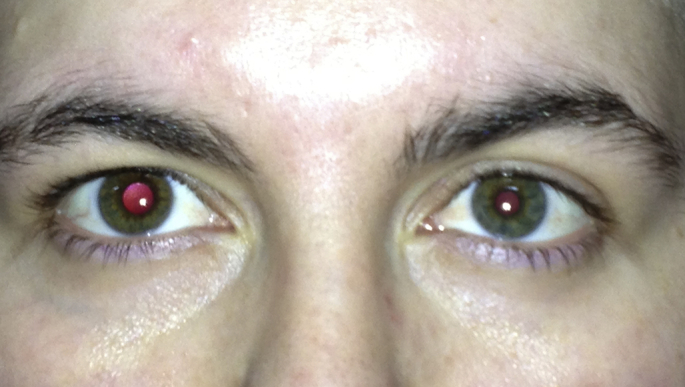
Pupil size before apraclonidine instillation.
Fig. 2.
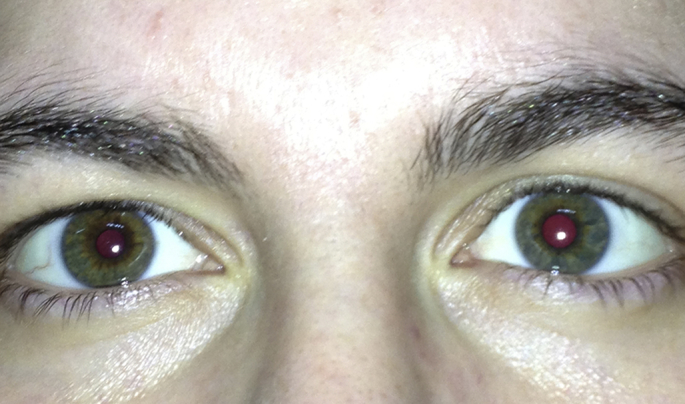
Pupil size 60 min after apraclonidine instillation.
Discussion
Oculosympathetic innervation is a three-neuron pathway starting in the central nervous system and finalizing in the eye. Interruption of this innervation causes mild ptosis on the affected upper eyelid, anhidrosis and myosis. Also, heterochromia occurs in congenital cases. While congenital cases may be linked to idiopathic or birth trauma,1 the tumoral infiltration which is common in the adult period may occur as a result of surgery and trauma.2 Moreover, Horner's syndrome may occur secondary to benign thyroid lesions.3 In our patient, Horner's syndrome was secondary to the thyroid surgery. Because access to the patient's surgery records was not available, the nature of primary lesion (malignant versus benign) was unknown. Due to the fact that the patient did not receive any other treatment except surgery and her screening was interrupted, we believe that it was benign.
What differentiates this particular case from other iatrogenic Horner is the availability of heterochromia just like in congenital cases. To best of our knowledge, few cases were reported to have acquired Horner's syndrome with heterochromia in the literature.4, 5, 6 With the exception of Diesenhouse's and Byrne's report,7, 8 most of these cases were acquired Horner's syndrome which developed in childhood. The researchers investigating congenital Horner's syndrome believe that the interruption of postganglionic pathway caused neurotropic diagenesis in the iris melanocytes.9 Moreover, the melanocytes in the stroma and sympathetic nerve endings were electron-microscopically defined and it was reported that iris hyperpigmentation was due to the melanocyte recruitment from the neural crest. It was reported that as a result of showing heterochromia in adult Horner's syndrome, this particular situation occurred due to the damage to the cells rather than the loss of the cells as a result of denervation.8
Even though Horner's syndrome can be clinically diagnosed, it should be confirmed by some pharmacologic tests in order to be able to differentiate them from the other anisocoria and ptosis causes, especially in adults.10, 11 While cocaine and apraclonidine are diagnostic in these tests, hydroxyamphetamine test can be used in differentiating pre-post ganglionic cases. Apraclonidine, which is alpha adrenergic agonist, finalizes the diagnosis by actualizing the mydriasis in eyes in which Horner's syndrome-related denervation hypersensitivity has developed. Since apraclonidine has recently become readily available and is difficult to differentiate with respect to sensitivity and specificity from cocaine, it has been used late more than before.12, 13 As we only had apraclonidine 0.5% available, we did this test and confirmed our Horner's syndrome diagnosis.
In conclusion, the development of Horner's syndrome as a result of neck surgery and especially thyroid surgery has been reported many times in the literature and is a well-known case. The present case shows that iris heterochromia may develop in iatrogenic Horner's syndrome in adults as well.
Footnotes
The author(s) declare(s) that there is no conflict of interests regarding the publication of this paper.
Funding sources: No stated funding sources.
Peer review under responsibility of the Iranian Society of Ophthalmology.
References
- 1.Jeffery A.R., Ellis F.J., Repka M.X., Buncic J.R. Pediatric Horner syndrome. J AAPOS. 1998;2:159–167. doi: 10.1016/s1091-8531(98)90008-8. [DOI] [PubMed] [Google Scholar]
- 2.Smith P.G., Dyches T.J., Burde R.M. Topographic analysis of Horner's syndrome. Otolaryngol Head Neck Surg. 1986;94:451–457. doi: 10.1177/019459988609400409. [DOI] [PubMed] [Google Scholar]
- 3.Vilallonga R., Fort J.M., Mazarro A. Postthyroidectomy Horner's syndrome. Case Rep Med. 2012;2012:316984. doi: 10.1155/2012/316984. [DOI] [PMC free article] [PubMed] [Google Scholar]
- 4.Rennie I.G. Don't it make my blue eyes brown: heterochromia and other abnormalities of the iris. Eye (Lond) 2012 Jan;26:29–50. doi: 10.1038/eye.2011.228. [DOI] [PMC free article] [PubMed] [Google Scholar]
- 5.Parsa C.F., George N.D., Hoyt C.S., George N.D. Pharmacological reversal of ptosis in a patient with acquired Horner's syndrome and heterochromia. Br J Ophthalmol. 1998 Sep;82:1095. doi: 10.1136/bjo.82.9.1090g. [DOI] [PMC free article] [PubMed] [Google Scholar]
- 6.Beynat J., Soichot P., Bidot S., Dugas B., Creuzot-Garcher C., Bron A. Iris heterochromia in acquired Horner's syndrome. J Fr Ophtalmol. 2007 Sep;30:e19. doi: 10.1016/s0181-5512(07)91365-0. [DOI] [PubMed] [Google Scholar]
- 7.Byrne P., Clough C. Hypochromia iridis in acquired Horner's syndrome. J Neurol Neurosurg Psychiatry. 1992 May;55:413. doi: 10.1136/jnnp.55.5.413-a. [DOI] [PMC free article] [PubMed] [Google Scholar]
- 8.Diesenhouse M.C., Palay D.A., Newman N.J., To K., Albert D.M. Acquired heterochromia with horner syndrome in two adults. Ophthalmology. 1992 Dec;99:1815–1817. doi: 10.1016/s0161-6420(92)31720-8. [DOI] [PubMed] [Google Scholar]
- 9.Weinstein J.M., Zweifel T.J., Thompson S. Congenital Horner's syndrome. Arch Ophthalmol. 1980;98:1074–1078. doi: 10.1001/archopht.1980.01020031064011. [DOI] [PubMed] [Google Scholar]
- 10.Başarır B., Altan Ç. Heterokromi. Turk J Ophthalmol. 2014;44:68–71. [Google Scholar]
- 11.Moodley A.A., Spooner R.B. Apraclonidine in the diagnosis of Horner's syndrome. S Afr Med J. 2007 Jul;97:506–507. [PubMed] [Google Scholar]
- 12.Pérez-Iñigo M.A., González I., Fernández F.J. Usefulness of apraclonidine in the diagnosis of Horner syndrome. Arch Soc Esp Oftalmol. 2009 Feb;84:105–108. doi: 10.4321/s0365-66912009000200009. [DOI] [PubMed] [Google Scholar]
- 13.Koc F., Kavuncu S., Kansu T., Acaroglu G., Firat E. The sensitivity and specificity of 0.5% apraclonidine in the diagnosis of oculosympathetic paresis. Br J Ophthalmol. 2005 Nov;89:1442–1444. doi: 10.1136/bjo.2005.074492. [DOI] [PMC free article] [PubMed] [Google Scholar]