



Abstract
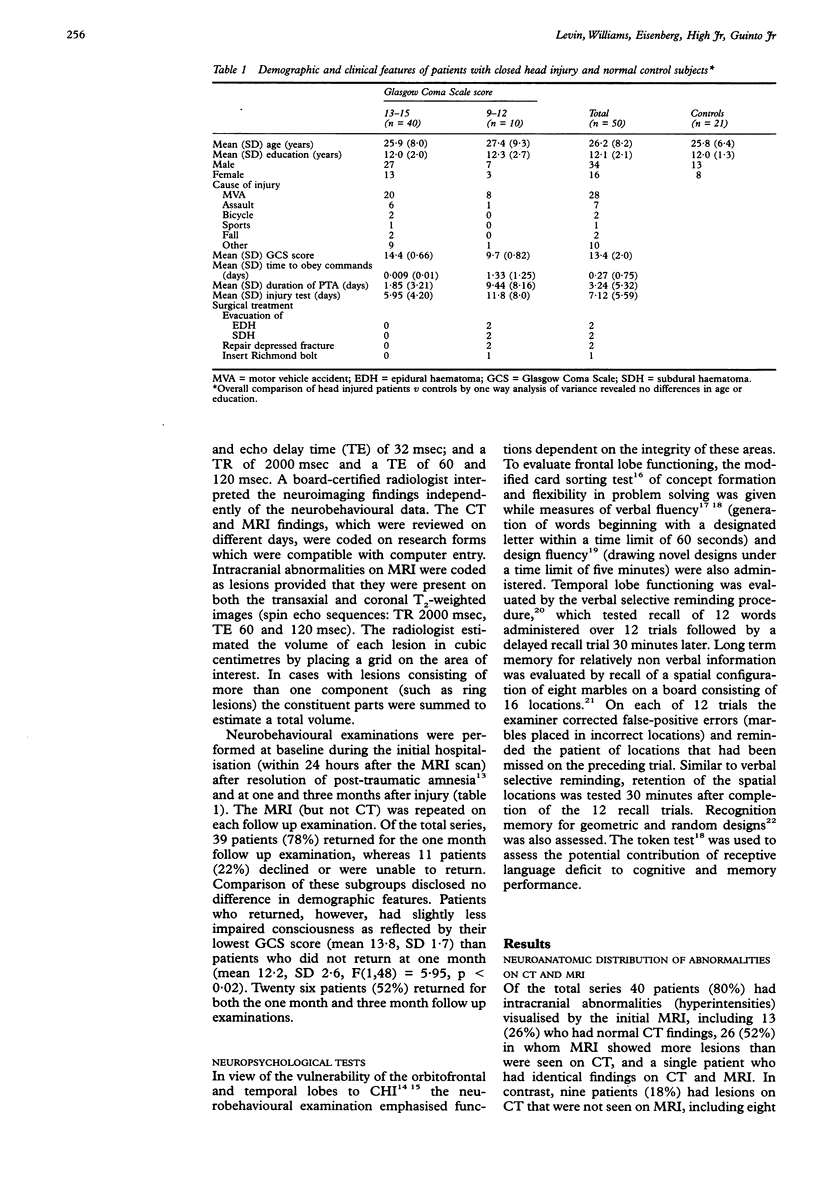
Fifty patients who sustained mild to moderate closed head injury (CHI) underwent a CT scan, MRI, and neurobehavioural testing. At baseline 40 patients had intracranial hyperintensities detected by MRI which predominated in the frontal and temporal regions, whereas 10 patients had lesions detected by CT. Neurobehavioural data obtained during the first admission to hospital disclosed no distinctive pattern in subgroups of patients characterised by lesions confined to the frontal, temporal, or frontotemporal regions, whereas all three groups exhibited pervasive deficits in relation to normal control subjects. The size of extraparenchymal lesion was significantly related to the initial Glasgow Coma Scale score, whereas this relation was not present in parenchymal lesions. One and three month follow up MRI findings showed substantial resolution of lesion while neuropsychological data reflected impressive recovery. The follow up data disclosed a trend from pervasive deficits to more specific impairments which were inconsistently related to the site of brain lesion. These results corroborate and extend previous findings, indicating that intracranial lesions detected by MRI are present in most patients hospitalised after mild to moderate CHI. Individual differences in the relation between site of lesion and the pattern of neuropsychological findings, which persist over one to three months after mild to moderate CHI, remain unexplained.
Full text
PDF


Images in this article
Selected References
These references are in PubMed. This may not be the complete list of references from this article.
- Adams J. H., Graham D. I., Scott G., Parker L. S., Doyle D. Brain damage in fatal non-missile head injury. J Clin Pathol. 1980 Dec;33(12):1132–1145. doi: 10.1136/jcp.33.12.1132. [DOI] [PMC free article] [PubMed] [Google Scholar]
- Buschke H., Fuld P. A. Evaluating storage, retention, and retrieval in disordered memory and learning. Neurology. 1974 Nov;24(11):1019–1025. doi: 10.1212/wnl.24.11.1019. [DOI] [PubMed] [Google Scholar]
- Bydder G. M., Steiner R. E., Young I. R., Hall A. S., Thomas D. J., Marshall J., Pallis C. A., Legg N. J. Clinical NMR imaging of the brain: 140 cases. AJR Am J Roentgenol. 1982 Aug;139(2):215–236. doi: 10.2214/ajr.139.2.215. [DOI] [PubMed] [Google Scholar]
- Gandy S. E., Snow R. B., Zimmerman R. D., Deck M. D. Cranial nuclear magnetic resonance imaging in head trauma. Ann Neurol. 1984 Aug;16(2):254–257. doi: 10.1002/ana.410160217. [DOI] [PubMed] [Google Scholar]
- Han J. S., Kaufman B., Alfidi R. J., Yeung H. N., Benson J. E., Haaga J. R., El Yousef S. J., Clampitt M. E., Bonstelle C. T., Huss R. Head trauma evaluated by magnetic resonance and computed tomography: a comparison. Radiology. 1984 Jan;150(1):71–77. doi: 10.1148/radiology.150.1.6689790. [DOI] [PubMed] [Google Scholar]
- Jenkins A., Teasdale G., Hadley M. D., Macpherson P., Rowan J. O. Brain lesions detected by magnetic resonance imaging in mild and severe head injuries. Lancet. 1986 Aug 23;2(8504):445–446. doi: 10.1016/s0140-6736(86)92145-8. [DOI] [PubMed] [Google Scholar]
- Jones-Gotman M., Milner B. Design fluency: the invention of nonsense drawings after focal cortical lesions. Neuropsychologia. 1977;15(4-5):653–674. doi: 10.1016/0028-3932(77)90070-7. [DOI] [PubMed] [Google Scholar]
- KIMURA D. Right temporal-lobe damage. Perception of unfamiliar stimuli after damage. Arch Neurol. 1963 Mar;8:264–271. doi: 10.1001/archneur.1963.00460030048004. [DOI] [PubMed] [Google Scholar]
- Kelly A. B., Zimmerman R. D., Snow R. B., Gandy S. E., Heier L. A., Deck M. D. Head trauma: comparison of MR and CT--experience in 100 patients. AJNR Am J Neuroradiol. 1988 Jul-Aug;9(4):699–708. [PMC free article] [PubMed] [Google Scholar]
- Levin H. S., Amparo E., Eisenberg H. M., Williams D. H., High W. M., Jr, McArdle C. B., Weiner R. L. Magnetic resonance imaging and computerized tomography in relation to the neurobehavioral sequelae of mild and moderate head injuries. J Neurosurg. 1987 May;66(5):706–713. doi: 10.3171/jns.1987.66.5.0706. [DOI] [PubMed] [Google Scholar]
- Levin H. S., Mattis S., Ruff R. M., Eisenberg H. M., Marshall L. F., Tabaddor K., High W. M., Jr, Frankowski R. F. Neurobehavioral outcome following minor head injury: a three-center study. J Neurosurg. 1987 Feb;66(2):234–243. doi: 10.3171/jns.1987.66.2.0234. [DOI] [PubMed] [Google Scholar]
- Levin H. S., O'Donnell V. M., Grossman R. G. The Galveston Orientation and Amnesia Test. A practical scale to assess cognition after head injury. J Nerv Ment Dis. 1979 Nov;167(11):675–684. doi: 10.1097/00005053-197911000-00004. [DOI] [PubMed] [Google Scholar]
- Nelson H. E. A modified card sorting test sensitive to frontal lobe defects. Cortex. 1976 Dec;12(4):313–324. doi: 10.1016/s0010-9452(76)80035-4. [DOI] [PubMed] [Google Scholar]
- Rimel R. W., Giordani B., Barth J. T., Boll T. J., Jane J. A. Disability caused by minor head injury. Neurosurgery. 1981 Sep;9(3):221–228. [PubMed] [Google Scholar]
- Rimel R. W., Giordani B., Barth J. T., Jane J. A. Moderate head injury: completing the clinical spectrum of brain trauma. Neurosurgery. 1982 Sep;11(3):344–351. doi: 10.1227/00006123-198209000-00002. [DOI] [PubMed] [Google Scholar]
- Snow R. B., Zimmerman R. D., Gandy S. E., Deck M. D. Comparison of magnetic resonance imaging and computed tomography in the evaluation of head injury. Neurosurgery. 1986 Jan;18(1):45–52. doi: 10.1227/00006123-198601000-00008. [DOI] [PubMed] [Google Scholar]
- Teasdale G., Jennett B. Assessment of coma and impaired consciousness. A practical scale. Lancet. 1974 Jul 13;2(7872):81–84. doi: 10.1016/s0140-6736(74)91639-0. [DOI] [PubMed] [Google Scholar]
- Wilson J. T., Wiedmann K. D., Hadley D. M., Condon B., Teasdale G., Brooks D. N. Early and late magnetic resonance imaging and neuropsychological outcome after head injury. J Neurol Neurosurg Psychiatry. 1988 Mar;51(3):391–396. doi: 10.1136/jnnp.51.3.391. [DOI] [PMC free article] [PubMed] [Google Scholar]