


Abbreviations
- aPTT
activated partial thromboplastin time
- CBC
complete blood count
- FDP
fibrinogen‐degradation product
- MCHC
mean corpuscular hemoglobin concentration
- MCV
mean corpuscular volume
- PCV
packed cell volume
- PT
prothrombin time
- RBC
red blood cell
- RRI
renal resistive index
- r‐TPA
recombinant tissue plasminogen activator
- TT
thrombin time
A 3‐year‐old male intact Spanish Water Dog was referred to the Small Animal Veterinary Teaching Hospital of the University of Cordoba for investigation of persistent hematuria and dysuria. Intermitent hematuria had been present as the dog was 4 months old. As the dog had been suffering this problem for several years, before presentation, it had received a variety of treatments including vitamin K, anti‐inflammatory drugs, and antibiotics.
On presentation the dog was quiet, alert, and responsive. The only relevant finding on physical examination was slightly pale mucous membranes. Complete blood cell count (CBC) was consistent with moderate microcytic and hypochromic semiregenerative anemia (PCV 34%; RI, 37.0–54.0%; MCV 55.5 fL; RI, 62.0–74.0 fL; MCHC 25.4 g/dL; RI, 32.0–36.0 g/dL; reticulocytes 0.5%). Abnormalities in blood biochemistry included slight hypoalbuminemia (2.1 g/dL; RI, 2.5–3.5 g/dL), slight hyperbilirubinemia (0.6 mg/dL; RI, 0.1–0.3 mg/dL), and severe iron deficiency (16.7 μg/dL; RI, 84.0–233.0 μg/dL). Results of the coagulation tests were within the reference ranges (aPTT 16.8 secs; RI, <25 secs; TT <15.8 secs; RI, <15.8 secs; PT 7.2 secs; RI, 5.9–9.8 secs; FDP <0.1; RI <0.1). Urine was obtained via cystocentesis, and urinalysis revealed a pH = 6.5, specific gravity = 1026, occult blood (3+), bilirubinuria (3+), proteinuria (4+), and slight leucocituria (+), as determined by urine dipstick tests. Microscopic examination of urine sediment revealed red blood cells (RBC) too numerous to count (>50 RBC/high power field). The urine culture was negative.
No abnormalities were detected on 3‐view abdominal radiographs. Excretory urography did not show morphological or functional abnormalities.
Abdominal ultrasound revealed a large clot in the lumen of the urinary bladder (Fig 1A). No structural renal abnormalities were observed, although the Doppler study revealed bilateral renal hypoperfusion and increased renal resistive index (RRI) in both kidneys (RRI >0.70).
Figure 1.
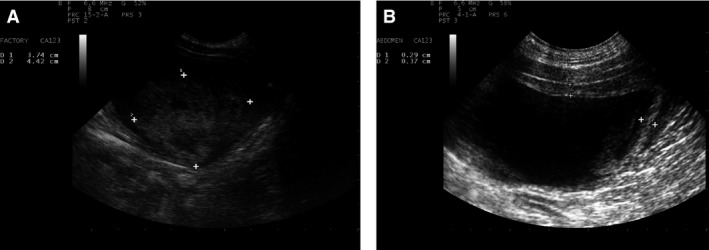
Ultrasound images of the urinary bladder, before (A) and after (B) intravesical treatment with alteplase. Note the presence of a large intravesical clot before treatment and its dissolution after instillation of alteplase.
Based on these data, a tentative diagnosis of idiopathic renal hematuria was made. Dysuria was considered to be secondary to impairment in urinary tract outflow caused by the large clot detected inside the bladder. Because of financial constraints, the owner declined further diagnostics. As surgical treatment for renal hematuria was not a viable option, a conservative medical approach aimed to reduce bleeding with oral aminocaproic acid1 (50 mg/kg q8 hours) and to treat anemia with an iron and folic acid supplement2 (300 mg iron gluconate, 1 mg folic acid q12 hours) was started.
To treat dysuria, which was the problem that was causing more discomfort to the dog, a decision was made to attempt dissolution of the urinary bladder clot using alteplase,3 a recombinant tissue plasminogen activator (r‐TPA), following a method previously described in human neonatology.1 Urethral catheterization was performed with an 8 Fr Foley urinary catheter.4 One milligram of alteplase3 was diluted to 10 mL with saline solution, and 5 mL of this solution (0.5 mg) were instilled into the urinary bladder through the Foley catheter. The catheter was clamped for 1 hour, after that the bladder was flushed with 10 mL of saline solution. Eight hours later, the procedure was repeated with the remaining 5 mL of alteplase solution. After instillation of the remaining dose of TPA, a complete dissolution of the intravesical clot was observed during the ultrasound follow up (Fig 1B).
Subsequently, local washes were repeated when presence of clots caused urinary tract obstruction and retention. A total of 6 intravesical TPA instillations were performed with an approximate interval of 1 month between each treatment. Although further sporadic episodes of hematuria have occurred, they have not been accompanied by large intravesical clots or difficulty urinating.
In the dog of this report, intravesical clots were causing urinary obstruction and thus clot removal was an important therapeutic goal. Thrombolytic treatment provides a less invasive option than surgery for the resolution of urinary bladder clots. In humans, the use of several thrombolytics such as streptokinase,2 urokinase,3 alteplase,1 and chymotrypsin combined with sodium bicarbonate irrigation technique has been described.4
We decided to use alteplase for the dissolution of the urinary bladder clot based on a previous report in a human neonate in which efficacy and safety of this thrombolytic agent was demonstrated.1 Alteplase (recombinant type plasminogen activator [r‐TPA]) is a serine protease produced mainly by endothelial cells that is involved in the fibrinolysis of blood clots by converting inactive endogenous plasminogen to plasmin.5 Alteplase is more fibrin‐specific than streptokinase or urokinase, resulting in less depletion of plasma fibrinogen and in fewer degradation products.5 Because of the lack of established dosing guidelines for intravesical alteplase in small animals, we used the dose previously reported in neonatal human medicine.1 Although alteplase is considered a safe thrombolytic agent adverse effects can occur, of which hemorrhage is the most important.1 In agreement with the previous human report,1 treatment with TPA was well tolerated, in our case no bleeding signs and no changes in the coagulation profile were observed when alteplase was administered locally (intravesical).
Our case shows that the intravesical administration of alteplase is a viable option for the resolution of urinary bladder clots in dogs. This medical treatment has obvious advantages when compared with surgical removal, including being less invasive, cheaper, and the possibility of performing as many treatments as necessary every time that intravesical clot formation becomes a problem. Nevertheless, further experience with the use of this drug is needed to establish the exact dose and duration of the treatment in small animals.
Acknowledgments
Conflict of Interest Declaration: Authors disclose no conflict of interest.
Off‐label Antimicrobial Declaration: Authors declare no off‐label use of antimicrobials.
The work was done at the Department of Medicina y Cirugia Animal – Small Animal Veterinary Teaching Hospital, University of Cordoba, Cordoba, Spain.
Footnotes
Aminocaproic acid (Caproamin Fides, 4 g/10 mL), Fides‐Rottapharm S.A., Valencia, Spain.
Iron and folic acid supplement (Normovite antianemico, 300/1 mg), Normon S.A., Madrid, Spain.
Alteplase (Actilyse, 1 mg), Boehringer Ingelheim S.A., Barcelona, Spain.
Foley urinary catheter 8 Fr, MILA International Inc., Kentucky, USA.
References
- 1. Olarte JL, Glover ML, Totapally BR. The use of alteplase for the resolution of an intravesical clot in a neonate receiving extracorporeal membrane oxygenation. ASAIO J 2001;47:565–568. [DOI] [PubMed] [Google Scholar]
- 2. Korkmaz K, Sahin H, Islim F, et al. A new treatment for clot retention: intravesical streptokinase instillation. J Urol 1996;156:201. [PubMed] [Google Scholar]
- 3. LaFave MS, Decter RM. Intravesical urokinase for the management of clot retention in boys. J Urol 1993;150:1467–1468. [DOI] [PubMed] [Google Scholar]
- 4. Bo J, Yangvang Y, Jiayuan L, et al. Evaluation of bladder clots using a nonsurgical treatment. Urology 2014;83:498–499. [DOI] [PubMed] [Google Scholar]
- 5. Gillis JC, Wagstaff AJ, Goa KL. Alteplase. A reappraisal of its pharmacological properties and therapeutic use in acute myocardial infarction. Drugs 1995;50:102–136. [DOI] [PubMed] [Google Scholar]