



Abstract
Introduction
Bird attacks are in general an uncommon event. To our knowledge, this is the first reported case in Bahrain. There have been very few cases reported worldwide. Mainly, birds attack humans as retaliation to threats surrounding their environment. At certain occasions, bird attack frequency increases especially during mating season or in the presence of a threat toward their young.
Methods
A 31-year-old male presented with a history of left-eye trauma, loss of vision, pain and tearing for 2 hours. A left corneal penetrating laceration and traumatic cataract were diagnosed. The corneal laceration was closed surgically, the lens was aspirated and anterior vitrectomy performed.
Results
After 4 months of follow-up, penetrating keratoplasty and posterior chamber intraocular lens implantation were performed elsewhere. The patient's vision improved from hand motion in his left eye to 20/200 without correction.
Conclusion
Corneal perforation secondary to a bird injury can be treated successfully with surgical closure and broad intravenous antibiotic coverage. This rare type of ocular trauma does not require any specific additional measures.
Key Words: Ruptured globe, Bird, Corneal laceration, Trauma, Eye
Case
A 31-year-old man presented to the emergency room with a history of left-eye trauma. The patient was complaining of left-eye pain, loss of vision and tearing for the duration of 2 hours. On examination, visual acuity was 20/20 in the right eye and counting fingers near the face in the left eye. The intraocular pressure was 12 mm Hg in the right eye; left-eye intraocular pressure was not measured. The left cornea showed an inverted V-shaped full-thickness corneal laceration 5 mm wide and 3 mm in height in the visual axis (fig. 1). The left anterior chamber was collapsed. The left pupil was distorted; the left lens had a traumatic cataract. The right eye showed a normal examination.
Fig. 1.
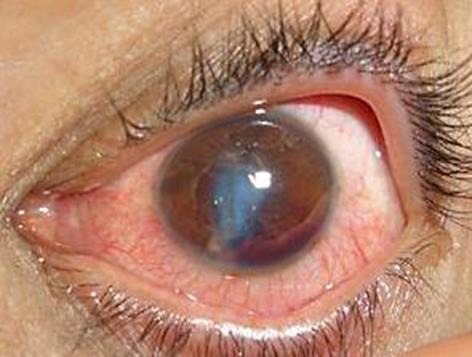
An image of the patient's left eye shows a central corneal laceration and hyphema.
The patient was admitted for urgent eye surgery. He received cefuroxime i.v. and vancomycin i.v. Then he underwent primary corneal wound repair, lens matter aspiration and anterior vitrectomy. The left eye was patched postoperatively.
On the following day, visual acuity in the left eye was hand movement near the face. There was no pain, discharge or eyelid swelling. The left eye showed conjunctival edema. The corneal wound was secure, Seidel test was negative. The wound was surrounded by corneal edema. Left anterior chamber had +2 cells. Red reflex was faint. The patient was started on prednisolone 1% eye drops 4 times a day, ofloxacin eye drops 4 times a day and oral acetazolamide 250 mg 3 times a day.
On the 2nd postoperative day, an ultasonography of the left eye was done showing a flat retina. Intravenous antibiotics and oral acetazolamide were stopped. On the third day, visual acuity did not show any improvement. The patient was discharged on prednisolone 1% eye drops 4 times a day, ofloxacin eye drops 4 times a day and cyclopentolate 0.5% 3 times a day.
The patient was seen in the clinic after 1 week in a stable condition. Visual acuity was still hand motion near the face. The wound was secure, anterior chamber had residual cortex, and red reflex was good. Steroids were tapered over 1 month. A penetrating keratoplasty and intraocular lens implantation were planned for visual restoration.
The patient missed the following appointments. After 3 months, he presented with left penetrating keratoplasty and posterior chamber intraocular lens implantation done elsewhere. His visual acuity improved to 20/200 without correction.
Discussion
Ocular trauma caused by bird attacks is very uncommon. In the medical literature, there are very few cases reported [1]. Kühl [2] reviewed a series of 14 patients from 1875 through 1970 caused by birds in Germany. All were penetrating ocular injuries, mostly carried out by owls in forests at night.
Our patient was attacked by a common myna (Acridotheres tristis). This bird is a member of the starling family, resident in the Indian subcontinent. An omnivorous bird with a strong territorial instinct, the myna has adapted well to urban environments [3]. These birds arrive at Bahrain by accompanying large cargo ships coming from India. In Bahrain, this bird is considered to be an invasive pest.
Conclusion
This case shows the importance of broad-spectrum antibiotic regimens in treating perforating ocular lacerations. The microorganisms which are harbored in the beaks of the common myna are not well defined, causing a difficulty in the selection of the proper antibiotic regimen. In our case, we have used two broad-spectrum intravenous antibiotics, cefuroxime and vancomycin, and ofloxacin eye drops, which provided adequate antimicrobial coverage.
Statement of Ethics
The patient has given voluntary written informed consent. During treatment, the health of the patient was our first consideration and we have acted in the patient's best interest when providing medical care.
Disclosure Statement
The authors declare no conflicts of interest. There are no financial or nonfinancial interests/relationships that may be interpreted to have influenced the manuscript.
References
- 1.Chaudhry IA, Al-Sharif AM, Hamdi M. Severe ocular and periocular injuries caused by an ostrich. Br J Ophthalmol. 2005;89:250–251. doi: 10.1136/bjo.2004.054155. [DOI] [PMC free article] [PubMed] [Google Scholar]
- 2.Kühl W. Eye injuries caused by birds (in German) Klin Monatsbl Augenheilkd. 1970;157:810–815. [PubMed] [Google Scholar]
- 3.Salim A, Ripley SD. Handbook of the Birds of India and Pakistan. New Delhi Oxford University Press. (ed 2) 2001;5:278. paperback. [Google Scholar]