



Abstract
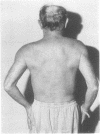
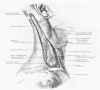
After apparently uncomplicated excision of benign lesions in the posterior cervical triangle, two patients had shoulder pain. In one, neck pain and trapezius weakness were not prominent until one month after surgery. Inability to elevate the arm above the horizontal without externally rotating it, and prominent scapular displacement on arm abduction, but not on forward pushing movements, highlighted the trapezius dysfunction and differentiated it from serratus anterior weakness. Spinal accessory nerve lesions should be considered when minor surgical procedures, lymphadenitis, minor trauma, or tumours involved the posterior triangle of the neck.
Full text
PDF


Images in this article
Selected References
These references are in PubMed. This may not be the complete list of references from this article.
- Anderson R., Flowers R. S. Free grafts of the spinal accessory nerve during radical neck dissection. Am J Surg. 1969 Nov;118(5):796–799. doi: 10.1016/0002-9610(69)90232-3. [DOI] [PubMed] [Google Scholar]
- Ballantyne A. J., Guinn G. A. Reduction of shoulder disability after neck dissection. Am J Surg. 1966 Nov;112(5):662–665. doi: 10.1016/0002-9610(66)90100-0. [DOI] [PubMed] [Google Scholar]
- Cherington M. Accessory nerve. Conduction studies. Arch Neurol. 1968 Jun;18(6):708–709. doi: 10.1001/archneur.1968.00470360130014. [DOI] [PubMed] [Google Scholar]
- Eisen A., Bertrand G. Isolated accessory nerve palsy of spontaneous origin. A clinical and electromyographic study. Arch Neurol. 1972 Dec;27(6):496–502. doi: 10.1001/archneur.1972.00490180032008. [DOI] [PubMed] [Google Scholar]
- MORROW R. C., BRODER A. I. SOME CRANIAL MOTOR NERVE INJURIES IN OTOLARYNGOLOGY. Laryngoscope. 1965 Jun;75:988–1002. doi: 10.1288/00005537-196506000-0012. [DOI] [PubMed] [Google Scholar]
- SCHNECK S. A. Peripheral and cranial nerve injuries resulting from general surgical procedures. Arch Surg. 1960 Dec;81:855–859. doi: 10.1001/archsurg.1960.01300060001001. [DOI] [PubMed] [Google Scholar]