



Abstract
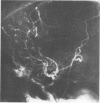
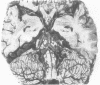
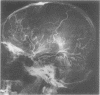
In addition to occlusion of the distal part and branches of the internal carotid artery in two adult patients, angiography revealed a fine vascular network on the convex surface and at the base of the brain, identical with the angiographic picture of `Moyamoya disease'. On the basis of the pathological examinations, the occlusion of the cerebral blood vessels was caused by arteriosclerosis in both cases. The causes and conditions of development of the `Moyamoya' picture are discussed. In the authors' opinion, this is not an independent disease: under the conditions described the characteristic pattern may develop in any type of vascular occlusion as a special form of accessory circulation in the cerebral areas the blood supply of which has been impaired.
Full text
PDF


Images in this article

Selected References
These references are in PubMed. This may not be the complete list of references from this article.
- Busch H. F. Unusual collateral cirulation in a child with cerebral arterial occlusion. Psychiatr Neurol Neurochir. 1969 Jan-Feb;72(1):23–28. [PubMed] [Google Scholar]
- De Gutiérrez-Mahoney, Schechter M. M. The myth of the rete mirabile in man. Neuroradiology. 1972 Oct;4(3):141–158. doi: 10.1007/BF00327579. [DOI] [PubMed] [Google Scholar]
- Fukuyama Y., Suzuki Y., Segawa M. [Acute recurrent transient hemiplegia in children with special reference to cases presenting telangiectasis-like anomalous vascularity at the base of brain]. No To Shinkei. 1965 Aug;17(8):757–760. [PubMed] [Google Scholar]
- Hilal S. K., Solomon G. E., Gold A. P., Carter S. Primary cerebral arterial occlusive disease in children. I. Acute acquired hemiplegia. Radiology. 1971 Apr;99(1):71–86. doi: 10.1148/99.1.71. [DOI] [PubMed] [Google Scholar]
- Jones R. R., Wetzel N. Bilateral carotid vertebrobasilar rete mirabile. Case report. J Neurosurg. 1970 Nov;33(5):581–586. doi: 10.3171/jns.1970.33.5.0581. [DOI] [PubMed] [Google Scholar]
- Kudo T. Spontaneous occlusion of the circle of Willis. A disease apparently confined to Japanese. Neurology. 1968 May;18(5):485–496. doi: 10.1212/wnl.18.5.485. [DOI] [PubMed] [Google Scholar]
- Leeds N. E., Abbott K. H. Collateral circulation in cerebrovascular disease in childhood via rete mirabile and perforating branches of anterior choroidal and posterior cerebral arteries. Radiology. 1965 Oct;85(4):628–634. doi: 10.1148/85.4.628. [DOI] [PubMed] [Google Scholar]
- Nishimoto A., Sugino N., Takeuchi S. [Malformations of the circle of Willis presenting a peculiar cerebral angiographic picture. Cases encountered in Japan]. No To Shinkei. 1966 May;18(5):508–513. [PubMed] [Google Scholar]
- Nishimoto A., Takeuchi S. Abnormal cerebrovascular network related to the internal cartoid arteries. J Neurosurg. 1968 Sep;29(3):255–260. doi: 10.3171/jns.1968.29.3.0255. [DOI] [PubMed] [Google Scholar]
- Nomura R. [Occlusion of the circle of Willis presenting rich collateral circulation]. No To Shinkei. 1965 Aug;17(8):777–778. [PubMed] [Google Scholar]
- Prensky A. L., Davis D. O. Obstruction of major cerebral vessels in early childhood without neurological signs. Neurology. 1970 Oct;20(10):945–953. doi: 10.1212/wnl.20.10.945. [DOI] [PubMed] [Google Scholar]
- Sano K. [Cerebral juxta-basal telangiectasis]. No To Shinkei. 1965 Aug;17(8):748–750. [PubMed] [Google Scholar]
- Simon J., Sabouraud O., Guy G., Turpin J. Un cas de maladie de Nishimoto. A propos d'une maladie rare et bilatérale de la carotide interne. Rev Neurol (Paris) 1968 Oct;119(4):376–383. [PubMed] [Google Scholar]
- Suzuki J., Takaku A. Cerebrovascular "moyamoya" disease. Disease showing abnormal net-like vessels in base of brain. Arch Neurol. 1969 Mar;20(3):288–299. doi: 10.1001/archneur.1969.00480090076012. [DOI] [PubMed] [Google Scholar]
- Taveras J. M. Multiple progressive intracranial arterial occlusions: a syndrome of children and young adults. Am J Roentgenol Radium Ther Nucl Med. 1969 Jun;106(2):235–268. doi: 10.2214/ajr.106.2.viii. [DOI] [PubMed] [Google Scholar]
- Urbánek K., Fárková H., Klaus E. Nishimoto-Takeuchi-Kudo disease: case report. J Neurol Neurosurg Psychiatry. 1970 Oct;33(5):671–673. doi: 10.1136/jnnp.33.5.671. [DOI] [PMC free article] [PubMed] [Google Scholar]
- Vuia O., Alexianu M., Gabor S. Hypoplasia and obstruction of the circle of Willis in a case of atypical cerebral hemorrhage and its relationship to Nishimoto's disease. Neurology. 1970 Apr;20(4):361–367. doi: 10.1212/wnl.20.4.361. [DOI] [PubMed] [Google Scholar]
- Weidner W., Crandall P., Hanafee W., Tomiyasu U. Collateral circulation in the posterior fossa via leptomeningeal anastomoses. Am J Roentgenol Radium Ther Nucl Med. 1965 Dec;95(4):831–836. doi: 10.2214/ajr.95.4.831. [DOI] [PubMed] [Google Scholar]
- [Hemangiomatous malformation of the bilateral internal carotid arteries at the base of brain]. No To Shinkei. 1965 Aug;17(8):750–756. [PubMed] [Google Scholar]