



Abstract
Lack of health insurance is associated with inter-facility transfer from emergency departments for several non-emergent conditions, but its association with transfers for ST-elevation myocardial infarction (STEMI), which requires timely definitive care for optimal outcomes, is unknown. Our objective was to determine whether insurance status is a predictor of inter-facility transfer for emergency department visits with STEMI. We analyzed data from the 2006 through 2011 Nationwide Emergency Department Sample examining all emergency department visits for patients age 18 years and older with a diagnosis of STEMI and a disposition of inter-facility transfer or hospitalization at the same institution. For emergency department visits with STEMI, our multivariable logistic regression model included emergency department disposition status (inter-facility transfer vs hospitalization at the same institution) as the primary outcome, and insurance status (none vs. any [including Medicare, Medicaid, and private insurance]) as the primary exposure. We found that among 1,377,827 emergency department STEMI visits, including 249,294 (18.1%) transfers, patients without health insurance (adjusted odds ratio: 1.6, 95% CI: 1.5, 1.7) were more likely to be transferred than those with insurance. Lack of health insurance status was also an independent risk factor for transfer compared to each sub-category of health insurance, including Medicare, Medicaid and private insurance. In conclusion, among patients presenting to United States emergency departments with STEMI, lack of insurance was an independent predictor of inter-facility transfer. In conclusion, because inter-facility transfer is associated with longer delays to definitive STEMI therapy than treatment at the same facility, lack of health insurance may lead to important health disparities among patients with STEMI.
Keywords: acute myocardial infarction, systems of care, emergency department, insurance
Insurance status itself, particularly lack of insurance, is a risk factor for suboptimal clinical outcomes. For example, patients without insurance had 43% higher odds of ruptured appendicitis,1 and have nearly 30% higher odds of death from intracerebral hemorrhage.2 As this group is already at risk for poor clinical outcomes due to a lack of health insurance, the introduction of additional delays as a result of inter-facility transfer may further jeopardize outcomes for this vulnerable population.3,4 Therefore, we sought to evaluate the association between insurance status and inter-facility transfer for patients diagnosed with ST-elevation myocardial infarction (STEMI) in United States emergency departments. Our hypothesis was that lack of health insurance was an independent risk factor for increased transfer.
METHODS
Our data source was the Nationwide Emergency Department Sample (NEDS), a publicly available administrative database from the Healthcare Cost and Utilization Project (HCUP) and the largest available source of national emergency department data. NEDS was constructed using the HCUP State Emergency Department Databases (SEDD) and State Inpatient Databases (SID). It includes a 20% sample of all emergency department visits in the United States and contains weighting variables to calculate national estimates from this sample.5 Using de-identified data, NEDS tracks geographic, hospital and patient characteristics, including diagnosis codes for each patient visit. NEDS contains between 25 and 30 million unweighted emergency department visits for each year between 2006 and 2011. The Vanderbilt University institutional review board approved this study as non-human research with waiver of informed consent.
For the current study, we included adult (patient age ≥ 18 years) emergency department visits between 2006 and 2011 with a NEDS diagnosis of STEMI (International Classification of Diseases, Ninth Revision, Clinical Modification codes: 410.01, 410.11, 410.21, 410.31, 410.41, 410.51, 410.61, 410.81, or 410.91).
We constructed a multivariable logistic regression model to evaluate the association between health insurance status and the odds of inter-facility transfer for emergency department patients with STEMI. The primary exposure variable was the patient’s health insurance status at the time of the emergency department visit for STEMI. Insurance status was categorized into four mutually exclusive groups based on the primary payer for the emergency department visit: no health insurance; Medicare; Medicaid; and private health insurance. Emergency department visits with an unknown insurance status in NEDS were excluded. The primary comparison was between patients with no health insurance and those with any health insurance (Medicare, Medicaid or private insurance). We also compared patients with no health insurance separately to those with Medicare, Medicaid and private insurance.
The primary outcome was disposition from the emergency department, categorized as admission at the same facility or transfer to another facility. Emergency department visits with a disposition listed as death in the emergency department were excluded because these patients did not have an opportunity for admission or transfer. We also excluded STEMI emergency department visits with an unknown disposition and those resulting in emergency department discharge. These visits resulting in emergency department discharge were excluded because this represents atypical care of STEMI patients and likely reflects special patient circumstances (e.g., palliative care wishes or leaving against medical advice).
Several potential confounders were included as covariates, including: patient age; sex, year of presentation (2006 through 2011), United States geographic region (West, Northeast, Midwest, and South), annual emergency department patient volume, household median income in the patient’s home zip code by quartiles, weekend presentation to the emergency department, trauma center designation (non-trauma center vs any trauma center designation), and urban/rural status (urban vs. rural). Cubic spline functions were applied to patient age and annual emergency department patient volume;6 both of these covariates had knots located at the 10th, 50th, and 90th percentiles. Additionally, a fourth knot was placed at 65 years old for patient age, because this is the typical age Americans qualify for Medicare services. All statistical analyses were conducted using SAS 9.4.
As some patients who lack insurance may be more or less likely to present to facilities that have pPCI capabilities, we planned to examine whether a facility’s inter-facility transfer rate influenced our results. To explore the association between insurance status and transfer specifically in hospitals that transfer some, but not all patients with STEMI, we performed two secondary analyses by limiting the study population to hospitals that transfer (i) between 5% and 95% of emergency department STEMI patients and (ii) between 10% and 90% of emergency department STEMI patients. The rationale for these secondary analyses was to identify patients who were simultaneously at risk for both admission to the local hospital and inter-facility transfer during their emergency department visit.
RESULTS
Between 2006 and 2011, there were an estimated 595,436,691 total adult emergency department visits in the United States, including 1,543,551 (0.3%) visits for STEMI. Among these 1,543,551 STEMI visits, we excluded 165,724 visits (10.7%) from our analysis, including 58,040 (3.8%) with an unknown insurance status, and 70,371 (4.6%) discharged from the emergency department, 29,852 (1.9%) who died in the emergency department, and 7,461 (0.5%) emergency department visits with an unknown disposition. Secondary analyses included 500,674 and 448,933 emergency department visits at hospitals with inter-facility transfer rates between 5 and 95%, and 10 and 90%, respectively. A flow diagram for case selection in the primary model and planned secondary analyses can be seen in Figure 1.
Figure 1.
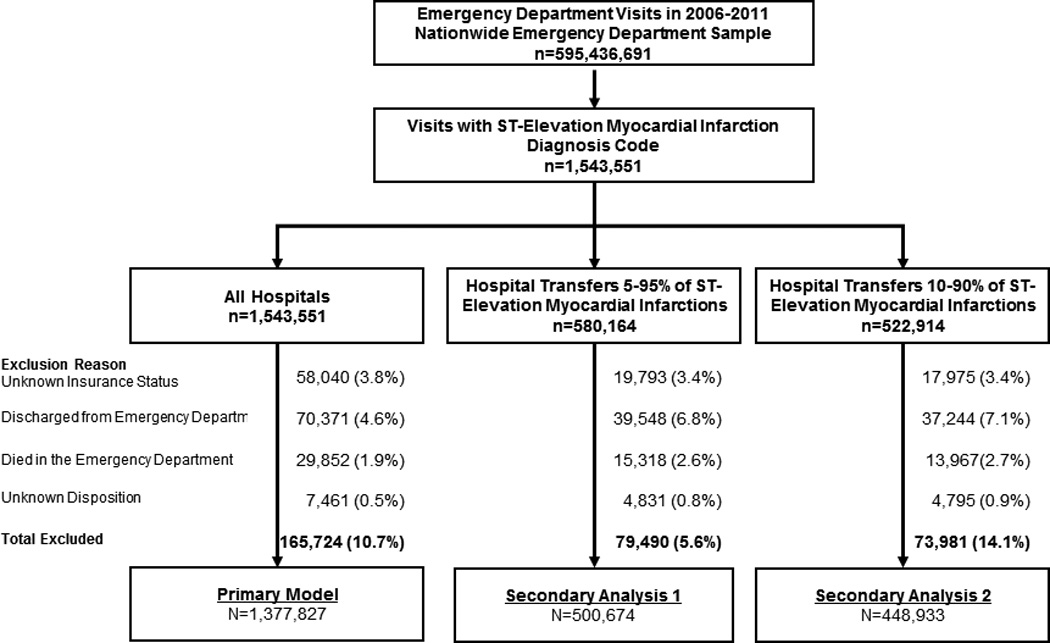
Flow chart of emergency department patient visits used in the study. Flow chart for included emergency department visits with an ST-elevation myocardial infarction diagnosis in the Nationwide Emergency Department Sample for years 2006 – 2011. Each model is determined by inter-facility transfer rate and excludes patients with unknown insurance status, and a disposition status of discharged, died in the emergency department, or unknown.
After these exclusions, 1,377,827 STEMI emergency department visits were included in the multivariable analysis; 110,321 (8.0%) of these visits were for patients without health insurance (Table 1 and Online Only Table 1). Compared to patients with insurance, those without insurance were younger, more likely to be male, and more likely to live in a zip code where the median household income was in the bottom quartile nationally. Among the 1,267,506 STEMI emergency department visits for patients with insurance, Medicare (n=747,565 [59.0%]) was the most common insurance type, followed by private insurance (n=433,542 [34.2%]) and Medicaid (n=86,399 [6.8%]).
Table 1.
Patient and hospital demographics. Patient and hospital characteristics for ST-elevation myocardial infarction emergency department visits in the United States by health insurance status, 2006–2011.
| Health Insurance | ||
|---|---|---|
| Variable | No (n =110,321) |
Yes (n = 1,267,506) |
| Age Group, years | ||
| 18–34 | 4,189 (3.8%) | 11,800 (0.9%) |
| 35–44 | 18,167 (16.5%) | 60,144 (4.8%) |
| 45–54 | 42,291 (38.3%) | 188,233 (14.9%) |
| 55–64 | 39,275 (35.6%) | 266,815 (21.1%) |
| 65–74 | 3,853 (3.5%) | 278,454 (22.0%) |
| 75–84 | 1,725 (1.6%) | 269,185 (21.2%) |
| 85+ | 821 (0.7%) | 192,876 (15.2%) |
| Sex | ||
| Male | 83,638 (75.8%) | 768,130 (60.6%) |
| Female | 26,655 (24.2%) | 499,204 (39.4%) |
| Timing of Emergency Department Presentation | ||
| Weekday | 79,030 (71.6%) | 906,940 (71.6%) |
| Weekend | 31,282 (28.4%) | 360,484 (28.4%) |
| Year | ||
| 2006 | 17,999 (16.3%) | 247,676 (19.5%) |
| 2007 | 18,943 (17.2%) | 227,475 (18.0%) |
| 2008 | 18,389 (16.7%) | 217,455 (17.2%) |
| 2009 | 16,939 (15.4%) | 198,953 (15.7%) |
| 2010 | 20,370 (18.5%) | 194,002 (15.3%) |
| 2011 | 17,681 (16.0%) | 181,944 (14.4%) |
| Median Household Income Quartiles | ||
| $1–$40,999 | 37,603 (35.2%) | 335,188 (27.0%) |
| $41,000–$50,999 | 31,973 (29.9%) | 346,310 (27.9%) |
| $51,000–$66,999 | 23,690 (22.2%) | 300,534 (24.2%) |
| $67,000+ | 13,611 (12.7%) | 258,222 (20.8%) |
| U.S. Region of the Hospital | ||
| West | 15,479 (14.0%) | 236,989 (18.7%) |
| Northeast | 13,215 (12.0%) | 208,850 (16.5%) |
| Midwest | 25,589 (23.2%) | 335,304 (26.5%) |
| South | 56,037 (50.8%) | 486,364 (38.4%) |
| Hospital Trauma Center Designation | ||
| Nontrauma center | 82,155 (74.5%) | 940,031 (74.2%) |
| Trauma center | 28,165 (25.5%) | 327,475 (25.8%) |
| Hospital Urban-Rural Location | ||
| Rural | 22,579 (20.5%) | 249,909 (19.7%) |
| Urban | 87,742 (79.5%) | 1,017,597 (80.3%) |
| Annual ED Volume Quartiles | ||
| < 25 percentile | 4,971 (4.5%) | 67,351 (5.3%) |
| [25, 50) percentile | 14,163 (12.8%) | 172,558 (13.6%) |
| [50, 75) percentile | 28,871 (26.2%) | 363,821 (28.7%) |
| >=75 percentile | 62,315 (56.5%) | 663,776 (52.4%) |
| Inter-facility Transfer | 29,522 (26.8%) | 219,772 (17.3%) |
Footnote: The Any Health Insurance Group included a combination of Medicare, Medicaid and Private Insurance. Due to rounding in the weighted calculations and missing data, the sum of the subgroups may not add to the reported category total.
During the 6-year study period, 249,294 (18.1%) of the included emergency department STEMI visits resulted in inter-facility transfer. Of the 110,321 STEMI emergency department visits by patients without insurance, 29,522 (26.8 %) resulted in transfer, compared to 219,772 (17.3%) transfers among the 1,267,506 STEMI visits by patients with health insurance (p<0.001). Overall, the percentage of STEMI emergency department visits resulting in inter-facility transfer increased over the study period, ranging from 14.9% in 2006 to 20.1% in 2011. Transfer was more common for STEMI visits by patients without health insurance than those with insurance during each year of the study (Figure 2).
Figure 2.

Percentage of emergency department visits transferred by insurance status. Unadjusted percentage of emergency department visits for ST-elevation myocardial infarction in the United States that resulted in inter-facility transfer by year for all hospitals. Error bars represent 95% confidence intervals.
In the primary multivariable logistic regression model, lack of health insurance was an independent risk factor for inter-facility transfer (adjusted odds ratio [aOR] for no health insurance compared with any health insurance: 1.6, 95% CI: 1.5, 1.7) (Table 2). Having no health insurance was also an independent risk factor of inter-facility transfer when separately compared with Medicare, Medicaid, and private health insurance (Table 2).
Table 2.
Multivariable logistic regression model results for predictors of inter-facility transfer among ST-elevation myocardial infarction emergency department visits in the U.S., 2006–2011. In addition to the predictor variables listed in the table, the multivariable logistic regression was also adjusted for median income in the patient’s zip code, trauma center presentation, annual emergency department volume, and patient age.
| Predictor Variable | Adjusted Odds Ratio |
95% Confidence Interval |
|
|---|---|---|---|
| Health insurance status | |||
| None vs. Any | 1.6 | 1.5 | 1.7 |
| None vs. Medicare | 1.8 | 1.6 | 2.0 |
| None vs. Medicaid | 1.8 | 1.6 | 2.0 |
| None vs. Private | 1.3 | 1.2 | 1.4 |
| Male (vs female) | 1.2 | 1.2 | 1.2 |
| Presentation on weekend (vs weekday) | 1.1 | 1.0 | 1.1 |
| Study year (continuous variable 2006 - 2011) | 1.1 | 1.1 | 1.2 |
| U.S. geographic region | |||
| West | Referent | ||
| Northeast | 1.8 | 1.3 | 2.5 |
| Midwest | 1.5 | 1.1 | 2.0 |
| South | 1.5 | 1.1 | 2.0 |
| Rural hospital (vs urban hospital) | 2.4 | 2.0 | 3.0 |
Other risk factors for inter-facility transfer included male sex, initial patient presentation to the emergency department on the weekend, and initial patient presentation to a non-trauma center or rural hospital (Table 2). Additionally, visits at emergency departments with lower annual patient volumes and visits by younger patients were also associated with increased inter-facility transfer (Figure 3a and b).
Figure 3.
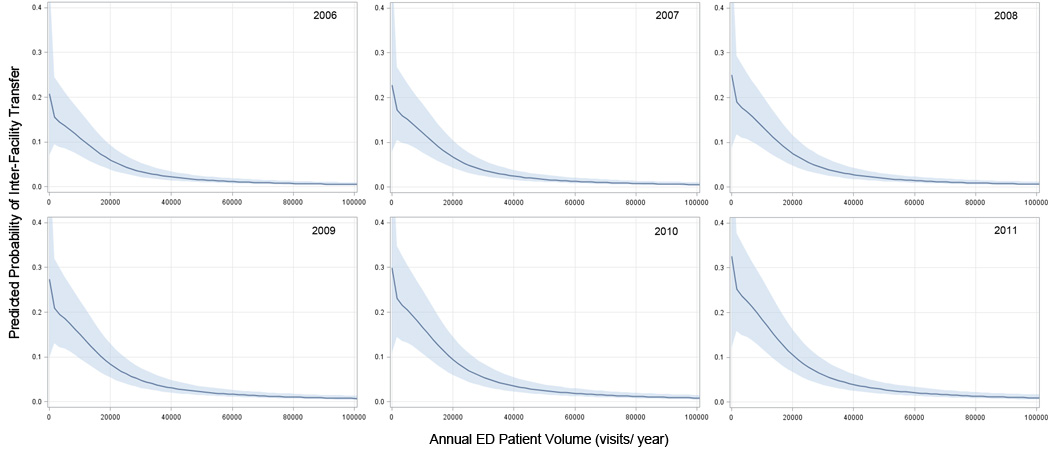
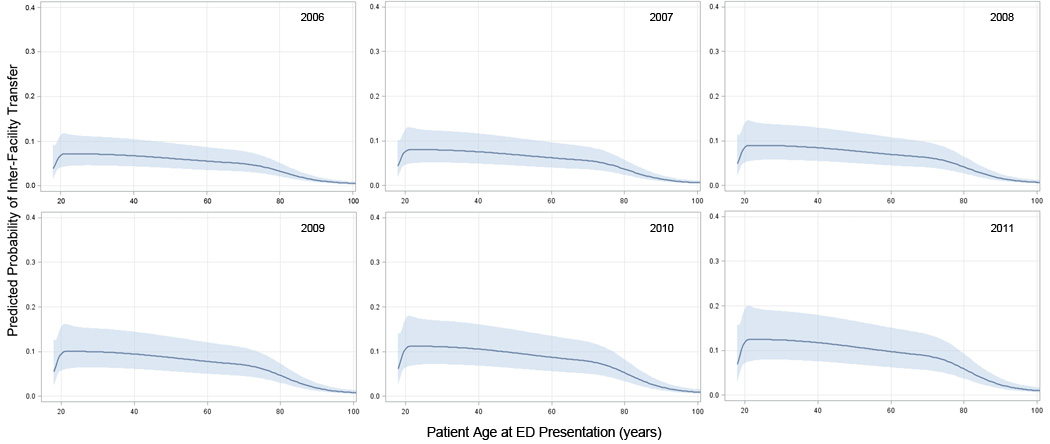
Predicted probability of inter-facility transfer for emergency department visits with ST-elevation myocardial infarction vs (a) Emergency department annual visit volume and (b) patient age, by year. Sample predicted probability plots of inter-facility transfer for emergency department visits with ST-elevation myocardial infarction by study year according to a) annual emergency department volume; and b) patient age at time of presentation to the emergency department. Plots were calculated from the multivariable regression model with other independent variables in the model fixed at the following values: trauma center, urban setting, women, West region, median household income in patient's zip code ≥$67,000, uninsured, median age of 65 years, and median annual emergency department volume of 22,135 visits per year. The shaded area represents the 95% confidence interval
We repeated our multivariable model for hospitals with an inter-facility transfer rate for STEMI between 5% and 95% (secondary analysis 1), and for hospitals with an inter-facility transfer rate for STEMI between 10% and 90% (secondary analysis 2). For our primary analysis of health insurance status comparing no insurance versus any type of insurance status, the adjusted odds of inter-facility transfer was unchanged at 1.6 for both planned secondary analyses. Full results for both planned secondary analyses can be found in the Online Only Table 2.
DISCUSSION
Among a six-year national sample of emergency department visits for STEMI in the U.S., lack of health insurance was an independent predictor of being transferred from the emergency department of one hospital to another hospital. Lack of health insurance increased the odds of inter-facility transfer by approximately 60%. While residual confounding in our regression models cannot be completely ruled out, our results suggest lack of health insurance is a significant risk factor for being transferred after a STEMI diagnosis, and thus, for experiencing less timely myocardial reperfusion. Our study suggests that patients with STEMI who do not have insurance are more likely to receive less timely care, which has significant implications for clinical outcomes.3,7
Two possible pathways may explain why STEMI patients without insurance are transferred more frequently than those with insurance. The first is that uninsured patients may be more likely to present to a facility with diminished access to emergency pPCI capabilities, leading to transfer after a STEMI is diagnosed. However, this is unlikely to fully explain the results as our secondary analyses demonstrated that the odds of transfer were unchanged when we accounted for a facility’s STEMI transfer rate. A second possibility is that uninsured STEMI patients may be selectively designated for transfer at facilities capable of pPCI. Unfortunately, we were unable to definitively explore the contribution of each of these pathways because the available data source (NEDS) does not distinguish a facility’s pPCI capabilities and we used a facility’s inter-facility transfer rate for this patient population as a surrogate. While understanding the reasons why uninsured patients are more likely to be transferred after a diagnosis of STEMI is important in future work, our findings nonetheless underscore that lack of insurance is strongly associated with the risk for transfer and delays in STEMI care. Regardless of the underlying causes, this represents an important disparity in care that places patients without health insurance at increased risk for mortality and morbidity due to the delays associated with inter-facility transfer.
Insurance status can play a seemingly paradoxical role in the decision to transfer patients. In some settings, patients without health insurance are transferred more frequently,8–10 and in others, less frequently.11 These previous studies suggest that compared to patients with health insurance, uninsured patients are more likely to be transferred for an emergent condition, but are less likely to be transferred after hospitalization; when a patient’s clinical status becomes more stable.8–12 These previous studies combined with our findings suggest that acuity of the clinical condition and location of care may not be the only factors affecting the transfer decision, but insurance status may also influence this as well. Further research is needed to examine whether pPCI center capabilities influences the transfer decision across insurance status.
In addition to insurance status, we also identified a gender difference in inter-facility transfers among patients with STEMI. Being male was associated with a nearly 15% greater odds of transfer in our multivariable model compared to being female. This is consistent with previous studies showing higher transfer rates among males compared to females for a wide range of conditions, including trauma, and hospitalized patients.11,13 Potential reasons for this difference between the sexes include different perceived severity of illness, and atypical presentations among women with suspected acute myocardial infarction.13,14
In our unadjusted results, we also found that the proportion of transferred patients with STEMI increased during the study period from 14.9 % in 2006 to 20.1% in 2011. Increases in the proportion of STEMI emergency department visits resulting in inter-facility transfer over time was observed in all regions, trauma center designations, rural-urban classifications, and annual emergency department volumes. Interestingly, the annual total number of STEMI emergency department visits dropped over the course of the study, from 265,675 visits in 2006 to 199,625 visits in 2011. Therefore, as time progressed, emergency departments treated fewer patients with STEMI, and transferred a greater proportion of the STEMI patients they did see. One potential reason for higher proportions of STEMI visits resulting in transfer over time may be delayed implementation of the 2004 American Heart Association guidelines recommending inter-facility transfer for pPCI as the preferred reperfusion strategy for facilities without pPCI capabilities.15,16
Our study was subject to the inherent limitations of using a large administrative database like NEDS as our data source. These include the reliance on ICD-9CM codes to define cases, potential of misclassification due to inaccurate coding, inability to identify individual patients, and failure of the dataset to include some important variables for an analysis.17–20 As discussed previously, pPCI capabilities are not available in NEDS, but we used inter-facility transfer rates as a surrogate to account for the some hospitals not having pPCI capabilities. In addition, NEDS does not contain data about the quality of care (e.g., timeliness of care and clinical outcomes). However, the association between timeliness of myocardial reperfusion (particularly in the setting of inter-facility transfer) and clinical outcomes has been well established in earlier work.3,7,21–23
Supplementary Material
Acknowledgments
Funding Sources: Dr. Ward was supported by Award Number K12 HL109019 from the National Heart, Lung, and Blood Institute and is currently supported by NIH grant K23 HL127130. Dr. Self is supported by NIH grant K23GM110469 from the National Institute of General Medical Sciences. The content is solely the responsibility of the authors and does not necessarily represent the official views of the National Institutes of Health.
References
- 1.Drake FT, Mottey NE, Farrokhi ET, Florence MG, Johnson MG, Mock C, Steele SR, Thirlby RC, Flum DR. Time to appendectomy and risk of perforation in acute appendicitis. JAMA surgery. 2014;149:837–844. doi: 10.1001/jamasurg.2014.77. [DOI] [PMC free article] [PubMed] [Google Scholar]
- 2.James ML, Grau-Sepulveda MV, Olson DM, Smith EE, Hernandez AF, Peterson ED, Schwamm LH, Bhatt DL, Fonarow GC. Insurance status and outcome after intracerebral hemorrhage: findings from Get With The Guidelines-stroke. J Stroke Cerebrovasc Dis. 2014;23:283–292. doi: 10.1016/j.jstrokecerebrovasdis.2013.02.016. [DOI] [PubMed] [Google Scholar]
- 3.Wang TY, Nallamothu BK, Krumholz HM, Li S, Roe MT, Jollis JG, Jacobs AK, Holmes DR, Peterson ED, Ting HH. Association of door-in to door-out time with reperfusion delays and outcomes among patients transferred for primary percutaneous coronary intervention. JAMA. 2011;305:2540–2547. doi: 10.1001/jama.2011.862. [DOI] [PubMed] [Google Scholar]
- 4.Antman EM. Time is muscle: translation into practice. Journal of the American College of Cardiology. 2008;52:1216–1221. doi: 10.1016/j.jacc.2008.07.011. [DOI] [PubMed] [Google Scholar]
- 5.HCUP Nationwide Emergency Department Sample (NEDS) Healthcare Cost and Utilization Project (HCUP) Agency for Healthcare Research and Quality; Rockville, MD: 2006 – 2011. www.hcup-us.ahrq.gov/nedsoverview.jsp. [PubMed] [Google Scholar]
- 6.Harrell FE. Regression modeling strategies: with applications to linear models, logistic regression, and survival analysis. Springer; New York: 2001. [Google Scholar]
- 7.Herrin J, Miller LE, Turkmani DF, Nsa W, Drye EE, Bernheim SM, Ling SM, Rapp MT, Han LF, Bratzler DW, Bradley EH, Nallamothu BK, Ting HH, Krumholz HM. National performance on door-in to door-out time among patients transferred for primary percutaneous coronary intervention. Arch Intern Med. 2011;171:1879–1886. doi: 10.1001/archinternmed.2011.481. [DOI] [PMC free article] [PubMed] [Google Scholar]
- 8.Butala P, Fisher MD, Blueschke G, Ruch DS, Richard MJ, Hollenbeck ST, Levinson H, Leversedge FJ, Erdmann D. Factors associated with transfer of hand injuries to a level 1 trauma center: a descriptive analysis of 1147 cases. Plastic and reconstructive surgery. 2014;133:842–848. doi: 10.1097/PRS.0000000000000017. [DOI] [PubMed] [Google Scholar]
- 9.Kindermann DR, Mutter RL, Cartwright-Smith L, Rosenbaum S, Pines JM. Admit or transfer? The role of insurance in high-transfer-rate medical conditions in the emergency department. Ann Emerg Med. 2014;63:561–571. doi: 10.1016/j.annemergmed.2013.11.019. e568. [DOI] [PubMed] [Google Scholar]
- 10.Delgado MK, Yokell MA, Staudenmayer KL, Spain DA, Hernandez-Boussard T, Wang NE. Factors associated with the disposition of severely injured patients initially seen at non-trauma center emergency departments: disparities by insurance status. JAMA surgery. 2014;149:422–430. doi: 10.1001/jamasurg.2013.4398. [DOI] [PMC free article] [PubMed] [Google Scholar]
- 11.Hanmer J, Lu X, Rosenthal GE, Cram P. Insurance status and the transfer of hospitalized patients: an observational study. Ann Intern Med. 2014;160:81–90. doi: 10.7326/M12-1977. [DOI] [PMC free article] [PubMed] [Google Scholar]
- 12.Missios S, Bekelis K. Nonmedical factors and the transfer of spine trauma patients initially evaluated at Level III and IV trauma centers. Spine J. 2015;15:2028–2035. doi: 10.1016/j.spinee.2015.05.017. [DOI] [PubMed] [Google Scholar]
- 13.Gomez D, Haas B, de Mestral C, Sharma S, Hsiao M, Zagorski B, Rubenfeld G, Ray J, Nathens AB. Gender-associated differences in access to trauma center care: A population-based analysis. Surgery. 2012;152:179–185. doi: 10.1016/j.surg.2012.04.006. [DOI] [PubMed] [Google Scholar]
- 14.Canto JG, Shlipak MG, Rogers WJ, Malmgren JA, Frederick PD, Lambrew CT, Ornato JP, Barron HV, Kiefe CI. Prevalence, clinical characteristics, and mortality among patients with myocardial infarction presenting without chest pain. JAMA. 2000;283:3223–3229. doi: 10.1001/jama.283.24.3223. [DOI] [PubMed] [Google Scholar]
- 15.Antman EM, Anbe DT, Armstrong PW, Bates ER, Green LA, Hand M, Hochman JS, Krumholz HM, Kushner FG, Lamas GA, Mullany CJ, Ornato JP, Pearle DL, Sloan MA, Smith SC, Jr, Alpert JS, Anderson JL, Faxon DP, Fuster V, Gibbons RJ, Gregoratos G, Halperin JL, Hiratzka LF, Hunt SA, Jacobs AK American College of Cardiology/American Heart Association Task Force on Practice G. ACC/AHA guidelines for the management of patients with ST-elevation myocardial infarction--executive summary: a report of the American College of Cardiology/American Heart Association Task Force on Practice Guidelines (Writing Committee to Revise the 1999 Guidelines for the Management of Patients With Acute Myocardial Infarction) Circulation. 2004;110:588–636. doi: 10.1161/01.CIR.0000134791.68010.FA. [DOI] [PubMed] [Google Scholar]
- 16.Haines A, Jones R. Implementing findings of research. BMJ. 1994;308:1488–1492. doi: 10.1136/bmj.308.6942.1488. [DOI] [PMC free article] [PubMed] [Google Scholar]
- 17.Cooper RJ. NHAMCS: does it hold up to scrutiny? Ann Emerg Med. 2012;60:722–725. doi: 10.1016/j.annemergmed.2012.10.013. [DOI] [PubMed] [Google Scholar]
- 18.McNaughton CD, Self WH. Observational health services studies using nationwide administrative datasets: understanding strengths and limitations of the National Hospital Ambulatory Medical Care Survey (NHAMCS) Ann Emerg Med. 2013;61:593–594. doi: 10.1016/j.annemergmed.2013.03.011. [DOI] [PMC free article] [PubMed] [Google Scholar]
- 19.McCaig LF, Burt CW. Understanding and interpreting the National Hospital Ambulatory Medical Care Survey: key questions and answers. Ann Emerg Med. 2012;60:716–721. doi: 10.1016/j.annemergmed.2012.07.010. e711. [DOI] [PubMed] [Google Scholar]
- 20.Mutter R, Stocks C. Using Healthcare Cost and Utilization Project (HCUP) Data for Emergency Medicine Research. Annals of Emergency Medicine. 2014;64:458–460. doi: 10.1016/j.annemergmed.2014.09.014. [DOI] [PubMed] [Google Scholar]
- 21.Chakrabarti A, Krumholz HM, Wang Y, Rumsfeld JS, Nallamothu BK National Cardiovascular Data R. Time-to-reperfusion in patients undergoing interhospital transfer for primary percutaneous coronary intervention in the U.S: an analysis of 2005 and 2006 data from the National Cardiovascular Data Registry. Journal of the American College of Cardiology. 2008;51:2442–2443. doi: 10.1016/j.jacc.2008.02.071. [DOI] [PMC free article] [PubMed] [Google Scholar]
- 22.Wang TY, Peterson ED, Ou FS, Nallamothu BK, Rumsfeld JS, Roe MT. Door-to-balloon times for patients with ST-segment elevation myocardial infarction requiring interhospital transfer for primary percutaneous coronary intervention: a report from the national cardiovascular data registry. Am Heart J. 2011;161:76–83. doi: 10.1016/j.ahj.2010.10.001. e71. [DOI] [PubMed] [Google Scholar]
- 23.Nallamothu BK, Normand SL, Wang Y, Hofer TP, Brush JE, Jr, Messenger JC, Bradley EH, Rumsfeld JS, Krumholz HM. Relation between door-to-balloon times and mortality after primary percutaneous coronary intervention over time: a retrospective study. Lancet. 2015;385:1114–1122. doi: 10.1016/S0140-6736(14)61932-2. [DOI] [PMC free article] [PubMed] [Google Scholar]
Associated Data
This section collects any data citations, data availability statements, or supplementary materials included in this article.