



Abstract
AIMS: To use a sensitive test of acute myocardial damage--immunohistological detection of complement component C9--to assess the prevalence of damage in an unselected series of hearts taken at necropsy in adults. METHODS: Sections of formalin fixed and paraffin wax embedded myocardium were cut from 128 consecutive necropsy cases on which a block of heart had been taken. These were stained with an immunohistological method for C9. Necropsy findings were reviewed and clinical risk factors for myocardial damage noted. The extent of C9 immunostaining was correlated with clinical and pathological findings. RESULTS: There was immunostaining for C9 in 109 heart sections (85%). Most had conventional evidence of coronary artery disease or acute or chronic myocardial abnormality, but necrosis was identified by orthodox microscopy in only 12 (11% of C9 positive cases). In 29 cases, orthodox examination showed no abnormality, but C9 was detected. These cases had clinical risk factors for damage such as hypoxia and hypotension. Increasing age, heart weight, and total number of risk factors and pathological findings were associated with increasing extent of C9 immunostaining. CONCLUSIONS: Acute myocardial damage was common in a hospital necropsy series and its prevalence was underestimated by conventional pathological techniques. Immunostaining for C9 was a simple and useful way of detecting such damage.
Full text
PDF


Images in this article
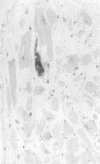
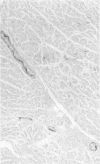
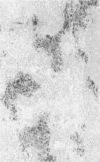
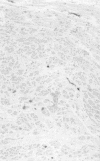
Selected References
These references are in PubMed. This may not be the complete list of references from this article.
- Doran J. P., Howie A. J., Townend J. N., Bonser R. S. Detection of myocardial infarction by immunohistological staining for C9 on formalin fixed, paraffin wax embedded sections. J Clin Pathol. 1996 Jan;49(1):34–37. doi: 10.1136/jcp.49.1.34. [DOI] [PMC free article] [PubMed] [Google Scholar]
- Edston E., Kawa K. Immunohistochemical detection of early myocardial infarction. An evaluation of antibodies against the terminal complement complex (C5b-9). Int J Legal Med. 1995;108(1):27–30. doi: 10.1007/BF01845613. [DOI] [PubMed] [Google Scholar]
- Engel A. G., Biesecker G. Complement activation in muscle fiber necrosis: demonstration of the membrane attack complex of complement in necrotic fibers. Ann Neurol. 1982 Sep;12(3):289–296. doi: 10.1002/ana.410120314. [DOI] [PubMed] [Google Scholar]
- Flint E. J. Phenazine methosulphate and the nitroblue tetrazolium macroreaction for recent myocardial infarction. J Clin Pathol. 1984 Apr;37(4):477–478. doi: 10.1136/jcp.37.4.477. [DOI] [PMC free article] [PubMed] [Google Scholar]
- Hopster D. J., Milroy C. M., Burns J., Roberts N. B. Necropsy study of the association between sudden cardiac death, cardiac isoenzymes and contraction band necrosis. J Clin Pathol. 1996 May;49(5):403–406. doi: 10.1136/jcp.49.5.403. [DOI] [PMC free article] [PubMed] [Google Scholar]
- Hugo F., Hamdoch T., Mathey D., Schäfer H., Bhakdi S. Quantitative measurement of SC5b-9 and C5b-9(m) in infarcted areas of human myocardium. Clin Exp Immunol. 1990 Jul;81(1):132–136. doi: 10.1111/j.1365-2249.1990.tb05303.x. [DOI] [PMC free article] [PubMed] [Google Scholar]
- Mathey D., Schofer J., Schäfer H. J., Hamdoch T., Joachim H. C., Ritgen A., Hugo F., Bhakdi S. Early accumulation of the terminal complement-complex in the ischaemic myocardium after reperfusion. Eur Heart J. 1994 Mar;15(3):418–423. doi: 10.1093/oxfordjournals.eurheartj.a060516. [DOI] [PubMed] [Google Scholar]
- Schäfer H., Mathey D., Hugo F., Bhakdi S. Deposition of the terminal C5b-9 complement complex in infarcted areas of human myocardium. J Immunol. 1986 Sep 15;137(6):1945–1949. [PubMed] [Google Scholar]
- Virmani R., Farb A., Burke A. Contraction-band necrosis: new use for an old friend. Lancet. 1996 Jun 22;347(9017):1710–1711. doi: 10.1016/s0140-6736(96)90803-x. [DOI] [PubMed] [Google Scholar]
- Väkevä A., Morgan B. P., Tikkanen I., Helin K., Laurila P., Meri S. Time course of complement activation and inhibitor expression after ischemic injury of rat myocardium. Am J Pathol. 1994 Jun;144(6):1357–1368. [PMC free article] [PubMed] [Google Scholar]