



Abstract
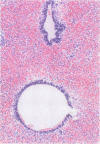
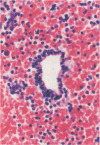
AIMS: To report the occurrence of an uncommon artefact producing pseudoglandular formations in clot sections from haemorrhagic fine needle aspirations. METHODS: All available histological material from 610 fine needle aspirations by pathologists (23 g needle) over a five year period was reviewed. The frequency and associations of the pseudoglandular artefact was assessed. RESULTS: Clot sections were prepared in 41 of the 610 cases (7%). Bubbles were present in the clots in 22 of these cases (54%), and in three cases (7%) these were lined by lymphocytes creating pseudoglandular formations. These were two lymph node aspirates and one thyroid aspirate. In four further cases lesser numbers of cells partly lined some of the bubbles; these were lymphocytes, macrophages, or in one case, thyroid epithelial cells. CONCLUSIONS: When clot sections are prepared in cases of haemorrhagic fine needle aspiration, bubbles are often produced during suction; these can on occasion become lined by lymphocytes or other cells, leading to pseudoglandular formations. Recognition of this artefact will prevent unnecessary further investigation of their nature.
Full text
PDF


Images in this article

Selected References
These references are in PubMed. This may not be the complete list of references from this article.
- Mravunac M., Verbeek D., van Heusden C., Reuterink A., Hop G., Smedts F. Applications of the microbiopsy technique in non-cervical cytology: where cytology and histology meet. Histopathology. 1998 Aug;33(2):174–182. doi: 10.1046/j.1365-2559.1998.00476.x. [DOI] [PubMed] [Google Scholar]
- Sethi S., Yu G. H. Rosette-like structures in a lymph node aspirate: pitfall in the diagnosis of neuroblastoma. Cytopathology. 1997 Jun;8(3):213–215. [PubMed] [Google Scholar]